What to check on a Reverse Osmosis Unit.
Where a thermal evaporator boils seawater under vacuum using waste heat from the jacket water circuit, an RO unit uses a high-pressure pump to push seawater across a membrane, rejecting dissolved salts and passing freshwater through. That makes RO independent of engine load and waste heat availability, which is why it is now the default choice on vessels that spend significant time at anchor or slow steaming, where an evaporator would starve for heat. The trade-off is a continuous, non-trivial electrical load to drive the high-pressure pump, and a membrane…
What Sets Reverse Osmosis Apart
Where a thermal evaporator boils seawater under vacuum using waste heat from the jacket water circuit, an RO unit uses a high-pressure pump to push seawater across a membrane, rejecting dissolved salts and passing freshwater through. That makes RO independent of engine load and waste heat availability, which is why it is now the default choice on vessels that spend significant time at anchor or slow steaming, where an evaporator would starve for heat. The trade-off is a continuous, non-trivial electrical load to drive the high-pressure pump, and a membrane that fouls and degrades over time rather than a shell that mostly just needs descaling. RO also tolerates a wider range of feed temperatures without the vacuum-breaking problems that plague evaporators in warm tropical seawater.
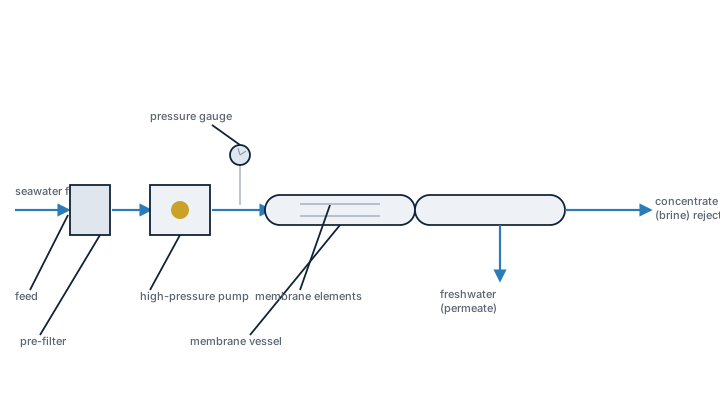
Main Components
Pretreatment Filters
Cartridge or media filters ahead of the high-pressure pump that remove suspended solids and protect the membranes from mechanical fouling.
High-Pressure Pump
Typically a multistage centrifugal or positive-displacement pump raising feed pressure to the range the membranes need to overcome osmotic pressure, commonly in the order of 55 to 70 bar for seawater RO.
Membrane Elements
Spiral-wound thin-film composite membranes housed in pressure vessels, arranged in series so the reject stream from one element feeds the next.
Energy Recovery Device
A pressure exchanger or turbine that recovers energy from the high-pressure reject brine and feeds it back into the process, substantially cutting the specific power consumption on larger plants.
Post-Treatment / Remineralization
A stage that adjusts pH and adds back minerals, since RO permeate is aggressive and unpalatable without it, before the water goes to the potable tank.
Selection and Sizing
- Required daily freshwater output against crew or passenger complement and any process water demand.
- Feed seawater temperature and salinity range for the trading area, since colder water needs more pressure for the same output.
- Available electrical power and whether an energy recovery device is justified for the plant size.
- Membrane fouling tendency of the intended trading waters, which drives pretreatment filter rating and cleaning frequency.
Regulations and Class
RO plant producing water for human consumption falls under the same potable water hygiene regime as other production methods, with product water quality checked against flag state or WHO-based guideline values. Class societies review the plant as part of the auxiliary machinery survey scope, and where the RO unit forms part of the ship's water supply redundancy required by SOLAS accommodation provisions, its availability is checked accordingly. There is no RO-specific IMO instrument beyond general potable water quality expectations.
Typical Faults
| Fault | Cause | Consequence |
|---|---|---|
| Declining permeate flow | Membrane fouling by biofilm, scale or suspended solids | Falling freshwater output at the same operating pressure |
| Rising salt passage | Membrane degradation, o-ring failure, or oxidation damage from residual chlorine in feed | Product water salinity exceeds potable limits |
| High-pressure pump seal wear | Normal wear under continuous high-pressure duty | Loss of feed pressure and reduced production |
| Pretreatment filter blinding | High turbidity feed water or missed cartridge change | Starved feed to the high-pressure pump, cavitation risk |
What to Look for in a Supplier
- Membrane specification and rejection rate quoted at the actual feed salinity and temperature the ship will operate in, not a standard test condition figure.
- Availability of spare membrane elements and pretreatment cartridges through the ship's normal supply chain.
- Documented cleaning-in-place procedure and chemicals compatible with what the vessel can realistically stock and dispose of.
- Energy recovery device efficiency data if fitted, since this materially affects daily power consumption over the plant's life.
Track permeate flow and salt passage at a fixed reference pressure and temperature, not raw daily output, otherwise seasonal seawater temperature swings will mask a membrane that is quietly fouling.