"> Sewage Treatment Plant - Equipment Database
Also listed under Oily Water & Waste Systems (96 models) · Galley & Domestic (20 models)

Sewage Treatment Plant

medium 32 models total

A marine STP has to turn raw sewage into an effluent meeting MARPOL Annex IV discharge limits inside a machinery space footprint, which is why biological treatment plants dominate over simple maceration and holding tanks on any ship staying at sea for more than a few days.

Read more — Sewage Treatment Plant explained

What makes this type

A sewage treatment plant breaks down black water biologically or chemically on board so the effluent can be discharged legally outside the distances set by MARPOL, rather than requiring the ship to hold everything in a tank until it reaches a port reception facility. Most marine STPs in service are biological, using aerobic bacteria to digest waste in stages, though chemical dosing units using disinfectant instead of biology are still found on smaller vessels and older installations. The choice between the two comes down to space, crew numbers and how much dosing chemical consumption the operator is willing to manage.
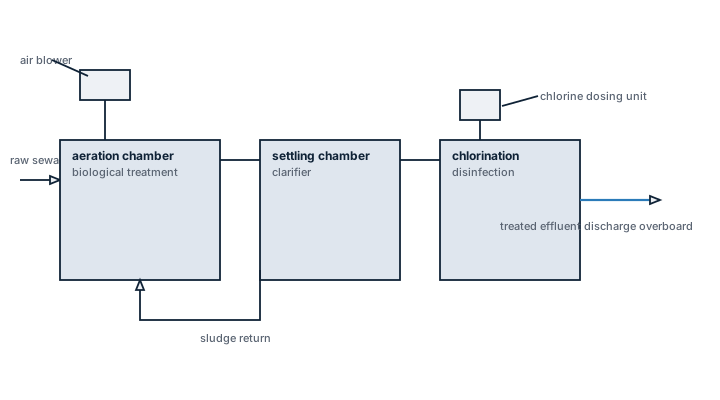
Biological sewage treatment plant, process flow
Process schema of a marine biological sewage treatment plant: raw sewage passes through the aerated biological chamber, the settling chamber with sludge return, and the chlorination chamber before treated effluent is discharged overboard.

Main components

Aeration and biological treatment chamber

Air is blown continuously through the first chamber to keep aerobic bacteria alive and digesting organic solids; this is the stage most sensitive to overload, chemical contamination and temperature.

Settling and clarification chamber

Treated liquid moves to a settling tank where solids sink out as sludge, which is periodically returned to the aeration chamber or removed, while clarified liquid moves forward.

Disinfection stage

A final chlorination or UV stage kills remaining pathogens before discharge, and chlorine dosing units need residual chlorine checked periodically to stay within an effective but not excessive range.

Air blower and control panel

The blower supplies the oxygen the biological process depends on; its failure is the single most common reason a biological plant stops treating properly, since the bacteria die within hours without aeration.

Selection and sizing

Sizing is driven by crew and passenger complement and daily flow per person, not by ship size directly. A plant undersized for the number of people on board will be chronically overloaded, producing effluent that fails discharge limits even when mechanically healthy. Retention time in each chamber matters as much as total tank volume, since bacteria need enough contact time with the waste stream to actually digest it.

Regulations and class

  • MARPOL Annex IV sets the discharge standard: type-approved plants must meet effluent limits for suspended solids, biochemical oxygen demand and coliform count, tested under the IMO's Resolution MEPC.227(64) or its predecessor.
  • Discharge of untreated or partially treated sewage is restricted by distance from land and, in some cases, by vessel speed while discharging.
  • Special areas and port state requirements can impose stricter local discharge rules than the MARPOL baseline, particularly in the Baltic Sea.
  • Class surveys confirm the type approval certificate matches the installed plant and check for unauthorised bypass piping around the treatment stages.

Typical faults

FaultConsequence
Blower failure or clogged air diffusersAerobic bacteria die off within hours, effluent quality collapses
Grease, disinfectant or paint solvent dumped into the systemBacterial culture is poisoned, plant needs days to weeks to recover
Excess sludge not removed from the settling chamberSolids carry over into discharge, failing suspended solids limits
Chlorine dosing pump miscalibratedUnder-dosing fails pathogen limits, over-dosing wastes chemical and can harm the biology upstream

What to look for in a supplier

  • Valid type approval certificate under the current MEPC resolution matched to the intended flag and trading area.
  • Correct sizing calculation based on actual crew and passenger numbers, not a generic vessel-class assumption.
  • Spare diffuser membranes, blower parts and dosing pump seals available without long lead times, since these are consumable wear items.
  • Clear guidance in the manual on what must never enter the system, useful for crew training and reducing chemical shock loading.

If effluent quality drops suddenly, check the blower and air lines before suspecting anything else; a starved aeration chamber accounts for the large majority of biological STP complaints reported by crews.

4 manufacturers · 32 models

Evac

23
Evac 910
Ship-wide system, 10-2000 users · Marine Equipment · vacuum sewage treatment plant
Type
Vacuum Toilet System
Common Failures & Inspection Points
  • Vacuum pump failure
  • Toilet valve seat leakage
  • Vacuum line blockage from foreign objects
  • Control panel fault
Service: Evac = market leader. Check vacuum level daily. Clean vacuum valves every 3 months. No foreign objects in toilets — crew training!
Spare Parts: Spare parts via Evac or authorized distribution partners. Lead time: 2-6 weeks.
Strengths
  • Very low freshwater consumption compared with conventional gravity systems
  • Small footprint – suitable for vessels with limited space
  • Integrated pump and control panel simplify installation and operation
  • Meets MARPOL Annex IV discharge standards out of the box
  • Easy access to valves for routine cleaning
Weaknesses
  • Reliance on a single vacuum pump – failure can halt waste handling
  • Requires strict crew discipline to prevent foreign objects in toilets
  • Higher initial purchase price than basic gravity‑type systems
  • Periodic valve and line cleaning (every 3 months) adds maintenance workload
  • Power demand is higher than non‑vacuum solutions
Typical Vessels: Cruise shipFerryOffshore supply vesselNaval auxiliaryPassenger liner
Certifications: IMO Type Approval (Annex IV)DNV class approval
Decision Guide: Choose if the vessel needs a space‑saving, low‑water‑use sewage solution and can maintain regular vacuum‑system upkeep. Avoid if the ship cannot guarantee reliable power for the pump or lacks crew training to keep foreign objects out of the system.
Use Cases: Commonly installed on passenger‑focused vessels such as cruise ships and ferries where water conservation and compact equipment are critical, as well as on offshore support ships that require a robust, compliant waste treatment plant in limited engine‑room space.
Evac MBR 50 unverified
· membrane bioreactor STP 50 PE
System description
membrane bioreactor STP 50 PE
Application
marine sanitary / water treatment
Person equivalent
50
Evac MBR 100 unverified
· membrane bioreactor STP 100 PE
System description
membrane bioreactor STP 100 PE
Application
marine sanitary / water treatment
Person equivalent
100
Evac MBR 200 unverified
· membrane bioreactor STP 200 PE
System description
membrane bioreactor STP 200 PE
Application
marine sanitary / water treatment
Person equivalent
200
Evac MBR 500 unverified
· membrane bioreactor STP 500 PE
System description
membrane bioreactor STP 500 PE
Application
marine sanitary / water treatment
Person equivalent
500
Evac Oy Advanced Waste Water Purification (AWP) System EcoOcean type: 90N, 120N
Advanced Waste Water Purification (AWP) System EcoOcean type: 90N, 120N
Per ship freshwater demand · Marine Equipment · Membrane bioreactor with UV disinfection
Common Failures & Inspection Points
  • Membrane fouling in reverse osmosis plants
  • UV-Lampe End-of-Life
  • Chemical dosing pump failure
  • Chlorinator-Fehlfunktion
Service: Membrane cleaning quarterly. UV lamp per operating hours. Check water quality daily.
Spare Parts: Spare parts via Evac Oy or authorized distribution partners. Lead time: 2–6 weeks.
Strengths
  • Compact modular design suitable for limited engine‑room space
  • High effluent quality (≤10 mg/L BOD, ≤1 mg/L total nitrogen) without heavy chemical dosing
  • Automatic membrane cleaning cycle reduces fouling risk
  • Integrated UV lamp provides reliable final disinfection
  • DNV and IMO type approval simplifies class certification
Weaknesses
  • Membrane modules require quarterly cleaning and periodic replacement, increasing O&M cost
  • UV lamp life is limited to operating‑hour thresholds; replacement adds downtime
  • Higher initial capital outlay compared with conventional biological treatment plants
  • Requires trained crew for membrane monitoring and chemical dosing system upkeep
Typical Vessels: Cruise shipsFerriesOffshore supply vesselsLNG carriers (zero‑discharge class)Container ships with strict environmental permits
Certifications: DNVIMO Type Approval (MARPOL Annex IV)
Decision Guide: Choose if: you need a compact system that delivers high‑quality effluent, operate in regions with stringent discharge limits, or prefer low chemical usage. Avoid if: budget constraints dominate the purchase decision, crew training for membrane handling is limited, or vessel space cannot accommodate the modular units.
Use Cases: The EcoOcean AWP is typically installed on passenger vessels and offshore support ships where regulatory pressure demands near‑zero sewage discharge, and on newbuilds seeking a future‑proof, low‑footprint treatment solution.
Evac Oy EcoOcean 90 Advanced Waste Water Purification (AWP) System
EcoOcean 90 Advanced Waste Water Purification (AWP) System
Per ship freshwater demand · Marine Equipment · Membrane‑bioreactor + RO + UV
Common Failures & Inspection Points
  • Membrane fouling in reverse osmosis plants
  • UV-Lampe End-of-Life
  • Chemical dosing pump failure
  • Chlorinator-Fehlfunktion
Service: Membrane cleaning quarterly. UV lamp per operating hours. Check water quality daily.
Spare Parts: Spare parts via Evac Oy or authorized distribution partners. Lead time: 2–6 weeks.
Strengths
  • Integrated multi‑stage treatment (MBR, RO, UV) delivers very low BOD5, nitrogen and pathogen levels, suitable for discharge in strict Emission Control Areas.
  • Small footprint and modular design allow installation on vessels with limited space.
  • Automated dosing and control system reduces crew workload; daily water‑quality checks are built‑in.
  • Quarterly membrane cleaning schedule is supported by manufacturer‑provided chemicals and procedures.
  • DNV approval confirms compliance with international classification society standards.
Weaknesses
  • Membrane fouling can increase maintenance frequency, especially on vessels with high organic loads.
  • UV lamp replacement must be tracked by operating hours; failure leads to immediate loss of disinfection capability.
  • Chemical dosing pumps are a single point of failure; redundancy is not standard and may require extra investment.
  • Chlorinator malfunction can affect final water quality if UV is offline, requiring manual intervention.
  • Higher capital cost compared with basic biological sewage plants.
Typical Vessels: Cruise shipsFerriesOffshore supply vesselsContainer ships operating in ECAsSpecialist tankers with zero‑discharge requirements
Certifications: DNVIMO MARPOL Annex IV compliance
Decision Guide: Choose if the vessel operates in Emission Control Areas, requires discharge of treated water that meets stringent quality limits, or needs a compact system with integrated UV disinfection. Avoid if budget constraints are tight, crew cannot commit to regular membrane cleaning, or redundancy for dosing pumps is mandatory.
Use Cases: The EcoOcean 90 AWP is typically installed on cruise liners and ferries that must discharge treated sewage in ports with strict environmental regulations, as well as on offshore supply vessels where zero‑discharge zones are common. It is also used on container ships transiting ECAs to avoid penalties for non‑compliant effluent.
Evac Oy Evac MBR 7KN
Evac MBR 7KN
Per ship freshwater demand · Marine Equipment · Membrane Bioreactor (MBR) sewage treatment
Common Failures & Inspection Points
  • Membrane fouling in reverse osmosis plants
  • UV-Lampe End-of-Life
  • Chemical dosing pump failure
  • Chlorinator-Fehlfunktion
Service: Membrane cleaning quarterly. UV lamp per operating hours. Check water quality daily.
Spare Parts: Spare parts via Evac Oy or authorized distribution partners. Lead time: 2–6 weeks.
Strengths
  • Produces effluent well below the 1 mg/L total suspended solids limit required by MARPOL Annex IV.
  • Small footprint compared with conventional activated‑sludge plants, suitable for space‑constrained vessels.
  • Low sludge production reduces handling and disposal requirements on board.
  • Automated control system with daily water‑quality monitoring and quarterly membrane cleaning schedule.
  • DNV‑GL approved design, providing recognized class society validation.
Weaknesses
  • Membrane fouling can increase operating costs; requires disciplined quarterly cleaning and occasional chemical cleaning.
  • Higher electrical power demand than simple biological systems due to pumps and UV lamp operation.
  • Reliance on UV lamps and chlorinator means critical components have limited service life and must be tracked by operating hours.
  • Chemical dosing pump failures can impair disinfection if not promptly addressed.
  • Initial capital cost is higher than basic septic‑tank style solutions.
Typical Vessels: Cruise shipsFerriesOffshore supply vesselsContainer ships (>5,000 GT)Large tankers with passenger accommodation
Certifications: IMO Type Approval (MARPOL Annex IV)DNV‑GL approval
Decision Guide: Choose if: you need a compact system that reliably meets strict effluent standards, have crew trained for membrane maintenance, and can budget for higher upfront cost and periodic chemical cleaning. Avoid if: the vessel operates on a very tight budget, has limited technical staff for regular membrane care, or primarily discharges in waters where less stringent treatment is acceptable.
Use Cases: The MBR 7KN is typically installed on passenger‑focused vessels such as cruise liners and ferries that generate large volumes of sewage and must comply with strict discharge regulations at every port. It is also used on offshore support ships and high‑capacity container or tanker vessels where deck space is premium and low sludge generation simplifies waste handling.
Evac Oy EVAK MBR 7K - 145K
EVAK MBR 7K - 145K
Per ship freshwater demand · Marine Equipment · Membrane Bioreactor (MBR) with UV disinfection
Common Failures & Inspection Points
  • Membrane fouling in reverse osmosis plants
  • UV-Lampe End-of-Life
  • Chemical dosing pump failure
  • Chlorinator-Fehlfunktion
Service: Membrane cleaning quarterly. UV lamp per operating hours. Check water quality daily.
Spare Parts: Spare parts via Evac Oy or authorized distribution partners. Lead time: 2–6 weeks.
Strengths
  • Delivers high‑quality effluent (<10 mg/L BOD, <1 mg/L total nitrogen) suitable for discharge in sensitive waters
  • Compact footprint compared with conventional septic tanks – advantageous on space‑constrained vessels
  • Integrated UV module provides reliable final disinfection without chemicals
  • Low sludge production reduces handling and storage requirements onboard
  • Automated control system with daily water‑quality monitoring
Weaknesses
  • Membrane fouling requires quarterly chemical cleaning, increasing O&M effort
  • UV lamp must be replaced according to operating hours; failure can compromise disinfection
  • Chemical dosing pumps have a known failure rate and need spare parts on board
  • Higher initial capital cost than simple gravity‑based treatment units
  • Requires trained crew for routine membrane maintenance and system diagnostics
Typical Vessels: Cruise shipFerryOffshore supply vesselContainer shipBulk carrier
Certifications: DNV
Decision Guide: Choose if the vessel needs high‑grade effluent to meet strict discharge regulations, has limited space for treatment equipment, and can support quarterly membrane cleaning and UV lamp replacement. Avoid if sewage volumes are low, budget constraints dominate, or crew lack the training for regular MBR maintenance.
Use Cases: Installed on passenger vessels, ferries and offshore supply ships that operate long voyages in emission‑control areas where MARPOL Annex IV discharge limits are enforced. Also used on large cargo carriers requiring a compact, high‑performance wastewater solution.
Models: 22K, 22KC, 30K, and 30KC
Per ship freshwater demand · Marine Equipment · Membrane bioreactor (MBR) with UV disinfection
Common Failures & Inspection Points
  • Membrane fouling in reverse osmosis plants
  • UV-Lampe End-of-Life
  • Chemical dosing pump failure
  • Chlorinator-Fehlfunktion
Service: Membrane cleaning quarterly. UV lamp per operating hours. Check water quality daily.
Spare Parts: Spare parts via Evac Oy or authorized distribution partners. Lead time: 2–6 weeks.
Strengths
  • Small footprint – suitable for vessels with limited space
  • Low power consumption compared with larger plant designs
  • Integrated UV lamp provides reliable final disinfection
  • Quarterly membrane cleaning schedule is straightforward
  • Meets international sewage discharge regulations (MARPOL Annex IV, USCG Type Approval)
Weaknesses
  • Maximum daily flow limited – best for small to medium vessels
  • Membrane fouling can increase maintenance effort if feed water quality is poor
  • UV lamp must be replaced according to operating hours, adding recurring cost
  • Optional chlorination module (KC versions) adds complexity and a potential failure point
  • No advanced nitrogen‑phosphorus removal – only basic BOD reduction
Typical Vessels: Passenger ferriesCoastal cargo vesselsOffshore supply shipsYachts / superyachtsSmall container or bulk carriers (up to ~10 000 gt)
Certifications: USCG Type ApprovalDNV GL Approved
Decision Guide: Choose if you need a compact, low‑energy sewage treatment solution that fits on medium‑size vessels and offers built‑in UV disinfection for MARPOL compliance. Avoid if the vessel has very high sewage flow rates, requires advanced nutrient removal, or prefers a fully redundant multi‑stage plant.
Use Cases: Typically installed on regional passenger ferries operating in EU waters, offshore supply vessels that need to meet strict discharge limits while preserving deck space, and luxury yachts where reliability and low noise are priorities.
Evac Oy Models: 2K, 2KC, 4K, and 4KC
Models: 2K, 2KC, 4K, and 4KC
Per ship freshwater demand · Marine Equipment · Biological‑membrane treatment with UV/Chlorine disinfection
Common Failures & Inspection Points
  • Membrane fouling in reverse osmosis plants
  • UV-Lampe End-of-Life
  • Chemical dosing pump failure
  • Chlorinator-Fehlfunktion
Service: Membrane cleaning quarterly. UV lamp per operating hours. Check water quality daily.
Spare Parts: Spare parts via Evac Oy or authorized distribution partners. Lead time: 2–6 weeks.
Strengths
  • Small footprint – can be installed on vessels with limited space
  • Fully automated control system reduces crew workload
  • Meets IMO and USCG sewage discharge regulations out of the box
  • Low power consumption compared with larger land‑based plants
  • Modular design allows scaling from 2K (≈200 m³/d) to 4K (≈400 m³/d)
Weaknesses
  • Membrane fouling requires quarterly cleaning and careful pretreatment
  • UV lamp life must be tracked; replacement adds operational cost
  • Chemical dosing pumps have a known failure rate, requiring spares on board
  • Maximum flow limited – not suitable for very high‑capacity tankers or bulk carriers
  • Chlorinator version (…C models) needs careful handling of chlorine chemicals
Typical Vessels: Passenger ferriesCruise ships (up to mid‑size)Offshore supply vesselsSmall tankers and product carriersRo‑Ro and container feeder vessels with limited deck space
Certifications: IMO MARPOL Annex IV complianceUSCG Type Approval (listed in CGMIX database)DNV Class approval (common for Evac BWMS installations)
Decision Guide: Choose if you need a compact, automated sewage treatment solution that fits on medium‑size vessels and must meet strict discharge limits with minimal crew intervention. Avoid if the vessel has very high sewage flow rates, limited maintenance capability for membrane cleaning, or if you prefer a purely mechanical system without UV/chlorine components.
Use Cases: Typically installed on passenger ferries operating short routes, cruise ships where deck space is at a premium, offshore supply vessels that require continuous compliance with discharge regulations, and small to medium cargo carriers that need an integrated BWMS without sacrificing cargo volume.
Evac Oy Models: 2K(C), 4K(C), 7K(C), 15K(C), 22K(C), 30K(C), and 45K(C) The models specified have been tested and found to meet the requirements of 33 CFR 159 and shall be labeled in accordance with 33 CFR 159.16.
Models: 2K(C), 4K(C), 7K(C), 15K(C), 22K(C), 30K(C), and 45K(C) The models specified have been tested and found to meet the requirements of 33 CFR 159 and shall be labeled in accordance with 33 CFR 159.16.
Per ship freshwater demand · Marine Equipment · Biological + UV disinfection sewage treatment plant
Common Failures & Inspection Points
  • Membrane fouling in reverse osmosis plants
  • UV-Lampe End-of-Life
  • Chemical dosing pump failure
  • Chlorinator-Fehlfunktion
Service: Membrane cleaning quarterly. UV lamp per operating hours. Check water quality daily.
Spare Parts: Spare parts via Evac Oy or authorized distribution partners. Lead time: 2–6 weeks.
Strengths
  • Compact, modular design suitable for vessels with limited space
  • Fully automated control panel; daily water‑quality monitoring built‑in
  • Meets IMO D‑2 and USCG Type‑Approval (33 CFR 159) requirements out of the box
  • Low power consumption compared with larger membrane‑based plants
  • Quarterly membrane cleaning schedule and UV‑lamp life tracking simplify maintenance
Weaknesses
  • Maximum flow capacity limited to the rating of each model; oversized loads may require multiple units
  • UV lamp must be replaced according to operating hours, adding recurring cost
  • Membrane fouling can occur if influent contains high solids or oil‑water emulsions
  • Optional chlorination adds chemical storage and handling requirements
  • Higher initial capital cost than simple macerators or basic bio‑filters
Typical Vessels: Offshore supply vesselPassenger ferryCruise ship (mid‑size)Fishing vessel / factory trawlerYacht / mega‑yachtSmall bulk carrier or tanker (30K/45K models)
Certifications: IMO D-2USCG Type Approval (33 CFR 159)ABS Approved
Decision Guide: Choose if: you need a compact, fully automated sewage plant that already complies with IMO Annex IV and USCG regulations, have limited installation space, and can commit to quarterly membrane cleaning and periodic UV‑lamp replacement. Avoid if: the vessel’s sewage flow exceeds the capacity of the selected model, budget constraints prohibit the higher upfront cost, or you prefer a low‑maintenance system without UV/chlorine components.
Use Cases: These plants are typically installed on vessels where space is at a premium but regulatory compliance is mandatory—e.g., offshore supply ships operating in US waters, passenger ferries serving coastal routes, mid‑size cruise ships, and high‑value yachts that require reliable, low‑maintenance wastewater treatment while meeting strict discharge standards.
Models: 45K and 45KC
Per ship freshwater demand · Marine Equipment · MBBR‑UV membrane bioreactor
Common Failures & Inspection Points
  • Membrane fouling in reverse osmosis plants
  • UV-Lampe End-of-Life
  • Chemical dosing pump failure
  • Chlorinator-Fehlfunktion
Service: Membrane cleaning quarterly. UV lamp per operating hours. Check water quality daily.
Spare Parts: Spare parts via Evac Oy or authorized distribution partners. Lead time: 2–6 weeks.
Strengths
  • Small footprint – fits vessels with limited engine room space
  • Low power consumption compared with larger plants
  • Integrated UV disinfection provides reliable pathogen kill
  • Quarterly membrane cleaning schedule is straightforward
  • Meets USCG and IMO type‑approval for sewage discharge
Weaknesses
  • Membrane fouling can increase pressure drop if pretreatment is inadequate
  • UV lamp must be replaced according to operating hours, adding recurring cost
  • Chemical dosing pump reliability has been reported as a weak point
  • Maximum flow capacity limits use on high‑capacity tankers or cruise ships
  • Daily water‑quality checks are required to maintain compliance
Typical Vessels: Offshore supply vesselFerryFeeder container shipSmall tankerFishing vesselPassenger tender
Certifications: USCG Type ApprovalIMO Type Approval (MARPOL Annex IV)
Decision Guide: Choose if you need a compact, low‑power sewage treatment solution for vessels up to ~200 m³/day discharge and can commit to quarterly membrane cleaning and regular UV lamp monitoring. Avoid if the vessel has very high sewage flow rates, limited crew time for daily water quality testing, or requires a system with minimal chemical dosing components.
Use Cases: Typically installed on medium‑size cargo ships, passenger ferries and offshore support vessels operating in ports with strict discharge regulations; used to treat blackwater before discharge in emission control areas or when shore reception facilities are unavailable.
Models: 7K, 7KC, 15K, and 15KC
Per ship freshwater demand · Marine Equipment · Biological + UV sewage treatment plant
Common Failures & Inspection Points
  • Membrane fouling in reverse osmosis plants
  • UV-Lampe End-of-Life
  • Chemical dosing pump failure
  • Chlorinator-Fehlfunktion
Service: Membrane cleaning quarterly. UV lamp per operating hours. Check water quality daily.
Spare Parts: Spare parts via Evac Oy or authorized distribution partners. Lead time: 2–6 weeks.
Strengths
  • Compact footprint suitable for vessels with limited space
  • Produces high‑quality effluent meeting strict discharge limits (MARPOL Annex IV)
  • Automatic quarterly membrane cleaning reduces fouling risk
  • Low power consumption compared to larger membrane‑RO systems
  • Modular design allows optional chlorination or chemical dosing
Weaknesses
  • Membrane fouling can occur if cleaning schedule is missed
  • UV lamp must be replaced based on operating hours, adding maintenance cost
  • Chemical dosing pumps have reported occasional failures
  • Maximum capacity (≈10 m³/d for 7K, ≈20 m³/d for 15K) limits use on very large vessels
  • Initial capital cost higher than simple macerators
Typical Vessels: Passenger ferryCruise shipOffshore supply vesselCoastal bulk carrierContainer feeder
Certifications: USCG Type ApprovalDNV Classification
Decision Guide: Choose if the vessel needs a compact, high‑performance sewage treatment solution that meets zero‑discharge zones and you can commit to regular membrane cleaning and UV lamp replacement. Avoid if the ship generates very large volumes of black water or lacks crew/maintenance capacity for quarterly membrane servicing.
Use Cases: Installed on EU coastal ferries operating in strict discharge areas, cruise ships requiring onboard treatment for passenger waste, and offshore supply vessels that need reliable compliance with MARPOL Annex IV while preserving deck space.
Evac Oy Models: MBR – 8 and 8C, 16 and 16C, 24 and 24C, 32 and 32C, 40 and 40C, 80 and 80C, 120 and 120C, 160 and 160C, and 240 and 240C.
Models: MBR – 8 and 8C, 16 and 16C, 24 and 24C, 32 and 32C, 40 and 40C, 80 and 80C, 120 and 120C, 160 and 160C, and 240 and 240C.
Per ship freshwater demand · Marine Equipment · Membrane bioreactor (MBR) sewage treatment
Common Failures & Inspection Points
  • Membrane fouling in reverse osmosis plants
  • UV-Lampe End-of-Life
  • Chemical dosing pump failure
  • Chlorinator-Fehlfunktion
Service: Membrane cleaning quarterly. UV lamp per operating hours. Check water quality daily.
Spare Parts: Spare parts via Evac Oy or authorized distribution partners. Lead time: 2–6 weeks.
Strengths
  • Produces high‑quality effluent (<10 mg/L BOD, <1 mg/L total nitrogen) compliant with strict regulations
  • Very small footprint; modular design fits vessels with limited space
  • Scalable capacity from 8 m³/d up to 240 m³/d using the same platform
  • Integrated UV disinfection eliminates need for chemical biocides
  • Low sludge production and simple waste handling
Weaknesses
  • Membrane fouling requires regular (quarterly) cleaning and monitoring
  • Higher initial capital cost compared with conventional activated‑sludge units
  • UV lamp must be replaced based on operating hours, adding maintenance expense
  • Energy consumption rises at high load; reliable power supply is essential
  • Chemical dosing pumps (if fitted) can fail, risking non‑compliance
Typical Vessels: Cruise shipFerryOffshore support vesselSupply tankerContainer feederResearch vessel
Certifications: IMO Type Approval (G8/3)USCG Type ApprovalDNV Classification Society approval
Decision Guide: Choose if: you need a compact, high‑efficiency sewage plant that can be scaled from small to large capacities and you value integrated UV disinfection with low sludge output. Avoid if: budget constraints prohibit higher upfront cost, or the vessel cannot accommodate regular membrane cleaning schedules and UV lamp maintenance.
Use Cases: Evac MBR units are typically installed on passenger vessels, offshore supply ships and large cargo carriers where space is at a premium but strict sewage discharge limits apply. They are favored for routes with frequent port calls and stringent local regulations, providing continuous compliance without the need for shore‑based treatment facilities.
Models: ORCA IIA – 12, 24, 36, 70, 165, 330, and 500
Per ship freshwater demand · Marine Equipment · Membrane bioreactor + UV disinfection
Common Failures & Inspection Points
  • Membrane fouling in reverse osmosis plants
  • UV-Lampe End-of-Life
  • Chemical dosing pump failure
  • Chlorinator-Fehlfunktion
Service: Membrane cleaning quarterly. UV lamp per operating hours. Check water quality daily.
Spare Parts: Spare parts via Evac Oy or authorized distribution partners. Lead time: 2–6 weeks.
Strengths
  • Modular capacity range allows sizing for small ferries to large cruise ships
  • Integrated UV system provides reliable final disinfection without chemicals
  • Automatic chemical dosing reduces operator workload and ensures consistent performance
  • Compact footprint fits in limited engine‑room spaces
  • IMO type‑approved, facilitating compliance on new builds and retrofits
Weaknesses
  • Membrane fouling requires quarterly cleaning and can increase O&M costs
  • UV lamp must be replaced according to operating hours, adding scheduled expense
  • Chemical dosing pumps add complexity and are a potential failure point
  • Higher initial capital cost compared with simpler biological plants
  • Requires trained personnel for routine monitoring and maintenance
Typical Vessels: Cruise shipFerryOffshore supply vesselContainer shipBulk carrier
Certifications: IMO Type Approval
Decision Guide: Choose if you need a proven, compact sewage plant with scalable capacity and UV disinfection for vessels that must meet strict MARPOL Annex IV limits and have the ability to perform regular membrane cleaning. Avoid if your crew lacks the training for membrane maintenance or if you require a low‑cost solution with minimal chemical handling.
Use Cases: Installed on passenger ferries, cruise liners, and offshore supply vessels to treat black water onboard, enabling compliance with discharge regulations in coastal waters and providing the option for water reuse where permitted. Frequently selected for retrofits where space is limited but high treatment performance is required.
Evac Oy Models: ORCA IVBA - 15, 35, 50, 65, 100, 200, and 300 The models specified have been tested and found to meet the requirements of 33 CFR 159 and shall be labeled in accordance with 33 CFR 159.16.
Models: ORCA IVBA - 15, 35, 50, 65, 100, 200, and 300 The models specified have been tested and found to meet the requirements of 33 CFR 159 and shall be labeled in accordance with 33 CFR 159.16.
Per ship freshwater demand · Marine Equipment · Membrane‑bioreactor with UV disinfection
Common Failures & Inspection Points
  • Membrane fouling in reverse osmosis plants
  • UV-Lampe End-of-Life
  • Chemical dosing pump failure
  • Chlorinator-Fehlfunktion
Service: Membrane cleaning quarterly. UV lamp per operating hours. Check water quality daily.
Spare Parts: Spare parts via Evac Oy or authorized distribution partners. Lead time: 2–6 weeks.
Strengths
  • Meets mandatory USCG 33 CFR 159 standards for sewage discharge
  • Modular design allows installation on vessels from 15 to 300 crew capacity
  • Combined membrane and UV treatment yields high-quality effluent with low odor
  • Compact footprint suitable for space‑constrained ships
  • Proven reliability in cruise ships, ferries and offshore supply vessels
Weaknesses
  • Membrane fouling requires quarterly chemical cleaning and skilled maintenance
  • UV lamp life is limited; replacement adds recurring cost and downtime
  • System depends on multiple dosing pumps; pump failure can impair treatment
  • Higher initial capital outlay compared with simple septic tanks
  • Requires daily water‑quality monitoring to verify compliance
Typical Vessels: Cruise shipsFerriesOffshore supply vesselsContainer ships (mid‑size)Tugboats and workboats with crew accommodations
Certifications: USCG Type Approval (33 CFR 159.16)IMO MARPOL Annex IV compliance
Decision Guide: Choose if: you need a compact, high‑performance sewage plant that guarantees compliance on vessels with limited space and a crew willing to perform regular membrane cleaning and UV lamp checks. Avoid if: the vessel operates on very low budgets, lacks trained personnel for routine maintenance, or can accept less stringent effluent quality.
Use Cases: The ORCA IVBA is typically installed on passenger‑focused ships (cruise liners, ferries) where odor control and strict discharge limits are mandatory, as well as on offshore supply vessels that must treat sewage onboard for extended periods between port calls. Its modular capacity range lets shipowners select a size matching crew numbers while staying within class society and flag state regulations.
Evac Oy Models: ORCA IV BAN - 15, 35, 50, 65, 100, 200, and 300 The models specified have been tested and found to meet the requirements of 33 CFR 159 and shall be labeled in accordance with 33 CFR 159.16.
Models: ORCA IV BAN - 15, 35, 50, 65, 100, 200, and 300 The models specified have been tested and found to meet the requirements of 33 CFR 159 and shall be labeled in accordance with 33 CFR 159.16.
Per ship freshwater demand · Marine Equipment · Membrane Bioreactor (MBR) with UV disinfection
Common Failures & Inspection Points
  • Membrane fouling in reverse osmosis plants
  • UV-Lampe End-of-Life
  • Chemical dosing pump failure
  • Chlorinator-Fehlfunktion
Service: Membrane cleaning quarterly. UV lamp per operating hours. Check water quality daily.
Spare Parts: Spare parts via Evac Oy or authorized distribution partners. Lead time: 2–6 weeks.
Strengths
  • Meets 33 CFR 159.16 labeling and discharge limits out‑of‑the‑box
  • Modular capacity range (15–300 m³/d) allows sizing to vessel crew/passenger load
  • High effluent quality – low BOD, nitrogen and pathogen levels
  • Small footprint compared with conventional septic tanks
  • Integrated UV unit provides chemical‑free final disinfection
Weaknesses
  • Membrane fouling requires quarterly cleaning and skilled operator oversight
  • UV lamp must be replaced on a defined operating‑hour schedule – adds OPEX
  • Chemical dosing pumps (pH, biocide) have documented failure rates in the field
  • Initial capital cost higher than simple gravity‑based systems
  • Requires reliable power supply and space for control panels
Typical Vessels: Cruise shipsFerriesOffshore supply vesselsContainer ships (large)Tankers with crew accommodationPassenger ferries
Certifications: USCG Type Approval (33 CFR 159.16)
Decision Guide: Choose if: the vessel operates in strict discharge zones, carries many passengers/crew, or must meet port reception facility requirements without relying on chemical disinfectants. Avoid if: budget constraints preclude higher capital cost, the crew lacks training for membrane maintenance, or space is insufficient for the modular plant and its ancillary equipment.
Use Cases: Deployed on vessels that need continuous, high‑quality sewage treatment for compliance with MARPOL Annex IV and US coastal regulations—e.g., cruise liners discharging in emission control areas, ferries serving densely populated ports, and offshore support ships where shore reception facilities are limited.
Evac Oy Panel Penetration for B-15 Bulkheads – Type: “Evac 910” or “Evac Optima” vacuum toilet pipe penetration (Evac 910 or Evac Optima)
Panel Penetration for B-15 Bulkheads – Type: “Evac 910” or “Evac Optima” vacuum toilet pipe penetration (Evac 910 or Evac Optima)
Per ship freshwater demand · Marine Equipment · vacuum toilet pipe penetration
Common Failures & Inspection Points
  • Membrane fouling in reverse osmosis plants
  • UV-Lampe End-of-Life
  • Chemical dosing pump failure
  • Chlorinator-Fehlfunktion
Service: Membrane cleaning quarterly. UV lamp per operating hours. Check water quality daily.
Spare Parts: Spare parts via Evac Oy or authorized distribution partners. Lead time: 2–6 weeks.
Strengths
  • Integrated sealing system minimizes risk of leaks through the bulkhead
  • Compact design fits within standard B-15 panel dimensions, saving space
  • Corrosion‑resistant materials suitable for marine environments
  • Easy to install and service without major structural modifications
  • Compatible with both Evac 910 and Evac Optima vacuum toilet lines
Weaknesses
  • Requires a dedicated vacuum pump system; not usable on non‑vacuum installations
  • Flow capacity limited to the specifications of the Evac vacuum system, unsuitable for very high‑throughput vessels
  • Potential for clogging if waste pre‑treatment (e.g., maceration) is inadequate
  • Higher initial procurement cost compared with simple gravity pipe penetrations
  • Regular inspection and maintenance of seals are mandatory to prevent failure
Typical Vessels: Passenger ferryCruise shipOffshore supply vesselRo‑Ro vesselContainer ship equipped with advanced sewage treatment
Certifications: DNVABS
Decision Guide: Choose if: the vessel already uses an Evac vacuum toilet system, space on the bulkhead is limited, and a leak‑tight, corrosion‑resistant connection is required. Avoid if: the ship relies on gravity‑driven sewage removal, has no vacuum pump infrastructure, or budget constraints preclude higher‑cost penetrations.
Use Cases: Typically installed in passenger vessels and cruise ships where high‑capacity vacuum toilet systems are standard, as well as offshore supply vessels that need compact, reliable waste handling to meet strict discharge regulations.
Shipboard incinerator, 2500 kW
Per ship freshwater demand · Marine Equipment · high‑temperature marine incinerator with integrated sewage treatment
Common Failures & Inspection Points
  • Membrane fouling in reverse osmosis plants
  • UV-Lampe End-of-Life
  • Chemical dosing pump failure
  • Chlorinator-Fehlfunktion
Service: Membrane cleaning quarterly. UV lamp per operating hours. Check water quality daily.
Spare Parts: Spare parts via Evac Oy or authorized distribution partners. Lead time: 2–6 weeks.
Strengths
  • High thermal output (2.5 MW) enables efficient energy recovery for ship services
  • Integrated sludge incineration eliminates the need for separate ash handling facilities
  • Compact footprint suitable for vessels with limited space
  • Meets IMO MARPOL Annex V discharge limits through complete combustion of sewage solids
  • DNV‑approved design assures compliance with class society standards
Weaknesses
  • Significant fuel consumption when operating at full capacity
  • Requires skilled personnel for safe operation and regular ash removal
  • Periodic maintenance of high‑temperature components (e.g., refractory linings) can be costly
  • Limited to sewage/sludge streams; cannot process oily or hazardous waste without pre‑treatment
  • Initial capital cost is higher than conventional biological sewage plants
Typical Vessels: Cruise shipsLarge passenger ferriesOffshore supply vesselsContainer ships with strict emission zonesNaval auxiliary vessels
Certifications: DNVIMO Type Approval (MARPOL Annex V)USCG Type Approval (where applicable)
Decision Guide: Choose if the vessel requires high‑capacity sewage treatment with on‑board sludge disposal, operates in emission‑controlled areas, and can accommodate the fuel penalty of a thermal incinerator. Avoid if the ship has limited crew expertise, tight fuel budgets, or only low‑volume sewage loads that can be handled by conventional biological systems.
Use Cases: Typically installed on cruise liners and large ferries where continuous passenger waste generation demands reliable, space‑efficient treatment and where ash disposal at port is impractical. Also used on offshore support vessels operating in environmentally sensitive regions that mandate zero liquid discharge of sewage solids.
Type NH 1400 - 2100 kW
Per ship freshwater demand · Marine Equipment · Membrane Bioreactor (MBR) with UV disinfection
Common Failures & Inspection Points
  • Membrane fouling in reverse osmosis plants
  • UV-Lampe End-of-Life
  • Chemical dosing pump failure
  • Chlorinator-Fehlfunktion
Service: Membrane cleaning quarterly. UV lamp per operating hours. Check water quality daily.
Spare Parts: Spare parts via Evac Oy or authorized distribution partners. Lead time: 2–6 weeks.
Strengths
  • High removal efficiency (>95 % BOD, >99 % pathogens) meeting strict MARPOL limits
  • Compact modular layout suitable for limited engine‑room space
  • Energy‑optimized design – power range 1400–2100 kW matches large vessel loads
  • Integrated automated control system with real‑time water‑quality monitoring
  • Quarterly membrane cleaning schedule reduces long‑term fouling risk
Weaknesses
  • Requires regular UV‑lamp replacement based on operating hours
  • Membrane fouling can increase chemical dosing if not cleaned as scheduled
  • Higher upfront capital cost compared with conventional septic tanks
  • Complex chemical dosing system demands trained operators
  • Spare‑part inventory (membranes, lamps) must be managed onboard
Typical Vessels: Cruise shipsRo‑Ro and passenger ferriesOffshore supply vesselsLarge container vessels with crew accommodationLNG carriers equipped with extensive crew facilities
Certifications: DNVIMO Type Approval (MARPOL Annex IV)ABS (typical for Evac M‑type plants)
Decision Guide: Choose if: you need a high‑capacity, low‑footprint sewage system that guarantees MARPOL compliance on large passenger or offshore vessels and can support regular membrane cleaning. Avoid if: the vessel operates with minimal crew, has limited budget for initial installation, or cannot accommodate scheduled UV‑lamp and membrane maintenance.
Use Cases: The NH series is commonly installed on cruise liners and ferries where large numbers of passengers generate significant sewage loads; it is also used on offshore support ships that must treat waste continuously while at sea to avoid discharge restrictions in sensitive waters.
Type NH 1400 - 2100 kW
Per ship freshwater demand · Marine Equipment · Membrane bioreactor (MBR)
Common Failures & Inspection Points
  • Membrane fouling in reverse osmosis plants
  • UV-Lampe End-of-Life
  • Chemical dosing pump failure
  • Chlorinator-Fehlfunktion
Service: Membrane cleaning quarterly. UV lamp per operating hours. Check water quality daily.
Spare Parts: Spare parts via Evac Oy or authorized distribution partners. Lead time: 2–6 weeks.
Strengths
  • Compact footprint for large-capacity vessels (1400–2100 kW)
  • Integrated UV disinfection provides reliable pathogen kill
  • Low sludge production thanks to membrane separation
  • Automated chemical dosing and monitoring reduces crew workload
  • Designed for compliance with MARPOL Annex IV discharge standards
Weaknesses
  • Membrane fouling requires quarterly cleaning and skilled maintenance
  • UV lamp life must be tracked by operating hours; replacement adds cost
  • Chemical dosing pumps have a known failure mode that may need redundancy
  • Relatively high power demand (up to 2100 kW) limits use on low‑power vessels
  • Initial capital cost higher than conventional biological treatment units
Typical Vessels: Cruise shipPassenger ferryOffshore support vesselLarge container shipBulk carrier
Certifications: DNV
Decision Guide: Choose if you need a compact, high‑capacity sewage plant with integrated UV that can handle >1 MW power and meet strict discharge limits. Avoid on vessels with limited power availability, low crew technical expertise, or where lower upfront cost is the primary driver.
Use Cases: Commonly installed on new builds of cruise ships, ferries and offshore supply vessels to satisfy MARPOL Annex IV requirements; also used in retrofits where existing treatment systems cannot meet tightened effluent standards.
Types NH 800 SG-S, NH 1600 SG-S & NH 1400-2100 kW
Per ship freshwater demand · Marine Equipment · membrane‑bioreactor + UV disinfection
Common Failures & Inspection Points
  • Membrane fouling in reverse osmosis plants
  • UV-Lampe End-of-Life
  • Chemical dosing pump failure
  • Chlorinator-Fehlfunktion
Service: Membrane cleaning quarterly. UV lamp per operating hours. Check water quality daily.
Spare Parts: Spare parts via Evac Oy or authorized distribution partners. Lead time: 2–6 weeks.
Strengths
  • Small footprint – suitable for vessels with limited space
  • Low power consumption relative to capacity (designed for 800–2100 kW engine power range)
  • Integrated UV unit provides reliable final disinfection without chemicals
  • Modular design allows scaling from 800 m³/d up to 2100 m³/d
  • DNV‑approved type and IMO Annex IV compliant out of the box
Weaknesses
  • Membrane fouling can increase maintenance intervals, especially with high oil/grease loads
  • UV lamp must be replaced based on operating hours; failure leads to non‑compliant discharge
  • Chemical dosing pumps (for pH control or chlorination backup) are a known point of failure
  • Limited redundancy – single‑line flow may require additional standby units for critical operations
Typical Vessels: Product tankersLNG carriersContainer ships up to 8 000 gtRo‑Ro vesselsOffshore supply vessels
Certifications: IMO D‑2 (Annex IV)DNV GL Type Approval
Decision Guide: Choose if you need a compact, low‑power sewage treatment solution that meets IMO Annex IV with built‑in UV disinfection and can be scaled across the 800–2100 kW power range. Avoid if your vessel operates in waters with high oil/grease content that would accelerate membrane fouling, or if you require full redundancy without adding a second unit.
Use Cases: The NH series is typically installed on medium‑size commercial vessels where space and fuel efficiency are at a premium. It is common on product tankers and LNG carriers that must treat black water continuously while cruising long distances, as well as on offshore supply ships that have limited deck area but still need to comply with strict discharge regulations.

Wärtsilä

7
Marine STP
10-200 persons · Marine Equipment · Aerobic biological STP
Type
Biological STP
Common Failures & Inspection Points
  • Aeration blower failure
  • Sludge pump blockage
  • UV lamp failure (if fitted)
  • Effluent quality alarm
Service: MARPOL Annex IV compliant. Monitor BOD/COD effluent quality. Maintain bacterial culture — no chemicals in system.
Spare Parts: Spare parts via Hamworthy (Wärtsilä) or authorized distribution partners. Lead time: 2-6 weeks.
Strengths
  • MARPOL Annex IV compliant without chemical additives
  • Compact modular design for easy installation in limited spaces
  • Low operating cost due to reliance on biological processes
  • Optional UV disinfection provides high‑quality effluent
  • Proven reliability with long‑life blower and pump modules
Weaknesses
  • Requires regular monitoring and maintenance of bacterial culture
  • Aeration blower is a single point of failure unless redundancy is added
  • Sludge handling capacity limited; frequent removal may be needed on high‑load vessels
  • Performance can decline in very cold water temperatures without heating
  • Higher initial capital cost compared with simple chemical dosing systems
Typical Vessels: Cruise shipFerryOffshore supply vesselContainer ship (crew accommodation)Oil tanker (crew quarters)
Certifications: MARPOL Annex IVDNV GL Approved
Decision Guide: Choose if: you need a chemical‑free, MARPOL‑compliant sewage solution on vessels with moderate to high crew accommodation and have space for a compact modular unit; low operating cost and routine bacterial culture maintenance are acceptable. Avoid if: the vessel experiences very high peak black‑water loads, operates in extremely cold climates without heating provision, or requires fully redundant aeration beyond the standard configuration.
Use Cases: Commonly installed on cruise liners, passenger ferries and offshore support vessels where crew comfort and strict environmental compliance are mandatory; also fitted on large cargo ships with dedicated accommodation decks to treat black water before discharge.
Wärtsilä Hamworthy STP Bio 50 unverified
· biological STP
Treatment Type
biological STP
Application
marine water treatment
Wärtsilä Hamworthy STP Bio 100 unverified
· biological STP
Treatment Type
biological STP
Application
marine water treatment
Wärtsilä Hamworthy STP Bio 200 unverified
· biological STP
Treatment Type
biological STP
Application
marine water treatment
Cruise Ships
System benefits
Customer benefits
IMO certified
No compliance problems, future proof
Exceeds USCG, HELCOM and Alaska effluent discharge standards
Cruising with peace of mind. The system meets and exceeds the likely regulatory requirements for both new and existing installations
Simple design & operation compared to submerged membrane or hybrid systems
Save time with easy maintenance
Safe, reliable operation with no coagulation, flocculation, chemical oxidants, or pH neutralisation
Operational peace of mind, lower power consumption, and no system blocking
Compact design saving space and weight
Get more space for revenue generating areas such as cabins
Remote monitoring by specialists
Feeling secure, there is always an expert at hand
Totally integrated systems for wet and dry waste
No interface issues between wet and dry waste interface
Robust construction for long life and low maintenance
Lowest possible cost of ownership
Membrane integrity is visible and secured
Easily accessible when needed
No odour emissions due to biological process
More comfort for your personnel and passengers
Complete flexibility with newbuild, conversion and retrofit options
You can receive a complete total package according to your needs
One supplier, one complete system
One point of contact, easier communication
[08.08.2026] Datenblattlink entfernt (fehler 404): https://www.wartsila.com/waw/waste-treatment/cruise-ships
Vacuum Collection Systems
Design flexibility
system can be run in any orientation, around obstacles.
Type
Marine Waste / Wastewater Treatment
Approval
IMO MEPC.227(64) / .244(66) / .295(71)
Capacity Range
10 - 1000 persons
BOD5 Removal
> 90 %
Process
Biological / chemical / MBR / vacuum
[08.08.2026] Datenblattlink entfernt (fehler 404): https://www.wartsila.com/waw/waste-treatment/wastewater/vacuum-collection-systems
Gm Series Grease Trap
Type
Marine Waste / Wastewater Treatment
Approval
IMO MEPC.227(64) / .244(66) / .295(71)
Capacity Range
10 - 1000 persons
BOD5 Removal
> 90 %
Process
Biological / chemical / MBR / vacuum
[08.08.2026] Datenblattlink entfernt (fehler 404): https://www.wartsila.com/waw/waste-treatment/wastewater/gm-series-grease-trap

DVZ

1
Marine STP
10-500 persons · Marine Equipment · MBR sewage treatment plant
Type
MBR Sewage Treatment
Common Failures & Inspection Points
  • Membrane fouling
  • Aeration system failure
  • Sludge tank level sensor fault
  • Control system error
Service: MBR technology — high effluent quality. Membrane cleaning every 6-12 months. Annual membrane integrity test.
Spare Parts: Spare parts via DVZ or authorized distribution partners. Lead time: 2–6 weeks.
Strengths
  • Produces effluent of very low BOD5 and pathogen levels, easily complying with the toughest discharge standards.
  • Compact module layout – membranes replace large secondary clarifiers, saving valuable deck space.
  • Reduced sludge production compared with conventional activated‑sludge systems, lowering disposal costs.
  • Automated membrane cleaning cycles (6–12 months) and built‑in integrity testing simplify operation.
  • Relatively low energy consumption per unit of treated water due to combined biological and filtration processes.
Weaknesses
  • Membrane fouling can increase maintenance frequency; periodic chemical cleaning or membrane replacement is required.
  • Higher upfront capital cost than simple aerobic treatment units.
  • Performance can be temperature‑sensitive; very warm sea water may accelerate fouling rates.
  • Requires trained personnel for routine monitoring of membrane integrity and control system diagnostics.
  • Spare‑part logistics for membranes and specialized pumps may be longer compared with conventional systems.
Typical Vessels: Cruise shipFerryOffshore supply vesselContainer shipTanker
Certifications: IMO Type Approval (MARPOL Annex IV)
Decision Guide: Choose if: you need consistently high effluent quality, have limited installation space, and can budget for higher capital cost with periodic membrane maintenance. Avoid if: the vessel operates in very warm waters where fouling risk is high, or if the operator lacks trained staff for MBR upkeep.
Use Cases: Commonly installed on passenger vessels and ferries that must meet stringent discharge limits in coastal and port areas, as well as on offshore supply ships operating under strict environmental regulations. The system is also favoured on newbuilds where deck space optimisation is a priority.

Scanship

1
Scanship Marine STP
Marine STP
100-6000 persons · Marine Equipment · Advanced Wastewater Treatment
Type
Advanced Wastewater Treatment
Common Failures & Inspection Points
  • Electrode wear/replacement
  • Chemical dosing pump failure
  • Process control fault
  • Sludge handling system blockage
Service: Cruise ship specialist. AWP (Advanced Wastewater Purification). Electrode replacement schedule per operating hours.
Spare Parts: Spare parts via Scanship or authorized distribution partners. Lead time: 2–6 weeks.
Strengths
  • Delivers >95% BOD/SS removal, complying with the strictest MARPOL Annex IV discharge standards
  • Compact, modular footprint suitable for limited engine‑room space on cruise ships
  • Proven reliability in long‑haul passenger operations with high load variability
  • Integrated sludge handling and automated control reduces crew workload
  • Scalable capacity options allow tailoring to vessel size and passenger count
Weaknesses
  • Electrode wear requires scheduled replacement based on operating hours, adding maintenance cost
  • Chemical dosing pump failures have been reported; redundancy may be needed for critical voyages
  • Process‑control faults can arise if the automation system is not regularly calibrated
  • Sludge handling system can become blocked if inlet screening is insufficient or waste streams are high in solids
  • Higher capital expenditure compared with basic biological sewage plants
Typical Vessels: Cruise shipFerryOffshore supply vesselLarge passenger linerHigh‑capacity coastal ro-ro
Certifications: IMO D-2 (MARPOL Annex IV)DNV class approval
Decision Guide: Choose if the vessel requires a compact, high‑efficiency system that meets the strictest discharge limits and operates under variable passenger loads; especially suitable for cruise ships where space is premium and crew training is available. Avoid if budget constraints dominate or if the operator cannot commit to regular electrode and sludge‑system maintenance.
Use Cases: Installed on modern cruise liners as the primary sewage treatment solution, often retrofitted on older ferries undergoing MARPOL Annex IV compliance upgrades, and used on offshore supply vessels that need high‑grade effluent for port entry without shore reception facilities.