Accommodation Ladder
An accommodation ladder is the ship's own hinged stairway to the quay, rigged out and lowered from a fixed platform on the ship's side, and it is a permanently fitted lifting appliance, not a portable gangway.
What to check on an Accommodation Ladder.
2 models from MacGregor in Accommodation Ladder. Below: the full model list.
What sets an accommodation ladder apart
Unlike a portable gangway that is craned aboard or a rope pilot ladder rigged for a single transfer, an accommodation ladder is a permanent fixture: a hinged flight of steps stowed against the ship's side and swung out and lowered on davits or a winch whenever the ship is alongside. It is built to take repeated foot traffic between ship and quay at whatever angle the tide and freeboard produce, which is why it needs a self-adjusting lower platform or a system to keep the steps reasonably level as the tide changes, something a fixed pilot ladder does not attempt. Most accommodation ladders are hydraulically operated for rigging out, lowering and recovery, though manually operated versions exist on smaller vessels. The ladder's own structure, not just its rigging wire, is classed as lifting appliance and inspected accordingly, because a structural failure drops people directly into the water or onto the quay.
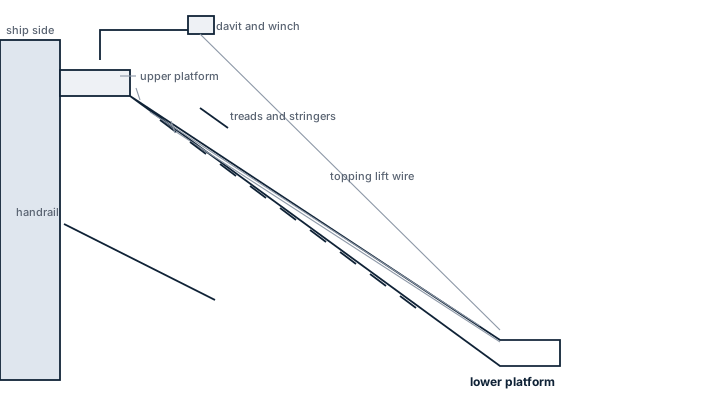
Legend
- treads and stringers
- ship side
- upper platform
- handrail
- topping lift wire
- davit and winch
- lower platform
Main components
- Ladder structure — the stepped flight itself, hinged at the upper platform
- Upper platform — fixed landing at deck level where the ladder pivots and stows
- Lower platform — self-levelling or manually adjustable landing at the bottom that meets the quay or a boat
- Suspension wires and winch — hydraulic or electric winch and wire arrangement that rigs the ladder out and controls its lowering and recovery
- Safety net — rigged beneath the ladder whenever it is in use, catching anyone who slips before they reach the water
Selection and sizing
- Length needed to cover the ship's maximum freeboard range, light to loaded condition, at the intended angle limits
- Safe working load for the number of people expected to use it at once
- Stowage arrangement and available deck space for the ladder in its rigged-in position
- Hydraulic power availability if the ladder is powered, matched to the ship's existing deck machinery supply
Regulations and class
SOLAS requires accommodation ladders and their rigging to be maintained in safe working condition and inspected before use, and class societies survey them as lifting appliances with periodic load testing of the suspension arrangement, not just a visual check of the steps. Angle limits are set for safe use — beyond a certain angle from the horizontal, the ladder must not be used for normal access, and this is marked on the ladder itself.
Typical faults
| Fault | Cause | Consequence |
|---|---|---|
| Corroded or fatigue-cracked treads and stringers | Salt water exposure and continuous flexing over years of use | Structural failure risk under normal foot traffic |
| Worn or corroded suspension wires | Repeated rigging cycles without adequate lubrication or inspection | Wire failure during lowering or recovery, dropping the ladder |
| Lower platform fails to self-level | Seized pivot bearings or damaged levelling mechanism | Ladder used at an unsafe angle or platform tips underfoot |
| Missing or damaged safety net | Net not rigged, or damaged and not replaced | No fall protection if someone slips while using the ladder |
What to look for in a supplier
- A ladder rated for the vessel's actual freeboard range, confirmed with as-fitted deck measurements, not a catalogue standard length
- Documented load test certification for the suspension arrangement, not only the ladder structure
- Corrosion protection suited to the ship's trading area, since this equipment sits exposed near the waterline constantly
- Spares support for winch and levelling mechanism components specific to that maker's design
Inspect the suspension wires and their attachment points at every opportunity, not only at survey — this is the one part of the ladder where a hidden fault turns a routine crew or visitor transfer into a fall from height.
Models in this type.
The best-documented model of each manufacturer first, then the next — 2 of 2 models in Accommodation Ladder. Every row links to full specifications, documents and service notes.
Manufacturers.
All 9 manufacturers with models of Accommodation Ladder. Names with a manufacturer page open it; the others open a search across the full library.
All manufacturers in the libraryAlso in Accommodation & Access Equipment.
The other equipment types in this category.
Inspection findings for this equipment
From public port state control and US Coast Guard records; OceanSphere assigns them to this equipment type from the descriptions.
Investigation reports
- 2017-06-26 · MAIB (UK) · Fall from accommodation ladder platform on chemical oil tanker Nabucco with loss of 1 life
- 2009-09-10 · MAIB (UK) · Uncontrolled descent of accommodation ladder from container vessel Ever Elite with loss of 1 life
Write to us about your machine — the answer comes by e-mail.
Name the make and the model and what the job is: a spare, a service call, a second opinion on a data sheet. We answer by e-mail.
No details at hand? A photo of the rating plate or the part is enough — simply attach it to the request.
Questions that come up with this equipment.
Is Accommodation Ladder data free?
Yes. Every model page, every guide and every datasheet for this type is readable without an account. An account adds saved searches and requests, nothing is taken away.
My model is missing — what now?
Send us the nameplate. We identify it by hand, add it to the library, and if you need a part or a service, the request is already on our desk.
Can you source a Accommodation Ladder part?
Yes. Tell us the manufacturer, the model and what you need — a person reads every request and replies by e-mail.