What to check on a Liferaft Launching Equipment.
Not every liferaft is simply thrown over the side. On ships with significant freeboard, or where SOLAS requires it based on the vessel's arrangement, liferafts are lowered under control using a purpose-built davit system, similar in principle to a lifeboat davit but lighter, since a liferaft container plus occupants is a fraction of a lifeboat's weight. This matters because a raft dropped from height onto water can be damaged on impact or blown away from the ship before anyone boards it; a davit-launched system lands the raft gently alongside and…
What sets liferaft launching equipment apart
Not every liferaft is simply thrown over the side. On ships with significant freeboard, or where SOLAS requires it based on the vessel's arrangement, liferafts are lowered under control using a purpose-built davit system, similar in principle to a lifeboat davit but lighter, since a liferaft container plus occupants is a fraction of a lifeboat's weight. This matters because a raft dropped from height onto water can be damaged on impact or blown away from the ship before anyone boards it; a davit-launched system lands the raft gently alongside and lets people board it at or near deck level in some arrangements before lowering.
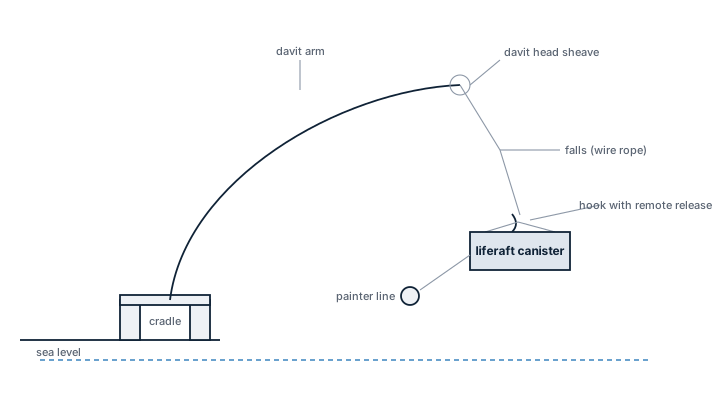
Main components
Davit arm
A single-arm or radial davit swings the raft container out over the ship's side, sized for the raft's stowed weight, not the loaded weight, since the raft inflates and is boarded after launching or during lowering depending on the arrangement.
Falls and winch
Wire or fibre falls run through the davit head to a winch that lowers the raft under control; the winch normally has a hand-crank backup for power failure.
Hydrostatic release unit
Fitted to the raft's painter line so the raft releases automatically and inflates if the ship sinks before anyone can launch it manually, a requirement independent of whether the raft is davit-launched or throw-over.
Painter line and inflation trigger
The painter connects the raft to the ship and triggers the CO2 inflation system when pulled out to its full length, whether the raft was thrown or lowered.
Selection and sizing
- Freeboard: the deciding factor for whether SOLAS requires davit launching rather than allowing a simple throw-over arrangement.
- Raft capacity and container weight: sets the davit's load rating and the winch's lowering speed control range.
- Number of stations: matched to total persons on board split across the required number of survival craft positions, with the usual port and starboard redundancy.
Regulations and class
SOLAS Chapter III sets out when davit-launched liferafts are required as opposed to throw-over rafts, based largely on the height of the embarkation deck above the waterline. The IMO LSA Code covers the davit, winch and release gear construction standards. Class surveys check the hydrostatic release unit's expiry date, since these units have a fixed service life and are one of the most commonly found overdue items at survey, along with load testing of the davit and winch at prescribed intervals.
Typical faults
| Fault | Consequence |
|---|---|
| Expired hydrostatic release unit | Raft may fail to release automatically if the ship sinks before manual launch |
| Winch brake wear or corrosion | Uncontrolled lowering speed, risk of raft hitting the water hard or the falls running out |
| Davit arm corrosion at the pivot | Arm will not swing out under manual effort when power is lost |
| Painter line chafed or incorrectly led | Fails to trigger inflation, or triggers it prematurely in the stowage |
What to look for in a supplier
- LSA Code type approval for the complete davit and winch assembly, matched to the raft weight it will actually launch.
- Clear service intervals and load test documentation for the winch and falls.
- Compatible hydrostatic release units with published expiry tracking, not a generic unit bought separately without confirmed compatibility.
Track hydrostatic release unit expiry dates on the same schedule as the liferaft's own service date, not separately — these are the two most common overdue findings at a lifesaving appliance survey and they rarely expire on the same day.