What to check on a Dry Powder Extinguisher.
A dry powder extinguisher works by chemical inhibition: the powder cloud interrupts the free-radical chain reaction that sustains combustion, rather than cooling the fuel like water or excluding oxygen like CO2 and foam. This makes it the fastest knock-down agent on a burning liquid or gas jet, but it leaves no cooling residue behind, so a hot surface can reignite spilled fuel seconds after the cloud settles. Unlike foam it will not seal a liquid surface, and unlike CO2 it is safe to use in an open or ventilated space…
What sets a dry powder extinguisher apart
A dry powder extinguisher works by chemical inhibition: the powder cloud interrupts the free-radical chain reaction that sustains combustion, rather than cooling the fuel like water or excluding oxygen like CO2 and foam. This makes it the fastest knock-down agent on a burning liquid or gas jet, but it leaves no cooling residue behind, so a hot surface can reignite spilled fuel seconds after the cloud settles. Unlike foam it will not seal a liquid surface, and unlike CO2 it is safe to use in an open or ventilated space because it does not displace breathable air.
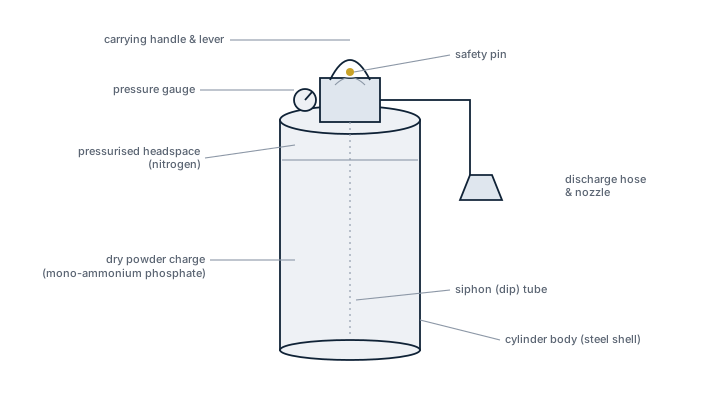
Main components
Cylinder and propellant
Marine units are almost always stored-pressure types: the powder and a nitrogen or dry-air propellant share the same steel cylinder, held at roughly 12-16 bar and shown on an integral pressure gauge. Cartridge-operated types, with a separate CO2 cartridge pierced on activation, still turn up on older tonnage but are harder to keep serviceable at sea.
Powder charge
Most marine charges are mono-ammonium phosphate (ABC-rated, effective on solids, liquids and gas) or sodium bicarbonate (BC-rated, for liquid and gas fires only). Both are hygroscopic and will cake into a solid block if moisture gets past the cylinder seal, which is why the annual shake test matters as much as the pressure check.
Valve, hose and nozzle
A lever-operated valve punctures or opens the propellant path; a short rubber hose carries powder to a fan-pattern nozzle. The valve seat is the component most often damaged by overpainting during routine maintenance rounds.
Selecting the right rating for a space
Marine dry powder units are sized in kg of charge, typically 5, 6, 9 or 12 kg, with discharge lasting 10-20 seconds and an effective throw of 3-6 metres. The fire class letters on the label (A, B, C) must match the risk in the space: a paint locker or workshop needs A/B/C coverage, while a space with exposed switchboards needs a charge with a stated dielectric test voltage. Powder is a poor choice next to sensitive electronics or navigation equipment, where a clean-agent or CO2 unit avoids residue damage.
Regulations and class requirements
Portable extinguisher numbers, types and distribution by space are set out under the SOLAS Chapter II-2 fire safety provisions and detailed in the IMO Fire Safety Systems (FSS) Code. Each unit needs an annual visual inspection, and the powder charge and propellant seal are opened, weighed and refilled at intervals set by the flag state or the manufacturer's approved service schedule, commonly every five years, with a hydrostatic cylinder test at longer intervals. A servicing tag showing the last inspection date is a standard port state control check item.
Typical faults
| Fault | Consequence |
|---|---|
| Powder caked by moisture ingress | Valve blocks on discharge; little or no powder reaches the fire |
| Slow pressure loss past the valve seal | Reduced throw and discharge time, unit reads full but underperforms |
| Corroded or dented cylinder wall | Fails hydrostatic test, unit condemned and removed from service |
| Overpainted lever or safety pin | Cannot be operated quickly in an emergency |
| Expired service tag | Non-conformity at survey or port state control inspection |
What to look for in a supplier
- Type approval and wheelmark or equivalent flag-state certification for the exact model
- An approved service station network reachable from the vessel's trading pattern
- Correct fire class and charge weight for the bracket and space it replaces
- Documented powder batch traceability and hygroscopic packaging during transit
- Availability of spare gauges, hoses and cartridges for the specific model
Shake or invert a stored-pressure unit briefly during the monthly rounds, not just look at the gauge; a caked charge can hold full pressure and still refuse to leave the hose.