Air Handling Unit
An air handling unit is the ducted, central plant that mixes fresh and recirculated air, filters it, and conditions it for delivery through trunking to many cabins and public spaces at once, unlike a split or self-contained unit that only serves the compartment it sits in.
What to check on an Air Handling Unit.
16 models from MENERGA Marine in Air Handling Unit. Below: the full model list.
What defines this type
An air handling unit (AHU) is a central, ducted machine: one cabinet handles the air for a whole accommodation deck or several spaces through a trunking network, rather than one refrigerant circuit per room. The unit mixes outside air with recirculated air, filters it, passes it over a cooling or heating coil, and a fan pushes the conditioned air out through ductwork with branch dampers to each space. The distinction from a split or self-contained unit is not the refrigeration side, it is the air distribution: an AHU is judged on duct-borne airflow and static pressure, not on room-by-room refrigerant charge.
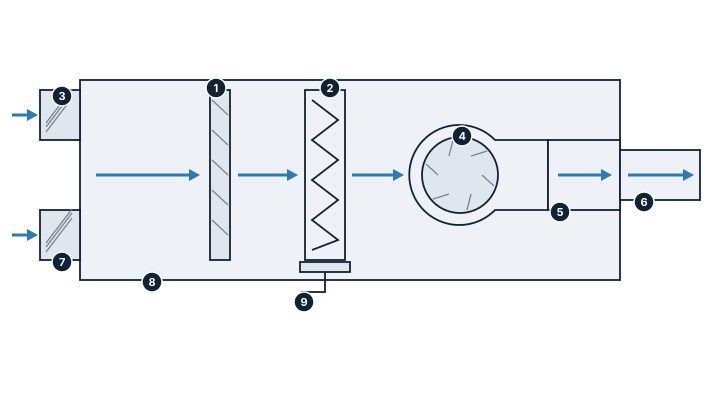
Legend
- Filter bank
- Cooling / heating coil
- Fresh air intake damper
- Supply fan (centrifugal)
- Fan discharge plenum
- Discharge duct
- Return air damper
- Mixing chamber
- Condensate drain
Main components
Damper and mixing section
Motorised fresh air and recirculation dampers set the outside air ratio. On many accommodation AHUs this ratio is fixed by class minimum fresh air requirements and rarely adjusted in service.
Filter section
A coarse pre-filter protects a finer secondary filter bank. Salt-laden air offshore loads the pre-filter quickly, and a neglected filter is the single most common cause of an AHU underperforming.
Read the full guide
Coil section
A chilled water or direct expansion cooling coil, sometimes paired with an electric or hot water heating coil for winter running or reheat dehumidification.
Fan section
A centrifugal or plug fan sized against the total duct resistance of the system it feeds, including attenuators and the longest branch run.
Control section
Supply air temperature and, on better-specified units, humidity sensors feed a controller that modulates the coil valve or compressor capacity.
Selection and sizing
Sizing an AHU starts from the total airflow (m³/h) needed across every space it serves, then works back through duct losses to a required fan static pressure. Key figures to check against a supplier's data sheet:
- Design cooling and heating load in kW for the served spaces, not just floor area.
- Fresh air quantity per person, since accommodation ventilation standards set a minimum outside air rate regardless of cooling load.
- External static pressure the fan must overcome, including attenuators, fire dampers and the worst-case branch.
- Filter class and expected pressure drop across the service interval.
- Casing construction, since a unit sited in an uninsulated void or exposed to weather needs a different corrosion allowance than one in a dry machinery space.
Regulations and class
Where ductwork from an AHU crosses a fire boundary, fire dampers are required and their operation is checked at survey; a damper found seized in the open or closed position is a recurring survey finding. Accommodation ventilation and habitability, including minimum fresh air supply and temperature control, sit under the flag state's implementation of crew accommodation requirements, and class societies apply their own ventilation and air conditioning rules for the machinery and control spaces an AHU serves. Design conditions for accommodation air conditioning are commonly checked against the marine industry's standard basis-of-calculation methodology rather than an ad hoc figure.
Typical faults
| Fault | Consequence |
|---|---|
| Clogged or torn filter | Reduced airflow, coil icing on DX units, and complaints of poor cooling despite a healthy compressor |
| Fire damper stuck closed | Starved airflow to the space it serves and a survey finding at the next fire door and damper test |
| Condensate drain blocked | Water tracking into the duct insulation or dripping into the space below the unit |
| Fan bearing wear | Rising noise and vibration, eventually a seized fan and total loss of airflow to that branch |
| Coil fouling or corrosion | Falling capacity that looks like a refrigerant problem but is actually restricted airflow or a leaking tube |
What to look for in a supplier
- Casing and internal coating rated for a salt-air environment, not a shore HVAC standard.
- Fire damper components carrying valid type approval for marine use.
- Published fan curves and filter pressure drop data, not just a single duty point.
- Footprint and weight compatible with the space if the unit is a retrofit rather than a newbuild fit.
- A spares list that covers filters, belts, bearings and damper actuators as routine consumables.
Before blaming the compressor or the chilled water plant for weak cooling, pull the filter and check duct static pressure at the unit first; a starved AHU behaves exactly like a low-charge refrigeration system.
Models in this type.
The best-documented model of each manufacturer first, then the next — 16 of 16 models in Air Handling Unit. Every row links to full specifications, documents and service notes.
Manufacturers.
All 21 manufacturers with models of Air Handling Unit. Names with a manufacturer page open it; the others open a search across the full library.
All manufacturersAlso in Air Conditioning.
The other equipment types in this category.
One request. A person reads it and replies by e-mail.
Tell us the manufacturer, the model and what you need — a part, a service call, a second opinion. A person reads every request and replies by e-mail.
No details at hand? A photo of the rating plate or the part is enough — simply attach it to the request.
Three things people ask first.
Is Air Handling Unit data free?
Yes. Every model page, every guide and every datasheet for this type is readable without an account. An account adds saved searches and requests, nothing is taken away.
My model is missing — what now?
Send us the nameplate. We identify it by hand, add it to the library, and if you need a part or a service, the request is already on our desk.
Can you source a Air Handling Unit part?
Yes. Tell us the manufacturer, the model and what you need — a person reads every request and replies by e-mail.