OceanSphere
Engines

Ship-to-Ship Cargo Hose

medium 315 models total

A floating cargo hose that stays on the surface between two vessels moored alongside, built with buoyancy elements the submarine type does not carry. Its job ends the moment the transfer does; it is rigged, used and recovered on the same day.

Read more — Ship-to-Ship Cargo Hose explained

What makes this type

The ship-to-ship (STS) cargo hose is a floating hose string rigged between two vessels moored alongside each other, most often during lightering, bunkering at anchor, or transfers where no jetty is available. Unlike the submarine hose, which is designed to sink and stay on the seabed, the STS hose must float on the surface throughout the operation so it can be handled by crane, tended by mooring boats, and recovered cleanly once cargo has passed. Buoyancy is built into the hose itself or added as separate float collars strapped along its length.
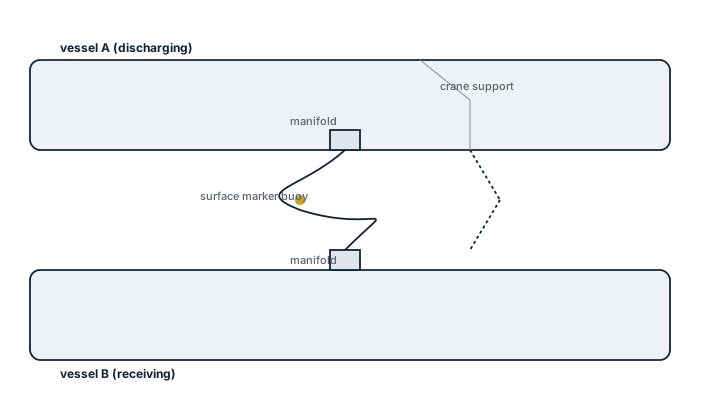
Ship-to-ship cargo hose arrangement
Plan view of a ship-to-ship transfer showing a floating cargo hose strung between the manifolds of two vessels moored alongside, supported by a crane and marked with surface buoys, rigged only for the duration of the transfer.

Main components

Hose body

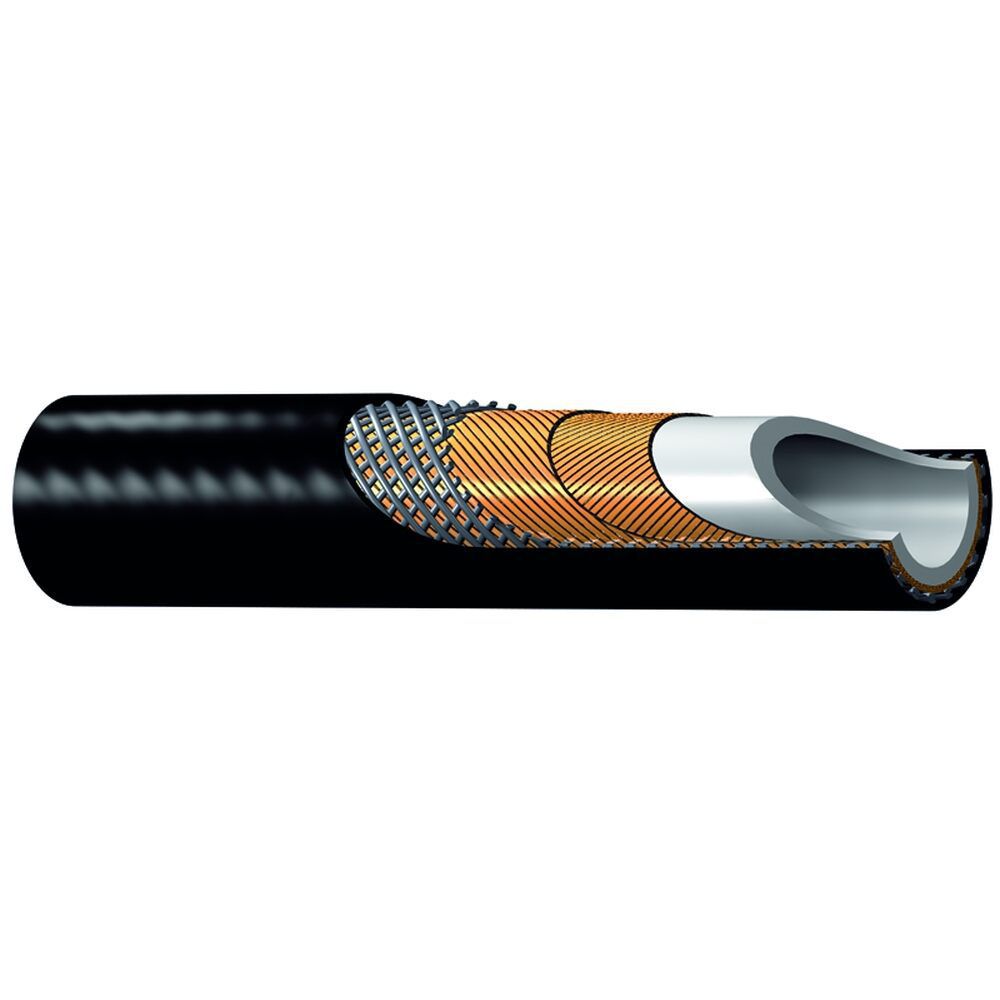
A synthetic rubber or composite tube reinforced with helical wire and textile plies, covered by an abrasion- and weather-resistant outer layer. The construction has to flex repeatedly without kinking as the two ships move on their moorings.

Flanges and couplings

Steel or aluminium flanges bonded to each hose length, matched to the manifold table (commonly ANSI or DIN pattern) of both vessels, with bolted or quick-connect couplings depending on the trade.

Floats

Closed-cell foam collars fitted around the hose at intervals, or hoses with integral buoyancy layers, keeping the string on the surface even when full of cargo.

Tail hose and pick-up gear

A shorter, more flexible tail section connects to the manifold, fitted with lifting bridles, pick-up ropes and a messenger line so mooring boats or the receiving ship's crane can bring the hose end aboard.

Selection / Sizing

  • Nominal bore, typically 6 to 16 inches, matched to the intended cargo throughput and both manifolds.
  • Working pressure rating, with the hose tested well above the maximum transfer pressure expected.
  • Minimum breaking load of the hose and its bridles, since the string carries its own weight plus dynamic loads from vessel motion.
  • Cargo compatibility of the lining: crude and dark products, clean products, and chemicals each need a different tube compound.
  • Overall string length, set by the anticipated distance between manifolds at the planned mooring configuration.

Regulations / Class

STS transfers are conducted under the OCIMF Ship to Ship Transfer Guide, which sets out hose testing, marking, and handling practice widely followed by charterers and terminals even where not mandatory. Hoses are pressure tested at survey intervals set by the operator's inspection regime, and each length carries a test date, working pressure, and identification marking. Electrical continuity across the string is checked as part of the same programme, since a break in bonding removes a path for static discharge.

Typical faults

FaultConsequence
Kinked or crushed hose from poor flaking on deckLocalised weak point, risk of burst under pressure
Waterlogged or damaged floatsHose sinks or hangs at an angle, increasing strain on flanges
Loss of electrical continuity between flangesNo discharge path for static, ignition risk during transfer
Cover abrasion from repeated deck handlingReinforcement exposed, hose condemned before its rated life

What to look for in a supplier

  • Current pressure test certificates and a legible hose history for every length in the string, not just the newest ones.
  • Manifold table compatibility confirmed before the hose is ordered, not discovered at the first transfer.
  • Float condition verified by weight check, since a waterlogged float looks intact but no longer supports the hose.
  • Bridles and lifting gear rated and certified separately from the hose itself.

Flake the hose in long, even bights on deck before lowering it; a hose stowed in tight coils will kink the moment it takes a load, and that kink is where it fails.

7 manufacturers · 315 models

ContiTech/Continental

45
CT Ship-to-Ship 4in x 6m unverified
Diameter (Zoll)
4
Length (m)
6
Working Pressure (bar)
21
Burst Pressure (bar)
63
Temperature Range (°C)
-30 to +80
Cargo Type
product
Common Failures & Inspection Points
  • Outer-cover cracking, abrasion or impact damage caused by handling and weather exposure, resulting in visible reinforcement or rejected hose condition
  • Inner-liner deterioration caused by cargo incompatibility, temperature or aging, resulting in leakage, blistering or contamination
  • End-fitting or flange leakage caused by gasket damage, loose fasteners or hose-end fatigue, resulting in cargo leakage during testing or transfer
  • Kinking or over-bending caused by poor support, waves or vessel movement, resulting in local deformation and hidden reinforcement damage
  • Electrical bonding or continuity failure caused by a broken conductive path or damaged fittings, resulting in failed continuity checks where bonding is required
Service: Inspect the entire hose length, end fittings, covers, identification and lifting or support points before transfer. Keep bend radius and support within the approved handling arrangement and prevent dragging, crushing or sharp contact. Perform required pressure, leak or continuity tests using approved procedures and maintain hose certificates and service history. Inspect gaskets and flange faces before connection and control hose movement during transfer. Remove any hose with bulges, exposed reinforcement, severe abrasion or suspect end fitting from service pending approved assessment. Refer to the manufacturer documentation for the exact figure for test pressure, bend radius, service life and temperature limits.
Spare Parts: Keep approved flange gaskets, protective caps, bonding leads where applicable, handling slings and hose-support consumables. Complete certified spare hoses may be required for critical cargo service. Replacement hoses must match cargo, pressure, temperature and connection requirements.
Use Cases: It is used for ship-to-shore, ship-to-ship and offshore cargo transfer on merchant ships, passenger vessels, offshore units or other vessel types where this equipment category is fitted.
CT Ship-to-Ship 4in x 9m unverified
Diameter (Zoll)
4
Length (m)
9
Working Pressure (bar)
21
Burst Pressure (bar)
63
Temperature Range (°C)
-30 to +80
Cargo Type
product
Common Failures & Inspection Points
  • Outer-cover cracking, abrasion or impact damage caused by handling and weather exposure, resulting in visible reinforcement or rejected hose condition
  • Inner-liner deterioration caused by cargo incompatibility, temperature or aging, resulting in leakage, blistering or contamination
  • End-fitting or flange leakage caused by gasket damage, loose fasteners or hose-end fatigue, resulting in cargo leakage during testing or transfer
  • Kinking or over-bending caused by poor support, waves or vessel movement, resulting in local deformation and hidden reinforcement damage
  • Electrical bonding or continuity failure caused by a broken conductive path or damaged fittings, resulting in failed continuity checks where bonding is required
Service: Inspect the entire hose length, end fittings, covers, identification and lifting or support points before transfer. Keep bend radius and support within the approved handling arrangement and prevent dragging, crushing or sharp contact. Perform required pressure, leak or continuity tests using approved procedures and maintain hose certificates and service history. Inspect gaskets and flange faces before connection and control hose movement during transfer. Remove any hose with bulges, exposed reinforcement, severe abrasion or suspect end fitting from service pending approved assessment. Refer to the manufacturer documentation for the exact figure for test pressure, bend radius, service life and temperature limits.
Spare Parts: Keep approved flange gaskets, protective caps, bonding leads where applicable, handling slings and hose-support consumables. Complete certified spare hoses may be required for critical cargo service. Replacement hoses must match cargo, pressure, temperature and connection requirements.
Use Cases: It is used for ship-to-shore, ship-to-ship and offshore cargo transfer on merchant ships, passenger vessels, offshore units or other vessel types where this equipment category is fitted.
CT Ship-to-Ship 4in x 12m unverified
Diameter (Zoll)
4
Length (m)
12
Working Pressure (bar)
21
Burst Pressure (bar)
63
Temperature Range (°C)
-30 to +80
Cargo Type
product
Common Failures & Inspection Points
  • Outer-cover cracking, abrasion or impact damage caused by handling and weather exposure, resulting in visible reinforcement or rejected hose condition
  • Inner-liner deterioration caused by cargo incompatibility, temperature or aging, resulting in leakage, blistering or contamination
  • End-fitting or flange leakage caused by gasket damage, loose fasteners or hose-end fatigue, resulting in cargo leakage during testing or transfer
  • Kinking or over-bending caused by poor support, waves or vessel movement, resulting in local deformation and hidden reinforcement damage
  • Electrical bonding or continuity failure caused by a broken conductive path or damaged fittings, resulting in failed continuity checks where bonding is required
Service: Inspect the entire hose length, end fittings, covers, identification and lifting or support points before transfer. Keep bend radius and support within the approved handling arrangement and prevent dragging, crushing or sharp contact. Perform required pressure, leak or continuity tests using approved procedures and maintain hose certificates and service history. Inspect gaskets and flange faces before connection and control hose movement during transfer. Remove any hose with bulges, exposed reinforcement, severe abrasion or suspect end fitting from service pending approved assessment. Refer to the manufacturer documentation for the exact figure for test pressure, bend radius, service life and temperature limits.
Spare Parts: Keep approved flange gaskets, protective caps, bonding leads where applicable, handling slings and hose-support consumables. Complete certified spare hoses may be required for critical cargo service. Replacement hoses must match cargo, pressure, temperature and connection requirements.
Use Cases: It is used for ship-to-shore, ship-to-ship and offshore cargo transfer on merchant ships, passenger vessels, offshore units or other vessel types where this equipment category is fitted.
CT Ship-to-Ship 4in x 15m unverified
Diameter (Zoll)
4
Length (m)
15
Working Pressure (bar)
21
Burst Pressure (bar)
63
Temperature Range (°C)
-30 to +80
Cargo Type
product
Common Failures & Inspection Points
  • Outer-cover cracking, abrasion or impact damage caused by handling and weather exposure, resulting in visible reinforcement or rejected hose condition
  • Inner-liner deterioration caused by cargo incompatibility, temperature or aging, resulting in leakage, blistering or contamination
  • End-fitting or flange leakage caused by gasket damage, loose fasteners or hose-end fatigue, resulting in cargo leakage during testing or transfer
  • Kinking or over-bending caused by poor support, waves or vessel movement, resulting in local deformation and hidden reinforcement damage
  • Electrical bonding or continuity failure caused by a broken conductive path or damaged fittings, resulting in failed continuity checks where bonding is required
Service: Inspect the entire hose length, end fittings, covers, identification and lifting or support points before transfer. Keep bend radius and support within the approved handling arrangement and prevent dragging, crushing or sharp contact. Perform required pressure, leak or continuity tests using approved procedures and maintain hose certificates and service history. Inspect gaskets and flange faces before connection and control hose movement during transfer. Remove any hose with bulges, exposed reinforcement, severe abrasion or suspect end fitting from service pending approved assessment. Refer to the manufacturer documentation for the exact figure for test pressure, bend radius, service life and temperature limits.
Spare Parts: Keep approved flange gaskets, protective caps, bonding leads where applicable, handling slings and hose-support consumables. Complete certified spare hoses may be required for critical cargo service. Replacement hoses must match cargo, pressure, temperature and connection requirements.
Use Cases: It is used for ship-to-shore, ship-to-ship and offshore cargo transfer on merchant ships, passenger vessels, offshore units or other vessel types where this equipment category is fitted.
CT Ship-to-Ship 4in x 18m unverified
Diameter (Zoll)
4
Length (m)
18
Working Pressure (bar)
21
Burst Pressure (bar)
63
Temperature Range (°C)
-30 to +80
Cargo Type
product
Common Failures & Inspection Points
  • Outer-cover cracking, abrasion or impact damage caused by handling and weather exposure, resulting in visible reinforcement or rejected hose condition
  • Inner-liner deterioration caused by cargo incompatibility, temperature or aging, resulting in leakage, blistering or contamination
  • End-fitting or flange leakage caused by gasket damage, loose fasteners or hose-end fatigue, resulting in cargo leakage during testing or transfer
  • Kinking or over-bending caused by poor support, waves or vessel movement, resulting in local deformation and hidden reinforcement damage
  • Electrical bonding or continuity failure caused by a broken conductive path or damaged fittings, resulting in failed continuity checks where bonding is required
Service: Inspect the entire hose length, end fittings, covers, identification and lifting or support points before transfer. Keep bend radius and support within the approved handling arrangement and prevent dragging, crushing or sharp contact. Perform required pressure, leak or continuity tests using approved procedures and maintain hose certificates and service history. Inspect gaskets and flange faces before connection and control hose movement during transfer. Remove any hose with bulges, exposed reinforcement, severe abrasion or suspect end fitting from service pending approved assessment. Refer to the manufacturer documentation for the exact figure for test pressure, bend radius, service life and temperature limits.
Spare Parts: Keep approved flange gaskets, protective caps, bonding leads where applicable, handling slings and hose-support consumables. Complete certified spare hoses may be required for critical cargo service. Replacement hoses must match cargo, pressure, temperature and connection requirements.
Use Cases: It is used for ship-to-shore, ship-to-ship and offshore cargo transfer on merchant ships, passenger vessels, offshore units or other vessel types where this equipment category is fitted.
CT Ship-to-Ship 6in x 6m unverified
Diameter (Zoll)
6
Length (m)
6
Working Pressure (bar)
21
Burst Pressure (bar)
63
Temperature Range (°C)
-30 to +80
Cargo Type
product
Common Failures & Inspection Points
  • Outer-cover cracking, abrasion or impact damage caused by handling and weather exposure, resulting in visible reinforcement or rejected hose condition
  • Inner-liner deterioration caused by cargo incompatibility, temperature or aging, resulting in leakage, blistering or contamination
  • End-fitting or flange leakage caused by gasket damage, loose fasteners or hose-end fatigue, resulting in cargo leakage during testing or transfer
  • Kinking or over-bending caused by poor support, waves or vessel movement, resulting in local deformation and hidden reinforcement damage
  • Electrical bonding or continuity failure caused by a broken conductive path or damaged fittings, resulting in failed continuity checks where bonding is required
Service: Inspect the entire hose length, end fittings, covers, identification and lifting or support points before transfer. Keep bend radius and support within the approved handling arrangement and prevent dragging, crushing or sharp contact. Perform required pressure, leak or continuity tests using approved procedures and maintain hose certificates and service history. Inspect gaskets and flange faces before connection and control hose movement during transfer. Remove any hose with bulges, exposed reinforcement, severe abrasion or suspect end fitting from service pending approved assessment. Refer to the manufacturer documentation for the exact figure for test pressure, bend radius, service life and temperature limits.
Spare Parts: Keep approved flange gaskets, protective caps, bonding leads where applicable, handling slings and hose-support consumables. Complete certified spare hoses may be required for critical cargo service. Replacement hoses must match cargo, pressure, temperature and connection requirements.
Use Cases: It is used for ship-to-shore, ship-to-ship and offshore cargo transfer on merchant ships, passenger vessels, offshore units or other vessel types where this equipment category is fitted.
CT Ship-to-Ship 6in x 9m unverified
Diameter (Zoll)
6
Length (m)
9
Working Pressure (bar)
21
Burst Pressure (bar)
63
Temperature Range (°C)
-30 to +80
Cargo Type
product
Common Failures & Inspection Points
  • Outer-cover cracking, abrasion or impact damage caused by handling and weather exposure, resulting in visible reinforcement or rejected hose condition
  • Inner-liner deterioration caused by cargo incompatibility, temperature or aging, resulting in leakage, blistering or contamination
  • End-fitting or flange leakage caused by gasket damage, loose fasteners or hose-end fatigue, resulting in cargo leakage during testing or transfer
  • Kinking or over-bending caused by poor support, waves or vessel movement, resulting in local deformation and hidden reinforcement damage
  • Electrical bonding or continuity failure caused by a broken conductive path or damaged fittings, resulting in failed continuity checks where bonding is required
Service: Inspect the entire hose length, end fittings, covers, identification and lifting or support points before transfer. Keep bend radius and support within the approved handling arrangement and prevent dragging, crushing or sharp contact. Perform required pressure, leak or continuity tests using approved procedures and maintain hose certificates and service history. Inspect gaskets and flange faces before connection and control hose movement during transfer. Remove any hose with bulges, exposed reinforcement, severe abrasion or suspect end fitting from service pending approved assessment. Refer to the manufacturer documentation for the exact figure for test pressure, bend radius, service life and temperature limits.
Spare Parts: Keep approved flange gaskets, protective caps, bonding leads where applicable, handling slings and hose-support consumables. Complete certified spare hoses may be required for critical cargo service. Replacement hoses must match cargo, pressure, temperature and connection requirements.
Use Cases: It is used for ship-to-shore, ship-to-ship and offshore cargo transfer on merchant ships, passenger vessels, offshore units or other vessel types where this equipment category is fitted.
CT Ship-to-Ship 6in x 12m unverified
Diameter (Zoll)
6
Length (m)
12
Working Pressure (bar)
21
Burst Pressure (bar)
63
Temperature Range (°C)
-30 to +80
Cargo Type
product
Common Failures & Inspection Points
  • Outer-cover cracking, abrasion or impact damage caused by handling and weather exposure, resulting in visible reinforcement or rejected hose condition
  • Inner-liner deterioration caused by cargo incompatibility, temperature or aging, resulting in leakage, blistering or contamination
  • End-fitting or flange leakage caused by gasket damage, loose fasteners or hose-end fatigue, resulting in cargo leakage during testing or transfer
  • Kinking or over-bending caused by poor support, waves or vessel movement, resulting in local deformation and hidden reinforcement damage
  • Electrical bonding or continuity failure caused by a broken conductive path or damaged fittings, resulting in failed continuity checks where bonding is required
Service: Inspect the entire hose length, end fittings, covers, identification and lifting or support points before transfer. Keep bend radius and support within the approved handling arrangement and prevent dragging, crushing or sharp contact. Perform required pressure, leak or continuity tests using approved procedures and maintain hose certificates and service history. Inspect gaskets and flange faces before connection and control hose movement during transfer. Remove any hose with bulges, exposed reinforcement, severe abrasion or suspect end fitting from service pending approved assessment. Refer to the manufacturer documentation for the exact figure for test pressure, bend radius, service life and temperature limits.
Spare Parts: Keep approved flange gaskets, protective caps, bonding leads where applicable, handling slings and hose-support consumables. Complete certified spare hoses may be required for critical cargo service. Replacement hoses must match cargo, pressure, temperature and connection requirements.
Use Cases: It is used for ship-to-shore, ship-to-ship and offshore cargo transfer on merchant ships, passenger vessels, offshore units or other vessel types where this equipment category is fitted.
CT Ship-to-Ship 6in x 15m unverified
Diameter (Zoll)
6
Length (m)
15
Working Pressure (bar)
21
Burst Pressure (bar)
63
Temperature Range (°C)
-30 to +80
Cargo Type
product
Common Failures & Inspection Points
  • Outer-cover cracking, abrasion or impact damage caused by handling and weather exposure, resulting in visible reinforcement or rejected hose condition
  • Inner-liner deterioration caused by cargo incompatibility, temperature or aging, resulting in leakage, blistering or contamination
  • End-fitting or flange leakage caused by gasket damage, loose fasteners or hose-end fatigue, resulting in cargo leakage during testing or transfer
  • Kinking or over-bending caused by poor support, waves or vessel movement, resulting in local deformation and hidden reinforcement damage
  • Electrical bonding or continuity failure caused by a broken conductive path or damaged fittings, resulting in failed continuity checks where bonding is required
Service: Inspect the entire hose length, end fittings, covers, identification and lifting or support points before transfer. Keep bend radius and support within the approved handling arrangement and prevent dragging, crushing or sharp contact. Perform required pressure, leak or continuity tests using approved procedures and maintain hose certificates and service history. Inspect gaskets and flange faces before connection and control hose movement during transfer. Remove any hose with bulges, exposed reinforcement, severe abrasion or suspect end fitting from service pending approved assessment. Refer to the manufacturer documentation for the exact figure for test pressure, bend radius, service life and temperature limits.
Spare Parts: Keep approved flange gaskets, protective caps, bonding leads where applicable, handling slings and hose-support consumables. Complete certified spare hoses may be required for critical cargo service. Replacement hoses must match cargo, pressure, temperature and connection requirements.
Use Cases: It is used for ship-to-shore, ship-to-ship and offshore cargo transfer on merchant ships, passenger vessels, offshore units or other vessel types where this equipment category is fitted.
CT Ship-to-Ship 6in x 18m unverified
Diameter (Zoll)
6
Length (m)
18
Working Pressure (bar)
21
Burst Pressure (bar)
63
Temperature Range (°C)
-30 to +80
Cargo Type
product
Common Failures & Inspection Points
  • Outer-cover cracking, abrasion or impact damage caused by handling and weather exposure, resulting in visible reinforcement or rejected hose condition
  • Inner-liner deterioration caused by cargo incompatibility, temperature or aging, resulting in leakage, blistering or contamination
  • End-fitting or flange leakage caused by gasket damage, loose fasteners or hose-end fatigue, resulting in cargo leakage during testing or transfer
  • Kinking or over-bending caused by poor support, waves or vessel movement, resulting in local deformation and hidden reinforcement damage
  • Electrical bonding or continuity failure caused by a broken conductive path or damaged fittings, resulting in failed continuity checks where bonding is required
Service: Inspect the entire hose length, end fittings, covers, identification and lifting or support points before transfer. Keep bend radius and support within the approved handling arrangement and prevent dragging, crushing or sharp contact. Perform required pressure, leak or continuity tests using approved procedures and maintain hose certificates and service history. Inspect gaskets and flange faces before connection and control hose movement during transfer. Remove any hose with bulges, exposed reinforcement, severe abrasion or suspect end fitting from service pending approved assessment. Refer to the manufacturer documentation for the exact figure for test pressure, bend radius, service life and temperature limits.
Spare Parts: Keep approved flange gaskets, protective caps, bonding leads where applicable, handling slings and hose-support consumables. Complete certified spare hoses may be required for critical cargo service. Replacement hoses must match cargo, pressure, temperature and connection requirements.
Use Cases: It is used for ship-to-shore, ship-to-ship and offshore cargo transfer on merchant ships, passenger vessels, offshore units or other vessel types where this equipment category is fitted.
CT Ship-to-Ship 8in x 6m unverified
Diameter (Zoll)
8
Length (m)
6
Working Pressure (bar)
21
Burst Pressure (bar)
63
Temperature Range (°C)
-30 to +80
Cargo Type
product
Common Failures & Inspection Points
  • Outer-cover cracking, abrasion or impact damage caused by handling and weather exposure, resulting in visible reinforcement or rejected hose condition
  • Inner-liner deterioration caused by cargo incompatibility, temperature or aging, resulting in leakage, blistering or contamination
  • End-fitting or flange leakage caused by gasket damage, loose fasteners or hose-end fatigue, resulting in cargo leakage during testing or transfer
  • Kinking or over-bending caused by poor support, waves or vessel movement, resulting in local deformation and hidden reinforcement damage
  • Electrical bonding or continuity failure caused by a broken conductive path or damaged fittings, resulting in failed continuity checks where bonding is required
Service: Inspect the entire hose length, end fittings, covers, identification and lifting or support points before transfer. Keep bend radius and support within the approved handling arrangement and prevent dragging, crushing or sharp contact. Perform required pressure, leak or continuity tests using approved procedures and maintain hose certificates and service history. Inspect gaskets and flange faces before connection and control hose movement during transfer. Remove any hose with bulges, exposed reinforcement, severe abrasion or suspect end fitting from service pending approved assessment. Refer to the manufacturer documentation for the exact figure for test pressure, bend radius, service life and temperature limits.
Spare Parts: Keep approved flange gaskets, protective caps, bonding leads where applicable, handling slings and hose-support consumables. Complete certified spare hoses may be required for critical cargo service. Replacement hoses must match cargo, pressure, temperature and connection requirements.
Use Cases: It is used for ship-to-shore, ship-to-ship and offshore cargo transfer on merchant ships, passenger vessels, offshore units or other vessel types where this equipment category is fitted.
CT Ship-to-Ship 8in x 9m unverified
Diameter (Zoll)
8
Length (m)
9
Working Pressure (bar)
21
Burst Pressure (bar)
63
Temperature Range (°C)
-30 to +80
Cargo Type
product
Common Failures & Inspection Points
  • Outer-cover cracking, abrasion or impact damage caused by handling and weather exposure, resulting in visible reinforcement or rejected hose condition
  • Inner-liner deterioration caused by cargo incompatibility, temperature or aging, resulting in leakage, blistering or contamination
  • End-fitting or flange leakage caused by gasket damage, loose fasteners or hose-end fatigue, resulting in cargo leakage during testing or transfer
  • Kinking or over-bending caused by poor support, waves or vessel movement, resulting in local deformation and hidden reinforcement damage
  • Electrical bonding or continuity failure caused by a broken conductive path or damaged fittings, resulting in failed continuity checks where bonding is required
Service: Inspect the entire hose length, end fittings, covers, identification and lifting or support points before transfer. Keep bend radius and support within the approved handling arrangement and prevent dragging, crushing or sharp contact. Perform required pressure, leak or continuity tests using approved procedures and maintain hose certificates and service history. Inspect gaskets and flange faces before connection and control hose movement during transfer. Remove any hose with bulges, exposed reinforcement, severe abrasion or suspect end fitting from service pending approved assessment. Refer to the manufacturer documentation for the exact figure for test pressure, bend radius, service life and temperature limits.
Spare Parts: Keep approved flange gaskets, protective caps, bonding leads where applicable, handling slings and hose-support consumables. Complete certified spare hoses may be required for critical cargo service. Replacement hoses must match cargo, pressure, temperature and connection requirements.
Use Cases: It is used for ship-to-shore, ship-to-ship and offshore cargo transfer on merchant ships, passenger vessels, offshore units or other vessel types where this equipment category is fitted.
CT Ship-to-Ship 8in x 12m unverified
Diameter (Zoll)
8
Length (m)
12
Working Pressure (bar)
21
Burst Pressure (bar)
63
Temperature Range (°C)
-30 to +80
Cargo Type
product
Common Failures & Inspection Points
  • Outer-cover cracking, abrasion or impact damage caused by handling and weather exposure, resulting in visible reinforcement or rejected hose condition
  • Inner-liner deterioration caused by cargo incompatibility, temperature or aging, resulting in leakage, blistering or contamination
  • End-fitting or flange leakage caused by gasket damage, loose fasteners or hose-end fatigue, resulting in cargo leakage during testing or transfer
  • Kinking or over-bending caused by poor support, waves or vessel movement, resulting in local deformation and hidden reinforcement damage
  • Electrical bonding or continuity failure caused by a broken conductive path or damaged fittings, resulting in failed continuity checks where bonding is required
Service: Inspect the entire hose length, end fittings, covers, identification and lifting or support points before transfer. Keep bend radius and support within the approved handling arrangement and prevent dragging, crushing or sharp contact. Perform required pressure, leak or continuity tests using approved procedures and maintain hose certificates and service history. Inspect gaskets and flange faces before connection and control hose movement during transfer. Remove any hose with bulges, exposed reinforcement, severe abrasion or suspect end fitting from service pending approved assessment. Refer to the manufacturer documentation for the exact figure for test pressure, bend radius, service life and temperature limits.
Spare Parts: Keep approved flange gaskets, protective caps, bonding leads where applicable, handling slings and hose-support consumables. Complete certified spare hoses may be required for critical cargo service. Replacement hoses must match cargo, pressure, temperature and connection requirements.
Use Cases: It is used for ship-to-shore, ship-to-ship and offshore cargo transfer on merchant ships, passenger vessels, offshore units or other vessel types where this equipment category is fitted.
CT Ship-to-Ship 8in x 15m unverified
Diameter (Zoll)
8
Length (m)
15
Working Pressure (bar)
21
Burst Pressure (bar)
63
Temperature Range (°C)
-30 to +80
Cargo Type
product
Common Failures & Inspection Points
  • Outer-cover cracking, abrasion or impact damage caused by handling and weather exposure, resulting in visible reinforcement or rejected hose condition
  • Inner-liner deterioration caused by cargo incompatibility, temperature or aging, resulting in leakage, blistering or contamination
  • End-fitting or flange leakage caused by gasket damage, loose fasteners or hose-end fatigue, resulting in cargo leakage during testing or transfer
  • Kinking or over-bending caused by poor support, waves or vessel movement, resulting in local deformation and hidden reinforcement damage
  • Electrical bonding or continuity failure caused by a broken conductive path or damaged fittings, resulting in failed continuity checks where bonding is required
Service: Inspect the entire hose length, end fittings, covers, identification and lifting or support points before transfer. Keep bend radius and support within the approved handling arrangement and prevent dragging, crushing or sharp contact. Perform required pressure, leak or continuity tests using approved procedures and maintain hose certificates and service history. Inspect gaskets and flange faces before connection and control hose movement during transfer. Remove any hose with bulges, exposed reinforcement, severe abrasion or suspect end fitting from service pending approved assessment. Refer to the manufacturer documentation for the exact figure for test pressure, bend radius, service life and temperature limits.
Spare Parts: Keep approved flange gaskets, protective caps, bonding leads where applicable, handling slings and hose-support consumables. Complete certified spare hoses may be required for critical cargo service. Replacement hoses must match cargo, pressure, temperature and connection requirements.
Use Cases: It is used for ship-to-shore, ship-to-ship and offshore cargo transfer on merchant ships, passenger vessels, offshore units or other vessel types where this equipment category is fitted.
CT Ship-to-Ship 8in x 18m unverified
Diameter (Zoll)
8
Length (m)
18
Working Pressure (bar)
21
Burst Pressure (bar)
63
Temperature Range (°C)
-30 to +80
Cargo Type
product
Common Failures & Inspection Points
  • Outer-cover cracking, abrasion or impact damage caused by handling and weather exposure, resulting in visible reinforcement or rejected hose condition
  • Inner-liner deterioration caused by cargo incompatibility, temperature or aging, resulting in leakage, blistering or contamination
  • End-fitting or flange leakage caused by gasket damage, loose fasteners or hose-end fatigue, resulting in cargo leakage during testing or transfer
  • Kinking or over-bending caused by poor support, waves or vessel movement, resulting in local deformation and hidden reinforcement damage
  • Electrical bonding or continuity failure caused by a broken conductive path or damaged fittings, resulting in failed continuity checks where bonding is required
Service: Inspect the entire hose length, end fittings, covers, identification and lifting or support points before transfer. Keep bend radius and support within the approved handling arrangement and prevent dragging, crushing or sharp contact. Perform required pressure, leak or continuity tests using approved procedures and maintain hose certificates and service history. Inspect gaskets and flange faces before connection and control hose movement during transfer. Remove any hose with bulges, exposed reinforcement, severe abrasion or suspect end fitting from service pending approved assessment. Refer to the manufacturer documentation for the exact figure for test pressure, bend radius, service life and temperature limits.
Spare Parts: Keep approved flange gaskets, protective caps, bonding leads where applicable, handling slings and hose-support consumables. Complete certified spare hoses may be required for critical cargo service. Replacement hoses must match cargo, pressure, temperature and connection requirements.
Use Cases: It is used for ship-to-shore, ship-to-ship and offshore cargo transfer on merchant ships, passenger vessels, offshore units or other vessel types where this equipment category is fitted.
CT Ship-to-Ship 10in x 6m unverified
Diameter (Zoll)
10
Length (m)
6
Working Pressure (bar)
19
Burst Pressure (bar)
57
Temperature Range (°C)
-30 to +80
Cargo Type
product
Common Failures & Inspection Points
  • Outer-cover cracking, abrasion or impact damage caused by handling and weather exposure, resulting in visible reinforcement or rejected hose condition
  • Inner-liner deterioration caused by cargo incompatibility, temperature or aging, resulting in leakage, blistering or contamination
  • End-fitting or flange leakage caused by gasket damage, loose fasteners or hose-end fatigue, resulting in cargo leakage during testing or transfer
  • Kinking or over-bending caused by poor support, waves or vessel movement, resulting in local deformation and hidden reinforcement damage
  • Electrical bonding or continuity failure caused by a broken conductive path or damaged fittings, resulting in failed continuity checks where bonding is required
Service: Inspect the entire hose length, end fittings, covers, identification and lifting or support points before transfer. Keep bend radius and support within the approved handling arrangement and prevent dragging, crushing or sharp contact. Perform required pressure, leak or continuity tests using approved procedures and maintain hose certificates and service history. Inspect gaskets and flange faces before connection and control hose movement during transfer. Remove any hose with bulges, exposed reinforcement, severe abrasion or suspect end fitting from service pending approved assessment. Refer to the manufacturer documentation for the exact figure for test pressure, bend radius, service life and temperature limits.
Spare Parts: Keep approved flange gaskets, protective caps, bonding leads where applicable, handling slings and hose-support consumables. Complete certified spare hoses may be required for critical cargo service. Replacement hoses must match cargo, pressure, temperature and connection requirements.
Use Cases: It is used for ship-to-shore, ship-to-ship and offshore cargo transfer on merchant ships, passenger vessels, offshore units or other vessel types where this equipment category is fitted.
CT Ship-to-Ship 10in x 9m unverified
Diameter (Zoll)
10
Length (m)
9
Working Pressure (bar)
19
Burst Pressure (bar)
57
Temperature Range (°C)
-30 to +80
Cargo Type
product
Common Failures & Inspection Points
  • Outer-cover cracking, abrasion or impact damage caused by handling and weather exposure, resulting in visible reinforcement or rejected hose condition
  • Inner-liner deterioration caused by cargo incompatibility, temperature or aging, resulting in leakage, blistering or contamination
  • End-fitting or flange leakage caused by gasket damage, loose fasteners or hose-end fatigue, resulting in cargo leakage during testing or transfer
  • Kinking or over-bending caused by poor support, waves or vessel movement, resulting in local deformation and hidden reinforcement damage
  • Electrical bonding or continuity failure caused by a broken conductive path or damaged fittings, resulting in failed continuity checks where bonding is required
Service: Inspect the entire hose length, end fittings, covers, identification and lifting or support points before transfer. Keep bend radius and support within the approved handling arrangement and prevent dragging, crushing or sharp contact. Perform required pressure, leak or continuity tests using approved procedures and maintain hose certificates and service history. Inspect gaskets and flange faces before connection and control hose movement during transfer. Remove any hose with bulges, exposed reinforcement, severe abrasion or suspect end fitting from service pending approved assessment. Refer to the manufacturer documentation for the exact figure for test pressure, bend radius, service life and temperature limits.
Spare Parts: Keep approved flange gaskets, protective caps, bonding leads where applicable, handling slings and hose-support consumables. Complete certified spare hoses may be required for critical cargo service. Replacement hoses must match cargo, pressure, temperature and connection requirements.
Use Cases: It is used for ship-to-shore, ship-to-ship and offshore cargo transfer on merchant ships, passenger vessels, offshore units or other vessel types where this equipment category is fitted.
CT Ship-to-Ship 10in x 12m unverified
Diameter (Zoll)
10
Length (m)
12
Working Pressure (bar)
19
Burst Pressure (bar)
57
Temperature Range (°C)
-30 to +80
Cargo Type
product
Common Failures & Inspection Points
  • Outer-cover cracking, abrasion or impact damage caused by handling and weather exposure, resulting in visible reinforcement or rejected hose condition
  • Inner-liner deterioration caused by cargo incompatibility, temperature or aging, resulting in leakage, blistering or contamination
  • End-fitting or flange leakage caused by gasket damage, loose fasteners or hose-end fatigue, resulting in cargo leakage during testing or transfer
  • Kinking or over-bending caused by poor support, waves or vessel movement, resulting in local deformation and hidden reinforcement damage
  • Electrical bonding or continuity failure caused by a broken conductive path or damaged fittings, resulting in failed continuity checks where bonding is required
Service: Inspect the entire hose length, end fittings, covers, identification and lifting or support points before transfer. Keep bend radius and support within the approved handling arrangement and prevent dragging, crushing or sharp contact. Perform required pressure, leak or continuity tests using approved procedures and maintain hose certificates and service history. Inspect gaskets and flange faces before connection and control hose movement during transfer. Remove any hose with bulges, exposed reinforcement, severe abrasion or suspect end fitting from service pending approved assessment. Refer to the manufacturer documentation for the exact figure for test pressure, bend radius, service life and temperature limits.
Spare Parts: Keep approved flange gaskets, protective caps, bonding leads where applicable, handling slings and hose-support consumables. Complete certified spare hoses may be required for critical cargo service. Replacement hoses must match cargo, pressure, temperature and connection requirements.
Use Cases: It is used for ship-to-shore, ship-to-ship and offshore cargo transfer on merchant ships, passenger vessels, offshore units or other vessel types where this equipment category is fitted.
CT Ship-to-Ship 10in x 15m unverified
Diameter (Zoll)
10
Length (m)
15
Working Pressure (bar)
19
Burst Pressure (bar)
57
Temperature Range (°C)
-30 to +80
Cargo Type
product
Common Failures & Inspection Points
  • Outer-cover cracking, abrasion or impact damage caused by handling and weather exposure, resulting in visible reinforcement or rejected hose condition
  • Inner-liner deterioration caused by cargo incompatibility, temperature or aging, resulting in leakage, blistering or contamination
  • End-fitting or flange leakage caused by gasket damage, loose fasteners or hose-end fatigue, resulting in cargo leakage during testing or transfer
  • Kinking or over-bending caused by poor support, waves or vessel movement, resulting in local deformation and hidden reinforcement damage
  • Electrical bonding or continuity failure caused by a broken conductive path or damaged fittings, resulting in failed continuity checks where bonding is required
Service: Inspect the entire hose length, end fittings, covers, identification and lifting or support points before transfer. Keep bend radius and support within the approved handling arrangement and prevent dragging, crushing or sharp contact. Perform required pressure, leak or continuity tests using approved procedures and maintain hose certificates and service history. Inspect gaskets and flange faces before connection and control hose movement during transfer. Remove any hose with bulges, exposed reinforcement, severe abrasion or suspect end fitting from service pending approved assessment. Refer to the manufacturer documentation for the exact figure for test pressure, bend radius, service life and temperature limits.
Spare Parts: Keep approved flange gaskets, protective caps, bonding leads where applicable, handling slings and hose-support consumables. Complete certified spare hoses may be required for critical cargo service. Replacement hoses must match cargo, pressure, temperature and connection requirements.
Use Cases: It is used for ship-to-shore, ship-to-ship and offshore cargo transfer on merchant ships, passenger vessels, offshore units or other vessel types where this equipment category is fitted.
CT Ship-to-Ship 10in x 18m unverified
Diameter (Zoll)
10
Length (m)
18
Working Pressure (bar)
19
Burst Pressure (bar)
57
Temperature Range (°C)
-30 to +80
Cargo Type
product
Common Failures & Inspection Points
  • Outer-cover cracking, abrasion or impact damage caused by handling and weather exposure, resulting in visible reinforcement or rejected hose condition
  • Inner-liner deterioration caused by cargo incompatibility, temperature or aging, resulting in leakage, blistering or contamination
  • End-fitting or flange leakage caused by gasket damage, loose fasteners or hose-end fatigue, resulting in cargo leakage during testing or transfer
  • Kinking or over-bending caused by poor support, waves or vessel movement, resulting in local deformation and hidden reinforcement damage
  • Electrical bonding or continuity failure caused by a broken conductive path or damaged fittings, resulting in failed continuity checks where bonding is required
Service: Inspect the entire hose length, end fittings, covers, identification and lifting or support points before transfer. Keep bend radius and support within the approved handling arrangement and prevent dragging, crushing or sharp contact. Perform required pressure, leak or continuity tests using approved procedures and maintain hose certificates and service history. Inspect gaskets and flange faces before connection and control hose movement during transfer. Remove any hose with bulges, exposed reinforcement, severe abrasion or suspect end fitting from service pending approved assessment. Refer to the manufacturer documentation for the exact figure for test pressure, bend radius, service life and temperature limits.
Spare Parts: Keep approved flange gaskets, protective caps, bonding leads where applicable, handling slings and hose-support consumables. Complete certified spare hoses may be required for critical cargo service. Replacement hoses must match cargo, pressure, temperature and connection requirements.
Use Cases: It is used for ship-to-shore, ship-to-ship and offshore cargo transfer on merchant ships, passenger vessels, offshore units or other vessel types where this equipment category is fitted.
CT Ship-to-Ship 12in x 6m unverified
Diameter (Zoll)
12
Length (m)
6
Working Pressure (bar)
19
Burst Pressure (bar)
57
Temperature Range (°C)
-30 to +80
Cargo Type
product
Common Failures & Inspection Points
  • Outer-cover cracking, abrasion or impact damage caused by handling and weather exposure, resulting in visible reinforcement or rejected hose condition
  • Inner-liner deterioration caused by cargo incompatibility, temperature or aging, resulting in leakage, blistering or contamination
  • End-fitting or flange leakage caused by gasket damage, loose fasteners or hose-end fatigue, resulting in cargo leakage during testing or transfer
  • Kinking or over-bending caused by poor support, waves or vessel movement, resulting in local deformation and hidden reinforcement damage
  • Electrical bonding or continuity failure caused by a broken conductive path or damaged fittings, resulting in failed continuity checks where bonding is required
Service: Inspect the entire hose length, end fittings, covers, identification and lifting or support points before transfer. Keep bend radius and support within the approved handling arrangement and prevent dragging, crushing or sharp contact. Perform required pressure, leak or continuity tests using approved procedures and maintain hose certificates and service history. Inspect gaskets and flange faces before connection and control hose movement during transfer. Remove any hose with bulges, exposed reinforcement, severe abrasion or suspect end fitting from service pending approved assessment. Refer to the manufacturer documentation for the exact figure for test pressure, bend radius, service life and temperature limits.
Spare Parts: Keep approved flange gaskets, protective caps, bonding leads where applicable, handling slings and hose-support consumables. Complete certified spare hoses may be required for critical cargo service. Replacement hoses must match cargo, pressure, temperature and connection requirements.
Use Cases: It is used for ship-to-shore, ship-to-ship and offshore cargo transfer on merchant ships, passenger vessels, offshore units or other vessel types where this equipment category is fitted.
CT Ship-to-Ship 12in x 9m unverified
Diameter (Zoll)
12
Length (m)
9
Working Pressure (bar)
19
Burst Pressure (bar)
57
Temperature Range (°C)
-30 to +80
Cargo Type
product
Common Failures & Inspection Points
  • Outer-cover cracking, abrasion or impact damage caused by handling and weather exposure, resulting in visible reinforcement or rejected hose condition
  • Inner-liner deterioration caused by cargo incompatibility, temperature or aging, resulting in leakage, blistering or contamination
  • End-fitting or flange leakage caused by gasket damage, loose fasteners or hose-end fatigue, resulting in cargo leakage during testing or transfer
  • Kinking or over-bending caused by poor support, waves or vessel movement, resulting in local deformation and hidden reinforcement damage
  • Electrical bonding or continuity failure caused by a broken conductive path or damaged fittings, resulting in failed continuity checks where bonding is required
Service: Inspect the entire hose length, end fittings, covers, identification and lifting or support points before transfer. Keep bend radius and support within the approved handling arrangement and prevent dragging, crushing or sharp contact. Perform required pressure, leak or continuity tests using approved procedures and maintain hose certificates and service history. Inspect gaskets and flange faces before connection and control hose movement during transfer. Remove any hose with bulges, exposed reinforcement, severe abrasion or suspect end fitting from service pending approved assessment. Refer to the manufacturer documentation for the exact figure for test pressure, bend radius, service life and temperature limits.
Spare Parts: Keep approved flange gaskets, protective caps, bonding leads where applicable, handling slings and hose-support consumables. Complete certified spare hoses may be required for critical cargo service. Replacement hoses must match cargo, pressure, temperature and connection requirements.
Use Cases: It is used for ship-to-shore, ship-to-ship and offshore cargo transfer on merchant ships, passenger vessels, offshore units or other vessel types where this equipment category is fitted.
CT Ship-to-Ship 12in x 12m unverified
Diameter (Zoll)
12
Length (m)
12
Working Pressure (bar)
19
Burst Pressure (bar)
57
Temperature Range (°C)
-30 to +80
Cargo Type
product
Common Failures & Inspection Points
  • Outer-cover cracking, abrasion or impact damage caused by handling and weather exposure, resulting in visible reinforcement or rejected hose condition
  • Inner-liner deterioration caused by cargo incompatibility, temperature or aging, resulting in leakage, blistering or contamination
  • End-fitting or flange leakage caused by gasket damage, loose fasteners or hose-end fatigue, resulting in cargo leakage during testing or transfer
  • Kinking or over-bending caused by poor support, waves or vessel movement, resulting in local deformation and hidden reinforcement damage
  • Electrical bonding or continuity failure caused by a broken conductive path or damaged fittings, resulting in failed continuity checks where bonding is required
Service: Inspect the entire hose length, end fittings, covers, identification and lifting or support points before transfer. Keep bend radius and support within the approved handling arrangement and prevent dragging, crushing or sharp contact. Perform required pressure, leak or continuity tests using approved procedures and maintain hose certificates and service history. Inspect gaskets and flange faces before connection and control hose movement during transfer. Remove any hose with bulges, exposed reinforcement, severe abrasion or suspect end fitting from service pending approved assessment. Refer to the manufacturer documentation for the exact figure for test pressure, bend radius, service life and temperature limits.
Spare Parts: Keep approved flange gaskets, protective caps, bonding leads where applicable, handling slings and hose-support consumables. Complete certified spare hoses may be required for critical cargo service. Replacement hoses must match cargo, pressure, temperature and connection requirements.
Use Cases: It is used for ship-to-shore, ship-to-ship and offshore cargo transfer on merchant ships, passenger vessels, offshore units or other vessel types where this equipment category is fitted.
CT Ship-to-Ship 12in x 15m unverified
Diameter (Zoll)
12
Length (m)
15
Working Pressure (bar)
19
Burst Pressure (bar)
57
Temperature Range (°C)
-30 to +80
Cargo Type
product
Common Failures & Inspection Points
  • Outer-cover cracking, abrasion or impact damage caused by handling and weather exposure, resulting in visible reinforcement or rejected hose condition
  • Inner-liner deterioration caused by cargo incompatibility, temperature or aging, resulting in leakage, blistering or contamination
  • End-fitting or flange leakage caused by gasket damage, loose fasteners or hose-end fatigue, resulting in cargo leakage during testing or transfer
  • Kinking or over-bending caused by poor support, waves or vessel movement, resulting in local deformation and hidden reinforcement damage
  • Electrical bonding or continuity failure caused by a broken conductive path or damaged fittings, resulting in failed continuity checks where bonding is required
Service: Inspect the entire hose length, end fittings, covers, identification and lifting or support points before transfer. Keep bend radius and support within the approved handling arrangement and prevent dragging, crushing or sharp contact. Perform required pressure, leak or continuity tests using approved procedures and maintain hose certificates and service history. Inspect gaskets and flange faces before connection and control hose movement during transfer. Remove any hose with bulges, exposed reinforcement, severe abrasion or suspect end fitting from service pending approved assessment. Refer to the manufacturer documentation for the exact figure for test pressure, bend radius, service life and temperature limits.
Spare Parts: Keep approved flange gaskets, protective caps, bonding leads where applicable, handling slings and hose-support consumables. Complete certified spare hoses may be required for critical cargo service. Replacement hoses must match cargo, pressure, temperature and connection requirements.
Use Cases: It is used for ship-to-shore, ship-to-ship and offshore cargo transfer on merchant ships, passenger vessels, offshore units or other vessel types where this equipment category is fitted.
CT Ship-to-Ship 12in x 18m unverified
Diameter (Zoll)
12
Length (m)
18
Working Pressure (bar)
19
Burst Pressure (bar)
57
Temperature Range (°C)
-30 to +80
Cargo Type
product
Common Failures & Inspection Points
  • Outer-cover cracking, abrasion or impact damage caused by handling and weather exposure, resulting in visible reinforcement or rejected hose condition
  • Inner-liner deterioration caused by cargo incompatibility, temperature or aging, resulting in leakage, blistering or contamination
  • End-fitting or flange leakage caused by gasket damage, loose fasteners or hose-end fatigue, resulting in cargo leakage during testing or transfer
  • Kinking or over-bending caused by poor support, waves or vessel movement, resulting in local deformation and hidden reinforcement damage
  • Electrical bonding or continuity failure caused by a broken conductive path or damaged fittings, resulting in failed continuity checks where bonding is required
Service: Inspect the entire hose length, end fittings, covers, identification and lifting or support points before transfer. Keep bend radius and support within the approved handling arrangement and prevent dragging, crushing or sharp contact. Perform required pressure, leak or continuity tests using approved procedures and maintain hose certificates and service history. Inspect gaskets and flange faces before connection and control hose movement during transfer. Remove any hose with bulges, exposed reinforcement, severe abrasion or suspect end fitting from service pending approved assessment. Refer to the manufacturer documentation for the exact figure for test pressure, bend radius, service life and temperature limits.
Spare Parts: Keep approved flange gaskets, protective caps, bonding leads where applicable, handling slings and hose-support consumables. Complete certified spare hoses may be required for critical cargo service. Replacement hoses must match cargo, pressure, temperature and connection requirements.
Use Cases: It is used for ship-to-shore, ship-to-ship and offshore cargo transfer on merchant ships, passenger vessels, offshore units or other vessel types where this equipment category is fitted.
CT Ship-to-Ship 14in x 6m unverified
Diameter (Zoll)
14
Length (m)
6
Working Pressure (bar)
17
Burst Pressure (bar)
51
Temperature Range (°C)
-30 to +80
Cargo Type
product
Common Failures & Inspection Points
  • Outer-cover cracking, abrasion or impact damage caused by handling and weather exposure, resulting in visible reinforcement or rejected hose condition
  • Inner-liner deterioration caused by cargo incompatibility, temperature or aging, resulting in leakage, blistering or contamination
  • End-fitting or flange leakage caused by gasket damage, loose fasteners or hose-end fatigue, resulting in cargo leakage during testing or transfer
  • Kinking or over-bending caused by poor support, waves or vessel movement, resulting in local deformation and hidden reinforcement damage
  • Electrical bonding or continuity failure caused by a broken conductive path or damaged fittings, resulting in failed continuity checks where bonding is required
Service: Inspect the entire hose length, end fittings, covers, identification and lifting or support points before transfer. Keep bend radius and support within the approved handling arrangement and prevent dragging, crushing or sharp contact. Perform required pressure, leak or continuity tests using approved procedures and maintain hose certificates and service history. Inspect gaskets and flange faces before connection and control hose movement during transfer. Remove any hose with bulges, exposed reinforcement, severe abrasion or suspect end fitting from service pending approved assessment. Refer to the manufacturer documentation for the exact figure for test pressure, bend radius, service life and temperature limits.
Spare Parts: Keep approved flange gaskets, protective caps, bonding leads where applicable, handling slings and hose-support consumables. Complete certified spare hoses may be required for critical cargo service. Replacement hoses must match cargo, pressure, temperature and connection requirements.
Use Cases: It is used for ship-to-shore, ship-to-ship and offshore cargo transfer on merchant ships, passenger vessels, offshore units or other vessel types where this equipment category is fitted.
CT Ship-to-Ship 14in x 9m unverified
Diameter (Zoll)
14
Length (m)
9
Working Pressure (bar)
17
Burst Pressure (bar)
51
Temperature Range (°C)
-30 to +80
Cargo Type
product
Common Failures & Inspection Points
  • Outer-cover cracking, abrasion or impact damage caused by handling and weather exposure, resulting in visible reinforcement or rejected hose condition
  • Inner-liner deterioration caused by cargo incompatibility, temperature or aging, resulting in leakage, blistering or contamination
  • End-fitting or flange leakage caused by gasket damage, loose fasteners or hose-end fatigue, resulting in cargo leakage during testing or transfer
  • Kinking or over-bending caused by poor support, waves or vessel movement, resulting in local deformation and hidden reinforcement damage
  • Electrical bonding or continuity failure caused by a broken conductive path or damaged fittings, resulting in failed continuity checks where bonding is required
Service: Inspect the entire hose length, end fittings, covers, identification and lifting or support points before transfer. Keep bend radius and support within the approved handling arrangement and prevent dragging, crushing or sharp contact. Perform required pressure, leak or continuity tests using approved procedures and maintain hose certificates and service history. Inspect gaskets and flange faces before connection and control hose movement during transfer. Remove any hose with bulges, exposed reinforcement, severe abrasion or suspect end fitting from service pending approved assessment. Refer to the manufacturer documentation for the exact figure for test pressure, bend radius, service life and temperature limits.
Spare Parts: Keep approved flange gaskets, protective caps, bonding leads where applicable, handling slings and hose-support consumables. Complete certified spare hoses may be required for critical cargo service. Replacement hoses must match cargo, pressure, temperature and connection requirements.
Use Cases: It is used for ship-to-shore, ship-to-ship and offshore cargo transfer on merchant ships, passenger vessels, offshore units or other vessel types where this equipment category is fitted.
CT Ship-to-Ship 14in x 12m unverified
Diameter (Zoll)
14
Length (m)
12
Working Pressure (bar)
17
Burst Pressure (bar)
51
Temperature Range (°C)
-30 to +80
Cargo Type
product
Common Failures & Inspection Points
  • Outer-cover cracking, abrasion or impact damage caused by handling and weather exposure, resulting in visible reinforcement or rejected hose condition
  • Inner-liner deterioration caused by cargo incompatibility, temperature or aging, resulting in leakage, blistering or contamination
  • End-fitting or flange leakage caused by gasket damage, loose fasteners or hose-end fatigue, resulting in cargo leakage during testing or transfer
  • Kinking or over-bending caused by poor support, waves or vessel movement, resulting in local deformation and hidden reinforcement damage
  • Electrical bonding or continuity failure caused by a broken conductive path or damaged fittings, resulting in failed continuity checks where bonding is required
Service: Inspect the entire hose length, end fittings, covers, identification and lifting or support points before transfer. Keep bend radius and support within the approved handling arrangement and prevent dragging, crushing or sharp contact. Perform required pressure, leak or continuity tests using approved procedures and maintain hose certificates and service history. Inspect gaskets and flange faces before connection and control hose movement during transfer. Remove any hose with bulges, exposed reinforcement, severe abrasion or suspect end fitting from service pending approved assessment. Refer to the manufacturer documentation for the exact figure for test pressure, bend radius, service life and temperature limits.
Spare Parts: Keep approved flange gaskets, protective caps, bonding leads where applicable, handling slings and hose-support consumables. Complete certified spare hoses may be required for critical cargo service. Replacement hoses must match cargo, pressure, temperature and connection requirements.
Use Cases: It is used for ship-to-shore, ship-to-ship and offshore cargo transfer on merchant ships, passenger vessels, offshore units or other vessel types where this equipment category is fitted.
CT Ship-to-Ship 14in x 15m unverified
Diameter (Zoll)
14
Length (m)
15
Working Pressure (bar)
17
Burst Pressure (bar)
51
Temperature Range (°C)
-30 to +80
Cargo Type
product
Common Failures & Inspection Points
  • Outer-cover cracking, abrasion or impact damage caused by handling and weather exposure, resulting in visible reinforcement or rejected hose condition
  • Inner-liner deterioration caused by cargo incompatibility, temperature or aging, resulting in leakage, blistering or contamination
  • End-fitting or flange leakage caused by gasket damage, loose fasteners or hose-end fatigue, resulting in cargo leakage during testing or transfer
  • Kinking or over-bending caused by poor support, waves or vessel movement, resulting in local deformation and hidden reinforcement damage
  • Electrical bonding or continuity failure caused by a broken conductive path or damaged fittings, resulting in failed continuity checks where bonding is required
Service: Inspect the entire hose length, end fittings, covers, identification and lifting or support points before transfer. Keep bend radius and support within the approved handling arrangement and prevent dragging, crushing or sharp contact. Perform required pressure, leak or continuity tests using approved procedures and maintain hose certificates and service history. Inspect gaskets and flange faces before connection and control hose movement during transfer. Remove any hose with bulges, exposed reinforcement, severe abrasion or suspect end fitting from service pending approved assessment. Refer to the manufacturer documentation for the exact figure for test pressure, bend radius, service life and temperature limits.
Spare Parts: Keep approved flange gaskets, protective caps, bonding leads where applicable, handling slings and hose-support consumables. Complete certified spare hoses may be required for critical cargo service. Replacement hoses must match cargo, pressure, temperature and connection requirements.
Use Cases: It is used for ship-to-shore, ship-to-ship and offshore cargo transfer on merchant ships, passenger vessels, offshore units or other vessel types where this equipment category is fitted.
CT Ship-to-Ship 14in x 18m unverified
Diameter (Zoll)
14
Length (m)
18
Working Pressure (bar)
17
Burst Pressure (bar)
51
Temperature Range (°C)
-30 to +80
Cargo Type
product
Common Failures & Inspection Points
  • Outer-cover cracking, abrasion or impact damage caused by handling and weather exposure, resulting in visible reinforcement or rejected hose condition
  • Inner-liner deterioration caused by cargo incompatibility, temperature or aging, resulting in leakage, blistering or contamination
  • End-fitting or flange leakage caused by gasket damage, loose fasteners or hose-end fatigue, resulting in cargo leakage during testing or transfer
  • Kinking or over-bending caused by poor support, waves or vessel movement, resulting in local deformation and hidden reinforcement damage
  • Electrical bonding or continuity failure caused by a broken conductive path or damaged fittings, resulting in failed continuity checks where bonding is required
Service: Inspect the entire hose length, end fittings, covers, identification and lifting or support points before transfer. Keep bend radius and support within the approved handling arrangement and prevent dragging, crushing or sharp contact. Perform required pressure, leak or continuity tests using approved procedures and maintain hose certificates and service history. Inspect gaskets and flange faces before connection and control hose movement during transfer. Remove any hose with bulges, exposed reinforcement, severe abrasion or suspect end fitting from service pending approved assessment. Refer to the manufacturer documentation for the exact figure for test pressure, bend radius, service life and temperature limits.
Spare Parts: Keep approved flange gaskets, protective caps, bonding leads where applicable, handling slings and hose-support consumables. Complete certified spare hoses may be required for critical cargo service. Replacement hoses must match cargo, pressure, temperature and connection requirements.
Use Cases: It is used for ship-to-shore, ship-to-ship and offshore cargo transfer on merchant ships, passenger vessels, offshore units or other vessel types where this equipment category is fitted.
CT Ship-to-Ship 16in x 6m unverified
Diameter (Zoll)
16
Length (m)
6
Working Pressure (bar)
17
Burst Pressure (bar)
51
Temperature Range (°C)
-30 to +80
Cargo Type
product
Common Failures & Inspection Points
  • Outer-cover cracking, abrasion or impact damage caused by handling and weather exposure, resulting in visible reinforcement or rejected hose condition
  • Inner-liner deterioration caused by cargo incompatibility, temperature or aging, resulting in leakage, blistering or contamination
  • End-fitting or flange leakage caused by gasket damage, loose fasteners or hose-end fatigue, resulting in cargo leakage during testing or transfer
  • Kinking or over-bending caused by poor support, waves or vessel movement, resulting in local deformation and hidden reinforcement damage
  • Electrical bonding or continuity failure caused by a broken conductive path or damaged fittings, resulting in failed continuity checks where bonding is required
Service: Inspect the entire hose length, end fittings, covers, identification and lifting or support points before transfer. Keep bend radius and support within the approved handling arrangement and prevent dragging, crushing or sharp contact. Perform required pressure, leak or continuity tests using approved procedures and maintain hose certificates and service history. Inspect gaskets and flange faces before connection and control hose movement during transfer. Remove any hose with bulges, exposed reinforcement, severe abrasion or suspect end fitting from service pending approved assessment. Refer to the manufacturer documentation for the exact figure for test pressure, bend radius, service life and temperature limits.
Spare Parts: Keep approved flange gaskets, protective caps, bonding leads where applicable, handling slings and hose-support consumables. Complete certified spare hoses may be required for critical cargo service. Replacement hoses must match cargo, pressure, temperature and connection requirements.
Use Cases: It is used for ship-to-shore, ship-to-ship and offshore cargo transfer on merchant ships, passenger vessels, offshore units or other vessel types where this equipment category is fitted.
CT Ship-to-Ship 16in x 9m unverified
Diameter (Zoll)
16
Length (m)
9
Working Pressure (bar)
17
Burst Pressure (bar)
51
Temperature Range (°C)
-30 to +80
Cargo Type
product
Common Failures & Inspection Points
  • Outer-cover cracking, abrasion or impact damage caused by handling and weather exposure, resulting in visible reinforcement or rejected hose condition
  • Inner-liner deterioration caused by cargo incompatibility, temperature or aging, resulting in leakage, blistering or contamination
  • End-fitting or flange leakage caused by gasket damage, loose fasteners or hose-end fatigue, resulting in cargo leakage during testing or transfer
  • Kinking or over-bending caused by poor support, waves or vessel movement, resulting in local deformation and hidden reinforcement damage
  • Electrical bonding or continuity failure caused by a broken conductive path or damaged fittings, resulting in failed continuity checks where bonding is required
Service: Inspect the entire hose length, end fittings, covers, identification and lifting or support points before transfer. Keep bend radius and support within the approved handling arrangement and prevent dragging, crushing or sharp contact. Perform required pressure, leak or continuity tests using approved procedures and maintain hose certificates and service history. Inspect gaskets and flange faces before connection and control hose movement during transfer. Remove any hose with bulges, exposed reinforcement, severe abrasion or suspect end fitting from service pending approved assessment. Refer to the manufacturer documentation for the exact figure for test pressure, bend radius, service life and temperature limits.
Spare Parts: Keep approved flange gaskets, protective caps, bonding leads where applicable, handling slings and hose-support consumables. Complete certified spare hoses may be required for critical cargo service. Replacement hoses must match cargo, pressure, temperature and connection requirements.
Use Cases: It is used for ship-to-shore, ship-to-ship and offshore cargo transfer on merchant ships, passenger vessels, offshore units or other vessel types where this equipment category is fitted.
CT Ship-to-Ship 16in x 12m unverified
Diameter (Zoll)
16
Length (m)
12
Working Pressure (bar)
17
Burst Pressure (bar)
51
Temperature Range (°C)
-30 to +80
Cargo Type
product
Common Failures & Inspection Points
  • Outer-cover cracking, abrasion or impact damage caused by handling and weather exposure, resulting in visible reinforcement or rejected hose condition
  • Inner-liner deterioration caused by cargo incompatibility, temperature or aging, resulting in leakage, blistering or contamination
  • End-fitting or flange leakage caused by gasket damage, loose fasteners or hose-end fatigue, resulting in cargo leakage during testing or transfer
  • Kinking or over-bending caused by poor support, waves or vessel movement, resulting in local deformation and hidden reinforcement damage
  • Electrical bonding or continuity failure caused by a broken conductive path or damaged fittings, resulting in failed continuity checks where bonding is required
Service: Inspect the entire hose length, end fittings, covers, identification and lifting or support points before transfer. Keep bend radius and support within the approved handling arrangement and prevent dragging, crushing or sharp contact. Perform required pressure, leak or continuity tests using approved procedures and maintain hose certificates and service history. Inspect gaskets and flange faces before connection and control hose movement during transfer. Remove any hose with bulges, exposed reinforcement, severe abrasion or suspect end fitting from service pending approved assessment. Refer to the manufacturer documentation for the exact figure for test pressure, bend radius, service life and temperature limits.
Spare Parts: Keep approved flange gaskets, protective caps, bonding leads where applicable, handling slings and hose-support consumables. Complete certified spare hoses may be required for critical cargo service. Replacement hoses must match cargo, pressure, temperature and connection requirements.
Use Cases: It is used for ship-to-shore, ship-to-ship and offshore cargo transfer on merchant ships, passenger vessels, offshore units or other vessel types where this equipment category is fitted.
CT Ship-to-Ship 16in x 15m unverified
Diameter (Zoll)
16
Length (m)
15
Working Pressure (bar)
17
Burst Pressure (bar)
51
Temperature Range (°C)
-30 to +80
Cargo Type
product
Common Failures & Inspection Points
  • Outer-cover cracking, abrasion or impact damage caused by handling and weather exposure, resulting in visible reinforcement or rejected hose condition
  • Inner-liner deterioration caused by cargo incompatibility, temperature or aging, resulting in leakage, blistering or contamination
  • End-fitting or flange leakage caused by gasket damage, loose fasteners or hose-end fatigue, resulting in cargo leakage during testing or transfer
  • Kinking or over-bending caused by poor support, waves or vessel movement, resulting in local deformation and hidden reinforcement damage
  • Electrical bonding or continuity failure caused by a broken conductive path or damaged fittings, resulting in failed continuity checks where bonding is required
Service: Inspect the entire hose length, end fittings, covers, identification and lifting or support points before transfer. Keep bend radius and support within the approved handling arrangement and prevent dragging, crushing or sharp contact. Perform required pressure, leak or continuity tests using approved procedures and maintain hose certificates and service history. Inspect gaskets and flange faces before connection and control hose movement during transfer. Remove any hose with bulges, exposed reinforcement, severe abrasion or suspect end fitting from service pending approved assessment. Refer to the manufacturer documentation for the exact figure for test pressure, bend radius, service life and temperature limits.
Spare Parts: Keep approved flange gaskets, protective caps, bonding leads where applicable, handling slings and hose-support consumables. Complete certified spare hoses may be required for critical cargo service. Replacement hoses must match cargo, pressure, temperature and connection requirements.
Use Cases: It is used for ship-to-shore, ship-to-ship and offshore cargo transfer on merchant ships, passenger vessels, offshore units or other vessel types where this equipment category is fitted.
CT Ship-to-Ship 16in x 18m unverified
Diameter (Zoll)
16
Length (m)
18
Working Pressure (bar)
17
Burst Pressure (bar)
51
Temperature Range (°C)
-30 to +80
Cargo Type
product
Common Failures & Inspection Points
  • Outer-cover cracking, abrasion or impact damage caused by handling and weather exposure, resulting in visible reinforcement or rejected hose condition
  • Inner-liner deterioration caused by cargo incompatibility, temperature or aging, resulting in leakage, blistering or contamination
  • End-fitting or flange leakage caused by gasket damage, loose fasteners or hose-end fatigue, resulting in cargo leakage during testing or transfer
  • Kinking or over-bending caused by poor support, waves or vessel movement, resulting in local deformation and hidden reinforcement damage
  • Electrical bonding or continuity failure caused by a broken conductive path or damaged fittings, resulting in failed continuity checks where bonding is required
Service: Inspect the entire hose length, end fittings, covers, identification and lifting or support points before transfer. Keep bend radius and support within the approved handling arrangement and prevent dragging, crushing or sharp contact. Perform required pressure, leak or continuity tests using approved procedures and maintain hose certificates and service history. Inspect gaskets and flange faces before connection and control hose movement during transfer. Remove any hose with bulges, exposed reinforcement, severe abrasion or suspect end fitting from service pending approved assessment. Refer to the manufacturer documentation for the exact figure for test pressure, bend radius, service life and temperature limits.
Spare Parts: Keep approved flange gaskets, protective caps, bonding leads where applicable, handling slings and hose-support consumables. Complete certified spare hoses may be required for critical cargo service. Replacement hoses must match cargo, pressure, temperature and connection requirements.
Use Cases: It is used for ship-to-shore, ship-to-ship and offshore cargo transfer on merchant ships, passenger vessels, offshore units or other vessel types where this equipment category is fitted.
CT Ship-to-Ship 20in x 6m unverified
Diameter (Zoll)
20
Length (m)
6
Working Pressure (bar)
15
Burst Pressure (bar)
45
Temperature Range (°C)
-30 to +80
Cargo Type
product
Common Failures & Inspection Points
  • Outer-cover cracking, abrasion or impact damage caused by handling and weather exposure, resulting in visible reinforcement or rejected hose condition
  • Inner-liner deterioration caused by cargo incompatibility, temperature or aging, resulting in leakage, blistering or contamination
  • End-fitting or flange leakage caused by gasket damage, loose fasteners or hose-end fatigue, resulting in cargo leakage during testing or transfer
  • Kinking or over-bending caused by poor support, waves or vessel movement, resulting in local deformation and hidden reinforcement damage
  • Electrical bonding or continuity failure caused by a broken conductive path or damaged fittings, resulting in failed continuity checks where bonding is required
Service: Inspect the entire hose length, end fittings, covers, identification and lifting or support points before transfer. Keep bend radius and support within the approved handling arrangement and prevent dragging, crushing or sharp contact. Perform required pressure, leak or continuity tests using approved procedures and maintain hose certificates and service history. Inspect gaskets and flange faces before connection and control hose movement during transfer. Remove any hose with bulges, exposed reinforcement, severe abrasion or suspect end fitting from service pending approved assessment. Refer to the manufacturer documentation for the exact figure for test pressure, bend radius, service life and temperature limits.
Spare Parts: Keep approved flange gaskets, protective caps, bonding leads where applicable, handling slings and hose-support consumables. Complete certified spare hoses may be required for critical cargo service. Replacement hoses must match cargo, pressure, temperature and connection requirements.
Use Cases: It is used for ship-to-shore, ship-to-ship and offshore cargo transfer on merchant ships, passenger vessels, offshore units or other vessel types where this equipment category is fitted.
CT Ship-to-Ship 20in x 9m unverified
Diameter (Zoll)
20
Length (m)
9
Working Pressure (bar)
15
Burst Pressure (bar)
45
Temperature Range (°C)
-30 to +80
Cargo Type
product
Common Failures & Inspection Points
  • Outer-cover cracking, abrasion or impact damage caused by handling and weather exposure, resulting in visible reinforcement or rejected hose condition
  • Inner-liner deterioration caused by cargo incompatibility, temperature or aging, resulting in leakage, blistering or contamination
  • End-fitting or flange leakage caused by gasket damage, loose fasteners or hose-end fatigue, resulting in cargo leakage during testing or transfer
  • Kinking or over-bending caused by poor support, waves or vessel movement, resulting in local deformation and hidden reinforcement damage
  • Electrical bonding or continuity failure caused by a broken conductive path or damaged fittings, resulting in failed continuity checks where bonding is required
Service: Inspect the entire hose length, end fittings, covers, identification and lifting or support points before transfer. Keep bend radius and support within the approved handling arrangement and prevent dragging, crushing or sharp contact. Perform required pressure, leak or continuity tests using approved procedures and maintain hose certificates and service history. Inspect gaskets and flange faces before connection and control hose movement during transfer. Remove any hose with bulges, exposed reinforcement, severe abrasion or suspect end fitting from service pending approved assessment. Refer to the manufacturer documentation for the exact figure for test pressure, bend radius, service life and temperature limits.
Spare Parts: Keep approved flange gaskets, protective caps, bonding leads where applicable, handling slings and hose-support consumables. Complete certified spare hoses may be required for critical cargo service. Replacement hoses must match cargo, pressure, temperature and connection requirements.
Use Cases: It is used for ship-to-shore, ship-to-ship and offshore cargo transfer on merchant ships, passenger vessels, offshore units or other vessel types where this equipment category is fitted.
CT Ship-to-Ship 20in x 12m unverified
Diameter (Zoll)
20
Length (m)
12
Working Pressure (bar)
15
Burst Pressure (bar)
45
Temperature Range (°C)
-30 to +80
Cargo Type
product
Common Failures & Inspection Points
  • Outer-cover cracking, abrasion or impact damage caused by handling and weather exposure, resulting in visible reinforcement or rejected hose condition
  • Inner-liner deterioration caused by cargo incompatibility, temperature or aging, resulting in leakage, blistering or contamination
  • End-fitting or flange leakage caused by gasket damage, loose fasteners or hose-end fatigue, resulting in cargo leakage during testing or transfer
  • Kinking or over-bending caused by poor support, waves or vessel movement, resulting in local deformation and hidden reinforcement damage
  • Electrical bonding or continuity failure caused by a broken conductive path or damaged fittings, resulting in failed continuity checks where bonding is required
Service: Inspect the entire hose length, end fittings, covers, identification and lifting or support points before transfer. Keep bend radius and support within the approved handling arrangement and prevent dragging, crushing or sharp contact. Perform required pressure, leak or continuity tests using approved procedures and maintain hose certificates and service history. Inspect gaskets and flange faces before connection and control hose movement during transfer. Remove any hose with bulges, exposed reinforcement, severe abrasion or suspect end fitting from service pending approved assessment. Refer to the manufacturer documentation for the exact figure for test pressure, bend radius, service life and temperature limits.
Spare Parts: Keep approved flange gaskets, protective caps, bonding leads where applicable, handling slings and hose-support consumables. Complete certified spare hoses may be required for critical cargo service. Replacement hoses must match cargo, pressure, temperature and connection requirements.
Use Cases: It is used for ship-to-shore, ship-to-ship and offshore cargo transfer on merchant ships, passenger vessels, offshore units or other vessel types where this equipment category is fitted.
CT Ship-to-Ship 20in x 15m unverified
Diameter (Zoll)
20
Length (m)
15
Working Pressure (bar)
15
Burst Pressure (bar)
45
Temperature Range (°C)
-30 to +80
Cargo Type
product
Common Failures & Inspection Points
  • Outer-cover cracking, abrasion or impact damage caused by handling and weather exposure, resulting in visible reinforcement or rejected hose condition
  • Inner-liner deterioration caused by cargo incompatibility, temperature or aging, resulting in leakage, blistering or contamination
  • End-fitting or flange leakage caused by gasket damage, loose fasteners or hose-end fatigue, resulting in cargo leakage during testing or transfer
  • Kinking or over-bending caused by poor support, waves or vessel movement, resulting in local deformation and hidden reinforcement damage
  • Electrical bonding or continuity failure caused by a broken conductive path or damaged fittings, resulting in failed continuity checks where bonding is required
Service: Inspect the entire hose length, end fittings, covers, identification and lifting or support points before transfer. Keep bend radius and support within the approved handling arrangement and prevent dragging, crushing or sharp contact. Perform required pressure, leak or continuity tests using approved procedures and maintain hose certificates and service history. Inspect gaskets and flange faces before connection and control hose movement during transfer. Remove any hose with bulges, exposed reinforcement, severe abrasion or suspect end fitting from service pending approved assessment. Refer to the manufacturer documentation for the exact figure for test pressure, bend radius, service life and temperature limits.
Spare Parts: Keep approved flange gaskets, protective caps, bonding leads where applicable, handling slings and hose-support consumables. Complete certified spare hoses may be required for critical cargo service. Replacement hoses must match cargo, pressure, temperature and connection requirements.
Use Cases: It is used for ship-to-shore, ship-to-ship and offshore cargo transfer on merchant ships, passenger vessels, offshore units or other vessel types where this equipment category is fitted.
CT Ship-to-Ship 20in x 18m unverified
Diameter (Zoll)
20
Length (m)
18
Working Pressure (bar)
15
Burst Pressure (bar)
45
Temperature Range (°C)
-30 to +80
Cargo Type
product
Common Failures & Inspection Points
  • Outer-cover cracking, abrasion or impact damage caused by handling and weather exposure, resulting in visible reinforcement or rejected hose condition
  • Inner-liner deterioration caused by cargo incompatibility, temperature or aging, resulting in leakage, blistering or contamination
  • End-fitting or flange leakage caused by gasket damage, loose fasteners or hose-end fatigue, resulting in cargo leakage during testing or transfer
  • Kinking or over-bending caused by poor support, waves or vessel movement, resulting in local deformation and hidden reinforcement damage
  • Electrical bonding or continuity failure caused by a broken conductive path or damaged fittings, resulting in failed continuity checks where bonding is required
Service: Inspect the entire hose length, end fittings, covers, identification and lifting or support points before transfer. Keep bend radius and support within the approved handling arrangement and prevent dragging, crushing or sharp contact. Perform required pressure, leak or continuity tests using approved procedures and maintain hose certificates and service history. Inspect gaskets and flange faces before connection and control hose movement during transfer. Remove any hose with bulges, exposed reinforcement, severe abrasion or suspect end fitting from service pending approved assessment. Refer to the manufacturer documentation for the exact figure for test pressure, bend radius, service life and temperature limits.
Spare Parts: Keep approved flange gaskets, protective caps, bonding leads where applicable, handling slings and hose-support consumables. Complete certified spare hoses may be required for critical cargo service. Replacement hoses must match cargo, pressure, temperature and connection requirements.
Use Cases: It is used for ship-to-shore, ship-to-ship and offshore cargo transfer on merchant ships, passenger vessels, offshore units or other vessel types where this equipment category is fitted.
CT Ship-to-Ship 24in x 6m unverified
Diameter (Zoll)
24
Length (m)
6
Working Pressure (bar)
15
Burst Pressure (bar)
45
Temperature Range (°C)
-30 to +80
Cargo Type
product
Common Failures & Inspection Points
  • Outer-cover cracking, abrasion or impact damage caused by handling and weather exposure, resulting in visible reinforcement or rejected hose condition
  • Inner-liner deterioration caused by cargo incompatibility, temperature or aging, resulting in leakage, blistering or contamination
  • End-fitting or flange leakage caused by gasket damage, loose fasteners or hose-end fatigue, resulting in cargo leakage during testing or transfer
  • Kinking or over-bending caused by poor support, waves or vessel movement, resulting in local deformation and hidden reinforcement damage
  • Electrical bonding or continuity failure caused by a broken conductive path or damaged fittings, resulting in failed continuity checks where bonding is required
Service: Inspect the entire hose length, end fittings, covers, identification and lifting or support points before transfer. Keep bend radius and support within the approved handling arrangement and prevent dragging, crushing or sharp contact. Perform required pressure, leak or continuity tests using approved procedures and maintain hose certificates and service history. Inspect gaskets and flange faces before connection and control hose movement during transfer. Remove any hose with bulges, exposed reinforcement, severe abrasion or suspect end fitting from service pending approved assessment. Refer to the manufacturer documentation for the exact figure for test pressure, bend radius, service life and temperature limits.
Spare Parts: Keep approved flange gaskets, protective caps, bonding leads where applicable, handling slings and hose-support consumables. Complete certified spare hoses may be required for critical cargo service. Replacement hoses must match cargo, pressure, temperature and connection requirements.
Use Cases: It is used for ship-to-shore, ship-to-ship and offshore cargo transfer on merchant ships, passenger vessels, offshore units or other vessel types where this equipment category is fitted.
CT Ship-to-Ship 24in x 9m unverified
Diameter (Zoll)
24
Length (m)
9
Working Pressure (bar)
15
Burst Pressure (bar)
45
Temperature Range (°C)
-30 to +80
Cargo Type
product
Common Failures & Inspection Points
  • Outer-cover cracking, abrasion or impact damage caused by handling and weather exposure, resulting in visible reinforcement or rejected hose condition
  • Inner-liner deterioration caused by cargo incompatibility, temperature or aging, resulting in leakage, blistering or contamination
  • End-fitting or flange leakage caused by gasket damage, loose fasteners or hose-end fatigue, resulting in cargo leakage during testing or transfer
  • Kinking or over-bending caused by poor support, waves or vessel movement, resulting in local deformation and hidden reinforcement damage
  • Electrical bonding or continuity failure caused by a broken conductive path or damaged fittings, resulting in failed continuity checks where bonding is required
Service: Inspect the entire hose length, end fittings, covers, identification and lifting or support points before transfer. Keep bend radius and support within the approved handling arrangement and prevent dragging, crushing or sharp contact. Perform required pressure, leak or continuity tests using approved procedures and maintain hose certificates and service history. Inspect gaskets and flange faces before connection and control hose movement during transfer. Remove any hose with bulges, exposed reinforcement, severe abrasion or suspect end fitting from service pending approved assessment. Refer to the manufacturer documentation for the exact figure for test pressure, bend radius, service life and temperature limits.
Spare Parts: Keep approved flange gaskets, protective caps, bonding leads where applicable, handling slings and hose-support consumables. Complete certified spare hoses may be required for critical cargo service. Replacement hoses must match cargo, pressure, temperature and connection requirements.
Use Cases: It is used for ship-to-shore, ship-to-ship and offshore cargo transfer on merchant ships, passenger vessels, offshore units or other vessel types where this equipment category is fitted.
CT Ship-to-Ship 24in x 12m unverified
Diameter (Zoll)
24
Length (m)
12
Working Pressure (bar)
15
Burst Pressure (bar)
45
Temperature Range (°C)
-30 to +80
Cargo Type
product
Common Failures & Inspection Points
  • Outer-cover cracking, abrasion or impact damage caused by handling and weather exposure, resulting in visible reinforcement or rejected hose condition
  • Inner-liner deterioration caused by cargo incompatibility, temperature or aging, resulting in leakage, blistering or contamination
  • End-fitting or flange leakage caused by gasket damage, loose fasteners or hose-end fatigue, resulting in cargo leakage during testing or transfer
  • Kinking or over-bending caused by poor support, waves or vessel movement, resulting in local deformation and hidden reinforcement damage
  • Electrical bonding or continuity failure caused by a broken conductive path or damaged fittings, resulting in failed continuity checks where bonding is required
Service: Inspect the entire hose length, end fittings, covers, identification and lifting or support points before transfer. Keep bend radius and support within the approved handling arrangement and prevent dragging, crushing or sharp contact. Perform required pressure, leak or continuity tests using approved procedures and maintain hose certificates and service history. Inspect gaskets and flange faces before connection and control hose movement during transfer. Remove any hose with bulges, exposed reinforcement, severe abrasion or suspect end fitting from service pending approved assessment. Refer to the manufacturer documentation for the exact figure for test pressure, bend radius, service life and temperature limits.
Spare Parts: Keep approved flange gaskets, protective caps, bonding leads where applicable, handling slings and hose-support consumables. Complete certified spare hoses may be required for critical cargo service. Replacement hoses must match cargo, pressure, temperature and connection requirements.
Use Cases: It is used for ship-to-shore, ship-to-ship and offshore cargo transfer on merchant ships, passenger vessels, offshore units or other vessel types where this equipment category is fitted.
CT Ship-to-Ship 24in x 15m unverified
Diameter (Zoll)
24
Length (m)
15
Working Pressure (bar)
15
Burst Pressure (bar)
45
Temperature Range (°C)
-30 to +80
Cargo Type
product
Common Failures & Inspection Points
  • Outer-cover cracking, abrasion or impact damage caused by handling and weather exposure, resulting in visible reinforcement or rejected hose condition
  • Inner-liner deterioration caused by cargo incompatibility, temperature or aging, resulting in leakage, blistering or contamination
  • End-fitting or flange leakage caused by gasket damage, loose fasteners or hose-end fatigue, resulting in cargo leakage during testing or transfer
  • Kinking or over-bending caused by poor support, waves or vessel movement, resulting in local deformation and hidden reinforcement damage
  • Electrical bonding or continuity failure caused by a broken conductive path or damaged fittings, resulting in failed continuity checks where bonding is required
Service: Inspect the entire hose length, end fittings, covers, identification and lifting or support points before transfer. Keep bend radius and support within the approved handling arrangement and prevent dragging, crushing or sharp contact. Perform required pressure, leak or continuity tests using approved procedures and maintain hose certificates and service history. Inspect gaskets and flange faces before connection and control hose movement during transfer. Remove any hose with bulges, exposed reinforcement, severe abrasion or suspect end fitting from service pending approved assessment. Refer to the manufacturer documentation for the exact figure for test pressure, bend radius, service life and temperature limits.
Spare Parts: Keep approved flange gaskets, protective caps, bonding leads where applicable, handling slings and hose-support consumables. Complete certified spare hoses may be required for critical cargo service. Replacement hoses must match cargo, pressure, temperature and connection requirements.
Use Cases: It is used for ship-to-shore, ship-to-ship and offshore cargo transfer on merchant ships, passenger vessels, offshore units or other vessel types where this equipment category is fitted.
CT Ship-to-Ship 24in x 18m unverified
Diameter (Zoll)
24
Length (m)
18
Working Pressure (bar)
15
Burst Pressure (bar)
45
Temperature Range (°C)
-30 to +80
Cargo Type
product
Common Failures & Inspection Points
  • Outer-cover cracking, abrasion or impact damage caused by handling and weather exposure, resulting in visible reinforcement or rejected hose condition
  • Inner-liner deterioration caused by cargo incompatibility, temperature or aging, resulting in leakage, blistering or contamination
  • End-fitting or flange leakage caused by gasket damage, loose fasteners or hose-end fatigue, resulting in cargo leakage during testing or transfer
  • Kinking or over-bending caused by poor support, waves or vessel movement, resulting in local deformation and hidden reinforcement damage
  • Electrical bonding or continuity failure caused by a broken conductive path or damaged fittings, resulting in failed continuity checks where bonding is required
Service: Inspect the entire hose length, end fittings, covers, identification and lifting or support points before transfer. Keep bend radius and support within the approved handling arrangement and prevent dragging, crushing or sharp contact. Perform required pressure, leak or continuity tests using approved procedures and maintain hose certificates and service history. Inspect gaskets and flange faces before connection and control hose movement during transfer. Remove any hose with bulges, exposed reinforcement, severe abrasion or suspect end fitting from service pending approved assessment. Refer to the manufacturer documentation for the exact figure for test pressure, bend radius, service life and temperature limits.
Spare Parts: Keep approved flange gaskets, protective caps, bonding leads where applicable, handling slings and hose-support consumables. Complete certified spare hoses may be required for critical cargo service. Replacement hoses must match cargo, pressure, temperature and connection requirements.
Use Cases: It is used for ship-to-shore, ship-to-ship and offshore cargo transfer on merchant ships, passenger vessels, offshore units or other vessel types where this equipment category is fitted.

Dunlop/Alfagomma

45
DA Ship-to-Ship 4in x 6m unverified
Diameter (Zoll)
4
Length (m)
6
Working Pressure (bar)
21
Burst Pressure (bar)
63
Temperature Range (°C)
-30 to +80
Cargo Type
product
Common Failures & Inspection Points
  • Cover cracking, abrasion or impact damage caused by handling and weather exposure, resulting in visible reinforcement or rejected hose condition
  • Inner-liner deterioration caused by cargo incompatibility, low temperature or aging, resulting in leakage, blistering or contamination
  • End-fitting or flange leakage caused by gasket damage, loose fasteners or hose-end fatigue, resulting in cargo leakage during pressure testing or transfer
  • Kinking or over-bending caused by poor support, waves or vessel movement, resulting in local deformation and hidden reinforcement damage
  • Electrical bonding or continuity failure caused by broken conductive path or damaged fittings, resulting in failed continuity checks where bonding is required
Service: Inspect the entire hose length, end fittings, covers, identification and lifting or support points before transfer. Keep bend radius and support within the approved handling arrangement and prevent dragging, crushing or sharp contact. Perform required pressure, leak or continuity tests using approved procedures and maintain hose certificates and service history. Inspect gaskets and flange faces before connection and control hose movement during transfer. Remove any hose with bulges, exposed reinforcement, severe abrasion or suspect end fitting from service pending approved assessment. Refer to the manufacturer documentation for the exact figure for test pressure, bend radius, service life and temperature limits.
Spare Parts: Keep approved flange gaskets, protective caps, bonding leads where applicable, handling slings and hose-support consumables suitable for the installed transfer system. Complete certified spare hoses may be required for critical cargo service. Replacement hoses must match cargo, pressure, temperature and connection requirements.
Use Cases: Chemical, oil, LPG, LNG, ship-to-ship, floating and submarine cargo transfer according to the listed hose type.
DA Ship-to-Ship 4in x 9m unverified
Diameter (Zoll)
4
Length (m)
9
Working Pressure (bar)
21
Burst Pressure (bar)
63
Temperature Range (°C)
-30 to +80
Cargo Type
product
Common Failures & Inspection Points
  • Cover cracking, abrasion or impact damage caused by handling and weather exposure, resulting in visible reinforcement or rejected hose condition
  • Inner-liner deterioration caused by cargo incompatibility, low temperature or aging, resulting in leakage, blistering or contamination
  • End-fitting or flange leakage caused by gasket damage, loose fasteners or hose-end fatigue, resulting in cargo leakage during pressure testing or transfer
  • Kinking or over-bending caused by poor support, waves or vessel movement, resulting in local deformation and hidden reinforcement damage
  • Electrical bonding or continuity failure caused by broken conductive path or damaged fittings, resulting in failed continuity checks where bonding is required
Service: Inspect the entire hose length, end fittings, covers, identification and lifting or support points before transfer. Keep bend radius and support within the approved handling arrangement and prevent dragging, crushing or sharp contact. Perform required pressure, leak or continuity tests using approved procedures and maintain hose certificates and service history. Inspect gaskets and flange faces before connection and control hose movement during transfer. Remove any hose with bulges, exposed reinforcement, severe abrasion or suspect end fitting from service pending approved assessment. Refer to the manufacturer documentation for the exact figure for test pressure, bend radius, service life and temperature limits.
Spare Parts: Keep approved flange gaskets, protective caps, bonding leads where applicable, handling slings and hose-support consumables suitable for the installed transfer system. Complete certified spare hoses may be required for critical cargo service. Replacement hoses must match cargo, pressure, temperature and connection requirements.
Use Cases: Chemical, oil, LPG, LNG, ship-to-ship, floating and submarine cargo transfer according to the listed hose type.
DA Ship-to-Ship 4in x 12m unverified
Diameter (Zoll)
4
Length (m)
12
Working Pressure (bar)
21
Burst Pressure (bar)
63
Temperature Range (°C)
-30 to +80
Cargo Type
product
Common Failures & Inspection Points
  • Outer-cover cracking, abrasion or impact damage caused by handling and weather exposure, resulting in visible reinforcement or rejected hose condition
  • Inner-liner deterioration caused by cargo incompatibility, temperature or aging, resulting in leakage, blistering or contamination
  • End-fitting or flange leakage caused by gasket damage, loose fasteners or hose-end fatigue, resulting in cargo leakage during testing or transfer
  • Kinking or over-bending caused by poor support, waves or vessel movement, resulting in local deformation and hidden reinforcement damage
  • Electrical bonding or continuity failure caused by a broken conductive path or damaged fittings, resulting in failed continuity checks where bonding is required
Service: Inspect the entire hose length, end fittings, covers, identification and lifting or support points before transfer. Keep bend radius and support within the approved handling arrangement and prevent dragging, crushing or sharp contact. Perform required pressure, leak or continuity tests using approved procedures and maintain hose certificates and service history. Inspect gaskets and flange faces before connection and control hose movement during transfer. Remove any hose with bulges, exposed reinforcement, severe abrasion or suspect end fitting from service pending approved assessment. Refer to the manufacturer documentation for the exact figure for test pressure, bend radius, service life and temperature limits.
Spare Parts: Keep approved flange gaskets, protective caps, bonding leads where applicable, handling slings and hose-support consumables. Complete certified spare hoses may be required for critical cargo service. Replacement hoses must match cargo, pressure, temperature and connection requirements.
Use Cases: It is used for ship-to-shore, ship-to-ship and offshore cargo transfer on merchant ships, passenger vessels, offshore units or other vessel types where this equipment category is fitted.
DA Ship-to-Ship 4in x 15m unverified
Diameter (Zoll)
4
Length (m)
15
Working Pressure (bar)
21
Burst Pressure (bar)
63
Temperature Range (°C)
-30 to +80
Cargo Type
product
Common Failures & Inspection Points
  • Outer-cover cracking, abrasion or impact damage caused by handling and weather exposure, resulting in visible reinforcement or rejected hose condition
  • Inner-liner deterioration caused by cargo incompatibility, temperature or aging, resulting in leakage, blistering or contamination
  • End-fitting or flange leakage caused by gasket damage, loose fasteners or hose-end fatigue, resulting in cargo leakage during testing or transfer
  • Kinking or over-bending caused by poor support, waves or vessel movement, resulting in local deformation and hidden reinforcement damage
  • Electrical bonding or continuity failure caused by a broken conductive path or damaged fittings, resulting in failed continuity checks where bonding is required
Service: Inspect the entire hose length, end fittings, covers, identification and lifting or support points before transfer. Keep bend radius and support within the approved handling arrangement and prevent dragging, crushing or sharp contact. Perform required pressure, leak or continuity tests using approved procedures and maintain hose certificates and service history. Inspect gaskets and flange faces before connection and control hose movement during transfer. Remove any hose with bulges, exposed reinforcement, severe abrasion or suspect end fitting from service pending approved assessment. Refer to the manufacturer documentation for the exact figure for test pressure, bend radius, service life and temperature limits.
Spare Parts: Keep approved flange gaskets, protective caps, bonding leads where applicable, handling slings and hose-support consumables. Complete certified spare hoses may be required for critical cargo service. Replacement hoses must match cargo, pressure, temperature and connection requirements.
Use Cases: It is used for ship-to-shore, ship-to-ship and offshore cargo transfer on merchant ships, passenger vessels, offshore units or other vessel types where this equipment category is fitted.
DA Ship-to-Ship 4in x 18m unverified
Diameter (Zoll)
4
Length (m)
18
Working Pressure (bar)
21
Burst Pressure (bar)
63
Temperature Range (°C)
-30 to +80
Cargo Type
product
Common Failures & Inspection Points
  • Outer-cover cracking, abrasion or impact damage caused by handling and weather exposure, resulting in visible reinforcement or rejected hose condition
  • Inner-liner deterioration caused by cargo incompatibility, temperature or aging, resulting in leakage, blistering or contamination
  • End-fitting or flange leakage caused by gasket damage, loose fasteners or hose-end fatigue, resulting in cargo leakage during testing or transfer
  • Kinking or over-bending caused by poor support, waves or vessel movement, resulting in local deformation and hidden reinforcement damage
  • Electrical bonding or continuity failure caused by a broken conductive path or damaged fittings, resulting in failed continuity checks where bonding is required
Service: Inspect the entire hose length, end fittings, covers, identification and lifting or support points before transfer. Keep bend radius and support within the approved handling arrangement and prevent dragging, crushing or sharp contact. Perform required pressure, leak or continuity tests using approved procedures and maintain hose certificates and service history. Inspect gaskets and flange faces before connection and control hose movement during transfer. Remove any hose with bulges, exposed reinforcement, severe abrasion or suspect end fitting from service pending approved assessment. Refer to the manufacturer documentation for the exact figure for test pressure, bend radius, service life and temperature limits.
Spare Parts: Keep approved flange gaskets, protective caps, bonding leads where applicable, handling slings and hose-support consumables. Complete certified spare hoses may be required for critical cargo service. Replacement hoses must match cargo, pressure, temperature and connection requirements.
Use Cases: It is used for ship-to-shore, ship-to-ship and offshore cargo transfer on merchant ships, passenger vessels, offshore units or other vessel types where this equipment category is fitted.
DA Ship-to-Ship 6in x 6m unverified
Diameter (Zoll)
6
Length (m)
6
Working Pressure (bar)
21
Burst Pressure (bar)
63
Temperature Range (°C)
-30 to +80
Cargo Type
product
Common Failures & Inspection Points
  • Cover cracking, abrasion or impact damage caused by handling and weather exposure, resulting in visible reinforcement or rejected hose condition
  • Inner-liner deterioration caused by cargo incompatibility, low temperature or aging, resulting in leakage, blistering or contamination
  • End-fitting or flange leakage caused by gasket damage, loose fasteners or hose-end fatigue, resulting in cargo leakage during pressure testing or transfer
  • Kinking or over-bending caused by poor support, waves or vessel movement, resulting in local deformation and hidden reinforcement damage
  • Electrical bonding or continuity failure caused by broken conductive path or damaged fittings, resulting in failed continuity checks where bonding is required
Service: Inspect the entire hose length, end fittings, covers, identification and lifting or support points before transfer. Keep bend radius and support within the approved handling arrangement and prevent dragging, crushing or sharp contact. Perform required pressure, leak or continuity tests using approved procedures and maintain hose certificates and service history. Inspect gaskets and flange faces before connection and control hose movement during transfer. Remove any hose with bulges, exposed reinforcement, severe abrasion or suspect end fitting from service pending approved assessment. Refer to the manufacturer documentation for the exact figure for test pressure, bend radius, service life and temperature limits.
Spare Parts: Keep approved flange gaskets, protective caps, bonding leads where applicable, handling slings and hose-support consumables suitable for the installed transfer system. Complete certified spare hoses may be required for critical cargo service. Replacement hoses must match cargo, pressure, temperature and connection requirements.
Use Cases: Chemical, oil, LPG, LNG, ship-to-ship, floating and submarine cargo transfer according to the listed hose type.
DA Ship-to-Ship 6in x 9m unverified
Diameter (Zoll)
6
Length (m)
9
Working Pressure (bar)
21
Burst Pressure (bar)
63
Temperature Range (°C)
-30 to +80
Cargo Type
product
Common Failures & Inspection Points
  • Cover cracking, abrasion or impact damage caused by handling and weather exposure, resulting in visible reinforcement or rejected hose condition
  • Inner-liner deterioration caused by cargo incompatibility, low temperature or aging, resulting in leakage, blistering or contamination
  • End-fitting or flange leakage caused by gasket damage, loose fasteners or hose-end fatigue, resulting in cargo leakage during pressure testing or transfer
  • Kinking or over-bending caused by poor support, waves or vessel movement, resulting in local deformation and hidden reinforcement damage
  • Electrical bonding or continuity failure caused by broken conductive path or damaged fittings, resulting in failed continuity checks where bonding is required
Service: Inspect the entire hose length, end fittings, covers, identification and lifting or support points before transfer. Keep bend radius and support within the approved handling arrangement and prevent dragging, crushing or sharp contact. Perform required pressure, leak or continuity tests using approved procedures and maintain hose certificates and service history. Inspect gaskets and flange faces before connection and control hose movement during transfer. Remove any hose with bulges, exposed reinforcement, severe abrasion or suspect end fitting from service pending approved assessment. Refer to the manufacturer documentation for the exact figure for test pressure, bend radius, service life and temperature limits.
Spare Parts: Keep approved flange gaskets, protective caps, bonding leads where applicable, handling slings and hose-support consumables suitable for the installed transfer system. Complete certified spare hoses may be required for critical cargo service. Replacement hoses must match cargo, pressure, temperature and connection requirements.
Use Cases: Chemical, oil, LPG, LNG, ship-to-ship, floating and submarine cargo transfer according to the listed hose type.
DA Ship-to-Ship 6in x 12m unverified
Diameter (Zoll)
6
Length (m)
12
Working Pressure (bar)
21
Burst Pressure (bar)
63
Temperature Range (°C)
-30 to +80
Cargo Type
product
Common Failures & Inspection Points
  • Outer-cover cracking, abrasion or impact damage caused by handling and weather exposure, resulting in visible reinforcement or rejected hose condition
  • Inner-liner deterioration caused by cargo incompatibility, temperature or aging, resulting in leakage, blistering or contamination
  • End-fitting or flange leakage caused by gasket damage, loose fasteners or hose-end fatigue, resulting in cargo leakage during testing or transfer
  • Kinking or over-bending caused by poor support, waves or vessel movement, resulting in local deformation and hidden reinforcement damage
  • Electrical bonding or continuity failure caused by a broken conductive path or damaged fittings, resulting in failed continuity checks where bonding is required
Service: Inspect the entire hose length, end fittings, covers, identification and lifting or support points before transfer. Keep bend radius and support within the approved handling arrangement and prevent dragging, crushing or sharp contact. Perform required pressure, leak or continuity tests using approved procedures and maintain hose certificates and service history. Inspect gaskets and flange faces before connection and control hose movement during transfer. Remove any hose with bulges, exposed reinforcement, severe abrasion or suspect end fitting from service pending approved assessment. Refer to the manufacturer documentation for the exact figure for test pressure, bend radius, service life and temperature limits.
Spare Parts: Keep approved flange gaskets, protective caps, bonding leads where applicable, handling slings and hose-support consumables. Complete certified spare hoses may be required for critical cargo service. Replacement hoses must match cargo, pressure, temperature and connection requirements.
Use Cases: It is used for ship-to-shore, ship-to-ship and offshore cargo transfer on merchant ships, passenger vessels, offshore units or other vessel types where this equipment category is fitted.
DA Ship-to-Ship 6in x 15m unverified
Diameter (Zoll)
6
Length (m)
15
Working Pressure (bar)
21
Burst Pressure (bar)
63
Temperature Range (°C)
-30 to +80
Cargo Type
product
Common Failures & Inspection Points
  • Outer-cover cracking, abrasion or impact damage caused by handling and weather exposure, resulting in visible reinforcement or rejected hose condition
  • Inner-liner deterioration caused by cargo incompatibility, temperature or aging, resulting in leakage, blistering or contamination
  • End-fitting or flange leakage caused by gasket damage, loose fasteners or hose-end fatigue, resulting in cargo leakage during testing or transfer
  • Kinking or over-bending caused by poor support, waves or vessel movement, resulting in local deformation and hidden reinforcement damage
  • Electrical bonding or continuity failure caused by a broken conductive path or damaged fittings, resulting in failed continuity checks where bonding is required
Service: Inspect the entire hose length, end fittings, covers, identification and lifting or support points before transfer. Keep bend radius and support within the approved handling arrangement and prevent dragging, crushing or sharp contact. Perform required pressure, leak or continuity tests using approved procedures and maintain hose certificates and service history. Inspect gaskets and flange faces before connection and control hose movement during transfer. Remove any hose with bulges, exposed reinforcement, severe abrasion or suspect end fitting from service pending approved assessment. Refer to the manufacturer documentation for the exact figure for test pressure, bend radius, service life and temperature limits.
Spare Parts: Keep approved flange gaskets, protective caps, bonding leads where applicable, handling slings and hose-support consumables. Complete certified spare hoses may be required for critical cargo service. Replacement hoses must match cargo, pressure, temperature and connection requirements.
Use Cases: It is used for ship-to-shore, ship-to-ship and offshore cargo transfer on merchant ships, passenger vessels, offshore units or other vessel types where this equipment category is fitted.
DA Ship-to-Ship 6in x 18m unverified
Diameter (Zoll)
6
Length (m)
18
Working Pressure (bar)
21
Burst Pressure (bar)
63
Temperature Range (°C)
-30 to +80
Cargo Type
product
Common Failures & Inspection Points
  • Outer-cover cracking, abrasion or impact damage caused by handling and weather exposure, resulting in visible reinforcement or rejected hose condition
  • Inner-liner deterioration caused by cargo incompatibility, temperature or aging, resulting in leakage, blistering or contamination
  • End-fitting or flange leakage caused by gasket damage, loose fasteners or hose-end fatigue, resulting in cargo leakage during testing or transfer
  • Kinking or over-bending caused by poor support, waves or vessel movement, resulting in local deformation and hidden reinforcement damage
  • Electrical bonding or continuity failure caused by a broken conductive path or damaged fittings, resulting in failed continuity checks where bonding is required
Service: Inspect the entire hose length, end fittings, covers, identification and lifting or support points before transfer. Keep bend radius and support within the approved handling arrangement and prevent dragging, crushing or sharp contact. Perform required pressure, leak or continuity tests using approved procedures and maintain hose certificates and service history. Inspect gaskets and flange faces before connection and control hose movement during transfer. Remove any hose with bulges, exposed reinforcement, severe abrasion or suspect end fitting from service pending approved assessment. Refer to the manufacturer documentation for the exact figure for test pressure, bend radius, service life and temperature limits.
Spare Parts: Keep approved flange gaskets, protective caps, bonding leads where applicable, handling slings and hose-support consumables. Complete certified spare hoses may be required for critical cargo service. Replacement hoses must match cargo, pressure, temperature and connection requirements.
Use Cases: It is used for ship-to-shore, ship-to-ship and offshore cargo transfer on merchant ships, passenger vessels, offshore units or other vessel types where this equipment category is fitted.
DA Ship-to-Ship 8in x 6m unverified
Diameter (Zoll)
8
Length (m)
6
Working Pressure (bar)
21
Burst Pressure (bar)
63
Temperature Range (°C)
-30 to +80
Cargo Type
product
Common Failures & Inspection Points
  • Cover cracking, abrasion or impact damage caused by handling and weather exposure, resulting in visible reinforcement or rejected hose condition
  • Inner-liner deterioration caused by cargo incompatibility, low temperature or aging, resulting in leakage, blistering or contamination
  • End-fitting or flange leakage caused by gasket damage, loose fasteners or hose-end fatigue, resulting in cargo leakage during pressure testing or transfer
  • Kinking or over-bending caused by poor support, waves or vessel movement, resulting in local deformation and hidden reinforcement damage
  • Electrical bonding or continuity failure caused by broken conductive path or damaged fittings, resulting in failed continuity checks where bonding is required
Service: Inspect the entire hose length, end fittings, covers, identification and lifting or support points before transfer. Keep bend radius and support within the approved handling arrangement and prevent dragging, crushing or sharp contact. Perform required pressure, leak or continuity tests using approved procedures and maintain hose certificates and service history. Inspect gaskets and flange faces before connection and control hose movement during transfer. Remove any hose with bulges, exposed reinforcement, severe abrasion or suspect end fitting from service pending approved assessment. Refer to the manufacturer documentation for the exact figure for test pressure, bend radius, service life and temperature limits.
Spare Parts: Keep approved flange gaskets, protective caps, bonding leads where applicable, handling slings and hose-support consumables suitable for the installed transfer system. Complete certified spare hoses may be required for critical cargo service. Replacement hoses must match cargo, pressure, temperature and connection requirements.
Use Cases: Chemical, oil, LPG, LNG, ship-to-ship, floating and submarine cargo transfer according to the listed hose type.
DA Ship-to-Ship 8in x 9m unverified
Diameter (Zoll)
8
Length (m)
9
Working Pressure (bar)
21
Burst Pressure (bar)
63
Temperature Range (°C)
-30 to +80
Cargo Type
product
Common Failures & Inspection Points
  • Cover cracking, abrasion or impact damage caused by handling and weather exposure, resulting in visible reinforcement or rejected hose condition
  • Inner-liner deterioration caused by cargo incompatibility, low temperature or aging, resulting in leakage, blistering or contamination
  • End-fitting or flange leakage caused by gasket damage, loose fasteners or hose-end fatigue, resulting in cargo leakage during pressure testing or transfer
  • Kinking or over-bending caused by poor support, waves or vessel movement, resulting in local deformation and hidden reinforcement damage
  • Electrical bonding or continuity failure caused by broken conductive path or damaged fittings, resulting in failed continuity checks where bonding is required
Service: Inspect the entire hose length, end fittings, covers, identification and lifting or support points before transfer. Keep bend radius and support within the approved handling arrangement and prevent dragging, crushing or sharp contact. Perform required pressure, leak or continuity tests using approved procedures and maintain hose certificates and service history. Inspect gaskets and flange faces before connection and control hose movement during transfer. Remove any hose with bulges, exposed reinforcement, severe abrasion or suspect end fitting from service pending approved assessment. Refer to the manufacturer documentation for the exact figure for test pressure, bend radius, service life and temperature limits.
Spare Parts: Keep approved flange gaskets, protective caps, bonding leads where applicable, handling slings and hose-support consumables suitable for the installed transfer system. Complete certified spare hoses may be required for critical cargo service. Replacement hoses must match cargo, pressure, temperature and connection requirements.
Use Cases: Chemical, oil, LPG, LNG, ship-to-ship, floating and submarine cargo transfer according to the listed hose type.
DA Ship-to-Ship 8in x 12m unverified
Diameter (Zoll)
8
Length (m)
12
Working Pressure (bar)
21
Burst Pressure (bar)
63
Temperature Range (°C)
-30 to +80
Cargo Type
product
Common Failures & Inspection Points
  • Outer-cover cracking, abrasion or impact damage caused by handling and weather exposure, resulting in visible reinforcement or rejected hose condition
  • Inner-liner deterioration caused by cargo incompatibility, temperature or aging, resulting in leakage, blistering or contamination
  • End-fitting or flange leakage caused by gasket damage, loose fasteners or hose-end fatigue, resulting in cargo leakage during testing or transfer
  • Kinking or over-bending caused by poor support, waves or vessel movement, resulting in local deformation and hidden reinforcement damage
  • Electrical bonding or continuity failure caused by a broken conductive path or damaged fittings, resulting in failed continuity checks where bonding is required
Service: Inspect the entire hose length, end fittings, covers, identification and lifting or support points before transfer. Keep bend radius and support within the approved handling arrangement and prevent dragging, crushing or sharp contact. Perform required pressure, leak or continuity tests using approved procedures and maintain hose certificates and service history. Inspect gaskets and flange faces before connection and control hose movement during transfer. Remove any hose with bulges, exposed reinforcement, severe abrasion or suspect end fitting from service pending approved assessment. Refer to the manufacturer documentation for the exact figure for test pressure, bend radius, service life and temperature limits.
Spare Parts: Keep approved flange gaskets, protective caps, bonding leads where applicable, handling slings and hose-support consumables. Complete certified spare hoses may be required for critical cargo service. Replacement hoses must match cargo, pressure, temperature and connection requirements.
Use Cases: It is used for ship-to-shore, ship-to-ship and offshore cargo transfer on merchant ships, passenger vessels, offshore units or other vessel types where this equipment category is fitted.
DA Ship-to-Ship 8in x 15m unverified
Diameter (Zoll)
8
Length (m)
15
Working Pressure (bar)
21
Burst Pressure (bar)
63
Temperature Range (°C)
-30 to +80
Cargo Type
product
Common Failures & Inspection Points
  • Outer-cover cracking, abrasion or impact damage caused by handling and weather exposure, resulting in visible reinforcement or rejected hose condition
  • Inner-liner deterioration caused by cargo incompatibility, temperature or aging, resulting in leakage, blistering or contamination
  • End-fitting or flange leakage caused by gasket damage, loose fasteners or hose-end fatigue, resulting in cargo leakage during testing or transfer
  • Kinking or over-bending caused by poor support, waves or vessel movement, resulting in local deformation and hidden reinforcement damage
  • Electrical bonding or continuity failure caused by a broken conductive path or damaged fittings, resulting in failed continuity checks where bonding is required
Service: Inspect the entire hose length, end fittings, covers, identification and lifting or support points before transfer. Keep bend radius and support within the approved handling arrangement and prevent dragging, crushing or sharp contact. Perform required pressure, leak or continuity tests using approved procedures and maintain hose certificates and service history. Inspect gaskets and flange faces before connection and control hose movement during transfer. Remove any hose with bulges, exposed reinforcement, severe abrasion or suspect end fitting from service pending approved assessment. Refer to the manufacturer documentation for the exact figure for test pressure, bend radius, service life and temperature limits.
Spare Parts: Keep approved flange gaskets, protective caps, bonding leads where applicable, handling slings and hose-support consumables. Complete certified spare hoses may be required for critical cargo service. Replacement hoses must match cargo, pressure, temperature and connection requirements.
Use Cases: It is used for ship-to-shore, ship-to-ship and offshore cargo transfer on merchant ships, passenger vessels, offshore units or other vessel types where this equipment category is fitted.
DA Ship-to-Ship 8in x 18m unverified
Diameter (Zoll)
8
Length (m)
18
Working Pressure (bar)
21
Burst Pressure (bar)
63
Temperature Range (°C)
-30 to +80
Cargo Type
product
Common Failures & Inspection Points
  • Outer-cover cracking, abrasion or impact damage caused by handling and weather exposure, resulting in visible reinforcement or rejected hose condition
  • Inner-liner deterioration caused by cargo incompatibility, temperature or aging, resulting in leakage, blistering or contamination
  • End-fitting or flange leakage caused by gasket damage, loose fasteners or hose-end fatigue, resulting in cargo leakage during testing or transfer
  • Kinking or over-bending caused by poor support, waves or vessel movement, resulting in local deformation and hidden reinforcement damage
  • Electrical bonding or continuity failure caused by a broken conductive path or damaged fittings, resulting in failed continuity checks where bonding is required
Service: Inspect the entire hose length, end fittings, covers, identification and lifting or support points before transfer. Keep bend radius and support within the approved handling arrangement and prevent dragging, crushing or sharp contact. Perform required pressure, leak or continuity tests using approved procedures and maintain hose certificates and service history. Inspect gaskets and flange faces before connection and control hose movement during transfer. Remove any hose with bulges, exposed reinforcement, severe abrasion or suspect end fitting from service pending approved assessment. Refer to the manufacturer documentation for the exact figure for test pressure, bend radius, service life and temperature limits.
Spare Parts: Keep approved flange gaskets, protective caps, bonding leads where applicable, handling slings and hose-support consumables. Complete certified spare hoses may be required for critical cargo service. Replacement hoses must match cargo, pressure, temperature and connection requirements.
Use Cases: It is used for ship-to-shore, ship-to-ship and offshore cargo transfer on merchant ships, passenger vessels, offshore units or other vessel types where this equipment category is fitted.
DA Ship-to-Ship 10in x 6m unverified
Diameter (Zoll)
10
Length (m)
6
Working Pressure (bar)
19
Burst Pressure (bar)
57
Temperature Range (°C)
-30 to +80
Cargo Type
product
Common Failures & Inspection Points
  • Outer-cover cracking, abrasion or impact damage caused by handling and weather exposure, resulting in visible reinforcement or rejected hose condition
  • Inner-liner deterioration caused by cargo incompatibility, temperature or aging, resulting in leakage, blistering or contamination
  • End-fitting or flange leakage caused by gasket damage, loose fasteners or hose-end fatigue, resulting in cargo leakage during testing or transfer
  • Kinking or over-bending caused by poor support, waves or vessel movement, resulting in local deformation and hidden reinforcement damage
  • Electrical bonding or continuity failure caused by a broken conductive path or damaged fittings, resulting in failed continuity checks where bonding is required
Service: Inspect the entire hose length, end fittings, covers, identification and lifting or support points before transfer. Keep bend radius and support within the approved handling arrangement and prevent dragging, crushing or sharp contact. Perform required pressure, leak or continuity tests using approved procedures and maintain hose certificates and service history. Inspect gaskets and flange faces before connection and control hose movement during transfer. Remove any hose with bulges, exposed reinforcement, severe abrasion or suspect end fitting from service pending approved assessment. Refer to the manufacturer documentation for the exact figure for test pressure, bend radius, service life and temperature limits.
Spare Parts: Keep approved flange gaskets, protective caps, bonding leads where applicable, handling slings and hose-support consumables. Complete certified spare hoses may be required for critical cargo service. Replacement hoses must match cargo, pressure, temperature and connection requirements.
Use Cases: It is used for ship-to-shore, ship-to-ship and offshore cargo transfer on merchant ships, passenger vessels, offshore units or other vessel types where this equipment category is fitted.
DA Ship-to-Ship 10in x 9m unverified
Diameter (Zoll)
10
Length (m)
9
Working Pressure (bar)
19
Burst Pressure (bar)
57
Temperature Range (°C)
-30 to +80
Cargo Type
product
Common Failures & Inspection Points
  • Outer-cover cracking, abrasion or impact damage caused by handling and weather exposure, resulting in visible reinforcement or rejected hose condition
  • Inner-liner deterioration caused by cargo incompatibility, temperature or aging, resulting in leakage, blistering or contamination
  • End-fitting or flange leakage caused by gasket damage, loose fasteners or hose-end fatigue, resulting in cargo leakage during testing or transfer
  • Kinking or over-bending caused by poor support, waves or vessel movement, resulting in local deformation and hidden reinforcement damage
  • Electrical bonding or continuity failure caused by a broken conductive path or damaged fittings, resulting in failed continuity checks where bonding is required
Service: Inspect the entire hose length, end fittings, covers, identification and lifting or support points before transfer. Keep bend radius and support within the approved handling arrangement and prevent dragging, crushing or sharp contact. Perform required pressure, leak or continuity tests using approved procedures and maintain hose certificates and service history. Inspect gaskets and flange faces before connection and control hose movement during transfer. Remove any hose with bulges, exposed reinforcement, severe abrasion or suspect end fitting from service pending approved assessment. Refer to the manufacturer documentation for the exact figure for test pressure, bend radius, service life and temperature limits.
Spare Parts: Keep approved flange gaskets, protective caps, bonding leads where applicable, handling slings and hose-support consumables. Complete certified spare hoses may be required for critical cargo service. Replacement hoses must match cargo, pressure, temperature and connection requirements.
Use Cases: It is used for ship-to-shore, ship-to-ship and offshore cargo transfer on merchant ships, passenger vessels, offshore units or other vessel types where this equipment category is fitted.
DA Ship-to-Ship 10in x 12m unverified
Diameter (Zoll)
10
Length (m)
12
Working Pressure (bar)
19
Burst Pressure (bar)
57
Temperature Range (°C)
-30 to +80
Cargo Type
product
Common Failures & Inspection Points
  • Outer-cover cracking, abrasion or impact damage caused by handling and weather exposure, resulting in visible reinforcement or rejected hose condition
  • Inner-liner deterioration caused by cargo incompatibility, temperature or aging, resulting in leakage, blistering or contamination
  • End-fitting or flange leakage caused by gasket damage, loose fasteners or hose-end fatigue, resulting in cargo leakage during testing or transfer
  • Kinking or over-bending caused by poor support, waves or vessel movement, resulting in local deformation and hidden reinforcement damage
  • Electrical bonding or continuity failure caused by a broken conductive path or damaged fittings, resulting in failed continuity checks where bonding is required
Service: Inspect the entire hose length, end fittings, covers, identification and lifting or support points before transfer. Keep bend radius and support within the approved handling arrangement and prevent dragging, crushing or sharp contact. Perform required pressure, leak or continuity tests using approved procedures and maintain hose certificates and service history. Inspect gaskets and flange faces before connection and control hose movement during transfer. Remove any hose with bulges, exposed reinforcement, severe abrasion or suspect end fitting from service pending approved assessment. Refer to the manufacturer documentation for the exact figure for test pressure, bend radius, service life and temperature limits.
Spare Parts: Keep approved flange gaskets, protective caps, bonding leads where applicable, handling slings and hose-support consumables. Complete certified spare hoses may be required for critical cargo service. Replacement hoses must match cargo, pressure, temperature and connection requirements.
Use Cases: It is used for ship-to-shore, ship-to-ship and offshore cargo transfer on merchant ships, passenger vessels, offshore units or other vessel types where this equipment category is fitted.
DA Ship-to-Ship 10in x 15m unverified
Diameter (Zoll)
10
Length (m)
15
Working Pressure (bar)
19
Burst Pressure (bar)
57
Temperature Range (°C)
-30 to +80
Cargo Type
product
Common Failures & Inspection Points
  • Outer-cover cracking, abrasion or impact damage caused by handling and weather exposure, resulting in visible reinforcement or rejected hose condition
  • Inner-liner deterioration caused by cargo incompatibility, temperature or aging, resulting in leakage, blistering or contamination
  • End-fitting or flange leakage caused by gasket damage, loose fasteners or hose-end fatigue, resulting in cargo leakage during testing or transfer
  • Kinking or over-bending caused by poor support, waves or vessel movement, resulting in local deformation and hidden reinforcement damage
  • Electrical bonding or continuity failure caused by a broken conductive path or damaged fittings, resulting in failed continuity checks where bonding is required
Service: Inspect the entire hose length, end fittings, covers, identification and lifting or support points before transfer. Keep bend radius and support within the approved handling arrangement and prevent dragging, crushing or sharp contact. Perform required pressure, leak or continuity tests using approved procedures and maintain hose certificates and service history. Inspect gaskets and flange faces before connection and control hose movement during transfer. Remove any hose with bulges, exposed reinforcement, severe abrasion or suspect end fitting from service pending approved assessment. Refer to the manufacturer documentation for the exact figure for test pressure, bend radius, service life and temperature limits.
Spare Parts: Keep approved flange gaskets, protective caps, bonding leads where applicable, handling slings and hose-support consumables. Complete certified spare hoses may be required for critical cargo service. Replacement hoses must match cargo, pressure, temperature and connection requirements.
Use Cases: It is used for ship-to-shore, ship-to-ship and offshore cargo transfer on merchant ships, passenger vessels, offshore units or other vessel types where this equipment category is fitted.
DA Ship-to-Ship 10in x 18m unverified
Diameter (Zoll)
10
Length (m)
18
Working Pressure (bar)
19
Burst Pressure (bar)
57
Temperature Range (°C)
-30 to +80
Cargo Type
product
Common Failures & Inspection Points
  • Outer-cover cracking, abrasion or impact damage caused by handling and weather exposure, resulting in visible reinforcement or rejected hose condition
  • Inner-liner deterioration caused by cargo incompatibility, temperature or aging, resulting in leakage, blistering or contamination
  • End-fitting or flange leakage caused by gasket damage, loose fasteners or hose-end fatigue, resulting in cargo leakage during testing or transfer
  • Kinking or over-bending caused by poor support, waves or vessel movement, resulting in local deformation and hidden reinforcement damage
  • Electrical bonding or continuity failure caused by a broken conductive path or damaged fittings, resulting in failed continuity checks where bonding is required
Service: Inspect the entire hose length, end fittings, covers, identification and lifting or support points before transfer. Keep bend radius and support within the approved handling arrangement and prevent dragging, crushing or sharp contact. Perform required pressure, leak or continuity tests using approved procedures and maintain hose certificates and service history. Inspect gaskets and flange faces before connection and control hose movement during transfer. Remove any hose with bulges, exposed reinforcement, severe abrasion or suspect end fitting from service pending approved assessment. Refer to the manufacturer documentation for the exact figure for test pressure, bend radius, service life and temperature limits.
Spare Parts: Keep approved flange gaskets, protective caps, bonding leads where applicable, handling slings and hose-support consumables. Complete certified spare hoses may be required for critical cargo service. Replacement hoses must match cargo, pressure, temperature and connection requirements.
Use Cases: It is used for ship-to-shore, ship-to-ship and offshore cargo transfer on merchant ships, passenger vessels, offshore units or other vessel types where this equipment category is fitted.
DA Ship-to-Ship 12in x 6m unverified
Diameter (Zoll)
12
Length (m)
6
Working Pressure (bar)
19
Burst Pressure (bar)
57
Temperature Range (°C)
-30 to +80
Cargo Type
product
Common Failures & Inspection Points
  • Outer-cover cracking, abrasion or impact damage caused by handling and weather exposure, resulting in visible reinforcement or rejected hose condition
  • Inner-liner deterioration caused by cargo incompatibility, temperature or aging, resulting in leakage, blistering or contamination
  • End-fitting or flange leakage caused by gasket damage, loose fasteners or hose-end fatigue, resulting in cargo leakage during testing or transfer
  • Kinking or over-bending caused by poor support, waves or vessel movement, resulting in local deformation and hidden reinforcement damage
  • Electrical bonding or continuity failure caused by a broken conductive path or damaged fittings, resulting in failed continuity checks where bonding is required
Service: Inspect the entire hose length, end fittings, covers, identification and lifting or support points before transfer. Keep bend radius and support within the approved handling arrangement and prevent dragging, crushing or sharp contact. Perform required pressure, leak or continuity tests using approved procedures and maintain hose certificates and service history. Inspect gaskets and flange faces before connection and control hose movement during transfer. Remove any hose with bulges, exposed reinforcement, severe abrasion or suspect end fitting from service pending approved assessment. Refer to the manufacturer documentation for the exact figure for test pressure, bend radius, service life and temperature limits.
Spare Parts: Keep approved flange gaskets, protective caps, bonding leads where applicable, handling slings and hose-support consumables. Complete certified spare hoses may be required for critical cargo service. Replacement hoses must match cargo, pressure, temperature and connection requirements.
Use Cases: It is used for ship-to-shore, ship-to-ship and offshore cargo transfer on merchant ships, passenger vessels, offshore units or other vessel types where this equipment category is fitted.
DA Ship-to-Ship 12in x 9m unverified
Diameter (Zoll)
12
Length (m)
9
Working Pressure (bar)
19
Burst Pressure (bar)
57
Temperature Range (°C)
-30 to +80
Cargo Type
product
Common Failures & Inspection Points
  • Outer-cover cracking, abrasion or impact damage caused by handling and weather exposure, resulting in visible reinforcement or rejected hose condition
  • Inner-liner deterioration caused by cargo incompatibility, temperature or aging, resulting in leakage, blistering or contamination
  • End-fitting or flange leakage caused by gasket damage, loose fasteners or hose-end fatigue, resulting in cargo leakage during testing or transfer
  • Kinking or over-bending caused by poor support, waves or vessel movement, resulting in local deformation and hidden reinforcement damage
  • Electrical bonding or continuity failure caused by a broken conductive path or damaged fittings, resulting in failed continuity checks where bonding is required
Service: Inspect the entire hose length, end fittings, covers, identification and lifting or support points before transfer. Keep bend radius and support within the approved handling arrangement and prevent dragging, crushing or sharp contact. Perform required pressure, leak or continuity tests using approved procedures and maintain hose certificates and service history. Inspect gaskets and flange faces before connection and control hose movement during transfer. Remove any hose with bulges, exposed reinforcement, severe abrasion or suspect end fitting from service pending approved assessment. Refer to the manufacturer documentation for the exact figure for test pressure, bend radius, service life and temperature limits.
Spare Parts: Keep approved flange gaskets, protective caps, bonding leads where applicable, handling slings and hose-support consumables. Complete certified spare hoses may be required for critical cargo service. Replacement hoses must match cargo, pressure, temperature and connection requirements.
Use Cases: It is used for ship-to-shore, ship-to-ship and offshore cargo transfer on merchant ships, passenger vessels, offshore units or other vessel types where this equipment category is fitted.
DA Ship-to-Ship 12in x 12m unverified
Diameter (Zoll)
12
Length (m)
12
Working Pressure (bar)
19
Burst Pressure (bar)
57
Temperature Range (°C)
-30 to +80
Cargo Type
product
Common Failures & Inspection Points
  • Outer-cover cracking, abrasion or impact damage caused by handling and weather exposure, resulting in visible reinforcement or rejected hose condition
  • Inner-liner deterioration caused by cargo incompatibility, temperature or aging, resulting in leakage, blistering or contamination
  • End-fitting or flange leakage caused by gasket damage, loose fasteners or hose-end fatigue, resulting in cargo leakage during testing or transfer
  • Kinking or over-bending caused by poor support, waves or vessel movement, resulting in local deformation and hidden reinforcement damage
  • Electrical bonding or continuity failure caused by a broken conductive path or damaged fittings, resulting in failed continuity checks where bonding is required
Service: Inspect the entire hose length, end fittings, covers, identification and lifting or support points before transfer. Keep bend radius and support within the approved handling arrangement and prevent dragging, crushing or sharp contact. Perform required pressure, leak or continuity tests using approved procedures and maintain hose certificates and service history. Inspect gaskets and flange faces before connection and control hose movement during transfer. Remove any hose with bulges, exposed reinforcement, severe abrasion or suspect end fitting from service pending approved assessment. Refer to the manufacturer documentation for the exact figure for test pressure, bend radius, service life and temperature limits.
Spare Parts: Keep approved flange gaskets, protective caps, bonding leads where applicable, handling slings and hose-support consumables. Complete certified spare hoses may be required for critical cargo service. Replacement hoses must match cargo, pressure, temperature and connection requirements.
Use Cases: It is used for ship-to-shore, ship-to-ship and offshore cargo transfer on merchant ships, passenger vessels, offshore units or other vessel types where this equipment category is fitted.
DA Ship-to-Ship 12in x 15m unverified
Diameter (Zoll)
12
Length (m)
15
Working Pressure (bar)
19
Burst Pressure (bar)
57
Temperature Range (°C)
-30 to +80
Cargo Type
product
Common Failures & Inspection Points
  • Outer-cover cracking, abrasion or impact damage caused by handling and weather exposure, resulting in visible reinforcement or rejected hose condition
  • Inner-liner deterioration caused by cargo incompatibility, temperature or aging, resulting in leakage, blistering or contamination
  • End-fitting or flange leakage caused by gasket damage, loose fasteners or hose-end fatigue, resulting in cargo leakage during testing or transfer
  • Kinking or over-bending caused by poor support, waves or vessel movement, resulting in local deformation and hidden reinforcement damage
  • Electrical bonding or continuity failure caused by a broken conductive path or damaged fittings, resulting in failed continuity checks where bonding is required
Service: Inspect the entire hose length, end fittings, covers, identification and lifting or support points before transfer. Keep bend radius and support within the approved handling arrangement and prevent dragging, crushing or sharp contact. Perform required pressure, leak or continuity tests using approved procedures and maintain hose certificates and service history. Inspect gaskets and flange faces before connection and control hose movement during transfer. Remove any hose with bulges, exposed reinforcement, severe abrasion or suspect end fitting from service pending approved assessment. Refer to the manufacturer documentation for the exact figure for test pressure, bend radius, service life and temperature limits.
Spare Parts: Keep approved flange gaskets, protective caps, bonding leads where applicable, handling slings and hose-support consumables. Complete certified spare hoses may be required for critical cargo service. Replacement hoses must match cargo, pressure, temperature and connection requirements.
Use Cases: It is used for ship-to-shore, ship-to-ship and offshore cargo transfer on merchant ships, passenger vessels, offshore units or other vessel types where this equipment category is fitted.
DA Ship-to-Ship 12in x 18m unverified
Diameter (Zoll)
12
Length (m)
18
Working Pressure (bar)
19
Burst Pressure (bar)
57
Temperature Range (°C)
-30 to +80
Cargo Type
product
Common Failures & Inspection Points
  • Outer-cover cracking, abrasion or impact damage caused by handling and weather exposure, resulting in visible reinforcement or rejected hose condition
  • Inner-liner deterioration caused by cargo incompatibility, temperature or aging, resulting in leakage, blistering or contamination
  • End-fitting or flange leakage caused by gasket damage, loose fasteners or hose-end fatigue, resulting in cargo leakage during testing or transfer
  • Kinking or over-bending caused by poor support, waves or vessel movement, resulting in local deformation and hidden reinforcement damage
  • Electrical bonding or continuity failure caused by a broken conductive path or damaged fittings, resulting in failed continuity checks where bonding is required
Service: Inspect the entire hose length, end fittings, covers, identification and lifting or support points before transfer. Keep bend radius and support within the approved handling arrangement and prevent dragging, crushing or sharp contact. Perform required pressure, leak or continuity tests using approved procedures and maintain hose certificates and service history. Inspect gaskets and flange faces before connection and control hose movement during transfer. Remove any hose with bulges, exposed reinforcement, severe abrasion or suspect end fitting from service pending approved assessment. Refer to the manufacturer documentation for the exact figure for test pressure, bend radius, service life and temperature limits.
Spare Parts: Keep approved flange gaskets, protective caps, bonding leads where applicable, handling slings and hose-support consumables. Complete certified spare hoses may be required for critical cargo service. Replacement hoses must match cargo, pressure, temperature and connection requirements.
Use Cases: It is used for ship-to-shore, ship-to-ship and offshore cargo transfer on merchant ships, passenger vessels, offshore units or other vessel types where this equipment category is fitted.
DA Ship-to-Ship 14in x 6m unverified
Diameter (Zoll)
14
Length (m)
6
Working Pressure (bar)
17
Burst Pressure (bar)
51
Temperature Range (°C)
-30 to +80
Cargo Type
product
Common Failures & Inspection Points
  • Outer-cover cracking, abrasion or impact damage caused by handling and weather exposure, resulting in visible reinforcement or rejected hose condition
  • Inner-liner deterioration caused by cargo incompatibility, temperature or aging, resulting in leakage, blistering or contamination
  • End-fitting or flange leakage caused by gasket damage, loose fasteners or hose-end fatigue, resulting in cargo leakage during testing or transfer
  • Kinking or over-bending caused by poor support, waves or vessel movement, resulting in local deformation and hidden reinforcement damage
  • Electrical bonding or continuity failure caused by a broken conductive path or damaged fittings, resulting in failed continuity checks where bonding is required
Service: Inspect the entire hose length, end fittings, covers, identification and lifting or support points before transfer. Keep bend radius and support within the approved handling arrangement and prevent dragging, crushing or sharp contact. Perform required pressure, leak or continuity tests using approved procedures and maintain hose certificates and service history. Inspect gaskets and flange faces before connection and control hose movement during transfer. Remove any hose with bulges, exposed reinforcement, severe abrasion or suspect end fitting from service pending approved assessment. Refer to the manufacturer documentation for the exact figure for test pressure, bend radius, service life and temperature limits.
Spare Parts: Keep approved flange gaskets, protective caps, bonding leads where applicable, handling slings and hose-support consumables. Complete certified spare hoses may be required for critical cargo service. Replacement hoses must match cargo, pressure, temperature and connection requirements.
Use Cases: It is used for ship-to-shore, ship-to-ship and offshore cargo transfer on merchant ships, passenger vessels, offshore units or other vessel types where this equipment category is fitted.
DA Ship-to-Ship 14in x 9m unverified
Diameter (Zoll)
14
Length (m)
9
Working Pressure (bar)
17
Burst Pressure (bar)
51
Temperature Range (°C)
-30 to +80
Cargo Type
product
Common Failures & Inspection Points
  • Outer-cover cracking, abrasion or impact damage caused by handling and weather exposure, resulting in visible reinforcement or rejected hose condition
  • Inner-liner deterioration caused by cargo incompatibility, temperature or aging, resulting in leakage, blistering or contamination
  • End-fitting or flange leakage caused by gasket damage, loose fasteners or hose-end fatigue, resulting in cargo leakage during testing or transfer
  • Kinking or over-bending caused by poor support, waves or vessel movement, resulting in local deformation and hidden reinforcement damage
  • Electrical bonding or continuity failure caused by a broken conductive path or damaged fittings, resulting in failed continuity checks where bonding is required
Service: Inspect the entire hose length, end fittings, covers, identification and lifting or support points before transfer. Keep bend radius and support within the approved handling arrangement and prevent dragging, crushing or sharp contact. Perform required pressure, leak or continuity tests using approved procedures and maintain hose certificates and service history. Inspect gaskets and flange faces before connection and control hose movement during transfer. Remove any hose with bulges, exposed reinforcement, severe abrasion or suspect end fitting from service pending approved assessment. Refer to the manufacturer documentation for the exact figure for test pressure, bend radius, service life and temperature limits.
Spare Parts: Keep approved flange gaskets, protective caps, bonding leads where applicable, handling slings and hose-support consumables. Complete certified spare hoses may be required for critical cargo service. Replacement hoses must match cargo, pressure, temperature and connection requirements.
Use Cases: It is used for ship-to-shore, ship-to-ship and offshore cargo transfer on merchant ships, passenger vessels, offshore units or other vessel types where this equipment category is fitted.
DA Ship-to-Ship 14in x 12m unverified
Diameter (Zoll)
14
Length (m)
12
Working Pressure (bar)
17
Burst Pressure (bar)
51
Temperature Range (°C)
-30 to +80
Cargo Type
product
Common Failures & Inspection Points
  • Outer-cover cracking, abrasion or impact damage caused by handling and weather exposure, resulting in visible reinforcement or rejected hose condition
  • Inner-liner deterioration caused by cargo incompatibility, temperature or aging, resulting in leakage, blistering or contamination
  • End-fitting or flange leakage caused by gasket damage, loose fasteners or hose-end fatigue, resulting in cargo leakage during testing or transfer
  • Kinking or over-bending caused by poor support, waves or vessel movement, resulting in local deformation and hidden reinforcement damage
  • Electrical bonding or continuity failure caused by a broken conductive path or damaged fittings, resulting in failed continuity checks where bonding is required
Service: Inspect the entire hose length, end fittings, covers, identification and lifting or support points before transfer. Keep bend radius and support within the approved handling arrangement and prevent dragging, crushing or sharp contact. Perform required pressure, leak or continuity tests using approved procedures and maintain hose certificates and service history. Inspect gaskets and flange faces before connection and control hose movement during transfer. Remove any hose with bulges, exposed reinforcement, severe abrasion or suspect end fitting from service pending approved assessment. Refer to the manufacturer documentation for the exact figure for test pressure, bend radius, service life and temperature limits.
Spare Parts: Keep approved flange gaskets, protective caps, bonding leads where applicable, handling slings and hose-support consumables. Complete certified spare hoses may be required for critical cargo service. Replacement hoses must match cargo, pressure, temperature and connection requirements.
Use Cases: It is used for ship-to-shore, ship-to-ship and offshore cargo transfer on merchant ships, passenger vessels, offshore units or other vessel types where this equipment category is fitted.
DA Ship-to-Ship 14in x 15m unverified
Diameter (Zoll)
14
Length (m)
15
Working Pressure (bar)
17
Burst Pressure (bar)
51
Temperature Range (°C)
-30 to +80
Cargo Type
product
Common Failures & Inspection Points
  • Outer-cover cracking, abrasion or impact damage caused by handling and weather exposure, resulting in visible reinforcement or rejected hose condition
  • Inner-liner deterioration caused by cargo incompatibility, temperature or aging, resulting in leakage, blistering or contamination
  • End-fitting or flange leakage caused by gasket damage, loose fasteners or hose-end fatigue, resulting in cargo leakage during testing or transfer
  • Kinking or over-bending caused by poor support, waves or vessel movement, resulting in local deformation and hidden reinforcement damage
  • Electrical bonding or continuity failure caused by a broken conductive path or damaged fittings, resulting in failed continuity checks where bonding is required
Service: Inspect the entire hose length, end fittings, covers, identification and lifting or support points before transfer. Keep bend radius and support within the approved handling arrangement and prevent dragging, crushing or sharp contact. Perform required pressure, leak or continuity tests using approved procedures and maintain hose certificates and service history. Inspect gaskets and flange faces before connection and control hose movement during transfer. Remove any hose with bulges, exposed reinforcement, severe abrasion or suspect end fitting from service pending approved assessment. Refer to the manufacturer documentation for the exact figure for test pressure, bend radius, service life and temperature limits.
Spare Parts: Keep approved flange gaskets, protective caps, bonding leads where applicable, handling slings and hose-support consumables. Complete certified spare hoses may be required for critical cargo service. Replacement hoses must match cargo, pressure, temperature and connection requirements.
Use Cases: It is used for ship-to-shore, ship-to-ship and offshore cargo transfer on merchant ships, passenger vessels, offshore units or other vessel types where this equipment category is fitted.
DA Ship-to-Ship 14in x 18m unverified
Diameter (Zoll)
14
Length (m)
18
Working Pressure (bar)
17
Burst Pressure (bar)
51
Temperature Range (°C)
-30 to +80
Cargo Type
product
Common Failures & Inspection Points
  • Outer-cover cracking, abrasion or impact damage caused by handling and weather exposure, resulting in visible reinforcement or rejected hose condition
  • Inner-liner deterioration caused by cargo incompatibility, temperature or aging, resulting in leakage, blistering or contamination
  • End-fitting or flange leakage caused by gasket damage, loose fasteners or hose-end fatigue, resulting in cargo leakage during testing or transfer
  • Kinking or over-bending caused by poor support, waves or vessel movement, resulting in local deformation and hidden reinforcement damage
  • Electrical bonding or continuity failure caused by a broken conductive path or damaged fittings, resulting in failed continuity checks where bonding is required
Service: Inspect the entire hose length, end fittings, covers, identification and lifting or support points before transfer. Keep bend radius and support within the approved handling arrangement and prevent dragging, crushing or sharp contact. Perform required pressure, leak or continuity tests using approved procedures and maintain hose certificates and service history. Inspect gaskets and flange faces before connection and control hose movement during transfer. Remove any hose with bulges, exposed reinforcement, severe abrasion or suspect end fitting from service pending approved assessment. Refer to the manufacturer documentation for the exact figure for test pressure, bend radius, service life and temperature limits.
Spare Parts: Keep approved flange gaskets, protective caps, bonding leads where applicable, handling slings and hose-support consumables. Complete certified spare hoses may be required for critical cargo service. Replacement hoses must match cargo, pressure, temperature and connection requirements.
Use Cases: It is used for ship-to-shore, ship-to-ship and offshore cargo transfer on merchant ships, passenger vessels, offshore units or other vessel types where this equipment category is fitted.
DA Ship-to-Ship 16in x 6m unverified
Diameter (Zoll)
16
Length (m)
6
Working Pressure (bar)
17
Burst Pressure (bar)
51
Temperature Range (°C)
-30 to +80
Cargo Type
product
Common Failures & Inspection Points
  • Outer-cover cracking, abrasion or impact damage caused by handling and weather exposure, resulting in visible reinforcement or rejected hose condition
  • Inner-liner deterioration caused by cargo incompatibility, temperature or aging, resulting in leakage, blistering or contamination
  • End-fitting or flange leakage caused by gasket damage, loose fasteners or hose-end fatigue, resulting in cargo leakage during testing or transfer
  • Kinking or over-bending caused by poor support, waves or vessel movement, resulting in local deformation and hidden reinforcement damage
  • Electrical bonding or continuity failure caused by a broken conductive path or damaged fittings, resulting in failed continuity checks where bonding is required
Service: Inspect the entire hose length, end fittings, covers, identification and lifting or support points before transfer. Keep bend radius and support within the approved handling arrangement and prevent dragging, crushing or sharp contact. Perform required pressure, leak or continuity tests using approved procedures and maintain hose certificates and service history. Inspect gaskets and flange faces before connection and control hose movement during transfer. Remove any hose with bulges, exposed reinforcement, severe abrasion or suspect end fitting from service pending approved assessment. Refer to the manufacturer documentation for the exact figure for test pressure, bend radius, service life and temperature limits.
Spare Parts: Keep approved flange gaskets, protective caps, bonding leads where applicable, handling slings and hose-support consumables. Complete certified spare hoses may be required for critical cargo service. Replacement hoses must match cargo, pressure, temperature and connection requirements.
Use Cases: It is used for ship-to-shore, ship-to-ship and offshore cargo transfer on merchant ships, passenger vessels, offshore units or other vessel types where this equipment category is fitted.
DA Ship-to-Ship 16in x 9m unverified
Diameter (Zoll)
16
Length (m)
9
Working Pressure (bar)
17
Burst Pressure (bar)
51
Temperature Range (°C)
-30 to +80
Cargo Type
product
Common Failures & Inspection Points
  • Outer-cover cracking, abrasion or impact damage caused by handling and weather exposure, resulting in visible reinforcement or rejected hose condition
  • Inner-liner deterioration caused by cargo incompatibility, temperature or aging, resulting in leakage, blistering or contamination
  • End-fitting or flange leakage caused by gasket damage, loose fasteners or hose-end fatigue, resulting in cargo leakage during testing or transfer
  • Kinking or over-bending caused by poor support, waves or vessel movement, resulting in local deformation and hidden reinforcement damage
  • Electrical bonding or continuity failure caused by a broken conductive path or damaged fittings, resulting in failed continuity checks where bonding is required
Service: Inspect the entire hose length, end fittings, covers, identification and lifting or support points before transfer. Keep bend radius and support within the approved handling arrangement and prevent dragging, crushing or sharp contact. Perform required pressure, leak or continuity tests using approved procedures and maintain hose certificates and service history. Inspect gaskets and flange faces before connection and control hose movement during transfer. Remove any hose with bulges, exposed reinforcement, severe abrasion or suspect end fitting from service pending approved assessment. Refer to the manufacturer documentation for the exact figure for test pressure, bend radius, service life and temperature limits.
Spare Parts: Keep approved flange gaskets, protective caps, bonding leads where applicable, handling slings and hose-support consumables. Complete certified spare hoses may be required for critical cargo service. Replacement hoses must match cargo, pressure, temperature and connection requirements.
Use Cases: It is used for ship-to-shore, ship-to-ship and offshore cargo transfer on merchant ships, passenger vessels, offshore units or other vessel types where this equipment category is fitted.
DA Ship-to-Ship 16in x 12m unverified
Diameter (Zoll)
16
Length (m)
12
Working Pressure (bar)
17
Burst Pressure (bar)
51
Temperature Range (°C)
-30 to +80
Cargo Type
product
Common Failures & Inspection Points
  • Outer-cover cracking, abrasion or impact damage caused by handling and weather exposure, resulting in visible reinforcement or rejected hose condition
  • Inner-liner deterioration caused by cargo incompatibility, temperature or aging, resulting in leakage, blistering or contamination
  • End-fitting or flange leakage caused by gasket damage, loose fasteners or hose-end fatigue, resulting in cargo leakage during testing or transfer
  • Kinking or over-bending caused by poor support, waves or vessel movement, resulting in local deformation and hidden reinforcement damage
  • Electrical bonding or continuity failure caused by a broken conductive path or damaged fittings, resulting in failed continuity checks where bonding is required
Service: Inspect the entire hose length, end fittings, covers, identification and lifting or support points before transfer. Keep bend radius and support within the approved handling arrangement and prevent dragging, crushing or sharp contact. Perform required pressure, leak or continuity tests using approved procedures and maintain hose certificates and service history. Inspect gaskets and flange faces before connection and control hose movement during transfer. Remove any hose with bulges, exposed reinforcement, severe abrasion or suspect end fitting from service pending approved assessment. Refer to the manufacturer documentation for the exact figure for test pressure, bend radius, service life and temperature limits.
Spare Parts: Keep approved flange gaskets, protective caps, bonding leads where applicable, handling slings and hose-support consumables. Complete certified spare hoses may be required for critical cargo service. Replacement hoses must match cargo, pressure, temperature and connection requirements.
Use Cases: It is used for ship-to-shore, ship-to-ship and offshore cargo transfer on merchant ships, passenger vessels, offshore units or other vessel types where this equipment category is fitted.
DA Ship-to-Ship 16in x 15m unverified
Diameter (Zoll)
16
Length (m)
15
Working Pressure (bar)
17
Burst Pressure (bar)
51
Temperature Range (°C)
-30 to +80
Cargo Type
product
Common Failures & Inspection Points
  • Outer-cover cracking, abrasion or impact damage caused by handling and weather exposure, resulting in visible reinforcement or rejected hose condition
  • Inner-liner deterioration caused by cargo incompatibility, temperature or aging, resulting in leakage, blistering or contamination
  • End-fitting or flange leakage caused by gasket damage, loose fasteners or hose-end fatigue, resulting in cargo leakage during testing or transfer
  • Kinking or over-bending caused by poor support, waves or vessel movement, resulting in local deformation and hidden reinforcement damage
  • Electrical bonding or continuity failure caused by a broken conductive path or damaged fittings, resulting in failed continuity checks where bonding is required
Service: Inspect the entire hose length, end fittings, covers, identification and lifting or support points before transfer. Keep bend radius and support within the approved handling arrangement and prevent dragging, crushing or sharp contact. Perform required pressure, leak or continuity tests using approved procedures and maintain hose certificates and service history. Inspect gaskets and flange faces before connection and control hose movement during transfer. Remove any hose with bulges, exposed reinforcement, severe abrasion or suspect end fitting from service pending approved assessment. Refer to the manufacturer documentation for the exact figure for test pressure, bend radius, service life and temperature limits.
Spare Parts: Keep approved flange gaskets, protective caps, bonding leads where applicable, handling slings and hose-support consumables. Complete certified spare hoses may be required for critical cargo service. Replacement hoses must match cargo, pressure, temperature and connection requirements.
Use Cases: It is used for ship-to-shore, ship-to-ship and offshore cargo transfer on merchant ships, passenger vessels, offshore units or other vessel types where this equipment category is fitted.
DA Ship-to-Ship 16in x 18m unverified
Diameter (Zoll)
16
Length (m)
18
Working Pressure (bar)
17
Burst Pressure (bar)
51
Temperature Range (°C)
-30 to +80
Cargo Type
product
Common Failures & Inspection Points
  • Outer-cover cracking, abrasion or impact damage caused by handling and weather exposure, resulting in visible reinforcement or rejected hose condition
  • Inner-liner deterioration caused by cargo incompatibility, temperature or aging, resulting in leakage, blistering or contamination
  • End-fitting or flange leakage caused by gasket damage, loose fasteners or hose-end fatigue, resulting in cargo leakage during testing or transfer
  • Kinking or over-bending caused by poor support, waves or vessel movement, resulting in local deformation and hidden reinforcement damage
  • Electrical bonding or continuity failure caused by a broken conductive path or damaged fittings, resulting in failed continuity checks where bonding is required
Service: Inspect the entire hose length, end fittings, covers, identification and lifting or support points before transfer. Keep bend radius and support within the approved handling arrangement and prevent dragging, crushing or sharp contact. Perform required pressure, leak or continuity tests using approved procedures and maintain hose certificates and service history. Inspect gaskets and flange faces before connection and control hose movement during transfer. Remove any hose with bulges, exposed reinforcement, severe abrasion or suspect end fitting from service pending approved assessment. Refer to the manufacturer documentation for the exact figure for test pressure, bend radius, service life and temperature limits.
Spare Parts: Keep approved flange gaskets, protective caps, bonding leads where applicable, handling slings and hose-support consumables. Complete certified spare hoses may be required for critical cargo service. Replacement hoses must match cargo, pressure, temperature and connection requirements.
Use Cases: It is used for ship-to-shore, ship-to-ship and offshore cargo transfer on merchant ships, passenger vessels, offshore units or other vessel types where this equipment category is fitted.
DA Ship-to-Ship 20in x 6m unverified
Diameter (Zoll)
20
Length (m)
6
Working Pressure (bar)
15
Burst Pressure (bar)
45
Temperature Range (°C)
-30 to +80
Cargo Type
product
Common Failures & Inspection Points
  • Outer-cover cracking, abrasion or impact damage caused by handling and weather exposure, resulting in visible reinforcement or rejected hose condition
  • Inner-liner deterioration caused by cargo incompatibility, temperature or aging, resulting in leakage, blistering or contamination
  • End-fitting or flange leakage caused by gasket damage, loose fasteners or hose-end fatigue, resulting in cargo leakage during testing or transfer
  • Kinking or over-bending caused by poor support, waves or vessel movement, resulting in local deformation and hidden reinforcement damage
  • Electrical bonding or continuity failure caused by a broken conductive path or damaged fittings, resulting in failed continuity checks where bonding is required
Service: Inspect the entire hose length, end fittings, covers, identification and lifting or support points before transfer. Keep bend radius and support within the approved handling arrangement and prevent dragging, crushing or sharp contact. Perform required pressure, leak or continuity tests using approved procedures and maintain hose certificates and service history. Inspect gaskets and flange faces before connection and control hose movement during transfer. Remove any hose with bulges, exposed reinforcement, severe abrasion or suspect end fitting from service pending approved assessment. Refer to the manufacturer documentation for the exact figure for test pressure, bend radius, service life and temperature limits.
Spare Parts: Keep approved flange gaskets, protective caps, bonding leads where applicable, handling slings and hose-support consumables. Complete certified spare hoses may be required for critical cargo service. Replacement hoses must match cargo, pressure, temperature and connection requirements.
Use Cases: It is used for ship-to-shore, ship-to-ship and offshore cargo transfer on merchant ships, passenger vessels, offshore units or other vessel types where this equipment category is fitted.
DA Ship-to-Ship 20in x 9m unverified
Diameter (Zoll)
20
Length (m)
9
Working Pressure (bar)
15
Burst Pressure (bar)
45
Temperature Range (°C)
-30 to +80
Cargo Type
product
Common Failures & Inspection Points
  • Outer-cover cracking, abrasion or impact damage caused by handling and weather exposure, resulting in visible reinforcement or rejected hose condition
  • Inner-liner deterioration caused by cargo incompatibility, temperature or aging, resulting in leakage, blistering or contamination
  • End-fitting or flange leakage caused by gasket damage, loose fasteners or hose-end fatigue, resulting in cargo leakage during testing or transfer
  • Kinking or over-bending caused by poor support, waves or vessel movement, resulting in local deformation and hidden reinforcement damage
  • Electrical bonding or continuity failure caused by a broken conductive path or damaged fittings, resulting in failed continuity checks where bonding is required
Service: Inspect the entire hose length, end fittings, covers, identification and lifting or support points before transfer. Keep bend radius and support within the approved handling arrangement and prevent dragging, crushing or sharp contact. Perform required pressure, leak or continuity tests using approved procedures and maintain hose certificates and service history. Inspect gaskets and flange faces before connection and control hose movement during transfer. Remove any hose with bulges, exposed reinforcement, severe abrasion or suspect end fitting from service pending approved assessment. Refer to the manufacturer documentation for the exact figure for test pressure, bend radius, service life and temperature limits.
Spare Parts: Keep approved flange gaskets, protective caps, bonding leads where applicable, handling slings and hose-support consumables. Complete certified spare hoses may be required for critical cargo service. Replacement hoses must match cargo, pressure, temperature and connection requirements.
Use Cases: It is used for ship-to-shore, ship-to-ship and offshore cargo transfer on merchant ships, passenger vessels, offshore units or other vessel types where this equipment category is fitted.
DA Ship-to-Ship 20in x 12m unverified
Diameter (Zoll)
20
Length (m)
12
Working Pressure (bar)
15
Burst Pressure (bar)
45
Temperature Range (°C)
-30 to +80
Cargo Type
product
Common Failures & Inspection Points
  • Outer-cover cracking, abrasion or impact damage caused by handling and weather exposure, resulting in visible reinforcement or rejected hose condition
  • Inner-liner deterioration caused by cargo incompatibility, temperature or aging, resulting in leakage, blistering or contamination
  • End-fitting or flange leakage caused by gasket damage, loose fasteners or hose-end fatigue, resulting in cargo leakage during testing or transfer
  • Kinking or over-bending caused by poor support, waves or vessel movement, resulting in local deformation and hidden reinforcement damage
  • Electrical bonding or continuity failure caused by a broken conductive path or damaged fittings, resulting in failed continuity checks where bonding is required
Service: Inspect the entire hose length, end fittings, covers, identification and lifting or support points before transfer. Keep bend radius and support within the approved handling arrangement and prevent dragging, crushing or sharp contact. Perform required pressure, leak or continuity tests using approved procedures and maintain hose certificates and service history. Inspect gaskets and flange faces before connection and control hose movement during transfer. Remove any hose with bulges, exposed reinforcement, severe abrasion or suspect end fitting from service pending approved assessment. Refer to the manufacturer documentation for the exact figure for test pressure, bend radius, service life and temperature limits.
Spare Parts: Keep approved flange gaskets, protective caps, bonding leads where applicable, handling slings and hose-support consumables. Complete certified spare hoses may be required for critical cargo service. Replacement hoses must match cargo, pressure, temperature and connection requirements.
Use Cases: It is used for ship-to-shore, ship-to-ship and offshore cargo transfer on merchant ships, passenger vessels, offshore units or other vessel types where this equipment category is fitted.
DA Ship-to-Ship 20in x 15m unverified
Diameter (Zoll)
20
Length (m)
15
Working Pressure (bar)
15
Burst Pressure (bar)
45
Temperature Range (°C)
-30 to +80
Cargo Type
product
Common Failures & Inspection Points
  • Outer-cover cracking, abrasion or impact damage caused by handling and weather exposure, resulting in visible reinforcement or rejected hose condition
  • Inner-liner deterioration caused by cargo incompatibility, temperature or aging, resulting in leakage, blistering or contamination
  • End-fitting or flange leakage caused by gasket damage, loose fasteners or hose-end fatigue, resulting in cargo leakage during testing or transfer
  • Kinking or over-bending caused by poor support, waves or vessel movement, resulting in local deformation and hidden reinforcement damage
  • Electrical bonding or continuity failure caused by a broken conductive path or damaged fittings, resulting in failed continuity checks where bonding is required
Service: Inspect the entire hose length, end fittings, covers, identification and lifting or support points before transfer. Keep bend radius and support within the approved handling arrangement and prevent dragging, crushing or sharp contact. Perform required pressure, leak or continuity tests using approved procedures and maintain hose certificates and service history. Inspect gaskets and flange faces before connection and control hose movement during transfer. Remove any hose with bulges, exposed reinforcement, severe abrasion or suspect end fitting from service pending approved assessment. Refer to the manufacturer documentation for the exact figure for test pressure, bend radius, service life and temperature limits.
Spare Parts: Keep approved flange gaskets, protective caps, bonding leads where applicable, handling slings and hose-support consumables. Complete certified spare hoses may be required for critical cargo service. Replacement hoses must match cargo, pressure, temperature and connection requirements.
Use Cases: It is used for ship-to-shore, ship-to-ship and offshore cargo transfer on merchant ships, passenger vessels, offshore units or other vessel types where this equipment category is fitted.
DA Ship-to-Ship 20in x 18m unverified
Diameter (Zoll)
20
Length (m)
18
Working Pressure (bar)
15
Burst Pressure (bar)
45
Temperature Range (°C)
-30 to +80
Cargo Type
product
Common Failures & Inspection Points
  • Outer-cover cracking, abrasion or impact damage caused by handling and weather exposure, resulting in visible reinforcement or rejected hose condition
  • Inner-liner deterioration caused by cargo incompatibility, temperature or aging, resulting in leakage, blistering or contamination
  • End-fitting or flange leakage caused by gasket damage, loose fasteners or hose-end fatigue, resulting in cargo leakage during testing or transfer
  • Kinking or over-bending caused by poor support, waves or vessel movement, resulting in local deformation and hidden reinforcement damage
  • Electrical bonding or continuity failure caused by a broken conductive path or damaged fittings, resulting in failed continuity checks where bonding is required
Service: Inspect the entire hose length, end fittings, covers, identification and lifting or support points before transfer. Keep bend radius and support within the approved handling arrangement and prevent dragging, crushing or sharp contact. Perform required pressure, leak or continuity tests using approved procedures and maintain hose certificates and service history. Inspect gaskets and flange faces before connection and control hose movement during transfer. Remove any hose with bulges, exposed reinforcement, severe abrasion or suspect end fitting from service pending approved assessment. Refer to the manufacturer documentation for the exact figure for test pressure, bend radius, service life and temperature limits.
Spare Parts: Keep approved flange gaskets, protective caps, bonding leads where applicable, handling slings and hose-support consumables. Complete certified spare hoses may be required for critical cargo service. Replacement hoses must match cargo, pressure, temperature and connection requirements.
Use Cases: It is used for ship-to-shore, ship-to-ship and offshore cargo transfer on merchant ships, passenger vessels, offshore units or other vessel types where this equipment category is fitted.
DA Ship-to-Ship 24in x 6m unverified
Diameter (Zoll)
24
Length (m)
6
Working Pressure (bar)
15
Burst Pressure (bar)
45
Temperature Range (°C)
-30 to +80
Cargo Type
product
Common Failures & Inspection Points
  • Outer-cover cracking, abrasion or impact damage caused by handling and weather exposure, resulting in visible reinforcement or rejected hose condition
  • Inner-liner deterioration caused by cargo incompatibility, temperature or aging, resulting in leakage, blistering or contamination
  • End-fitting or flange leakage caused by gasket damage, loose fasteners or hose-end fatigue, resulting in cargo leakage during testing or transfer
  • Kinking or over-bending caused by poor support, waves or vessel movement, resulting in local deformation and hidden reinforcement damage
  • Electrical bonding or continuity failure caused by a broken conductive path or damaged fittings, resulting in failed continuity checks where bonding is required
Service: Inspect the entire hose length, end fittings, covers, identification and lifting or support points before transfer. Keep bend radius and support within the approved handling arrangement and prevent dragging, crushing or sharp contact. Perform required pressure, leak or continuity tests using approved procedures and maintain hose certificates and service history. Inspect gaskets and flange faces before connection and control hose movement during transfer. Remove any hose with bulges, exposed reinforcement, severe abrasion or suspect end fitting from service pending approved assessment. Refer to the manufacturer documentation for the exact figure for test pressure, bend radius, service life and temperature limits.
Spare Parts: Keep approved flange gaskets, protective caps, bonding leads where applicable, handling slings and hose-support consumables. Complete certified spare hoses may be required for critical cargo service. Replacement hoses must match cargo, pressure, temperature and connection requirements.
Use Cases: It is used for ship-to-shore, ship-to-ship and offshore cargo transfer on merchant ships, passenger vessels, offshore units or other vessel types where this equipment category is fitted.
DA Ship-to-Ship 24in x 9m unverified
Diameter (Zoll)
24
Length (m)
9
Working Pressure (bar)
15
Burst Pressure (bar)
45
Temperature Range (°C)
-30 to +80
Cargo Type
product
Common Failures & Inspection Points
  • Outer-cover cracking, abrasion or impact damage caused by handling and weather exposure, resulting in visible reinforcement or rejected hose condition
  • Inner-liner deterioration caused by cargo incompatibility, temperature or aging, resulting in leakage, blistering or contamination
  • End-fitting or flange leakage caused by gasket damage, loose fasteners or hose-end fatigue, resulting in cargo leakage during testing or transfer
  • Kinking or over-bending caused by poor support, waves or vessel movement, resulting in local deformation and hidden reinforcement damage
  • Electrical bonding or continuity failure caused by a broken conductive path or damaged fittings, resulting in failed continuity checks where bonding is required
Service: Inspect the entire hose length, end fittings, covers, identification and lifting or support points before transfer. Keep bend radius and support within the approved handling arrangement and prevent dragging, crushing or sharp contact. Perform required pressure, leak or continuity tests using approved procedures and maintain hose certificates and service history. Inspect gaskets and flange faces before connection and control hose movement during transfer. Remove any hose with bulges, exposed reinforcement, severe abrasion or suspect end fitting from service pending approved assessment. Refer to the manufacturer documentation for the exact figure for test pressure, bend radius, service life and temperature limits.
Spare Parts: Keep approved flange gaskets, protective caps, bonding leads where applicable, handling slings and hose-support consumables. Complete certified spare hoses may be required for critical cargo service. Replacement hoses must match cargo, pressure, temperature and connection requirements.
Use Cases: It is used for ship-to-shore, ship-to-ship and offshore cargo transfer on merchant ships, passenger vessels, offshore units or other vessel types where this equipment category is fitted.
DA Ship-to-Ship 24in x 12m unverified
Diameter (Zoll)
24
Length (m)
12
Working Pressure (bar)
15
Burst Pressure (bar)
45
Temperature Range (°C)
-30 to +80
Cargo Type
product
Common Failures & Inspection Points
  • Outer-cover cracking, abrasion or impact damage caused by handling and weather exposure, resulting in visible reinforcement or rejected hose condition
  • Inner-liner deterioration caused by cargo incompatibility, temperature or aging, resulting in leakage, blistering or contamination
  • End-fitting or flange leakage caused by gasket damage, loose fasteners or hose-end fatigue, resulting in cargo leakage during testing or transfer
  • Kinking or over-bending caused by poor support, waves or vessel movement, resulting in local deformation and hidden reinforcement damage
  • Electrical bonding or continuity failure caused by a broken conductive path or damaged fittings, resulting in failed continuity checks where bonding is required
Service: Inspect the entire hose length, end fittings, covers, identification and lifting or support points before transfer. Keep bend radius and support within the approved handling arrangement and prevent dragging, crushing or sharp contact. Perform required pressure, leak or continuity tests using approved procedures and maintain hose certificates and service history. Inspect gaskets and flange faces before connection and control hose movement during transfer. Remove any hose with bulges, exposed reinforcement, severe abrasion or suspect end fitting from service pending approved assessment. Refer to the manufacturer documentation for the exact figure for test pressure, bend radius, service life and temperature limits.
Spare Parts: Keep approved flange gaskets, protective caps, bonding leads where applicable, handling slings and hose-support consumables. Complete certified spare hoses may be required for critical cargo service. Replacement hoses must match cargo, pressure, temperature and connection requirements.
Use Cases: It is used for ship-to-shore, ship-to-ship and offshore cargo transfer on merchant ships, passenger vessels, offshore units or other vessel types where this equipment category is fitted.
DA Ship-to-Ship 24in x 15m unverified
Diameter (Zoll)
24
Length (m)
15
Working Pressure (bar)
15
Burst Pressure (bar)
45
Temperature Range (°C)
-30 to +80
Cargo Type
product
Common Failures & Inspection Points
  • Outer-cover cracking, abrasion or impact damage caused by handling and weather exposure, resulting in visible reinforcement or rejected hose condition
  • Inner-liner deterioration caused by cargo incompatibility, temperature or aging, resulting in leakage, blistering or contamination
  • End-fitting or flange leakage caused by gasket damage, loose fasteners or hose-end fatigue, resulting in cargo leakage during testing or transfer
  • Kinking or over-bending caused by poor support, waves or vessel movement, resulting in local deformation and hidden reinforcement damage
  • Electrical bonding or continuity failure caused by a broken conductive path or damaged fittings, resulting in failed continuity checks where bonding is required
Service: Inspect the entire hose length, end fittings, covers, identification and lifting or support points before transfer. Keep bend radius and support within the approved handling arrangement and prevent dragging, crushing or sharp contact. Perform required pressure, leak or continuity tests using approved procedures and maintain hose certificates and service history. Inspect gaskets and flange faces before connection and control hose movement during transfer. Remove any hose with bulges, exposed reinforcement, severe abrasion or suspect end fitting from service pending approved assessment. Refer to the manufacturer documentation for the exact figure for test pressure, bend radius, service life and temperature limits.
Spare Parts: Keep approved flange gaskets, protective caps, bonding leads where applicable, handling slings and hose-support consumables. Complete certified spare hoses may be required for critical cargo service. Replacement hoses must match cargo, pressure, temperature and connection requirements.
Use Cases: It is used for ship-to-shore, ship-to-ship and offshore cargo transfer on merchant ships, passenger vessels, offshore units or other vessel types where this equipment category is fitted.
DA Ship-to-Ship 24in x 18m unverified
Diameter (Zoll)
24
Length (m)
18
Working Pressure (bar)
15
Burst Pressure (bar)
45
Temperature Range (°C)
-30 to +80
Cargo Type
product
Common Failures & Inspection Points
  • Outer-cover cracking, abrasion or impact damage caused by handling and weather exposure, resulting in visible reinforcement or rejected hose condition
  • Inner-liner deterioration caused by cargo incompatibility, temperature or aging, resulting in leakage, blistering or contamination
  • End-fitting or flange leakage caused by gasket damage, loose fasteners or hose-end fatigue, resulting in cargo leakage during testing or transfer
  • Kinking or over-bending caused by poor support, waves or vessel movement, resulting in local deformation and hidden reinforcement damage
  • Electrical bonding or continuity failure caused by a broken conductive path or damaged fittings, resulting in failed continuity checks where bonding is required
Service: Inspect the entire hose length, end fittings, covers, identification and lifting or support points before transfer. Keep bend radius and support within the approved handling arrangement and prevent dragging, crushing or sharp contact. Perform required pressure, leak or continuity tests using approved procedures and maintain hose certificates and service history. Inspect gaskets and flange faces before connection and control hose movement during transfer. Remove any hose with bulges, exposed reinforcement, severe abrasion or suspect end fitting from service pending approved assessment. Refer to the manufacturer documentation for the exact figure for test pressure, bend radius, service life and temperature limits.
Spare Parts: Keep approved flange gaskets, protective caps, bonding leads where applicable, handling slings and hose-support consumables. Complete certified spare hoses may be required for critical cargo service. Replacement hoses must match cargo, pressure, temperature and connection requirements.
Use Cases: It is used for ship-to-shore, ship-to-ship and offshore cargo transfer on merchant ships, passenger vessels, offshore units or other vessel types where this equipment category is fitted.

IVG Colbachini

45
IVG Ship-to-Ship 4in x 6m unverified
Diameter (Zoll)
4
Length (m)
6
Working Pressure (bar)
21
Burst Pressure (bar)
63
Temperature Range (°C)
-30 to +80
Cargo Type
product
Common Failures & Inspection Points
  • Cover cracking, abrasion or impact damage caused by handling and weather exposure, resulting in visible reinforcement or rejected hose condition
  • Inner-liner deterioration caused by cargo incompatibility, low temperature or aging, resulting in leakage, blistering or contamination
  • End-fitting or flange leakage caused by gasket damage, loose fasteners or hose-end fatigue, resulting in cargo leakage during pressure testing or transfer
  • Kinking or over-bending caused by poor support, waves or vessel movement, resulting in local deformation and hidden reinforcement damage
  • Electrical bonding or continuity failure caused by broken conductive path or damaged fittings, resulting in failed continuity checks where bonding is required
Service: Inspect the entire hose length, end fittings, covers, identification and lifting or support points before transfer. Keep bend radius and support within the approved handling arrangement and prevent dragging, crushing or sharp contact. Perform required pressure, leak or continuity tests using approved procedures and maintain hose certificates and service history. Inspect gaskets and flange faces before connection and control hose movement during transfer. Remove any hose with bulges, exposed reinforcement, severe abrasion or suspect end fitting from service pending approved assessment. Refer to the manufacturer documentation for the exact figure for test pressure, bend radius, service life and temperature limits.
Spare Parts: Keep approved flange gaskets, protective caps, bonding leads where applicable, handling slings and hose-support consumables suitable for the installed transfer system. Complete certified spare hoses may be required for critical cargo service. Replacement hoses must match cargo, pressure, temperature and connection requirements.
Use Cases: Chemical, oil, LPG, LNG, ship-to-ship, floating and submarine cargo transfer according to the listed hose type.
IVG Ship-to-Ship 4in x 9m unverified
Diameter (Zoll)
4
Length (m)
9
Working Pressure (bar)
21
Burst Pressure (bar)
63
Temperature Range (°C)
-30 to +80
Cargo Type
product
Common Failures & Inspection Points
  • Cover cracking, abrasion or impact damage caused by handling and weather exposure, resulting in visible reinforcement or rejected hose condition
  • Inner-liner deterioration caused by cargo incompatibility, low temperature or aging, resulting in leakage, blistering or contamination
  • End-fitting or flange leakage caused by gasket damage, loose fasteners or hose-end fatigue, resulting in cargo leakage during pressure testing or transfer
  • Kinking or over-bending caused by poor support, waves or vessel movement, resulting in local deformation and hidden reinforcement damage
  • Electrical bonding or continuity failure caused by broken conductive path or damaged fittings, resulting in failed continuity checks where bonding is required
Service: Inspect the entire hose length, end fittings, covers, identification and lifting or support points before transfer. Keep bend radius and support within the approved handling arrangement and prevent dragging, crushing or sharp contact. Perform required pressure, leak or continuity tests using approved procedures and maintain hose certificates and service history. Inspect gaskets and flange faces before connection and control hose movement during transfer. Remove any hose with bulges, exposed reinforcement, severe abrasion or suspect end fitting from service pending approved assessment. Refer to the manufacturer documentation for the exact figure for test pressure, bend radius, service life and temperature limits.
Spare Parts: Keep approved flange gaskets, protective caps, bonding leads where applicable, handling slings and hose-support consumables suitable for the installed transfer system. Complete certified spare hoses may be required for critical cargo service. Replacement hoses must match cargo, pressure, temperature and connection requirements.
Use Cases: Chemical, oil, LPG, LNG, ship-to-ship, floating and submarine cargo transfer according to the listed hose type.
IVG Ship-to-Ship 4in x 12m unverified
Diameter (Zoll)
4
Length (m)
12
Working Pressure (bar)
21
Burst Pressure (bar)
63
Temperature Range (°C)
-30 to +80
Cargo Type
product
Common Failures & Inspection Points
  • Cover cracking, abrasion or impact damage caused by handling and weather exposure, resulting in visible reinforcement or rejected hose condition
  • Inner-liner deterioration caused by cargo incompatibility, low temperature or aging, resulting in leakage, blistering or contamination
  • End-fitting or flange leakage caused by gasket damage, loose fasteners or hose-end fatigue, resulting in cargo leakage during pressure testing or transfer
  • Kinking or over-bending caused by poor support, waves or vessel movement, resulting in local deformation and hidden reinforcement damage
  • Electrical bonding or continuity failure caused by broken conductive path or damaged fittings, resulting in failed continuity checks where bonding is required
Service: Inspect the entire hose length, end fittings, covers, identification and lifting or support points before transfer. Keep bend radius and support within the approved handling arrangement and prevent dragging, crushing or sharp contact. Perform required pressure, leak or continuity tests using approved procedures and maintain hose certificates and service history. Inspect gaskets and flange faces before connection and control hose movement during transfer. Remove any hose with bulges, exposed reinforcement, severe abrasion or suspect end fitting from service pending approved assessment. Refer to the manufacturer documentation for the exact figure for test pressure, bend radius, service life and temperature limits.
Spare Parts: Keep approved flange gaskets, protective caps, bonding leads where applicable, handling slings and hose-support consumables suitable for the installed transfer system. Complete certified spare hoses may be required for critical cargo service. Replacement hoses must match cargo, pressure, temperature and connection requirements.
Use Cases: Chemical, oil, LPG, LNG, ship-to-ship, floating and submarine cargo transfer according to the listed hose type.
IVG Ship-to-Ship 4in x 15m unverified
Diameter (Zoll)
4
Length (m)
15
Working Pressure (bar)
21
Burst Pressure (bar)
63
Temperature Range (°C)
-30 to +80
Cargo Type
product
Common Failures & Inspection Points
  • Cover cracking, abrasion or impact damage caused by handling and weather exposure, resulting in visible reinforcement or rejected hose condition
  • Inner-liner deterioration caused by cargo incompatibility, low temperature or aging, resulting in leakage, blistering or contamination
  • End-fitting or flange leakage caused by gasket damage, loose fasteners or hose-end fatigue, resulting in cargo leakage during pressure testing or transfer
  • Kinking or over-bending caused by poor support, waves or vessel movement, resulting in local deformation and hidden reinforcement damage
  • Electrical bonding or continuity failure caused by broken conductive path or damaged fittings, resulting in failed continuity checks where bonding is required
Service: Inspect the entire hose length, end fittings, covers, identification and lifting or support points before transfer. Keep bend radius and support within the approved handling arrangement and prevent dragging, crushing or sharp contact. Perform required pressure, leak or continuity tests using approved procedures and maintain hose certificates and service history. Inspect gaskets and flange faces before connection and control hose movement during transfer. Remove any hose with bulges, exposed reinforcement, severe abrasion or suspect end fitting from service pending approved assessment. Refer to the manufacturer documentation for the exact figure for test pressure, bend radius, service life and temperature limits.
Spare Parts: Keep approved flange gaskets, protective caps, bonding leads where applicable, handling slings and hose-support consumables suitable for the installed transfer system. Complete certified spare hoses may be required for critical cargo service. Replacement hoses must match cargo, pressure, temperature and connection requirements.
Use Cases: Chemical, oil, LPG, LNG, ship-to-ship, floating and submarine cargo transfer according to the listed hose type.
IVG Ship-to-Ship 4in x 18m unverified
Diameter (Zoll)
4
Length (m)
18
Working Pressure (bar)
21
Burst Pressure (bar)
63
Temperature Range (°C)
-30 to +80
Cargo Type
product
Common Failures & Inspection Points
  • Cover cracking, abrasion or impact damage caused by handling and weather exposure, resulting in visible reinforcement or rejected hose condition
  • Inner-liner deterioration caused by cargo incompatibility, low temperature or aging, resulting in leakage, blistering or contamination
  • End-fitting or flange leakage caused by gasket damage, loose fasteners or hose-end fatigue, resulting in cargo leakage during pressure testing or transfer
  • Kinking or over-bending caused by poor support, waves or vessel movement, resulting in local deformation and hidden reinforcement damage
  • Electrical bonding or continuity failure caused by broken conductive path or damaged fittings, resulting in failed continuity checks where bonding is required
Service: Inspect the entire hose length, end fittings, covers, identification and lifting or support points before transfer. Keep bend radius and support within the approved handling arrangement and prevent dragging, crushing or sharp contact. Perform required pressure, leak or continuity tests using approved procedures and maintain hose certificates and service history. Inspect gaskets and flange faces before connection and control hose movement during transfer. Remove any hose with bulges, exposed reinforcement, severe abrasion or suspect end fitting from service pending approved assessment. Refer to the manufacturer documentation for the exact figure for test pressure, bend radius, service life and temperature limits.
Spare Parts: Keep approved flange gaskets, protective caps, bonding leads where applicable, handling slings and hose-support consumables suitable for the installed transfer system. Complete certified spare hoses may be required for critical cargo service. Replacement hoses must match cargo, pressure, temperature and connection requirements.
Use Cases: Chemical, oil, LPG, LNG, ship-to-ship, floating and submarine cargo transfer according to the listed hose type.
IVG Ship-to-Ship 6in x 6m unverified
Diameter (Zoll)
6
Length (m)
6
Working Pressure (bar)
21
Burst Pressure (bar)
63
Temperature Range (°C)
-30 to +80
Cargo Type
product
Common Failures & Inspection Points
  • Cover cracking, abrasion or impact damage caused by handling and weather exposure, resulting in visible reinforcement or rejected hose condition
  • Inner-liner deterioration caused by cargo incompatibility, low temperature or aging, resulting in leakage, blistering or contamination
  • End-fitting or flange leakage caused by gasket damage, loose fasteners or hose-end fatigue, resulting in cargo leakage during pressure testing or transfer
  • Kinking or over-bending caused by poor support, waves or vessel movement, resulting in local deformation and hidden reinforcement damage
  • Electrical bonding or continuity failure caused by broken conductive path or damaged fittings, resulting in failed continuity checks where bonding is required
Service: Inspect the entire hose length, end fittings, covers, identification and lifting or support points before transfer. Keep bend radius and support within the approved handling arrangement and prevent dragging, crushing or sharp contact. Perform required pressure, leak or continuity tests using approved procedures and maintain hose certificates and service history. Inspect gaskets and flange faces before connection and control hose movement during transfer. Remove any hose with bulges, exposed reinforcement, severe abrasion or suspect end fitting from service pending approved assessment. Refer to the manufacturer documentation for the exact figure for test pressure, bend radius, service life and temperature limits.
Spare Parts: Keep approved flange gaskets, protective caps, bonding leads where applicable, handling slings and hose-support consumables suitable for the installed transfer system. Complete certified spare hoses may be required for critical cargo service. Replacement hoses must match cargo, pressure, temperature and connection requirements.
Use Cases: Chemical, oil, LPG, LNG, ship-to-ship, floating and submarine cargo transfer according to the listed hose type.
IVG Ship-to-Ship 6in x 9m unverified
Diameter (Zoll)
6
Length (m)
9
Working Pressure (bar)
21
Burst Pressure (bar)
63
Temperature Range (°C)
-30 to +80
Cargo Type
product
Common Failures & Inspection Points
  • Cover cracking, abrasion or impact damage caused by handling and weather exposure, resulting in visible reinforcement or rejected hose condition
  • Inner-liner deterioration caused by cargo incompatibility, low temperature or aging, resulting in leakage, blistering or contamination
  • End-fitting or flange leakage caused by gasket damage, loose fasteners or hose-end fatigue, resulting in cargo leakage during pressure testing or transfer
  • Kinking or over-bending caused by poor support, waves or vessel movement, resulting in local deformation and hidden reinforcement damage
  • Electrical bonding or continuity failure caused by broken conductive path or damaged fittings, resulting in failed continuity checks where bonding is required
Service: Inspect the entire hose length, end fittings, covers, identification and lifting or support points before transfer. Keep bend radius and support within the approved handling arrangement and prevent dragging, crushing or sharp contact. Perform required pressure, leak or continuity tests using approved procedures and maintain hose certificates and service history. Inspect gaskets and flange faces before connection and control hose movement during transfer. Remove any hose with bulges, exposed reinforcement, severe abrasion or suspect end fitting from service pending approved assessment. Refer to the manufacturer documentation for the exact figure for test pressure, bend radius, service life and temperature limits.
Spare Parts: Keep approved flange gaskets, protective caps, bonding leads where applicable, handling slings and hose-support consumables suitable for the installed transfer system. Complete certified spare hoses may be required for critical cargo service. Replacement hoses must match cargo, pressure, temperature and connection requirements.
Use Cases: Chemical, oil, LPG, LNG, ship-to-ship, floating and submarine cargo transfer according to the listed hose type.
IVG Ship-to-Ship 6in x 12m unverified
Diameter (Zoll)
6
Length (m)
12
Working Pressure (bar)
21
Burst Pressure (bar)
63
Temperature Range (°C)
-30 to +80
Cargo Type
product
Common Failures & Inspection Points
  • Cover cracking, abrasion or impact damage caused by handling and weather exposure, resulting in visible reinforcement or rejected hose condition
  • Inner-liner deterioration caused by cargo incompatibility, low temperature or aging, resulting in leakage, blistering or contamination
  • End-fitting or flange leakage caused by gasket damage, loose fasteners or hose-end fatigue, resulting in cargo leakage during pressure testing or transfer
  • Kinking or over-bending caused by poor support, waves or vessel movement, resulting in local deformation and hidden reinforcement damage
  • Electrical bonding or continuity failure caused by broken conductive path or damaged fittings, resulting in failed continuity checks where bonding is required
Service: Inspect the entire hose length, end fittings, covers, identification and lifting or support points before transfer. Keep bend radius and support within the approved handling arrangement and prevent dragging, crushing or sharp contact. Perform required pressure, leak or continuity tests using approved procedures and maintain hose certificates and service history. Inspect gaskets and flange faces before connection and control hose movement during transfer. Remove any hose with bulges, exposed reinforcement, severe abrasion or suspect end fitting from service pending approved assessment. Refer to the manufacturer documentation for the exact figure for test pressure, bend radius, service life and temperature limits.
Spare Parts: Keep approved flange gaskets, protective caps, bonding leads where applicable, handling slings and hose-support consumables suitable for the installed transfer system. Complete certified spare hoses may be required for critical cargo service. Replacement hoses must match cargo, pressure, temperature and connection requirements.
Use Cases: Chemical, oil, LPG, LNG, ship-to-ship, floating and submarine cargo transfer according to the listed hose type.
IVG Ship-to-Ship 6in x 15m unverified
Diameter (Zoll)
6
Length (m)
15
Working Pressure (bar)
21
Burst Pressure (bar)
63
Temperature Range (°C)
-30 to +80
Cargo Type
product
Common Failures & Inspection Points
  • Cover cracking, abrasion or impact damage caused by handling and weather exposure, resulting in visible reinforcement or rejected hose condition
  • Inner-liner deterioration caused by cargo incompatibility, low temperature or aging, resulting in leakage, blistering or contamination
  • End-fitting or flange leakage caused by gasket damage, loose fasteners or hose-end fatigue, resulting in cargo leakage during pressure testing or transfer
  • Kinking or over-bending caused by poor support, waves or vessel movement, resulting in local deformation and hidden reinforcement damage
  • Electrical bonding or continuity failure caused by broken conductive path or damaged fittings, resulting in failed continuity checks where bonding is required
Service: Inspect the entire hose length, end fittings, covers, identification and lifting or support points before transfer. Keep bend radius and support within the approved handling arrangement and prevent dragging, crushing or sharp contact. Perform required pressure, leak or continuity tests using approved procedures and maintain hose certificates and service history. Inspect gaskets and flange faces before connection and control hose movement during transfer. Remove any hose with bulges, exposed reinforcement, severe abrasion or suspect end fitting from service pending approved assessment. Refer to the manufacturer documentation for the exact figure for test pressure, bend radius, service life and temperature limits.
Spare Parts: Keep approved flange gaskets, protective caps, bonding leads where applicable, handling slings and hose-support consumables suitable for the installed transfer system. Complete certified spare hoses may be required for critical cargo service. Replacement hoses must match cargo, pressure, temperature and connection requirements.
Use Cases: Chemical, oil, LPG, LNG, ship-to-ship, floating and submarine cargo transfer according to the listed hose type.
IVG Ship-to-Ship 6in x 18m unverified
Diameter (Zoll)
6
Length (m)
18
Working Pressure (bar)
21
Burst Pressure (bar)
63
Temperature Range (°C)
-30 to +80
Cargo Type
product
Common Failures & Inspection Points
  • Cover cracking, abrasion or impact damage caused by handling and weather exposure, resulting in visible reinforcement or rejected hose condition
  • Inner-liner deterioration caused by cargo incompatibility, low temperature or aging, resulting in leakage, blistering or contamination
  • End-fitting or flange leakage caused by gasket damage, loose fasteners or hose-end fatigue, resulting in cargo leakage during pressure testing or transfer
  • Kinking or over-bending caused by poor support, waves or vessel movement, resulting in local deformation and hidden reinforcement damage
  • Electrical bonding or continuity failure caused by broken conductive path or damaged fittings, resulting in failed continuity checks where bonding is required
Service: Inspect the entire hose length, end fittings, covers, identification and lifting or support points before transfer. Keep bend radius and support within the approved handling arrangement and prevent dragging, crushing or sharp contact. Perform required pressure, leak or continuity tests using approved procedures and maintain hose certificates and service history. Inspect gaskets and flange faces before connection and control hose movement during transfer. Remove any hose with bulges, exposed reinforcement, severe abrasion or suspect end fitting from service pending approved assessment. Refer to the manufacturer documentation for the exact figure for test pressure, bend radius, service life and temperature limits.
Spare Parts: Keep approved flange gaskets, protective caps, bonding leads where applicable, handling slings and hose-support consumables suitable for the installed transfer system. Complete certified spare hoses may be required for critical cargo service. Replacement hoses must match cargo, pressure, temperature and connection requirements.
Use Cases: Chemical, oil, LPG, LNG, ship-to-ship, floating and submarine cargo transfer according to the listed hose type.
IVG Ship-to-Ship 8in x 6m unverified
Diameter (Zoll)
8
Length (m)
6
Working Pressure (bar)
21
Burst Pressure (bar)
63
Temperature Range (°C)
-30 to +80
Cargo Type
product
Common Failures & Inspection Points
  • Cover cracking, abrasion or impact damage caused by handling and weather exposure, resulting in visible reinforcement or rejected hose condition
  • Inner-liner deterioration caused by cargo incompatibility, low temperature or aging, resulting in leakage, blistering or contamination
  • End-fitting or flange leakage caused by gasket damage, loose fasteners or hose-end fatigue, resulting in cargo leakage during pressure testing or transfer
  • Kinking or over-bending caused by poor support, waves or vessel movement, resulting in local deformation and hidden reinforcement damage
  • Electrical bonding or continuity failure caused by broken conductive path or damaged fittings, resulting in failed continuity checks where bonding is required
Service: Inspect the entire hose length, end fittings, covers, identification and lifting or support points before transfer. Keep bend radius and support within the approved handling arrangement and prevent dragging, crushing or sharp contact. Perform required pressure, leak or continuity tests using approved procedures and maintain hose certificates and service history. Inspect gaskets and flange faces before connection and control hose movement during transfer. Remove any hose with bulges, exposed reinforcement, severe abrasion or suspect end fitting from service pending approved assessment. Refer to the manufacturer documentation for the exact figure for test pressure, bend radius, service life and temperature limits.
Spare Parts: Keep approved flange gaskets, protective caps, bonding leads where applicable, handling slings and hose-support consumables suitable for the installed transfer system. Complete certified spare hoses may be required for critical cargo service. Replacement hoses must match cargo, pressure, temperature and connection requirements.
Use Cases: Chemical, oil, LPG, LNG, ship-to-ship, floating and submarine cargo transfer according to the listed hose type.
IVG Ship-to-Ship 8in x 9m unverified
Diameter (Zoll)
8
Length (m)
9
Working Pressure (bar)
21
Burst Pressure (bar)
63
Temperature Range (°C)
-30 to +80
Cargo Type
product
Common Failures & Inspection Points
  • Cover cracking, abrasion or impact damage caused by handling and weather exposure, resulting in visible reinforcement or rejected hose condition
  • Inner-liner deterioration caused by cargo incompatibility, low temperature or aging, resulting in leakage, blistering or contamination
  • End-fitting or flange leakage caused by gasket damage, loose fasteners or hose-end fatigue, resulting in cargo leakage during pressure testing or transfer
  • Kinking or over-bending caused by poor support, waves or vessel movement, resulting in local deformation and hidden reinforcement damage
  • Electrical bonding or continuity failure caused by broken conductive path or damaged fittings, resulting in failed continuity checks where bonding is required
Service: Inspect the entire hose length, end fittings, covers, identification and lifting or support points before transfer. Keep bend radius and support within the approved handling arrangement and prevent dragging, crushing or sharp contact. Perform required pressure, leak or continuity tests using approved procedures and maintain hose certificates and service history. Inspect gaskets and flange faces before connection and control hose movement during transfer. Remove any hose with bulges, exposed reinforcement, severe abrasion or suspect end fitting from service pending approved assessment. Refer to the manufacturer documentation for the exact figure for test pressure, bend radius, service life and temperature limits.
Spare Parts: Keep approved flange gaskets, protective caps, bonding leads where applicable, handling slings and hose-support consumables suitable for the installed transfer system. Complete certified spare hoses may be required for critical cargo service. Replacement hoses must match cargo, pressure, temperature and connection requirements.
Use Cases: Chemical, oil, LPG, LNG, ship-to-ship, floating and submarine cargo transfer according to the listed hose type.
IVG Ship-to-Ship 8in x 12m unverified
Diameter (Zoll)
8
Length (m)
12
Working Pressure (bar)
21
Burst Pressure (bar)
63
Temperature Range (°C)
-30 to +80
Cargo Type
product
Common Failures & Inspection Points
  • Cover cracking, abrasion or impact damage caused by handling and weather exposure, resulting in visible reinforcement or rejected hose condition
  • Inner-liner deterioration caused by cargo incompatibility, low temperature or aging, resulting in leakage, blistering or contamination
  • End-fitting or flange leakage caused by gasket damage, loose fasteners or hose-end fatigue, resulting in cargo leakage during pressure testing or transfer
  • Kinking or over-bending caused by poor support, waves or vessel movement, resulting in local deformation and hidden reinforcement damage
  • Electrical bonding or continuity failure caused by broken conductive path or damaged fittings, resulting in failed continuity checks where bonding is required
Service: Inspect the entire hose length, end fittings, covers, identification and lifting or support points before transfer. Keep bend radius and support within the approved handling arrangement and prevent dragging, crushing or sharp contact. Perform required pressure, leak or continuity tests using approved procedures and maintain hose certificates and service history. Inspect gaskets and flange faces before connection and control hose movement during transfer. Remove any hose with bulges, exposed reinforcement, severe abrasion or suspect end fitting from service pending approved assessment. Refer to the manufacturer documentation for the exact figure for test pressure, bend radius, service life and temperature limits.
Spare Parts: Keep approved flange gaskets, protective caps, bonding leads where applicable, handling slings and hose-support consumables suitable for the installed transfer system. Complete certified spare hoses may be required for critical cargo service. Replacement hoses must match cargo, pressure, temperature and connection requirements.
Use Cases: Chemical, oil, LPG, LNG, ship-to-ship, floating and submarine cargo transfer according to the listed hose type.
IVG Ship-to-Ship 8in x 15m unverified
Diameter (Zoll)
8
Length (m)
15
Working Pressure (bar)
21
Burst Pressure (bar)
63
Temperature Range (°C)
-30 to +80
Cargo Type
product
Common Failures & Inspection Points
  • Cover cracking, abrasion or impact damage caused by handling and weather exposure, resulting in visible reinforcement or rejected hose condition
  • Inner-liner deterioration caused by cargo incompatibility, low temperature or aging, resulting in leakage, blistering or contamination
  • End-fitting or flange leakage caused by gasket damage, loose fasteners or hose-end fatigue, resulting in cargo leakage during pressure testing or transfer
  • Kinking or over-bending caused by poor support, waves or vessel movement, resulting in local deformation and hidden reinforcement damage
  • Electrical bonding or continuity failure caused by broken conductive path or damaged fittings, resulting in failed continuity checks where bonding is required
Service: Inspect the entire hose length, end fittings, covers, identification and lifting or support points before transfer. Keep bend radius and support within the approved handling arrangement and prevent dragging, crushing or sharp contact. Perform required pressure, leak or continuity tests using approved procedures and maintain hose certificates and service history. Inspect gaskets and flange faces before connection and control hose movement during transfer. Remove any hose with bulges, exposed reinforcement, severe abrasion or suspect end fitting from service pending approved assessment. Refer to the manufacturer documentation for the exact figure for test pressure, bend radius, service life and temperature limits.
Spare Parts: Keep approved flange gaskets, protective caps, bonding leads where applicable, handling slings and hose-support consumables suitable for the installed transfer system. Complete certified spare hoses may be required for critical cargo service. Replacement hoses must match cargo, pressure, temperature and connection requirements.
Use Cases: Chemical, oil, LPG, LNG, ship-to-ship, floating and submarine cargo transfer according to the listed hose type.
IVG Ship-to-Ship 8in x 18m unverified
Diameter (Zoll)
8
Length (m)
18
Working Pressure (bar)
21
Burst Pressure (bar)
63
Temperature Range (°C)
-30 to +80
Cargo Type
product
Common Failures & Inspection Points
  • Cover cracking, abrasion or impact damage caused by handling and weather exposure, resulting in visible reinforcement or rejected hose condition
  • Inner-liner deterioration caused by cargo incompatibility, low temperature or aging, resulting in leakage, blistering or contamination
  • End-fitting or flange leakage caused by gasket damage, loose fasteners or hose-end fatigue, resulting in cargo leakage during pressure testing or transfer
  • Kinking or over-bending caused by poor support, waves or vessel movement, resulting in local deformation and hidden reinforcement damage
  • Electrical bonding or continuity failure caused by broken conductive path or damaged fittings, resulting in failed continuity checks where bonding is required
Service: Inspect the entire hose length, end fittings, covers, identification and lifting or support points before transfer. Keep bend radius and support within the approved handling arrangement and prevent dragging, crushing or sharp contact. Perform required pressure, leak or continuity tests using approved procedures and maintain hose certificates and service history. Inspect gaskets and flange faces before connection and control hose movement during transfer. Remove any hose with bulges, exposed reinforcement, severe abrasion or suspect end fitting from service pending approved assessment. Refer to the manufacturer documentation for the exact figure for test pressure, bend radius, service life and temperature limits.
Spare Parts: Keep approved flange gaskets, protective caps, bonding leads where applicable, handling slings and hose-support consumables suitable for the installed transfer system. Complete certified spare hoses may be required for critical cargo service. Replacement hoses must match cargo, pressure, temperature and connection requirements.
Use Cases: Chemical, oil, LPG, LNG, ship-to-ship, floating and submarine cargo transfer according to the listed hose type.
IVG Ship-to-Ship 10in x 6m unverified
Diameter (Zoll)
10
Length (m)
6
Working Pressure (bar)
19
Burst Pressure (bar)
57
Temperature Range (°C)
-30 to +80
Cargo Type
product
Common Failures & Inspection Points
  • Cover cracking, abrasion or impact damage caused by handling and weather exposure, resulting in visible reinforcement or rejected hose condition
  • Inner-liner deterioration caused by cargo incompatibility, low temperature or aging, resulting in leakage, blistering or contamination
  • End-fitting or flange leakage caused by gasket damage, loose fasteners or hose-end fatigue, resulting in cargo leakage during pressure testing or transfer
  • Kinking or over-bending caused by poor support, waves or vessel movement, resulting in local deformation and hidden reinforcement damage
  • Electrical bonding or continuity failure caused by broken conductive path or damaged fittings, resulting in failed continuity checks where bonding is required
Service: Inspect the entire hose length, end fittings, covers, identification and lifting or support points before transfer. Keep bend radius and support within the approved handling arrangement and prevent dragging, crushing or sharp contact. Perform required pressure, leak or continuity tests using approved procedures and maintain hose certificates and service history. Inspect gaskets and flange faces before connection and control hose movement during transfer. Remove any hose with bulges, exposed reinforcement, severe abrasion or suspect end fitting from service pending approved assessment. Refer to the manufacturer documentation for the exact figure for test pressure, bend radius, service life and temperature limits.
Spare Parts: Keep approved flange gaskets, protective caps, bonding leads where applicable, handling slings and hose-support consumables suitable for the installed transfer system. Complete certified spare hoses may be required for critical cargo service. Replacement hoses must match cargo, pressure, temperature and connection requirements.
Use Cases: Chemical, oil, LPG, LNG, ship-to-ship, floating and submarine cargo transfer according to the listed hose type.
IVG Ship-to-Ship 10in x 9m unverified
Diameter (Zoll)
10
Length (m)
9
Working Pressure (bar)
19
Burst Pressure (bar)
57
Temperature Range (°C)
-30 to +80
Cargo Type
product
Common Failures & Inspection Points
  • Cover cracking, abrasion or impact damage caused by handling and weather exposure, resulting in visible reinforcement or rejected hose condition
  • Inner-liner deterioration caused by cargo incompatibility, low temperature or aging, resulting in leakage, blistering or contamination
  • End-fitting or flange leakage caused by gasket damage, loose fasteners or hose-end fatigue, resulting in cargo leakage during pressure testing or transfer
  • Kinking or over-bending caused by poor support, waves or vessel movement, resulting in local deformation and hidden reinforcement damage
  • Electrical bonding or continuity failure caused by broken conductive path or damaged fittings, resulting in failed continuity checks where bonding is required
Service: Inspect the entire hose length, end fittings, covers, identification and lifting or support points before transfer. Keep bend radius and support within the approved handling arrangement and prevent dragging, crushing or sharp contact. Perform required pressure, leak or continuity tests using approved procedures and maintain hose certificates and service history. Inspect gaskets and flange faces before connection and control hose movement during transfer. Remove any hose with bulges, exposed reinforcement, severe abrasion or suspect end fitting from service pending approved assessment. Refer to the manufacturer documentation for the exact figure for test pressure, bend radius, service life and temperature limits.
Spare Parts: Keep approved flange gaskets, protective caps, bonding leads where applicable, handling slings and hose-support consumables suitable for the installed transfer system. Complete certified spare hoses may be required for critical cargo service. Replacement hoses must match cargo, pressure, temperature and connection requirements.
Use Cases: Chemical, oil, LPG, LNG, ship-to-ship, floating and submarine cargo transfer according to the listed hose type.
IVG Ship-to-Ship 10in x 12m unverified
Diameter (Zoll)
10
Length (m)
12
Working Pressure (bar)
19
Burst Pressure (bar)
57
Temperature Range (°C)
-30 to +80
Cargo Type
product
Common Failures & Inspection Points
  • Outer-cover cracking, abrasion or impact damage caused by handling and weather exposure, resulting in visible reinforcement or rejected hose condition
  • Inner-liner deterioration caused by cargo incompatibility, temperature or aging, resulting in leakage, blistering or contamination
  • End-fitting or flange leakage caused by gasket damage, loose fasteners or hose-end fatigue, resulting in cargo leakage during testing or transfer
  • Kinking or over-bending caused by poor support, waves or vessel movement, resulting in local deformation and hidden reinforcement damage
  • Electrical bonding or continuity failure caused by a broken conductive path or damaged fittings, resulting in failed continuity checks where bonding is required
Service: Inspect the entire hose length, end fittings, covers, identification and lifting or support points before transfer. Keep bend radius and support within the approved handling arrangement and prevent dragging, crushing or sharp contact. Perform required pressure, leak or continuity tests using approved procedures and maintain hose certificates and service history. Inspect gaskets and flange faces before connection and control hose movement during transfer. Remove any hose with bulges, exposed reinforcement, severe abrasion or suspect end fitting from service pending approved assessment. Refer to the manufacturer documentation for the exact figure for test pressure, bend radius, service life and temperature limits.
Spare Parts: Keep approved flange gaskets, protective caps, bonding leads where applicable, handling slings and hose-support consumables. Complete certified spare hoses may be required for critical cargo service. Replacement hoses must match cargo, pressure, temperature and connection requirements.
Use Cases: It is used for ship-to-shore, ship-to-ship and offshore cargo transfer on merchant ships, passenger vessels, offshore units or other vessel types where this equipment category is fitted.
IVG Ship-to-Ship 10in x 15m unverified
Diameter (Zoll)
10
Length (m)
15
Working Pressure (bar)
19
Burst Pressure (bar)
57
Temperature Range (°C)
-30 to +80
Cargo Type
product
Common Failures & Inspection Points
  • Outer-cover cracking, abrasion or impact damage caused by handling and weather exposure, resulting in visible reinforcement or rejected hose condition
  • Inner-liner deterioration caused by cargo incompatibility, temperature or aging, resulting in leakage, blistering or contamination
  • End-fitting or flange leakage caused by gasket damage, loose fasteners or hose-end fatigue, resulting in cargo leakage during testing or transfer
  • Kinking or over-bending caused by poor support, waves or vessel movement, resulting in local deformation and hidden reinforcement damage
  • Electrical bonding or continuity failure caused by a broken conductive path or damaged fittings, resulting in failed continuity checks where bonding is required
Service: Inspect the entire hose length, end fittings, covers, identification and lifting or support points before transfer. Keep bend radius and support within the approved handling arrangement and prevent dragging, crushing or sharp contact. Perform required pressure, leak or continuity tests using approved procedures and maintain hose certificates and service history. Inspect gaskets and flange faces before connection and control hose movement during transfer. Remove any hose with bulges, exposed reinforcement, severe abrasion or suspect end fitting from service pending approved assessment. Refer to the manufacturer documentation for the exact figure for test pressure, bend radius, service life and temperature limits.
Spare Parts: Keep approved flange gaskets, protective caps, bonding leads where applicable, handling slings and hose-support consumables. Complete certified spare hoses may be required for critical cargo service. Replacement hoses must match cargo, pressure, temperature and connection requirements.
Use Cases: It is used for ship-to-shore, ship-to-ship and offshore cargo transfer on merchant ships, passenger vessels, offshore units or other vessel types where this equipment category is fitted.
IVG Ship-to-Ship 10in x 18m unverified
Diameter (Zoll)
10
Length (m)
18
Working Pressure (bar)
19
Burst Pressure (bar)
57
Temperature Range (°C)
-30 to +80
Cargo Type
product
Common Failures & Inspection Points
  • Outer-cover cracking, abrasion or impact damage caused by handling and weather exposure, resulting in visible reinforcement or rejected hose condition
  • Inner-liner deterioration caused by cargo incompatibility, temperature or aging, resulting in leakage, blistering or contamination
  • End-fitting or flange leakage caused by gasket damage, loose fasteners or hose-end fatigue, resulting in cargo leakage during testing or transfer
  • Kinking or over-bending caused by poor support, waves or vessel movement, resulting in local deformation and hidden reinforcement damage
  • Electrical bonding or continuity failure caused by a broken conductive path or damaged fittings, resulting in failed continuity checks where bonding is required
Service: Inspect the entire hose length, end fittings, covers, identification and lifting or support points before transfer. Keep bend radius and support within the approved handling arrangement and prevent dragging, crushing or sharp contact. Perform required pressure, leak or continuity tests using approved procedures and maintain hose certificates and service history. Inspect gaskets and flange faces before connection and control hose movement during transfer. Remove any hose with bulges, exposed reinforcement, severe abrasion or suspect end fitting from service pending approved assessment. Refer to the manufacturer documentation for the exact figure for test pressure, bend radius, service life and temperature limits.
Spare Parts: Keep approved flange gaskets, protective caps, bonding leads where applicable, handling slings and hose-support consumables. Complete certified spare hoses may be required for critical cargo service. Replacement hoses must match cargo, pressure, temperature and connection requirements.
Use Cases: It is used for ship-to-shore, ship-to-ship and offshore cargo transfer on merchant ships, passenger vessels, offshore units or other vessel types where this equipment category is fitted.
IVG Ship-to-Ship 12in x 6m unverified
Diameter (Zoll)
12
Length (m)
6
Working Pressure (bar)
19
Burst Pressure (bar)
57
Temperature Range (°C)
-30 to +80
Cargo Type
product
Common Failures & Inspection Points
  • Cover cracking, abrasion or impact damage caused by handling and weather exposure, resulting in visible reinforcement or rejected hose condition
  • Inner-liner deterioration caused by cargo incompatibility, low temperature or aging, resulting in leakage, blistering or contamination
  • End-fitting or flange leakage caused by gasket damage, loose fasteners or hose-end fatigue, resulting in cargo leakage during pressure testing or transfer
  • Kinking or over-bending caused by poor support, waves or vessel movement, resulting in local deformation and hidden reinforcement damage
  • Electrical bonding or continuity failure caused by broken conductive path or damaged fittings, resulting in failed continuity checks where bonding is required
Service: Inspect the entire hose length, end fittings, covers, identification and lifting or support points before transfer. Keep bend radius and support within the approved handling arrangement and prevent dragging, crushing or sharp contact. Perform required pressure, leak or continuity tests using approved procedures and maintain hose certificates and service history. Inspect gaskets and flange faces before connection and control hose movement during transfer. Remove any hose with bulges, exposed reinforcement, severe abrasion or suspect end fitting from service pending approved assessment. Refer to the manufacturer documentation for the exact figure for test pressure, bend radius, service life and temperature limits.
Spare Parts: Keep approved flange gaskets, protective caps, bonding leads where applicable, handling slings and hose-support consumables suitable for the installed transfer system. Complete certified spare hoses may be required for critical cargo service. Replacement hoses must match cargo, pressure, temperature and connection requirements.
Use Cases: Chemical, oil, LPG, LNG, ship-to-ship, floating and submarine cargo transfer according to the listed hose type.
IVG Ship-to-Ship 12in x 9m unverified
Diameter (Zoll)
12
Length (m)
9
Working Pressure (bar)
19
Burst Pressure (bar)
57
Temperature Range (°C)
-30 to +80
Cargo Type
product
Common Failures & Inspection Points
  • Cover cracking, abrasion or impact damage caused by handling and weather exposure, resulting in visible reinforcement or rejected hose condition
  • Inner-liner deterioration caused by cargo incompatibility, low temperature or aging, resulting in leakage, blistering or contamination
  • End-fitting or flange leakage caused by gasket damage, loose fasteners or hose-end fatigue, resulting in cargo leakage during pressure testing or transfer
  • Kinking or over-bending caused by poor support, waves or vessel movement, resulting in local deformation and hidden reinforcement damage
  • Electrical bonding or continuity failure caused by broken conductive path or damaged fittings, resulting in failed continuity checks where bonding is required
Service: Inspect the entire hose length, end fittings, covers, identification and lifting or support points before transfer. Keep bend radius and support within the approved handling arrangement and prevent dragging, crushing or sharp contact. Perform required pressure, leak or continuity tests using approved procedures and maintain hose certificates and service history. Inspect gaskets and flange faces before connection and control hose movement during transfer. Remove any hose with bulges, exposed reinforcement, severe abrasion or suspect end fitting from service pending approved assessment. Refer to the manufacturer documentation for the exact figure for test pressure, bend radius, service life and temperature limits.
Spare Parts: Keep approved flange gaskets, protective caps, bonding leads where applicable, handling slings and hose-support consumables suitable for the installed transfer system. Complete certified spare hoses may be required for critical cargo service. Replacement hoses must match cargo, pressure, temperature and connection requirements.
Use Cases: Chemical, oil, LPG, LNG, ship-to-ship, floating and submarine cargo transfer according to the listed hose type.
IVG Ship-to-Ship 12in x 12m unverified
Diameter (Zoll)
12
Length (m)
12
Working Pressure (bar)
19
Burst Pressure (bar)
57
Temperature Range (°C)
-30 to +80
Cargo Type
product
Common Failures & Inspection Points
  • Outer-cover cracking, abrasion or impact damage caused by handling and weather exposure, resulting in visible reinforcement or rejected hose condition
  • Inner-liner deterioration caused by cargo incompatibility, temperature or aging, resulting in leakage, blistering or contamination
  • End-fitting or flange leakage caused by gasket damage, loose fasteners or hose-end fatigue, resulting in cargo leakage during testing or transfer
  • Kinking or over-bending caused by poor support, waves or vessel movement, resulting in local deformation and hidden reinforcement damage
  • Electrical bonding or continuity failure caused by a broken conductive path or damaged fittings, resulting in failed continuity checks where bonding is required
Service: Inspect the entire hose length, end fittings, covers, identification and lifting or support points before transfer. Keep bend radius and support within the approved handling arrangement and prevent dragging, crushing or sharp contact. Perform required pressure, leak or continuity tests using approved procedures and maintain hose certificates and service history. Inspect gaskets and flange faces before connection and control hose movement during transfer. Remove any hose with bulges, exposed reinforcement, severe abrasion or suspect end fitting from service pending approved assessment. Refer to the manufacturer documentation for the exact figure for test pressure, bend radius, service life and temperature limits.
Spare Parts: Keep approved flange gaskets, protective caps, bonding leads where applicable, handling slings and hose-support consumables. Complete certified spare hoses may be required for critical cargo service. Replacement hoses must match cargo, pressure, temperature and connection requirements.
Use Cases: It is used for ship-to-shore, ship-to-ship and offshore cargo transfer on merchant ships, passenger vessels, offshore units or other vessel types where this equipment category is fitted.
IVG Ship-to-Ship 12in x 15m unverified
Diameter (Zoll)
12
Length (m)
15
Working Pressure (bar)
19
Burst Pressure (bar)
57
Temperature Range (°C)
-30 to +80
Cargo Type
product
Common Failures & Inspection Points
  • Outer-cover cracking, abrasion or impact damage caused by handling and weather exposure, resulting in visible reinforcement or rejected hose condition
  • Inner-liner deterioration caused by cargo incompatibility, temperature or aging, resulting in leakage, blistering or contamination
  • End-fitting or flange leakage caused by gasket damage, loose fasteners or hose-end fatigue, resulting in cargo leakage during testing or transfer
  • Kinking or over-bending caused by poor support, waves or vessel movement, resulting in local deformation and hidden reinforcement damage
  • Electrical bonding or continuity failure caused by a broken conductive path or damaged fittings, resulting in failed continuity checks where bonding is required
Service: Inspect the entire hose length, end fittings, covers, identification and lifting or support points before transfer. Keep bend radius and support within the approved handling arrangement and prevent dragging, crushing or sharp contact. Perform required pressure, leak or continuity tests using approved procedures and maintain hose certificates and service history. Inspect gaskets and flange faces before connection and control hose movement during transfer. Remove any hose with bulges, exposed reinforcement, severe abrasion or suspect end fitting from service pending approved assessment. Refer to the manufacturer documentation for the exact figure for test pressure, bend radius, service life and temperature limits.
Spare Parts: Keep approved flange gaskets, protective caps, bonding leads where applicable, handling slings and hose-support consumables. Complete certified spare hoses may be required for critical cargo service. Replacement hoses must match cargo, pressure, temperature and connection requirements.
Use Cases: It is used for ship-to-shore, ship-to-ship and offshore cargo transfer on merchant ships, passenger vessels, offshore units or other vessel types where this equipment category is fitted.
IVG Ship-to-Ship 12in x 18m unverified
Diameter (Zoll)
12
Length (m)
18
Working Pressure (bar)
19
Burst Pressure (bar)
57
Temperature Range (°C)
-30 to +80
Cargo Type
product
Common Failures & Inspection Points
  • Outer-cover cracking, abrasion or impact damage caused by handling and weather exposure, resulting in visible reinforcement or rejected hose condition
  • Inner-liner deterioration caused by cargo incompatibility, temperature or aging, resulting in leakage, blistering or contamination
  • End-fitting or flange leakage caused by gasket damage, loose fasteners or hose-end fatigue, resulting in cargo leakage during testing or transfer
  • Kinking or over-bending caused by poor support, waves or vessel movement, resulting in local deformation and hidden reinforcement damage
  • Electrical bonding or continuity failure caused by a broken conductive path or damaged fittings, resulting in failed continuity checks where bonding is required
Service: Inspect the entire hose length, end fittings, covers, identification and lifting or support points before transfer. Keep bend radius and support within the approved handling arrangement and prevent dragging, crushing or sharp contact. Perform required pressure, leak or continuity tests using approved procedures and maintain hose certificates and service history. Inspect gaskets and flange faces before connection and control hose movement during transfer. Remove any hose with bulges, exposed reinforcement, severe abrasion or suspect end fitting from service pending approved assessment. Refer to the manufacturer documentation for the exact figure for test pressure, bend radius, service life and temperature limits.
Spare Parts: Keep approved flange gaskets, protective caps, bonding leads where applicable, handling slings and hose-support consumables. Complete certified spare hoses may be required for critical cargo service. Replacement hoses must match cargo, pressure, temperature and connection requirements.
Use Cases: It is used for ship-to-shore, ship-to-ship and offshore cargo transfer on merchant ships, passenger vessels, offshore units or other vessel types where this equipment category is fitted.
IVG Ship-to-Ship 14in x 6m unverified
Diameter (Zoll)
14
Length (m)
6
Working Pressure (bar)
17
Burst Pressure (bar)
51
Temperature Range (°C)
-30 to +80
Cargo Type
product
Common Failures & Inspection Points
  • Cover cracking, abrasion or impact damage caused by handling and weather exposure, resulting in visible reinforcement or rejected hose condition
  • Inner-liner deterioration caused by cargo incompatibility, low temperature or aging, resulting in leakage, blistering or contamination
  • End-fitting or flange leakage caused by gasket damage, loose fasteners or hose-end fatigue, resulting in cargo leakage during pressure testing or transfer
  • Kinking or over-bending caused by poor support, waves or vessel movement, resulting in local deformation and hidden reinforcement damage
  • Electrical bonding or continuity failure caused by broken conductive path or damaged fittings, resulting in failed continuity checks where bonding is required
Service: Inspect the entire hose length, end fittings, covers, identification and lifting or support points before transfer. Keep bend radius and support within the approved handling arrangement and prevent dragging, crushing or sharp contact. Perform required pressure, leak or continuity tests using approved procedures and maintain hose certificates and service history. Inspect gaskets and flange faces before connection and control hose movement during transfer. Remove any hose with bulges, exposed reinforcement, severe abrasion or suspect end fitting from service pending approved assessment. Refer to the manufacturer documentation for the exact figure for test pressure, bend radius, service life and temperature limits.
Spare Parts: Keep approved flange gaskets, protective caps, bonding leads where applicable, handling slings and hose-support consumables suitable for the installed transfer system. Complete certified spare hoses may be required for critical cargo service. Replacement hoses must match cargo, pressure, temperature and connection requirements.
Use Cases: Chemical, oil, LPG, LNG, ship-to-ship, floating and submarine cargo transfer according to the listed hose type.
IVG Ship-to-Ship 14in x 9m unverified
Diameter (Zoll)
14
Length (m)
9
Working Pressure (bar)
17
Burst Pressure (bar)
51
Temperature Range (°C)
-30 to +80
Cargo Type
product
Common Failures & Inspection Points
  • Cover cracking, abrasion or impact damage caused by handling and weather exposure, resulting in visible reinforcement or rejected hose condition
  • Inner-liner deterioration caused by cargo incompatibility, low temperature or aging, resulting in leakage, blistering or contamination
  • End-fitting or flange leakage caused by gasket damage, loose fasteners or hose-end fatigue, resulting in cargo leakage during pressure testing or transfer
  • Kinking or over-bending caused by poor support, waves or vessel movement, resulting in local deformation and hidden reinforcement damage
  • Electrical bonding or continuity failure caused by broken conductive path or damaged fittings, resulting in failed continuity checks where bonding is required
Service: Inspect the entire hose length, end fittings, covers, identification and lifting or support points before transfer. Keep bend radius and support within the approved handling arrangement and prevent dragging, crushing or sharp contact. Perform required pressure, leak or continuity tests using approved procedures and maintain hose certificates and service history. Inspect gaskets and flange faces before connection and control hose movement during transfer. Remove any hose with bulges, exposed reinforcement, severe abrasion or suspect end fitting from service pending approved assessment. Refer to the manufacturer documentation for the exact figure for test pressure, bend radius, service life and temperature limits.
Spare Parts: Keep approved flange gaskets, protective caps, bonding leads where applicable, handling slings and hose-support consumables suitable for the installed transfer system. Complete certified spare hoses may be required for critical cargo service. Replacement hoses must match cargo, pressure, temperature and connection requirements.
Use Cases: Chemical, oil, LPG, LNG, ship-to-ship, floating and submarine cargo transfer according to the listed hose type.
IVG Ship-to-Ship 14in x 12m unverified
Diameter (Zoll)
14
Length (m)
12
Working Pressure (bar)
17
Burst Pressure (bar)
51
Temperature Range (°C)
-30 to +80
Cargo Type
product
Common Failures & Inspection Points
  • Outer-cover cracking, abrasion or impact damage caused by handling and weather exposure, resulting in visible reinforcement or rejected hose condition
  • Inner-liner deterioration caused by cargo incompatibility, temperature or aging, resulting in leakage, blistering or contamination
  • End-fitting or flange leakage caused by gasket damage, loose fasteners or hose-end fatigue, resulting in cargo leakage during testing or transfer
  • Kinking or over-bending caused by poor support, waves or vessel movement, resulting in local deformation and hidden reinforcement damage
  • Electrical bonding or continuity failure caused by a broken conductive path or damaged fittings, resulting in failed continuity checks where bonding is required
Service: Inspect the entire hose length, end fittings, covers, identification and lifting or support points before transfer. Keep bend radius and support within the approved handling arrangement and prevent dragging, crushing or sharp contact. Perform required pressure, leak or continuity tests using approved procedures and maintain hose certificates and service history. Inspect gaskets and flange faces before connection and control hose movement during transfer. Remove any hose with bulges, exposed reinforcement, severe abrasion or suspect end fitting from service pending approved assessment. Refer to the manufacturer documentation for the exact figure for test pressure, bend radius, service life and temperature limits.
Spare Parts: Keep approved flange gaskets, protective caps, bonding leads where applicable, handling slings and hose-support consumables. Complete certified spare hoses may be required for critical cargo service. Replacement hoses must match cargo, pressure, temperature and connection requirements.
Use Cases: It is used for ship-to-shore, ship-to-ship and offshore cargo transfer on merchant ships, passenger vessels, offshore units or other vessel types where this equipment category is fitted.
IVG Ship-to-Ship 14in x 15m unverified
Diameter (Zoll)
14
Length (m)
15
Working Pressure (bar)
17
Burst Pressure (bar)
51
Temperature Range (°C)
-30 to +80
Cargo Type
product
Common Failures & Inspection Points
  • Outer-cover cracking, abrasion or impact damage caused by handling and weather exposure, resulting in visible reinforcement or rejected hose condition
  • Inner-liner deterioration caused by cargo incompatibility, temperature or aging, resulting in leakage, blistering or contamination
  • End-fitting or flange leakage caused by gasket damage, loose fasteners or hose-end fatigue, resulting in cargo leakage during testing or transfer
  • Kinking or over-bending caused by poor support, waves or vessel movement, resulting in local deformation and hidden reinforcement damage
  • Electrical bonding or continuity failure caused by a broken conductive path or damaged fittings, resulting in failed continuity checks where bonding is required
Service: Inspect the entire hose length, end fittings, covers, identification and lifting or support points before transfer. Keep bend radius and support within the approved handling arrangement and prevent dragging, crushing or sharp contact. Perform required pressure, leak or continuity tests using approved procedures and maintain hose certificates and service history. Inspect gaskets and flange faces before connection and control hose movement during transfer. Remove any hose with bulges, exposed reinforcement, severe abrasion or suspect end fitting from service pending approved assessment. Refer to the manufacturer documentation for the exact figure for test pressure, bend radius, service life and temperature limits.
Spare Parts: Keep approved flange gaskets, protective caps, bonding leads where applicable, handling slings and hose-support consumables. Complete certified spare hoses may be required for critical cargo service. Replacement hoses must match cargo, pressure, temperature and connection requirements.
Use Cases: It is used for ship-to-shore, ship-to-ship and offshore cargo transfer on merchant ships, passenger vessels, offshore units or other vessel types where this equipment category is fitted.
IVG Ship-to-Ship 14in x 18m unverified
Diameter (Zoll)
14
Length (m)
18
Working Pressure (bar)
17
Burst Pressure (bar)
51
Temperature Range (°C)
-30 to +80
Cargo Type
product
Common Failures & Inspection Points
  • Outer-cover cracking, abrasion or impact damage caused by handling and weather exposure, resulting in visible reinforcement or rejected hose condition
  • Inner-liner deterioration caused by cargo incompatibility, temperature or aging, resulting in leakage, blistering or contamination
  • End-fitting or flange leakage caused by gasket damage, loose fasteners or hose-end fatigue, resulting in cargo leakage during testing or transfer
  • Kinking or over-bending caused by poor support, waves or vessel movement, resulting in local deformation and hidden reinforcement damage
  • Electrical bonding or continuity failure caused by a broken conductive path or damaged fittings, resulting in failed continuity checks where bonding is required
Service: Inspect the entire hose length, end fittings, covers, identification and lifting or support points before transfer. Keep bend radius and support within the approved handling arrangement and prevent dragging, crushing or sharp contact. Perform required pressure, leak or continuity tests using approved procedures and maintain hose certificates and service history. Inspect gaskets and flange faces before connection and control hose movement during transfer. Remove any hose with bulges, exposed reinforcement, severe abrasion or suspect end fitting from service pending approved assessment. Refer to the manufacturer documentation for the exact figure for test pressure, bend radius, service life and temperature limits.
Spare Parts: Keep approved flange gaskets, protective caps, bonding leads where applicable, handling slings and hose-support consumables. Complete certified spare hoses may be required for critical cargo service. Replacement hoses must match cargo, pressure, temperature and connection requirements.
Use Cases: It is used for ship-to-shore, ship-to-ship and offshore cargo transfer on merchant ships, passenger vessels, offshore units or other vessel types where this equipment category is fitted.
IVG Ship-to-Ship 16in x 6m unverified
Diameter (Zoll)
16
Length (m)
6
Working Pressure (bar)
17
Burst Pressure (bar)
51
Temperature Range (°C)
-30 to +80
Cargo Type
product
Common Failures & Inspection Points
  • Cover cracking, abrasion or impact damage caused by handling and weather exposure, resulting in visible reinforcement or rejected hose condition
  • Inner-liner deterioration caused by cargo incompatibility, low temperature or aging, resulting in leakage, blistering or contamination
  • End-fitting or flange leakage caused by gasket damage, loose fasteners or hose-end fatigue, resulting in cargo leakage during pressure testing or transfer
  • Kinking or over-bending caused by poor support, waves or vessel movement, resulting in local deformation and hidden reinforcement damage
  • Electrical bonding or continuity failure caused by broken conductive path or damaged fittings, resulting in failed continuity checks where bonding is required
Service: Inspect the entire hose length, end fittings, covers, identification and lifting or support points before transfer. Keep bend radius and support within the approved handling arrangement and prevent dragging, crushing or sharp contact. Perform required pressure, leak or continuity tests using approved procedures and maintain hose certificates and service history. Inspect gaskets and flange faces before connection and control hose movement during transfer. Remove any hose with bulges, exposed reinforcement, severe abrasion or suspect end fitting from service pending approved assessment. Refer to the manufacturer documentation for the exact figure for test pressure, bend radius, service life and temperature limits.
Spare Parts: Keep approved flange gaskets, protective caps, bonding leads where applicable, handling slings and hose-support consumables suitable for the installed transfer system. Complete certified spare hoses may be required for critical cargo service. Replacement hoses must match cargo, pressure, temperature and connection requirements.
Use Cases: Chemical, oil, LPG, LNG, ship-to-ship, floating and submarine cargo transfer according to the listed hose type.
IVG Ship-to-Ship 16in x 9m unverified
Diameter (Zoll)
16
Length (m)
9
Working Pressure (bar)
17
Burst Pressure (bar)
51
Temperature Range (°C)
-30 to +80
Cargo Type
product
Common Failures & Inspection Points
  • Cover cracking, abrasion or impact damage caused by handling and weather exposure, resulting in visible reinforcement or rejected hose condition
  • Inner-liner deterioration caused by cargo incompatibility, low temperature or aging, resulting in leakage, blistering or contamination
  • End-fitting or flange leakage caused by gasket damage, loose fasteners or hose-end fatigue, resulting in cargo leakage during pressure testing or transfer
  • Kinking or over-bending caused by poor support, waves or vessel movement, resulting in local deformation and hidden reinforcement damage
  • Electrical bonding or continuity failure caused by broken conductive path or damaged fittings, resulting in failed continuity checks where bonding is required
Service: Inspect the entire hose length, end fittings, covers, identification and lifting or support points before transfer. Keep bend radius and support within the approved handling arrangement and prevent dragging, crushing or sharp contact. Perform required pressure, leak or continuity tests using approved procedures and maintain hose certificates and service history. Inspect gaskets and flange faces before connection and control hose movement during transfer. Remove any hose with bulges, exposed reinforcement, severe abrasion or suspect end fitting from service pending approved assessment. Refer to the manufacturer documentation for the exact figure for test pressure, bend radius, service life and temperature limits.
Spare Parts: Keep approved flange gaskets, protective caps, bonding leads where applicable, handling slings and hose-support consumables suitable for the installed transfer system. Complete certified spare hoses may be required for critical cargo service. Replacement hoses must match cargo, pressure, temperature and connection requirements.
Use Cases: Chemical, oil, LPG, LNG, ship-to-ship, floating and submarine cargo transfer according to the listed hose type.
IVG Ship-to-Ship 16in x 12m unverified
Diameter (Zoll)
16
Length (m)
12
Working Pressure (bar)
17
Burst Pressure (bar)
51
Temperature Range (°C)
-30 to +80
Cargo Type
product
Common Failures & Inspection Points
  • Outer-cover cracking, abrasion or impact damage caused by handling and weather exposure, resulting in visible reinforcement or rejected hose condition
  • Inner-liner deterioration caused by cargo incompatibility, temperature or aging, resulting in leakage, blistering or contamination
  • End-fitting or flange leakage caused by gasket damage, loose fasteners or hose-end fatigue, resulting in cargo leakage during testing or transfer
  • Kinking or over-bending caused by poor support, waves or vessel movement, resulting in local deformation and hidden reinforcement damage
  • Electrical bonding or continuity failure caused by a broken conductive path or damaged fittings, resulting in failed continuity checks where bonding is required
Service: Inspect the entire hose length, end fittings, covers, identification and lifting or support points before transfer. Keep bend radius and support within the approved handling arrangement and prevent dragging, crushing or sharp contact. Perform required pressure, leak or continuity tests using approved procedures and maintain hose certificates and service history. Inspect gaskets and flange faces before connection and control hose movement during transfer. Remove any hose with bulges, exposed reinforcement, severe abrasion or suspect end fitting from service pending approved assessment. Refer to the manufacturer documentation for the exact figure for test pressure, bend radius, service life and temperature limits.
Spare Parts: Keep approved flange gaskets, protective caps, bonding leads where applicable, handling slings and hose-support consumables. Complete certified spare hoses may be required for critical cargo service. Replacement hoses must match cargo, pressure, temperature and connection requirements.
Use Cases: It is used for ship-to-shore, ship-to-ship and offshore cargo transfer on merchant ships, passenger vessels, offshore units or other vessel types where this equipment category is fitted.
IVG Ship-to-Ship 16in x 15m unverified
Diameter (Zoll)
16
Length (m)
15
Working Pressure (bar)
17
Burst Pressure (bar)
51
Temperature Range (°C)
-30 to +80
Cargo Type
product
Common Failures & Inspection Points
  • Outer-cover cracking, abrasion or impact damage caused by handling and weather exposure, resulting in visible reinforcement or rejected hose condition
  • Inner-liner deterioration caused by cargo incompatibility, temperature or aging, resulting in leakage, blistering or contamination
  • End-fitting or flange leakage caused by gasket damage, loose fasteners or hose-end fatigue, resulting in cargo leakage during testing or transfer
  • Kinking or over-bending caused by poor support, waves or vessel movement, resulting in local deformation and hidden reinforcement damage
  • Electrical bonding or continuity failure caused by a broken conductive path or damaged fittings, resulting in failed continuity checks where bonding is required
Service: Inspect the entire hose length, end fittings, covers, identification and lifting or support points before transfer. Keep bend radius and support within the approved handling arrangement and prevent dragging, crushing or sharp contact. Perform required pressure, leak or continuity tests using approved procedures and maintain hose certificates and service history. Inspect gaskets and flange faces before connection and control hose movement during transfer. Remove any hose with bulges, exposed reinforcement, severe abrasion or suspect end fitting from service pending approved assessment. Refer to the manufacturer documentation for the exact figure for test pressure, bend radius, service life and temperature limits.
Spare Parts: Keep approved flange gaskets, protective caps, bonding leads where applicable, handling slings and hose-support consumables. Complete certified spare hoses may be required for critical cargo service. Replacement hoses must match cargo, pressure, temperature and connection requirements.
Use Cases: It is used for ship-to-shore, ship-to-ship and offshore cargo transfer on merchant ships, passenger vessels, offshore units or other vessel types where this equipment category is fitted.
IVG Ship-to-Ship 16in x 18m unverified
Diameter (Zoll)
16
Length (m)
18
Working Pressure (bar)
17
Burst Pressure (bar)
51
Temperature Range (°C)
-30 to +80
Cargo Type
product
Common Failures & Inspection Points
  • Outer-cover cracking, abrasion or impact damage caused by handling and weather exposure, resulting in visible reinforcement or rejected hose condition
  • Inner-liner deterioration caused by cargo incompatibility, temperature or aging, resulting in leakage, blistering or contamination
  • End-fitting or flange leakage caused by gasket damage, loose fasteners or hose-end fatigue, resulting in cargo leakage during testing or transfer
  • Kinking or over-bending caused by poor support, waves or vessel movement, resulting in local deformation and hidden reinforcement damage
  • Electrical bonding or continuity failure caused by a broken conductive path or damaged fittings, resulting in failed continuity checks where bonding is required
Service: Inspect the entire hose length, end fittings, covers, identification and lifting or support points before transfer. Keep bend radius and support within the approved handling arrangement and prevent dragging, crushing or sharp contact. Perform required pressure, leak or continuity tests using approved procedures and maintain hose certificates and service history. Inspect gaskets and flange faces before connection and control hose movement during transfer. Remove any hose with bulges, exposed reinforcement, severe abrasion or suspect end fitting from service pending approved assessment. Refer to the manufacturer documentation for the exact figure for test pressure, bend radius, service life and temperature limits.
Spare Parts: Keep approved flange gaskets, protective caps, bonding leads where applicable, handling slings and hose-support consumables. Complete certified spare hoses may be required for critical cargo service. Replacement hoses must match cargo, pressure, temperature and connection requirements.
Use Cases: It is used for ship-to-shore, ship-to-ship and offshore cargo transfer on merchant ships, passenger vessels, offshore units or other vessel types where this equipment category is fitted.
IVG Ship-to-Ship 20in x 6m unverified
Diameter (Zoll)
20
Length (m)
6
Working Pressure (bar)
15
Burst Pressure (bar)
45
Temperature Range (°C)
-30 to +80
Cargo Type
product
Common Failures & Inspection Points
  • Cover cracking, abrasion or impact damage caused by handling and weather exposure, resulting in visible reinforcement or rejected hose condition
  • Inner-liner deterioration caused by cargo incompatibility, low temperature or aging, resulting in leakage, blistering or contamination
  • End-fitting or flange leakage caused by gasket damage, loose fasteners or hose-end fatigue, resulting in cargo leakage during pressure testing or transfer
  • Kinking or over-bending caused by poor support, waves or vessel movement, resulting in local deformation and hidden reinforcement damage
  • Electrical bonding or continuity failure caused by broken conductive path or damaged fittings, resulting in failed continuity checks where bonding is required
Service: Inspect the entire hose length, end fittings, covers, identification and lifting or support points before transfer. Keep bend radius and support within the approved handling arrangement and prevent dragging, crushing or sharp contact. Perform required pressure, leak or continuity tests using approved procedures and maintain hose certificates and service history. Inspect gaskets and flange faces before connection and control hose movement during transfer. Remove any hose with bulges, exposed reinforcement, severe abrasion or suspect end fitting from service pending approved assessment. Refer to the manufacturer documentation for the exact figure for test pressure, bend radius, service life and temperature limits.
Spare Parts: Keep approved flange gaskets, protective caps, bonding leads where applicable, handling slings and hose-support consumables suitable for the installed transfer system. Complete certified spare hoses may be required for critical cargo service. Replacement hoses must match cargo, pressure, temperature and connection requirements.
Use Cases: Chemical, oil, LPG, LNG, ship-to-ship, floating and submarine cargo transfer according to the listed hose type.
IVG Ship-to-Ship 20in x 9m unverified
Diameter (Zoll)
20
Length (m)
9
Working Pressure (bar)
15
Burst Pressure (bar)
45
Temperature Range (°C)
-30 to +80
Cargo Type
product
Common Failures & Inspection Points
  • Cover cracking, abrasion or impact damage caused by handling and weather exposure, resulting in visible reinforcement or rejected hose condition
  • Inner-liner deterioration caused by cargo incompatibility, low temperature or aging, resulting in leakage, blistering or contamination
  • End-fitting or flange leakage caused by gasket damage, loose fasteners or hose-end fatigue, resulting in cargo leakage during pressure testing or transfer
  • Kinking or over-bending caused by poor support, waves or vessel movement, resulting in local deformation and hidden reinforcement damage
  • Electrical bonding or continuity failure caused by broken conductive path or damaged fittings, resulting in failed continuity checks where bonding is required
Service: Inspect the entire hose length, end fittings, covers, identification and lifting or support points before transfer. Keep bend radius and support within the approved handling arrangement and prevent dragging, crushing or sharp contact. Perform required pressure, leak or continuity tests using approved procedures and maintain hose certificates and service history. Inspect gaskets and flange faces before connection and control hose movement during transfer. Remove any hose with bulges, exposed reinforcement, severe abrasion or suspect end fitting from service pending approved assessment. Refer to the manufacturer documentation for the exact figure for test pressure, bend radius, service life and temperature limits.
Spare Parts: Keep approved flange gaskets, protective caps, bonding leads where applicable, handling slings and hose-support consumables suitable for the installed transfer system. Complete certified spare hoses may be required for critical cargo service. Replacement hoses must match cargo, pressure, temperature and connection requirements.
Use Cases: Chemical, oil, LPG, LNG, ship-to-ship, floating and submarine cargo transfer according to the listed hose type.
IVG Ship-to-Ship 20in x 12m unverified
Diameter (Zoll)
20
Length (m)
12
Working Pressure (bar)
15
Burst Pressure (bar)
45
Temperature Range (°C)
-30 to +80
Cargo Type
product
Common Failures & Inspection Points
  • Outer-cover cracking, abrasion or impact damage caused by handling and weather exposure, resulting in visible reinforcement or rejected hose condition
  • Inner-liner deterioration caused by cargo incompatibility, temperature or aging, resulting in leakage, blistering or contamination
  • End-fitting or flange leakage caused by gasket damage, loose fasteners or hose-end fatigue, resulting in cargo leakage during testing or transfer
  • Kinking or over-bending caused by poor support, waves or vessel movement, resulting in local deformation and hidden reinforcement damage
  • Electrical bonding or continuity failure caused by a broken conductive path or damaged fittings, resulting in failed continuity checks where bonding is required
Service: Inspect the entire hose length, end fittings, covers, identification and lifting or support points before transfer. Keep bend radius and support within the approved handling arrangement and prevent dragging, crushing or sharp contact. Perform required pressure, leak or continuity tests using approved procedures and maintain hose certificates and service history. Inspect gaskets and flange faces before connection and control hose movement during transfer. Remove any hose with bulges, exposed reinforcement, severe abrasion or suspect end fitting from service pending approved assessment. Refer to the manufacturer documentation for the exact figure for test pressure, bend radius, service life and temperature limits.
Spare Parts: Keep approved flange gaskets, protective caps, bonding leads where applicable, handling slings and hose-support consumables. Complete certified spare hoses may be required for critical cargo service. Replacement hoses must match cargo, pressure, temperature and connection requirements.
Use Cases: It is used for ship-to-shore, ship-to-ship and offshore cargo transfer on merchant ships, passenger vessels, offshore units or other vessel types where this equipment category is fitted.
IVG Ship-to-Ship 20in x 15m unverified
Diameter (Zoll)
20
Length (m)
15
Working Pressure (bar)
15
Burst Pressure (bar)
45
Temperature Range (°C)
-30 to +80
Cargo Type
product
Common Failures & Inspection Points
  • Outer-cover cracking, abrasion or impact damage caused by handling and weather exposure, resulting in visible reinforcement or rejected hose condition
  • Inner-liner deterioration caused by cargo incompatibility, temperature or aging, resulting in leakage, blistering or contamination
  • End-fitting or flange leakage caused by gasket damage, loose fasteners or hose-end fatigue, resulting in cargo leakage during testing or transfer
  • Kinking or over-bending caused by poor support, waves or vessel movement, resulting in local deformation and hidden reinforcement damage
  • Electrical bonding or continuity failure caused by a broken conductive path or damaged fittings, resulting in failed continuity checks where bonding is required
Service: Inspect the entire hose length, end fittings, covers, identification and lifting or support points before transfer. Keep bend radius and support within the approved handling arrangement and prevent dragging, crushing or sharp contact. Perform required pressure, leak or continuity tests using approved procedures and maintain hose certificates and service history. Inspect gaskets and flange faces before connection and control hose movement during transfer. Remove any hose with bulges, exposed reinforcement, severe abrasion or suspect end fitting from service pending approved assessment. Refer to the manufacturer documentation for the exact figure for test pressure, bend radius, service life and temperature limits.
Spare Parts: Keep approved flange gaskets, protective caps, bonding leads where applicable, handling slings and hose-support consumables. Complete certified spare hoses may be required for critical cargo service. Replacement hoses must match cargo, pressure, temperature and connection requirements.
Use Cases: It is used for ship-to-shore, ship-to-ship and offshore cargo transfer on merchant ships, passenger vessels, offshore units or other vessel types where this equipment category is fitted.
IVG Ship-to-Ship 20in x 18m unverified
Diameter (Zoll)
20
Length (m)
18
Working Pressure (bar)
15
Burst Pressure (bar)
45
Temperature Range (°C)
-30 to +80
Cargo Type
product
Common Failures & Inspection Points
  • Outer-cover cracking, abrasion or impact damage caused by handling and weather exposure, resulting in visible reinforcement or rejected hose condition
  • Inner-liner deterioration caused by cargo incompatibility, temperature or aging, resulting in leakage, blistering or contamination
  • End-fitting or flange leakage caused by gasket damage, loose fasteners or hose-end fatigue, resulting in cargo leakage during testing or transfer
  • Kinking or over-bending caused by poor support, waves or vessel movement, resulting in local deformation and hidden reinforcement damage
  • Electrical bonding or continuity failure caused by a broken conductive path or damaged fittings, resulting in failed continuity checks where bonding is required
Service: Inspect the entire hose length, end fittings, covers, identification and lifting or support points before transfer. Keep bend radius and support within the approved handling arrangement and prevent dragging, crushing or sharp contact. Perform required pressure, leak or continuity tests using approved procedures and maintain hose certificates and service history. Inspect gaskets and flange faces before connection and control hose movement during transfer. Remove any hose with bulges, exposed reinforcement, severe abrasion or suspect end fitting from service pending approved assessment. Refer to the manufacturer documentation for the exact figure for test pressure, bend radius, service life and temperature limits.
Spare Parts: Keep approved flange gaskets, protective caps, bonding leads where applicable, handling slings and hose-support consumables. Complete certified spare hoses may be required for critical cargo service. Replacement hoses must match cargo, pressure, temperature and connection requirements.
Use Cases: It is used for ship-to-shore, ship-to-ship and offshore cargo transfer on merchant ships, passenger vessels, offshore units or other vessel types where this equipment category is fitted.
IVG Ship-to-Ship 24in x 6m unverified
Diameter (Zoll)
24
Length (m)
6
Working Pressure (bar)
15
Burst Pressure (bar)
45
Temperature Range (°C)
-30 to +80
Cargo Type
product
Common Failures & Inspection Points
  • Cover cracking, abrasion or impact damage caused by handling and weather exposure, resulting in visible reinforcement or rejected hose condition
  • Inner-liner deterioration caused by cargo incompatibility, low temperature or aging, resulting in leakage, blistering or contamination
  • End-fitting or flange leakage caused by gasket damage, loose fasteners or hose-end fatigue, resulting in cargo leakage during pressure testing or transfer
  • Kinking or over-bending caused by poor support, waves or vessel movement, resulting in local deformation and hidden reinforcement damage
  • Electrical bonding or continuity failure caused by broken conductive path or damaged fittings, resulting in failed continuity checks where bonding is required
Service: Inspect the entire hose length, end fittings, covers, identification and lifting or support points before transfer. Keep bend radius and support within the approved handling arrangement and prevent dragging, crushing or sharp contact. Perform required pressure, leak or continuity tests using approved procedures and maintain hose certificates and service history. Inspect gaskets and flange faces before connection and control hose movement during transfer. Remove any hose with bulges, exposed reinforcement, severe abrasion or suspect end fitting from service pending approved assessment. Refer to the manufacturer documentation for the exact figure for test pressure, bend radius, service life and temperature limits.
Spare Parts: Keep approved flange gaskets, protective caps, bonding leads where applicable, handling slings and hose-support consumables suitable for the installed transfer system. Complete certified spare hoses may be required for critical cargo service. Replacement hoses must match cargo, pressure, temperature and connection requirements.
Use Cases: Chemical, oil, LPG, LNG, ship-to-ship, floating and submarine cargo transfer according to the listed hose type.
IVG Ship-to-Ship 24in x 9m unverified
Diameter (Zoll)
24
Length (m)
9
Working Pressure (bar)
15
Burst Pressure (bar)
45
Temperature Range (°C)
-30 to +80
Cargo Type
product
Common Failures & Inspection Points
  • Cover cracking, abrasion or impact damage caused by handling and weather exposure, resulting in visible reinforcement or rejected hose condition
  • Inner-liner deterioration caused by cargo incompatibility, low temperature or aging, resulting in leakage, blistering or contamination
  • End-fitting or flange leakage caused by gasket damage, loose fasteners or hose-end fatigue, resulting in cargo leakage during pressure testing or transfer
  • Kinking or over-bending caused by poor support, waves or vessel movement, resulting in local deformation and hidden reinforcement damage
  • Electrical bonding or continuity failure caused by broken conductive path or damaged fittings, resulting in failed continuity checks where bonding is required
Service: Inspect the entire hose length, end fittings, covers, identification and lifting or support points before transfer. Keep bend radius and support within the approved handling arrangement and prevent dragging, crushing or sharp contact. Perform required pressure, leak or continuity tests using approved procedures and maintain hose certificates and service history. Inspect gaskets and flange faces before connection and control hose movement during transfer. Remove any hose with bulges, exposed reinforcement, severe abrasion or suspect end fitting from service pending approved assessment. Refer to the manufacturer documentation for the exact figure for test pressure, bend radius, service life and temperature limits.
Spare Parts: Keep approved flange gaskets, protective caps, bonding leads where applicable, handling slings and hose-support consumables suitable for the installed transfer system. Complete certified spare hoses may be required for critical cargo service. Replacement hoses must match cargo, pressure, temperature and connection requirements.
Use Cases: Chemical, oil, LPG, LNG, ship-to-ship, floating and submarine cargo transfer according to the listed hose type.
IVG Ship-to-Ship 24in x 12m unverified
Diameter (Zoll)
24
Length (m)
12
Working Pressure (bar)
15
Burst Pressure (bar)
45
Temperature Range (°C)
-30 to +80
Cargo Type
product
Common Failures & Inspection Points
  • Outer-cover cracking, abrasion or impact damage caused by handling and weather exposure, resulting in visible reinforcement or rejected hose condition
  • Inner-liner deterioration caused by cargo incompatibility, temperature or aging, resulting in leakage, blistering or contamination
  • End-fitting or flange leakage caused by gasket damage, loose fasteners or hose-end fatigue, resulting in cargo leakage during testing or transfer
  • Kinking or over-bending caused by poor support, waves or vessel movement, resulting in local deformation and hidden reinforcement damage
  • Electrical bonding or continuity failure caused by a broken conductive path or damaged fittings, resulting in failed continuity checks where bonding is required
Service: Inspect the entire hose length, end fittings, covers, identification and lifting or support points before transfer. Keep bend radius and support within the approved handling arrangement and prevent dragging, crushing or sharp contact. Perform required pressure, leak or continuity tests using approved procedures and maintain hose certificates and service history. Inspect gaskets and flange faces before connection and control hose movement during transfer. Remove any hose with bulges, exposed reinforcement, severe abrasion or suspect end fitting from service pending approved assessment. Refer to the manufacturer documentation for the exact figure for test pressure, bend radius, service life and temperature limits.
Spare Parts: Keep approved flange gaskets, protective caps, bonding leads where applicable, handling slings and hose-support consumables. Complete certified spare hoses may be required for critical cargo service. Replacement hoses must match cargo, pressure, temperature and connection requirements.
Use Cases: It is used for ship-to-shore, ship-to-ship and offshore cargo transfer on merchant ships, passenger vessels, offshore units or other vessel types where this equipment category is fitted.
IVG Ship-to-Ship 24in x 15m unverified
Diameter (Zoll)
24
Length (m)
15
Working Pressure (bar)
15
Burst Pressure (bar)
45
Temperature Range (°C)
-30 to +80
Cargo Type
product
Common Failures & Inspection Points
  • Outer-cover cracking, abrasion or impact damage caused by handling and weather exposure, resulting in visible reinforcement or rejected hose condition
  • Inner-liner deterioration caused by cargo incompatibility, temperature or aging, resulting in leakage, blistering or contamination
  • End-fitting or flange leakage caused by gasket damage, loose fasteners or hose-end fatigue, resulting in cargo leakage during testing or transfer
  • Kinking or over-bending caused by poor support, waves or vessel movement, resulting in local deformation and hidden reinforcement damage
  • Electrical bonding or continuity failure caused by a broken conductive path or damaged fittings, resulting in failed continuity checks where bonding is required
Service: Inspect the entire hose length, end fittings, covers, identification and lifting or support points before transfer. Keep bend radius and support within the approved handling arrangement and prevent dragging, crushing or sharp contact. Perform required pressure, leak or continuity tests using approved procedures and maintain hose certificates and service history. Inspect gaskets and flange faces before connection and control hose movement during transfer. Remove any hose with bulges, exposed reinforcement, severe abrasion or suspect end fitting from service pending approved assessment. Refer to the manufacturer documentation for the exact figure for test pressure, bend radius, service life and temperature limits.
Spare Parts: Keep approved flange gaskets, protective caps, bonding leads where applicable, handling slings and hose-support consumables. Complete certified spare hoses may be required for critical cargo service. Replacement hoses must match cargo, pressure, temperature and connection requirements.
Use Cases: It is used for ship-to-shore, ship-to-ship and offshore cargo transfer on merchant ships, passenger vessels, offshore units or other vessel types where this equipment category is fitted.
IVG Ship-to-Ship 24in x 18m unverified
Diameter (Zoll)
24
Length (m)
18
Working Pressure (bar)
15
Burst Pressure (bar)
45
Temperature Range (°C)
-30 to +80
Cargo Type
product
Common Failures & Inspection Points
  • Outer-cover cracking, abrasion or impact damage caused by handling and weather exposure, resulting in visible reinforcement or rejected hose condition
  • Inner-liner deterioration caused by cargo incompatibility, temperature or aging, resulting in leakage, blistering or contamination
  • End-fitting or flange leakage caused by gasket damage, loose fasteners or hose-end fatigue, resulting in cargo leakage during testing or transfer
  • Kinking or over-bending caused by poor support, waves or vessel movement, resulting in local deformation and hidden reinforcement damage
  • Electrical bonding or continuity failure caused by a broken conductive path or damaged fittings, resulting in failed continuity checks where bonding is required
Service: Inspect the entire hose length, end fittings, covers, identification and lifting or support points before transfer. Keep bend radius and support within the approved handling arrangement and prevent dragging, crushing or sharp contact. Perform required pressure, leak or continuity tests using approved procedures and maintain hose certificates and service history. Inspect gaskets and flange faces before connection and control hose movement during transfer. Remove any hose with bulges, exposed reinforcement, severe abrasion or suspect end fitting from service pending approved assessment. Refer to the manufacturer documentation for the exact figure for test pressure, bend radius, service life and temperature limits.
Spare Parts: Keep approved flange gaskets, protective caps, bonding leads where applicable, handling slings and hose-support consumables. Complete certified spare hoses may be required for critical cargo service. Replacement hoses must match cargo, pressure, temperature and connection requirements.
Use Cases: It is used for ship-to-shore, ship-to-ship and offshore cargo transfer on merchant ships, passenger vessels, offshore units or other vessel types where this equipment category is fitted.

Manuli Marine

45
MN Ship-to-Ship 4in x 6m unverified
Diameter (Zoll)
4
Length (m)
6
Working Pressure (bar)
21
Burst Pressure (bar)
63
Temperature Range (°C)
-30 to +80
Cargo Type
product
Common Failures & Inspection Points
  • Cover cracking, abrasion or impact damage caused by handling and weather exposure, resulting in visible reinforcement or rejected hose condition
  • Inner-liner deterioration caused by cargo incompatibility, low temperature or aging, resulting in leakage, blistering or contamination
  • End-fitting or flange leakage caused by gasket damage, loose fasteners or hose-end fatigue, resulting in cargo leakage during pressure testing or transfer
  • Kinking or over-bending caused by poor support, waves or vessel movement, resulting in local deformation and hidden reinforcement damage
  • Electrical bonding or continuity failure caused by broken conductive path or damaged fittings, resulting in failed continuity checks where bonding is required
Service: Inspect the entire hose length, end fittings, covers, identification and lifting or support points before transfer. Keep bend radius and support within the approved handling arrangement and prevent dragging, crushing or sharp contact. Perform required pressure, leak or continuity tests using approved procedures and maintain hose certificates and service history. Inspect gaskets and flange faces before connection and control hose movement during transfer. Remove any hose with bulges, exposed reinforcement, severe abrasion or suspect end fitting from service pending approved assessment. Refer to the manufacturer documentation for the exact figure for test pressure, bend radius, service life and temperature limits.
Spare Parts: Keep approved flange gaskets, protective caps, bonding leads where applicable, handling slings and hose-support consumables suitable for the installed transfer system. Complete certified spare hoses may be required for critical cargo service. Replacement hoses must match cargo, pressure, temperature and connection requirements.
Use Cases: Chemical, oil, LPG, LNG, ship-to-ship, floating and submarine cargo transfer according to the listed hose type.
MN Ship-to-Ship 4in x 9m unverified
Diameter (Zoll)
4
Length (m)
9
Working Pressure (bar)
21
Burst Pressure (bar)
63
Temperature Range (°C)
-30 to +80
Cargo Type
product
Common Failures & Inspection Points
  • Cover cracking, abrasion or impact damage caused by handling and weather exposure, resulting in visible reinforcement or rejected hose condition
  • Inner-liner deterioration caused by cargo incompatibility, low temperature or aging, resulting in leakage, blistering or contamination
  • End-fitting or flange leakage caused by gasket damage, loose fasteners or hose-end fatigue, resulting in cargo leakage during pressure testing or transfer
  • Kinking or over-bending caused by poor support, waves or vessel movement, resulting in local deformation and hidden reinforcement damage
  • Electrical bonding or continuity failure caused by broken conductive path or damaged fittings, resulting in failed continuity checks where bonding is required
Service: Inspect the entire hose length, end fittings, covers, identification and lifting or support points before transfer. Keep bend radius and support within the approved handling arrangement and prevent dragging, crushing or sharp contact. Perform required pressure, leak or continuity tests using approved procedures and maintain hose certificates and service history. Inspect gaskets and flange faces before connection and control hose movement during transfer. Remove any hose with bulges, exposed reinforcement, severe abrasion or suspect end fitting from service pending approved assessment. Refer to the manufacturer documentation for the exact figure for test pressure, bend radius, service life and temperature limits.
Spare Parts: Keep approved flange gaskets, protective caps, bonding leads where applicable, handling slings and hose-support consumables suitable for the installed transfer system. Complete certified spare hoses may be required for critical cargo service. Replacement hoses must match cargo, pressure, temperature and connection requirements.
Use Cases: Chemical, oil, LPG, LNG, ship-to-ship, floating and submarine cargo transfer according to the listed hose type.
MN Ship-to-Ship 4in x 12m unverified
Diameter (Zoll)
4
Length (m)
12
Working Pressure (bar)
21
Burst Pressure (bar)
63
Temperature Range (°C)
-30 to +80
Cargo Type
product
Common Failures & Inspection Points
  • Cover cracking, abrasion or impact damage caused by handling and weather exposure, resulting in visible reinforcement or rejected hose condition
  • Inner-liner deterioration caused by cargo incompatibility, low temperature or aging, resulting in leakage, blistering or contamination
  • End-fitting or flange leakage caused by gasket damage, loose fasteners or hose-end fatigue, resulting in cargo leakage during pressure testing or transfer
  • Kinking or over-bending caused by poor support, waves or vessel movement, resulting in local deformation and hidden reinforcement damage
  • Electrical bonding or continuity failure caused by broken conductive path or damaged fittings, resulting in failed continuity checks where bonding is required
Service: Inspect the entire hose length, end fittings, covers, identification and lifting or support points before transfer. Keep bend radius and support within the approved handling arrangement and prevent dragging, crushing or sharp contact. Perform required pressure, leak or continuity tests using approved procedures and maintain hose certificates and service history. Inspect gaskets and flange faces before connection and control hose movement during transfer. Remove any hose with bulges, exposed reinforcement, severe abrasion or suspect end fitting from service pending approved assessment. Refer to the manufacturer documentation for the exact figure for test pressure, bend radius, service life and temperature limits.
Spare Parts: Keep approved flange gaskets, protective caps, bonding leads where applicable, handling slings and hose-support consumables suitable for the installed transfer system. Complete certified spare hoses may be required for critical cargo service. Replacement hoses must match cargo, pressure, temperature and connection requirements.
Use Cases: Chemical, oil, LPG, LNG, ship-to-ship, floating and submarine cargo transfer according to the listed hose type.
MN Ship-to-Ship 4in x 15m unverified
Diameter (Zoll)
4
Length (m)
15
Working Pressure (bar)
21
Burst Pressure (bar)
63
Temperature Range (°C)
-30 to +80
Cargo Type
product
Common Failures & Inspection Points
  • Cover cracking, abrasion or impact damage caused by handling and weather exposure, resulting in visible reinforcement or rejected hose condition
  • Inner-liner deterioration caused by cargo incompatibility, low temperature or aging, resulting in leakage, blistering or contamination
  • End-fitting or flange leakage caused by gasket damage, loose fasteners or hose-end fatigue, resulting in cargo leakage during pressure testing or transfer
  • Kinking or over-bending caused by poor support, waves or vessel movement, resulting in local deformation and hidden reinforcement damage
  • Electrical bonding or continuity failure caused by broken conductive path or damaged fittings, resulting in failed continuity checks where bonding is required
Service: Inspect the entire hose length, end fittings, covers, identification and lifting or support points before transfer. Keep bend radius and support within the approved handling arrangement and prevent dragging, crushing or sharp contact. Perform required pressure, leak or continuity tests using approved procedures and maintain hose certificates and service history. Inspect gaskets and flange faces before connection and control hose movement during transfer. Remove any hose with bulges, exposed reinforcement, severe abrasion or suspect end fitting from service pending approved assessment. Refer to the manufacturer documentation for the exact figure for test pressure, bend radius, service life and temperature limits.
Spare Parts: Keep approved flange gaskets, protective caps, bonding leads where applicable, handling slings and hose-support consumables suitable for the installed transfer system. Complete certified spare hoses may be required for critical cargo service. Replacement hoses must match cargo, pressure, temperature and connection requirements.
Use Cases: Chemical, oil, LPG, LNG, ship-to-ship, floating and submarine cargo transfer according to the listed hose type.
MN Ship-to-Ship 4in x 18m unverified
Diameter (Zoll)
4
Length (m)
18
Working Pressure (bar)
21
Burst Pressure (bar)
63
Temperature Range (°C)
-30 to +80
Cargo Type
product
Common Failures & Inspection Points
  • Cover cracking, abrasion or impact damage caused by handling and weather exposure, resulting in visible reinforcement or rejected hose condition
  • Inner-liner deterioration caused by cargo incompatibility, low temperature or aging, resulting in leakage, blistering or contamination
  • End-fitting or flange leakage caused by gasket damage, loose fasteners or hose-end fatigue, resulting in cargo leakage during pressure testing or transfer
  • Kinking or over-bending caused by poor support, waves or vessel movement, resulting in local deformation and hidden reinforcement damage
  • Electrical bonding or continuity failure caused by broken conductive path or damaged fittings, resulting in failed continuity checks where bonding is required
Service: Inspect the entire hose length, end fittings, covers, identification and lifting or support points before transfer. Keep bend radius and support within the approved handling arrangement and prevent dragging, crushing or sharp contact. Perform required pressure, leak or continuity tests using approved procedures and maintain hose certificates and service history. Inspect gaskets and flange faces before connection and control hose movement during transfer. Remove any hose with bulges, exposed reinforcement, severe abrasion or suspect end fitting from service pending approved assessment. Refer to the manufacturer documentation for the exact figure for test pressure, bend radius, service life and temperature limits.
Spare Parts: Keep approved flange gaskets, protective caps, bonding leads where applicable, handling slings and hose-support consumables suitable for the installed transfer system. Complete certified spare hoses may be required for critical cargo service. Replacement hoses must match cargo, pressure, temperature and connection requirements.
Use Cases: Chemical, oil, LPG, LNG, ship-to-ship, floating and submarine cargo transfer according to the listed hose type.
MN Ship-to-Ship 6in x 6m unverified
Diameter (Zoll)
6
Length (m)
6
Working Pressure (bar)
21
Burst Pressure (bar)
63
Temperature Range (°C)
-30 to +80
Cargo Type
product
Common Failures & Inspection Points
  • Cover cracking, abrasion or impact damage caused by handling and weather exposure, resulting in visible reinforcement or rejected hose condition
  • Inner-liner deterioration caused by cargo incompatibility, low temperature or aging, resulting in leakage, blistering or contamination
  • End-fitting or flange leakage caused by gasket damage, loose fasteners or hose-end fatigue, resulting in cargo leakage during pressure testing or transfer
  • Kinking or over-bending caused by poor support, waves or vessel movement, resulting in local deformation and hidden reinforcement damage
  • Electrical bonding or continuity failure caused by broken conductive path or damaged fittings, resulting in failed continuity checks where bonding is required
Service: Inspect the entire hose length, end fittings, covers, identification and lifting or support points before transfer. Keep bend radius and support within the approved handling arrangement and prevent dragging, crushing or sharp contact. Perform required pressure, leak or continuity tests using approved procedures and maintain hose certificates and service history. Inspect gaskets and flange faces before connection and control hose movement during transfer. Remove any hose with bulges, exposed reinforcement, severe abrasion or suspect end fitting from service pending approved assessment. Refer to the manufacturer documentation for the exact figure for test pressure, bend radius, service life and temperature limits.
Spare Parts: Keep approved flange gaskets, protective caps, bonding leads where applicable, handling slings and hose-support consumables suitable for the installed transfer system. Complete certified spare hoses may be required for critical cargo service. Replacement hoses must match cargo, pressure, temperature and connection requirements.
Use Cases: Chemical, oil, LPG, LNG, ship-to-ship, floating and submarine cargo transfer according to the listed hose type.
MN Ship-to-Ship 6in x 9m unverified
Diameter (Zoll)
6
Length (m)
9
Working Pressure (bar)
21
Burst Pressure (bar)
63
Temperature Range (°C)
-30 to +80
Cargo Type
product
Common Failures & Inspection Points
  • Cover cracking, abrasion or impact damage caused by handling and weather exposure, resulting in visible reinforcement or rejected hose condition
  • Inner-liner deterioration caused by cargo incompatibility, low temperature or aging, resulting in leakage, blistering or contamination
  • End-fitting or flange leakage caused by gasket damage, loose fasteners or hose-end fatigue, resulting in cargo leakage during pressure testing or transfer
  • Kinking or over-bending caused by poor support, waves or vessel movement, resulting in local deformation and hidden reinforcement damage
  • Electrical bonding or continuity failure caused by broken conductive path or damaged fittings, resulting in failed continuity checks where bonding is required
Service: Inspect the entire hose length, end fittings, covers, identification and lifting or support points before transfer. Keep bend radius and support within the approved handling arrangement and prevent dragging, crushing or sharp contact. Perform required pressure, leak or continuity tests using approved procedures and maintain hose certificates and service history. Inspect gaskets and flange faces before connection and control hose movement during transfer. Remove any hose with bulges, exposed reinforcement, severe abrasion or suspect end fitting from service pending approved assessment. Refer to the manufacturer documentation for the exact figure for test pressure, bend radius, service life and temperature limits.
Spare Parts: Keep approved flange gaskets, protective caps, bonding leads where applicable, handling slings and hose-support consumables suitable for the installed transfer system. Complete certified spare hoses may be required for critical cargo service. Replacement hoses must match cargo, pressure, temperature and connection requirements.
Use Cases: Chemical, oil, LPG, LNG, ship-to-ship, floating and submarine cargo transfer according to the listed hose type.
MN Ship-to-Ship 6in x 12m unverified
Diameter (Zoll)
6
Length (m)
12
Working Pressure (bar)
21
Burst Pressure (bar)
63
Temperature Range (°C)
-30 to +80
Cargo Type
product
Common Failures & Inspection Points
  • Cover cracking, abrasion or impact damage caused by handling and weather exposure, resulting in visible reinforcement or rejected hose condition
  • Inner-liner deterioration caused by cargo incompatibility, low temperature or aging, resulting in leakage, blistering or contamination
  • End-fitting or flange leakage caused by gasket damage, loose fasteners or hose-end fatigue, resulting in cargo leakage during pressure testing or transfer
  • Kinking or over-bending caused by poor support, waves or vessel movement, resulting in local deformation and hidden reinforcement damage
  • Electrical bonding or continuity failure caused by broken conductive path or damaged fittings, resulting in failed continuity checks where bonding is required
Service: Inspect the entire hose length, end fittings, covers, identification and lifting or support points before transfer. Keep bend radius and support within the approved handling arrangement and prevent dragging, crushing or sharp contact. Perform required pressure, leak or continuity tests using approved procedures and maintain hose certificates and service history. Inspect gaskets and flange faces before connection and control hose movement during transfer. Remove any hose with bulges, exposed reinforcement, severe abrasion or suspect end fitting from service pending approved assessment. Refer to the manufacturer documentation for the exact figure for test pressure, bend radius, service life and temperature limits.
Spare Parts: Keep approved flange gaskets, protective caps, bonding leads where applicable, handling slings and hose-support consumables suitable for the installed transfer system. Complete certified spare hoses may be required for critical cargo service. Replacement hoses must match cargo, pressure, temperature and connection requirements.
Use Cases: Chemical, oil, LPG, LNG, ship-to-ship, floating and submarine cargo transfer according to the listed hose type.
MN Ship-to-Ship 6in x 15m unverified
Diameter (Zoll)
6
Length (m)
15
Working Pressure (bar)
21
Burst Pressure (bar)
63
Temperature Range (°C)
-30 to +80
Cargo Type
product
Common Failures & Inspection Points
  • Cover cracking, abrasion or impact damage caused by handling and weather exposure, resulting in visible reinforcement or rejected hose condition
  • Inner-liner deterioration caused by cargo incompatibility, low temperature or aging, resulting in leakage, blistering or contamination
  • End-fitting or flange leakage caused by gasket damage, loose fasteners or hose-end fatigue, resulting in cargo leakage during pressure testing or transfer
  • Kinking or over-bending caused by poor support, waves or vessel movement, resulting in local deformation and hidden reinforcement damage
  • Electrical bonding or continuity failure caused by broken conductive path or damaged fittings, resulting in failed continuity checks where bonding is required
Service: Inspect the entire hose length, end fittings, covers, identification and lifting or support points before transfer. Keep bend radius and support within the approved handling arrangement and prevent dragging, crushing or sharp contact. Perform required pressure, leak or continuity tests using approved procedures and maintain hose certificates and service history. Inspect gaskets and flange faces before connection and control hose movement during transfer. Remove any hose with bulges, exposed reinforcement, severe abrasion or suspect end fitting from service pending approved assessment. Refer to the manufacturer documentation for the exact figure for test pressure, bend radius, service life and temperature limits.
Spare Parts: Keep approved flange gaskets, protective caps, bonding leads where applicable, handling slings and hose-support consumables suitable for the installed transfer system. Complete certified spare hoses may be required for critical cargo service. Replacement hoses must match cargo, pressure, temperature and connection requirements.
Use Cases: Chemical, oil, LPG, LNG, ship-to-ship, floating and submarine cargo transfer according to the listed hose type.
MN Ship-to-Ship 6in x 18m unverified
Diameter (Zoll)
6
Length (m)
18
Working Pressure (bar)
21
Burst Pressure (bar)
63
Temperature Range (°C)
-30 to +80
Cargo Type
product
Common Failures & Inspection Points
  • Cover cracking, abrasion or impact damage caused by handling and weather exposure, resulting in visible reinforcement or rejected hose condition
  • Inner-liner deterioration caused by cargo incompatibility, low temperature or aging, resulting in leakage, blistering or contamination
  • End-fitting or flange leakage caused by gasket damage, loose fasteners or hose-end fatigue, resulting in cargo leakage during pressure testing or transfer
  • Kinking or over-bending caused by poor support, waves or vessel movement, resulting in local deformation and hidden reinforcement damage
  • Electrical bonding or continuity failure caused by broken conductive path or damaged fittings, resulting in failed continuity checks where bonding is required
Service: Inspect the entire hose length, end fittings, covers, identification and lifting or support points before transfer. Keep bend radius and support within the approved handling arrangement and prevent dragging, crushing or sharp contact. Perform required pressure, leak or continuity tests using approved procedures and maintain hose certificates and service history. Inspect gaskets and flange faces before connection and control hose movement during transfer. Remove any hose with bulges, exposed reinforcement, severe abrasion or suspect end fitting from service pending approved assessment. Refer to the manufacturer documentation for the exact figure for test pressure, bend radius, service life and temperature limits.
Spare Parts: Keep approved flange gaskets, protective caps, bonding leads where applicable, handling slings and hose-support consumables suitable for the installed transfer system. Complete certified spare hoses may be required for critical cargo service. Replacement hoses must match cargo, pressure, temperature and connection requirements.
Use Cases: Chemical, oil, LPG, LNG, ship-to-ship, floating and submarine cargo transfer according to the listed hose type.
MN Ship-to-Ship 8in x 6m unverified
Diameter (Zoll)
8
Length (m)
6
Working Pressure (bar)
21
Burst Pressure (bar)
63
Temperature Range (°C)
-30 to +80
Cargo Type
product
Common Failures & Inspection Points
  • Cover cracking, abrasion or impact damage caused by handling and weather exposure, resulting in visible reinforcement or rejected hose condition
  • Inner-liner deterioration caused by cargo incompatibility, low temperature or aging, resulting in leakage, blistering or contamination
  • End-fitting or flange leakage caused by gasket damage, loose fasteners or hose-end fatigue, resulting in cargo leakage during pressure testing or transfer
  • Kinking or over-bending caused by poor support, waves or vessel movement, resulting in local deformation and hidden reinforcement damage
  • Electrical bonding or continuity failure caused by broken conductive path or damaged fittings, resulting in failed continuity checks where bonding is required
Service: Inspect the entire hose length, end fittings, covers, identification and lifting or support points before transfer. Keep bend radius and support within the approved handling arrangement and prevent dragging, crushing or sharp contact. Perform required pressure, leak or continuity tests using approved procedures and maintain hose certificates and service history. Inspect gaskets and flange faces before connection and control hose movement during transfer. Remove any hose with bulges, exposed reinforcement, severe abrasion or suspect end fitting from service pending approved assessment. Refer to the manufacturer documentation for the exact figure for test pressure, bend radius, service life and temperature limits.
Spare Parts: Keep approved flange gaskets, protective caps, bonding leads where applicable, handling slings and hose-support consumables suitable for the installed transfer system. Complete certified spare hoses may be required for critical cargo service. Replacement hoses must match cargo, pressure, temperature and connection requirements.
Use Cases: Chemical, oil, LPG, LNG, ship-to-ship, floating and submarine cargo transfer according to the listed hose type.
MN Ship-to-Ship 8in x 9m unverified
Diameter (Zoll)
8
Length (m)
9
Working Pressure (bar)
21
Burst Pressure (bar)
63
Temperature Range (°C)
-30 to +80
Cargo Type
product
Common Failures & Inspection Points
  • Cover cracking, abrasion or impact damage caused by handling and weather exposure, resulting in visible reinforcement or rejected hose condition
  • Inner-liner deterioration caused by cargo incompatibility, low temperature or aging, resulting in leakage, blistering or contamination
  • End-fitting or flange leakage caused by gasket damage, loose fasteners or hose-end fatigue, resulting in cargo leakage during pressure testing or transfer
  • Kinking or over-bending caused by poor support, waves or vessel movement, resulting in local deformation and hidden reinforcement damage
  • Electrical bonding or continuity failure caused by broken conductive path or damaged fittings, resulting in failed continuity checks where bonding is required
Service: Inspect the entire hose length, end fittings, covers, identification and lifting or support points before transfer. Keep bend radius and support within the approved handling arrangement and prevent dragging, crushing or sharp contact. Perform required pressure, leak or continuity tests using approved procedures and maintain hose certificates and service history. Inspect gaskets and flange faces before connection and control hose movement during transfer. Remove any hose with bulges, exposed reinforcement, severe abrasion or suspect end fitting from service pending approved assessment. Refer to the manufacturer documentation for the exact figure for test pressure, bend radius, service life and temperature limits.
Spare Parts: Keep approved flange gaskets, protective caps, bonding leads where applicable, handling slings and hose-support consumables suitable for the installed transfer system. Complete certified spare hoses may be required for critical cargo service. Replacement hoses must match cargo, pressure, temperature and connection requirements.
Use Cases: Chemical, oil, LPG, LNG, ship-to-ship, floating and submarine cargo transfer according to the listed hose type.
MN Ship-to-Ship 8in x 12m unverified
Diameter (Zoll)
8
Length (m)
12
Working Pressure (bar)
21
Burst Pressure (bar)
63
Temperature Range (°C)
-30 to +80
Cargo Type
product
Common Failures & Inspection Points
  • Cover cracking, abrasion or impact damage caused by handling and weather exposure, resulting in visible reinforcement or rejected hose condition
  • Inner-liner deterioration caused by cargo incompatibility, low temperature or aging, resulting in leakage, blistering or contamination
  • End-fitting or flange leakage caused by gasket damage, loose fasteners or hose-end fatigue, resulting in cargo leakage during pressure testing or transfer
  • Kinking or over-bending caused by poor support, waves or vessel movement, resulting in local deformation and hidden reinforcement damage
  • Electrical bonding or continuity failure caused by broken conductive path or damaged fittings, resulting in failed continuity checks where bonding is required
Service: Inspect the entire hose length, end fittings, covers, identification and lifting or support points before transfer. Keep bend radius and support within the approved handling arrangement and prevent dragging, crushing or sharp contact. Perform required pressure, leak or continuity tests using approved procedures and maintain hose certificates and service history. Inspect gaskets and flange faces before connection and control hose movement during transfer. Remove any hose with bulges, exposed reinforcement, severe abrasion or suspect end fitting from service pending approved assessment. Refer to the manufacturer documentation for the exact figure for test pressure, bend radius, service life and temperature limits.
Spare Parts: Keep approved flange gaskets, protective caps, bonding leads where applicable, handling slings and hose-support consumables suitable for the installed transfer system. Complete certified spare hoses may be required for critical cargo service. Replacement hoses must match cargo, pressure, temperature and connection requirements.
Use Cases: Chemical, oil, LPG, LNG, ship-to-ship, floating and submarine cargo transfer according to the listed hose type.
MN Ship-to-Ship 8in x 15m unverified
Diameter (Zoll)
8
Length (m)
15
Working Pressure (bar)
21
Burst Pressure (bar)
63
Temperature Range (°C)
-30 to +80
Cargo Type
product
Common Failures & Inspection Points
  • Cover cracking, abrasion or impact damage caused by handling and weather exposure, resulting in visible reinforcement or rejected hose condition
  • Inner-liner deterioration caused by cargo incompatibility, low temperature or aging, resulting in leakage, blistering or contamination
  • End-fitting or flange leakage caused by gasket damage, loose fasteners or hose-end fatigue, resulting in cargo leakage during pressure testing or transfer
  • Kinking or over-bending caused by poor support, waves or vessel movement, resulting in local deformation and hidden reinforcement damage
  • Electrical bonding or continuity failure caused by broken conductive path or damaged fittings, resulting in failed continuity checks where bonding is required
Service: Inspect the entire hose length, end fittings, covers, identification and lifting or support points before transfer. Keep bend radius and support within the approved handling arrangement and prevent dragging, crushing or sharp contact. Perform required pressure, leak or continuity tests using approved procedures and maintain hose certificates and service history. Inspect gaskets and flange faces before connection and control hose movement during transfer. Remove any hose with bulges, exposed reinforcement, severe abrasion or suspect end fitting from service pending approved assessment. Refer to the manufacturer documentation for the exact figure for test pressure, bend radius, service life and temperature limits.
Spare Parts: Keep approved flange gaskets, protective caps, bonding leads where applicable, handling slings and hose-support consumables suitable for the installed transfer system. Complete certified spare hoses may be required for critical cargo service. Replacement hoses must match cargo, pressure, temperature and connection requirements.
Use Cases: Chemical, oil, LPG, LNG, ship-to-ship, floating and submarine cargo transfer according to the listed hose type.
MN Ship-to-Ship 8in x 18m unverified
Diameter (Zoll)
8
Length (m)
18
Working Pressure (bar)
21
Burst Pressure (bar)
63
Temperature Range (°C)
-30 to +80
Cargo Type
product
Common Failures & Inspection Points
  • Cover cracking, abrasion or impact damage caused by handling and weather exposure, resulting in visible reinforcement or rejected hose condition
  • Inner-liner deterioration caused by cargo incompatibility, low temperature or aging, resulting in leakage, blistering or contamination
  • End-fitting or flange leakage caused by gasket damage, loose fasteners or hose-end fatigue, resulting in cargo leakage during pressure testing or transfer
  • Kinking or over-bending caused by poor support, waves or vessel movement, resulting in local deformation and hidden reinforcement damage
  • Electrical bonding or continuity failure caused by broken conductive path or damaged fittings, resulting in failed continuity checks where bonding is required
Service: Inspect the entire hose length, end fittings, covers, identification and lifting or support points before transfer. Keep bend radius and support within the approved handling arrangement and prevent dragging, crushing or sharp contact. Perform required pressure, leak or continuity tests using approved procedures and maintain hose certificates and service history. Inspect gaskets and flange faces before connection and control hose movement during transfer. Remove any hose with bulges, exposed reinforcement, severe abrasion or suspect end fitting from service pending approved assessment. Refer to the manufacturer documentation for the exact figure for test pressure, bend radius, service life and temperature limits.
Spare Parts: Keep approved flange gaskets, protective caps, bonding leads where applicable, handling slings and hose-support consumables suitable for the installed transfer system. Complete certified spare hoses may be required for critical cargo service. Replacement hoses must match cargo, pressure, temperature and connection requirements.
Use Cases: Chemical, oil, LPG, LNG, ship-to-ship, floating and submarine cargo transfer according to the listed hose type.
MN Ship-to-Ship 10in x 6m unverified
Diameter (Zoll)
10
Length (m)
6
Working Pressure (bar)
19
Burst Pressure (bar)
57
Temperature Range (°C)
-30 to +80
Cargo Type
product
Common Failures & Inspection Points
  • Cover cracking, abrasion or impact damage caused by handling and weather exposure, resulting in visible reinforcement or rejected hose condition
  • Inner-liner deterioration caused by cargo incompatibility, low temperature or aging, resulting in leakage, blistering or contamination
  • End-fitting or flange leakage caused by gasket damage, loose fasteners or hose-end fatigue, resulting in cargo leakage during pressure testing or transfer
  • Kinking or over-bending caused by poor support, waves or vessel movement, resulting in local deformation and hidden reinforcement damage
  • Electrical bonding or continuity failure caused by broken conductive path or damaged fittings, resulting in failed continuity checks where bonding is required
Service: Inspect the entire hose length, end fittings, covers, identification and lifting or support points before transfer. Keep bend radius and support within the approved handling arrangement and prevent dragging, crushing or sharp contact. Perform required pressure, leak or continuity tests using approved procedures and maintain hose certificates and service history. Inspect gaskets and flange faces before connection and control hose movement during transfer. Remove any hose with bulges, exposed reinforcement, severe abrasion or suspect end fitting from service pending approved assessment. Refer to the manufacturer documentation for the exact figure for test pressure, bend radius, service life and temperature limits.
Spare Parts: Keep approved flange gaskets, protective caps, bonding leads where applicable, handling slings and hose-support consumables suitable for the installed transfer system. Complete certified spare hoses may be required for critical cargo service. Replacement hoses must match cargo, pressure, temperature and connection requirements.
Use Cases: Chemical, oil, LPG, LNG, ship-to-ship, floating and submarine cargo transfer according to the listed hose type.
MN Ship-to-Ship 10in x 9m unverified
Diameter (Zoll)
10
Length (m)
9
Working Pressure (bar)
19
Burst Pressure (bar)
57
Temperature Range (°C)
-30 to +80
Cargo Type
product
Common Failures & Inspection Points
  • Cover cracking, abrasion or impact damage caused by handling and weather exposure, resulting in visible reinforcement or rejected hose condition
  • Inner-liner deterioration caused by cargo incompatibility, low temperature or aging, resulting in leakage, blistering or contamination
  • End-fitting or flange leakage caused by gasket damage, loose fasteners or hose-end fatigue, resulting in cargo leakage during pressure testing or transfer
  • Kinking or over-bending caused by poor support, waves or vessel movement, resulting in local deformation and hidden reinforcement damage
  • Electrical bonding or continuity failure caused by broken conductive path or damaged fittings, resulting in failed continuity checks where bonding is required
Service: Inspect the entire hose length, end fittings, covers, identification and lifting or support points before transfer. Keep bend radius and support within the approved handling arrangement and prevent dragging, crushing or sharp contact. Perform required pressure, leak or continuity tests using approved procedures and maintain hose certificates and service history. Inspect gaskets and flange faces before connection and control hose movement during transfer. Remove any hose with bulges, exposed reinforcement, severe abrasion or suspect end fitting from service pending approved assessment. Refer to the manufacturer documentation for the exact figure for test pressure, bend radius, service life and temperature limits.
Spare Parts: Keep approved flange gaskets, protective caps, bonding leads where applicable, handling slings and hose-support consumables suitable for the installed transfer system. Complete certified spare hoses may be required for critical cargo service. Replacement hoses must match cargo, pressure, temperature and connection requirements.
Use Cases: Chemical, oil, LPG, LNG, ship-to-ship, floating and submarine cargo transfer according to the listed hose type.
MN Ship-to-Ship 10in x 12m unverified
Diameter (Zoll)
10
Length (m)
12
Working Pressure (bar)
19
Burst Pressure (bar)
57
Temperature Range (°C)
-30 to +80
Cargo Type
product
Common Failures & Inspection Points
  • Cover cracking, abrasion or impact damage caused by handling and weather exposure, resulting in visible reinforcement or rejected hose condition
  • Inner-liner deterioration caused by cargo incompatibility, low temperature or aging, resulting in leakage, blistering or contamination
  • End-fitting or flange leakage caused by gasket damage, loose fasteners or hose-end fatigue, resulting in cargo leakage during pressure testing or transfer
  • Kinking or over-bending caused by poor support, waves or vessel movement, resulting in local deformation and hidden reinforcement damage
  • Electrical bonding or continuity failure caused by broken conductive path or damaged fittings, resulting in failed continuity checks where bonding is required
Service: Inspect the entire hose length, end fittings, covers, identification and lifting or support points before transfer. Keep bend radius and support within the approved handling arrangement and prevent dragging, crushing or sharp contact. Perform required pressure, leak or continuity tests using approved procedures and maintain hose certificates and service history. Inspect gaskets and flange faces before connection and control hose movement during transfer. Remove any hose with bulges, exposed reinforcement, severe abrasion or suspect end fitting from service pending approved assessment. Refer to the manufacturer documentation for the exact figure for test pressure, bend radius, service life and temperature limits.
Spare Parts: Keep approved flange gaskets, protective caps, bonding leads where applicable, handling slings and hose-support consumables suitable for the installed transfer system. Complete certified spare hoses may be required for critical cargo service. Replacement hoses must match cargo, pressure, temperature and connection requirements.
Use Cases: Chemical, oil, LPG, LNG, ship-to-ship, floating and submarine cargo transfer according to the listed hose type.
MN Ship-to-Ship 10in x 15m unverified
Diameter (Zoll)
10
Length (m)
15
Working Pressure (bar)
19
Burst Pressure (bar)
57
Temperature Range (°C)
-30 to +80
Cargo Type
product
Common Failures & Inspection Points
  • Cover cracking, abrasion or impact damage caused by handling and weather exposure, resulting in visible reinforcement or rejected hose condition
  • Inner-liner deterioration caused by cargo incompatibility, low temperature or aging, resulting in leakage, blistering or contamination
  • End-fitting or flange leakage caused by gasket damage, loose fasteners or hose-end fatigue, resulting in cargo leakage during pressure testing or transfer
  • Kinking or over-bending caused by poor support, waves or vessel movement, resulting in local deformation and hidden reinforcement damage
  • Electrical bonding or continuity failure caused by broken conductive path or damaged fittings, resulting in failed continuity checks where bonding is required
Service: Inspect the entire hose length, end fittings, covers, identification and lifting or support points before transfer. Keep bend radius and support within the approved handling arrangement and prevent dragging, crushing or sharp contact. Perform required pressure, leak or continuity tests using approved procedures and maintain hose certificates and service history. Inspect gaskets and flange faces before connection and control hose movement during transfer. Remove any hose with bulges, exposed reinforcement, severe abrasion or suspect end fitting from service pending approved assessment. Refer to the manufacturer documentation for the exact figure for test pressure, bend radius, service life and temperature limits.
Spare Parts: Keep approved flange gaskets, protective caps, bonding leads where applicable, handling slings and hose-support consumables suitable for the installed transfer system. Complete certified spare hoses may be required for critical cargo service. Replacement hoses must match cargo, pressure, temperature and connection requirements.
Use Cases: Chemical, oil, LPG, LNG, ship-to-ship, floating and submarine cargo transfer according to the listed hose type.
MN Ship-to-Ship 10in x 18m unverified
Diameter (Zoll)
10
Length (m)
18
Working Pressure (bar)
19
Burst Pressure (bar)
57
Temperature Range (°C)
-30 to +80
Cargo Type
product
Common Failures & Inspection Points
  • Cover cracking, abrasion or impact damage caused by handling and weather exposure, resulting in visible reinforcement or rejected hose condition
  • Inner-liner deterioration caused by cargo incompatibility, low temperature or aging, resulting in leakage, blistering or contamination
  • End-fitting or flange leakage caused by gasket damage, loose fasteners or hose-end fatigue, resulting in cargo leakage during pressure testing or transfer
  • Kinking or over-bending caused by poor support, waves or vessel movement, resulting in local deformation and hidden reinforcement damage
  • Electrical bonding or continuity failure caused by broken conductive path or damaged fittings, resulting in failed continuity checks where bonding is required
Service: Inspect the entire hose length, end fittings, covers, identification and lifting or support points before transfer. Keep bend radius and support within the approved handling arrangement and prevent dragging, crushing or sharp contact. Perform required pressure, leak or continuity tests using approved procedures and maintain hose certificates and service history. Inspect gaskets and flange faces before connection and control hose movement during transfer. Remove any hose with bulges, exposed reinforcement, severe abrasion or suspect end fitting from service pending approved assessment. Refer to the manufacturer documentation for the exact figure for test pressure, bend radius, service life and temperature limits.
Spare Parts: Keep approved flange gaskets, protective caps, bonding leads where applicable, handling slings and hose-support consumables suitable for the installed transfer system. Complete certified spare hoses may be required for critical cargo service. Replacement hoses must match cargo, pressure, temperature and connection requirements.
Use Cases: Chemical, oil, LPG, LNG, ship-to-ship, floating and submarine cargo transfer according to the listed hose type.
MN Ship-to-Ship 12in x 6m unverified
Diameter (Zoll)
12
Length (m)
6
Working Pressure (bar)
19
Burst Pressure (bar)
57
Temperature Range (°C)
-30 to +80
Cargo Type
product
Common Failures & Inspection Points
  • Cover cracking, abrasion or impact damage caused by handling and weather exposure, resulting in visible reinforcement or rejected hose condition
  • Inner-liner deterioration caused by cargo incompatibility, low temperature or aging, resulting in leakage, blistering or contamination
  • End-fitting or flange leakage caused by gasket damage, loose fasteners or hose-end fatigue, resulting in cargo leakage during pressure testing or transfer
  • Kinking or over-bending caused by poor support, waves or vessel movement, resulting in local deformation and hidden reinforcement damage
  • Electrical bonding or continuity failure caused by broken conductive path or damaged fittings, resulting in failed continuity checks where bonding is required
Service: Inspect the entire hose length, end fittings, covers, identification and lifting or support points before transfer. Keep bend radius and support within the approved handling arrangement and prevent dragging, crushing or sharp contact. Perform required pressure, leak or continuity tests using approved procedures and maintain hose certificates and service history. Inspect gaskets and flange faces before connection and control hose movement during transfer. Remove any hose with bulges, exposed reinforcement, severe abrasion or suspect end fitting from service pending approved assessment. Refer to the manufacturer documentation for the exact figure for test pressure, bend radius, service life and temperature limits.
Spare Parts: Keep approved flange gaskets, protective caps, bonding leads where applicable, handling slings and hose-support consumables suitable for the installed transfer system. Complete certified spare hoses may be required for critical cargo service. Replacement hoses must match cargo, pressure, temperature and connection requirements.
Use Cases: Chemical, oil, LPG, LNG, ship-to-ship, floating and submarine cargo transfer according to the listed hose type.
MN Ship-to-Ship 12in x 9m unverified
Diameter (Zoll)
12
Length (m)
9
Working Pressure (bar)
19
Burst Pressure (bar)
57
Temperature Range (°C)
-30 to +80
Cargo Type
product
Common Failures & Inspection Points
  • Cover cracking, abrasion or impact damage caused by handling and weather exposure, resulting in visible reinforcement or rejected hose condition
  • Inner-liner deterioration caused by cargo incompatibility, low temperature or aging, resulting in leakage, blistering or contamination
  • End-fitting or flange leakage caused by gasket damage, loose fasteners or hose-end fatigue, resulting in cargo leakage during pressure testing or transfer
  • Kinking or over-bending caused by poor support, waves or vessel movement, resulting in local deformation and hidden reinforcement damage
  • Electrical bonding or continuity failure caused by broken conductive path or damaged fittings, resulting in failed continuity checks where bonding is required
Service: Inspect the entire hose length, end fittings, covers, identification and lifting or support points before transfer. Keep bend radius and support within the approved handling arrangement and prevent dragging, crushing or sharp contact. Perform required pressure, leak or continuity tests using approved procedures and maintain hose certificates and service history. Inspect gaskets and flange faces before connection and control hose movement during transfer. Remove any hose with bulges, exposed reinforcement, severe abrasion or suspect end fitting from service pending approved assessment. Refer to the manufacturer documentation for the exact figure for test pressure, bend radius, service life and temperature limits.
Spare Parts: Keep approved flange gaskets, protective caps, bonding leads where applicable, handling slings and hose-support consumables suitable for the installed transfer system. Complete certified spare hoses may be required for critical cargo service. Replacement hoses must match cargo, pressure, temperature and connection requirements.
Use Cases: Chemical, oil, LPG, LNG, ship-to-ship, floating and submarine cargo transfer according to the listed hose type.
MN Ship-to-Ship 12in x 12m unverified
Diameter (Zoll)
12
Length (m)
12
Working Pressure (bar)
19
Burst Pressure (bar)
57
Temperature Range (°C)
-30 to +80
Cargo Type
product
Common Failures & Inspection Points
  • Cover cracking, abrasion or impact damage caused by handling and weather exposure, resulting in visible reinforcement or rejected hose condition
  • Inner-liner deterioration caused by cargo incompatibility, low temperature or aging, resulting in leakage, blistering or contamination
  • End-fitting or flange leakage caused by gasket damage, loose fasteners or hose-end fatigue, resulting in cargo leakage during pressure testing or transfer
  • Kinking or over-bending caused by poor support, waves or vessel movement, resulting in local deformation and hidden reinforcement damage
  • Electrical bonding or continuity failure caused by broken conductive path or damaged fittings, resulting in failed continuity checks where bonding is required
Service: Inspect the entire hose length, end fittings, covers, identification and lifting or support points before transfer. Keep bend radius and support within the approved handling arrangement and prevent dragging, crushing or sharp contact. Perform required pressure, leak or continuity tests using approved procedures and maintain hose certificates and service history. Inspect gaskets and flange faces before connection and control hose movement during transfer. Remove any hose with bulges, exposed reinforcement, severe abrasion or suspect end fitting from service pending approved assessment. Refer to the manufacturer documentation for the exact figure for test pressure, bend radius, service life and temperature limits.
Spare Parts: Keep approved flange gaskets, protective caps, bonding leads where applicable, handling slings and hose-support consumables suitable for the installed transfer system. Complete certified spare hoses may be required for critical cargo service. Replacement hoses must match cargo, pressure, temperature and connection requirements.
Use Cases: Chemical, oil, LPG, LNG, ship-to-ship, floating and submarine cargo transfer according to the listed hose type.
MN Ship-to-Ship 12in x 15m unverified
Diameter (Zoll)
12
Length (m)
15
Working Pressure (bar)
19
Burst Pressure (bar)
57
Temperature Range (°C)
-30 to +80
Cargo Type
product
Common Failures & Inspection Points
  • Cover cracking, abrasion or impact damage caused by handling and weather exposure, resulting in visible reinforcement or rejected hose condition
  • Inner-liner deterioration caused by cargo incompatibility, low temperature or aging, resulting in leakage, blistering or contamination
  • End-fitting or flange leakage caused by gasket damage, loose fasteners or hose-end fatigue, resulting in cargo leakage during pressure testing or transfer
  • Kinking or over-bending caused by poor support, waves or vessel movement, resulting in local deformation and hidden reinforcement damage
  • Electrical bonding or continuity failure caused by broken conductive path or damaged fittings, resulting in failed continuity checks where bonding is required
Service: Inspect the entire hose length, end fittings, covers, identification and lifting or support points before transfer. Keep bend radius and support within the approved handling arrangement and prevent dragging, crushing or sharp contact. Perform required pressure, leak or continuity tests using approved procedures and maintain hose certificates and service history. Inspect gaskets and flange faces before connection and control hose movement during transfer. Remove any hose with bulges, exposed reinforcement, severe abrasion or suspect end fitting from service pending approved assessment. Refer to the manufacturer documentation for the exact figure for test pressure, bend radius, service life and temperature limits.
Spare Parts: Keep approved flange gaskets, protective caps, bonding leads where applicable, handling slings and hose-support consumables suitable for the installed transfer system. Complete certified spare hoses may be required for critical cargo service. Replacement hoses must match cargo, pressure, temperature and connection requirements.
Use Cases: Chemical, oil, LPG, LNG, ship-to-ship, floating and submarine cargo transfer according to the listed hose type.
MN Ship-to-Ship 12in x 18m unverified
Diameter (Zoll)
12
Length (m)
18
Working Pressure (bar)
19
Burst Pressure (bar)
57
Temperature Range (°C)
-30 to +80
Cargo Type
product
Common Failures & Inspection Points
  • Cover cracking, abrasion or impact damage caused by handling and weather exposure, resulting in visible reinforcement or rejected hose condition
  • Inner-liner deterioration caused by cargo incompatibility, low temperature or aging, resulting in leakage, blistering or contamination
  • End-fitting or flange leakage caused by gasket damage, loose fasteners or hose-end fatigue, resulting in cargo leakage during pressure testing or transfer
  • Kinking or over-bending caused by poor support, waves or vessel movement, resulting in local deformation and hidden reinforcement damage
  • Electrical bonding or continuity failure caused by broken conductive path or damaged fittings, resulting in failed continuity checks where bonding is required
Service: Inspect the entire hose length, end fittings, covers, identification and lifting or support points before transfer. Keep bend radius and support within the approved handling arrangement and prevent dragging, crushing or sharp contact. Perform required pressure, leak or continuity tests using approved procedures and maintain hose certificates and service history. Inspect gaskets and flange faces before connection and control hose movement during transfer. Remove any hose with bulges, exposed reinforcement, severe abrasion or suspect end fitting from service pending approved assessment. Refer to the manufacturer documentation for the exact figure for test pressure, bend radius, service life and temperature limits.
Spare Parts: Keep approved flange gaskets, protective caps, bonding leads where applicable, handling slings and hose-support consumables suitable for the installed transfer system. Complete certified spare hoses may be required for critical cargo service. Replacement hoses must match cargo, pressure, temperature and connection requirements.
Use Cases: Chemical, oil, LPG, LNG, ship-to-ship, floating and submarine cargo transfer according to the listed hose type.
MN Ship-to-Ship 14in x 6m unverified
Diameter (Zoll)
14
Length (m)
6
Working Pressure (bar)
17
Burst Pressure (bar)
51
Temperature Range (°C)
-30 to +80
Cargo Type
product
Common Failures & Inspection Points
  • Cover cracking, abrasion or impact damage caused by handling and weather exposure, resulting in visible reinforcement or rejected hose condition
  • Inner-liner deterioration caused by cargo incompatibility, low temperature or aging, resulting in leakage, blistering or contamination
  • End-fitting or flange leakage caused by gasket damage, loose fasteners or hose-end fatigue, resulting in cargo leakage during pressure testing or transfer
  • Kinking or over-bending caused by poor support, waves or vessel movement, resulting in local deformation and hidden reinforcement damage
  • Electrical bonding or continuity failure caused by broken conductive path or damaged fittings, resulting in failed continuity checks where bonding is required
Service: Inspect the entire hose length, end fittings, covers, identification and lifting or support points before transfer. Keep bend radius and support within the approved handling arrangement and prevent dragging, crushing or sharp contact. Perform required pressure, leak or continuity tests using approved procedures and maintain hose certificates and service history. Inspect gaskets and flange faces before connection and control hose movement during transfer. Remove any hose with bulges, exposed reinforcement, severe abrasion or suspect end fitting from service pending approved assessment. Refer to the manufacturer documentation for the exact figure for test pressure, bend radius, service life and temperature limits.
Spare Parts: Keep approved flange gaskets, protective caps, bonding leads where applicable, handling slings and hose-support consumables suitable for the installed transfer system. Complete certified spare hoses may be required for critical cargo service. Replacement hoses must match cargo, pressure, temperature and connection requirements.
Use Cases: Chemical, oil, LPG, LNG, ship-to-ship, floating and submarine cargo transfer according to the listed hose type.
MN Ship-to-Ship 14in x 9m unverified
Diameter (Zoll)
14
Length (m)
9
Working Pressure (bar)
17
Burst Pressure (bar)
51
Temperature Range (°C)
-30 to +80
Cargo Type
product
Common Failures & Inspection Points
  • Cover cracking, abrasion or impact damage caused by handling and weather exposure, resulting in visible reinforcement or rejected hose condition
  • Inner-liner deterioration caused by cargo incompatibility, low temperature or aging, resulting in leakage, blistering or contamination
  • End-fitting or flange leakage caused by gasket damage, loose fasteners or hose-end fatigue, resulting in cargo leakage during pressure testing or transfer
  • Kinking or over-bending caused by poor support, waves or vessel movement, resulting in local deformation and hidden reinforcement damage
  • Electrical bonding or continuity failure caused by broken conductive path or damaged fittings, resulting in failed continuity checks where bonding is required
Service: Inspect the entire hose length, end fittings, covers, identification and lifting or support points before transfer. Keep bend radius and support within the approved handling arrangement and prevent dragging, crushing or sharp contact. Perform required pressure, leak or continuity tests using approved procedures and maintain hose certificates and service history. Inspect gaskets and flange faces before connection and control hose movement during transfer. Remove any hose with bulges, exposed reinforcement, severe abrasion or suspect end fitting from service pending approved assessment. Refer to the manufacturer documentation for the exact figure for test pressure, bend radius, service life and temperature limits.
Spare Parts: Keep approved flange gaskets, protective caps, bonding leads where applicable, handling slings and hose-support consumables suitable for the installed transfer system. Complete certified spare hoses may be required for critical cargo service. Replacement hoses must match cargo, pressure, temperature and connection requirements.
Use Cases: Chemical, oil, LPG, LNG, ship-to-ship, floating and submarine cargo transfer according to the listed hose type.
MN Ship-to-Ship 14in x 12m unverified
Diameter (Zoll)
14
Length (m)
12
Working Pressure (bar)
17
Burst Pressure (bar)
51
Temperature Range (°C)
-30 to +80
Cargo Type
product
Common Failures & Inspection Points
  • Cover cracking, abrasion or impact damage caused by handling and weather exposure, resulting in visible reinforcement or rejected hose condition
  • Inner-liner deterioration caused by cargo incompatibility, low temperature or aging, resulting in leakage, blistering or contamination
  • End-fitting or flange leakage caused by gasket damage, loose fasteners or hose-end fatigue, resulting in cargo leakage during pressure testing or transfer
  • Kinking or over-bending caused by poor support, waves or vessel movement, resulting in local deformation and hidden reinforcement damage
  • Electrical bonding or continuity failure caused by broken conductive path or damaged fittings, resulting in failed continuity checks where bonding is required
Service: Inspect the entire hose length, end fittings, covers, identification and lifting or support points before transfer. Keep bend radius and support within the approved handling arrangement and prevent dragging, crushing or sharp contact. Perform required pressure, leak or continuity tests using approved procedures and maintain hose certificates and service history. Inspect gaskets and flange faces before connection and control hose movement during transfer. Remove any hose with bulges, exposed reinforcement, severe abrasion or suspect end fitting from service pending approved assessment. Refer to the manufacturer documentation for the exact figure for test pressure, bend radius, service life and temperature limits.
Spare Parts: Keep approved flange gaskets, protective caps, bonding leads where applicable, handling slings and hose-support consumables suitable for the installed transfer system. Complete certified spare hoses may be required for critical cargo service. Replacement hoses must match cargo, pressure, temperature and connection requirements.
Use Cases: Chemical, oil, LPG, LNG, ship-to-ship, floating and submarine cargo transfer according to the listed hose type.
MN Ship-to-Ship 14in x 15m unverified
Diameter (Zoll)
14
Length (m)
15
Working Pressure (bar)
17
Burst Pressure (bar)
51
Temperature Range (°C)
-30 to +80
Cargo Type
product
Common Failures & Inspection Points
  • Cover cracking, abrasion or impact damage caused by handling and weather exposure, resulting in visible reinforcement or rejected hose condition
  • Inner-liner deterioration caused by cargo incompatibility, low temperature or aging, resulting in leakage, blistering or contamination
  • End-fitting or flange leakage caused by gasket damage, loose fasteners or hose-end fatigue, resulting in cargo leakage during pressure testing or transfer
  • Kinking or over-bending caused by poor support, waves or vessel movement, resulting in local deformation and hidden reinforcement damage
  • Electrical bonding or continuity failure caused by broken conductive path or damaged fittings, resulting in failed continuity checks where bonding is required
Service: Inspect the entire hose length, end fittings, covers, identification and lifting or support points before transfer. Keep bend radius and support within the approved handling arrangement and prevent dragging, crushing or sharp contact. Perform required pressure, leak or continuity tests using approved procedures and maintain hose certificates and service history. Inspect gaskets and flange faces before connection and control hose movement during transfer. Remove any hose with bulges, exposed reinforcement, severe abrasion or suspect end fitting from service pending approved assessment. Refer to the manufacturer documentation for the exact figure for test pressure, bend radius, service life and temperature limits.
Spare Parts: Keep approved flange gaskets, protective caps, bonding leads where applicable, handling slings and hose-support consumables suitable for the installed transfer system. Complete certified spare hoses may be required for critical cargo service. Replacement hoses must match cargo, pressure, temperature and connection requirements.
Use Cases: Chemical, oil, LPG, LNG, ship-to-ship, floating and submarine cargo transfer according to the listed hose type.
MN Ship-to-Ship 14in x 18m unverified
Diameter (Zoll)
14
Length (m)
18
Working Pressure (bar)
17
Burst Pressure (bar)
51
Temperature Range (°C)
-30 to +80
Cargo Type
product
Common Failures & Inspection Points
  • Cover cracking, abrasion or impact damage caused by handling and weather exposure, resulting in visible reinforcement or rejected hose condition
  • Inner-liner deterioration caused by cargo incompatibility, low temperature or aging, resulting in leakage, blistering or contamination
  • End-fitting or flange leakage caused by gasket damage, loose fasteners or hose-end fatigue, resulting in cargo leakage during pressure testing or transfer
  • Kinking or over-bending caused by poor support, waves or vessel movement, resulting in local deformation and hidden reinforcement damage
  • Electrical bonding or continuity failure caused by broken conductive path or damaged fittings, resulting in failed continuity checks where bonding is required
Service: Inspect the entire hose length, end fittings, covers, identification and lifting or support points before transfer. Keep bend radius and support within the approved handling arrangement and prevent dragging, crushing or sharp contact. Perform required pressure, leak or continuity tests using approved procedures and maintain hose certificates and service history. Inspect gaskets and flange faces before connection and control hose movement during transfer. Remove any hose with bulges, exposed reinforcement, severe abrasion or suspect end fitting from service pending approved assessment. Refer to the manufacturer documentation for the exact figure for test pressure, bend radius, service life and temperature limits.
Spare Parts: Keep approved flange gaskets, protective caps, bonding leads where applicable, handling slings and hose-support consumables suitable for the installed transfer system. Complete certified spare hoses may be required for critical cargo service. Replacement hoses must match cargo, pressure, temperature and connection requirements.
Use Cases: Chemical, oil, LPG, LNG, ship-to-ship, floating and submarine cargo transfer according to the listed hose type.
MN Ship-to-Ship 16in x 6m unverified
Diameter (Zoll)
16
Length (m)
6
Working Pressure (bar)
17
Burst Pressure (bar)
51
Temperature Range (°C)
-30 to +80
Cargo Type
product
Common Failures & Inspection Points
  • Cover cracking, abrasion or impact damage caused by handling and weather exposure, resulting in visible reinforcement or rejected hose condition
  • Inner-liner deterioration caused by cargo incompatibility, low temperature or aging, resulting in leakage, blistering or contamination
  • End-fitting or flange leakage caused by gasket damage, loose fasteners or hose-end fatigue, resulting in cargo leakage during pressure testing or transfer
  • Kinking or over-bending caused by poor support, waves or vessel movement, resulting in local deformation and hidden reinforcement damage
  • Electrical bonding or continuity failure caused by broken conductive path or damaged fittings, resulting in failed continuity checks where bonding is required
Service: Inspect the entire hose length, end fittings, covers, identification and lifting or support points before transfer. Keep bend radius and support within the approved handling arrangement and prevent dragging, crushing or sharp contact. Perform required pressure, leak or continuity tests using approved procedures and maintain hose certificates and service history. Inspect gaskets and flange faces before connection and control hose movement during transfer. Remove any hose with bulges, exposed reinforcement, severe abrasion or suspect end fitting from service pending approved assessment. Refer to the manufacturer documentation for the exact figure for test pressure, bend radius, service life and temperature limits.
Spare Parts: Keep approved flange gaskets, protective caps, bonding leads where applicable, handling slings and hose-support consumables suitable for the installed transfer system. Complete certified spare hoses may be required for critical cargo service. Replacement hoses must match cargo, pressure, temperature and connection requirements.
Use Cases: Chemical, oil, LPG, LNG, ship-to-ship, floating and submarine cargo transfer according to the listed hose type.
MN Ship-to-Ship 16in x 9m unverified
Diameter (Zoll)
16
Length (m)
9
Working Pressure (bar)
17
Burst Pressure (bar)
51
Temperature Range (°C)
-30 to +80
Cargo Type
product
Common Failures & Inspection Points
  • Cover cracking, abrasion or impact damage caused by handling and weather exposure, resulting in visible reinforcement or rejected hose condition
  • Inner-liner deterioration caused by cargo incompatibility, low temperature or aging, resulting in leakage, blistering or contamination
  • End-fitting or flange leakage caused by gasket damage, loose fasteners or hose-end fatigue, resulting in cargo leakage during pressure testing or transfer
  • Kinking or over-bending caused by poor support, waves or vessel movement, resulting in local deformation and hidden reinforcement damage
  • Electrical bonding or continuity failure caused by broken conductive path or damaged fittings, resulting in failed continuity checks where bonding is required
Service: Inspect the entire hose length, end fittings, covers, identification and lifting or support points before transfer. Keep bend radius and support within the approved handling arrangement and prevent dragging, crushing or sharp contact. Perform required pressure, leak or continuity tests using approved procedures and maintain hose certificates and service history. Inspect gaskets and flange faces before connection and control hose movement during transfer. Remove any hose with bulges, exposed reinforcement, severe abrasion or suspect end fitting from service pending approved assessment. Refer to the manufacturer documentation for the exact figure for test pressure, bend radius, service life and temperature limits.
Spare Parts: Keep approved flange gaskets, protective caps, bonding leads where applicable, handling slings and hose-support consumables suitable for the installed transfer system. Complete certified spare hoses may be required for critical cargo service. Replacement hoses must match cargo, pressure, temperature and connection requirements.
Use Cases: Chemical, oil, LPG, LNG, ship-to-ship, floating and submarine cargo transfer according to the listed hose type.
MN Ship-to-Ship 16in x 12m unverified
Diameter (Zoll)
16
Length (m)
12
Working Pressure (bar)
17
Burst Pressure (bar)
51
Temperature Range (°C)
-30 to +80
Cargo Type
product
Common Failures & Inspection Points
  • Cover cracking, abrasion or impact damage caused by handling and weather exposure, resulting in visible reinforcement or rejected hose condition
  • Inner-liner deterioration caused by cargo incompatibility, low temperature or aging, resulting in leakage, blistering or contamination
  • End-fitting or flange leakage caused by gasket damage, loose fasteners or hose-end fatigue, resulting in cargo leakage during pressure testing or transfer
  • Kinking or over-bending caused by poor support, waves or vessel movement, resulting in local deformation and hidden reinforcement damage
  • Electrical bonding or continuity failure caused by broken conductive path or damaged fittings, resulting in failed continuity checks where bonding is required
Service: Inspect the entire hose length, end fittings, covers, identification and lifting or support points before transfer. Keep bend radius and support within the approved handling arrangement and prevent dragging, crushing or sharp contact. Perform required pressure, leak or continuity tests using approved procedures and maintain hose certificates and service history. Inspect gaskets and flange faces before connection and control hose movement during transfer. Remove any hose with bulges, exposed reinforcement, severe abrasion or suspect end fitting from service pending approved assessment. Refer to the manufacturer documentation for the exact figure for test pressure, bend radius, service life and temperature limits.
Spare Parts: Keep approved flange gaskets, protective caps, bonding leads where applicable, handling slings and hose-support consumables suitable for the installed transfer system. Complete certified spare hoses may be required for critical cargo service. Replacement hoses must match cargo, pressure, temperature and connection requirements.
Use Cases: Chemical, oil, LPG, LNG, ship-to-ship, floating and submarine cargo transfer according to the listed hose type.
MN Ship-to-Ship 16in x 15m unverified
Diameter (Zoll)
16
Length (m)
15
Working Pressure (bar)
17
Burst Pressure (bar)
51
Temperature Range (°C)
-30 to +80
Cargo Type
product
Common Failures & Inspection Points
  • Cover cracking, abrasion or impact damage caused by handling and weather exposure, resulting in visible reinforcement or rejected hose condition
  • Inner-liner deterioration caused by cargo incompatibility, low temperature or aging, resulting in leakage, blistering or contamination
  • End-fitting or flange leakage caused by gasket damage, loose fasteners or hose-end fatigue, resulting in cargo leakage during pressure testing or transfer
  • Kinking or over-bending caused by poor support, waves or vessel movement, resulting in local deformation and hidden reinforcement damage
  • Electrical bonding or continuity failure caused by broken conductive path or damaged fittings, resulting in failed continuity checks where bonding is required
Service: Inspect the entire hose length, end fittings, covers, identification and lifting or support points before transfer. Keep bend radius and support within the approved handling arrangement and prevent dragging, crushing or sharp contact. Perform required pressure, leak or continuity tests using approved procedures and maintain hose certificates and service history. Inspect gaskets and flange faces before connection and control hose movement during transfer. Remove any hose with bulges, exposed reinforcement, severe abrasion or suspect end fitting from service pending approved assessment. Refer to the manufacturer documentation for the exact figure for test pressure, bend radius, service life and temperature limits.
Spare Parts: Keep approved flange gaskets, protective caps, bonding leads where applicable, handling slings and hose-support consumables suitable for the installed transfer system. Complete certified spare hoses may be required for critical cargo service. Replacement hoses must match cargo, pressure, temperature and connection requirements.
Use Cases: Chemical, oil, LPG, LNG, ship-to-ship, floating and submarine cargo transfer according to the listed hose type.
MN Ship-to-Ship 16in x 18m unverified
Diameter (Zoll)
16
Length (m)
18
Working Pressure (bar)
17
Burst Pressure (bar)
51
Temperature Range (°C)
-30 to +80
Cargo Type
product
Common Failures & Inspection Points
  • Cover cracking, abrasion or impact damage caused by handling and weather exposure, resulting in visible reinforcement or rejected hose condition
  • Inner-liner deterioration caused by cargo incompatibility, low temperature or aging, resulting in leakage, blistering or contamination
  • End-fitting or flange leakage caused by gasket damage, loose fasteners or hose-end fatigue, resulting in cargo leakage during pressure testing or transfer
  • Kinking or over-bending caused by poor support, waves or vessel movement, resulting in local deformation and hidden reinforcement damage
  • Electrical bonding or continuity failure caused by broken conductive path or damaged fittings, resulting in failed continuity checks where bonding is required
Service: Inspect the entire hose length, end fittings, covers, identification and lifting or support points before transfer. Keep bend radius and support within the approved handling arrangement and prevent dragging, crushing or sharp contact. Perform required pressure, leak or continuity tests using approved procedures and maintain hose certificates and service history. Inspect gaskets and flange faces before connection and control hose movement during transfer. Remove any hose with bulges, exposed reinforcement, severe abrasion or suspect end fitting from service pending approved assessment. Refer to the manufacturer documentation for the exact figure for test pressure, bend radius, service life and temperature limits.
Spare Parts: Keep approved flange gaskets, protective caps, bonding leads where applicable, handling slings and hose-support consumables suitable for the installed transfer system. Complete certified spare hoses may be required for critical cargo service. Replacement hoses must match cargo, pressure, temperature and connection requirements.
Use Cases: Chemical, oil, LPG, LNG, ship-to-ship, floating and submarine cargo transfer according to the listed hose type.
MN Ship-to-Ship 20in x 6m unverified
Diameter (Zoll)
20
Length (m)
6
Working Pressure (bar)
15
Burst Pressure (bar)
45
Temperature Range (°C)
-30 to +80
Cargo Type
product
Common Failures & Inspection Points
  • Cover cracking, abrasion or impact damage caused by handling and weather exposure, resulting in visible reinforcement or rejected hose condition
  • Inner-liner deterioration caused by cargo incompatibility, low temperature or aging, resulting in leakage, blistering or contamination
  • End-fitting or flange leakage caused by gasket damage, loose fasteners or hose-end fatigue, resulting in cargo leakage during pressure testing or transfer
  • Kinking or over-bending caused by poor support, waves or vessel movement, resulting in local deformation and hidden reinforcement damage
  • Electrical bonding or continuity failure caused by broken conductive path or damaged fittings, resulting in failed continuity checks where bonding is required
Service: Inspect the entire hose length, end fittings, covers, identification and lifting or support points before transfer. Keep bend radius and support within the approved handling arrangement and prevent dragging, crushing or sharp contact. Perform required pressure, leak or continuity tests using approved procedures and maintain hose certificates and service history. Inspect gaskets and flange faces before connection and control hose movement during transfer. Remove any hose with bulges, exposed reinforcement, severe abrasion or suspect end fitting from service pending approved assessment. Refer to the manufacturer documentation for the exact figure for test pressure, bend radius, service life and temperature limits.
Spare Parts: Keep approved flange gaskets, protective caps, bonding leads where applicable, handling slings and hose-support consumables suitable for the installed transfer system. Complete certified spare hoses may be required for critical cargo service. Replacement hoses must match cargo, pressure, temperature and connection requirements.
Use Cases: Chemical, oil, LPG, LNG, ship-to-ship, floating and submarine cargo transfer according to the listed hose type.
MN Ship-to-Ship 20in x 9m unverified
Diameter (Zoll)
20
Length (m)
9
Working Pressure (bar)
15
Burst Pressure (bar)
45
Temperature Range (°C)
-30 to +80
Cargo Type
product
Common Failures & Inspection Points
  • Cover cracking, abrasion or impact damage caused by handling and weather exposure, resulting in visible reinforcement or rejected hose condition
  • Inner-liner deterioration caused by cargo incompatibility, low temperature or aging, resulting in leakage, blistering or contamination
  • End-fitting or flange leakage caused by gasket damage, loose fasteners or hose-end fatigue, resulting in cargo leakage during pressure testing or transfer
  • Kinking or over-bending caused by poor support, waves or vessel movement, resulting in local deformation and hidden reinforcement damage
  • Electrical bonding or continuity failure caused by broken conductive path or damaged fittings, resulting in failed continuity checks where bonding is required
Service: Inspect the entire hose length, end fittings, covers, identification and lifting or support points before transfer. Keep bend radius and support within the approved handling arrangement and prevent dragging, crushing or sharp contact. Perform required pressure, leak or continuity tests using approved procedures and maintain hose certificates and service history. Inspect gaskets and flange faces before connection and control hose movement during transfer. Remove any hose with bulges, exposed reinforcement, severe abrasion or suspect end fitting from service pending approved assessment. Refer to the manufacturer documentation for the exact figure for test pressure, bend radius, service life and temperature limits.
Spare Parts: Keep approved flange gaskets, protective caps, bonding leads where applicable, handling slings and hose-support consumables suitable for the installed transfer system. Complete certified spare hoses may be required for critical cargo service. Replacement hoses must match cargo, pressure, temperature and connection requirements.
Use Cases: Chemical, oil, LPG, LNG, ship-to-ship, floating and submarine cargo transfer according to the listed hose type.
MN Ship-to-Ship 20in x 12m unverified
Diameter (Zoll)
20
Length (m)
12
Working Pressure (bar)
15
Burst Pressure (bar)
45
Temperature Range (°C)
-30 to +80
Cargo Type
product
Common Failures & Inspection Points
  • Cover cracking, abrasion or impact damage caused by handling and weather exposure, resulting in visible reinforcement or rejected hose condition
  • Inner-liner deterioration caused by cargo incompatibility, low temperature or aging, resulting in leakage, blistering or contamination
  • End-fitting or flange leakage caused by gasket damage, loose fasteners or hose-end fatigue, resulting in cargo leakage during pressure testing or transfer
  • Kinking or over-bending caused by poor support, waves or vessel movement, resulting in local deformation and hidden reinforcement damage
  • Electrical bonding or continuity failure caused by broken conductive path or damaged fittings, resulting in failed continuity checks where bonding is required
Service: Inspect the entire hose length, end fittings, covers, identification and lifting or support points before transfer. Keep bend radius and support within the approved handling arrangement and prevent dragging, crushing or sharp contact. Perform required pressure, leak or continuity tests using approved procedures and maintain hose certificates and service history. Inspect gaskets and flange faces before connection and control hose movement during transfer. Remove any hose with bulges, exposed reinforcement, severe abrasion or suspect end fitting from service pending approved assessment. Refer to the manufacturer documentation for the exact figure for test pressure, bend radius, service life and temperature limits.
Spare Parts: Keep approved flange gaskets, protective caps, bonding leads where applicable, handling slings and hose-support consumables suitable for the installed transfer system. Complete certified spare hoses may be required for critical cargo service. Replacement hoses must match cargo, pressure, temperature and connection requirements.
Use Cases: Chemical, oil, LPG, LNG, ship-to-ship, floating and submarine cargo transfer according to the listed hose type.
MN Ship-to-Ship 20in x 15m unverified
Diameter (Zoll)
20
Length (m)
15
Working Pressure (bar)
15
Burst Pressure (bar)
45
Temperature Range (°C)
-30 to +80
Cargo Type
product
Common Failures & Inspection Points
  • Cover cracking, abrasion or impact damage caused by handling and weather exposure, resulting in visible reinforcement or rejected hose condition
  • Inner-liner deterioration caused by cargo incompatibility, low temperature or aging, resulting in leakage, blistering or contamination
  • End-fitting or flange leakage caused by gasket damage, loose fasteners or hose-end fatigue, resulting in cargo leakage during pressure testing or transfer
  • Kinking or over-bending caused by poor support, waves or vessel movement, resulting in local deformation and hidden reinforcement damage
  • Electrical bonding or continuity failure caused by broken conductive path or damaged fittings, resulting in failed continuity checks where bonding is required
Service: Inspect the entire hose length, end fittings, covers, identification and lifting or support points before transfer. Keep bend radius and support within the approved handling arrangement and prevent dragging, crushing or sharp contact. Perform required pressure, leak or continuity tests using approved procedures and maintain hose certificates and service history. Inspect gaskets and flange faces before connection and control hose movement during transfer. Remove any hose with bulges, exposed reinforcement, severe abrasion or suspect end fitting from service pending approved assessment. Refer to the manufacturer documentation for the exact figure for test pressure, bend radius, service life and temperature limits.
Spare Parts: Keep approved flange gaskets, protective caps, bonding leads where applicable, handling slings and hose-support consumables suitable for the installed transfer system. Complete certified spare hoses may be required for critical cargo service. Replacement hoses must match cargo, pressure, temperature and connection requirements.
Use Cases: Chemical, oil, LPG, LNG, ship-to-ship, floating and submarine cargo transfer according to the listed hose type.
MN Ship-to-Ship 20in x 18m unverified
Diameter (Zoll)
20
Length (m)
18
Working Pressure (bar)
15
Burst Pressure (bar)
45
Temperature Range (°C)
-30 to +80
Cargo Type
product
Common Failures & Inspection Points
  • Cover cracking, abrasion or impact damage caused by handling and weather exposure, resulting in visible reinforcement or rejected hose condition
  • Inner-liner deterioration caused by cargo incompatibility, low temperature or aging, resulting in leakage, blistering or contamination
  • End-fitting or flange leakage caused by gasket damage, loose fasteners or hose-end fatigue, resulting in cargo leakage during pressure testing or transfer
  • Kinking or over-bending caused by poor support, waves or vessel movement, resulting in local deformation and hidden reinforcement damage
  • Electrical bonding or continuity failure caused by broken conductive path or damaged fittings, resulting in failed continuity checks where bonding is required
Service: Inspect the entire hose length, end fittings, covers, identification and lifting or support points before transfer. Keep bend radius and support within the approved handling arrangement and prevent dragging, crushing or sharp contact. Perform required pressure, leak or continuity tests using approved procedures and maintain hose certificates and service history. Inspect gaskets and flange faces before connection and control hose movement during transfer. Remove any hose with bulges, exposed reinforcement, severe abrasion or suspect end fitting from service pending approved assessment. Refer to the manufacturer documentation for the exact figure for test pressure, bend radius, service life and temperature limits.
Spare Parts: Keep approved flange gaskets, protective caps, bonding leads where applicable, handling slings and hose-support consumables suitable for the installed transfer system. Complete certified spare hoses may be required for critical cargo service. Replacement hoses must match cargo, pressure, temperature and connection requirements.
Use Cases: Chemical, oil, LPG, LNG, ship-to-ship, floating and submarine cargo transfer according to the listed hose type.
MN Ship-to-Ship 24in x 6m unverified
Diameter (Zoll)
24
Length (m)
6
Working Pressure (bar)
15
Burst Pressure (bar)
45
Temperature Range (°C)
-30 to +80
Cargo Type
product
Common Failures & Inspection Points
  • Cover cracking, abrasion or impact damage caused by handling and weather exposure, resulting in visible reinforcement or rejected hose condition
  • Inner-liner deterioration caused by cargo incompatibility, low temperature or aging, resulting in leakage, blistering or contamination
  • End-fitting or flange leakage caused by gasket damage, loose fasteners or hose-end fatigue, resulting in cargo leakage during pressure testing or transfer
  • Kinking or over-bending caused by poor support, waves or vessel movement, resulting in local deformation and hidden reinforcement damage
  • Electrical bonding or continuity failure caused by broken conductive path or damaged fittings, resulting in failed continuity checks where bonding is required
Service: Inspect the entire hose length, end fittings, covers, identification and lifting or support points before transfer. Keep bend radius and support within the approved handling arrangement and prevent dragging, crushing or sharp contact. Perform required pressure, leak or continuity tests using approved procedures and maintain hose certificates and service history. Inspect gaskets and flange faces before connection and control hose movement during transfer. Remove any hose with bulges, exposed reinforcement, severe abrasion or suspect end fitting from service pending approved assessment. Refer to the manufacturer documentation for the exact figure for test pressure, bend radius, service life and temperature limits.
Spare Parts: Keep approved flange gaskets, protective caps, bonding leads where applicable, handling slings and hose-support consumables suitable for the installed transfer system. Complete certified spare hoses may be required for critical cargo service. Replacement hoses must match cargo, pressure, temperature and connection requirements.
Use Cases: Chemical, oil, LPG, LNG, ship-to-ship, floating and submarine cargo transfer according to the listed hose type.
MN Ship-to-Ship 24in x 9m unverified
Diameter (Zoll)
24
Length (m)
9
Working Pressure (bar)
15
Burst Pressure (bar)
45
Temperature Range (°C)
-30 to +80
Cargo Type
product
Common Failures & Inspection Points
  • Cover cracking, abrasion or impact damage caused by handling and weather exposure, resulting in visible reinforcement or rejected hose condition
  • Inner-liner deterioration caused by cargo incompatibility, low temperature or aging, resulting in leakage, blistering or contamination
  • End-fitting or flange leakage caused by gasket damage, loose fasteners or hose-end fatigue, resulting in cargo leakage during pressure testing or transfer
  • Kinking or over-bending caused by poor support, waves or vessel movement, resulting in local deformation and hidden reinforcement damage
  • Electrical bonding or continuity failure caused by broken conductive path or damaged fittings, resulting in failed continuity checks where bonding is required
Service: Inspect the entire hose length, end fittings, covers, identification and lifting or support points before transfer. Keep bend radius and support within the approved handling arrangement and prevent dragging, crushing or sharp contact. Perform required pressure, leak or continuity tests using approved procedures and maintain hose certificates and service history. Inspect gaskets and flange faces before connection and control hose movement during transfer. Remove any hose with bulges, exposed reinforcement, severe abrasion or suspect end fitting from service pending approved assessment. Refer to the manufacturer documentation for the exact figure for test pressure, bend radius, service life and temperature limits.
Spare Parts: Keep approved flange gaskets, protective caps, bonding leads where applicable, handling slings and hose-support consumables suitable for the installed transfer system. Complete certified spare hoses may be required for critical cargo service. Replacement hoses must match cargo, pressure, temperature and connection requirements.
Use Cases: Chemical, oil, LPG, LNG, ship-to-ship, floating and submarine cargo transfer according to the listed hose type.
MN Ship-to-Ship 24in x 12m unverified
Diameter (Zoll)
24
Length (m)
12
Working Pressure (bar)
15
Burst Pressure (bar)
45
Temperature Range (°C)
-30 to +80
Cargo Type
product
Common Failures & Inspection Points
  • Cover cracking, abrasion or impact damage caused by handling and weather exposure, resulting in visible reinforcement or rejected hose condition
  • Inner-liner deterioration caused by cargo incompatibility, low temperature or aging, resulting in leakage, blistering or contamination
  • End-fitting or flange leakage caused by gasket damage, loose fasteners or hose-end fatigue, resulting in cargo leakage during pressure testing or transfer
  • Kinking or over-bending caused by poor support, waves or vessel movement, resulting in local deformation and hidden reinforcement damage
  • Electrical bonding or continuity failure caused by broken conductive path or damaged fittings, resulting in failed continuity checks where bonding is required
Service: Inspect the entire hose length, end fittings, covers, identification and lifting or support points before transfer. Keep bend radius and support within the approved handling arrangement and prevent dragging, crushing or sharp contact. Perform required pressure, leak or continuity tests using approved procedures and maintain hose certificates and service history. Inspect gaskets and flange faces before connection and control hose movement during transfer. Remove any hose with bulges, exposed reinforcement, severe abrasion or suspect end fitting from service pending approved assessment. Refer to the manufacturer documentation for the exact figure for test pressure, bend radius, service life and temperature limits.
Spare Parts: Keep approved flange gaskets, protective caps, bonding leads where applicable, handling slings and hose-support consumables suitable for the installed transfer system. Complete certified spare hoses may be required for critical cargo service. Replacement hoses must match cargo, pressure, temperature and connection requirements.
Use Cases: Chemical, oil, LPG, LNG, ship-to-ship, floating and submarine cargo transfer according to the listed hose type.
MN Ship-to-Ship 24in x 15m unverified
Diameter (Zoll)
24
Length (m)
15
Working Pressure (bar)
15
Burst Pressure (bar)
45
Temperature Range (°C)
-30 to +80
Cargo Type
product
Common Failures & Inspection Points
  • Cover cracking, abrasion or impact damage caused by handling and weather exposure, resulting in visible reinforcement or rejected hose condition
  • Inner-liner deterioration caused by cargo incompatibility, low temperature or aging, resulting in leakage, blistering or contamination
  • End-fitting or flange leakage caused by gasket damage, loose fasteners or hose-end fatigue, resulting in cargo leakage during pressure testing or transfer
  • Kinking or over-bending caused by poor support, waves or vessel movement, resulting in local deformation and hidden reinforcement damage
  • Electrical bonding or continuity failure caused by broken conductive path or damaged fittings, resulting in failed continuity checks where bonding is required
Service: Inspect the entire hose length, end fittings, covers, identification and lifting or support points before transfer. Keep bend radius and support within the approved handling arrangement and prevent dragging, crushing or sharp contact. Perform required pressure, leak or continuity tests using approved procedures and maintain hose certificates and service history. Inspect gaskets and flange faces before connection and control hose movement during transfer. Remove any hose with bulges, exposed reinforcement, severe abrasion or suspect end fitting from service pending approved assessment. Refer to the manufacturer documentation for the exact figure for test pressure, bend radius, service life and temperature limits.
Spare Parts: Keep approved flange gaskets, protective caps, bonding leads where applicable, handling slings and hose-support consumables suitable for the installed transfer system. Complete certified spare hoses may be required for critical cargo service. Replacement hoses must match cargo, pressure, temperature and connection requirements.
Use Cases: Chemical, oil, LPG, LNG, ship-to-ship, floating and submarine cargo transfer according to the listed hose type.
MN Ship-to-Ship 24in x 18m unverified
Diameter (Zoll)
24
Length (m)
18
Working Pressure (bar)
15
Burst Pressure (bar)
45
Temperature Range (°C)
-30 to +80
Cargo Type
product
Common Failures & Inspection Points
  • Cover cracking, abrasion or impact damage caused by handling and weather exposure, resulting in visible reinforcement or rejected hose condition
  • Inner-liner deterioration caused by cargo incompatibility, low temperature or aging, resulting in leakage, blistering or contamination
  • End-fitting or flange leakage caused by gasket damage, loose fasteners or hose-end fatigue, resulting in cargo leakage during pressure testing or transfer
  • Kinking or over-bending caused by poor support, waves or vessel movement, resulting in local deformation and hidden reinforcement damage
  • Electrical bonding or continuity failure caused by broken conductive path or damaged fittings, resulting in failed continuity checks where bonding is required
Service: Inspect the entire hose length, end fittings, covers, identification and lifting or support points before transfer. Keep bend radius and support within the approved handling arrangement and prevent dragging, crushing or sharp contact. Perform required pressure, leak or continuity tests using approved procedures and maintain hose certificates and service history. Inspect gaskets and flange faces before connection and control hose movement during transfer. Remove any hose with bulges, exposed reinforcement, severe abrasion or suspect end fitting from service pending approved assessment. Refer to the manufacturer documentation for the exact figure for test pressure, bend radius, service life and temperature limits.
Spare Parts: Keep approved flange gaskets, protective caps, bonding leads where applicable, handling slings and hose-support consumables suitable for the installed transfer system. Complete certified spare hoses may be required for critical cargo service. Replacement hoses must match cargo, pressure, temperature and connection requirements.
Use Cases: Chemical, oil, LPG, LNG, ship-to-ship, floating and submarine cargo transfer according to the listed hose type.

Parker/Polyflex

45
PP Ship-to-Ship 4in x 6m unverified
Diameter (Zoll)
4
Length (m)
6
Working Pressure (bar)
21
Burst Pressure (bar)
63
Temperature Range (°C)
-30 to +80
Cargo Type
product
Common Failures & Inspection Points
  • Cover cracking, abrasion or impact damage caused by handling and weather exposure, resulting in visible reinforcement or rejected hose condition
  • Inner-liner deterioration caused by cargo incompatibility, low temperature or aging, resulting in leakage, blistering or contamination
  • End-fitting or flange leakage caused by gasket damage, loose fasteners or hose-end fatigue, resulting in cargo leakage during pressure testing or transfer
  • Kinking or over-bending caused by poor support, waves or vessel movement, resulting in local deformation and hidden reinforcement damage
  • Electrical bonding or continuity failure caused by broken conductive path or damaged fittings, resulting in failed continuity checks where bonding is required
Service: Inspect the entire hose length, end fittings, covers, identification and lifting or support points before transfer. Keep bend radius and support within the approved handling arrangement and prevent dragging, crushing or sharp contact. Perform required pressure, leak or continuity tests using approved procedures and maintain hose certificates and service history. Inspect gaskets and flange faces before connection and control hose movement during transfer. Remove any hose with bulges, exposed reinforcement, severe abrasion or suspect end fitting from service pending approved assessment. Refer to the manufacturer documentation for the exact figure for test pressure, bend radius, service life and temperature limits.
Spare Parts: Keep approved flange gaskets, protective caps, bonding leads where applicable, handling slings and hose-support consumables suitable for the installed transfer system. Complete certified spare hoses may be required for critical cargo service. Replacement hoses must match cargo, pressure, temperature and connection requirements.
Use Cases: Chemical, oil, LPG, LNG, ship-to-ship, floating and submarine cargo transfer according to the listed hose type.
PP Ship-to-Ship 4in x 9m unverified
Diameter (Zoll)
4
Length (m)
9
Working Pressure (bar)
21
Burst Pressure (bar)
63
Temperature Range (°C)
-30 to +80
Cargo Type
product
Common Failures & Inspection Points
  • Cover cracking, abrasion or impact damage caused by handling and weather exposure, resulting in visible reinforcement or rejected hose condition
  • Inner-liner deterioration caused by cargo incompatibility, low temperature or aging, resulting in leakage, blistering or contamination
  • End-fitting or flange leakage caused by gasket damage, loose fasteners or hose-end fatigue, resulting in cargo leakage during pressure testing or transfer
  • Kinking or over-bending caused by poor support, waves or vessel movement, resulting in local deformation and hidden reinforcement damage
  • Electrical bonding or continuity failure caused by broken conductive path or damaged fittings, resulting in failed continuity checks where bonding is required
Service: Inspect the entire hose length, end fittings, covers, identification and lifting or support points before transfer. Keep bend radius and support within the approved handling arrangement and prevent dragging, crushing or sharp contact. Perform required pressure, leak or continuity tests using approved procedures and maintain hose certificates and service history. Inspect gaskets and flange faces before connection and control hose movement during transfer. Remove any hose with bulges, exposed reinforcement, severe abrasion or suspect end fitting from service pending approved assessment. Refer to the manufacturer documentation for the exact figure for test pressure, bend radius, service life and temperature limits.
Spare Parts: Keep approved flange gaskets, protective caps, bonding leads where applicable, handling slings and hose-support consumables suitable for the installed transfer system. Complete certified spare hoses may be required for critical cargo service. Replacement hoses must match cargo, pressure, temperature and connection requirements.
Use Cases: Chemical, oil, LPG, LNG, ship-to-ship, floating and submarine cargo transfer according to the listed hose type.
PP Ship-to-Ship 4in x 12m unverified
Diameter (Zoll)
4
Length (m)
12
Working Pressure (bar)
21
Burst Pressure (bar)
63
Temperature Range (°C)
-30 to +80
Cargo Type
product
Common Failures & Inspection Points
  • Cover cracking, abrasion or impact damage caused by handling and weather exposure, resulting in visible reinforcement or rejected hose condition
  • Inner-liner deterioration caused by cargo incompatibility, low temperature or aging, resulting in leakage, blistering or contamination
  • End-fitting or flange leakage caused by gasket damage, loose fasteners or hose-end fatigue, resulting in cargo leakage during pressure testing or transfer
  • Kinking or over-bending caused by poor support, waves or vessel movement, resulting in local deformation and hidden reinforcement damage
  • Electrical bonding or continuity failure caused by broken conductive path or damaged fittings, resulting in failed continuity checks where bonding is required
Service: Inspect the entire hose length, end fittings, covers, identification and lifting or support points before transfer. Keep bend radius and support within the approved handling arrangement and prevent dragging, crushing or sharp contact. Perform required pressure, leak or continuity tests using approved procedures and maintain hose certificates and service history. Inspect gaskets and flange faces before connection and control hose movement during transfer. Remove any hose with bulges, exposed reinforcement, severe abrasion or suspect end fitting from service pending approved assessment. Refer to the manufacturer documentation for the exact figure for test pressure, bend radius, service life and temperature limits.
Spare Parts: Keep approved flange gaskets, protective caps, bonding leads where applicable, handling slings and hose-support consumables suitable for the installed transfer system. Complete certified spare hoses may be required for critical cargo service. Replacement hoses must match cargo, pressure, temperature and connection requirements.
Use Cases: Chemical, oil, LPG, LNG, ship-to-ship, floating and submarine cargo transfer according to the listed hose type.
PP Ship-to-Ship 4in x 15m unverified
Diameter (Zoll)
4
Length (m)
15
Working Pressure (bar)
21
Burst Pressure (bar)
63
Temperature Range (°C)
-30 to +80
Cargo Type
product
Common Failures & Inspection Points
  • Cover cracking, abrasion or impact damage caused by handling and weather exposure, resulting in visible reinforcement or rejected hose condition
  • Inner-liner deterioration caused by cargo incompatibility, low temperature or aging, resulting in leakage, blistering or contamination
  • End-fitting or flange leakage caused by gasket damage, loose fasteners or hose-end fatigue, resulting in cargo leakage during pressure testing or transfer
  • Kinking or over-bending caused by poor support, waves or vessel movement, resulting in local deformation and hidden reinforcement damage
  • Electrical bonding or continuity failure caused by broken conductive path or damaged fittings, resulting in failed continuity checks where bonding is required
Service: Inspect the entire hose length, end fittings, covers, identification and lifting or support points before transfer. Keep bend radius and support within the approved handling arrangement and prevent dragging, crushing or sharp contact. Perform required pressure, leak or continuity tests using approved procedures and maintain hose certificates and service history. Inspect gaskets and flange faces before connection and control hose movement during transfer. Remove any hose with bulges, exposed reinforcement, severe abrasion or suspect end fitting from service pending approved assessment. Refer to the manufacturer documentation for the exact figure for test pressure, bend radius, service life and temperature limits.
Spare Parts: Keep approved flange gaskets, protective caps, bonding leads where applicable, handling slings and hose-support consumables suitable for the installed transfer system. Complete certified spare hoses may be required for critical cargo service. Replacement hoses must match cargo, pressure, temperature and connection requirements.
Use Cases: Chemical, oil, LPG, LNG, ship-to-ship, floating and submarine cargo transfer according to the listed hose type.
PP Ship-to-Ship 4in x 18m unverified
Diameter (Zoll)
4
Length (m)
18
Working Pressure (bar)
21
Burst Pressure (bar)
63
Temperature Range (°C)
-30 to +80
Cargo Type
product
Common Failures & Inspection Points
  • Cover cracking, abrasion or impact damage caused by handling and weather exposure, resulting in visible reinforcement or rejected hose condition
  • Inner-liner deterioration caused by cargo incompatibility, low temperature or aging, resulting in leakage, blistering or contamination
  • End-fitting or flange leakage caused by gasket damage, loose fasteners or hose-end fatigue, resulting in cargo leakage during pressure testing or transfer
  • Kinking or over-bending caused by poor support, waves or vessel movement, resulting in local deformation and hidden reinforcement damage
  • Electrical bonding or continuity failure caused by broken conductive path or damaged fittings, resulting in failed continuity checks where bonding is required
Service: Inspect the entire hose length, end fittings, covers, identification and lifting or support points before transfer. Keep bend radius and support within the approved handling arrangement and prevent dragging, crushing or sharp contact. Perform required pressure, leak or continuity tests using approved procedures and maintain hose certificates and service history. Inspect gaskets and flange faces before connection and control hose movement during transfer. Remove any hose with bulges, exposed reinforcement, severe abrasion or suspect end fitting from service pending approved assessment. Refer to the manufacturer documentation for the exact figure for test pressure, bend radius, service life and temperature limits.
Spare Parts: Keep approved flange gaskets, protective caps, bonding leads where applicable, handling slings and hose-support consumables suitable for the installed transfer system. Complete certified spare hoses may be required for critical cargo service. Replacement hoses must match cargo, pressure, temperature and connection requirements.
Use Cases: Chemical, oil, LPG, LNG, ship-to-ship, floating and submarine cargo transfer according to the listed hose type.
PP Ship-to-Ship 6in x 6m unverified
Diameter (Zoll)
6
Length (m)
6
Working Pressure (bar)
21
Burst Pressure (bar)
63
Temperature Range (°C)
-30 to +80
Cargo Type
product
Common Failures & Inspection Points
  • Cover cracking, abrasion or impact damage caused by handling and weather exposure, resulting in visible reinforcement or rejected hose condition
  • Inner-liner deterioration caused by cargo incompatibility, low temperature or aging, resulting in leakage, blistering or contamination
  • End-fitting or flange leakage caused by gasket damage, loose fasteners or hose-end fatigue, resulting in cargo leakage during pressure testing or transfer
  • Kinking or over-bending caused by poor support, waves or vessel movement, resulting in local deformation and hidden reinforcement damage
  • Electrical bonding or continuity failure caused by broken conductive path or damaged fittings, resulting in failed continuity checks where bonding is required
Service: Inspect the entire hose length, end fittings, covers, identification and lifting or support points before transfer. Keep bend radius and support within the approved handling arrangement and prevent dragging, crushing or sharp contact. Perform required pressure, leak or continuity tests using approved procedures and maintain hose certificates and service history. Inspect gaskets and flange faces before connection and control hose movement during transfer. Remove any hose with bulges, exposed reinforcement, severe abrasion or suspect end fitting from service pending approved assessment. Refer to the manufacturer documentation for the exact figure for test pressure, bend radius, service life and temperature limits.
Spare Parts: Keep approved flange gaskets, protective caps, bonding leads where applicable, handling slings and hose-support consumables suitable for the installed transfer system. Complete certified spare hoses may be required for critical cargo service. Replacement hoses must match cargo, pressure, temperature and connection requirements.
Use Cases: Chemical, oil, LPG, LNG, ship-to-ship, floating and submarine cargo transfer according to the listed hose type.
PP Ship-to-Ship 6in x 9m unverified
Diameter (Zoll)
6
Length (m)
9
Working Pressure (bar)
21
Burst Pressure (bar)
63
Temperature Range (°C)
-30 to +80
Cargo Type
product
Common Failures & Inspection Points
  • Cover cracking, abrasion or impact damage caused by handling and weather exposure, resulting in visible reinforcement or rejected hose condition
  • Inner-liner deterioration caused by cargo incompatibility, low temperature or aging, resulting in leakage, blistering or contamination
  • End-fitting or flange leakage caused by gasket damage, loose fasteners or hose-end fatigue, resulting in cargo leakage during pressure testing or transfer
  • Kinking or over-bending caused by poor support, waves or vessel movement, resulting in local deformation and hidden reinforcement damage
  • Electrical bonding or continuity failure caused by broken conductive path or damaged fittings, resulting in failed continuity checks where bonding is required
Service: Inspect the entire hose length, end fittings, covers, identification and lifting or support points before transfer. Keep bend radius and support within the approved handling arrangement and prevent dragging, crushing or sharp contact. Perform required pressure, leak or continuity tests using approved procedures and maintain hose certificates and service history. Inspect gaskets and flange faces before connection and control hose movement during transfer. Remove any hose with bulges, exposed reinforcement, severe abrasion or suspect end fitting from service pending approved assessment. Refer to the manufacturer documentation for the exact figure for test pressure, bend radius, service life and temperature limits.
Spare Parts: Keep approved flange gaskets, protective caps, bonding leads where applicable, handling slings and hose-support consumables suitable for the installed transfer system. Complete certified spare hoses may be required for critical cargo service. Replacement hoses must match cargo, pressure, temperature and connection requirements.
Use Cases: Chemical, oil, LPG, LNG, ship-to-ship, floating and submarine cargo transfer according to the listed hose type.
PP Ship-to-Ship 6in x 12m unverified
Diameter (Zoll)
6
Length (m)
12
Working Pressure (bar)
21
Burst Pressure (bar)
63
Temperature Range (°C)
-30 to +80
Cargo Type
product
Common Failures & Inspection Points
  • Cover cracking, abrasion or impact damage caused by handling and weather exposure, resulting in visible reinforcement or rejected hose condition
  • Inner-liner deterioration caused by cargo incompatibility, low temperature or aging, resulting in leakage, blistering or contamination
  • End-fitting or flange leakage caused by gasket damage, loose fasteners or hose-end fatigue, resulting in cargo leakage during pressure testing or transfer
  • Kinking or over-bending caused by poor support, waves or vessel movement, resulting in local deformation and hidden reinforcement damage
  • Electrical bonding or continuity failure caused by broken conductive path or damaged fittings, resulting in failed continuity checks where bonding is required
Service: Inspect the entire hose length, end fittings, covers, identification and lifting or support points before transfer. Keep bend radius and support within the approved handling arrangement and prevent dragging, crushing or sharp contact. Perform required pressure, leak or continuity tests using approved procedures and maintain hose certificates and service history. Inspect gaskets and flange faces before connection and control hose movement during transfer. Remove any hose with bulges, exposed reinforcement, severe abrasion or suspect end fitting from service pending approved assessment. Refer to the manufacturer documentation for the exact figure for test pressure, bend radius, service life and temperature limits.
Spare Parts: Keep approved flange gaskets, protective caps, bonding leads where applicable, handling slings and hose-support consumables suitable for the installed transfer system. Complete certified spare hoses may be required for critical cargo service. Replacement hoses must match cargo, pressure, temperature and connection requirements.
Use Cases: Chemical, oil, LPG, LNG, ship-to-ship, floating and submarine cargo transfer according to the listed hose type.
PP Ship-to-Ship 6in x 15m unverified
Diameter (Zoll)
6
Length (m)
15
Working Pressure (bar)
21
Burst Pressure (bar)
63
Temperature Range (°C)
-30 to +80
Cargo Type
product
Common Failures & Inspection Points
  • Cover cracking, abrasion or impact damage caused by handling and weather exposure, resulting in visible reinforcement or rejected hose condition
  • Inner-liner deterioration caused by cargo incompatibility, low temperature or aging, resulting in leakage, blistering or contamination
  • End-fitting or flange leakage caused by gasket damage, loose fasteners or hose-end fatigue, resulting in cargo leakage during pressure testing or transfer
  • Kinking or over-bending caused by poor support, waves or vessel movement, resulting in local deformation and hidden reinforcement damage
  • Electrical bonding or continuity failure caused by broken conductive path or damaged fittings, resulting in failed continuity checks where bonding is required
Service: Inspect the entire hose length, end fittings, covers, identification and lifting or support points before transfer. Keep bend radius and support within the approved handling arrangement and prevent dragging, crushing or sharp contact. Perform required pressure, leak or continuity tests using approved procedures and maintain hose certificates and service history. Inspect gaskets and flange faces before connection and control hose movement during transfer. Remove any hose with bulges, exposed reinforcement, severe abrasion or suspect end fitting from service pending approved assessment. Refer to the manufacturer documentation for the exact figure for test pressure, bend radius, service life and temperature limits.
Spare Parts: Keep approved flange gaskets, protective caps, bonding leads where applicable, handling slings and hose-support consumables suitable for the installed transfer system. Complete certified spare hoses may be required for critical cargo service. Replacement hoses must match cargo, pressure, temperature and connection requirements.
Use Cases: Chemical, oil, LPG, LNG, ship-to-ship, floating and submarine cargo transfer according to the listed hose type.
PP Ship-to-Ship 6in x 18m unverified
Diameter (Zoll)
6
Length (m)
18
Working Pressure (bar)
21
Burst Pressure (bar)
63
Temperature Range (°C)
-30 to +80
Cargo Type
product
Common Failures & Inspection Points
  • Cover cracking, abrasion or impact damage caused by handling and weather exposure, resulting in visible reinforcement or rejected hose condition
  • Inner-liner deterioration caused by cargo incompatibility, low temperature or aging, resulting in leakage, blistering or contamination
  • End-fitting or flange leakage caused by gasket damage, loose fasteners or hose-end fatigue, resulting in cargo leakage during pressure testing or transfer
  • Kinking or over-bending caused by poor support, waves or vessel movement, resulting in local deformation and hidden reinforcement damage
  • Electrical bonding or continuity failure caused by broken conductive path or damaged fittings, resulting in failed continuity checks where bonding is required
Service: Inspect the entire hose length, end fittings, covers, identification and lifting or support points before transfer. Keep bend radius and support within the approved handling arrangement and prevent dragging, crushing or sharp contact. Perform required pressure, leak or continuity tests using approved procedures and maintain hose certificates and service history. Inspect gaskets and flange faces before connection and control hose movement during transfer. Remove any hose with bulges, exposed reinforcement, severe abrasion or suspect end fitting from service pending approved assessment. Refer to the manufacturer documentation for the exact figure for test pressure, bend radius, service life and temperature limits.
Spare Parts: Keep approved flange gaskets, protective caps, bonding leads where applicable, handling slings and hose-support consumables suitable for the installed transfer system. Complete certified spare hoses may be required for critical cargo service. Replacement hoses must match cargo, pressure, temperature and connection requirements.
Use Cases: Chemical, oil, LPG, LNG, ship-to-ship, floating and submarine cargo transfer according to the listed hose type.
PP Ship-to-Ship 8in x 6m unverified
Diameter (Zoll)
8
Length (m)
6
Working Pressure (bar)
21
Burst Pressure (bar)
63
Temperature Range (°C)
-30 to +80
Cargo Type
product
Common Failures & Inspection Points
  • Cover cracking, abrasion or impact damage caused by handling and weather exposure, resulting in visible reinforcement or rejected hose condition
  • Inner-liner deterioration caused by cargo incompatibility, low temperature or aging, resulting in leakage, blistering or contamination
  • End-fitting or flange leakage caused by gasket damage, loose fasteners or hose-end fatigue, resulting in cargo leakage during pressure testing or transfer
  • Kinking or over-bending caused by poor support, waves or vessel movement, resulting in local deformation and hidden reinforcement damage
  • Electrical bonding or continuity failure caused by broken conductive path or damaged fittings, resulting in failed continuity checks where bonding is required
Service: Inspect the entire hose length, end fittings, covers, identification and lifting or support points before transfer. Keep bend radius and support within the approved handling arrangement and prevent dragging, crushing or sharp contact. Perform required pressure, leak or continuity tests using approved procedures and maintain hose certificates and service history. Inspect gaskets and flange faces before connection and control hose movement during transfer. Remove any hose with bulges, exposed reinforcement, severe abrasion or suspect end fitting from service pending approved assessment. Refer to the manufacturer documentation for the exact figure for test pressure, bend radius, service life and temperature limits.
Spare Parts: Keep approved flange gaskets, protective caps, bonding leads where applicable, handling slings and hose-support consumables suitable for the installed transfer system. Complete certified spare hoses may be required for critical cargo service. Replacement hoses must match cargo, pressure, temperature and connection requirements.
Use Cases: Chemical, oil, LPG, LNG, ship-to-ship, floating and submarine cargo transfer according to the listed hose type.
PP Ship-to-Ship 8in x 9m unverified
Diameter (Zoll)
8
Length (m)
9
Working Pressure (bar)
21
Burst Pressure (bar)
63
Temperature Range (°C)
-30 to +80
Cargo Type
product
Common Failures & Inspection Points
  • Cover cracking, abrasion or impact damage caused by handling and weather exposure, resulting in visible reinforcement or rejected hose condition
  • Inner-liner deterioration caused by cargo incompatibility, low temperature or aging, resulting in leakage, blistering or contamination
  • End-fitting or flange leakage caused by gasket damage, loose fasteners or hose-end fatigue, resulting in cargo leakage during pressure testing or transfer
  • Kinking or over-bending caused by poor support, waves or vessel movement, resulting in local deformation and hidden reinforcement damage
  • Electrical bonding or continuity failure caused by broken conductive path or damaged fittings, resulting in failed continuity checks where bonding is required
Service: Inspect the entire hose length, end fittings, covers, identification and lifting or support points before transfer. Keep bend radius and support within the approved handling arrangement and prevent dragging, crushing or sharp contact. Perform required pressure, leak or continuity tests using approved procedures and maintain hose certificates and service history. Inspect gaskets and flange faces before connection and control hose movement during transfer. Remove any hose with bulges, exposed reinforcement, severe abrasion or suspect end fitting from service pending approved assessment. Refer to the manufacturer documentation for the exact figure for test pressure, bend radius, service life and temperature limits.
Spare Parts: Keep approved flange gaskets, protective caps, bonding leads where applicable, handling slings and hose-support consumables suitable for the installed transfer system. Complete certified spare hoses may be required for critical cargo service. Replacement hoses must match cargo, pressure, temperature and connection requirements.
Use Cases: Chemical, oil, LPG, LNG, ship-to-ship, floating and submarine cargo transfer according to the listed hose type.
PP Ship-to-Ship 8in x 12m unverified
Diameter (Zoll)
8
Length (m)
12
Working Pressure (bar)
21
Burst Pressure (bar)
63
Temperature Range (°C)
-30 to +80
Cargo Type
product
Common Failures & Inspection Points
  • Cover cracking, abrasion or impact damage caused by handling and weather exposure, resulting in visible reinforcement or rejected hose condition
  • Inner-liner deterioration caused by cargo incompatibility, low temperature or aging, resulting in leakage, blistering or contamination
  • End-fitting or flange leakage caused by gasket damage, loose fasteners or hose-end fatigue, resulting in cargo leakage during pressure testing or transfer
  • Kinking or over-bending caused by poor support, waves or vessel movement, resulting in local deformation and hidden reinforcement damage
  • Electrical bonding or continuity failure caused by broken conductive path or damaged fittings, resulting in failed continuity checks where bonding is required
Service: Inspect the entire hose length, end fittings, covers, identification and lifting or support points before transfer. Keep bend radius and support within the approved handling arrangement and prevent dragging, crushing or sharp contact. Perform required pressure, leak or continuity tests using approved procedures and maintain hose certificates and service history. Inspect gaskets and flange faces before connection and control hose movement during transfer. Remove any hose with bulges, exposed reinforcement, severe abrasion or suspect end fitting from service pending approved assessment. Refer to the manufacturer documentation for the exact figure for test pressure, bend radius, service life and temperature limits.
Spare Parts: Keep approved flange gaskets, protective caps, bonding leads where applicable, handling slings and hose-support consumables suitable for the installed transfer system. Complete certified spare hoses may be required for critical cargo service. Replacement hoses must match cargo, pressure, temperature and connection requirements.
Use Cases: Chemical, oil, LPG, LNG, ship-to-ship, floating and submarine cargo transfer according to the listed hose type.
PP Ship-to-Ship 8in x 15m unverified
Diameter (Zoll)
8
Length (m)
15
Working Pressure (bar)
21
Burst Pressure (bar)
63
Temperature Range (°C)
-30 to +80
Cargo Type
product
Common Failures & Inspection Points
  • Cover cracking, abrasion or impact damage caused by handling and weather exposure, resulting in visible reinforcement or rejected hose condition
  • Inner-liner deterioration caused by cargo incompatibility, low temperature or aging, resulting in leakage, blistering or contamination
  • End-fitting or flange leakage caused by gasket damage, loose fasteners or hose-end fatigue, resulting in cargo leakage during pressure testing or transfer
  • Kinking or over-bending caused by poor support, waves or vessel movement, resulting in local deformation and hidden reinforcement damage
  • Electrical bonding or continuity failure caused by broken conductive path or damaged fittings, resulting in failed continuity checks where bonding is required
Service: Inspect the entire hose length, end fittings, covers, identification and lifting or support points before transfer. Keep bend radius and support within the approved handling arrangement and prevent dragging, crushing or sharp contact. Perform required pressure, leak or continuity tests using approved procedures and maintain hose certificates and service history. Inspect gaskets and flange faces before connection and control hose movement during transfer. Remove any hose with bulges, exposed reinforcement, severe abrasion or suspect end fitting from service pending approved assessment. Refer to the manufacturer documentation for the exact figure for test pressure, bend radius, service life and temperature limits.
Spare Parts: Keep approved flange gaskets, protective caps, bonding leads where applicable, handling slings and hose-support consumables suitable for the installed transfer system. Complete certified spare hoses may be required for critical cargo service. Replacement hoses must match cargo, pressure, temperature and connection requirements.
Use Cases: Chemical, oil, LPG, LNG, ship-to-ship, floating and submarine cargo transfer according to the listed hose type.
PP Ship-to-Ship 8in x 18m unverified
Diameter (Zoll)
8
Length (m)
18
Working Pressure (bar)
21
Burst Pressure (bar)
63
Temperature Range (°C)
-30 to +80
Cargo Type
product
Common Failures & Inspection Points
  • Cover cracking, abrasion or impact damage caused by handling and weather exposure, resulting in visible reinforcement or rejected hose condition
  • Inner-liner deterioration caused by cargo incompatibility, low temperature or aging, resulting in leakage, blistering or contamination
  • End-fitting or flange leakage caused by gasket damage, loose fasteners or hose-end fatigue, resulting in cargo leakage during pressure testing or transfer
  • Kinking or over-bending caused by poor support, waves or vessel movement, resulting in local deformation and hidden reinforcement damage
  • Electrical bonding or continuity failure caused by broken conductive path or damaged fittings, resulting in failed continuity checks where bonding is required
Service: Inspect the entire hose length, end fittings, covers, identification and lifting or support points before transfer. Keep bend radius and support within the approved handling arrangement and prevent dragging, crushing or sharp contact. Perform required pressure, leak or continuity tests using approved procedures and maintain hose certificates and service history. Inspect gaskets and flange faces before connection and control hose movement during transfer. Remove any hose with bulges, exposed reinforcement, severe abrasion or suspect end fitting from service pending approved assessment. Refer to the manufacturer documentation for the exact figure for test pressure, bend radius, service life and temperature limits.
Spare Parts: Keep approved flange gaskets, protective caps, bonding leads where applicable, handling slings and hose-support consumables suitable for the installed transfer system. Complete certified spare hoses may be required for critical cargo service. Replacement hoses must match cargo, pressure, temperature and connection requirements.
Use Cases: Chemical, oil, LPG, LNG, ship-to-ship, floating and submarine cargo transfer according to the listed hose type.
PP Ship-to-Ship 10in x 6m unverified
Diameter (Zoll)
10
Length (m)
6
Working Pressure (bar)
19
Burst Pressure (bar)
57
Temperature Range (°C)
-30 to +80
Cargo Type
product
Common Failures & Inspection Points
  • Cover cracking, abrasion or impact damage caused by handling and weather exposure, resulting in visible reinforcement or rejected hose condition
  • Inner-liner deterioration caused by cargo incompatibility, low temperature or aging, resulting in leakage, blistering or contamination
  • End-fitting or flange leakage caused by gasket damage, loose fasteners or hose-end fatigue, resulting in cargo leakage during pressure testing or transfer
  • Kinking or over-bending caused by poor support, waves or vessel movement, resulting in local deformation and hidden reinforcement damage
  • Electrical bonding or continuity failure caused by broken conductive path or damaged fittings, resulting in failed continuity checks where bonding is required
Service: Inspect the entire hose length, end fittings, covers, identification and lifting or support points before transfer. Keep bend radius and support within the approved handling arrangement and prevent dragging, crushing or sharp contact. Perform required pressure, leak or continuity tests using approved procedures and maintain hose certificates and service history. Inspect gaskets and flange faces before connection and control hose movement during transfer. Remove any hose with bulges, exposed reinforcement, severe abrasion or suspect end fitting from service pending approved assessment. Refer to the manufacturer documentation for the exact figure for test pressure, bend radius, service life and temperature limits.
Spare Parts: Keep approved flange gaskets, protective caps, bonding leads where applicable, handling slings and hose-support consumables suitable for the installed transfer system. Complete certified spare hoses may be required for critical cargo service. Replacement hoses must match cargo, pressure, temperature and connection requirements.
Use Cases: Chemical, oil, LPG, LNG, ship-to-ship, floating and submarine cargo transfer according to the listed hose type.
PP Ship-to-Ship 10in x 9m unverified
Diameter (Zoll)
10
Length (m)
9
Working Pressure (bar)
19
Burst Pressure (bar)
57
Temperature Range (°C)
-30 to +80
Cargo Type
product
Common Failures & Inspection Points
  • Cover cracking, abrasion or impact damage caused by handling and weather exposure, resulting in visible reinforcement or rejected hose condition
  • Inner-liner deterioration caused by cargo incompatibility, low temperature or aging, resulting in leakage, blistering or contamination
  • End-fitting or flange leakage caused by gasket damage, loose fasteners or hose-end fatigue, resulting in cargo leakage during pressure testing or transfer
  • Kinking or over-bending caused by poor support, waves or vessel movement, resulting in local deformation and hidden reinforcement damage
  • Electrical bonding or continuity failure caused by broken conductive path or damaged fittings, resulting in failed continuity checks where bonding is required
Service: Inspect the entire hose length, end fittings, covers, identification and lifting or support points before transfer. Keep bend radius and support within the approved handling arrangement and prevent dragging, crushing or sharp contact. Perform required pressure, leak or continuity tests using approved procedures and maintain hose certificates and service history. Inspect gaskets and flange faces before connection and control hose movement during transfer. Remove any hose with bulges, exposed reinforcement, severe abrasion or suspect end fitting from service pending approved assessment. Refer to the manufacturer documentation for the exact figure for test pressure, bend radius, service life and temperature limits.
Spare Parts: Keep approved flange gaskets, protective caps, bonding leads where applicable, handling slings and hose-support consumables suitable for the installed transfer system. Complete certified spare hoses may be required for critical cargo service. Replacement hoses must match cargo, pressure, temperature and connection requirements.
Use Cases: Chemical, oil, LPG, LNG, ship-to-ship, floating and submarine cargo transfer according to the listed hose type.
PP Ship-to-Ship 10in x 12m unverified
Diameter (Zoll)
10
Length (m)
12
Working Pressure (bar)
19
Burst Pressure (bar)
57
Temperature Range (°C)
-30 to +80
Cargo Type
product
Common Failures & Inspection Points
  • Outer-cover cracking, abrasion or impact damage caused by handling and weather exposure, resulting in visible reinforcement or rejected hose condition
  • Inner-liner deterioration caused by cargo incompatibility, temperature or aging, resulting in leakage, blistering or contamination
  • End-fitting or flange leakage caused by gasket damage, loose fasteners or hose-end fatigue, resulting in cargo leakage during testing or transfer
  • Kinking or over-bending caused by poor support, waves or vessel movement, resulting in local deformation and hidden reinforcement damage
  • Electrical bonding or continuity failure caused by a broken conductive path or damaged fittings, resulting in failed continuity checks where bonding is required
Service: Inspect the entire hose length, end fittings, covers, identification and lifting or support points before transfer. Keep bend radius and support within the approved handling arrangement and prevent dragging, crushing or sharp contact. Perform required pressure, leak or continuity tests using approved procedures and maintain hose certificates and service history. Inspect gaskets and flange faces before connection and control hose movement during transfer. Remove any hose with bulges, exposed reinforcement, severe abrasion or suspect end fitting from service pending approved assessment. Refer to the manufacturer documentation for the exact figure for test pressure, bend radius, service life and temperature limits.
Spare Parts: Keep approved flange gaskets, protective caps, bonding leads where applicable, handling slings and hose-support consumables. Complete certified spare hoses may be required for critical cargo service. Replacement hoses must match cargo, pressure, temperature and connection requirements.
Use Cases: It is used for ship-to-shore, ship-to-ship and offshore cargo transfer on merchant ships, passenger vessels, offshore units or other vessel types where this equipment category is fitted.
PP Ship-to-Ship 10in x 15m unverified
Diameter (Zoll)
10
Length (m)
15
Working Pressure (bar)
19
Burst Pressure (bar)
57
Temperature Range (°C)
-30 to +80
Cargo Type
product
Common Failures & Inspection Points
  • Outer-cover cracking, abrasion or impact damage caused by handling and weather exposure, resulting in visible reinforcement or rejected hose condition
  • Inner-liner deterioration caused by cargo incompatibility, temperature or aging, resulting in leakage, blistering or contamination
  • End-fitting or flange leakage caused by gasket damage, loose fasteners or hose-end fatigue, resulting in cargo leakage during testing or transfer
  • Kinking or over-bending caused by poor support, waves or vessel movement, resulting in local deformation and hidden reinforcement damage
  • Electrical bonding or continuity failure caused by a broken conductive path or damaged fittings, resulting in failed continuity checks where bonding is required
Service: Inspect the entire hose length, end fittings, covers, identification and lifting or support points before transfer. Keep bend radius and support within the approved handling arrangement and prevent dragging, crushing or sharp contact. Perform required pressure, leak or continuity tests using approved procedures and maintain hose certificates and service history. Inspect gaskets and flange faces before connection and control hose movement during transfer. Remove any hose with bulges, exposed reinforcement, severe abrasion or suspect end fitting from service pending approved assessment. Refer to the manufacturer documentation for the exact figure for test pressure, bend radius, service life and temperature limits.
Spare Parts: Keep approved flange gaskets, protective caps, bonding leads where applicable, handling slings and hose-support consumables. Complete certified spare hoses may be required for critical cargo service. Replacement hoses must match cargo, pressure, temperature and connection requirements.
Use Cases: It is used for ship-to-shore, ship-to-ship and offshore cargo transfer on merchant ships, passenger vessels, offshore units or other vessel types where this equipment category is fitted.
PP Ship-to-Ship 10in x 18m unverified
Diameter (Zoll)
10
Length (m)
18
Working Pressure (bar)
19
Burst Pressure (bar)
57
Temperature Range (°C)
-30 to +80
Cargo Type
product
Common Failures & Inspection Points
  • Outer-cover cracking, abrasion or impact damage caused by handling and weather exposure, resulting in visible reinforcement or rejected hose condition
  • Inner-liner deterioration caused by cargo incompatibility, temperature or aging, resulting in leakage, blistering or contamination
  • End-fitting or flange leakage caused by gasket damage, loose fasteners or hose-end fatigue, resulting in cargo leakage during testing or transfer
  • Kinking or over-bending caused by poor support, waves or vessel movement, resulting in local deformation and hidden reinforcement damage
  • Electrical bonding or continuity failure caused by a broken conductive path or damaged fittings, resulting in failed continuity checks where bonding is required
Service: Inspect the entire hose length, end fittings, covers, identification and lifting or support points before transfer. Keep bend radius and support within the approved handling arrangement and prevent dragging, crushing or sharp contact. Perform required pressure, leak or continuity tests using approved procedures and maintain hose certificates and service history. Inspect gaskets and flange faces before connection and control hose movement during transfer. Remove any hose with bulges, exposed reinforcement, severe abrasion or suspect end fitting from service pending approved assessment. Refer to the manufacturer documentation for the exact figure for test pressure, bend radius, service life and temperature limits.
Spare Parts: Keep approved flange gaskets, protective caps, bonding leads where applicable, handling slings and hose-support consumables. Complete certified spare hoses may be required for critical cargo service. Replacement hoses must match cargo, pressure, temperature and connection requirements.
Use Cases: It is used for ship-to-shore, ship-to-ship and offshore cargo transfer on merchant ships, passenger vessels, offshore units or other vessel types where this equipment category is fitted.
PP Ship-to-Ship 12in x 6m unverified
Diameter (Zoll)
12
Length (m)
6
Working Pressure (bar)
19
Burst Pressure (bar)
57
Temperature Range (°C)
-30 to +80
Cargo Type
product
Common Failures & Inspection Points
  • Cover cracking, abrasion or impact damage caused by handling and weather exposure, resulting in visible reinforcement or rejected hose condition
  • Inner-liner deterioration caused by cargo incompatibility, low temperature or aging, resulting in leakage, blistering or contamination
  • End-fitting or flange leakage caused by gasket damage, loose fasteners or hose-end fatigue, resulting in cargo leakage during pressure testing or transfer
  • Kinking or over-bending caused by poor support, waves or vessel movement, resulting in local deformation and hidden reinforcement damage
  • Electrical bonding or continuity failure caused by broken conductive path or damaged fittings, resulting in failed continuity checks where bonding is required
Service: Inspect the entire hose length, end fittings, covers, identification and lifting or support points before transfer. Keep bend radius and support within the approved handling arrangement and prevent dragging, crushing or sharp contact. Perform required pressure, leak or continuity tests using approved procedures and maintain hose certificates and service history. Inspect gaskets and flange faces before connection and control hose movement during transfer. Remove any hose with bulges, exposed reinforcement, severe abrasion or suspect end fitting from service pending approved assessment. Refer to the manufacturer documentation for the exact figure for test pressure, bend radius, service life and temperature limits.
Spare Parts: Keep approved flange gaskets, protective caps, bonding leads where applicable, handling slings and hose-support consumables suitable for the installed transfer system. Complete certified spare hoses may be required for critical cargo service. Replacement hoses must match cargo, pressure, temperature and connection requirements.
Use Cases: Chemical, oil, LPG, LNG, ship-to-ship, floating and submarine cargo transfer according to the listed hose type.
PP Ship-to-Ship 12in x 9m unverified
Diameter (Zoll)
12
Length (m)
9
Working Pressure (bar)
19
Burst Pressure (bar)
57
Temperature Range (°C)
-30 to +80
Cargo Type
product
Common Failures & Inspection Points
  • Cover cracking, abrasion or impact damage caused by handling and weather exposure, resulting in visible reinforcement or rejected hose condition
  • Inner-liner deterioration caused by cargo incompatibility, low temperature or aging, resulting in leakage, blistering or contamination
  • End-fitting or flange leakage caused by gasket damage, loose fasteners or hose-end fatigue, resulting in cargo leakage during pressure testing or transfer
  • Kinking or over-bending caused by poor support, waves or vessel movement, resulting in local deformation and hidden reinforcement damage
  • Electrical bonding or continuity failure caused by broken conductive path or damaged fittings, resulting in failed continuity checks where bonding is required
Service: Inspect the entire hose length, end fittings, covers, identification and lifting or support points before transfer. Keep bend radius and support within the approved handling arrangement and prevent dragging, crushing or sharp contact. Perform required pressure, leak or continuity tests using approved procedures and maintain hose certificates and service history. Inspect gaskets and flange faces before connection and control hose movement during transfer. Remove any hose with bulges, exposed reinforcement, severe abrasion or suspect end fitting from service pending approved assessment. Refer to the manufacturer documentation for the exact figure for test pressure, bend radius, service life and temperature limits.
Spare Parts: Keep approved flange gaskets, protective caps, bonding leads where applicable, handling slings and hose-support consumables suitable for the installed transfer system. Complete certified spare hoses may be required for critical cargo service. Replacement hoses must match cargo, pressure, temperature and connection requirements.
Use Cases: Chemical, oil, LPG, LNG, ship-to-ship, floating and submarine cargo transfer according to the listed hose type.
PP Ship-to-Ship 12in x 12m unverified
Diameter (Zoll)
12
Length (m)
12
Working Pressure (bar)
19
Burst Pressure (bar)
57
Temperature Range (°C)
-30 to +80
Cargo Type
product
Common Failures & Inspection Points
  • Outer-cover cracking, abrasion or impact damage caused by handling and weather exposure, resulting in visible reinforcement or rejected hose condition
  • Inner-liner deterioration caused by cargo incompatibility, temperature or aging, resulting in leakage, blistering or contamination
  • End-fitting or flange leakage caused by gasket damage, loose fasteners or hose-end fatigue, resulting in cargo leakage during testing or transfer
  • Kinking or over-bending caused by poor support, waves or vessel movement, resulting in local deformation and hidden reinforcement damage
  • Electrical bonding or continuity failure caused by a broken conductive path or damaged fittings, resulting in failed continuity checks where bonding is required
Service: Inspect the entire hose length, end fittings, covers, identification and lifting or support points before transfer. Keep bend radius and support within the approved handling arrangement and prevent dragging, crushing or sharp contact. Perform required pressure, leak or continuity tests using approved procedures and maintain hose certificates and service history. Inspect gaskets and flange faces before connection and control hose movement during transfer. Remove any hose with bulges, exposed reinforcement, severe abrasion or suspect end fitting from service pending approved assessment. Refer to the manufacturer documentation for the exact figure for test pressure, bend radius, service life and temperature limits.
Spare Parts: Keep approved flange gaskets, protective caps, bonding leads where applicable, handling slings and hose-support consumables. Complete certified spare hoses may be required for critical cargo service. Replacement hoses must match cargo, pressure, temperature and connection requirements.
Use Cases: It is used for ship-to-shore, ship-to-ship and offshore cargo transfer on merchant ships, passenger vessels, offshore units or other vessel types where this equipment category is fitted.
PP Ship-to-Ship 12in x 15m unverified
Diameter (Zoll)
12
Length (m)
15
Working Pressure (bar)
19
Burst Pressure (bar)
57
Temperature Range (°C)
-30 to +80
Cargo Type
product
Common Failures & Inspection Points
  • Outer-cover cracking, abrasion or impact damage caused by handling and weather exposure, resulting in visible reinforcement or rejected hose condition
  • Inner-liner deterioration caused by cargo incompatibility, temperature or aging, resulting in leakage, blistering or contamination
  • End-fitting or flange leakage caused by gasket damage, loose fasteners or hose-end fatigue, resulting in cargo leakage during testing or transfer
  • Kinking or over-bending caused by poor support, waves or vessel movement, resulting in local deformation and hidden reinforcement damage
  • Electrical bonding or continuity failure caused by a broken conductive path or damaged fittings, resulting in failed continuity checks where bonding is required
Service: Inspect the entire hose length, end fittings, covers, identification and lifting or support points before transfer. Keep bend radius and support within the approved handling arrangement and prevent dragging, crushing or sharp contact. Perform required pressure, leak or continuity tests using approved procedures and maintain hose certificates and service history. Inspect gaskets and flange faces before connection and control hose movement during transfer. Remove any hose with bulges, exposed reinforcement, severe abrasion or suspect end fitting from service pending approved assessment. Refer to the manufacturer documentation for the exact figure for test pressure, bend radius, service life and temperature limits.
Spare Parts: Keep approved flange gaskets, protective caps, bonding leads where applicable, handling slings and hose-support consumables. Complete certified spare hoses may be required for critical cargo service. Replacement hoses must match cargo, pressure, temperature and connection requirements.
Use Cases: It is used for ship-to-shore, ship-to-ship and offshore cargo transfer on merchant ships, passenger vessels, offshore units or other vessel types where this equipment category is fitted.
PP Ship-to-Ship 12in x 18m unverified
Diameter (Zoll)
12
Length (m)
18
Working Pressure (bar)
19
Burst Pressure (bar)
57
Temperature Range (°C)
-30 to +80
Cargo Type
product
Common Failures & Inspection Points
  • Outer-cover cracking, abrasion or impact damage caused by handling and weather exposure, resulting in visible reinforcement or rejected hose condition
  • Inner-liner deterioration caused by cargo incompatibility, temperature or aging, resulting in leakage, blistering or contamination
  • End-fitting or flange leakage caused by gasket damage, loose fasteners or hose-end fatigue, resulting in cargo leakage during testing or transfer
  • Kinking or over-bending caused by poor support, waves or vessel movement, resulting in local deformation and hidden reinforcement damage
  • Electrical bonding or continuity failure caused by a broken conductive path or damaged fittings, resulting in failed continuity checks where bonding is required
Service: Inspect the entire hose length, end fittings, covers, identification and lifting or support points before transfer. Keep bend radius and support within the approved handling arrangement and prevent dragging, crushing or sharp contact. Perform required pressure, leak or continuity tests using approved procedures and maintain hose certificates and service history. Inspect gaskets and flange faces before connection and control hose movement during transfer. Remove any hose with bulges, exposed reinforcement, severe abrasion or suspect end fitting from service pending approved assessment. Refer to the manufacturer documentation for the exact figure for test pressure, bend radius, service life and temperature limits.
Spare Parts: Keep approved flange gaskets, protective caps, bonding leads where applicable, handling slings and hose-support consumables. Complete certified spare hoses may be required for critical cargo service. Replacement hoses must match cargo, pressure, temperature and connection requirements.
Use Cases: It is used for ship-to-shore, ship-to-ship and offshore cargo transfer on merchant ships, passenger vessels, offshore units or other vessel types where this equipment category is fitted.
PP Ship-to-Ship 14in x 6m unverified
Diameter (Zoll)
14
Length (m)
6
Working Pressure (bar)
17
Burst Pressure (bar)
51
Temperature Range (°C)
-30 to +80
Cargo Type
product
Common Failures & Inspection Points
  • Cover cracking, abrasion or impact damage caused by handling and weather exposure, resulting in visible reinforcement or rejected hose condition
  • Inner-liner deterioration caused by cargo incompatibility, low temperature or aging, resulting in leakage, blistering or contamination
  • End-fitting or flange leakage caused by gasket damage, loose fasteners or hose-end fatigue, resulting in cargo leakage during pressure testing or transfer
  • Kinking or over-bending caused by poor support, waves or vessel movement, resulting in local deformation and hidden reinforcement damage
  • Electrical bonding or continuity failure caused by broken conductive path or damaged fittings, resulting in failed continuity checks where bonding is required
Service: Inspect the entire hose length, end fittings, covers, identification and lifting or support points before transfer. Keep bend radius and support within the approved handling arrangement and prevent dragging, crushing or sharp contact. Perform required pressure, leak or continuity tests using approved procedures and maintain hose certificates and service history. Inspect gaskets and flange faces before connection and control hose movement during transfer. Remove any hose with bulges, exposed reinforcement, severe abrasion or suspect end fitting from service pending approved assessment. Refer to the manufacturer documentation for the exact figure for test pressure, bend radius, service life and temperature limits.
Spare Parts: Keep approved flange gaskets, protective caps, bonding leads where applicable, handling slings and hose-support consumables suitable for the installed transfer system. Complete certified spare hoses may be required for critical cargo service. Replacement hoses must match cargo, pressure, temperature and connection requirements.
Use Cases: Chemical, oil, LPG, LNG, ship-to-ship, floating and submarine cargo transfer according to the listed hose type.
PP Ship-to-Ship 14in x 9m unverified
Diameter (Zoll)
14
Length (m)
9
Working Pressure (bar)
17
Burst Pressure (bar)
51
Temperature Range (°C)
-30 to +80
Cargo Type
product
Common Failures & Inspection Points
  • Cover cracking, abrasion or impact damage caused by handling and weather exposure, resulting in visible reinforcement or rejected hose condition
  • Inner-liner deterioration caused by cargo incompatibility, low temperature or aging, resulting in leakage, blistering or contamination
  • End-fitting or flange leakage caused by gasket damage, loose fasteners or hose-end fatigue, resulting in cargo leakage during pressure testing or transfer
  • Kinking or over-bending caused by poor support, waves or vessel movement, resulting in local deformation and hidden reinforcement damage
  • Electrical bonding or continuity failure caused by broken conductive path or damaged fittings, resulting in failed continuity checks where bonding is required
Service: Inspect the entire hose length, end fittings, covers, identification and lifting or support points before transfer. Keep bend radius and support within the approved handling arrangement and prevent dragging, crushing or sharp contact. Perform required pressure, leak or continuity tests using approved procedures and maintain hose certificates and service history. Inspect gaskets and flange faces before connection and control hose movement during transfer. Remove any hose with bulges, exposed reinforcement, severe abrasion or suspect end fitting from service pending approved assessment. Refer to the manufacturer documentation for the exact figure for test pressure, bend radius, service life and temperature limits.
Spare Parts: Keep approved flange gaskets, protective caps, bonding leads where applicable, handling slings and hose-support consumables suitable for the installed transfer system. Complete certified spare hoses may be required for critical cargo service. Replacement hoses must match cargo, pressure, temperature and connection requirements.
Use Cases: Chemical, oil, LPG, LNG, ship-to-ship, floating and submarine cargo transfer according to the listed hose type.
Parker/Polyflex PP Ship-to-Ship 14in x 12m
PP Ship-to-Ship 14in x 12m unverified
Diameter (Zoll)
14
Length (m)
12
Working Pressure (bar)
17
Burst Pressure (bar)
51
Temperature Range (°C)
-30 to +80
Cargo Type
product
Common Failures & Inspection Points
  • Outer-cover cracking, abrasion or impact damage caused by handling and weather exposure, resulting in visible reinforcement or rejected hose condition
  • Inner-liner deterioration caused by cargo incompatibility, temperature or aging, resulting in leakage, blistering or contamination
  • End-fitting or flange leakage caused by gasket damage, loose fasteners or hose-end fatigue, resulting in cargo leakage during testing or transfer
  • Kinking or over-bending caused by poor support, waves or vessel movement, resulting in local deformation and hidden reinforcement damage
  • Electrical bonding or continuity failure caused by a broken conductive path or damaged fittings, resulting in failed continuity checks where bonding is required
Service: Inspect the entire hose length, end fittings, covers, identification and lifting or support points before transfer. Keep bend radius and support within the approved handling arrangement and prevent dragging, crushing or sharp contact. Perform required pressure, leak or continuity tests using approved procedures and maintain hose certificates and service history. Inspect gaskets and flange faces before connection and control hose movement during transfer. Remove any hose with bulges, exposed reinforcement, severe abrasion or suspect end fitting from service pending approved assessment. Refer to the manufacturer documentation for the exact figure for test pressure, bend radius, service life and temperature limits.
Spare Parts: Keep approved flange gaskets, protective caps, bonding leads where applicable, handling slings and hose-support consumables. Complete certified spare hoses may be required for critical cargo service. Replacement hoses must match cargo, pressure, temperature and connection requirements.
Use Cases: It is used for ship-to-shore, ship-to-ship and offshore cargo transfer on merchant ships, passenger vessels, offshore units or other vessel types where this equipment category is fitted.
PP Ship-to-Ship 14in x 15m unverified
Diameter (Zoll)
14
Length (m)
15
Working Pressure (bar)
17
Burst Pressure (bar)
51
Temperature Range (°C)
-30 to +80
Cargo Type
product
Common Failures & Inspection Points
  • Outer-cover cracking, abrasion or impact damage caused by handling and weather exposure, resulting in visible reinforcement or rejected hose condition
  • Inner-liner deterioration caused by cargo incompatibility, temperature or aging, resulting in leakage, blistering or contamination
  • End-fitting or flange leakage caused by gasket damage, loose fasteners or hose-end fatigue, resulting in cargo leakage during testing or transfer
  • Kinking or over-bending caused by poor support, waves or vessel movement, resulting in local deformation and hidden reinforcement damage
  • Electrical bonding or continuity failure caused by a broken conductive path or damaged fittings, resulting in failed continuity checks where bonding is required
Service: Inspect the entire hose length, end fittings, covers, identification and lifting or support points before transfer. Keep bend radius and support within the approved handling arrangement and prevent dragging, crushing or sharp contact. Perform required pressure, leak or continuity tests using approved procedures and maintain hose certificates and service history. Inspect gaskets and flange faces before connection and control hose movement during transfer. Remove any hose with bulges, exposed reinforcement, severe abrasion or suspect end fitting from service pending approved assessment. Refer to the manufacturer documentation for the exact figure for test pressure, bend radius, service life and temperature limits.
Spare Parts: Keep approved flange gaskets, protective caps, bonding leads where applicable, handling slings and hose-support consumables. Complete certified spare hoses may be required for critical cargo service. Replacement hoses must match cargo, pressure, temperature and connection requirements.
Use Cases: It is used for ship-to-shore, ship-to-ship and offshore cargo transfer on merchant ships, passenger vessels, offshore units or other vessel types where this equipment category is fitted.
PP Ship-to-Ship 14in x 18m unverified
Diameter (Zoll)
14
Length (m)
18
Working Pressure (bar)
17
Burst Pressure (bar)
51
Temperature Range (°C)
-30 to +80
Cargo Type
product
Common Failures & Inspection Points
  • Outer-cover cracking, abrasion or impact damage caused by handling and weather exposure, resulting in visible reinforcement or rejected hose condition
  • Inner-liner deterioration caused by cargo incompatibility, temperature or aging, resulting in leakage, blistering or contamination
  • End-fitting or flange leakage caused by gasket damage, loose fasteners or hose-end fatigue, resulting in cargo leakage during testing or transfer
  • Kinking or over-bending caused by poor support, waves or vessel movement, resulting in local deformation and hidden reinforcement damage
  • Electrical bonding or continuity failure caused by a broken conductive path or damaged fittings, resulting in failed continuity checks where bonding is required
Service: Inspect the entire hose length, end fittings, covers, identification and lifting or support points before transfer. Keep bend radius and support within the approved handling arrangement and prevent dragging, crushing or sharp contact. Perform required pressure, leak or continuity tests using approved procedures and maintain hose certificates and service history. Inspect gaskets and flange faces before connection and control hose movement during transfer. Remove any hose with bulges, exposed reinforcement, severe abrasion or suspect end fitting from service pending approved assessment. Refer to the manufacturer documentation for the exact figure for test pressure, bend radius, service life and temperature limits.
Spare Parts: Keep approved flange gaskets, protective caps, bonding leads where applicable, handling slings and hose-support consumables. Complete certified spare hoses may be required for critical cargo service. Replacement hoses must match cargo, pressure, temperature and connection requirements.
Use Cases: It is used for ship-to-shore, ship-to-ship and offshore cargo transfer on merchant ships, passenger vessels, offshore units or other vessel types where this equipment category is fitted.
PP Ship-to-Ship 16in x 6m unverified
Diameter (Zoll)
16
Length (m)
6
Working Pressure (bar)
17
Burst Pressure (bar)
51
Temperature Range (°C)
-30 to +80
Cargo Type
product
Common Failures & Inspection Points
  • Cover cracking, abrasion or impact damage caused by handling and weather exposure, resulting in visible reinforcement or rejected hose condition
  • Inner-liner deterioration caused by cargo incompatibility, low temperature or aging, resulting in leakage, blistering or contamination
  • End-fitting or flange leakage caused by gasket damage, loose fasteners or hose-end fatigue, resulting in cargo leakage during pressure testing or transfer
  • Kinking or over-bending caused by poor support, waves or vessel movement, resulting in local deformation and hidden reinforcement damage
  • Electrical bonding or continuity failure caused by broken conductive path or damaged fittings, resulting in failed continuity checks where bonding is required
Service: Inspect the entire hose length, end fittings, covers, identification and lifting or support points before transfer. Keep bend radius and support within the approved handling arrangement and prevent dragging, crushing or sharp contact. Perform required pressure, leak or continuity tests using approved procedures and maintain hose certificates and service history. Inspect gaskets and flange faces before connection and control hose movement during transfer. Remove any hose with bulges, exposed reinforcement, severe abrasion or suspect end fitting from service pending approved assessment. Refer to the manufacturer documentation for the exact figure for test pressure, bend radius, service life and temperature limits.
Spare Parts: Keep approved flange gaskets, protective caps, bonding leads where applicable, handling slings and hose-support consumables suitable for the installed transfer system. Complete certified spare hoses may be required for critical cargo service. Replacement hoses must match cargo, pressure, temperature and connection requirements.
Use Cases: Chemical, oil, LPG, LNG, ship-to-ship, floating and submarine cargo transfer according to the listed hose type.
PP Ship-to-Ship 16in x 9m unverified
Diameter (Zoll)
16
Length (m)
9
Working Pressure (bar)
17
Burst Pressure (bar)
51
Temperature Range (°C)
-30 to +80
Cargo Type
product
Common Failures & Inspection Points
  • Cover cracking, abrasion or impact damage caused by handling and weather exposure, resulting in visible reinforcement or rejected hose condition
  • Inner-liner deterioration caused by cargo incompatibility, low temperature or aging, resulting in leakage, blistering or contamination
  • End-fitting or flange leakage caused by gasket damage, loose fasteners or hose-end fatigue, resulting in cargo leakage during pressure testing or transfer
  • Kinking or over-bending caused by poor support, waves or vessel movement, resulting in local deformation and hidden reinforcement damage
  • Electrical bonding or continuity failure caused by broken conductive path or damaged fittings, resulting in failed continuity checks where bonding is required
Service: Inspect the entire hose length, end fittings, covers, identification and lifting or support points before transfer. Keep bend radius and support within the approved handling arrangement and prevent dragging, crushing or sharp contact. Perform required pressure, leak or continuity tests using approved procedures and maintain hose certificates and service history. Inspect gaskets and flange faces before connection and control hose movement during transfer. Remove any hose with bulges, exposed reinforcement, severe abrasion or suspect end fitting from service pending approved assessment. Refer to the manufacturer documentation for the exact figure for test pressure, bend radius, service life and temperature limits.
Spare Parts: Keep approved flange gaskets, protective caps, bonding leads where applicable, handling slings and hose-support consumables suitable for the installed transfer system. Complete certified spare hoses may be required for critical cargo service. Replacement hoses must match cargo, pressure, temperature and connection requirements.
Use Cases: Chemical, oil, LPG, LNG, ship-to-ship, floating and submarine cargo transfer according to the listed hose type.
PP Ship-to-Ship 16in x 12m unverified
Diameter (Zoll)
16
Length (m)
12
Working Pressure (bar)
17
Burst Pressure (bar)
51
Temperature Range (°C)
-30 to +80
Cargo Type
product
Common Failures & Inspection Points
  • Outer-cover cracking, abrasion or impact damage caused by handling and weather exposure, resulting in visible reinforcement or rejected hose condition
  • Inner-liner deterioration caused by cargo incompatibility, temperature or aging, resulting in leakage, blistering or contamination
  • End-fitting or flange leakage caused by gasket damage, loose fasteners or hose-end fatigue, resulting in cargo leakage during testing or transfer
  • Kinking or over-bending caused by poor support, waves or vessel movement, resulting in local deformation and hidden reinforcement damage
  • Electrical bonding or continuity failure caused by a broken conductive path or damaged fittings, resulting in failed continuity checks where bonding is required
Service: Inspect the entire hose length, end fittings, covers, identification and lifting or support points before transfer. Keep bend radius and support within the approved handling arrangement and prevent dragging, crushing or sharp contact. Perform required pressure, leak or continuity tests using approved procedures and maintain hose certificates and service history. Inspect gaskets and flange faces before connection and control hose movement during transfer. Remove any hose with bulges, exposed reinforcement, severe abrasion or suspect end fitting from service pending approved assessment. Refer to the manufacturer documentation for the exact figure for test pressure, bend radius, service life and temperature limits.
Spare Parts: Keep approved flange gaskets, protective caps, bonding leads where applicable, handling slings and hose-support consumables. Complete certified spare hoses may be required for critical cargo service. Replacement hoses must match cargo, pressure, temperature and connection requirements.
Use Cases: It is used for ship-to-shore, ship-to-ship and offshore cargo transfer on merchant ships, passenger vessels, offshore units or other vessel types where this equipment category is fitted.
PP Ship-to-Ship 16in x 15m unverified
Diameter (Zoll)
16
Length (m)
15
Working Pressure (bar)
17
Burst Pressure (bar)
51
Temperature Range (°C)
-30 to +80
Cargo Type
product
Common Failures & Inspection Points
  • Outer-cover cracking, abrasion or impact damage caused by handling and weather exposure, resulting in visible reinforcement or rejected hose condition
  • Inner-liner deterioration caused by cargo incompatibility, temperature or aging, resulting in leakage, blistering or contamination
  • End-fitting or flange leakage caused by gasket damage, loose fasteners or hose-end fatigue, resulting in cargo leakage during testing or transfer
  • Kinking or over-bending caused by poor support, waves or vessel movement, resulting in local deformation and hidden reinforcement damage
  • Electrical bonding or continuity failure caused by a broken conductive path or damaged fittings, resulting in failed continuity checks where bonding is required
Service: Inspect the entire hose length, end fittings, covers, identification and lifting or support points before transfer. Keep bend radius and support within the approved handling arrangement and prevent dragging, crushing or sharp contact. Perform required pressure, leak or continuity tests using approved procedures and maintain hose certificates and service history. Inspect gaskets and flange faces before connection and control hose movement during transfer. Remove any hose with bulges, exposed reinforcement, severe abrasion or suspect end fitting from service pending approved assessment. Refer to the manufacturer documentation for the exact figure for test pressure, bend radius, service life and temperature limits.
Spare Parts: Keep approved flange gaskets, protective caps, bonding leads where applicable, handling slings and hose-support consumables. Complete certified spare hoses may be required for critical cargo service. Replacement hoses must match cargo, pressure, temperature and connection requirements.
Use Cases: It is used for ship-to-shore, ship-to-ship and offshore cargo transfer on merchant ships, passenger vessels, offshore units or other vessel types where this equipment category is fitted.
PP Ship-to-Ship 16in x 18m unverified
Diameter (Zoll)
16
Length (m)
18
Working Pressure (bar)
17
Burst Pressure (bar)
51
Temperature Range (°C)
-30 to +80
Cargo Type
product
Common Failures & Inspection Points
  • Outer-cover cracking, abrasion or impact damage caused by handling and weather exposure, resulting in visible reinforcement or rejected hose condition
  • Inner-liner deterioration caused by cargo incompatibility, temperature or aging, resulting in leakage, blistering or contamination
  • End-fitting or flange leakage caused by gasket damage, loose fasteners or hose-end fatigue, resulting in cargo leakage during testing or transfer
  • Kinking or over-bending caused by poor support, waves or vessel movement, resulting in local deformation and hidden reinforcement damage
  • Electrical bonding or continuity failure caused by a broken conductive path or damaged fittings, resulting in failed continuity checks where bonding is required
Service: Inspect the entire hose length, end fittings, covers, identification and lifting or support points before transfer. Keep bend radius and support within the approved handling arrangement and prevent dragging, crushing or sharp contact. Perform required pressure, leak or continuity tests using approved procedures and maintain hose certificates and service history. Inspect gaskets and flange faces before connection and control hose movement during transfer. Remove any hose with bulges, exposed reinforcement, severe abrasion or suspect end fitting from service pending approved assessment. Refer to the manufacturer documentation for the exact figure for test pressure, bend radius, service life and temperature limits.
Spare Parts: Keep approved flange gaskets, protective caps, bonding leads where applicable, handling slings and hose-support consumables. Complete certified spare hoses may be required for critical cargo service. Replacement hoses must match cargo, pressure, temperature and connection requirements.
Use Cases: It is used for ship-to-shore, ship-to-ship and offshore cargo transfer on merchant ships, passenger vessels, offshore units or other vessel types where this equipment category is fitted.
PP Ship-to-Ship 20in x 6m unverified
Diameter (Zoll)
20
Length (m)
6
Working Pressure (bar)
15
Burst Pressure (bar)
45
Temperature Range (°C)
-30 to +80
Cargo Type
product
Common Failures & Inspection Points
  • Cover cracking, abrasion or impact damage caused by handling and weather exposure, resulting in visible reinforcement or rejected hose condition
  • Inner-liner deterioration caused by cargo incompatibility, low temperature or aging, resulting in leakage, blistering or contamination
  • End-fitting or flange leakage caused by gasket damage, loose fasteners or hose-end fatigue, resulting in cargo leakage during pressure testing or transfer
  • Kinking or over-bending caused by poor support, waves or vessel movement, resulting in local deformation and hidden reinforcement damage
  • Electrical bonding or continuity failure caused by broken conductive path or damaged fittings, resulting in failed continuity checks where bonding is required
Service: Inspect the entire hose length, end fittings, covers, identification and lifting or support points before transfer. Keep bend radius and support within the approved handling arrangement and prevent dragging, crushing or sharp contact. Perform required pressure, leak or continuity tests using approved procedures and maintain hose certificates and service history. Inspect gaskets and flange faces before connection and control hose movement during transfer. Remove any hose with bulges, exposed reinforcement, severe abrasion or suspect end fitting from service pending approved assessment. Refer to the manufacturer documentation for the exact figure for test pressure, bend radius, service life and temperature limits.
Spare Parts: Keep approved flange gaskets, protective caps, bonding leads where applicable, handling slings and hose-support consumables suitable for the installed transfer system. Complete certified spare hoses may be required for critical cargo service. Replacement hoses must match cargo, pressure, temperature and connection requirements.
Use Cases: Chemical, oil, LPG, LNG, ship-to-ship, floating and submarine cargo transfer according to the listed hose type.
PP Ship-to-Ship 20in x 9m unverified
Diameter (Zoll)
20
Length (m)
9
Working Pressure (bar)
15
Burst Pressure (bar)
45
Temperature Range (°C)
-30 to +80
Cargo Type
product
Common Failures & Inspection Points
  • Cover cracking, abrasion or impact damage caused by handling and weather exposure, resulting in visible reinforcement or rejected hose condition
  • Inner-liner deterioration caused by cargo incompatibility, low temperature or aging, resulting in leakage, blistering or contamination
  • End-fitting or flange leakage caused by gasket damage, loose fasteners or hose-end fatigue, resulting in cargo leakage during pressure testing or transfer
  • Kinking or over-bending caused by poor support, waves or vessel movement, resulting in local deformation and hidden reinforcement damage
  • Electrical bonding or continuity failure caused by broken conductive path or damaged fittings, resulting in failed continuity checks where bonding is required
Service: Inspect the entire hose length, end fittings, covers, identification and lifting or support points before transfer. Keep bend radius and support within the approved handling arrangement and prevent dragging, crushing or sharp contact. Perform required pressure, leak or continuity tests using approved procedures and maintain hose certificates and service history. Inspect gaskets and flange faces before connection and control hose movement during transfer. Remove any hose with bulges, exposed reinforcement, severe abrasion or suspect end fitting from service pending approved assessment. Refer to the manufacturer documentation for the exact figure for test pressure, bend radius, service life and temperature limits.
Spare Parts: Keep approved flange gaskets, protective caps, bonding leads where applicable, handling slings and hose-support consumables suitable for the installed transfer system. Complete certified spare hoses may be required for critical cargo service. Replacement hoses must match cargo, pressure, temperature and connection requirements.
Use Cases: Chemical, oil, LPG, LNG, ship-to-ship, floating and submarine cargo transfer according to the listed hose type.
PP Ship-to-Ship 20in x 12m unverified
Diameter (Zoll)
20
Length (m)
12
Working Pressure (bar)
15
Burst Pressure (bar)
45
Temperature Range (°C)
-30 to +80
Cargo Type
product
Common Failures & Inspection Points
  • Outer-cover cracking, abrasion or impact damage caused by handling and weather exposure, resulting in visible reinforcement or rejected hose condition
  • Inner-liner deterioration caused by cargo incompatibility, temperature or aging, resulting in leakage, blistering or contamination
  • End-fitting or flange leakage caused by gasket damage, loose fasteners or hose-end fatigue, resulting in cargo leakage during testing or transfer
  • Kinking or over-bending caused by poor support, waves or vessel movement, resulting in local deformation and hidden reinforcement damage
  • Electrical bonding or continuity failure caused by a broken conductive path or damaged fittings, resulting in failed continuity checks where bonding is required
Service: Inspect the entire hose length, end fittings, covers, identification and lifting or support points before transfer. Keep bend radius and support within the approved handling arrangement and prevent dragging, crushing or sharp contact. Perform required pressure, leak or continuity tests using approved procedures and maintain hose certificates and service history. Inspect gaskets and flange faces before connection and control hose movement during transfer. Remove any hose with bulges, exposed reinforcement, severe abrasion or suspect end fitting from service pending approved assessment. Refer to the manufacturer documentation for the exact figure for test pressure, bend radius, service life and temperature limits.
Spare Parts: Keep approved flange gaskets, protective caps, bonding leads where applicable, handling slings and hose-support consumables. Complete certified spare hoses may be required for critical cargo service. Replacement hoses must match cargo, pressure, temperature and connection requirements.
Use Cases: It is used for ship-to-shore, ship-to-ship and offshore cargo transfer on merchant ships, passenger vessels, offshore units or other vessel types where this equipment category is fitted.
PP Ship-to-Ship 20in x 15m unverified
Diameter (Zoll)
20
Length (m)
15
Working Pressure (bar)
15
Burst Pressure (bar)
45
Temperature Range (°C)
-30 to +80
Cargo Type
product
Common Failures & Inspection Points
  • Outer-cover cracking, abrasion or impact damage caused by handling and weather exposure, resulting in visible reinforcement or rejected hose condition
  • Inner-liner deterioration caused by cargo incompatibility, temperature or aging, resulting in leakage, blistering or contamination
  • End-fitting or flange leakage caused by gasket damage, loose fasteners or hose-end fatigue, resulting in cargo leakage during testing or transfer
  • Kinking or over-bending caused by poor support, waves or vessel movement, resulting in local deformation and hidden reinforcement damage
  • Electrical bonding or continuity failure caused by a broken conductive path or damaged fittings, resulting in failed continuity checks where bonding is required
Service: Inspect the entire hose length, end fittings, covers, identification and lifting or support points before transfer. Keep bend radius and support within the approved handling arrangement and prevent dragging, crushing or sharp contact. Perform required pressure, leak or continuity tests using approved procedures and maintain hose certificates and service history. Inspect gaskets and flange faces before connection and control hose movement during transfer. Remove any hose with bulges, exposed reinforcement, severe abrasion or suspect end fitting from service pending approved assessment. Refer to the manufacturer documentation for the exact figure for test pressure, bend radius, service life and temperature limits.
Spare Parts: Keep approved flange gaskets, protective caps, bonding leads where applicable, handling slings and hose-support consumables. Complete certified spare hoses may be required for critical cargo service. Replacement hoses must match cargo, pressure, temperature and connection requirements.
Use Cases: It is used for ship-to-shore, ship-to-ship and offshore cargo transfer on merchant ships, passenger vessels, offshore units or other vessel types where this equipment category is fitted.
PP Ship-to-Ship 20in x 18m unverified
Diameter (Zoll)
20
Length (m)
18
Working Pressure (bar)
15
Burst Pressure (bar)
45
Temperature Range (°C)
-30 to +80
Cargo Type
product
Common Failures & Inspection Points
  • Outer-cover cracking, abrasion or impact damage caused by handling and weather exposure, resulting in visible reinforcement or rejected hose condition
  • Inner-liner deterioration caused by cargo incompatibility, temperature or aging, resulting in leakage, blistering or contamination
  • End-fitting or flange leakage caused by gasket damage, loose fasteners or hose-end fatigue, resulting in cargo leakage during testing or transfer
  • Kinking or over-bending caused by poor support, waves or vessel movement, resulting in local deformation and hidden reinforcement damage
  • Electrical bonding or continuity failure caused by a broken conductive path or damaged fittings, resulting in failed continuity checks where bonding is required
Service: Inspect the entire hose length, end fittings, covers, identification and lifting or support points before transfer. Keep bend radius and support within the approved handling arrangement and prevent dragging, crushing or sharp contact. Perform required pressure, leak or continuity tests using approved procedures and maintain hose certificates and service history. Inspect gaskets and flange faces before connection and control hose movement during transfer. Remove any hose with bulges, exposed reinforcement, severe abrasion or suspect end fitting from service pending approved assessment. Refer to the manufacturer documentation for the exact figure for test pressure, bend radius, service life and temperature limits.
Spare Parts: Keep approved flange gaskets, protective caps, bonding leads where applicable, handling slings and hose-support consumables. Complete certified spare hoses may be required for critical cargo service. Replacement hoses must match cargo, pressure, temperature and connection requirements.
Use Cases: It is used for ship-to-shore, ship-to-ship and offshore cargo transfer on merchant ships, passenger vessels, offshore units or other vessel types where this equipment category is fitted.
PP Ship-to-Ship 24in x 6m unverified
Diameter (Zoll)
24
Length (m)
6
Working Pressure (bar)
15
Burst Pressure (bar)
45
Temperature Range (°C)
-30 to +80
Cargo Type
product
Common Failures & Inspection Points
  • Cover cracking, abrasion or impact damage caused by handling and weather exposure, resulting in visible reinforcement or rejected hose condition
  • Inner-liner deterioration caused by cargo incompatibility, low temperature or aging, resulting in leakage, blistering or contamination
  • End-fitting or flange leakage caused by gasket damage, loose fasteners or hose-end fatigue, resulting in cargo leakage during pressure testing or transfer
  • Kinking or over-bending caused by poor support, waves or vessel movement, resulting in local deformation and hidden reinforcement damage
  • Electrical bonding or continuity failure caused by broken conductive path or damaged fittings, resulting in failed continuity checks where bonding is required
Service: Inspect the entire hose length, end fittings, covers, identification and lifting or support points before transfer. Keep bend radius and support within the approved handling arrangement and prevent dragging, crushing or sharp contact. Perform required pressure, leak or continuity tests using approved procedures and maintain hose certificates and service history. Inspect gaskets and flange faces before connection and control hose movement during transfer. Remove any hose with bulges, exposed reinforcement, severe abrasion or suspect end fitting from service pending approved assessment. Refer to the manufacturer documentation for the exact figure for test pressure, bend radius, service life and temperature limits.
Spare Parts: Keep approved flange gaskets, protective caps, bonding leads where applicable, handling slings and hose-support consumables suitable for the installed transfer system. Complete certified spare hoses may be required for critical cargo service. Replacement hoses must match cargo, pressure, temperature and connection requirements.
Use Cases: Chemical, oil, LPG, LNG, ship-to-ship, floating and submarine cargo transfer according to the listed hose type.
PP Ship-to-Ship 24in x 9m unverified
Diameter (Zoll)
24
Length (m)
9
Working Pressure (bar)
15
Burst Pressure (bar)
45
Temperature Range (°C)
-30 to +80
Cargo Type
product
Common Failures & Inspection Points
  • Cover cracking, abrasion or impact damage caused by handling and weather exposure, resulting in visible reinforcement or rejected hose condition
  • Inner-liner deterioration caused by cargo incompatibility, low temperature or aging, resulting in leakage, blistering or contamination
  • End-fitting or flange leakage caused by gasket damage, loose fasteners or hose-end fatigue, resulting in cargo leakage during pressure testing or transfer
  • Kinking or over-bending caused by poor support, waves or vessel movement, resulting in local deformation and hidden reinforcement damage
  • Electrical bonding or continuity failure caused by broken conductive path or damaged fittings, resulting in failed continuity checks where bonding is required
Service: Inspect the entire hose length, end fittings, covers, identification and lifting or support points before transfer. Keep bend radius and support within the approved handling arrangement and prevent dragging, crushing or sharp contact. Perform required pressure, leak or continuity tests using approved procedures and maintain hose certificates and service history. Inspect gaskets and flange faces before connection and control hose movement during transfer. Remove any hose with bulges, exposed reinforcement, severe abrasion or suspect end fitting from service pending approved assessment. Refer to the manufacturer documentation for the exact figure for test pressure, bend radius, service life and temperature limits.
Spare Parts: Keep approved flange gaskets, protective caps, bonding leads where applicable, handling slings and hose-support consumables suitable for the installed transfer system. Complete certified spare hoses may be required for critical cargo service. Replacement hoses must match cargo, pressure, temperature and connection requirements.
Use Cases: Chemical, oil, LPG, LNG, ship-to-ship, floating and submarine cargo transfer according to the listed hose type.
PP Ship-to-Ship 24in x 12m unverified
Diameter (Zoll)
24
Length (m)
12
Working Pressure (bar)
15
Burst Pressure (bar)
45
Temperature Range (°C)
-30 to +80
Cargo Type
product
Common Failures & Inspection Points
  • Outer-cover cracking, abrasion or impact damage caused by handling and weather exposure, resulting in visible reinforcement or rejected hose condition
  • Inner-liner deterioration caused by cargo incompatibility, temperature or aging, resulting in leakage, blistering or contamination
  • End-fitting or flange leakage caused by gasket damage, loose fasteners or hose-end fatigue, resulting in cargo leakage during testing or transfer
  • Kinking or over-bending caused by poor support, waves or vessel movement, resulting in local deformation and hidden reinforcement damage
  • Electrical bonding or continuity failure caused by a broken conductive path or damaged fittings, resulting in failed continuity checks where bonding is required
Service: Inspect the entire hose length, end fittings, covers, identification and lifting or support points before transfer. Keep bend radius and support within the approved handling arrangement and prevent dragging, crushing or sharp contact. Perform required pressure, leak or continuity tests using approved procedures and maintain hose certificates and service history. Inspect gaskets and flange faces before connection and control hose movement during transfer. Remove any hose with bulges, exposed reinforcement, severe abrasion or suspect end fitting from service pending approved assessment. Refer to the manufacturer documentation for the exact figure for test pressure, bend radius, service life and temperature limits.
Spare Parts: Keep approved flange gaskets, protective caps, bonding leads where applicable, handling slings and hose-support consumables. Complete certified spare hoses may be required for critical cargo service. Replacement hoses must match cargo, pressure, temperature and connection requirements.
Use Cases: It is used for ship-to-shore, ship-to-ship and offshore cargo transfer on merchant ships, passenger vessels, offshore units or other vessel types where this equipment category is fitted.
PP Ship-to-Ship 24in x 15m unverified
Diameter (Zoll)
24
Length (m)
15
Working Pressure (bar)
15
Burst Pressure (bar)
45
Temperature Range (°C)
-30 to +80
Cargo Type
product
Common Failures & Inspection Points
  • Outer-cover cracking, abrasion or impact damage caused by handling and weather exposure, resulting in visible reinforcement or rejected hose condition
  • Inner-liner deterioration caused by cargo incompatibility, temperature or aging, resulting in leakage, blistering or contamination
  • End-fitting or flange leakage caused by gasket damage, loose fasteners or hose-end fatigue, resulting in cargo leakage during testing or transfer
  • Kinking or over-bending caused by poor support, waves or vessel movement, resulting in local deformation and hidden reinforcement damage
  • Electrical bonding or continuity failure caused by a broken conductive path or damaged fittings, resulting in failed continuity checks where bonding is required
Service: Inspect the entire hose length, end fittings, covers, identification and lifting or support points before transfer. Keep bend radius and support within the approved handling arrangement and prevent dragging, crushing or sharp contact. Perform required pressure, leak or continuity tests using approved procedures and maintain hose certificates and service history. Inspect gaskets and flange faces before connection and control hose movement during transfer. Remove any hose with bulges, exposed reinforcement, severe abrasion or suspect end fitting from service pending approved assessment. Refer to the manufacturer documentation for the exact figure for test pressure, bend radius, service life and temperature limits.
Spare Parts: Keep approved flange gaskets, protective caps, bonding leads where applicable, handling slings and hose-support consumables. Complete certified spare hoses may be required for critical cargo service. Replacement hoses must match cargo, pressure, temperature and connection requirements.
Use Cases: It is used for ship-to-shore, ship-to-ship and offshore cargo transfer on merchant ships, passenger vessels, offshore units or other vessel types where this equipment category is fitted.
PP Ship-to-Ship 24in x 18m unverified
Diameter (Zoll)
24
Length (m)
18
Working Pressure (bar)
15
Burst Pressure (bar)
45
Temperature Range (°C)
-30 to +80
Cargo Type
product
Common Failures & Inspection Points
  • Outer-cover cracking, abrasion or impact damage caused by handling and weather exposure, resulting in visible reinforcement or rejected hose condition
  • Inner-liner deterioration caused by cargo incompatibility, temperature or aging, resulting in leakage, blistering or contamination
  • End-fitting or flange leakage caused by gasket damage, loose fasteners or hose-end fatigue, resulting in cargo leakage during testing or transfer
  • Kinking or over-bending caused by poor support, waves or vessel movement, resulting in local deformation and hidden reinforcement damage
  • Electrical bonding or continuity failure caused by a broken conductive path or damaged fittings, resulting in failed continuity checks where bonding is required
Service: Inspect the entire hose length, end fittings, covers, identification and lifting or support points before transfer. Keep bend radius and support within the approved handling arrangement and prevent dragging, crushing or sharp contact. Perform required pressure, leak or continuity tests using approved procedures and maintain hose certificates and service history. Inspect gaskets and flange faces before connection and control hose movement during transfer. Remove any hose with bulges, exposed reinforcement, severe abrasion or suspect end fitting from service pending approved assessment. Refer to the manufacturer documentation for the exact figure for test pressure, bend radius, service life and temperature limits.
Spare Parts: Keep approved flange gaskets, protective caps, bonding leads where applicable, handling slings and hose-support consumables. Complete certified spare hoses may be required for critical cargo service. Replacement hoses must match cargo, pressure, temperature and connection requirements.
Use Cases: It is used for ship-to-shore, ship-to-ship and offshore cargo transfer on merchant ships, passenger vessels, offshore units or other vessel types where this equipment category is fitted.

Trelleborg Marine

45
TM Ship-to-Ship 4in x 6m unverified
Diameter (Zoll)
4
Length (m)
6
Working Pressure (bar)
21
Burst Pressure (bar)
63
Temperature Range (°C)
-30 to +80
Cargo Type
product
Common Failures & Inspection Points
  • Outer-cover cracking, abrasion or impact damage caused by handling and weather exposure, resulting in visible reinforcement or rejected hose condition
  • Inner-liner deterioration caused by cargo incompatibility, temperature or aging, resulting in leakage, blistering or contamination
  • End-fitting or flange leakage caused by gasket damage, loose fasteners or hose-end fatigue, resulting in cargo leakage during testing or transfer
  • Kinking or over-bending caused by poor support, waves or vessel movement, resulting in local deformation and hidden reinforcement damage
  • Electrical bonding or continuity failure caused by a broken conductive path or damaged fittings, resulting in failed continuity checks where bonding is required
Service: Inspect the entire hose length, end fittings, covers, identification and lifting or support points before transfer. Keep bend radius and support within the approved handling arrangement and prevent dragging, crushing or sharp contact. Perform required pressure, leak or continuity tests using approved procedures and maintain hose certificates and service history. Inspect gaskets and flange faces before connection and control hose movement during transfer. Remove any hose with bulges, exposed reinforcement, severe abrasion or suspect end fitting from service pending approved assessment. Refer to the manufacturer documentation for the exact figure for test pressure, bend radius, service life and temperature limits.
Spare Parts: Keep approved flange gaskets, protective caps, bonding leads where applicable, handling slings and hose-support consumables. Complete certified spare hoses may be required for critical cargo service. Replacement hoses must match cargo, pressure, temperature and connection requirements.
Use Cases: It is used for ship-to-shore, ship-to-ship and offshore cargo transfer on merchant ships, passenger vessels, offshore units or other vessel types where this equipment category is fitted.
TM Ship-to-Ship 4in x 9m unverified
Diameter (Zoll)
4
Length (m)
9
Working Pressure (bar)
21
Burst Pressure (bar)
63
Temperature Range (°C)
-30 to +80
Cargo Type
product
Common Failures & Inspection Points
  • Outer-cover cracking, abrasion or impact damage caused by handling and weather exposure, resulting in visible reinforcement or rejected hose condition
  • Inner-liner deterioration caused by cargo incompatibility, temperature or aging, resulting in leakage, blistering or contamination
  • End-fitting or flange leakage caused by gasket damage, loose fasteners or hose-end fatigue, resulting in cargo leakage during testing or transfer
  • Kinking or over-bending caused by poor support, waves or vessel movement, resulting in local deformation and hidden reinforcement damage
  • Electrical bonding or continuity failure caused by a broken conductive path or damaged fittings, resulting in failed continuity checks where bonding is required
Service: Inspect the entire hose length, end fittings, covers, identification and lifting or support points before transfer. Keep bend radius and support within the approved handling arrangement and prevent dragging, crushing or sharp contact. Perform required pressure, leak or continuity tests using approved procedures and maintain hose certificates and service history. Inspect gaskets and flange faces before connection and control hose movement during transfer. Remove any hose with bulges, exposed reinforcement, severe abrasion or suspect end fitting from service pending approved assessment. Refer to the manufacturer documentation for the exact figure for test pressure, bend radius, service life and temperature limits.
Spare Parts: Keep approved flange gaskets, protective caps, bonding leads where applicable, handling slings and hose-support consumables. Complete certified spare hoses may be required for critical cargo service. Replacement hoses must match cargo, pressure, temperature and connection requirements.
Use Cases: It is used for ship-to-shore, ship-to-ship and offshore cargo transfer on merchant ships, passenger vessels, offshore units or other vessel types where this equipment category is fitted.
TM Ship-to-Ship 4in x 12m unverified
Diameter (Zoll)
4
Length (m)
12
Working Pressure (bar)
21
Burst Pressure (bar)
63
Temperature Range (°C)
-30 to +80
Cargo Type
product
Common Failures & Inspection Points
  • Outer-cover cracking, abrasion or impact damage caused by handling and weather exposure, resulting in visible reinforcement or rejected hose condition
  • Inner-liner deterioration caused by cargo incompatibility, temperature or aging, resulting in leakage, blistering or contamination
  • End-fitting or flange leakage caused by gasket damage, loose fasteners or hose-end fatigue, resulting in cargo leakage during testing or transfer
  • Kinking or over-bending caused by poor support, waves or vessel movement, resulting in local deformation and hidden reinforcement damage
  • Electrical bonding or continuity failure caused by a broken conductive path or damaged fittings, resulting in failed continuity checks where bonding is required
Service: Inspect the entire hose length, end fittings, covers, identification and lifting or support points before transfer. Keep bend radius and support within the approved handling arrangement and prevent dragging, crushing or sharp contact. Perform required pressure, leak or continuity tests using approved procedures and maintain hose certificates and service history. Inspect gaskets and flange faces before connection and control hose movement during transfer. Remove any hose with bulges, exposed reinforcement, severe abrasion or suspect end fitting from service pending approved assessment. Refer to the manufacturer documentation for the exact figure for test pressure, bend radius, service life and temperature limits.
Spare Parts: Keep approved flange gaskets, protective caps, bonding leads where applicable, handling slings and hose-support consumables. Complete certified spare hoses may be required for critical cargo service. Replacement hoses must match cargo, pressure, temperature and connection requirements.
Use Cases: It is used for ship-to-shore, ship-to-ship and offshore cargo transfer on merchant ships, passenger vessels, offshore units or other vessel types where this equipment category is fitted.
TM Ship-to-Ship 4in x 15m unverified
Diameter (Zoll)
4
Length (m)
15
Working Pressure (bar)
21
Burst Pressure (bar)
63
Temperature Range (°C)
-30 to +80
Cargo Type
product
Common Failures & Inspection Points
  • Outer-cover cracking, abrasion or impact damage caused by handling and weather exposure, resulting in visible reinforcement or rejected hose condition
  • Inner-liner deterioration caused by cargo incompatibility, temperature or aging, resulting in leakage, blistering or contamination
  • End-fitting or flange leakage caused by gasket damage, loose fasteners or hose-end fatigue, resulting in cargo leakage during testing or transfer
  • Kinking or over-bending caused by poor support, waves or vessel movement, resulting in local deformation and hidden reinforcement damage
  • Electrical bonding or continuity failure caused by a broken conductive path or damaged fittings, resulting in failed continuity checks where bonding is required
Service: Inspect the entire hose length, end fittings, covers, identification and lifting or support points before transfer. Keep bend radius and support within the approved handling arrangement and prevent dragging, crushing or sharp contact. Perform required pressure, leak or continuity tests using approved procedures and maintain hose certificates and service history. Inspect gaskets and flange faces before connection and control hose movement during transfer. Remove any hose with bulges, exposed reinforcement, severe abrasion or suspect end fitting from service pending approved assessment. Refer to the manufacturer documentation for the exact figure for test pressure, bend radius, service life and temperature limits.
Spare Parts: Keep approved flange gaskets, protective caps, bonding leads where applicable, handling slings and hose-support consumables. Complete certified spare hoses may be required for critical cargo service. Replacement hoses must match cargo, pressure, temperature and connection requirements.
Use Cases: It is used for ship-to-shore, ship-to-ship and offshore cargo transfer on merchant ships, passenger vessels, offshore units or other vessel types where this equipment category is fitted.
TM Ship-to-Ship 4in x 18m unverified
Diameter (Zoll)
4
Length (m)
18
Working Pressure (bar)
21
Burst Pressure (bar)
63
Temperature Range (°C)
-30 to +80
Cargo Type
product
Common Failures & Inspection Points
  • Outer-cover cracking, abrasion or impact damage caused by handling and weather exposure, resulting in visible reinforcement or rejected hose condition
  • Inner-liner deterioration caused by cargo incompatibility, temperature or aging, resulting in leakage, blistering or contamination
  • End-fitting or flange leakage caused by gasket damage, loose fasteners or hose-end fatigue, resulting in cargo leakage during testing or transfer
  • Kinking or over-bending caused by poor support, waves or vessel movement, resulting in local deformation and hidden reinforcement damage
  • Electrical bonding or continuity failure caused by a broken conductive path or damaged fittings, resulting in failed continuity checks where bonding is required
Service: Inspect the entire hose length, end fittings, covers, identification and lifting or support points before transfer. Keep bend radius and support within the approved handling arrangement and prevent dragging, crushing or sharp contact. Perform required pressure, leak or continuity tests using approved procedures and maintain hose certificates and service history. Inspect gaskets and flange faces before connection and control hose movement during transfer. Remove any hose with bulges, exposed reinforcement, severe abrasion or suspect end fitting from service pending approved assessment. Refer to the manufacturer documentation for the exact figure for test pressure, bend radius, service life and temperature limits.
Spare Parts: Keep approved flange gaskets, protective caps, bonding leads where applicable, handling slings and hose-support consumables. Complete certified spare hoses may be required for critical cargo service. Replacement hoses must match cargo, pressure, temperature and connection requirements.
Use Cases: It is used for ship-to-shore, ship-to-ship and offshore cargo transfer on merchant ships, passenger vessels, offshore units or other vessel types where this equipment category is fitted.
TM Ship-to-Ship 6in x 6m unverified
Diameter (Zoll)
6
Length (m)
6
Working Pressure (bar)
21
Burst Pressure (bar)
63
Temperature Range (°C)
-30 to +80
Cargo Type
product
Common Failures & Inspection Points
  • Outer-cover cracking, abrasion or impact damage caused by handling and weather exposure, resulting in visible reinforcement or rejected hose condition
  • Inner-liner deterioration caused by cargo incompatibility, temperature or aging, resulting in leakage, blistering or contamination
  • End-fitting or flange leakage caused by gasket damage, loose fasteners or hose-end fatigue, resulting in cargo leakage during testing or transfer
  • Kinking or over-bending caused by poor support, waves or vessel movement, resulting in local deformation and hidden reinforcement damage
  • Electrical bonding or continuity failure caused by a broken conductive path or damaged fittings, resulting in failed continuity checks where bonding is required
Service: Inspect the entire hose length, end fittings, covers, identification and lifting or support points before transfer. Keep bend radius and support within the approved handling arrangement and prevent dragging, crushing or sharp contact. Perform required pressure, leak or continuity tests using approved procedures and maintain hose certificates and service history. Inspect gaskets and flange faces before connection and control hose movement during transfer. Remove any hose with bulges, exposed reinforcement, severe abrasion or suspect end fitting from service pending approved assessment. Refer to the manufacturer documentation for the exact figure for test pressure, bend radius, service life and temperature limits.
Spare Parts: Keep approved flange gaskets, protective caps, bonding leads where applicable, handling slings and hose-support consumables. Complete certified spare hoses may be required for critical cargo service. Replacement hoses must match cargo, pressure, temperature and connection requirements.
Use Cases: It is used for ship-to-shore, ship-to-ship and offshore cargo transfer on merchant ships, passenger vessels, offshore units or other vessel types where this equipment category is fitted.
TM Ship-to-Ship 6in x 9m unverified
Diameter (Zoll)
6
Length (m)
9
Working Pressure (bar)
21
Burst Pressure (bar)
63
Temperature Range (°C)
-30 to +80
Cargo Type
product
Common Failures & Inspection Points
  • Outer-cover cracking, abrasion or impact damage caused by handling and weather exposure, resulting in visible reinforcement or rejected hose condition
  • Inner-liner deterioration caused by cargo incompatibility, temperature or aging, resulting in leakage, blistering or contamination
  • End-fitting or flange leakage caused by gasket damage, loose fasteners or hose-end fatigue, resulting in cargo leakage during testing or transfer
  • Kinking or over-bending caused by poor support, waves or vessel movement, resulting in local deformation and hidden reinforcement damage
  • Electrical bonding or continuity failure caused by a broken conductive path or damaged fittings, resulting in failed continuity checks where bonding is required
Service: Inspect the entire hose length, end fittings, covers, identification and lifting or support points before transfer. Keep bend radius and support within the approved handling arrangement and prevent dragging, crushing or sharp contact. Perform required pressure, leak or continuity tests using approved procedures and maintain hose certificates and service history. Inspect gaskets and flange faces before connection and control hose movement during transfer. Remove any hose with bulges, exposed reinforcement, severe abrasion or suspect end fitting from service pending approved assessment. Refer to the manufacturer documentation for the exact figure for test pressure, bend radius, service life and temperature limits.
Spare Parts: Keep approved flange gaskets, protective caps, bonding leads where applicable, handling slings and hose-support consumables. Complete certified spare hoses may be required for critical cargo service. Replacement hoses must match cargo, pressure, temperature and connection requirements.
Use Cases: It is used for ship-to-shore, ship-to-ship and offshore cargo transfer on merchant ships, passenger vessels, offshore units or other vessel types where this equipment category is fitted.
TM Ship-to-Ship 6in x 12m unverified
Diameter (Zoll)
6
Length (m)
12
Working Pressure (bar)
21
Burst Pressure (bar)
63
Temperature Range (°C)
-30 to +80
Cargo Type
product
Common Failures & Inspection Points
  • Outer-cover cracking, abrasion or impact damage caused by handling and weather exposure, resulting in visible reinforcement or rejected hose condition
  • Inner-liner deterioration caused by cargo incompatibility, temperature or aging, resulting in leakage, blistering or contamination
  • End-fitting or flange leakage caused by gasket damage, loose fasteners or hose-end fatigue, resulting in cargo leakage during testing or transfer
  • Kinking or over-bending caused by poor support, waves or vessel movement, resulting in local deformation and hidden reinforcement damage
  • Electrical bonding or continuity failure caused by a broken conductive path or damaged fittings, resulting in failed continuity checks where bonding is required
Service: Inspect the entire hose length, end fittings, covers, identification and lifting or support points before transfer. Keep bend radius and support within the approved handling arrangement and prevent dragging, crushing or sharp contact. Perform required pressure, leak or continuity tests using approved procedures and maintain hose certificates and service history. Inspect gaskets and flange faces before connection and control hose movement during transfer. Remove any hose with bulges, exposed reinforcement, severe abrasion or suspect end fitting from service pending approved assessment. Refer to the manufacturer documentation for the exact figure for test pressure, bend radius, service life and temperature limits.
Spare Parts: Keep approved flange gaskets, protective caps, bonding leads where applicable, handling slings and hose-support consumables. Complete certified spare hoses may be required for critical cargo service. Replacement hoses must match cargo, pressure, temperature and connection requirements.
Use Cases: It is used for ship-to-shore, ship-to-ship and offshore cargo transfer on merchant ships, passenger vessels, offshore units or other vessel types where this equipment category is fitted.
TM Ship-to-Ship 6in x 15m unverified
Diameter (Zoll)
6
Length (m)
15
Working Pressure (bar)
21
Burst Pressure (bar)
63
Temperature Range (°C)
-30 to +80
Cargo Type
product
Common Failures & Inspection Points
  • Outer-cover cracking, abrasion or impact damage caused by handling and weather exposure, resulting in visible reinforcement or rejected hose condition
  • Inner-liner deterioration caused by cargo incompatibility, temperature or aging, resulting in leakage, blistering or contamination
  • End-fitting or flange leakage caused by gasket damage, loose fasteners or hose-end fatigue, resulting in cargo leakage during testing or transfer
  • Kinking or over-bending caused by poor support, waves or vessel movement, resulting in local deformation and hidden reinforcement damage
  • Electrical bonding or continuity failure caused by a broken conductive path or damaged fittings, resulting in failed continuity checks where bonding is required
Service: Inspect the entire hose length, end fittings, covers, identification and lifting or support points before transfer. Keep bend radius and support within the approved handling arrangement and prevent dragging, crushing or sharp contact. Perform required pressure, leak or continuity tests using approved procedures and maintain hose certificates and service history. Inspect gaskets and flange faces before connection and control hose movement during transfer. Remove any hose with bulges, exposed reinforcement, severe abrasion or suspect end fitting from service pending approved assessment. Refer to the manufacturer documentation for the exact figure for test pressure, bend radius, service life and temperature limits.
Spare Parts: Keep approved flange gaskets, protective caps, bonding leads where applicable, handling slings and hose-support consumables. Complete certified spare hoses may be required for critical cargo service. Replacement hoses must match cargo, pressure, temperature and connection requirements.
Use Cases: It is used for ship-to-shore, ship-to-ship and offshore cargo transfer on merchant ships, passenger vessels, offshore units or other vessel types where this equipment category is fitted.
TM Ship-to-Ship 6in x 18m unverified
Diameter (Zoll)
6
Length (m)
18
Working Pressure (bar)
21
Burst Pressure (bar)
63
Temperature Range (°C)
-30 to +80
Cargo Type
product
Common Failures & Inspection Points
  • Outer-cover cracking, abrasion or impact damage caused by handling and weather exposure, resulting in visible reinforcement or rejected hose condition
  • Inner-liner deterioration caused by cargo incompatibility, temperature or aging, resulting in leakage, blistering or contamination
  • End-fitting or flange leakage caused by gasket damage, loose fasteners or hose-end fatigue, resulting in cargo leakage during testing or transfer
  • Kinking or over-bending caused by poor support, waves or vessel movement, resulting in local deformation and hidden reinforcement damage
  • Electrical bonding or continuity failure caused by a broken conductive path or damaged fittings, resulting in failed continuity checks where bonding is required
Service: Inspect the entire hose length, end fittings, covers, identification and lifting or support points before transfer. Keep bend radius and support within the approved handling arrangement and prevent dragging, crushing or sharp contact. Perform required pressure, leak or continuity tests using approved procedures and maintain hose certificates and service history. Inspect gaskets and flange faces before connection and control hose movement during transfer. Remove any hose with bulges, exposed reinforcement, severe abrasion or suspect end fitting from service pending approved assessment. Refer to the manufacturer documentation for the exact figure for test pressure, bend radius, service life and temperature limits.
Spare Parts: Keep approved flange gaskets, protective caps, bonding leads where applicable, handling slings and hose-support consumables. Complete certified spare hoses may be required for critical cargo service. Replacement hoses must match cargo, pressure, temperature and connection requirements.
Use Cases: It is used for ship-to-shore, ship-to-ship and offshore cargo transfer on merchant ships, passenger vessels, offshore units or other vessel types where this equipment category is fitted.
TM Ship-to-Ship 8in x 6m unverified
Diameter (Zoll)
8
Length (m)
6
Working Pressure (bar)
21
Burst Pressure (bar)
63
Temperature Range (°C)
-30 to +80
Cargo Type
product
Common Failures & Inspection Points
  • Outer-cover cracking, abrasion or impact damage caused by handling and weather exposure, resulting in visible reinforcement or rejected hose condition
  • Inner-liner deterioration caused by cargo incompatibility, temperature or aging, resulting in leakage, blistering or contamination
  • End-fitting or flange leakage caused by gasket damage, loose fasteners or hose-end fatigue, resulting in cargo leakage during testing or transfer
  • Kinking or over-bending caused by poor support, waves or vessel movement, resulting in local deformation and hidden reinforcement damage
  • Electrical bonding or continuity failure caused by a broken conductive path or damaged fittings, resulting in failed continuity checks where bonding is required
Service: Inspect the entire hose length, end fittings, covers, identification and lifting or support points before transfer. Keep bend radius and support within the approved handling arrangement and prevent dragging, crushing or sharp contact. Perform required pressure, leak or continuity tests using approved procedures and maintain hose certificates and service history. Inspect gaskets and flange faces before connection and control hose movement during transfer. Remove any hose with bulges, exposed reinforcement, severe abrasion or suspect end fitting from service pending approved assessment. Refer to the manufacturer documentation for the exact figure for test pressure, bend radius, service life and temperature limits.
Spare Parts: Keep approved flange gaskets, protective caps, bonding leads where applicable, handling slings and hose-support consumables. Complete certified spare hoses may be required for critical cargo service. Replacement hoses must match cargo, pressure, temperature and connection requirements.
Use Cases: It is used for ship-to-shore, ship-to-ship and offshore cargo transfer on merchant ships, passenger vessels, offshore units or other vessel types where this equipment category is fitted.
TM Ship-to-Ship 8in x 9m unverified
Diameter (Zoll)
8
Length (m)
9
Working Pressure (bar)
21
Burst Pressure (bar)
63
Temperature Range (°C)
-30 to +80
Cargo Type
product
Common Failures & Inspection Points
  • Outer-cover cracking, abrasion or impact damage caused by handling and weather exposure, resulting in visible reinforcement or rejected hose condition
  • Inner-liner deterioration caused by cargo incompatibility, temperature or aging, resulting in leakage, blistering or contamination
  • End-fitting or flange leakage caused by gasket damage, loose fasteners or hose-end fatigue, resulting in cargo leakage during testing or transfer
  • Kinking or over-bending caused by poor support, waves or vessel movement, resulting in local deformation and hidden reinforcement damage
  • Electrical bonding or continuity failure caused by a broken conductive path or damaged fittings, resulting in failed continuity checks where bonding is required
Service: Inspect the entire hose length, end fittings, covers, identification and lifting or support points before transfer. Keep bend radius and support within the approved handling arrangement and prevent dragging, crushing or sharp contact. Perform required pressure, leak or continuity tests using approved procedures and maintain hose certificates and service history. Inspect gaskets and flange faces before connection and control hose movement during transfer. Remove any hose with bulges, exposed reinforcement, severe abrasion or suspect end fitting from service pending approved assessment. Refer to the manufacturer documentation for the exact figure for test pressure, bend radius, service life and temperature limits.
Spare Parts: Keep approved flange gaskets, protective caps, bonding leads where applicable, handling slings and hose-support consumables. Complete certified spare hoses may be required for critical cargo service. Replacement hoses must match cargo, pressure, temperature and connection requirements.
Use Cases: It is used for ship-to-shore, ship-to-ship and offshore cargo transfer on merchant ships, passenger vessels, offshore units or other vessel types where this equipment category is fitted.
TM Ship-to-Ship 8in x 12m unverified
Diameter (Zoll)
8
Length (m)
12
Working Pressure (bar)
21
Burst Pressure (bar)
63
Temperature Range (°C)
-30 to +80
Cargo Type
product
Common Failures & Inspection Points
  • Outer-cover cracking, abrasion or impact damage caused by handling and weather exposure, resulting in visible reinforcement or rejected hose condition
  • Inner-liner deterioration caused by cargo incompatibility, temperature or aging, resulting in leakage, blistering or contamination
  • End-fitting or flange leakage caused by gasket damage, loose fasteners or hose-end fatigue, resulting in cargo leakage during testing or transfer
  • Kinking or over-bending caused by poor support, waves or vessel movement, resulting in local deformation and hidden reinforcement damage
  • Electrical bonding or continuity failure caused by a broken conductive path or damaged fittings, resulting in failed continuity checks where bonding is required
Service: Inspect the entire hose length, end fittings, covers, identification and lifting or support points before transfer. Keep bend radius and support within the approved handling arrangement and prevent dragging, crushing or sharp contact. Perform required pressure, leak or continuity tests using approved procedures and maintain hose certificates and service history. Inspect gaskets and flange faces before connection and control hose movement during transfer. Remove any hose with bulges, exposed reinforcement, severe abrasion or suspect end fitting from service pending approved assessment. Refer to the manufacturer documentation for the exact figure for test pressure, bend radius, service life and temperature limits.
Spare Parts: Keep approved flange gaskets, protective caps, bonding leads where applicable, handling slings and hose-support consumables. Complete certified spare hoses may be required for critical cargo service. Replacement hoses must match cargo, pressure, temperature and connection requirements.
Use Cases: It is used for ship-to-shore, ship-to-ship and offshore cargo transfer on merchant ships, passenger vessels, offshore units or other vessel types where this equipment category is fitted.
TM Ship-to-Ship 8in x 15m unverified
Diameter (Zoll)
8
Length (m)
15
Working Pressure (bar)
21
Burst Pressure (bar)
63
Temperature Range (°C)
-30 to +80
Cargo Type
product
Common Failures & Inspection Points
  • Outer-cover cracking, abrasion or impact damage caused by handling and weather exposure, resulting in visible reinforcement or rejected hose condition
  • Inner-liner deterioration caused by cargo incompatibility, temperature or aging, resulting in leakage, blistering or contamination
  • End-fitting or flange leakage caused by gasket damage, loose fasteners or hose-end fatigue, resulting in cargo leakage during testing or transfer
  • Kinking or over-bending caused by poor support, waves or vessel movement, resulting in local deformation and hidden reinforcement damage
  • Electrical bonding or continuity failure caused by a broken conductive path or damaged fittings, resulting in failed continuity checks where bonding is required
Service: Inspect the entire hose length, end fittings, covers, identification and lifting or support points before transfer. Keep bend radius and support within the approved handling arrangement and prevent dragging, crushing or sharp contact. Perform required pressure, leak or continuity tests using approved procedures and maintain hose certificates and service history. Inspect gaskets and flange faces before connection and control hose movement during transfer. Remove any hose with bulges, exposed reinforcement, severe abrasion or suspect end fitting from service pending approved assessment. Refer to the manufacturer documentation for the exact figure for test pressure, bend radius, service life and temperature limits.
Spare Parts: Keep approved flange gaskets, protective caps, bonding leads where applicable, handling slings and hose-support consumables. Complete certified spare hoses may be required for critical cargo service. Replacement hoses must match cargo, pressure, temperature and connection requirements.
Use Cases: It is used for ship-to-shore, ship-to-ship and offshore cargo transfer on merchant ships, passenger vessels, offshore units or other vessel types where this equipment category is fitted.
TM Ship-to-Ship 8in x 18m unverified
Diameter (Zoll)
8
Length (m)
18
Working Pressure (bar)
21
Burst Pressure (bar)
63
Temperature Range (°C)
-30 to +80
Cargo Type
product
Common Failures & Inspection Points
  • Outer-cover cracking, abrasion or impact damage caused by handling and weather exposure, resulting in visible reinforcement or rejected hose condition
  • Inner-liner deterioration caused by cargo incompatibility, temperature or aging, resulting in leakage, blistering or contamination
  • End-fitting or flange leakage caused by gasket damage, loose fasteners or hose-end fatigue, resulting in cargo leakage during testing or transfer
  • Kinking or over-bending caused by poor support, waves or vessel movement, resulting in local deformation and hidden reinforcement damage
  • Electrical bonding or continuity failure caused by a broken conductive path or damaged fittings, resulting in failed continuity checks where bonding is required
Service: Inspect the entire hose length, end fittings, covers, identification and lifting or support points before transfer. Keep bend radius and support within the approved handling arrangement and prevent dragging, crushing or sharp contact. Perform required pressure, leak or continuity tests using approved procedures and maintain hose certificates and service history. Inspect gaskets and flange faces before connection and control hose movement during transfer. Remove any hose with bulges, exposed reinforcement, severe abrasion or suspect end fitting from service pending approved assessment. Refer to the manufacturer documentation for the exact figure for test pressure, bend radius, service life and temperature limits.
Spare Parts: Keep approved flange gaskets, protective caps, bonding leads where applicable, handling slings and hose-support consumables. Complete certified spare hoses may be required for critical cargo service. Replacement hoses must match cargo, pressure, temperature and connection requirements.
Use Cases: It is used for ship-to-shore, ship-to-ship and offshore cargo transfer on merchant ships, passenger vessels, offshore units or other vessel types where this equipment category is fitted.
TM Ship-to-Ship 10in x 6m unverified
Diameter (Zoll)
10
Length (m)
6
Working Pressure (bar)
19
Burst Pressure (bar)
57
Temperature Range (°C)
-30 to +80
Cargo Type
product
Common Failures & Inspection Points
  • Outer-cover cracking, abrasion or impact damage caused by handling and weather exposure, resulting in visible reinforcement or rejected hose condition
  • Inner-liner deterioration caused by cargo incompatibility, temperature or aging, resulting in leakage, blistering or contamination
  • End-fitting or flange leakage caused by gasket damage, loose fasteners or hose-end fatigue, resulting in cargo leakage during testing or transfer
  • Kinking or over-bending caused by poor support, waves or vessel movement, resulting in local deformation and hidden reinforcement damage
  • Electrical bonding or continuity failure caused by a broken conductive path or damaged fittings, resulting in failed continuity checks where bonding is required
Service: Inspect the entire hose length, end fittings, covers, identification and lifting or support points before transfer. Keep bend radius and support within the approved handling arrangement and prevent dragging, crushing or sharp contact. Perform required pressure, leak or continuity tests using approved procedures and maintain hose certificates and service history. Inspect gaskets and flange faces before connection and control hose movement during transfer. Remove any hose with bulges, exposed reinforcement, severe abrasion or suspect end fitting from service pending approved assessment. Refer to the manufacturer documentation for the exact figure for test pressure, bend radius, service life and temperature limits.
Spare Parts: Keep approved flange gaskets, protective caps, bonding leads where applicable, handling slings and hose-support consumables. Complete certified spare hoses may be required for critical cargo service. Replacement hoses must match cargo, pressure, temperature and connection requirements.
Use Cases: It is used for ship-to-shore, ship-to-ship and offshore cargo transfer on merchant ships, passenger vessels, offshore units or other vessel types where this equipment category is fitted.
TM Ship-to-Ship 10in x 9m unverified
Diameter (Zoll)
10
Length (m)
9
Working Pressure (bar)
19
Burst Pressure (bar)
57
Temperature Range (°C)
-30 to +80
Cargo Type
product
Common Failures & Inspection Points
  • Outer-cover cracking, abrasion or impact damage caused by handling and weather exposure, resulting in visible reinforcement or rejected hose condition
  • Inner-liner deterioration caused by cargo incompatibility, temperature or aging, resulting in leakage, blistering or contamination
  • End-fitting or flange leakage caused by gasket damage, loose fasteners or hose-end fatigue, resulting in cargo leakage during testing or transfer
  • Kinking or over-bending caused by poor support, waves or vessel movement, resulting in local deformation and hidden reinforcement damage
  • Electrical bonding or continuity failure caused by a broken conductive path or damaged fittings, resulting in failed continuity checks where bonding is required
Service: Inspect the entire hose length, end fittings, covers, identification and lifting or support points before transfer. Keep bend radius and support within the approved handling arrangement and prevent dragging, crushing or sharp contact. Perform required pressure, leak or continuity tests using approved procedures and maintain hose certificates and service history. Inspect gaskets and flange faces before connection and control hose movement during transfer. Remove any hose with bulges, exposed reinforcement, severe abrasion or suspect end fitting from service pending approved assessment. Refer to the manufacturer documentation for the exact figure for test pressure, bend radius, service life and temperature limits.
Spare Parts: Keep approved flange gaskets, protective caps, bonding leads where applicable, handling slings and hose-support consumables. Complete certified spare hoses may be required for critical cargo service. Replacement hoses must match cargo, pressure, temperature and connection requirements.
Use Cases: It is used for ship-to-shore, ship-to-ship and offshore cargo transfer on merchant ships, passenger vessels, offshore units or other vessel types where this equipment category is fitted.
TM Ship-to-Ship 10in x 12m unverified
Diameter (Zoll)
10
Length (m)
12
Working Pressure (bar)
19
Burst Pressure (bar)
57
Temperature Range (°C)
-30 to +80
Cargo Type
product
Common Failures & Inspection Points
  • Outer-cover cracking, abrasion or impact damage caused by handling and weather exposure, resulting in visible reinforcement or rejected hose condition
  • Inner-liner deterioration caused by cargo incompatibility, temperature or aging, resulting in leakage, blistering or contamination
  • End-fitting or flange leakage caused by gasket damage, loose fasteners or hose-end fatigue, resulting in cargo leakage during testing or transfer
  • Kinking or over-bending caused by poor support, waves or vessel movement, resulting in local deformation and hidden reinforcement damage
  • Electrical bonding or continuity failure caused by a broken conductive path or damaged fittings, resulting in failed continuity checks where bonding is required
Service: Inspect the entire hose length, end fittings, covers, identification and lifting or support points before transfer. Keep bend radius and support within the approved handling arrangement and prevent dragging, crushing or sharp contact. Perform required pressure, leak or continuity tests using approved procedures and maintain hose certificates and service history. Inspect gaskets and flange faces before connection and control hose movement during transfer. Remove any hose with bulges, exposed reinforcement, severe abrasion or suspect end fitting from service pending approved assessment. Refer to the manufacturer documentation for the exact figure for test pressure, bend radius, service life and temperature limits.
Spare Parts: Keep approved flange gaskets, protective caps, bonding leads where applicable, handling slings and hose-support consumables. Complete certified spare hoses may be required for critical cargo service. Replacement hoses must match cargo, pressure, temperature and connection requirements.
Use Cases: It is used for ship-to-shore, ship-to-ship and offshore cargo transfer on merchant ships, passenger vessels, offshore units or other vessel types where this equipment category is fitted.
TM Ship-to-Ship 10in x 15m unverified
Diameter (Zoll)
10
Length (m)
15
Working Pressure (bar)
19
Burst Pressure (bar)
57
Temperature Range (°C)
-30 to +80
Cargo Type
product
Common Failures & Inspection Points
  • Outer-cover cracking, abrasion or impact damage caused by handling and weather exposure, resulting in visible reinforcement or rejected hose condition
  • Inner-liner deterioration caused by cargo incompatibility, temperature or aging, resulting in leakage, blistering or contamination
  • End-fitting or flange leakage caused by gasket damage, loose fasteners or hose-end fatigue, resulting in cargo leakage during testing or transfer
  • Kinking or over-bending caused by poor support, waves or vessel movement, resulting in local deformation and hidden reinforcement damage
  • Electrical bonding or continuity failure caused by a broken conductive path or damaged fittings, resulting in failed continuity checks where bonding is required
Service: Inspect the entire hose length, end fittings, covers, identification and lifting or support points before transfer. Keep bend radius and support within the approved handling arrangement and prevent dragging, crushing or sharp contact. Perform required pressure, leak or continuity tests using approved procedures and maintain hose certificates and service history. Inspect gaskets and flange faces before connection and control hose movement during transfer. Remove any hose with bulges, exposed reinforcement, severe abrasion or suspect end fitting from service pending approved assessment. Refer to the manufacturer documentation for the exact figure for test pressure, bend radius, service life and temperature limits.
Spare Parts: Keep approved flange gaskets, protective caps, bonding leads where applicable, handling slings and hose-support consumables. Complete certified spare hoses may be required for critical cargo service. Replacement hoses must match cargo, pressure, temperature and connection requirements.
Use Cases: It is used for ship-to-shore, ship-to-ship and offshore cargo transfer on merchant ships, passenger vessels, offshore units or other vessel types where this equipment category is fitted.
TM Ship-to-Ship 10in x 18m unverified
Diameter (Zoll)
10
Length (m)
18
Working Pressure (bar)
19
Burst Pressure (bar)
57
Temperature Range (°C)
-30 to +80
Cargo Type
product
Common Failures & Inspection Points
  • Outer-cover cracking, abrasion or impact damage caused by handling and weather exposure, resulting in visible reinforcement or rejected hose condition
  • Inner-liner deterioration caused by cargo incompatibility, temperature or aging, resulting in leakage, blistering or contamination
  • End-fitting or flange leakage caused by gasket damage, loose fasteners or hose-end fatigue, resulting in cargo leakage during testing or transfer
  • Kinking or over-bending caused by poor support, waves or vessel movement, resulting in local deformation and hidden reinforcement damage
  • Electrical bonding or continuity failure caused by a broken conductive path or damaged fittings, resulting in failed continuity checks where bonding is required
Service: Inspect the entire hose length, end fittings, covers, identification and lifting or support points before transfer. Keep bend radius and support within the approved handling arrangement and prevent dragging, crushing or sharp contact. Perform required pressure, leak or continuity tests using approved procedures and maintain hose certificates and service history. Inspect gaskets and flange faces before connection and control hose movement during transfer. Remove any hose with bulges, exposed reinforcement, severe abrasion or suspect end fitting from service pending approved assessment. Refer to the manufacturer documentation for the exact figure for test pressure, bend radius, service life and temperature limits.
Spare Parts: Keep approved flange gaskets, protective caps, bonding leads where applicable, handling slings and hose-support consumables. Complete certified spare hoses may be required for critical cargo service. Replacement hoses must match cargo, pressure, temperature and connection requirements.
Use Cases: It is used for ship-to-shore, ship-to-ship and offshore cargo transfer on merchant ships, passenger vessels, offshore units or other vessel types where this equipment category is fitted.
TM Ship-to-Ship 12in x 6m unverified
Diameter (Zoll)
12
Length (m)
6
Working Pressure (bar)
19
Burst Pressure (bar)
57
Temperature Range (°C)
-30 to +80
Cargo Type
product
Common Failures & Inspection Points
  • Outer-cover cracking, abrasion or impact damage caused by handling and weather exposure, resulting in visible reinforcement or rejected hose condition
  • Inner-liner deterioration caused by cargo incompatibility, temperature or aging, resulting in leakage, blistering or contamination
  • End-fitting or flange leakage caused by gasket damage, loose fasteners or hose-end fatigue, resulting in cargo leakage during testing or transfer
  • Kinking or over-bending caused by poor support, waves or vessel movement, resulting in local deformation and hidden reinforcement damage
  • Electrical bonding or continuity failure caused by a broken conductive path or damaged fittings, resulting in failed continuity checks where bonding is required
Service: Inspect the entire hose length, end fittings, covers, identification and lifting or support points before transfer. Keep bend radius and support within the approved handling arrangement and prevent dragging, crushing or sharp contact. Perform required pressure, leak or continuity tests using approved procedures and maintain hose certificates and service history. Inspect gaskets and flange faces before connection and control hose movement during transfer. Remove any hose with bulges, exposed reinforcement, severe abrasion or suspect end fitting from service pending approved assessment. Refer to the manufacturer documentation for the exact figure for test pressure, bend radius, service life and temperature limits.
Spare Parts: Keep approved flange gaskets, protective caps, bonding leads where applicable, handling slings and hose-support consumables. Complete certified spare hoses may be required for critical cargo service. Replacement hoses must match cargo, pressure, temperature and connection requirements.
Use Cases: It is used for ship-to-shore, ship-to-ship and offshore cargo transfer on merchant ships, passenger vessels, offshore units or other vessel types where this equipment category is fitted.
TM Ship-to-Ship 12in x 9m unverified
Diameter (Zoll)
12
Length (m)
9
Working Pressure (bar)
19
Burst Pressure (bar)
57
Temperature Range (°C)
-30 to +80
Cargo Type
product
Common Failures & Inspection Points
  • Outer-cover cracking, abrasion or impact damage caused by handling and weather exposure, resulting in visible reinforcement or rejected hose condition
  • Inner-liner deterioration caused by cargo incompatibility, temperature or aging, resulting in leakage, blistering or contamination
  • End-fitting or flange leakage caused by gasket damage, loose fasteners or hose-end fatigue, resulting in cargo leakage during testing or transfer
  • Kinking or over-bending caused by poor support, waves or vessel movement, resulting in local deformation and hidden reinforcement damage
  • Electrical bonding or continuity failure caused by a broken conductive path or damaged fittings, resulting in failed continuity checks where bonding is required
Service: Inspect the entire hose length, end fittings, covers, identification and lifting or support points before transfer. Keep bend radius and support within the approved handling arrangement and prevent dragging, crushing or sharp contact. Perform required pressure, leak or continuity tests using approved procedures and maintain hose certificates and service history. Inspect gaskets and flange faces before connection and control hose movement during transfer. Remove any hose with bulges, exposed reinforcement, severe abrasion or suspect end fitting from service pending approved assessment. Refer to the manufacturer documentation for the exact figure for test pressure, bend radius, service life and temperature limits.
Spare Parts: Keep approved flange gaskets, protective caps, bonding leads where applicable, handling slings and hose-support consumables. Complete certified spare hoses may be required for critical cargo service. Replacement hoses must match cargo, pressure, temperature and connection requirements.
Use Cases: It is used for ship-to-shore, ship-to-ship and offshore cargo transfer on merchant ships, passenger vessels, offshore units or other vessel types where this equipment category is fitted.
TM Ship-to-Ship 12in x 12m unverified
Diameter (Zoll)
12
Length (m)
12
Working Pressure (bar)
19
Burst Pressure (bar)
57
Temperature Range (°C)
-30 to +80
Cargo Type
product
Common Failures & Inspection Points
  • Outer-cover cracking, abrasion or impact damage caused by handling and weather exposure, resulting in visible reinforcement or rejected hose condition
  • Inner-liner deterioration caused by cargo incompatibility, temperature or aging, resulting in leakage, blistering or contamination
  • End-fitting or flange leakage caused by gasket damage, loose fasteners or hose-end fatigue, resulting in cargo leakage during testing or transfer
  • Kinking or over-bending caused by poor support, waves or vessel movement, resulting in local deformation and hidden reinforcement damage
  • Electrical bonding or continuity failure caused by a broken conductive path or damaged fittings, resulting in failed continuity checks where bonding is required
Service: Inspect the entire hose length, end fittings, covers, identification and lifting or support points before transfer. Keep bend radius and support within the approved handling arrangement and prevent dragging, crushing or sharp contact. Perform required pressure, leak or continuity tests using approved procedures and maintain hose certificates and service history. Inspect gaskets and flange faces before connection and control hose movement during transfer. Remove any hose with bulges, exposed reinforcement, severe abrasion or suspect end fitting from service pending approved assessment. Refer to the manufacturer documentation for the exact figure for test pressure, bend radius, service life and temperature limits.
Spare Parts: Keep approved flange gaskets, protective caps, bonding leads where applicable, handling slings and hose-support consumables. Complete certified spare hoses may be required for critical cargo service. Replacement hoses must match cargo, pressure, temperature and connection requirements.
Use Cases: It is used for ship-to-shore, ship-to-ship and offshore cargo transfer on merchant ships, passenger vessels, offshore units or other vessel types where this equipment category is fitted.
TM Ship-to-Ship 12in x 15m unverified
Diameter (Zoll)
12
Length (m)
15
Working Pressure (bar)
19
Burst Pressure (bar)
57
Temperature Range (°C)
-30 to +80
Cargo Type
product
Common Failures & Inspection Points
  • Outer-cover cracking, abrasion or impact damage caused by handling and weather exposure, resulting in visible reinforcement or rejected hose condition
  • Inner-liner deterioration caused by cargo incompatibility, temperature or aging, resulting in leakage, blistering or contamination
  • End-fitting or flange leakage caused by gasket damage, loose fasteners or hose-end fatigue, resulting in cargo leakage during testing or transfer
  • Kinking or over-bending caused by poor support, waves or vessel movement, resulting in local deformation and hidden reinforcement damage
  • Electrical bonding or continuity failure caused by a broken conductive path or damaged fittings, resulting in failed continuity checks where bonding is required
Service: Inspect the entire hose length, end fittings, covers, identification and lifting or support points before transfer. Keep bend radius and support within the approved handling arrangement and prevent dragging, crushing or sharp contact. Perform required pressure, leak or continuity tests using approved procedures and maintain hose certificates and service history. Inspect gaskets and flange faces before connection and control hose movement during transfer. Remove any hose with bulges, exposed reinforcement, severe abrasion or suspect end fitting from service pending approved assessment. Refer to the manufacturer documentation for the exact figure for test pressure, bend radius, service life and temperature limits.
Spare Parts: Keep approved flange gaskets, protective caps, bonding leads where applicable, handling slings and hose-support consumables. Complete certified spare hoses may be required for critical cargo service. Replacement hoses must match cargo, pressure, temperature and connection requirements.
Use Cases: It is used for ship-to-shore, ship-to-ship and offshore cargo transfer on merchant ships, passenger vessels, offshore units or other vessel types where this equipment category is fitted.
TM Ship-to-Ship 12in x 18m unverified
Diameter (Zoll)
12
Length (m)
18
Working Pressure (bar)
19
Burst Pressure (bar)
57
Temperature Range (°C)
-30 to +80
Cargo Type
product
Common Failures & Inspection Points
  • Outer-cover cracking, abrasion or impact damage caused by handling and weather exposure, resulting in visible reinforcement or rejected hose condition
  • Inner-liner deterioration caused by cargo incompatibility, temperature or aging, resulting in leakage, blistering or contamination
  • End-fitting or flange leakage caused by gasket damage, loose fasteners or hose-end fatigue, resulting in cargo leakage during testing or transfer
  • Kinking or over-bending caused by poor support, waves or vessel movement, resulting in local deformation and hidden reinforcement damage
  • Electrical bonding or continuity failure caused by a broken conductive path or damaged fittings, resulting in failed continuity checks where bonding is required
Service: Inspect the entire hose length, end fittings, covers, identification and lifting or support points before transfer. Keep bend radius and support within the approved handling arrangement and prevent dragging, crushing or sharp contact. Perform required pressure, leak or continuity tests using approved procedures and maintain hose certificates and service history. Inspect gaskets and flange faces before connection and control hose movement during transfer. Remove any hose with bulges, exposed reinforcement, severe abrasion or suspect end fitting from service pending approved assessment. Refer to the manufacturer documentation for the exact figure for test pressure, bend radius, service life and temperature limits.
Spare Parts: Keep approved flange gaskets, protective caps, bonding leads where applicable, handling slings and hose-support consumables. Complete certified spare hoses may be required for critical cargo service. Replacement hoses must match cargo, pressure, temperature and connection requirements.
Use Cases: It is used for ship-to-shore, ship-to-ship and offshore cargo transfer on merchant ships, passenger vessels, offshore units or other vessel types where this equipment category is fitted.
TM Ship-to-Ship 14in x 6m unverified
Diameter (Zoll)
14
Length (m)
6
Working Pressure (bar)
17
Burst Pressure (bar)
51
Temperature Range (°C)
-30 to +80
Cargo Type
product
Common Failures & Inspection Points
  • Outer-cover cracking, abrasion or impact damage caused by handling and weather exposure, resulting in visible reinforcement or rejected hose condition
  • Inner-liner deterioration caused by cargo incompatibility, temperature or aging, resulting in leakage, blistering or contamination
  • End-fitting or flange leakage caused by gasket damage, loose fasteners or hose-end fatigue, resulting in cargo leakage during testing or transfer
  • Kinking or over-bending caused by poor support, waves or vessel movement, resulting in local deformation and hidden reinforcement damage
  • Electrical bonding or continuity failure caused by a broken conductive path or damaged fittings, resulting in failed continuity checks where bonding is required
Service: Inspect the entire hose length, end fittings, covers, identification and lifting or support points before transfer. Keep bend radius and support within the approved handling arrangement and prevent dragging, crushing or sharp contact. Perform required pressure, leak or continuity tests using approved procedures and maintain hose certificates and service history. Inspect gaskets and flange faces before connection and control hose movement during transfer. Remove any hose with bulges, exposed reinforcement, severe abrasion or suspect end fitting from service pending approved assessment. Refer to the manufacturer documentation for the exact figure for test pressure, bend radius, service life and temperature limits.
Spare Parts: Keep approved flange gaskets, protective caps, bonding leads where applicable, handling slings and hose-support consumables. Complete certified spare hoses may be required for critical cargo service. Replacement hoses must match cargo, pressure, temperature and connection requirements.
Use Cases: It is used for ship-to-shore, ship-to-ship and offshore cargo transfer on merchant ships, passenger vessels, offshore units or other vessel types where this equipment category is fitted.
TM Ship-to-Ship 14in x 9m unverified
Diameter (Zoll)
14
Length (m)
9
Working Pressure (bar)
17
Burst Pressure (bar)
51
Temperature Range (°C)
-30 to +80
Cargo Type
product
Common Failures & Inspection Points
  • Outer-cover cracking, abrasion or impact damage caused by handling and weather exposure, resulting in visible reinforcement or rejected hose condition
  • Inner-liner deterioration caused by cargo incompatibility, temperature or aging, resulting in leakage, blistering or contamination
  • End-fitting or flange leakage caused by gasket damage, loose fasteners or hose-end fatigue, resulting in cargo leakage during testing or transfer
  • Kinking or over-bending caused by poor support, waves or vessel movement, resulting in local deformation and hidden reinforcement damage
  • Electrical bonding or continuity failure caused by a broken conductive path or damaged fittings, resulting in failed continuity checks where bonding is required
Service: Inspect the entire hose length, end fittings, covers, identification and lifting or support points before transfer. Keep bend radius and support within the approved handling arrangement and prevent dragging, crushing or sharp contact. Perform required pressure, leak or continuity tests using approved procedures and maintain hose certificates and service history. Inspect gaskets and flange faces before connection and control hose movement during transfer. Remove any hose with bulges, exposed reinforcement, severe abrasion or suspect end fitting from service pending approved assessment. Refer to the manufacturer documentation for the exact figure for test pressure, bend radius, service life and temperature limits.
Spare Parts: Keep approved flange gaskets, protective caps, bonding leads where applicable, handling slings and hose-support consumables. Complete certified spare hoses may be required for critical cargo service. Replacement hoses must match cargo, pressure, temperature and connection requirements.
Use Cases: It is used for ship-to-shore, ship-to-ship and offshore cargo transfer on merchant ships, passenger vessels, offshore units or other vessel types where this equipment category is fitted.
TM Ship-to-Ship 14in x 12m unverified
Diameter (Zoll)
14
Length (m)
12
Working Pressure (bar)
17
Burst Pressure (bar)
51
Temperature Range (°C)
-30 to +80
Cargo Type
product
Common Failures & Inspection Points
  • Outer-cover cracking, abrasion or impact damage caused by handling and weather exposure, resulting in visible reinforcement or rejected hose condition
  • Inner-liner deterioration caused by cargo incompatibility, temperature or aging, resulting in leakage, blistering or contamination
  • End-fitting or flange leakage caused by gasket damage, loose fasteners or hose-end fatigue, resulting in cargo leakage during testing or transfer
  • Kinking or over-bending caused by poor support, waves or vessel movement, resulting in local deformation and hidden reinforcement damage
  • Electrical bonding or continuity failure caused by a broken conductive path or damaged fittings, resulting in failed continuity checks where bonding is required
Service: Inspect the entire hose length, end fittings, covers, identification and lifting or support points before transfer. Keep bend radius and support within the approved handling arrangement and prevent dragging, crushing or sharp contact. Perform required pressure, leak or continuity tests using approved procedures and maintain hose certificates and service history. Inspect gaskets and flange faces before connection and control hose movement during transfer. Remove any hose with bulges, exposed reinforcement, severe abrasion or suspect end fitting from service pending approved assessment. Refer to the manufacturer documentation for the exact figure for test pressure, bend radius, service life and temperature limits.
Spare Parts: Keep approved flange gaskets, protective caps, bonding leads where applicable, handling slings and hose-support consumables. Complete certified spare hoses may be required for critical cargo service. Replacement hoses must match cargo, pressure, temperature and connection requirements.
Use Cases: It is used for ship-to-shore, ship-to-ship and offshore cargo transfer on merchant ships, passenger vessels, offshore units or other vessel types where this equipment category is fitted.
TM Ship-to-Ship 14in x 15m unverified
Diameter (Zoll)
14
Length (m)
15
Working Pressure (bar)
17
Burst Pressure (bar)
51
Temperature Range (°C)
-30 to +80
Cargo Type
product
Common Failures & Inspection Points
  • Outer-cover cracking, abrasion or impact damage caused by handling and weather exposure, resulting in visible reinforcement or rejected hose condition
  • Inner-liner deterioration caused by cargo incompatibility, temperature or aging, resulting in leakage, blistering or contamination
  • End-fitting or flange leakage caused by gasket damage, loose fasteners or hose-end fatigue, resulting in cargo leakage during testing or transfer
  • Kinking or over-bending caused by poor support, waves or vessel movement, resulting in local deformation and hidden reinforcement damage
  • Electrical bonding or continuity failure caused by a broken conductive path or damaged fittings, resulting in failed continuity checks where bonding is required
Service: Inspect the entire hose length, end fittings, covers, identification and lifting or support points before transfer. Keep bend radius and support within the approved handling arrangement and prevent dragging, crushing or sharp contact. Perform required pressure, leak or continuity tests using approved procedures and maintain hose certificates and service history. Inspect gaskets and flange faces before connection and control hose movement during transfer. Remove any hose with bulges, exposed reinforcement, severe abrasion or suspect end fitting from service pending approved assessment. Refer to the manufacturer documentation for the exact figure for test pressure, bend radius, service life and temperature limits.
Spare Parts: Keep approved flange gaskets, protective caps, bonding leads where applicable, handling slings and hose-support consumables. Complete certified spare hoses may be required for critical cargo service. Replacement hoses must match cargo, pressure, temperature and connection requirements.
Use Cases: It is used for ship-to-shore, ship-to-ship and offshore cargo transfer on merchant ships, passenger vessels, offshore units or other vessel types where this equipment category is fitted.
TM Ship-to-Ship 14in x 18m unverified
Diameter (Zoll)
14
Length (m)
18
Working Pressure (bar)
17
Burst Pressure (bar)
51
Temperature Range (°C)
-30 to +80
Cargo Type
product
Common Failures & Inspection Points
  • Outer-cover cracking, abrasion or impact damage caused by handling and weather exposure, resulting in visible reinforcement or rejected hose condition
  • Inner-liner deterioration caused by cargo incompatibility, temperature or aging, resulting in leakage, blistering or contamination
  • End-fitting or flange leakage caused by gasket damage, loose fasteners or hose-end fatigue, resulting in cargo leakage during testing or transfer
  • Kinking or over-bending caused by poor support, waves or vessel movement, resulting in local deformation and hidden reinforcement damage
  • Electrical bonding or continuity failure caused by a broken conductive path or damaged fittings, resulting in failed continuity checks where bonding is required
Service: Inspect the entire hose length, end fittings, covers, identification and lifting or support points before transfer. Keep bend radius and support within the approved handling arrangement and prevent dragging, crushing or sharp contact. Perform required pressure, leak or continuity tests using approved procedures and maintain hose certificates and service history. Inspect gaskets and flange faces before connection and control hose movement during transfer. Remove any hose with bulges, exposed reinforcement, severe abrasion or suspect end fitting from service pending approved assessment. Refer to the manufacturer documentation for the exact figure for test pressure, bend radius, service life and temperature limits.
Spare Parts: Keep approved flange gaskets, protective caps, bonding leads where applicable, handling slings and hose-support consumables. Complete certified spare hoses may be required for critical cargo service. Replacement hoses must match cargo, pressure, temperature and connection requirements.
Use Cases: It is used for ship-to-shore, ship-to-ship and offshore cargo transfer on merchant ships, passenger vessels, offshore units or other vessel types where this equipment category is fitted.
TM Ship-to-Ship 16in x 6m unverified
Diameter (Zoll)
16
Length (m)
6
Working Pressure (bar)
17
Burst Pressure (bar)
51
Temperature Range (°C)
-30 to +80
Cargo Type
product
Common Failures & Inspection Points
  • Outer-cover cracking, abrasion or impact damage caused by handling and weather exposure, resulting in visible reinforcement or rejected hose condition
  • Inner-liner deterioration caused by cargo incompatibility, temperature or aging, resulting in leakage, blistering or contamination
  • End-fitting or flange leakage caused by gasket damage, loose fasteners or hose-end fatigue, resulting in cargo leakage during testing or transfer
  • Kinking or over-bending caused by poor support, waves or vessel movement, resulting in local deformation and hidden reinforcement damage
  • Electrical bonding or continuity failure caused by a broken conductive path or damaged fittings, resulting in failed continuity checks where bonding is required
Service: Inspect the entire hose length, end fittings, covers, identification and lifting or support points before transfer. Keep bend radius and support within the approved handling arrangement and prevent dragging, crushing or sharp contact. Perform required pressure, leak or continuity tests using approved procedures and maintain hose certificates and service history. Inspect gaskets and flange faces before connection and control hose movement during transfer. Remove any hose with bulges, exposed reinforcement, severe abrasion or suspect end fitting from service pending approved assessment. Refer to the manufacturer documentation for the exact figure for test pressure, bend radius, service life and temperature limits.
Spare Parts: Keep approved flange gaskets, protective caps, bonding leads where applicable, handling slings and hose-support consumables. Complete certified spare hoses may be required for critical cargo service. Replacement hoses must match cargo, pressure, temperature and connection requirements.
Use Cases: It is used for ship-to-shore, ship-to-ship and offshore cargo transfer on merchant ships, passenger vessels, offshore units or other vessel types where this equipment category is fitted.
TM Ship-to-Ship 16in x 9m unverified
Diameter (Zoll)
16
Length (m)
9
Working Pressure (bar)
17
Burst Pressure (bar)
51
Temperature Range (°C)
-30 to +80
Cargo Type
product
Common Failures & Inspection Points
  • Outer-cover cracking, abrasion or impact damage caused by handling and weather exposure, resulting in visible reinforcement or rejected hose condition
  • Inner-liner deterioration caused by cargo incompatibility, temperature or aging, resulting in leakage, blistering or contamination
  • End-fitting or flange leakage caused by gasket damage, loose fasteners or hose-end fatigue, resulting in cargo leakage during testing or transfer
  • Kinking or over-bending caused by poor support, waves or vessel movement, resulting in local deformation and hidden reinforcement damage
  • Electrical bonding or continuity failure caused by a broken conductive path or damaged fittings, resulting in failed continuity checks where bonding is required
Service: Inspect the entire hose length, end fittings, covers, identification and lifting or support points before transfer. Keep bend radius and support within the approved handling arrangement and prevent dragging, crushing or sharp contact. Perform required pressure, leak or continuity tests using approved procedures and maintain hose certificates and service history. Inspect gaskets and flange faces before connection and control hose movement during transfer. Remove any hose with bulges, exposed reinforcement, severe abrasion or suspect end fitting from service pending approved assessment. Refer to the manufacturer documentation for the exact figure for test pressure, bend radius, service life and temperature limits.
Spare Parts: Keep approved flange gaskets, protective caps, bonding leads where applicable, handling slings and hose-support consumables. Complete certified spare hoses may be required for critical cargo service. Replacement hoses must match cargo, pressure, temperature and connection requirements.
Use Cases: It is used for ship-to-shore, ship-to-ship and offshore cargo transfer on merchant ships, passenger vessels, offshore units or other vessel types where this equipment category is fitted.
TM Ship-to-Ship 16in x 12m unverified
Diameter (Zoll)
16
Length (m)
12
Working Pressure (bar)
17
Burst Pressure (bar)
51
Temperature Range (°C)
-30 to +80
Cargo Type
product
Common Failures & Inspection Points
  • Outer-cover cracking, abrasion or impact damage caused by handling and weather exposure, resulting in visible reinforcement or rejected hose condition
  • Inner-liner deterioration caused by cargo incompatibility, temperature or aging, resulting in leakage, blistering or contamination
  • End-fitting or flange leakage caused by gasket damage, loose fasteners or hose-end fatigue, resulting in cargo leakage during testing or transfer
  • Kinking or over-bending caused by poor support, waves or vessel movement, resulting in local deformation and hidden reinforcement damage
  • Electrical bonding or continuity failure caused by a broken conductive path or damaged fittings, resulting in failed continuity checks where bonding is required
Service: Inspect the entire hose length, end fittings, covers, identification and lifting or support points before transfer. Keep bend radius and support within the approved handling arrangement and prevent dragging, crushing or sharp contact. Perform required pressure, leak or continuity tests using approved procedures and maintain hose certificates and service history. Inspect gaskets and flange faces before connection and control hose movement during transfer. Remove any hose with bulges, exposed reinforcement, severe abrasion or suspect end fitting from service pending approved assessment. Refer to the manufacturer documentation for the exact figure for test pressure, bend radius, service life and temperature limits.
Spare Parts: Keep approved flange gaskets, protective caps, bonding leads where applicable, handling slings and hose-support consumables. Complete certified spare hoses may be required for critical cargo service. Replacement hoses must match cargo, pressure, temperature and connection requirements.
Use Cases: It is used for ship-to-shore, ship-to-ship and offshore cargo transfer on merchant ships, passenger vessels, offshore units or other vessel types where this equipment category is fitted.
TM Ship-to-Ship 16in x 15m unverified
Diameter (Zoll)
16
Length (m)
15
Working Pressure (bar)
17
Burst Pressure (bar)
51
Temperature Range (°C)
-30 to +80
Cargo Type
product
Common Failures & Inspection Points
  • Outer-cover cracking, abrasion or impact damage caused by handling and weather exposure, resulting in visible reinforcement or rejected hose condition
  • Inner-liner deterioration caused by cargo incompatibility, temperature or aging, resulting in leakage, blistering or contamination
  • End-fitting or flange leakage caused by gasket damage, loose fasteners or hose-end fatigue, resulting in cargo leakage during testing or transfer
  • Kinking or over-bending caused by poor support, waves or vessel movement, resulting in local deformation and hidden reinforcement damage
  • Electrical bonding or continuity failure caused by a broken conductive path or damaged fittings, resulting in failed continuity checks where bonding is required
Service: Inspect the entire hose length, end fittings, covers, identification and lifting or support points before transfer. Keep bend radius and support within the approved handling arrangement and prevent dragging, crushing or sharp contact. Perform required pressure, leak or continuity tests using approved procedures and maintain hose certificates and service history. Inspect gaskets and flange faces before connection and control hose movement during transfer. Remove any hose with bulges, exposed reinforcement, severe abrasion or suspect end fitting from service pending approved assessment. Refer to the manufacturer documentation for the exact figure for test pressure, bend radius, service life and temperature limits.
Spare Parts: Keep approved flange gaskets, protective caps, bonding leads where applicable, handling slings and hose-support consumables. Complete certified spare hoses may be required for critical cargo service. Replacement hoses must match cargo, pressure, temperature and connection requirements.
Use Cases: It is used for ship-to-shore, ship-to-ship and offshore cargo transfer on merchant ships, passenger vessels, offshore units or other vessel types where this equipment category is fitted.
TM Ship-to-Ship 16in x 18m unverified
Diameter (Zoll)
16
Length (m)
18
Working Pressure (bar)
17
Burst Pressure (bar)
51
Temperature Range (°C)
-30 to +80
Cargo Type
product
Common Failures & Inspection Points
  • Outer-cover cracking, abrasion or impact damage caused by handling and weather exposure, resulting in visible reinforcement or rejected hose condition
  • Inner-liner deterioration caused by cargo incompatibility, temperature or aging, resulting in leakage, blistering or contamination
  • End-fitting or flange leakage caused by gasket damage, loose fasteners or hose-end fatigue, resulting in cargo leakage during testing or transfer
  • Kinking or over-bending caused by poor support, waves or vessel movement, resulting in local deformation and hidden reinforcement damage
  • Electrical bonding or continuity failure caused by a broken conductive path or damaged fittings, resulting in failed continuity checks where bonding is required
Service: Inspect the entire hose length, end fittings, covers, identification and lifting or support points before transfer. Keep bend radius and support within the approved handling arrangement and prevent dragging, crushing or sharp contact. Perform required pressure, leak or continuity tests using approved procedures and maintain hose certificates and service history. Inspect gaskets and flange faces before connection and control hose movement during transfer. Remove any hose with bulges, exposed reinforcement, severe abrasion or suspect end fitting from service pending approved assessment. Refer to the manufacturer documentation for the exact figure for test pressure, bend radius, service life and temperature limits.
Spare Parts: Keep approved flange gaskets, protective caps, bonding leads where applicable, handling slings and hose-support consumables. Complete certified spare hoses may be required for critical cargo service. Replacement hoses must match cargo, pressure, temperature and connection requirements.
Use Cases: It is used for ship-to-shore, ship-to-ship and offshore cargo transfer on merchant ships, passenger vessels, offshore units or other vessel types where this equipment category is fitted.
TM Ship-to-Ship 20in x 6m unverified
Diameter (Zoll)
20
Length (m)
6
Working Pressure (bar)
15
Burst Pressure (bar)
45
Temperature Range (°C)
-30 to +80
Cargo Type
product
Common Failures & Inspection Points
  • Outer-cover cracking, abrasion or impact damage caused by handling and weather exposure, resulting in visible reinforcement or rejected hose condition
  • Inner-liner deterioration caused by cargo incompatibility, temperature or aging, resulting in leakage, blistering or contamination
  • End-fitting or flange leakage caused by gasket damage, loose fasteners or hose-end fatigue, resulting in cargo leakage during testing or transfer
  • Kinking or over-bending caused by poor support, waves or vessel movement, resulting in local deformation and hidden reinforcement damage
  • Electrical bonding or continuity failure caused by a broken conductive path or damaged fittings, resulting in failed continuity checks where bonding is required
Service: Inspect the entire hose length, end fittings, covers, identification and lifting or support points before transfer. Keep bend radius and support within the approved handling arrangement and prevent dragging, crushing or sharp contact. Perform required pressure, leak or continuity tests using approved procedures and maintain hose certificates and service history. Inspect gaskets and flange faces before connection and control hose movement during transfer. Remove any hose with bulges, exposed reinforcement, severe abrasion or suspect end fitting from service pending approved assessment. Refer to the manufacturer documentation for the exact figure for test pressure, bend radius, service life and temperature limits.
Spare Parts: Keep approved flange gaskets, protective caps, bonding leads where applicable, handling slings and hose-support consumables. Complete certified spare hoses may be required for critical cargo service. Replacement hoses must match cargo, pressure, temperature and connection requirements.
Use Cases: It is used for ship-to-shore, ship-to-ship and offshore cargo transfer on merchant ships, passenger vessels, offshore units or other vessel types where this equipment category is fitted.
TM Ship-to-Ship 20in x 9m unverified
Diameter (Zoll)
20
Length (m)
9
Working Pressure (bar)
15
Burst Pressure (bar)
45
Temperature Range (°C)
-30 to +80
Cargo Type
product
Common Failures & Inspection Points
  • Outer-cover cracking, abrasion or impact damage caused by handling and weather exposure, resulting in visible reinforcement or rejected hose condition
  • Inner-liner deterioration caused by cargo incompatibility, temperature or aging, resulting in leakage, blistering or contamination
  • End-fitting or flange leakage caused by gasket damage, loose fasteners or hose-end fatigue, resulting in cargo leakage during testing or transfer
  • Kinking or over-bending caused by poor support, waves or vessel movement, resulting in local deformation and hidden reinforcement damage
  • Electrical bonding or continuity failure caused by a broken conductive path or damaged fittings, resulting in failed continuity checks where bonding is required
Service: Inspect the entire hose length, end fittings, covers, identification and lifting or support points before transfer. Keep bend radius and support within the approved handling arrangement and prevent dragging, crushing or sharp contact. Perform required pressure, leak or continuity tests using approved procedures and maintain hose certificates and service history. Inspect gaskets and flange faces before connection and control hose movement during transfer. Remove any hose with bulges, exposed reinforcement, severe abrasion or suspect end fitting from service pending approved assessment. Refer to the manufacturer documentation for the exact figure for test pressure, bend radius, service life and temperature limits.
Spare Parts: Keep approved flange gaskets, protective caps, bonding leads where applicable, handling slings and hose-support consumables. Complete certified spare hoses may be required for critical cargo service. Replacement hoses must match cargo, pressure, temperature and connection requirements.
Use Cases: It is used for ship-to-shore, ship-to-ship and offshore cargo transfer on merchant ships, passenger vessels, offshore units or other vessel types where this equipment category is fitted.
TM Ship-to-Ship 20in x 12m unverified
Diameter (Zoll)
20
Length (m)
12
Working Pressure (bar)
15
Burst Pressure (bar)
45
Temperature Range (°C)
-30 to +80
Cargo Type
product
Common Failures & Inspection Points
  • Outer-cover cracking, abrasion or impact damage caused by handling and weather exposure, resulting in visible reinforcement or rejected hose condition
  • Inner-liner deterioration caused by cargo incompatibility, temperature or aging, resulting in leakage, blistering or contamination
  • End-fitting or flange leakage caused by gasket damage, loose fasteners or hose-end fatigue, resulting in cargo leakage during testing or transfer
  • Kinking or over-bending caused by poor support, waves or vessel movement, resulting in local deformation and hidden reinforcement damage
  • Electrical bonding or continuity failure caused by a broken conductive path or damaged fittings, resulting in failed continuity checks where bonding is required
Service: Inspect the entire hose length, end fittings, covers, identification and lifting or support points before transfer. Keep bend radius and support within the approved handling arrangement and prevent dragging, crushing or sharp contact. Perform required pressure, leak or continuity tests using approved procedures and maintain hose certificates and service history. Inspect gaskets and flange faces before connection and control hose movement during transfer. Remove any hose with bulges, exposed reinforcement, severe abrasion or suspect end fitting from service pending approved assessment. Refer to the manufacturer documentation for the exact figure for test pressure, bend radius, service life and temperature limits.
Spare Parts: Keep approved flange gaskets, protective caps, bonding leads where applicable, handling slings and hose-support consumables. Complete certified spare hoses may be required for critical cargo service. Replacement hoses must match cargo, pressure, temperature and connection requirements.
Use Cases: It is used for ship-to-shore, ship-to-ship and offshore cargo transfer on merchant ships, passenger vessels, offshore units or other vessel types where this equipment category is fitted.
TM Ship-to-Ship 20in x 15m unverified
Diameter (Zoll)
20
Length (m)
15
Working Pressure (bar)
15
Burst Pressure (bar)
45
Temperature Range (°C)
-30 to +80
Cargo Type
product
Common Failures & Inspection Points
  • Outer-cover cracking, abrasion or impact damage caused by handling and weather exposure, resulting in visible reinforcement or rejected hose condition
  • Inner-liner deterioration caused by cargo incompatibility, temperature or aging, resulting in leakage, blistering or contamination
  • End-fitting or flange leakage caused by gasket damage, loose fasteners or hose-end fatigue, resulting in cargo leakage during testing or transfer
  • Kinking or over-bending caused by poor support, waves or vessel movement, resulting in local deformation and hidden reinforcement damage
  • Electrical bonding or continuity failure caused by a broken conductive path or damaged fittings, resulting in failed continuity checks where bonding is required
Service: Inspect the entire hose length, end fittings, covers, identification and lifting or support points before transfer. Keep bend radius and support within the approved handling arrangement and prevent dragging, crushing or sharp contact. Perform required pressure, leak or continuity tests using approved procedures and maintain hose certificates and service history. Inspect gaskets and flange faces before connection and control hose movement during transfer. Remove any hose with bulges, exposed reinforcement, severe abrasion or suspect end fitting from service pending approved assessment. Refer to the manufacturer documentation for the exact figure for test pressure, bend radius, service life and temperature limits.
Spare Parts: Keep approved flange gaskets, protective caps, bonding leads where applicable, handling slings and hose-support consumables. Complete certified spare hoses may be required for critical cargo service. Replacement hoses must match cargo, pressure, temperature and connection requirements.
Use Cases: It is used for ship-to-shore, ship-to-ship and offshore cargo transfer on merchant ships, passenger vessels, offshore units or other vessel types where this equipment category is fitted.
TM Ship-to-Ship 20in x 18m unverified
Diameter (Zoll)
20
Length (m)
18
Working Pressure (bar)
15
Burst Pressure (bar)
45
Temperature Range (°C)
-30 to +80
Cargo Type
product
Common Failures & Inspection Points
  • Outer-cover cracking, abrasion or impact damage caused by handling and weather exposure, resulting in visible reinforcement or rejected hose condition
  • Inner-liner deterioration caused by cargo incompatibility, temperature or aging, resulting in leakage, blistering or contamination
  • End-fitting or flange leakage caused by gasket damage, loose fasteners or hose-end fatigue, resulting in cargo leakage during testing or transfer
  • Kinking or over-bending caused by poor support, waves or vessel movement, resulting in local deformation and hidden reinforcement damage
  • Electrical bonding or continuity failure caused by a broken conductive path or damaged fittings, resulting in failed continuity checks where bonding is required
Service: Inspect the entire hose length, end fittings, covers, identification and lifting or support points before transfer. Keep bend radius and support within the approved handling arrangement and prevent dragging, crushing or sharp contact. Perform required pressure, leak or continuity tests using approved procedures and maintain hose certificates and service history. Inspect gaskets and flange faces before connection and control hose movement during transfer. Remove any hose with bulges, exposed reinforcement, severe abrasion or suspect end fitting from service pending approved assessment. Refer to the manufacturer documentation for the exact figure for test pressure, bend radius, service life and temperature limits.
Spare Parts: Keep approved flange gaskets, protective caps, bonding leads where applicable, handling slings and hose-support consumables. Complete certified spare hoses may be required for critical cargo service. Replacement hoses must match cargo, pressure, temperature and connection requirements.
Use Cases: It is used for ship-to-shore, ship-to-ship and offshore cargo transfer on merchant ships, passenger vessels, offshore units or other vessel types where this equipment category is fitted.
TM Ship-to-Ship 24in x 6m unverified
Diameter (Zoll)
24
Length (m)
6
Working Pressure (bar)
15
Burst Pressure (bar)
45
Temperature Range (°C)
-30 to +80
Cargo Type
product
Common Failures & Inspection Points
  • Outer-cover cracking, abrasion or impact damage caused by handling and weather exposure, resulting in visible reinforcement or rejected hose condition
  • Inner-liner deterioration caused by cargo incompatibility, temperature or aging, resulting in leakage, blistering or contamination
  • End-fitting or flange leakage caused by gasket damage, loose fasteners or hose-end fatigue, resulting in cargo leakage during testing or transfer
  • Kinking or over-bending caused by poor support, waves or vessel movement, resulting in local deformation and hidden reinforcement damage
  • Electrical bonding or continuity failure caused by a broken conductive path or damaged fittings, resulting in failed continuity checks where bonding is required
Service: Inspect the entire hose length, end fittings, covers, identification and lifting or support points before transfer. Keep bend radius and support within the approved handling arrangement and prevent dragging, crushing or sharp contact. Perform required pressure, leak or continuity tests using approved procedures and maintain hose certificates and service history. Inspect gaskets and flange faces before connection and control hose movement during transfer. Remove any hose with bulges, exposed reinforcement, severe abrasion or suspect end fitting from service pending approved assessment. Refer to the manufacturer documentation for the exact figure for test pressure, bend radius, service life and temperature limits.
Spare Parts: Keep approved flange gaskets, protective caps, bonding leads where applicable, handling slings and hose-support consumables. Complete certified spare hoses may be required for critical cargo service. Replacement hoses must match cargo, pressure, temperature and connection requirements.
Use Cases: It is used for ship-to-shore, ship-to-ship and offshore cargo transfer on merchant ships, passenger vessels, offshore units or other vessel types where this equipment category is fitted.
TM Ship-to-Ship 24in x 9m unverified
Diameter (Zoll)
24
Length (m)
9
Working Pressure (bar)
15
Burst Pressure (bar)
45
Temperature Range (°C)
-30 to +80
Cargo Type
product
Common Failures & Inspection Points
  • Outer-cover cracking, abrasion or impact damage caused by handling and weather exposure, resulting in visible reinforcement or rejected hose condition
  • Inner-liner deterioration caused by cargo incompatibility, temperature or aging, resulting in leakage, blistering or contamination
  • End-fitting or flange leakage caused by gasket damage, loose fasteners or hose-end fatigue, resulting in cargo leakage during testing or transfer
  • Kinking or over-bending caused by poor support, waves or vessel movement, resulting in local deformation and hidden reinforcement damage
  • Electrical bonding or continuity failure caused by a broken conductive path or damaged fittings, resulting in failed continuity checks where bonding is required
Service: Inspect the entire hose length, end fittings, covers, identification and lifting or support points before transfer. Keep bend radius and support within the approved handling arrangement and prevent dragging, crushing or sharp contact. Perform required pressure, leak or continuity tests using approved procedures and maintain hose certificates and service history. Inspect gaskets and flange faces before connection and control hose movement during transfer. Remove any hose with bulges, exposed reinforcement, severe abrasion or suspect end fitting from service pending approved assessment. Refer to the manufacturer documentation for the exact figure for test pressure, bend radius, service life and temperature limits.
Spare Parts: Keep approved flange gaskets, protective caps, bonding leads where applicable, handling slings and hose-support consumables. Complete certified spare hoses may be required for critical cargo service. Replacement hoses must match cargo, pressure, temperature and connection requirements.
Use Cases: It is used for ship-to-shore, ship-to-ship and offshore cargo transfer on merchant ships, passenger vessels, offshore units or other vessel types where this equipment category is fitted.
TM Ship-to-Ship 24in x 12m unverified
Diameter (Zoll)
24
Length (m)
12
Working Pressure (bar)
15
Burst Pressure (bar)
45
Temperature Range (°C)
-30 to +80
Cargo Type
product
Common Failures & Inspection Points
  • Outer-cover cracking, abrasion or impact damage caused by handling and weather exposure, resulting in visible reinforcement or rejected hose condition
  • Inner-liner deterioration caused by cargo incompatibility, temperature or aging, resulting in leakage, blistering or contamination
  • End-fitting or flange leakage caused by gasket damage, loose fasteners or hose-end fatigue, resulting in cargo leakage during testing or transfer
  • Kinking or over-bending caused by poor support, waves or vessel movement, resulting in local deformation and hidden reinforcement damage
  • Electrical bonding or continuity failure caused by a broken conductive path or damaged fittings, resulting in failed continuity checks where bonding is required
Service: Inspect the entire hose length, end fittings, covers, identification and lifting or support points before transfer. Keep bend radius and support within the approved handling arrangement and prevent dragging, crushing or sharp contact. Perform required pressure, leak or continuity tests using approved procedures and maintain hose certificates and service history. Inspect gaskets and flange faces before connection and control hose movement during transfer. Remove any hose with bulges, exposed reinforcement, severe abrasion or suspect end fitting from service pending approved assessment. Refer to the manufacturer documentation for the exact figure for test pressure, bend radius, service life and temperature limits.
Spare Parts: Keep approved flange gaskets, protective caps, bonding leads where applicable, handling slings and hose-support consumables. Complete certified spare hoses may be required for critical cargo service. Replacement hoses must match cargo, pressure, temperature and connection requirements.
Use Cases: It is used for ship-to-shore, ship-to-ship and offshore cargo transfer on merchant ships, passenger vessels, offshore units or other vessel types where this equipment category is fitted.
TM Ship-to-Ship 24in x 15m unverified
Diameter (Zoll)
24
Length (m)
15
Working Pressure (bar)
15
Burst Pressure (bar)
45
Temperature Range (°C)
-30 to +80
Cargo Type
product
Common Failures & Inspection Points
  • Outer-cover cracking, abrasion or impact damage caused by handling and weather exposure, resulting in visible reinforcement or rejected hose condition
  • Inner-liner deterioration caused by cargo incompatibility, temperature or aging, resulting in leakage, blistering or contamination
  • End-fitting or flange leakage caused by gasket damage, loose fasteners or hose-end fatigue, resulting in cargo leakage during testing or transfer
  • Kinking or over-bending caused by poor support, waves or vessel movement, resulting in local deformation and hidden reinforcement damage
  • Electrical bonding or continuity failure caused by a broken conductive path or damaged fittings, resulting in failed continuity checks where bonding is required
Service: Inspect the entire hose length, end fittings, covers, identification and lifting or support points before transfer. Keep bend radius and support within the approved handling arrangement and prevent dragging, crushing or sharp contact. Perform required pressure, leak or continuity tests using approved procedures and maintain hose certificates and service history. Inspect gaskets and flange faces before connection and control hose movement during transfer. Remove any hose with bulges, exposed reinforcement, severe abrasion or suspect end fitting from service pending approved assessment. Refer to the manufacturer documentation for the exact figure for test pressure, bend radius, service life and temperature limits.
Spare Parts: Keep approved flange gaskets, protective caps, bonding leads where applicable, handling slings and hose-support consumables. Complete certified spare hoses may be required for critical cargo service. Replacement hoses must match cargo, pressure, temperature and connection requirements.
Use Cases: It is used for ship-to-shore, ship-to-ship and offshore cargo transfer on merchant ships, passenger vessels, offshore units or other vessel types where this equipment category is fitted.
TM Ship-to-Ship 24in x 18m unverified
Diameter (Zoll)
24
Length (m)
18
Working Pressure (bar)
15
Burst Pressure (bar)
45
Temperature Range (°C)
-30 to +80
Cargo Type
product
Common Failures & Inspection Points
  • Outer-cover cracking, abrasion or impact damage caused by handling and weather exposure, resulting in visible reinforcement or rejected hose condition
  • Inner-liner deterioration caused by cargo incompatibility, temperature or aging, resulting in leakage, blistering or contamination
  • End-fitting or flange leakage caused by gasket damage, loose fasteners or hose-end fatigue, resulting in cargo leakage during testing or transfer
  • Kinking or over-bending caused by poor support, waves or vessel movement, resulting in local deformation and hidden reinforcement damage
  • Electrical bonding or continuity failure caused by a broken conductive path or damaged fittings, resulting in failed continuity checks where bonding is required
Service: Inspect the entire hose length, end fittings, covers, identification and lifting or support points before transfer. Keep bend radius and support within the approved handling arrangement and prevent dragging, crushing or sharp contact. Perform required pressure, leak or continuity tests using approved procedures and maintain hose certificates and service history. Inspect gaskets and flange faces before connection and control hose movement during transfer. Remove any hose with bulges, exposed reinforcement, severe abrasion or suspect end fitting from service pending approved assessment. Refer to the manufacturer documentation for the exact figure for test pressure, bend radius, service life and temperature limits.
Spare Parts: Keep approved flange gaskets, protective caps, bonding leads where applicable, handling slings and hose-support consumables. Complete certified spare hoses may be required for critical cargo service. Replacement hoses must match cargo, pressure, temperature and connection requirements.
Use Cases: It is used for ship-to-shore, ship-to-ship and offshore cargo transfer on merchant ships, passenger vessels, offshore units or other vessel types where this equipment category is fitted.

Yokohama

45
YK Ship-to-Ship 4in x 6m unverified
Diameter (Zoll)
4
Length (m)
6
Working Pressure (bar)
21
Burst Pressure (bar)
63
Temperature Range (°C)
-30 to +80
Cargo Type
product
Common Failures & Inspection Points
  • Outer cover cracking or abrasion from chafing, dragging or weather exposure, typically indicated by visible cuts, exposed reinforcement or local soft spots
  • Internal liner damage from chemical incompatibility, ageing or excessive flexing, typically indicated by contamination, blistering, leakage or abnormal pressure behavior during transfer
  • End fitting or flange leakage from damaged gaskets, loose fasteners or distorted fittings, typically indicated by weeping product, odor, pressure loss or visible leakage at the coupling
  • Reinforcement fatigue or carcass damage from over-bending, kinking or repeated dynamic loading, typically indicated by bulging, permanent deformation or failed inspection
  • Electrical continuity or bonding defects where applicable because of broken bonding paths or corroded connections, typically indicated by failed continuity checks or unsafe static-control condition
Service: Inspect the full hose length, end fittings, flange faces, lifting points and identification markings; review hose handling history and test records; reject any hose with damage beyond the approved acceptance criteria and refer to the manufacturer documentation for the exact figure.
Spare Parts: Keep approved flange gaskets, seals, protective caps, bonding leads where fitted, and compatible coupling hardware; replacement hose sections should match the approved cargo service and certification.
Use Cases: Used on tankers, chemical carriers, gas carriers, FPSO/offshore loading systems and ship-to-ship transfer arrangements according to the hose's approved cargo service. This entry applies specifically to the Ship-to-Ship Cargo Hose variant identified as Yokohama YK Ship-to-Ship 4in x 6m.
YK Ship-to-Ship 4in x 9m unverified
Diameter (Zoll)
4
Length (m)
9
Working Pressure (bar)
21
Burst Pressure (bar)
63
Temperature Range (°C)
-30 to +80
Cargo Type
product
Common Failures & Inspection Points
  • Outer cover cracking or abrasion from chafing, dragging or weather exposure, typically indicated by visible cuts, exposed reinforcement or local soft spots
  • Internal liner damage from chemical incompatibility, ageing or excessive flexing, typically indicated by contamination, blistering, leakage or abnormal pressure behavior during transfer
  • End fitting or flange leakage from damaged gaskets, loose fasteners or distorted fittings, typically indicated by weeping product, odor, pressure loss or visible leakage at the coupling
  • Reinforcement fatigue or carcass damage from over-bending, kinking or repeated dynamic loading, typically indicated by bulging, permanent deformation or failed inspection
  • Electrical continuity or bonding defects where applicable because of broken bonding paths or corroded connections, typically indicated by failed continuity checks or unsafe static-control condition
Service: Inspect the full hose length, end fittings, flange faces, lifting points and identification markings; review hose handling history and test records; reject any hose with damage beyond the approved acceptance criteria and refer to the manufacturer documentation for the exact figure.
Spare Parts: Keep approved flange gaskets, seals, protective caps, bonding leads where fitted, and compatible coupling hardware; replacement hose sections should match the approved cargo service and certification.
Use Cases: Used on tankers, chemical carriers, gas carriers, FPSO/offshore loading systems and ship-to-ship transfer arrangements according to the hose's approved cargo service. This entry applies specifically to the Ship-to-Ship Cargo Hose variant identified as Yokohama YK Ship-to-Ship 4in x 9m.
YK Ship-to-Ship 4in x 12m unverified
Diameter (Zoll)
4
Length (m)
12
Working Pressure (bar)
21
Burst Pressure (bar)
63
Temperature Range (°C)
-30 to +80
Cargo Type
product
Common Failures & Inspection Points
  • Outer cover cracking or abrasion from chafing, dragging or weather exposure, typically indicated by visible cuts, exposed reinforcement or local soft spots
  • Internal liner damage from chemical incompatibility, ageing or excessive flexing, typically indicated by contamination, blistering, leakage or abnormal pressure behavior during transfer
  • End fitting or flange leakage from damaged gaskets, loose fasteners or distorted fittings, typically indicated by weeping product, odor, pressure loss or visible leakage at the coupling
  • Reinforcement fatigue or carcass damage from over-bending, kinking or repeated dynamic loading, typically indicated by bulging, permanent deformation or failed inspection
  • Electrical continuity or bonding defects where applicable because of broken bonding paths or corroded connections, typically indicated by failed continuity checks or unsafe static-control condition
Service: Inspect the full hose length, end fittings, flange faces, lifting points and identification markings; review hose handling history and test records; reject any hose with damage beyond the approved acceptance criteria and refer to the manufacturer documentation for the exact figure.
Spare Parts: Keep approved flange gaskets, seals, protective caps, bonding leads where fitted, and compatible coupling hardware; replacement hose sections should match the approved cargo service and certification.
Use Cases: Used on tankers, chemical carriers, gas carriers, FPSO/offshore loading systems and ship-to-ship transfer arrangements according to the hose's approved cargo service. This entry applies specifically to the Ship-to-Ship Cargo Hose variant identified as Yokohama YK Ship-to-Ship 4in x 12m.
YK Ship-to-Ship 4in x 15m unverified
Diameter (Zoll)
4
Length (m)
15
Working Pressure (bar)
21
Burst Pressure (bar)
63
Temperature Range (°C)
-30 to +80
Cargo Type
product
Common Failures & Inspection Points
  • Outer cover cracking or abrasion from chafing, dragging or weather exposure, typically indicated by visible cuts, exposed reinforcement or local soft spots
  • Internal liner damage from chemical incompatibility, ageing or excessive flexing, typically indicated by contamination, blistering, leakage or abnormal pressure behavior during transfer
  • End fitting or flange leakage from damaged gaskets, loose fasteners or distorted fittings, typically indicated by weeping product, odor, pressure loss or visible leakage at the coupling
  • Reinforcement fatigue or carcass damage from over-bending, kinking or repeated dynamic loading, typically indicated by bulging, permanent deformation or failed inspection
  • Electrical continuity or bonding defects where applicable because of broken bonding paths or corroded connections, typically indicated by failed continuity checks or unsafe static-control condition
Service: Inspect the full hose length, end fittings, flange faces, lifting points and identification markings; review hose handling history and test records; reject any hose with damage beyond the approved acceptance criteria and refer to the manufacturer documentation for the exact figure.
Spare Parts: Keep approved flange gaskets, seals, protective caps, bonding leads where fitted, and compatible coupling hardware; replacement hose sections should match the approved cargo service and certification.
Use Cases: Used on tankers, chemical carriers, gas carriers, FPSO/offshore loading systems and ship-to-ship transfer arrangements according to the hose's approved cargo service. This entry applies specifically to the Ship-to-Ship Cargo Hose variant identified as Yokohama YK Ship-to-Ship 4in x 15m.
YK Ship-to-Ship 4in x 18m unverified
Diameter (Zoll)
4
Length (m)
18
Working Pressure (bar)
21
Burst Pressure (bar)
63
Temperature Range (°C)
-30 to +80
Cargo Type
product
Common Failures & Inspection Points
  • Outer cover cracking or abrasion from chafing, dragging or weather exposure, typically indicated by visible cuts, exposed reinforcement or local soft spots
  • Internal liner damage from chemical incompatibility, ageing or excessive flexing, typically indicated by contamination, blistering, leakage or abnormal pressure behavior during transfer
  • End fitting or flange leakage from damaged gaskets, loose fasteners or distorted fittings, typically indicated by weeping product, odor, pressure loss or visible leakage at the coupling
  • Reinforcement fatigue or carcass damage from over-bending, kinking or repeated dynamic loading, typically indicated by bulging, permanent deformation or failed inspection
  • Electrical continuity or bonding defects where applicable because of broken bonding paths or corroded connections, typically indicated by failed continuity checks or unsafe static-control condition
Service: Inspect the full hose length, end fittings, flange faces, lifting points and identification markings; review hose handling history and test records; reject any hose with damage beyond the approved acceptance criteria and refer to the manufacturer documentation for the exact figure.
Spare Parts: Keep approved flange gaskets, seals, protective caps, bonding leads where fitted, and compatible coupling hardware; replacement hose sections should match the approved cargo service and certification.
Use Cases: Used on tankers, chemical carriers, gas carriers, FPSO/offshore loading systems and ship-to-ship transfer arrangements according to the hose's approved cargo service. This entry applies specifically to the Ship-to-Ship Cargo Hose variant identified as Yokohama YK Ship-to-Ship 4in x 18m.
YK Ship-to-Ship 6in x 6m unverified
Diameter (Zoll)
6
Length (m)
6
Working Pressure (bar)
21
Burst Pressure (bar)
63
Temperature Range (°C)
-30 to +80
Cargo Type
product
Common Failures & Inspection Points
  • Outer cover cracking or abrasion from chafing, dragging or weather exposure, typically indicated by visible cuts, exposed reinforcement or local soft spots
  • Internal liner damage from chemical incompatibility, ageing or excessive flexing, typically indicated by contamination, blistering, leakage or abnormal pressure behavior during transfer
  • End fitting or flange leakage from damaged gaskets, loose fasteners or distorted fittings, typically indicated by weeping product, odor, pressure loss or visible leakage at the coupling
  • Reinforcement fatigue or carcass damage from over-bending, kinking or repeated dynamic loading, typically indicated by bulging, permanent deformation or failed inspection
  • Electrical continuity or bonding defects where applicable because of broken bonding paths or corroded connections, typically indicated by failed continuity checks or unsafe static-control condition
Service: Inspect the full hose length, end fittings, flange faces, lifting points and identification markings; review hose handling history and test records; reject any hose with damage beyond the approved acceptance criteria and refer to the manufacturer documentation for the exact figure.
Spare Parts: Keep approved flange gaskets, seals, protective caps, bonding leads where fitted, and compatible coupling hardware; replacement hose sections should match the approved cargo service and certification.
Use Cases: Used on tankers, chemical carriers, gas carriers, FPSO/offshore loading systems and ship-to-ship transfer arrangements according to the hose's approved cargo service. This entry applies specifically to the Ship-to-Ship Cargo Hose variant identified as Yokohama YK Ship-to-Ship 6in x 6m.
YK Ship-to-Ship 6in x 9m unverified
Diameter (Zoll)
6
Length (m)
9
Working Pressure (bar)
21
Burst Pressure (bar)
63
Temperature Range (°C)
-30 to +80
Cargo Type
product
Common Failures & Inspection Points
  • Outer cover cracking or abrasion from chafing, dragging or weather exposure, typically indicated by visible cuts, exposed reinforcement or local soft spots
  • Internal liner damage from chemical incompatibility, ageing or excessive flexing, typically indicated by contamination, blistering, leakage or abnormal pressure behavior during transfer
  • End fitting or flange leakage from damaged gaskets, loose fasteners or distorted fittings, typically indicated by weeping product, odor, pressure loss or visible leakage at the coupling
  • Reinforcement fatigue or carcass damage from over-bending, kinking or repeated dynamic loading, typically indicated by bulging, permanent deformation or failed inspection
  • Electrical continuity or bonding defects where applicable because of broken bonding paths or corroded connections, typically indicated by failed continuity checks or unsafe static-control condition
Service: Inspect the full hose length, end fittings, flange faces, lifting points and identification markings; review hose handling history and test records; reject any hose with damage beyond the approved acceptance criteria and refer to the manufacturer documentation for the exact figure.
Spare Parts: Keep approved flange gaskets, seals, protective caps, bonding leads where fitted, and compatible coupling hardware; replacement hose sections should match the approved cargo service and certification.
Use Cases: Used on tankers, chemical carriers, gas carriers, FPSO/offshore loading systems and ship-to-ship transfer arrangements according to the hose's approved cargo service. This entry applies specifically to the Ship-to-Ship Cargo Hose variant identified as Yokohama YK Ship-to-Ship 6in x 9m.
YK Ship-to-Ship 6in x 12m unverified
Diameter (Zoll)
6
Length (m)
12
Working Pressure (bar)
21
Burst Pressure (bar)
63
Temperature Range (°C)
-30 to +80
Cargo Type
product
Common Failures & Inspection Points
  • Outer cover cracking or abrasion from chafing, dragging or weather exposure, typically indicated by visible cuts, exposed reinforcement or local soft spots
  • Internal liner damage from chemical incompatibility, ageing or excessive flexing, typically indicated by contamination, blistering, leakage or abnormal pressure behavior during transfer
  • End fitting or flange leakage from damaged gaskets, loose fasteners or distorted fittings, typically indicated by weeping product, odor, pressure loss or visible leakage at the coupling
  • Reinforcement fatigue or carcass damage from over-bending, kinking or repeated dynamic loading, typically indicated by bulging, permanent deformation or failed inspection
  • Electrical continuity or bonding defects where applicable because of broken bonding paths or corroded connections, typically indicated by failed continuity checks or unsafe static-control condition
Service: Inspect the full hose length, end fittings, flange faces, lifting points and identification markings; review hose handling history and test records; reject any hose with damage beyond the approved acceptance criteria and refer to the manufacturer documentation for the exact figure.
Spare Parts: Keep approved flange gaskets, seals, protective caps, bonding leads where fitted, and compatible coupling hardware; replacement hose sections should match the approved cargo service and certification.
Use Cases: Used on tankers, chemical carriers, gas carriers, FPSO/offshore loading systems and ship-to-ship transfer arrangements according to the hose's approved cargo service. This entry applies specifically to the Ship-to-Ship Cargo Hose variant identified as Yokohama YK Ship-to-Ship 6in x 12m.
YK Ship-to-Ship 6in x 15m unverified
Diameter (Zoll)
6
Length (m)
15
Working Pressure (bar)
21
Burst Pressure (bar)
63
Temperature Range (°C)
-30 to +80
Cargo Type
product
Common Failures & Inspection Points
  • Outer cover cracking or abrasion from chafing, dragging or weather exposure, typically indicated by visible cuts, exposed reinforcement or local soft spots
  • Internal liner damage from chemical incompatibility, ageing or excessive flexing, typically indicated by contamination, blistering, leakage or abnormal pressure behavior during transfer
  • End fitting or flange leakage from damaged gaskets, loose fasteners or distorted fittings, typically indicated by weeping product, odor, pressure loss or visible leakage at the coupling
  • Reinforcement fatigue or carcass damage from over-bending, kinking or repeated dynamic loading, typically indicated by bulging, permanent deformation or failed inspection
  • Electrical continuity or bonding defects where applicable because of broken bonding paths or corroded connections, typically indicated by failed continuity checks or unsafe static-control condition
Service: Inspect the full hose length, end fittings, flange faces, lifting points and identification markings; review hose handling history and test records; reject any hose with damage beyond the approved acceptance criteria and refer to the manufacturer documentation for the exact figure.
Spare Parts: Keep approved flange gaskets, seals, protective caps, bonding leads where fitted, and compatible coupling hardware; replacement hose sections should match the approved cargo service and certification.
Use Cases: Used on tankers, chemical carriers, gas carriers, FPSO/offshore loading systems and ship-to-ship transfer arrangements according to the hose's approved cargo service. This entry applies specifically to the Ship-to-Ship Cargo Hose variant identified as Yokohama YK Ship-to-Ship 6in x 15m.
YK Ship-to-Ship 6in x 18m unverified
Diameter (Zoll)
6
Length (m)
18
Working Pressure (bar)
21
Burst Pressure (bar)
63
Temperature Range (°C)
-30 to +80
Cargo Type
product
Common Failures & Inspection Points
  • Outer cover cracking or abrasion from chafing, dragging or weather exposure, typically indicated by visible cuts, exposed reinforcement or local soft spots
  • Internal liner damage from chemical incompatibility, ageing or excessive flexing, typically indicated by contamination, blistering, leakage or abnormal pressure behavior during transfer
  • End fitting or flange leakage from damaged gaskets, loose fasteners or distorted fittings, typically indicated by weeping product, odor, pressure loss or visible leakage at the coupling
  • Reinforcement fatigue or carcass damage from over-bending, kinking or repeated dynamic loading, typically indicated by bulging, permanent deformation or failed inspection
  • Electrical continuity or bonding defects where applicable because of broken bonding paths or corroded connections, typically indicated by failed continuity checks or unsafe static-control condition
Service: Inspect the full hose length, end fittings, flange faces, lifting points and identification markings; review hose handling history and test records; reject any hose with damage beyond the approved acceptance criteria and refer to the manufacturer documentation for the exact figure.
Spare Parts: Keep approved flange gaskets, seals, protective caps, bonding leads where fitted, and compatible coupling hardware; replacement hose sections should match the approved cargo service and certification.
Use Cases: Used on tankers, chemical carriers, gas carriers, FPSO/offshore loading systems and ship-to-ship transfer arrangements according to the hose's approved cargo service. This entry applies specifically to the Ship-to-Ship Cargo Hose variant identified as Yokohama YK Ship-to-Ship 6in x 18m.
YK Ship-to-Ship 8in x 6m unverified
Diameter (Zoll)
8
Length (m)
6
Working Pressure (bar)
21
Burst Pressure (bar)
63
Temperature Range (°C)
-30 to +80
Cargo Type
product
Common Failures & Inspection Points
  • Outer cover cracking or abrasion from chafing, dragging or weather exposure, typically indicated by visible cuts, exposed reinforcement or local soft spots
  • Internal liner damage from chemical incompatibility, ageing or excessive flexing, typically indicated by contamination, blistering, leakage or abnormal pressure behavior during transfer
  • End fitting or flange leakage from damaged gaskets, loose fasteners or distorted fittings, typically indicated by weeping product, odor, pressure loss or visible leakage at the coupling
  • Reinforcement fatigue or carcass damage from over-bending, kinking or repeated dynamic loading, typically indicated by bulging, permanent deformation or failed inspection
  • Electrical continuity or bonding defects where applicable because of broken bonding paths or corroded connections, typically indicated by failed continuity checks or unsafe static-control condition
Service: Inspect the full hose length, end fittings, flange faces, lifting points and identification markings; review hose handling history and test records; reject any hose with damage beyond the approved acceptance criteria and refer to the manufacturer documentation for the exact figure.
Spare Parts: Keep approved flange gaskets, seals, protective caps, bonding leads where fitted, and compatible coupling hardware; replacement hose sections should match the approved cargo service and certification.
Use Cases: Used on tankers, chemical carriers, gas carriers, FPSO/offshore loading systems and ship-to-ship transfer arrangements according to the hose's approved cargo service. This entry applies specifically to the Ship-to-Ship Cargo Hose variant identified as Yokohama YK Ship-to-Ship 8in x 6m.
YK Ship-to-Ship 8in x 9m unverified
Diameter (Zoll)
8
Length (m)
9
Working Pressure (bar)
21
Burst Pressure (bar)
63
Temperature Range (°C)
-30 to +80
Cargo Type
product
Common Failures & Inspection Points
  • Outer cover cracking or abrasion from chafing, dragging or weather exposure, typically indicated by visible cuts, exposed reinforcement or local soft spots
  • Internal liner damage from chemical incompatibility, ageing or excessive flexing, typically indicated by contamination, blistering, leakage or abnormal pressure behavior during transfer
  • End fitting or flange leakage from damaged gaskets, loose fasteners or distorted fittings, typically indicated by weeping product, odor, pressure loss or visible leakage at the coupling
  • Reinforcement fatigue or carcass damage from over-bending, kinking or repeated dynamic loading, typically indicated by bulging, permanent deformation or failed inspection
  • Electrical continuity or bonding defects where applicable because of broken bonding paths or corroded connections, typically indicated by failed continuity checks or unsafe static-control condition
Service: Inspect the full hose length, end fittings, flange faces, lifting points and identification markings; review hose handling history and test records; reject any hose with damage beyond the approved acceptance criteria and refer to the manufacturer documentation for the exact figure.
Spare Parts: Keep approved flange gaskets, seals, protective caps, bonding leads where fitted, and compatible coupling hardware; replacement hose sections should match the approved cargo service and certification.
Use Cases: Used on tankers, chemical carriers, gas carriers, FPSO/offshore loading systems and ship-to-ship transfer arrangements according to the hose's approved cargo service. This entry applies specifically to the Ship-to-Ship Cargo Hose variant identified as Yokohama YK Ship-to-Ship 8in x 9m.
YK Ship-to-Ship 8in x 12m unverified
Diameter (Zoll)
8
Length (m)
12
Working Pressure (bar)
21
Burst Pressure (bar)
63
Temperature Range (°C)
-30 to +80
Cargo Type
product
Common Failures & Inspection Points
  • Outer cover cracking or abrasion from chafing, dragging or weather exposure, typically indicated by visible cuts, exposed reinforcement or local soft spots
  • Internal liner damage from chemical incompatibility, ageing or excessive flexing, typically indicated by contamination, blistering, leakage or abnormal pressure behavior during transfer
  • End fitting or flange leakage from damaged gaskets, loose fasteners or distorted fittings, typically indicated by weeping product, odor, pressure loss or visible leakage at the coupling
  • Reinforcement fatigue or carcass damage from over-bending, kinking or repeated dynamic loading, typically indicated by bulging, permanent deformation or failed inspection
  • Electrical continuity or bonding defects where applicable because of broken bonding paths or corroded connections, typically indicated by failed continuity checks or unsafe static-control condition
Service: Inspect the full hose length, end fittings, flange faces, lifting points and identification markings; review hose handling history and test records; reject any hose with damage beyond the approved acceptance criteria and refer to the manufacturer documentation for the exact figure.
Spare Parts: Keep approved flange gaskets, seals, protective caps, bonding leads where fitted, and compatible coupling hardware; replacement hose sections should match the approved cargo service and certification.
Use Cases: Used on tankers, chemical carriers, gas carriers, FPSO/offshore loading systems and ship-to-ship transfer arrangements according to the hose's approved cargo service. This entry applies specifically to the Ship-to-Ship Cargo Hose variant identified as Yokohama YK Ship-to-Ship 8in x 12m.
YK Ship-to-Ship 8in x 15m unverified
Diameter (Zoll)
8
Length (m)
15
Working Pressure (bar)
21
Burst Pressure (bar)
63
Temperature Range (°C)
-30 to +80
Cargo Type
product
Common Failures & Inspection Points
  • Outer cover cracking or abrasion from chafing, dragging or weather exposure, typically indicated by visible cuts, exposed reinforcement or local soft spots
  • Internal liner damage from chemical incompatibility, ageing or excessive flexing, typically indicated by contamination, blistering, leakage or abnormal pressure behavior during transfer
  • End fitting or flange leakage from damaged gaskets, loose fasteners or distorted fittings, typically indicated by weeping product, odor, pressure loss or visible leakage at the coupling
  • Reinforcement fatigue or carcass damage from over-bending, kinking or repeated dynamic loading, typically indicated by bulging, permanent deformation or failed inspection
  • Electrical continuity or bonding defects where applicable because of broken bonding paths or corroded connections, typically indicated by failed continuity checks or unsafe static-control condition
Service: Inspect the full hose length, end fittings, flange faces, lifting points and identification markings; review hose handling history and test records; reject any hose with damage beyond the approved acceptance criteria and refer to the manufacturer documentation for the exact figure.
Spare Parts: Keep approved flange gaskets, seals, protective caps, bonding leads where fitted, and compatible coupling hardware; replacement hose sections should match the approved cargo service and certification.
Use Cases: Used on tankers, chemical carriers, gas carriers, FPSO/offshore loading systems and ship-to-ship transfer arrangements according to the hose's approved cargo service. This entry applies specifically to the Ship-to-Ship Cargo Hose variant identified as Yokohama YK Ship-to-Ship 8in x 15m.
YK Ship-to-Ship 8in x 18m unverified
Diameter (Zoll)
8
Length (m)
18
Working Pressure (bar)
21
Burst Pressure (bar)
63
Temperature Range (°C)
-30 to +80
Cargo Type
product
Common Failures & Inspection Points
  • Outer cover cracking or abrasion from chafing, dragging or weather exposure, typically indicated by visible cuts, exposed reinforcement or local soft spots
  • Internal liner damage from chemical incompatibility, ageing or excessive flexing, typically indicated by contamination, blistering, leakage or abnormal pressure behavior during transfer
  • End fitting or flange leakage from damaged gaskets, loose fasteners or distorted fittings, typically indicated by weeping product, odor, pressure loss or visible leakage at the coupling
  • Reinforcement fatigue or carcass damage from over-bending, kinking or repeated dynamic loading, typically indicated by bulging, permanent deformation or failed inspection
  • Electrical continuity or bonding defects where applicable because of broken bonding paths or corroded connections, typically indicated by failed continuity checks or unsafe static-control condition
Service: Inspect the full hose length, end fittings, flange faces, lifting points and identification markings; review hose handling history and test records; reject any hose with damage beyond the approved acceptance criteria and refer to the manufacturer documentation for the exact figure.
Spare Parts: Keep approved flange gaskets, seals, protective caps, bonding leads where fitted, and compatible coupling hardware; replacement hose sections should match the approved cargo service and certification.
Use Cases: Used on tankers, chemical carriers, gas carriers, FPSO/offshore loading systems and ship-to-ship transfer arrangements according to the hose's approved cargo service. This entry applies specifically to the Ship-to-Ship Cargo Hose variant identified as Yokohama YK Ship-to-Ship 8in x 18m.
YK Ship-to-Ship 10in x 6m unverified
Diameter (Zoll)
10
Length (m)
6
Working Pressure (bar)
19
Burst Pressure (bar)
57
Temperature Range (°C)
-30 to +80
Cargo Type
product
Common Failures & Inspection Points
  • Outer cover cracking or abrasion from chafing, dragging or weather exposure, typically indicated by visible cuts, exposed reinforcement or local soft spots
  • Internal liner damage from chemical incompatibility, ageing or excessive flexing, typically indicated by contamination, blistering, leakage or abnormal pressure behavior during transfer
  • End fitting or flange leakage from damaged gaskets, loose fasteners or distorted fittings, typically indicated by weeping product, odor, pressure loss or visible leakage at the coupling
  • Reinforcement fatigue or carcass damage from over-bending, kinking or repeated dynamic loading, typically indicated by bulging, permanent deformation or failed inspection
  • Electrical continuity or bonding defects where applicable because of broken bonding paths or corroded connections, typically indicated by failed continuity checks or unsafe static-control condition
Service: Inspect the full hose length, end fittings, flange faces, lifting points and identification markings; review hose handling history and test records; reject any hose with damage beyond the approved acceptance criteria and refer to the manufacturer documentation for the exact figure.
Spare Parts: Keep approved flange gaskets, seals, protective caps, bonding leads where fitted, and compatible coupling hardware; replacement hose sections should match the approved cargo service and certification.
Use Cases: Used on tankers, chemical carriers, gas carriers, FPSO/offshore loading systems and ship-to-ship transfer arrangements according to the hose's approved cargo service. This entry applies specifically to the Ship-to-Ship Cargo Hose variant identified as Yokohama YK Ship-to-Ship 10in x 6m.
YK Ship-to-Ship 10in x 9m unverified
Diameter (Zoll)
10
Length (m)
9
Working Pressure (bar)
19
Burst Pressure (bar)
57
Temperature Range (°C)
-30 to +80
Cargo Type
product
Common Failures & Inspection Points
  • Outer cover cracking or abrasion from chafing, dragging or weather exposure, typically indicated by visible cuts, exposed reinforcement or local soft spots
  • Internal liner damage from chemical incompatibility, ageing or excessive flexing, typically indicated by contamination, blistering, leakage or abnormal pressure behavior during transfer
  • End fitting or flange leakage from damaged gaskets, loose fasteners or distorted fittings, typically indicated by weeping product, odor, pressure loss or visible leakage at the coupling
  • Reinforcement fatigue or carcass damage from over-bending, kinking or repeated dynamic loading, typically indicated by bulging, permanent deformation or failed inspection
  • Electrical continuity or bonding defects where applicable because of broken bonding paths or corroded connections, typically indicated by failed continuity checks or unsafe static-control condition
Service: Inspect the full hose length, end fittings, flange faces, lifting points and identification markings; review hose handling history and test records; reject any hose with damage beyond the approved acceptance criteria and refer to the manufacturer documentation for the exact figure.
Spare Parts: Keep approved flange gaskets, seals, protective caps, bonding leads where fitted, and compatible coupling hardware; replacement hose sections should match the approved cargo service and certification.
Use Cases: Used on tankers, chemical carriers, gas carriers, FPSO/offshore loading systems and ship-to-ship transfer arrangements according to the hose's approved cargo service. This entry applies specifically to the Ship-to-Ship Cargo Hose variant identified as Yokohama YK Ship-to-Ship 10in x 9m.
YK Ship-to-Ship 10in x 12m unverified
Diameter (Zoll)
10
Length (m)
12
Working Pressure (bar)
19
Burst Pressure (bar)
57
Temperature Range (°C)
-30 to +80
Cargo Type
product
Common Failures & Inspection Points
  • Cover cuts, abrasion, blistering or reinforcement damage weakens the hose and is noticed as visible deformation, seepage or failed inspection
  • Gasket, flange or coupling deterioration causes cargo leakage, vapour release or pressure loss at the connection
  • Excessive bending, twisting or poor support causes kinking, flattening or local structural damage
  • Chemical, temperature or environmental incompatibility degrades the hose lining and produces swelling, softening or leakage
  • Bonding, continuity or connection faults on applicable transfer arrangements create static-control or monitoring concerns during cargo operations
Service: Inspect hose cover, end fittings, flanges, gaskets, supports, bend condition and any bonding or monitoring features before transfer. Review certification, pressure-test and service records required by the vessel's cargo procedure. Remove any hose with unexplained blistering, exposed reinforcement, leakage or damaged end fittings from service pending assessment. Refer to the manufacturer and cargo-system documentation for the exact figure for pressure, bend, temperature and retirement criteria.
Spare Parts: Carry compatible flange gaskets, seals, blanking arrangements, bolts or approved fasteners, protective caps and manufacturer-approved hose or coupling service items.
Use Cases: Oil, chemical, LNG and other tanker cargo transfer, including ship-to-shore and ship-to-ship operations.
YK Ship-to-Ship 10in x 15m unverified
Diameter (Zoll)
10
Length (m)
15
Working Pressure (bar)
19
Burst Pressure (bar)
57
Temperature Range (°C)
-30 to +80
Cargo Type
product
Common Failures & Inspection Points
  • Cover cuts, abrasion, blistering or reinforcement damage weakens the hose and is noticed as visible deformation, seepage or failed inspection
  • Gasket, flange or coupling deterioration causes cargo leakage, vapour release or pressure loss at the connection
  • Excessive bending, twisting or poor support causes kinking, flattening or local structural damage
  • Chemical, temperature or environmental incompatibility degrades the hose lining and produces swelling, softening or leakage
  • Bonding, continuity or connection faults on applicable transfer arrangements create static-control or monitoring concerns during cargo operations
Service: Inspect hose cover, end fittings, flanges, gaskets, supports, bend condition and any bonding or monitoring features before transfer. Review certification, pressure-test and service records required by the vessel's cargo procedure. Remove any hose with unexplained blistering, exposed reinforcement, leakage or damaged end fittings from service pending assessment. Refer to the manufacturer and cargo-system documentation for the exact figure for pressure, bend, temperature and retirement criteria.
Spare Parts: Carry compatible flange gaskets, seals, blanking arrangements, bolts or approved fasteners, protective caps and manufacturer-approved hose or coupling service items.
Use Cases: Oil, chemical, LNG and other tanker cargo transfer, including ship-to-shore and ship-to-ship operations.
YK Ship-to-Ship 10in x 18m unverified
Diameter (Zoll)
10
Length (m)
18
Working Pressure (bar)
19
Burst Pressure (bar)
57
Temperature Range (°C)
-30 to +80
Cargo Type
product
Common Failures & Inspection Points
  • Cover cuts, abrasion, blistering or reinforcement damage weakens the hose and is noticed as visible deformation, seepage or failed inspection
  • Gasket, flange or coupling deterioration causes cargo leakage, vapour release or pressure loss at the connection
  • Excessive bending, twisting or poor support causes kinking, flattening or local structural damage
  • Chemical, temperature or environmental incompatibility degrades the hose lining and produces swelling, softening or leakage
  • Bonding, continuity or connection faults on applicable transfer arrangements create static-control or monitoring concerns during cargo operations
Service: Inspect hose cover, end fittings, flanges, gaskets, supports, bend condition and any bonding or monitoring features before transfer. Review certification, pressure-test and service records required by the vessel's cargo procedure. Remove any hose with unexplained blistering, exposed reinforcement, leakage or damaged end fittings from service pending assessment. Refer to the manufacturer and cargo-system documentation for the exact figure for pressure, bend, temperature and retirement criteria.
Spare Parts: Carry compatible flange gaskets, seals, blanking arrangements, bolts or approved fasteners, protective caps and manufacturer-approved hose or coupling service items.
Use Cases: Oil, chemical, LNG and other tanker cargo transfer, including ship-to-shore and ship-to-ship operations.
YK Ship-to-Ship 12in x 6m unverified
Diameter (Zoll)
12
Length (m)
6
Working Pressure (bar)
19
Burst Pressure (bar)
57
Temperature Range (°C)
-30 to +80
Cargo Type
product
Common Failures & Inspection Points
  • Outer cover cracking or abrasion from chafing, dragging or weather exposure, typically indicated by visible cuts, exposed reinforcement or local soft spots
  • Internal liner damage from chemical incompatibility, ageing or excessive flexing, typically indicated by contamination, blistering, leakage or abnormal pressure behavior during transfer
  • End fitting or flange leakage from damaged gaskets, loose fasteners or distorted fittings, typically indicated by weeping product, odor, pressure loss or visible leakage at the coupling
  • Reinforcement fatigue or carcass damage from over-bending, kinking or repeated dynamic loading, typically indicated by bulging, permanent deformation or failed inspection
  • Electrical continuity or bonding defects where applicable because of broken bonding paths or corroded connections, typically indicated by failed continuity checks or unsafe static-control condition
Service: Inspect the full hose length, end fittings, flange faces, lifting points and identification markings; review hose handling history and test records; reject any hose with damage beyond the approved acceptance criteria and refer to the manufacturer documentation for the exact figure.
Spare Parts: Keep approved flange gaskets, seals, protective caps, bonding leads where fitted, and compatible coupling hardware; replacement hose sections should match the approved cargo service and certification.
Use Cases: Used on tankers, chemical carriers, gas carriers, FPSO/offshore loading systems and ship-to-ship transfer arrangements according to the hose's approved cargo service. This entry applies specifically to the Ship-to-Ship Cargo Hose variant identified as Yokohama YK Ship-to-Ship 12in x 6m.
YK Ship-to-Ship 12in x 9m unverified
Diameter (Zoll)
12
Length (m)
9
Working Pressure (bar)
19
Burst Pressure (bar)
57
Temperature Range (°C)
-30 to +80
Cargo Type
product
Common Failures & Inspection Points
  • Outer cover cracking or abrasion from chafing, dragging or weather exposure, typically indicated by visible cuts, exposed reinforcement or local soft spots
  • Internal liner damage from chemical incompatibility, ageing or excessive flexing, typically indicated by contamination, blistering, leakage or abnormal pressure behavior during transfer
  • End fitting or flange leakage from damaged gaskets, loose fasteners or distorted fittings, typically indicated by weeping product, odor, pressure loss or visible leakage at the coupling
  • Reinforcement fatigue or carcass damage from over-bending, kinking or repeated dynamic loading, typically indicated by bulging, permanent deformation or failed inspection
  • Electrical continuity or bonding defects where applicable because of broken bonding paths or corroded connections, typically indicated by failed continuity checks or unsafe static-control condition
Service: Inspect the full hose length, end fittings, flange faces, lifting points and identification markings; review hose handling history and test records; reject any hose with damage beyond the approved acceptance criteria and refer to the manufacturer documentation for the exact figure.
Spare Parts: Keep approved flange gaskets, seals, protective caps, bonding leads where fitted, and compatible coupling hardware; replacement hose sections should match the approved cargo service and certification.
Use Cases: Used on tankers, chemical carriers, gas carriers, FPSO/offshore loading systems and ship-to-ship transfer arrangements according to the hose's approved cargo service. This entry applies specifically to the Ship-to-Ship Cargo Hose variant identified as Yokohama YK Ship-to-Ship 12in x 9m.
YK Ship-to-Ship 12in x 12m unverified
Diameter (Zoll)
12
Length (m)
12
Working Pressure (bar)
19
Burst Pressure (bar)
57
Temperature Range (°C)
-30 to +80
Cargo Type
product
Common Failures & Inspection Points
  • Cover cuts, abrasion, blistering or reinforcement damage weakens the hose and is noticed as visible deformation, seepage or failed inspection
  • Gasket, flange or coupling deterioration causes cargo leakage, vapour release or pressure loss at the connection
  • Excessive bending, twisting or poor support causes kinking, flattening or local structural damage
  • Chemical, temperature or environmental incompatibility degrades the hose lining and produces swelling, softening or leakage
  • Bonding, continuity or connection faults on applicable transfer arrangements create static-control or monitoring concerns during cargo operations
Service: Inspect hose cover, end fittings, flanges, gaskets, supports, bend condition and any bonding or monitoring features before transfer. Review certification, pressure-test and service records required by the vessel's cargo procedure. Remove any hose with unexplained blistering, exposed reinforcement, leakage or damaged end fittings from service pending assessment. Refer to the manufacturer and cargo-system documentation for the exact figure for pressure, bend, temperature and retirement criteria.
Spare Parts: Carry compatible flange gaskets, seals, blanking arrangements, bolts or approved fasteners, protective caps and manufacturer-approved hose or coupling service items.
Use Cases: Oil, chemical, LNG and other tanker cargo transfer, including ship-to-shore and ship-to-ship operations.
YK Ship-to-Ship 12in x 15m unverified
Diameter (Zoll)
12
Length (m)
15
Working Pressure (bar)
19
Burst Pressure (bar)
57
Temperature Range (°C)
-30 to +80
Cargo Type
product
Common Failures & Inspection Points
  • Cover cuts, abrasion, blistering or reinforcement damage weakens the hose and is noticed as visible deformation, seepage or failed inspection
  • Gasket, flange or coupling deterioration causes cargo leakage, vapour release or pressure loss at the connection
  • Excessive bending, twisting or poor support causes kinking, flattening or local structural damage
  • Chemical, temperature or environmental incompatibility degrades the hose lining and produces swelling, softening or leakage
  • Bonding, continuity or connection faults on applicable transfer arrangements create static-control or monitoring concerns during cargo operations
Service: Inspect hose cover, end fittings, flanges, gaskets, supports, bend condition and any bonding or monitoring features before transfer. Review certification, pressure-test and service records required by the vessel's cargo procedure. Remove any hose with unexplained blistering, exposed reinforcement, leakage or damaged end fittings from service pending assessment. Refer to the manufacturer and cargo-system documentation for the exact figure for pressure, bend, temperature and retirement criteria.
Spare Parts: Carry compatible flange gaskets, seals, blanking arrangements, bolts or approved fasteners, protective caps and manufacturer-approved hose or coupling service items.
Use Cases: Oil, chemical, LNG and other tanker cargo transfer, including ship-to-shore and ship-to-ship operations.
YK Ship-to-Ship 12in x 18m unverified
Diameter (Zoll)
12
Length (m)
18
Working Pressure (bar)
19
Burst Pressure (bar)
57
Temperature Range (°C)
-30 to +80
Cargo Type
product
Common Failures & Inspection Points
  • Cover cuts, abrasion, blistering or reinforcement damage weakens the hose and is noticed as visible deformation, seepage or failed inspection
  • Gasket, flange or coupling deterioration causes cargo leakage, vapour release or pressure loss at the connection
  • Excessive bending, twisting or poor support causes kinking, flattening or local structural damage
  • Chemical, temperature or environmental incompatibility degrades the hose lining and produces swelling, softening or leakage
  • Bonding, continuity or connection faults on applicable transfer arrangements create static-control or monitoring concerns during cargo operations
Service: Inspect hose cover, end fittings, flanges, gaskets, supports, bend condition and any bonding or monitoring features before transfer. Review certification, pressure-test and service records required by the vessel's cargo procedure. Remove any hose with unexplained blistering, exposed reinforcement, leakage or damaged end fittings from service pending assessment. Refer to the manufacturer and cargo-system documentation for the exact figure for pressure, bend, temperature and retirement criteria.
Spare Parts: Carry compatible flange gaskets, seals, blanking arrangements, bolts or approved fasteners, protective caps and manufacturer-approved hose or coupling service items.
Use Cases: Oil, chemical, LNG and other tanker cargo transfer, including ship-to-shore and ship-to-ship operations.
YK Ship-to-Ship 14in x 6m unverified
Diameter (Zoll)
14
Length (m)
6
Working Pressure (bar)
17
Burst Pressure (bar)
51
Temperature Range (°C)
-30 to +80
Cargo Type
product
Common Failures & Inspection Points
  • Outer cover cracking or abrasion from chafing, dragging or weather exposure, typically indicated by visible cuts, exposed reinforcement or local soft spots
  • Internal liner damage from chemical incompatibility, ageing or excessive flexing, typically indicated by contamination, blistering, leakage or abnormal pressure behavior during transfer
  • End fitting or flange leakage from damaged gaskets, loose fasteners or distorted fittings, typically indicated by weeping product, odor, pressure loss or visible leakage at the coupling
  • Reinforcement fatigue or carcass damage from over-bending, kinking or repeated dynamic loading, typically indicated by bulging, permanent deformation or failed inspection
  • Electrical continuity or bonding defects where applicable because of broken bonding paths or corroded connections, typically indicated by failed continuity checks or unsafe static-control condition
Service: Inspect the full hose length, end fittings, flange faces, lifting points and identification markings; review hose handling history and test records; reject any hose with damage beyond the approved acceptance criteria and refer to the manufacturer documentation for the exact figure.
Spare Parts: Keep approved flange gaskets, seals, protective caps, bonding leads where fitted, and compatible coupling hardware; replacement hose sections should match the approved cargo service and certification.
Use Cases: Used on tankers, chemical carriers, gas carriers, FPSO/offshore loading systems and ship-to-ship transfer arrangements according to the hose's approved cargo service. This entry applies specifically to the Ship-to-Ship Cargo Hose variant identified as Yokohama YK Ship-to-Ship 14in x 6m.
YK Ship-to-Ship 14in x 9m unverified
Diameter (Zoll)
14
Length (m)
9
Working Pressure (bar)
17
Burst Pressure (bar)
51
Temperature Range (°C)
-30 to +80
Cargo Type
product
Common Failures & Inspection Points
  • Outer cover cracking or abrasion from chafing, dragging or weather exposure, typically indicated by visible cuts, exposed reinforcement or local soft spots
  • Internal liner damage from chemical incompatibility, ageing or excessive flexing, typically indicated by contamination, blistering, leakage or abnormal pressure behavior during transfer
  • End fitting or flange leakage from damaged gaskets, loose fasteners or distorted fittings, typically indicated by weeping product, odor, pressure loss or visible leakage at the coupling
  • Reinforcement fatigue or carcass damage from over-bending, kinking or repeated dynamic loading, typically indicated by bulging, permanent deformation or failed inspection
  • Electrical continuity or bonding defects where applicable because of broken bonding paths or corroded connections, typically indicated by failed continuity checks or unsafe static-control condition
Service: Inspect the full hose length, end fittings, flange faces, lifting points and identification markings; review hose handling history and test records; reject any hose with damage beyond the approved acceptance criteria and refer to the manufacturer documentation for the exact figure.
Spare Parts: Keep approved flange gaskets, seals, protective caps, bonding leads where fitted, and compatible coupling hardware; replacement hose sections should match the approved cargo service and certification.
Use Cases: Used on tankers, chemical carriers, gas carriers, FPSO/offshore loading systems and ship-to-ship transfer arrangements according to the hose's approved cargo service. This entry applies specifically to the Ship-to-Ship Cargo Hose variant identified as Yokohama YK Ship-to-Ship 14in x 9m.
YK Ship-to-Ship 14in x 12m unverified
Diameter (Zoll)
14
Length (m)
12
Working Pressure (bar)
17
Burst Pressure (bar)
51
Temperature Range (°C)
-30 to +80
Cargo Type
product
Common Failures & Inspection Points
  • Cover cuts, abrasion, blistering or reinforcement damage weakens the hose and is noticed as visible deformation, seepage or failed inspection
  • Gasket, flange or coupling deterioration causes cargo leakage, vapour release or pressure loss at the connection
  • Excessive bending, twisting or poor support causes kinking, flattening or local structural damage
  • Chemical, temperature or environmental incompatibility degrades the hose lining and produces swelling, softening or leakage
  • Bonding, continuity or connection faults on applicable transfer arrangements create static-control or monitoring concerns during cargo operations
Service: Inspect hose cover, end fittings, flanges, gaskets, supports, bend condition and any bonding or monitoring features before transfer. Review certification, pressure-test and service records required by the vessel's cargo procedure. Remove any hose with unexplained blistering, exposed reinforcement, leakage or damaged end fittings from service pending assessment. Refer to the manufacturer and cargo-system documentation for the exact figure for pressure, bend, temperature and retirement criteria.
Spare Parts: Carry compatible flange gaskets, seals, blanking arrangements, bolts or approved fasteners, protective caps and manufacturer-approved hose or coupling service items.
Use Cases: Oil, chemical, LNG and other tanker cargo transfer, including ship-to-shore and ship-to-ship operations.
YK Ship-to-Ship 14in x 15m unverified
Diameter (Zoll)
14
Length (m)
15
Working Pressure (bar)
17
Burst Pressure (bar)
51
Temperature Range (°C)
-30 to +80
Cargo Type
product
Common Failures & Inspection Points
  • Cover cuts, abrasion, blistering or reinforcement damage weakens the hose and is noticed as visible deformation, seepage or failed inspection
  • Gasket, flange or coupling deterioration causes cargo leakage, vapour release or pressure loss at the connection
  • Excessive bending, twisting or poor support causes kinking, flattening or local structural damage
  • Chemical, temperature or environmental incompatibility degrades the hose lining and produces swelling, softening or leakage
  • Bonding, continuity or connection faults on applicable transfer arrangements create static-control or monitoring concerns during cargo operations
Service: Inspect hose cover, end fittings, flanges, gaskets, supports, bend condition and any bonding or monitoring features before transfer. Review certification, pressure-test and service records required by the vessel's cargo procedure. Remove any hose with unexplained blistering, exposed reinforcement, leakage or damaged end fittings from service pending assessment. Refer to the manufacturer and cargo-system documentation for the exact figure for pressure, bend, temperature and retirement criteria.
Spare Parts: Carry compatible flange gaskets, seals, blanking arrangements, bolts or approved fasteners, protective caps and manufacturer-approved hose or coupling service items.
Use Cases: Oil, chemical, LNG and other tanker cargo transfer, including ship-to-shore and ship-to-ship operations.
YK Ship-to-Ship 14in x 18m unverified
Diameter (Zoll)
14
Length (m)
18
Working Pressure (bar)
17
Burst Pressure (bar)
51
Temperature Range (°C)
-30 to +80
Cargo Type
product
Common Failures & Inspection Points
  • Cover cuts, abrasion, blistering or reinforcement damage weakens the hose and is noticed as visible deformation, seepage or failed inspection
  • Gasket, flange or coupling deterioration causes cargo leakage, vapour release or pressure loss at the connection
  • Excessive bending, twisting or poor support causes kinking, flattening or local structural damage
  • Chemical, temperature or environmental incompatibility degrades the hose lining and produces swelling, softening or leakage
  • Bonding, continuity or connection faults on applicable transfer arrangements create static-control or monitoring concerns during cargo operations
Service: Inspect hose cover, end fittings, flanges, gaskets, supports, bend condition and any bonding or monitoring features before transfer. Review certification, pressure-test and service records required by the vessel's cargo procedure. Remove any hose with unexplained blistering, exposed reinforcement, leakage or damaged end fittings from service pending assessment. Refer to the manufacturer and cargo-system documentation for the exact figure for pressure, bend, temperature and retirement criteria.
Spare Parts: Carry compatible flange gaskets, seals, blanking arrangements, bolts or approved fasteners, protective caps and manufacturer-approved hose or coupling service items.
Use Cases: Oil, chemical, LNG and other tanker cargo transfer, including ship-to-shore and ship-to-ship operations.
YK Ship-to-Ship 16in x 6m unverified
Diameter (Zoll)
16
Length (m)
6
Working Pressure (bar)
17
Burst Pressure (bar)
51
Temperature Range (°C)
-30 to +80
Cargo Type
product
Common Failures & Inspection Points
  • Outer cover cracking or abrasion from chafing, dragging or weather exposure, typically indicated by visible cuts, exposed reinforcement or local soft spots
  • Internal liner damage from chemical incompatibility, ageing or excessive flexing, typically indicated by contamination, blistering, leakage or abnormal pressure behavior during transfer
  • End fitting or flange leakage from damaged gaskets, loose fasteners or distorted fittings, typically indicated by weeping product, odor, pressure loss or visible leakage at the coupling
  • Reinforcement fatigue or carcass damage from over-bending, kinking or repeated dynamic loading, typically indicated by bulging, permanent deformation or failed inspection
  • Electrical continuity or bonding defects where applicable because of broken bonding paths or corroded connections, typically indicated by failed continuity checks or unsafe static-control condition
Service: Inspect the full hose length, end fittings, flange faces, lifting points and identification markings; review hose handling history and test records; reject any hose with damage beyond the approved acceptance criteria and refer to the manufacturer documentation for the exact figure.
Spare Parts: Keep approved flange gaskets, seals, protective caps, bonding leads where fitted, and compatible coupling hardware; replacement hose sections should match the approved cargo service and certification.
Use Cases: Used on tankers, chemical carriers, gas carriers, FPSO/offshore loading systems and ship-to-ship transfer arrangements according to the hose's approved cargo service. This entry applies specifically to the Ship-to-Ship Cargo Hose variant identified as Yokohama YK Ship-to-Ship 16in x 6m.
YK Ship-to-Ship 16in x 9m unverified
Diameter (Zoll)
16
Length (m)
9
Working Pressure (bar)
17
Burst Pressure (bar)
51
Temperature Range (°C)
-30 to +80
Cargo Type
product
Common Failures & Inspection Points
  • Outer cover cracking or abrasion from chafing, dragging or weather exposure, typically indicated by visible cuts, exposed reinforcement or local soft spots
  • Internal liner damage from chemical incompatibility, ageing or excessive flexing, typically indicated by contamination, blistering, leakage or abnormal pressure behavior during transfer
  • End fitting or flange leakage from damaged gaskets, loose fasteners or distorted fittings, typically indicated by weeping product, odor, pressure loss or visible leakage at the coupling
  • Reinforcement fatigue or carcass damage from over-bending, kinking or repeated dynamic loading, typically indicated by bulging, permanent deformation or failed inspection
  • Electrical continuity or bonding defects where applicable because of broken bonding paths or corroded connections, typically indicated by failed continuity checks or unsafe static-control condition
Service: Inspect the full hose length, end fittings, flange faces, lifting points and identification markings; review hose handling history and test records; reject any hose with damage beyond the approved acceptance criteria and refer to the manufacturer documentation for the exact figure.
Spare Parts: Keep approved flange gaskets, seals, protective caps, bonding leads where fitted, and compatible coupling hardware; replacement hose sections should match the approved cargo service and certification.
Use Cases: Used on tankers, chemical carriers, gas carriers, FPSO/offshore loading systems and ship-to-ship transfer arrangements according to the hose's approved cargo service. This entry applies specifically to the Ship-to-Ship Cargo Hose variant identified as Yokohama YK Ship-to-Ship 16in x 9m.
YK Ship-to-Ship 16in x 12m unverified
Diameter (Zoll)
16
Length (m)
12
Working Pressure (bar)
17
Burst Pressure (bar)
51
Temperature Range (°C)
-30 to +80
Cargo Type
product
Common Failures & Inspection Points
  • Cover cuts, abrasion, blistering or reinforcement damage weakens the hose and is noticed as visible deformation, seepage or failed inspection
  • Gasket, flange or coupling deterioration causes cargo leakage, vapour release or pressure loss at the connection
  • Excessive bending, twisting or poor support causes kinking, flattening or local structural damage
  • Chemical, temperature or environmental incompatibility degrades the hose lining and produces swelling, softening or leakage
  • Bonding, continuity or connection faults on applicable transfer arrangements create static-control or monitoring concerns during cargo operations
Service: Inspect hose cover, end fittings, flanges, gaskets, supports, bend condition and any bonding or monitoring features before transfer. Review certification, pressure-test and service records required by the vessel's cargo procedure. Remove any hose with unexplained blistering, exposed reinforcement, leakage or damaged end fittings from service pending assessment. Refer to the manufacturer and cargo-system documentation for the exact figure for pressure, bend, temperature and retirement criteria.
Spare Parts: Carry compatible flange gaskets, seals, blanking arrangements, bolts or approved fasteners, protective caps and manufacturer-approved hose or coupling service items.
Use Cases: Oil, chemical, LNG and other tanker cargo transfer, including ship-to-shore and ship-to-ship operations.
YK Ship-to-Ship 16in x 15m unverified
Diameter (Zoll)
16
Length (m)
15
Working Pressure (bar)
17
Burst Pressure (bar)
51
Temperature Range (°C)
-30 to +80
Cargo Type
product
Common Failures & Inspection Points
  • Cover cuts, abrasion, blistering or reinforcement damage weakens the hose and is noticed as visible deformation, seepage or failed inspection
  • Gasket, flange or coupling deterioration causes cargo leakage, vapour release or pressure loss at the connection
  • Excessive bending, twisting or poor support causes kinking, flattening or local structural damage
  • Chemical, temperature or environmental incompatibility degrades the hose lining and produces swelling, softening or leakage
  • Bonding, continuity or connection faults on applicable transfer arrangements create static-control or monitoring concerns during cargo operations
Service: Inspect hose cover, end fittings, flanges, gaskets, supports, bend condition and any bonding or monitoring features before transfer. Review certification, pressure-test and service records required by the vessel's cargo procedure. Remove any hose with unexplained blistering, exposed reinforcement, leakage or damaged end fittings from service pending assessment. Refer to the manufacturer and cargo-system documentation for the exact figure for pressure, bend, temperature and retirement criteria.
Spare Parts: Carry compatible flange gaskets, seals, blanking arrangements, bolts or approved fasteners, protective caps and manufacturer-approved hose or coupling service items.
Use Cases: Oil, chemical, LNG and other tanker cargo transfer, including ship-to-shore and ship-to-ship operations.
YK Ship-to-Ship 16in x 18m unverified
Diameter (Zoll)
16
Length (m)
18
Working Pressure (bar)
17
Burst Pressure (bar)
51
Temperature Range (°C)
-30 to +80
Cargo Type
product
Common Failures & Inspection Points
  • Cover cuts, abrasion, blistering or reinforcement damage weakens the hose and is noticed as visible deformation, seepage or failed inspection
  • Gasket, flange or coupling deterioration causes cargo leakage, vapour release or pressure loss at the connection
  • Excessive bending, twisting or poor support causes kinking, flattening or local structural damage
  • Chemical, temperature or environmental incompatibility degrades the hose lining and produces swelling, softening or leakage
  • Bonding, continuity or connection faults on applicable transfer arrangements create static-control or monitoring concerns during cargo operations
Service: Inspect hose cover, end fittings, flanges, gaskets, supports, bend condition and any bonding or monitoring features before transfer. Review certification, pressure-test and service records required by the vessel's cargo procedure. Remove any hose with unexplained blistering, exposed reinforcement, leakage or damaged end fittings from service pending assessment. Refer to the manufacturer and cargo-system documentation for the exact figure for pressure, bend, temperature and retirement criteria.
Spare Parts: Carry compatible flange gaskets, seals, blanking arrangements, bolts or approved fasteners, protective caps and manufacturer-approved hose or coupling service items.
Use Cases: Oil, chemical, LNG and other tanker cargo transfer, including ship-to-shore and ship-to-ship operations.
YK Ship-to-Ship 20in x 6m unverified
Diameter (Zoll)
20
Length (m)
6
Working Pressure (bar)
15
Burst Pressure (bar)
45
Temperature Range (°C)
-30 to +80
Cargo Type
product
Common Failures & Inspection Points
  • Outer cover cracking or abrasion from chafing, dragging or weather exposure, typically indicated by visible cuts, exposed reinforcement or local soft spots
  • Internal liner damage from chemical incompatibility, ageing or excessive flexing, typically indicated by contamination, blistering, leakage or abnormal pressure behavior during transfer
  • End fitting or flange leakage from damaged gaskets, loose fasteners or distorted fittings, typically indicated by weeping product, odor, pressure loss or visible leakage at the coupling
  • Reinforcement fatigue or carcass damage from over-bending, kinking or repeated dynamic loading, typically indicated by bulging, permanent deformation or failed inspection
  • Electrical continuity or bonding defects where applicable because of broken bonding paths or corroded connections, typically indicated by failed continuity checks or unsafe static-control condition
Service: Inspect the full hose length, end fittings, flange faces, lifting points and identification markings; review hose handling history and test records; reject any hose with damage beyond the approved acceptance criteria and refer to the manufacturer documentation for the exact figure.
Spare Parts: Keep approved flange gaskets, seals, protective caps, bonding leads where fitted, and compatible coupling hardware; replacement hose sections should match the approved cargo service and certification.
Use Cases: Used on tankers, chemical carriers, gas carriers, FPSO/offshore loading systems and ship-to-ship transfer arrangements according to the hose's approved cargo service. This entry applies specifically to the Ship-to-Ship Cargo Hose variant identified as Yokohama YK Ship-to-Ship 20in x 6m.
YK Ship-to-Ship 20in x 9m unverified
Diameter (Zoll)
20
Length (m)
9
Working Pressure (bar)
15
Burst Pressure (bar)
45
Temperature Range (°C)
-30 to +80
Cargo Type
product
Common Failures & Inspection Points
  • Outer cover cracking or abrasion from chafing, dragging or weather exposure, typically indicated by visible cuts, exposed reinforcement or local soft spots
  • Internal liner damage from chemical incompatibility, ageing or excessive flexing, typically indicated by contamination, blistering, leakage or abnormal pressure behavior during transfer
  • End fitting or flange leakage from damaged gaskets, loose fasteners or distorted fittings, typically indicated by weeping product, odor, pressure loss or visible leakage at the coupling
  • Reinforcement fatigue or carcass damage from over-bending, kinking or repeated dynamic loading, typically indicated by bulging, permanent deformation or failed inspection
  • Electrical continuity or bonding defects where applicable because of broken bonding paths or corroded connections, typically indicated by failed continuity checks or unsafe static-control condition
Service: Inspect the full hose length, end fittings, flange faces, lifting points and identification markings; review hose handling history and test records; reject any hose with damage beyond the approved acceptance criteria and refer to the manufacturer documentation for the exact figure.
Spare Parts: Keep approved flange gaskets, seals, protective caps, bonding leads where fitted, and compatible coupling hardware; replacement hose sections should match the approved cargo service and certification.
Use Cases: Used on tankers, chemical carriers, gas carriers, FPSO/offshore loading systems and ship-to-ship transfer arrangements according to the hose's approved cargo service. This entry applies specifically to the Ship-to-Ship Cargo Hose variant identified as Yokohama YK Ship-to-Ship 20in x 9m.
YK Ship-to-Ship 20in x 12m unverified
Diameter (Zoll)
20
Length (m)
12
Working Pressure (bar)
15
Burst Pressure (bar)
45
Temperature Range (°C)
-30 to +80
Cargo Type
product
Common Failures & Inspection Points
  • Cover cuts, abrasion, blistering or reinforcement damage weakens the hose and is noticed as visible deformation, seepage or failed inspection
  • Gasket, flange or coupling deterioration causes cargo leakage, vapour release or pressure loss at the connection
  • Excessive bending, twisting or poor support causes kinking, flattening or local structural damage
  • Chemical, temperature or environmental incompatibility degrades the hose lining and produces swelling, softening or leakage
  • Bonding, continuity or connection faults on applicable transfer arrangements create static-control or monitoring concerns during cargo operations
Service: Inspect hose cover, end fittings, flanges, gaskets, supports, bend condition and any bonding or monitoring features before transfer. Review certification, pressure-test and service records required by the vessel's cargo procedure. Remove any hose with unexplained blistering, exposed reinforcement, leakage or damaged end fittings from service pending assessment. Refer to the manufacturer and cargo-system documentation for the exact figure for pressure, bend, temperature and retirement criteria.
Spare Parts: Carry compatible flange gaskets, seals, blanking arrangements, bolts or approved fasteners, protective caps and manufacturer-approved hose or coupling service items.
Use Cases: Oil, chemical, LNG and other tanker cargo transfer, including ship-to-shore and ship-to-ship operations.
YK Ship-to-Ship 20in x 15m unverified
Diameter (Zoll)
20
Length (m)
15
Working Pressure (bar)
15
Burst Pressure (bar)
45
Temperature Range (°C)
-30 to +80
Cargo Type
product
Common Failures & Inspection Points
  • Cover cuts, abrasion, blistering or reinforcement damage weakens the hose and is noticed as visible deformation, seepage or failed inspection
  • Gasket, flange or coupling deterioration causes cargo leakage, vapour release or pressure loss at the connection
  • Excessive bending, twisting or poor support causes kinking, flattening or local structural damage
  • Chemical, temperature or environmental incompatibility degrades the hose lining and produces swelling, softening or leakage
  • Bonding, continuity or connection faults on applicable transfer arrangements create static-control or monitoring concerns during cargo operations
Service: Inspect hose cover, end fittings, flanges, gaskets, supports, bend condition and any bonding or monitoring features before transfer. Review certification, pressure-test and service records required by the vessel's cargo procedure. Remove any hose with unexplained blistering, exposed reinforcement, leakage or damaged end fittings from service pending assessment. Refer to the manufacturer and cargo-system documentation for the exact figure for pressure, bend, temperature and retirement criteria.
Spare Parts: Carry compatible flange gaskets, seals, blanking arrangements, bolts or approved fasteners, protective caps and manufacturer-approved hose or coupling service items.
Use Cases: Oil, chemical, LNG and other tanker cargo transfer, including ship-to-shore and ship-to-ship operations.
YK Ship-to-Ship 20in x 18m unverified
Diameter (Zoll)
20
Length (m)
18
Working Pressure (bar)
15
Burst Pressure (bar)
45
Temperature Range (°C)
-30 to +80
Cargo Type
product
Common Failures & Inspection Points
  • Cover cuts, abrasion, blistering or reinforcement damage weakens the hose and is noticed as visible deformation, seepage or failed inspection
  • Gasket, flange or coupling deterioration causes cargo leakage, vapour release or pressure loss at the connection
  • Excessive bending, twisting or poor support causes kinking, flattening or local structural damage
  • Chemical, temperature or environmental incompatibility degrades the hose lining and produces swelling, softening or leakage
  • Bonding, continuity or connection faults on applicable transfer arrangements create static-control or monitoring concerns during cargo operations
Service: Inspect hose cover, end fittings, flanges, gaskets, supports, bend condition and any bonding or monitoring features before transfer. Review certification, pressure-test and service records required by the vessel's cargo procedure. Remove any hose with unexplained blistering, exposed reinforcement, leakage or damaged end fittings from service pending assessment. Refer to the manufacturer and cargo-system documentation for the exact figure for pressure, bend, temperature and retirement criteria.
Spare Parts: Carry compatible flange gaskets, seals, blanking arrangements, bolts or approved fasteners, protective caps and manufacturer-approved hose or coupling service items.
Use Cases: Oil, chemical, LNG and other tanker cargo transfer, including ship-to-shore and ship-to-ship operations.
YK Ship-to-Ship 24in x 6m unverified
Diameter (Zoll)
24
Length (m)
6
Working Pressure (bar)
15
Burst Pressure (bar)
45
Temperature Range (°C)
-30 to +80
Cargo Type
product
Common Failures & Inspection Points
  • Outer cover cracking or abrasion from chafing, dragging or weather exposure, typically indicated by visible cuts, exposed reinforcement or local soft spots
  • Internal liner damage from chemical incompatibility, ageing or excessive flexing, typically indicated by contamination, blistering, leakage or abnormal pressure behavior during transfer
  • End fitting or flange leakage from damaged gaskets, loose fasteners or distorted fittings, typically indicated by weeping product, odor, pressure loss or visible leakage at the coupling
  • Reinforcement fatigue or carcass damage from over-bending, kinking or repeated dynamic loading, typically indicated by bulging, permanent deformation or failed inspection
  • Electrical continuity or bonding defects where applicable because of broken bonding paths or corroded connections, typically indicated by failed continuity checks or unsafe static-control condition
Service: Inspect the full hose length, end fittings, flange faces, lifting points and identification markings; review hose handling history and test records; reject any hose with damage beyond the approved acceptance criteria and refer to the manufacturer documentation for the exact figure.
Spare Parts: Keep approved flange gaskets, seals, protective caps, bonding leads where fitted, and compatible coupling hardware; replacement hose sections should match the approved cargo service and certification.
Use Cases: Used on tankers, chemical carriers, gas carriers, FPSO/offshore loading systems and ship-to-ship transfer arrangements according to the hose's approved cargo service. This entry applies specifically to the Ship-to-Ship Cargo Hose variant identified as Yokohama YK Ship-to-Ship 24in x 6m.
YK Ship-to-Ship 24in x 9m unverified
Diameter (Zoll)
24
Length (m)
9
Working Pressure (bar)
15
Burst Pressure (bar)
45
Temperature Range (°C)
-30 to +80
Cargo Type
product
Common Failures & Inspection Points
  • Outer cover cracking or abrasion from chafing, dragging or weather exposure, typically indicated by visible cuts, exposed reinforcement or local soft spots
  • Internal liner damage from chemical incompatibility, ageing or excessive flexing, typically indicated by contamination, blistering, leakage or abnormal pressure behavior during transfer
  • End fitting or flange leakage from damaged gaskets, loose fasteners or distorted fittings, typically indicated by weeping product, odor, pressure loss or visible leakage at the coupling
  • Reinforcement fatigue or carcass damage from over-bending, kinking or repeated dynamic loading, typically indicated by bulging, permanent deformation or failed inspection
  • Electrical continuity or bonding defects where applicable because of broken bonding paths or corroded connections, typically indicated by failed continuity checks or unsafe static-control condition
Service: Inspect the full hose length, end fittings, flange faces, lifting points and identification markings; review hose handling history and test records; reject any hose with damage beyond the approved acceptance criteria and refer to the manufacturer documentation for the exact figure.
Spare Parts: Keep approved flange gaskets, seals, protective caps, bonding leads where fitted, and compatible coupling hardware; replacement hose sections should match the approved cargo service and certification.
Use Cases: Used on tankers, chemical carriers, gas carriers, FPSO/offshore loading systems and ship-to-ship transfer arrangements according to the hose's approved cargo service. This entry applies specifically to the Ship-to-Ship Cargo Hose variant identified as Yokohama YK Ship-to-Ship 24in x 9m.
YK Ship-to-Ship 24in x 12m unverified
Diameter (Zoll)
24
Length (m)
12
Working Pressure (bar)
15
Burst Pressure (bar)
45
Temperature Range (°C)
-30 to +80
Cargo Type
product
Common Failures & Inspection Points
  • Cover cuts, abrasion, blistering or reinforcement damage weakens the hose and is noticed as visible deformation, seepage or failed inspection
  • Gasket, flange or coupling deterioration causes cargo leakage, vapour release or pressure loss at the connection
  • Excessive bending, twisting or poor support causes kinking, flattening or local structural damage
  • Chemical, temperature or environmental incompatibility degrades the hose lining and produces swelling, softening or leakage
  • Bonding, continuity or connection faults on applicable transfer arrangements create static-control or monitoring concerns during cargo operations
Service: Inspect hose cover, end fittings, flanges, gaskets, supports, bend condition and any bonding or monitoring features before transfer. Review certification, pressure-test and service records required by the vessel's cargo procedure. Remove any hose with unexplained blistering, exposed reinforcement, leakage or damaged end fittings from service pending assessment. Refer to the manufacturer and cargo-system documentation for the exact figure for pressure, bend, temperature and retirement criteria.
Spare Parts: Carry compatible flange gaskets, seals, blanking arrangements, bolts or approved fasteners, protective caps and manufacturer-approved hose or coupling service items.
Use Cases: Oil, chemical, LNG and other tanker cargo transfer, including ship-to-shore and ship-to-ship operations.
YK Ship-to-Ship 24in x 15m unverified
Diameter (Zoll)
24
Length (m)
15
Working Pressure (bar)
15
Burst Pressure (bar)
45
Temperature Range (°C)
-30 to +80
Cargo Type
product
Common Failures & Inspection Points
  • Cover cuts, abrasion, blistering or reinforcement damage weakens the hose and is noticed as visible deformation, seepage or failed inspection
  • Gasket, flange or coupling deterioration causes cargo leakage, vapour release or pressure loss at the connection
  • Excessive bending, twisting or poor support causes kinking, flattening or local structural damage
  • Chemical, temperature or environmental incompatibility degrades the hose lining and produces swelling, softening or leakage
  • Bonding, continuity or connection faults on applicable transfer arrangements create static-control or monitoring concerns during cargo operations
Service: Inspect hose cover, end fittings, flanges, gaskets, supports, bend condition and any bonding or monitoring features before transfer. Review certification, pressure-test and service records required by the vessel's cargo procedure. Remove any hose with unexplained blistering, exposed reinforcement, leakage or damaged end fittings from service pending assessment. Refer to the manufacturer and cargo-system documentation for the exact figure for pressure, bend, temperature and retirement criteria.
Spare Parts: Carry compatible flange gaskets, seals, blanking arrangements, bolts or approved fasteners, protective caps and manufacturer-approved hose or coupling service items.
Use Cases: Oil, chemical, LNG and other tanker cargo transfer, including ship-to-shore and ship-to-ship operations.
YK Ship-to-Ship 24in x 18m unverified
Diameter (Zoll)
24
Length (m)
18
Working Pressure (bar)
15
Burst Pressure (bar)
45
Temperature Range (°C)
-30 to +80
Cargo Type
product
Common Failures & Inspection Points
  • Cover cuts, abrasion, blistering or reinforcement damage weakens the hose and is noticed as visible deformation, seepage or failed inspection
  • Gasket, flange or coupling deterioration causes cargo leakage, vapour release or pressure loss at the connection
  • Excessive bending, twisting or poor support causes kinking, flattening or local structural damage
  • Chemical, temperature or environmental incompatibility degrades the hose lining and produces swelling, softening or leakage
  • Bonding, continuity or connection faults on applicable transfer arrangements create static-control or monitoring concerns during cargo operations
Service: Inspect hose cover, end fittings, flanges, gaskets, supports, bend condition and any bonding or monitoring features before transfer. Review certification, pressure-test and service records required by the vessel's cargo procedure. Remove any hose with unexplained blistering, exposed reinforcement, leakage or damaged end fittings from service pending assessment. Refer to the manufacturer and cargo-system documentation for the exact figure for pressure, bend, temperature and retirement criteria.
Spare Parts: Carry compatible flange gaskets, seals, blanking arrangements, bolts or approved fasteners, protective caps and manufacturer-approved hose or coupling service items.
Use Cases: Oil, chemical, LNG and other tanker cargo transfer, including ship-to-shore and ship-to-ship operations.