IG Scrubber/Dryer
The scrubber and dryer sit between the inert gas generator and the tank main, and their only job is to take flue gas that is hot, wet and full of sulphur compounds and hand the deck seal something cool, dry and clean enough not to corrode the cargo tanks it protects.
What to check on an IG Scrubber/Dryer.
6 models from SAACKE in IG Scrubber/Dryer. Below: the full model list.
What the scrubber/dryer stage does within an inert gas system
Raw flue gas from a combustion-type or dedicated inert gas generator arrives at roughly 250-350°C, carrying soot, sulphur dioxide and moisture. None of that can go straight into a cargo tank: the heat would damage tank coatings and seals, the SO2 combines with water to form corrosive sulphurous acid, and excess moisture raises the risk of condensation inside the tank. The scrubber tower washes the gas with sea water to cool it and strip out particulates and much of the SO2; a downstream demister or dryer stage removes the water droplets the scrubbing process itself introduces, so the gas leaving for the deck seal is both cool and reasonably dry.
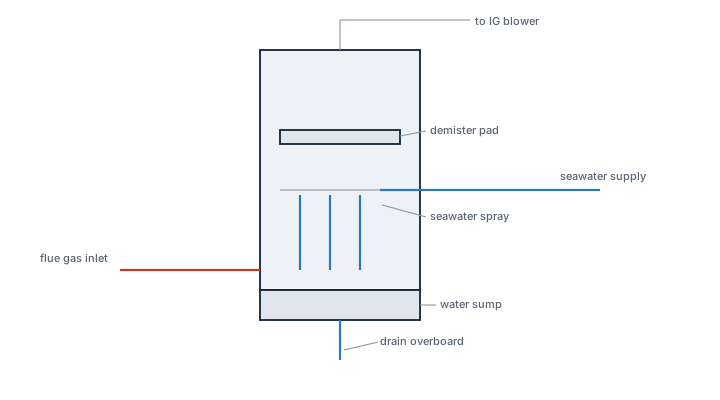
Legend
- to IG blower
- demister pad
- seawater supply
- seawater spray
- flue gas inlet
- water sump
- drain overboard
Main components
Scrubber tower and spray system
A packed or spray-tower vessel where sea water is sprayed counter-current to the rising flue gas, typically dropping gas temperature to within a few degrees of the sea water temperature while washing out soot and dissolving sulphur dioxide. Spray nozzles and packing material are the main wear items, since they sit in a continuous stream of acidic, particulate-laden water.
Demister / dryer section
Mesh pad or vane-type demisters strip entrained water droplets from the gas before it reaches the blower and deck seal. Some systems add a separate drying stage to reduce moisture further, since a wet gas stream promotes corrosion all the way along the deck main to the tank.
Read the full guide
Effluent and drain system
Scrubber wash water, now acidic and carrying soot, is discharged overboard through a dedicated effluent line, subject to its own discharge criteria distinct from oily water separator effluent.
Regulations and class
The IG system as a whole, including the scrubber, falls under SOLAS Chapter II-2 requirements for inert gas on tankers, and IACS unified requirements set performance criteria for oxygen content and gas quality leaving the plant, typically requiring the system to reliably deliver gas with oxygen content at or below 5% by volume. Scrubber effluent discharge is addressed under MARPOL, and class surveys check the scrubber's ability to actually cool and clean the gas to specification, not just that the plant runs.
Typical faults
| Fault | Consequence |
|---|---|
| Scrubber spray nozzles blocked or worn from continuous acidic flow | Poor gas cooling and washing, letting hot, sulphur-laden gas through toward the deck seal |
| Demister pad fouled with soot and salt buildup | Wet gas carries over to the deck main, accelerating corrosion of piping and valves |
| Sea water supply pump undersized or fouled strainer restricting flow | Inadequate cooling raises delivered gas temperature above design limits |
| Effluent line partially blocked with accumulated soot sludge | Back-pressure in the scrubber disturbs the water level and gas flow through the tower |
Typical wear and inspection points
- Spray nozzle condition and coverage pattern, checked visually whenever the tower is opened.
- Demister pad cleanliness and pressure drop across the section, an early indicator of fouling before gas quality actually suffers.
- Internal coating and corrosion condition of the scrubber shell itself, since it runs permanently wet with acidic water.
- Level control and drain valve operation, since a flooded or dry scrubber both disrupt gas flow to the deck seal.
What to look for in a supplier
- Materials of construction suited to continuous acidic sea water service — coating specification matters as much as vessel size.
- Spare nozzle and demister pad kits sized to the specific tower model rather than a generic fit.
- Documentation supporting the gas quality performance the system is expected to deliver, for class renewal.
Track the pressure drop across the demister over time rather than waiting for a gas quality alarm — a rising differential is the earliest warning that fouling is building up before it starts letting wet gas through to the deck seal.
Models in this type.
The best-documented model of each manufacturer first, then the next — 6 of 6 models in IG Scrubber/Dryer. Every row links to full specifications, documents and service notes.
Manufacturers.
All 5 manufacturers with models of IG Scrubber/Dryer. Names with a manufacturer page open it; the others open a search across the full library.
All manufacturers in the libraryAlso in Inert Gas Systems.
The other equipment types in this category.
Write to us about this model — the answer comes by e-mail.
Name the make and the model and what the job is: a spare, a service call, a second opinion on a data sheet. We answer by e-mail.
No details at hand? A photo of the rating plate or the part is enough — simply attach it to the request.
Questions that come up with this equipment.
Is IG Scrubber/Dryer data free?
Yes. Every model page, every guide and every datasheet for this type is readable without an account. An account adds saved searches and requests, nothing is taken away.
My model is missing — what now?
Send us the nameplate. We identify it by hand, add it to the library, and if you need a part or a service, the request is already on our desk.
Can you source a IG Scrubber/Dryer part?
Yes. Tell us the manufacturer, the model and what you need — a person reads every request and replies by e-mail.