Emergency Light
Emergency lighting has to work for a fixed duration on battery power alone after the main supply fails, and SOLAS treats the escape route lighting and the machinery space lighting as two different, separately tested requirements.
What to check on an Emergency Light.
2 models from Daniamant in Emergency Light. Below: the full model list.
What makes this type
Emergency lights are the fittings that switch to battery power the instant the main and emergency generators both fail to supply them, covering the short but critical gap during blackout and generator start-up, and continuing to run for a defined period afterwards. They are distinct from the ship's transitional emergency lighting, which runs off the emergency generator, and from the low-location lighting strips along escape routes, which are a separate self-contained system built for visibility through smoke rather than general illumination.
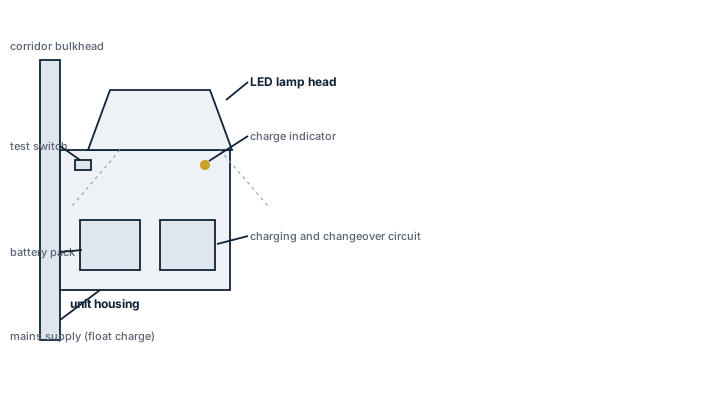
The defining feature is self-sufficiency: each fitting, or a small cluster fed from one battery unit, has to keep working with no connection to any ship supply at all, because the scenario it protects against is total loss of both main and emergency power at once.
Main components
Light fitting
Usually LED now rather than the older fluorescent or incandescent tubes, chosen for lower current draw against a fixed battery capacity and longer service life in a vibrating, humid engine room environment.
Read the full guide
Battery and charger
Either a sealed lead-acid or nickel-cadmium battery built into the fitting itself, or a central battery bank feeding several fittings through dedicated cabling. The charger keeps the battery topped up during normal operation and switches the load to battery automatically on loss of supply.
Changeover circuit
A relay or electronic sensing circuit that detects loss of the incoming AC supply and transfers the fitting to battery within a fraction of a second, so there is no perceptible blackout gap for the crew.
Self-test module
Many modern fittings include a built-in test cycle that periodically discharges the battery under load and reports a fault via an indicator LED, replacing what used to be a manual monthly test with a torch and stopwatch.
Selection and sizing
The relevant figures are duration and lux level, not wattage. SOLAS requires transitional source lighting for at least 30 minutes and, where fitted with self-contained batteries, further stand-by lighting to maintain a minimum illumination level, commonly around 5 lux at deck level, in machinery spaces, control stations, muster and embarkation areas for a longer period, typically half an hour to three hours depending on the space and the flag administration's interpretation. Fittings are selected by battery duration first, then by lumen output matched to the compartment size, not the other way round.
Regulations and class
- SOLAS Chapter II-1, Regulation 42/43, sets the emergency source of electrical power and the associated lighting requirements.
- SOLAS Chapter II-2 covers the low-location and escape route lighting requirements separately from general emergency lighting.
- Class rules require documented monthly function tests and an annual full-duration discharge test for battery-backed fittings.
- Battery replacement intervals are usually set by the manufacturer, commonly three to five years for sealed lead-acid, and verified at survey rather than by a fixed statutory number.
Typical faults
| Fault | Consequence |
|---|---|
| Battery capacity fades below rated duration with age | Fitting goes dark before the required period elapses in a real blackout |
| Charger circuit fails silently while mains is present | Battery sits uncharged and fails completely the first time it is called on |
| Sealed battery swells or leaks in a hot engine room | Fitting fails and can damage surrounding cabling or paintwork |
| Self-test LED ignored during rounds | Fault fittings accumulate unnoticed until the annual survey |
What to look for in a supplier
- Marine type approval for the fitting, not a shore-side emergency light adapted for a ship.
- Stated battery duration and lux output matched to actual compartment sizes and layout.
- Availability of replacement battery packs matching the fitting years after initial purchase.
- A built-in self-test function if the fleet wants to move away from manual monthly checks.
Log every self-test fault indicator the day it appears rather than waiting for the annual discharge test; a fitting that has silently lost its charger connection looks identical to a healthy one until the lights actually go out.
Models in this type.
The best-documented model of each manufacturer first, then the next — 2 of 2 models in Emergency Light. Every row links to full specifications, documents and service notes.
Manufacturers.
All 15 manufacturers with models of Emergency Light. Names with a manufacturer page open it; the others open a search across the full library.
All manufacturersAlso in Lighting.
The other equipment types in this category.
One request. A person reads it and replies by e-mail.
Tell us the manufacturer, the model and what you need — a part, a service call, a second opinion. A person reads every request and replies by e-mail.
No details at hand? A photo of the rating plate or the part is enough — simply attach it to the request.
Three things people ask first.
Is Emergency Light data free?
Yes. Every model page, every guide and every datasheet for this type is readable without an account. An account adds saved searches and requests, nothing is taken away.
My model is missing — what now?
Send us the nameplate. We identify it by hand, add it to the library, and if you need a part or a service, the request is already on our desk.
Can you source a Emergency Light part?
Yes. Tell us the manufacturer, the model and what you need — a person reads every request and replies by e-mail.