5S60ME-GA10
The MAN 5S60ME-GA10 is a high‑power, low‑speed two‑stroke main engine delivering 28.3 MW at 105 rpm, notable for its multi‑fuel capability including ethane and LNG.
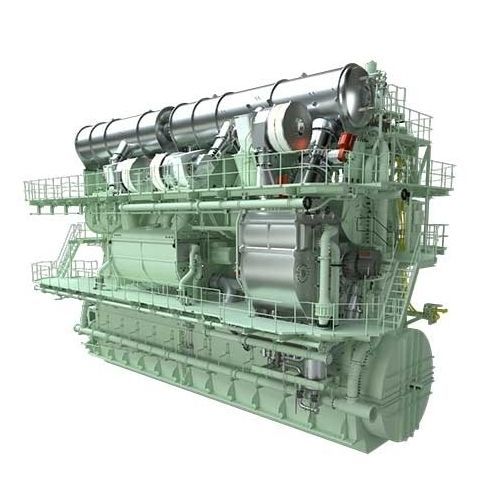
Engine Specifications
Inspector Detail
✓ verified
▸
Designation decoded
5 stands for 5 cylinders, S for Super-Long-Stroke, 60 for 600 mm bore, ME-GA for electronically controlled two-stroke engine with ethane-capable gas injection, 10 for Mark 10.
Background
The S60ME-GA10 is a dual-fuel engine of the ME-GA series from MAN Energy Solutions, specifically developed for operation with ethane and other VOC gases (Volatile Organic Compounds). ME-GA stands for gas injection with ethane capability. Primary use in VLEC (Very Large Ethane Carriers) and VLGC (Very Large Gas Carriers), which use their cargo as fuel (boil-off gas). Mark 10 as the current generation with fully electronic control (injection and exhaust valve hydraulic/electronic).
Calculated metrics
Inspector checklist
- Cylinder liners: S/B 4.0 — significant side forces, gas operation tends toward lower liner temperatures than HFO — watch for cold corrosion wear risk
- Piston rings: Gas operation has different lubrication conditions — no ash film as with HFO, piston ring wear may proceed differently
- Cylinder lubrication: Adjust cylinder oil BN in gas operation — gas produces no sulfuric acid, too high a BN causes damage
- Crosshead bearing: Temperature and oil supply
- Stuffing box: Cleaner in gas operation than HFO — still check drainage
- Piston rod: Run-out and surface condition
- High-pressure gas injection valves: Check tightness and function — gas leakage is safety-critical
- Gas supply system: Monitor pressure, temperature and flow of the ethane
- FGSS (Fuel Gas Supply System): Compressor condition, evaporator, safety valves
- Gas detectors in the engine room: Function and calibration — ethane is heavier than air and can collect in low points
- ME control system: Fully electronic control (FIVA valves) — sensors, hydraulic unit (HPS/HCU), EICU
- Gas/diesel changeover: Test automatic and manual switchover procedure
- Safety logic: Gas trip functions, shutdown valves, ventilation sequence
- Scavenge air box: Cleaner in gas operation — possible oil ingress when switching to diesel
- Turbocharger: Gas operation produces less fouling — adjust cleaning intervals
- Exhaust temperature: Typically lower in gas operation than diesel
Logbook reference values
| Parameter | Expected | Deviation means |
|---|---|---|
| Exhaust temperature by cylinder | 320–380 °C at MCR (gas operation); 350–420 °C (diesel operation) | Spread >15 °C → check gas injection or pilot injection |
| Scavenge air pressure | 2.5–3.2 bar | Drop → TC/cooler |
| Pmax | ±2 bar cylinder balance | Deviation → check gas injection and pilot timing |
| Gas injection pressure | 250–300 bar (high-pressure gas injection) | Deviation → check gas compressor or injection valve |
| Pilot fuel quantity | Depends on load profile, typically 3-8% of total energy | Too high → inefficient gas injection; too low → ignition problems |
Common Failure Modes
Expert tips
- 💡 ME-GA in ethane operation: Ethane is heavier than air (density ~1.28 g/L at 15°C) — gas detectors near the floor of the engine room must be especially reliable
- 💡 In gas operation: Switch cylinder lubrication to BN25 or lower — the sulfur-free gas produces no acid, too high a BN leads to deposits
- 💡 Dual-fuel changeover gas→diesel: Avoid thermal shock to liner and piston — slow transition over several minutes, not an abrupt switch
Related components
Classification & regulatory
ME-GA is designed for IMO Tier II and Tier III with EGR/SCR. Observe the IGC Code (International Gas Carrier Code) for gas carriers. SOLAS requirements for gas operation (MSC.391(95)). MARPOL Annex VI — gas operation reduces SOx emissions to near zero and CO2 by approx. 20% compared to HFO.
Reference content for inspector orientation. Always verify against manufacturer's manual, latest service letters and class society requirements.
Other Cylinder Configurations 15
Components & Design
Component data being added…
Technical Data
🤖 Ask about this model
One free question — answered like a marine engineer. No account needed.
Suppliers & Spare Parts
Direct links to manufacturer, datasheet, spare-parts portal and dealers — request access below.
📄 Request sourcing links & documentsCases, daily reports, timesheets and AI troubleshooting in the OceanSphere Marine app — free for 14 days.
Start free trial →Find manufacturers, repair shops and spare-part dealers in the Maritime Network — our global company directory.
Maritime Network →