What to check on a Main Engine 2-Stroke.
A two-stroke main engine completes a full working cycle — intake, compression, power, exhaust — in a single crankshaft revolution, against the four revolutions a medium-speed four-stroke needs for the same cycle. That single fact drives almost everything else about the type: one power stroke per cylinder per revolution at low rpm produces enormous torque directly at the crankshaft, so the engine can be coupled straight to a fixed-pitch propeller without a reduction gearbox. There is no camshaft-driven inlet valve either; scavenge air enters through ports uncovered by the piston…
What makes a two-stroke main engine different
A two-stroke main engine completes a full working cycle — intake, compression, power, exhaust — in a single crankshaft revolution, against the four revolutions a medium-speed four-stroke needs for the same cycle. That single fact drives almost everything else about the type: one power stroke per cylinder per revolution at low rpm produces enormous torque directly at the crankshaft, so the engine can be coupled straight to a fixed-pitch propeller without a reduction gearbox. There is no camshaft-driven inlet valve either; scavenge air enters through ports uncovered by the piston near bottom dead centre, and only the exhaust side uses a mechanically or hydraulically actuated valve at the cylinder head. The crosshead design, unique among large diesels of this size, keeps the piston running vertically and takes the side thrust of the connecting rod on a separate crosshead bearing, so the cylinder liner only ever sees axial load from the piston.
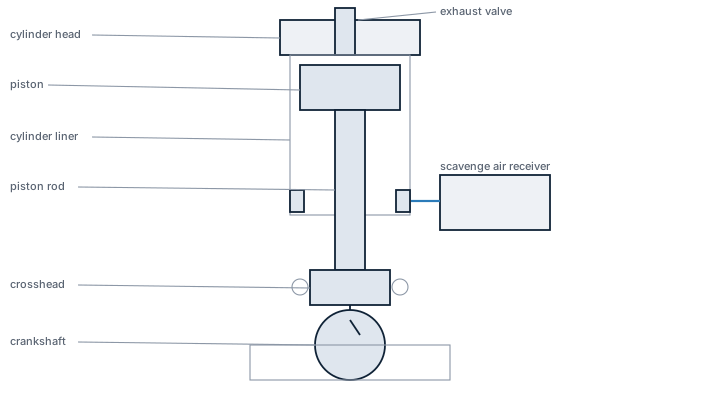
Main components
Crosshead and piston assembly
The piston, piston rod and crosshead are separate parts joined below the stuffing box, which keeps combustion gas and crankcase oil in two physically separated spaces. The piston crown takes the full thermal load of combustion and is oil-cooled from underneath; piston rings are chrome or ceramic-coated to survive tens of thousands of running hours between overhauls.
Uniflow scavenging
Scavenge air enters low on the liner through ports arranged around the circumference and exits through a single exhaust valve at the top, so flow moves in one direction (uniflow) rather than looping back on itself as in older loop- or cross-scavenged designs. This gives cleaner scavenging at low rpm and is now close to universal on new low-speed engines.
Exhaust valve and camshaft, or camshaft-free electronic control
Older tonnage uses a chain- or gear-driven camshaft to time fuel injection and the exhaust valve mechanically. Electronically controlled engines (ME from MAN Energy Solutions, X-DF and similar from WinGD) replace the camshaft with hydraulic or servo actuators driven by a control system, which allows the injection and exhaust timing to be varied with load and even shut down individual cylinders for slow steaming.
Turbocharger and scavenge air system
One or more turbochargers, usually constant-pressure rather than pulse type at this size, supply scavenge air through an air cooler. Auxiliary blowers cover low-load and starting conditions when exhaust energy is too low to drive the turbocharger alone.
Selecting and sizing a two-stroke engine
The engine is chosen to match the ship's design speed and propeller characteristics, not picked from a generic power table. The relevant figures are:
- Maximum continuous rating (MCR) in kW and the corresponding rpm, which fixes propeller diameter and pitch
- Number of cylinders and bore, which set the power step available within a given engine family
- Mean effective pressure and specific fuel consumption at the chosen load point, usually 70–85% of MCR for the economic operating point
- Fuel flexibility — conventional HFO/MGO, or dual-fuel variants burning LNG, methanol or LPG as the primary fuel with liquid pilot or backup fuel
Regulations and class
Two-stroke main engines fall under IMO NOx Tier III when built for operation in an Emission Control Area, which in practice means either exhaust gas recirculation, selective catalytic reduction, or a dual-fuel gas mode certified to meet the limit. MARPOL Annex VI also governs SOx through fuel sulphur limits or scrubber fitment. Classification societies require a type approval for the engine design and periodic surveys of crankshaft deflections, bearing clearances and crankcase explosion relief devices under their machinery survey scheme; continuous machinery survey arrangements are common on this engine type given its size and running hours.
Typical faults
| Fault | Cause | Consequence |
|---|---|---|
| Scavenge fire | Oil accumulation in the scavenge space igniting, often from piston ring blow-by or dirty scavenge ports | Local damage to piston skirt and liner, risk of fire spreading if not caught early |
| Crosshead bearing wipe | Loss of lubrication or contaminated system oil | Metal-to-metal contact, potential connecting rod damage, unplanned dry-dock repair |
| Exhaust valve burning | Poor valve seating, fuel quality issues, or actuator timing drift on electronic engines | Loss of compression, increased fuel consumption, cylinder unit shutdown |
| Turbocharger surge | Fouled turbine or compressor side, or sudden load changes | Vibration, reduced scavenge pressure, risk of turbocharger damage |
What to look for in a supplier
- Genuine parts traceable to the engine designer's licence, not just dimensionally matching copies
- Documented material certificates for crankshafts, connecting rods and cylinder covers
- Service support and spare parts availability in the trading area the ship actually operates in
- Experience with the specific engine family and control system version, particularly for electronically controlled types
A slow, gradual rise in exhaust temperature spread across cylinders is usually worth investigating before it becomes a scavenge fire — by the time the alarm sounds, the oil has often already been smouldering in the scavenge space for a watch or two.