What to check on a Battery Management System (BMS).
A battery pack without a BMS is just a stack of cells wired together, trusting that every cell charges and discharges evenly and stays within its safe temperature and voltage window for its whole life. In practice cells never age identically, and a marine battery and UPS installation - whether lead-acid, lithium iron phosphate, or another chemistry - needs active supervision to stay safe and to reach its rated cycle life. The BMS measures individual cell or module voltage and temperature, balances charge across cells, and disconnects the pack, a…
What a BMS actually does
A battery pack without a BMS is just a stack of cells wired together, trusting that every cell charges and discharges evenly and stays within its safe temperature and voltage window for its whole life. In practice cells never age identically, and a marine battery and UPS installation - whether lead-acid, lithium iron phosphate, or another chemistry - needs active supervision to stay safe and to reach its rated cycle life. The BMS measures individual cell or module voltage and temperature, balances charge across cells, and disconnects the pack, a string, or a single faulty module before a fault propagates into a fire.
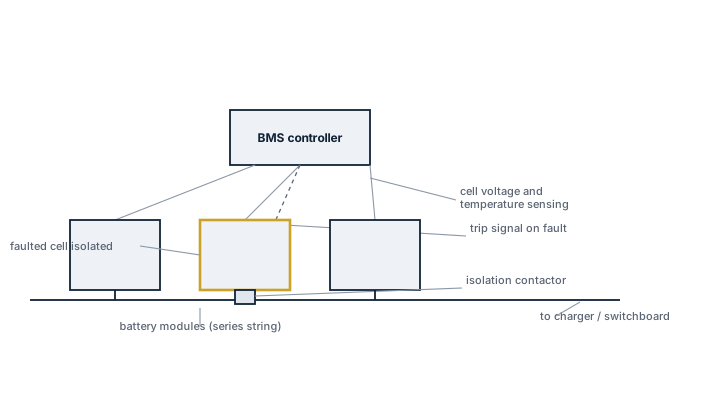
Main components
- Cell/module monitoring boards - measure voltage and temperature at the individual cell or module level and report to the central controller.
- Central BMS controller - aggregates monitoring data, runs balancing logic, and issues disconnect commands to the contactors.
- Contactors and fuses - the physical disconnect devices the BMS commands; these carry their own independent rating and are not optional even with a healthy BMS.
- Balancing circuit - passive resistive bleed or active charge transfer between cells, keeping the pack's weakest cell from setting the usable capacity for the whole string.
- Communication interface - CAN bus or similar link to the vessel's power management system, so the BMS can request load shedding rather than simply tripping offline.
Selection and sizing
A BMS is chosen to match the battery chemistry and pack architecture, not bought as a generic add-on:
| Factor | Why it matters |
|---|---|
| Chemistry match | Lithium and lead-acid have different safe voltage/temperature windows; a mismatched BMS will not protect correctly |
| Cell count and topology | Series/parallel arrangement determines how many monitoring channels are needed |
| Balancing current | Passive balancing is cheaper but slower; active balancing recovers more usable capacity from an ageing pack |
| Communication protocol | Must match the vessel's power management system, not just the battery installer's default |
Regulations and class requirements
Class societies apply specific rules to lithium battery installations covering the BMS, ventilation, fire detection, and containment around the battery room or enclosure, generally requiring the BMS to have an independent safety function separate from normal operational control, and to fail safe by disconnecting on loss of communication or sensor failure. IACS members have aligned much of this under battery-specific class notations; SOLAS Ch. II-2 fire safety provisions apply to the space housing the battery installation as they would to any other fire risk.
Typical faults
- Sensor drift on ageing monitoring boards - a cell reads warmer or cooler than it actually is, skewing balancing decisions over months before it is caught.
- Contactor welding after repeated fault trips - a contactor that has interrupted fault current several times can weld closed, defeating the next disconnect command.
- Firmware left at commissioning defaults - protection thresholds not tuned to the actual installed chemistry and pack size.
- Communication loss treated as a nuisance alarm - a BMS that has lost its link to the power management system should be treated as a safety event, not silenced.
What to look for in a supplier
- Type approval for the specific battery chemistry, not a generic BMS claim.
- Documented fail-safe behaviour on sensor or communication loss.
- Firmware update and support pathway, since BMS logic gets refined as chemistries mature.
- Independent safety disconnect path that does not rely solely on the same controller running normal balancing.
Never silence a BMS communication alarm as a nuisance fault - a BMS that has stopped talking to the power management system has also stopped being able to ask for load shedding before a real fault develops.