What to check on a Marine UPS.
A marine uninterruptible power supply keeps designated circuits alive through the interval between loss of main power and the emergency generator coming online and taking load, a gap that typically runs 30 to 45 seconds under SOLAS requirements but can run longer if the generator fails to start on the first attempt. This is the UPS's entire purpose: it is not sized to run equipment for hours, it is sized to cover that bridging interval without a voltage dip or restart cycle on the connected equipment. Circuits without UPS backup…
What defines a marine UPS
A marine uninterruptible power supply keeps designated circuits alive through the interval between loss of main power and the emergency generator coming online and taking load, a gap that typically runs 30 to 45 seconds under SOLAS requirements but can run longer if the generator fails to start on the first attempt. This is the UPS's entire purpose: it is not sized to run equipment for hours, it is sized to cover that bridging interval without a voltage dip or restart cycle on the connected equipment. Circuits without UPS backup simply go dark and restart once the emergency generator picks up; navigation displays, radio equipment, and alarm systems cannot tolerate that restart cycle at the exact moment power is lost, which is why they sit behind a UPS rather than directly on the emergency switchboard.
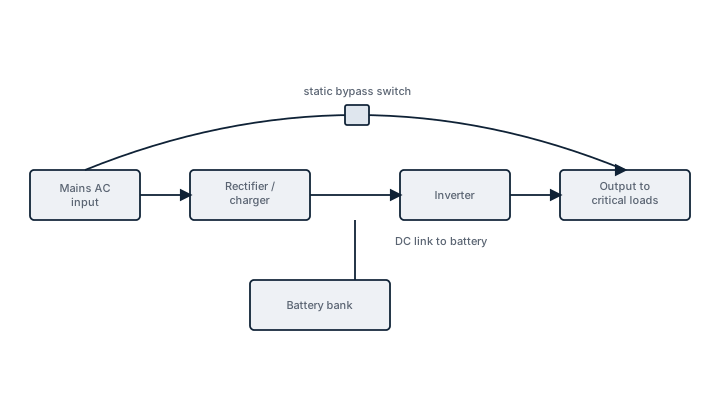
Main components
Rectifier/charger
Converts incoming AC to DC, both to charge the battery bank and to feed the inverter directly during normal operation, so the battery is topped up continuously rather than cycled on every mains fluctuation.
Battery bank
Sealed lead-acid (VRLA) batteries are standard aboard for their low maintenance and tolerance of vibration; lithium battery UPS installations are appearing but require additional fire safety provisions under current class guidance.
Inverter
Converts the DC battery output back to clean AC for the connected load, and on double-conversion designs runs continuously so there is genuinely zero transfer time when mains power drops.
Static bypass switch
Routes load directly from mains, bypassing the battery and inverter entirely, if the UPS itself develops a fault - this prevents the UPS becoming a single point of failure for the circuits it protects.
Battery monitoring
Tracks battery health, internal resistance, and remaining backup time, since a UPS with a dead or degraded battery bank looks fully functional until the moment mains power actually fails.
Selection and sizing
- Load rating in kVA, calculated from the connected equipment's actual power draw with margin for inrush current on start-up.
- Backup runtime required, set by the vessel's emergency generator start time plus a safety margin, not by an arbitrary "several hours" figure.
- Double-conversion versus line-interactive topology - double-conversion gives zero transfer time and is standard for navigation and GMDSS loads.
- Battery type and its ambient temperature tolerance, since engine room or deck-adjacent installations run hotter than a dedicated equipment room.
Regulations and class
SOLAS Chapter II-1 requires transitional power sources for emergency lighting and essential navigation and communication equipment during the gap before the emergency generator takes load, and UPS units fulfilling this role fall under class society approval for the associated equipment. IACS UR and individual class rules specify battery capacity testing intervals and require documented load testing to confirm the UPS actually delivers its rated backup time, not just that it powers on. Fire safety provisions apply to the battery compartment, with additional requirements where lithium battery chemistries are used.
Typical faults
| Fault | Cause | Consequence |
|---|---|---|
| Battery bank fails under real load | Battery ageing undetected because the UPS is never load-tested to failure | Connected equipment loses power exactly when mains power is lost |
| Overheating in the battery compartment | Poor ventilation or installation near a heat source | Accelerated battery ageing and increased fire risk |
| Static bypass switch fails to transfer | Contactor wear or control fault undetected between tests | UPS fault takes down the protected load instead of bypassing it |
| False low-battery alarms | Monitoring sensor drift or a loose connection | Crew desensitised to alarms, real failures potentially ignored |
What to look for in a supplier
- Documented backup runtime under full rated load, verified by an actual load test, not a calculated estimate.
- Battery replacement and monitoring support matched to the vessel's trading pattern and dry-docking schedule.
- Class approval for the specific equipment the UPS is intended to protect, since navigation, GMDSS, and general power UPS units can carry different requirements.
- Clear guidance on ambient temperature limits for the installation location proposed aboard.
Schedule an actual load test to the point of battery cutoff at least annually - a UPS that has never been tested under real load is an assumption, not a working piece of safety equipment.