What to check on a Marine Energy Storage System.
A marine Energy Storage System (ESS) is a battery installation built around lithium-ion cells, packaged into modules and racks with its own battery management system (BMS), and integrated into the vessel's power management system so it can charge from and discharge into the switchboard under automatic control. It differs from a UPS in duty: a UPS exists to bridge a short gap on a failure of mains power to critical loads, sized in minutes; a marine ESS is a working part of the power plant, sized in kilowatt-hours to carry…
What defines a marine energy storage system
A marine Energy Storage System (ESS) is a battery installation built around lithium-ion cells, packaged into modules and racks with its own battery management system (BMS), and integrated into the vessel's power management system so it can charge from and discharge into the switchboard under automatic control. It differs from a UPS in duty: a UPS exists to bridge a short gap on a failure of mains power to critical loads, sized in minutes; a marine ESS is a working part of the power plant, sized in kilowatt-hours to carry propulsion or hotel load for minutes to hours, to smooth or "shave" the peaks that would otherwise force a diesel generator to run at poor part load, or to allow fully electric manoeuvring and port stays with generators shut down.
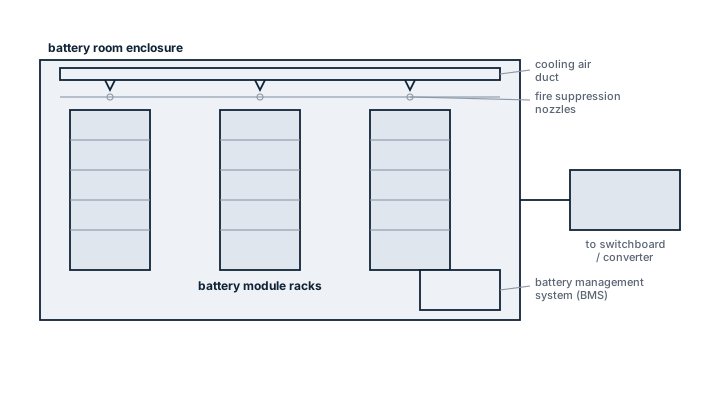
Main components
Battery modules and racks
Cells are grouped into modules, modules into racks, each rack fitted with its own fusing, contactors and temperature sensors. Marine lithium-ion chemistries in service include NMC (higher energy density, more sensitive to abuse) and LFP (lower energy density, more tolerant of overcharge and thermal stress); the choice affects both footprint and the fire-fighting arrangement required.
Battery Management System (BMS)
The BMS monitors cell voltage, temperature and current at module level, balances cells, and trips the rack contactors on any parameter outside its set limits. It is the primary protection layer and reports state of charge and state of health to the vessel's power management system.
Power conversion (DC/AC converters)
Bidirectional converters interface the battery's DC bus with the ship's AC switchboard, controlling charge and discharge rate and following commands from the power management system for peak shaving, spinning-reserve replacement or zero-emission mode.
Thermal management and fire protection
Battery rooms are fitted with dedicated ventilation, often forced air or a liquid-cooled rack design, gas detection for battery off-gassing, and a fixed fire-extinguishing system suited to lithium-ion fires, since a conventional CO2 system cannot stop a cell going into thermal runaway.
Selection and sizing
Sizing starts from the duty the battery must perform: pure peak shaving needs high power for short bursts and modest energy capacity; zero-emission port stays or fully electric short-sea transits need much higher usable energy capacity at correspondingly higher capital cost and weight. Key figures are usable capacity in kWh, continuous and peak discharge power in kW, cycle life at the intended depth of discharge, and round-trip efficiency. Installed location matters as much as electrical rating: battery rooms need to be positioned for straightforward ventilation trunking and for fire boundaries that do not compromise adjacent escape routes.
| Parameter | Relevance |
|---|---|
| Usable energy (kWh) | Determines duration of zero-emission or peak-shaving operation |
| Continuous/peak power (kW) | Sets how much diesel-generator load can be offset |
| Cycle life at target DoD | Drives expected years in service before capacity fade forces replacement |
| Chemistry (NMC vs LFP) | Trade-off between energy density and thermal stability |
Regulations and class
All major class societies have dedicated rules for battery-powered and hybrid propulsion, typically requiring a battery power or battery safety class notation, a hazard identification study, segregation of the battery room from accommodation and machinery spaces by A-class boundaries, dedicated ventilation and gas detection, and a fixed extinguishing system suited to the installed chemistry. IMO's interim guidelines for lithium-ion battery installations on ships and IACS unified requirements are commonly referenced in the approved arrangement. Survey includes periodic testing of the BMS protection functions and of the fire and gas detection systems on the same cycle as the vessel's other safety systems.
Typical faults
- Cell imbalance — one or more cells drift out of balance with the rest of the rack, reducing usable capacity and, if undetected, driving a cell toward an overvoltage trip.
- BMS communication fault — loss of data between rack BMS and the power management system forces the rack offline as a protective default, cutting available power exactly when it may be needed.
- Cooling system failure — elevated rack temperature accelerates capacity fade and, in a worst case, initiates thermal runaway in a cell.
- Capacity fade beyond specification — normal ageing reduces usable kWh over years of cycling; when it falls below the duty requirement the rack, not just a cell, needs replacement.
What to look for in a supplier
- Type approval for the specific battery chemistry and rack design from the class society the vessel is built to.
- A documented thermal runaway propagation test for the rack and enclosure, not only cell-level test data.
- Remote monitoring and diagnostic support for the BMS, since early detection of cell imbalance is largely a software function.
- A clear end-of-life and disposal or second-life pathway for the battery modules, agreed before installation.
Treat any BMS-forced rack shutdown as a report, not a nuisance trip: it is the system telling you a cell went outside its safe window, and resetting it without checking the underlying cause is how a battery room fire starts.