What to check on a Marine UPS System.
1 models from victronenergy in Marine UPS System. Below: the full model list.
What distinguishes this UPS from a shore installation
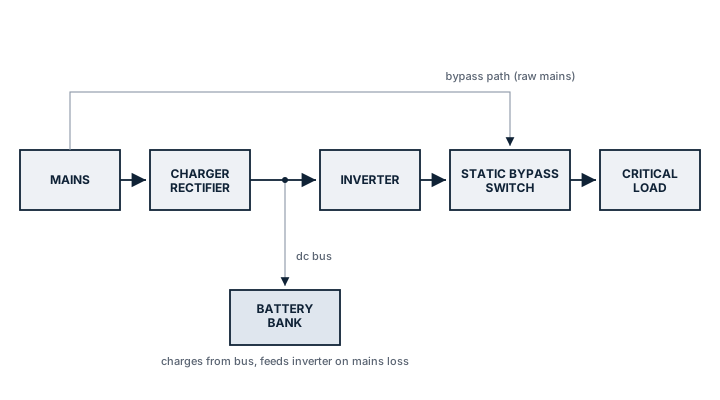
A marine UPS is built to hold navigation, radio, alarm and automation circuits on line through the blackout gap before the emergency generator starts and takes load, typically measured in tens of seconds to a few minutes, not the extended runtimes common ashore. It must tolerate the ship's own electrical environment: voltage transients from large motor starts, higher ambient temperatures in machinery spaces, vibration, and salt-laden air. Static UPS units used on board are almost always double-conversion, running the load continuously through the inverter so there is no transfer time when mains fails, which matters for equipment that cannot tolerate even a short interruption.
Read the full guide
Main components
Rectifier/charger
Converts incoming AC to DC to power the inverter and float-charge the battery simultaneously.
Battery bank
Vented lead-acid batteries need a dedicated, ventilated battery room due to hydrogen gassing on charge; valve-regulated lead-acid (VRLA) batteries are sealed and tolerate a cabinet installation but have a shorter service life at high temperature; lithium battery UPS units are more compact and tolerant of partial charge cycling but need a battery management system and different fire risk considerations.
Inverter
Converts the battery DC back to clean AC for the protected bus, continuously in double-conversion designs.
Static bypass switch
Transfers the load directly to raw mains, without going through the inverter, if the UPS itself faults, so a UPS failure does not black out its own load.
Selection and sizing
- Load in kVA and its power factor, sized with margin for future additions rather than the exact present load.
- Required autonomy time, set by how long the emergency generator realistically takes to start, synchronise and pick up load on that particular vessel.
- Battery chemistry versus available space and ventilation - a VLA bank needs a certified battery room, a VRLA or lithium bank does not.
- Ambient temperature at the installation location, since lead-acid capacity and life both fall sharply above around 25 to 30 degrees C.
Regulations and class
SOLAS Chapter II-1 sets requirements for emergency power and for the transitional source of emergency power that a UPS often serves on vessels required to carry one. Class rules require battery rooms for vented lead-acid batteries to have independent ventilation to prevent hydrogen accumulation, and require periodic testing of battery capacity and of automatic changeover to confirm the UPS still delivers its rated autonomy, not just that it powers up.
Typical faults
| Fault | Cause | Consequence |
|---|---|---|
| Autonomy shorter than rated | Aged or sulfated battery cells, one weak cell dragging the string | Load drops before the emergency generator picks up |
| UPS runs on battery with mains present | Faulty rectifier/charger, blown input fuse | Battery discharges continuously; no reserve left when a real mains loss occurs |
| Failure to transfer to bypass | Static switch fault, wrong bypass settings after a load change | Protected bus blacks out instead of failing safe to raw mains |
| Hydrogen alarm in battery room | Ventilation fan failure or blocked ducting on a VLA installation | Explosion risk if charging continues unventilated |
What to look for in a supplier
- Battery chemistry and expected service life stated for the specific ambient temperature on board, not a datasheet figure at 20 degrees C.
- Type approval for marine use covering vibration, temperature and EMC, not an industrial-only certification.
- Battery monitoring capability - individual cell voltage or impedance trending catches a weak cell before it takes the whole string down.
- Physical footprint and weight compatible with the intended battery room or cabinet space.
Test autonomy by actually running the UPS on battery under real load for a timed interval at the survey, not just by checking the charger's float voltage - a battery bank can look fine on a voltmeter and still fail under load.