What to check on a Lead-Acid Battery Bank.
9 models from victronenergy in Lead-Acid Battery Bank. Below: the full model list.
What sets a lead-acid bank apart from other chemistries
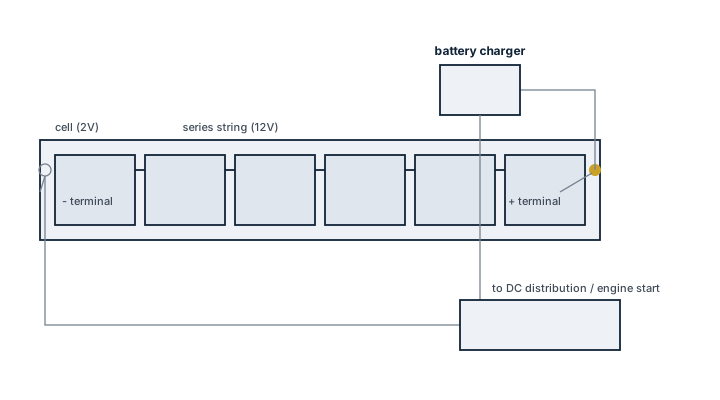
A lead-acid bank works on the same reversible reaction as a car battery, scaled up into individual 2V cells that are strung in series to reach the ship's DC bus voltage, typically 24V for starting and control circuits or up to 220V for larger emergency banks. Compared with nickel-cadmium or lithium iron phosphate alternatives, lead-acid tolerates being held on permanent float charge without active cell balancing, self-discharges slowly enough for infrequent standby duty, and its failure mode is gradual capacity loss rather than sudden thermal runaway. The trade-off is weight, a shorter cycle life under deep discharge, and the need for periodic electrolyte maintenance on flooded types.
Read the full guide
Main components
Cells and plates
Each cell holds positive and negative lead plates separated by microporous separators, immersed in dilute sulphuric acid. Flooded cells expose the electrolyte for topping up with distilled water; VRLA (gel or AGM) cells hold the electrolyte immobilised and are sealed except for a pressure relief valve, trading maintenance access for a lower risk of acid spill and no requirement for a dedicated acid-resistant space.
Battery box and ventilation
Charging releases hydrogen, so the box and the compartment it sits in need forced or natural ventilation sized to keep hydrogen concentration well under the lower explosive limit. Class rules typically require the battery locker to be gas-tight from other spaces, with ventilation trunking leading directly outside and no ignition sources such as switches or fittings inside the locker itself.
Charger and distribution
A three-stage charger (bulk, absorption, float) keeps the bank topped up without boiling off electrolyte. Emergency banks feed their loads through a dedicated distribution board with fusing sized to the cell manufacturer's short-circuit current, since a shorted lead-acid string can deliver several thousand amps for a brief period.
Selection and sizing
Sizing starts from the connected load in amp-hours over the required autonomy period, then derates for the minimum expected temperature (capacity drops noticeably below 0°C) and for the ageing margin the operator wants at replacement time.
- Autonomy required by class for navigation lights, alarms and radio: commonly 6 to 36 hours depending on ship type and equipment.
- Ampere-hour capacity at the C10 or C20 discharge rate quoted by the manufacturer, not the higher-rate figure.
- Float voltage and temperature compensation range of the charger, matched to the cell chemistry.
- Physical footprint and weight, since a fully sized bank for a large emergency load can run to several hundred kilograms.
Regulations and class requirements
SOLAS Ch. II-1 sets the autonomy required for the emergency source of electrical power on the ship types it covers, and class societies specify the ventilation, containment and fusing arrangements for the battery locker in their rules for electrical installations. Periodic survey typically includes a capacity or load test, inspection of terminal corrosion, and verification that ventilation trunking is clear and that no unapproved equipment has been added to the locker.
Typical faults
| Fault | Cause | Consequence |
|---|---|---|
| Sulphation of plates | Prolonged storage at low state of charge, or undercharging | Permanent capacity loss, bank fails autonomy test |
| Electrolyte loss | Overcharging boils off water on flooded cells, missed topping-up | Plate exposure, accelerated corrosion, reduced life |
| Terminal corrosion | Acid mist reacting with connectors, poor ventilation | High resistance connections, voltage drop under load, fire risk |
| Thermal runaway on VRLA | Charger fault holding voltage too high | Case swelling, venting, in extreme cases fire |
What to look for in a supplier
- Cell data sheets giving capacity at C10, C20 and C100 rates so autonomy calculations are not based on optimistic figures.
- Certification matching the flag and class requirements for the vessel, not just a generic industrial rating.
- Availability of matched replacement cells years after the initial supply, since mixing old and new cells in one string shortens the life of the new ones.
- Clear guidance on charger compatibility, especially temperature compensation settings.
Never mix cells of different age or capacity in the same string; the weakest cell sets the usable capacity of the whole bank and ages the others prematurely through repeated deep discharge.