What to check on a Lithium-Ion Battery System (ESS).
1 models from MBC Marine in Lithium-Ion Battery System (ESS). Below: the full model list.
What Defines a Lithium-Ion Battery System
A marine lithium-ion energy storage system (ESS) is a battery installation built to supply or absorb significant electrical power over minutes to hours, not just the few seconds a conventional UPS bridges. It sits on the ship's power network through a power conversion system and is managed by a battery management system (BMS) that constantly tracks cell voltage, temperature and state of charge. What separates it from a simple UPS battery bank is scale and integration: an ESS can peak-shave generator load, provide spinning reserve for a diesel-electric plant, or in hybrid and full-electric vessels, drive propulsion directly, whereas a UPS exists purely to hold critical control and navigation circuits alive during a mains gap.
Read the full guide
Main components
Battery modules and racks
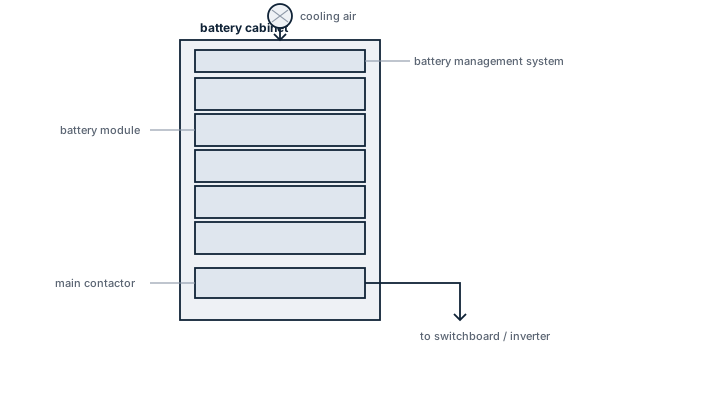
Lithium-ion cells, commonly NMC or LFP chemistry, grouped into modules and stacked in racks inside a dedicated, fire-rated battery room or containerised enclosure, each rack fitted with its own fusing and disconnect.
Battery management system
Monitors every cell or cell group for voltage, temperature and current, balances charge between cells, and can isolate a faulted module before a problem propagates through the rack.
Power conversion system
Bidirectional inverters that convert the battery's DC to the ship's AC network and back, matching voltage and frequency during charge and discharge.
Thermal management and fire suppression
Air or liquid cooling keeps cells within their operating temperature band, and a dedicated fire detection and suppression system, often with gas venting to prevent an explosive atmosphere, protects against thermal runaway.
Selection and sizing
- Usable energy capacity in kWh, sized for the intended duty: peak shaving, spinning reserve, zero-emission port stays, or propulsion
- Power rating in kW of the power conversion system, which can be the limiting factor even when energy capacity is ample
- Cell chemistry trade-off: LFP cells tolerate abuse and thermal stress better, NMC cells pack more energy into less volume and weight
- Cycle life and expected degradation curve over the system's design life, since capacity fades with charge cycles
- Space, weight and required fire-rated compartment volume, which on smaller vessels can be the deciding constraint
Class and regulatory requirements
Classification societies issue dedicated battery installation notations covering cell safety testing, battery room fire protection, ventilation to prevent gas accumulation, and segregation from other spaces. IMO interim guidelines for ships using lithium-ion battery technology, together with SOLAS Chapter II-2 fire safety provisions, shape the required fire detection, suppression and ventilation arrangements. Surveys include periodic BMS function checks, insulation resistance testing of the battery circuit, and inspection of the battery room's fire suppression and ventilation systems; class rules on many notations also require periodic capacity testing to confirm the system still meets its rated duty as it ages.
Typical faults
| Fault | Cause | Consequence |
|---|---|---|
| Thermal runaway | Cell damage, internal short circuit, or cooling system failure | Rapid heat and gas release, risk of fire propagating cell to cell |
| Cell imbalance | BMS balancing circuit fault or aged, mismatched cells | Reduced usable capacity, premature end-of-life on affected modules |
| Capacity fade | Normal cycling aging, accelerated by high temperature or deep discharge | System no longer meets its original duty, needs earlier module replacement |
| Ventilation or detection fault | Blocked vents, disabled gas detectors after maintenance | Undetected gas buildup, explosion risk in a thermal event |
What to look for in a supplier
- Cell-level and system-level type approval from the relevant classification society, not just component certification
- A documented thermal runaway propagation test for the specific rack design
- Remote monitoring and diagnostic support, since early cell degradation is easier for the maker's software to catch than a crew visual check
- Clear module replacement strategy and availability, since batteries are a wear item with a finite cycle life unlike most other electrical plant
Treat a single BMS module-isolation alarm as an event to log and investigate, not reset and forget; the BMS isolated that module because a cell parameter left its safe window, and the same trigger recurring days later on a different module often signals a rack-wide problem developing.