Open Loop Scrubber
An open loop scrubber sprays untreated seawater through the exhaust stream to absorb sulphur oxides, then discharges the wash water overboard after treatment, trading a simple process for a discharge that a growing number of ports now restrict or ban.
What to check on an Open Loop Scrubber.
3 models from Langh Tech in Open Loop Scrubber. Below: the full model list.
What makes this type distinct
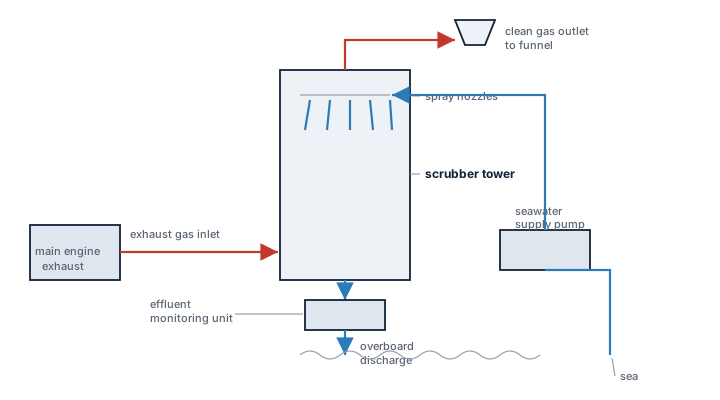
An open loop scrubber draws seawater directly from the sea chest, sprays it through a tower against the rising exhaust gas, and discharges the wash water overboard after settling and monitoring, with no recirculation and no chemical dosing beyond what the seawater's own natural alkalinity provides. This sets it apart from a closed loop scrubber, which recirculates a caustic-dosed fresh water stream and only bleeds off a small treated portion, and from a hybrid scrubber, which can switch between the two modes. Open loop needs seawater with enough natural alkalinity to neutralise the sulphuric acid formed when SO2 dissolves, which is why it performs less consistently in low-alkalinity waters such as parts of the Baltic.
Main components
Scrubber tower
Vertical vessel where seawater is sprayed countercurrent to the exhaust gas across spray nozzles or a packed bed, stripping SO2 and much of the particulate matter.
Seawater supply and lift pumps
High-capacity pumps drawing large volumes of seawater, since open loop operation depends on flow rate rather than chemical dosing to achieve the required wash ratio.
Read the full guide
Wash water treatment unit
Settling tank or hydrocyclone removing particulates and free oil from the discharge stream before it goes overboard, feeding sludge to a residue tank.
Monitoring skid
Continuously measures wash water pH, PAH (polycyclic aromatic hydrocarbon) content, turbidity and flow, alongside SO2/CO2 ratio in the cleaned exhaust, to prove compliance.
Bypass and changeover arrangement
Allows the engine to run on the scrubber or bypass it if fitted with dual-fuel capability to run on compliant low-sulphur fuel instead.
Selection and sizing
Sizing follows engine exhaust gas flow at full load, not ship size directly. The scrubber and its exhaust gas system must handle the combined main engine and auxiliary engine exhaust volumes it is designed to serve, at the required SO2 reduction to meet a 0.10% or 0.50% sulphur-equivalent limit depending on the operating area. Wash water flow rate, usually expressed in m3 per MWh of engine power scrubbed, is the other key sizing figure, since it drives pump capacity, piping diameter and the footprint of the treatment skid.
Regulations and class
- MARPOL Annex VI Regulation 4 permits exhaust gas cleaning as an equivalent means of meeting the fuel sulphur limits, provided the system meets the 2015 IMO EGCS Guidelines (MEPC.259(68)).
- Wash water discharge criteria cover pH at the overboard point, PAH concentration relative to a washwater/seawater ratio, turbidity above ambient, and nitrate addition rate.
- A growing list of ports, coastal states and entire sea areas, including several in the Baltic, North Sea and various national waters, restrict or prohibit open loop discharge; the ship's trading pattern determines whether open loop alone is workable or a hybrid unit is needed.
- Class requires continuous monitoring records to be retained and available to port state control.
Typical faults
| Fault | Consequence |
|---|---|
| Spray nozzle scaling or blockage | Uneven gas-liquid contact, SO2 reduction falls below the required ratio |
| Wash water pump cavitation at low sea chest level or in heavy weather | Loss of wash flow, automatic changeover to low-sulphur fuel or engine power reduction |
| pH monitor fouling or drift | Discharge criteria breach going undetected, or false compliance failures forcing unnecessary bypass |
| Tower internals corrosion from continuous acidic wash | Structural thinning over time, requiring coating renewal or plate replacement at dry dock |
What to look for in a supplier
- Demonstrated SO2 reduction and wash water compliance data from ships in comparable trades, not just bench test figures.
- Materials of construction for the tower and piping, since acidic wash water is aggressive to ordinary steel.
- Whether the unit is offered as open loop only or hybrid-capable, given the expanding list of open loop discharge bans.
- Footprint and weight impact on the ship, since retrofits often compete with cargo space or stability margins.
Check the port and coastal state discharge ban list before the voyage is planned, not after the ship arrives outside the limit; an open loop scrubber that cannot discharge has to switch to compliant fuel, and that fuel has to already be aboard.
Models in this type.
The best-documented model of each manufacturer first, then the next — 3 of 3 models in Open Loop Scrubber. Every row links to full specifications, documents and service notes.
Manufacturers.
All 21 manufacturers with models of Open Loop Scrubber. Names with a manufacturer page open it; the others open a search across the full library.
All manufacturersAlso in Exhaust Gas Cleaning.
The other equipment types in this category.
One request. A person reads it and replies by e-mail.
Tell us the manufacturer, the model and what you need — a part, a service call, a second opinion. A person reads every request and replies by e-mail.
No details at hand? A photo of the rating plate or the part is enough — simply attach it to the request.
Three things people ask first.
Is Open Loop Scrubber data free?
Yes. Every model page, every guide and every datasheet for this type is readable without an account. An account adds saved searches and requests, nothing is taken away.
My model is missing — what now?
Send us the nameplate. We identify it by hand, add it to the library, and if you need a part or a service, the request is already on our desk.
Can you source a Open Loop Scrubber part?
Yes. Tell us the manufacturer, the model and what you need — a person reads every request and replies by e-mail.