"> Open Loop Scrubber - Equipment Database

Open Loop Scrubber

medium 2 models total

An open loop scrubber sprays untreated seawater through the exhaust stream to absorb sulphur oxides, then discharges the wash water overboard after treatment, trading a simple process for a discharge that a growing number of ports now restrict or ban.

Read more — Open Loop Scrubber explained

What makes this type distinct

An open loop scrubber draws seawater directly from the sea chest, sprays it through a tower against the rising exhaust gas, and discharges the wash water overboard after settling and monitoring, with no recirculation and no chemical dosing beyond what the seawater's own natural alkalinity provides. This sets it apart from a closed loop scrubber, which recirculates a caustic-dosed fresh water stream and only bleeds off a small treated portion, and from a hybrid scrubber, which can switch between the two modes. Open loop needs seawater with enough natural alkalinity to neutralise the sulphuric acid formed when SO2 dissolves, which is why it performs less consistently in low-alkalinity waters such as parts of the Baltic.
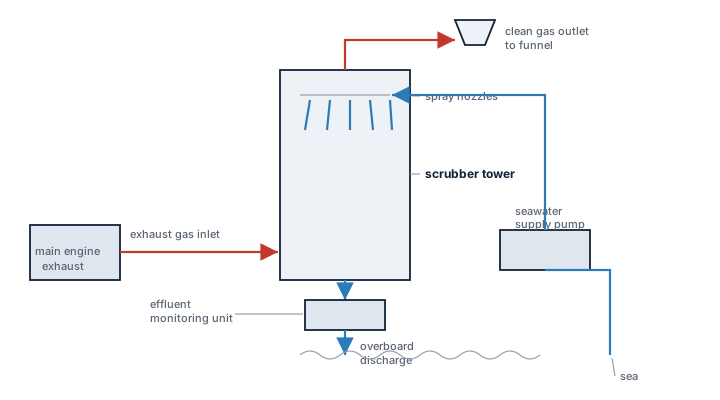
Open loop scrubber process
Flow diagram of an open loop exhaust gas scrubber: engine exhaust rises through a seawater spray tower and leaves clean at the top, while the untreated seawater drawn from the sea falls as wash water through an effluent monitor back overboard.

Main components

Scrubber tower

Vertical vessel where seawater is sprayed countercurrent to the exhaust gas across spray nozzles or a packed bed, stripping SO2 and much of the particulate matter.

Seawater supply and lift pumps

High-capacity pumps drawing large volumes of seawater, since open loop operation depends on flow rate rather than chemical dosing to achieve the required wash ratio.

Wash water treatment unit

Settling tank or hydrocyclone removing particulates and free oil from the discharge stream before it goes overboard, feeding sludge to a residue tank.

Monitoring skid

Continuously measures wash water pH, PAH (polycyclic aromatic hydrocarbon) content, turbidity and flow, alongside SO2/CO2 ratio in the cleaned exhaust, to prove compliance.

Bypass and changeover arrangement

Allows the engine to run on the scrubber or bypass it if fitted with dual-fuel capability to run on compliant low-sulphur fuel instead.

Selection and sizing

Sizing follows engine exhaust gas flow at full load, not ship size directly. The scrubber and its exhaust gas system must handle the combined main engine and auxiliary engine exhaust volumes it is designed to serve, at the required SO2 reduction to meet a 0.10% or 0.50% sulphur-equivalent limit depending on the operating area. Wash water flow rate, usually expressed in m3 per MWh of engine power scrubbed, is the other key sizing figure, since it drives pump capacity, piping diameter and the footprint of the treatment skid.

Regulations and class

  • MARPOL Annex VI Regulation 4 permits exhaust gas cleaning as an equivalent means of meeting the fuel sulphur limits, provided the system meets the 2015 IMO EGCS Guidelines (MEPC.259(68)).
  • Wash water discharge criteria cover pH at the overboard point, PAH concentration relative to a washwater/seawater ratio, turbidity above ambient, and nitrate addition rate.
  • A growing list of ports, coastal states and entire sea areas, including several in the Baltic, North Sea and various national waters, restrict or prohibit open loop discharge; the ship's trading pattern determines whether open loop alone is workable or a hybrid unit is needed.
  • Class requires continuous monitoring records to be retained and available to port state control.

Typical faults

FaultConsequence
Spray nozzle scaling or blockageUneven gas-liquid contact, SO2 reduction falls below the required ratio
Wash water pump cavitation at low sea chest level or in heavy weatherLoss of wash flow, automatic changeover to low-sulphur fuel or engine power reduction
pH monitor fouling or driftDischarge criteria breach going undetected, or false compliance failures forcing unnecessary bypass
Tower internals corrosion from continuous acidic washStructural thinning over time, requiring coating renewal or plate replacement at dry dock

What to look for in a supplier

  • Demonstrated SO2 reduction and wash water compliance data from ships in comparable trades, not just bench test figures.
  • Materials of construction for the tower and piping, since acidic wash water is aggressive to ordinary steel.
  • Whether the unit is offered as open loop only or hybrid-capable, given the expanding list of open loop discharge bans.
  • Footprint and weight impact on the ship, since retrofits often compete with cargo space or stability margins.

Check the port and coastal state discharge ban list before the voyage is planned, not after the ship arrives outside the limit; an open loop scrubber that cannot discharge has to switch to compliant fuel, and that fuel has to already be aboard.

2 manufacturers · 2 models

Alfa Laval

1
Alfa Laval PureSOx Open Loop
PureSOx Open Loop
variable · Exhaust Gas Treatment · Open‑loop exhaust gas scrubber
Type
open_loop
Marpol
ja
Technical Specifications
Sox-abscheidung
>98% Removal mit Partikelfiltration
Betriebsweisen
Open-Loop, Closed-Loop, Hybrid, mit optionalem Energy Reduction Mode
Wasser-reinigungseinheit
Centrifugal-Separator (PureSOx H2O), 6 m² Grundfläche, modulare 3-Skid-Konstruktion
Installationen
100+ Schiffe weltweit, 200+ Retrofit-Projekte abgeschlossen
Service-Verfügbarkeit
24/7 Global Support, 24-Stunden-Ersatzteilversand, Dry Dock Services, Crew-Training
Product Lines
  • PureSOx U-Design
  • PureSOx I-Design (Inline)
  • PureSOx Express
  • PureSOx Hybrid
  • PureSOx Closed-Loop
  • PureSOx Open-Loop
Common Failures & Inspection Points
  • Area: Düsen- und Sprühsystem-Verschleiß: Nozzles können durch Erosion, Verschlammung oder Mineralabsatz verstopfen/beschädigt werden, was Sprühmuster beeinträchtigt u
    Check: Visuelle Inspektion der Spray-Nozzles auf Verschleiß, Risse, Ablagerungen; Funktionalitäts-Test des Sprühmusters; Verwendung echte Ersatz-Nozzles via Alfa Laval Sprayer Replacement Programme mit Hersteller-Kalibrierung
  • Area: pH und PAH Sensor-Kalibrierung: Sensoren (PAH, Trübung) müssen 2-jährlich werkseitig kalibriert werden (MEPC-Standard). Ungenaue Messungen führen zu Compliance-
    Check: Überprüfung Kalibrierungs-Datum (sollte nicht älter als 2 Jahre sein); Sensor-Austausch via Alfa Laval Exchange Programme; Dokumentation der Kalibrierungs-Zertifikate und Mess-Logs (aktueller Standard: Logging alle ~90 Sekunden)
  • Area: Absorber-Korrosion: Das Absorber-Modul (separat vom Jet-Modul durch natürliche Water Trap) ist Salzwasser/Säure-Umgebung ausgesetzt und kann korrodieren; Korros
    Check: Trockendock-Condition Assessment durchführen (idealerweise 6 Monate vor Dock geplant); visuelle Inspektion auf Korrosions-Flecken, Materialverlust an Wänden/Böden; Messung der Wanddicke (kritische Bereiche); Dokumentation und Reparaturempfehlungen
  • Area: Wash Water Monitoring und Leck-Detektion: Im Closed-Loop/Hybrid-Betrieb entsteht Schmutzwasser mit Ruß, Mineralien und Öl; unzureichendes Monitoring oder Leck i
    Check: Prüfung der Wasser-Reinigungs-Einheit (PureSOx H2O Zentrifugal-Separator) auf Verschleiß/Verschlammung; Überprüfung pH/PAH/Trübungs-Messungen und Aufzeichnungen (Kontinuierliches Logging gefordert); Sichtprüfung auf Leckagen an Rohrleitungen und Armaturen; Validierung, dass Trübung <25 FTU bleibt
  • Area: Jet- und Absorber-Modul-Verrohrung und Damper-Ventile: U-Design oder Inline-Design nutzen komplexe interne Rohrsysteme; Ablagerungen, Korrosion oder Ventil-Vers
    Check: Dry Dock Inspektion: Sichtprüfung internaler Rohre (Endoskop nutzen wenn nötig) auf Ablagerungen/Korrosion; Funktionsprüfung von Damper-Ventilen und Pumpen; Inspizieren von kritischen Komponenten gemäß Alfa Laval Dry Dock Service Kit (Damper Valves, Pumps, Sensors); Austausch verschlissener Teile mit Original-Ersatzteilen
  • Area: Discharge Water Testing und Compliance-Dokumentation: IMO MEPC fordert Labor-Tests des Ablaufwassers nach Commissioning und vor jeder Schiffsbesichtigung; Tests
    Check: Prüfung der Discharge-Water-Test-Zertifikate (Labor-bestätigt) und deren Datum; Vergleich Messwerte gegen Grenzwerte (pH ≥6,5, PAH ≤50 µg/L, Trübung ≤25 FNU, Temperatur ≤60°C); in US-Gewässern: mindestens 2 Tests im 1. Jahr, dann jährlich 1x; in anderen Regionen evtl. häufiger; Dokumentation im Schiffs-Compliance-Logbuch

Typ-universelle Inspektions-/Wartungspunkte fuer Exhaust Gas Cleaning (Alfa Laval, Mega-Schwarm 2026-06). Per-Modell-Specs nicht auto-gefuellt.

Service: PureSOx brand. Open-loop mode. Washwater treatment required.
Spare Parts: Alfa Laval: Spezialteile per Hersteller. Lead time: 4-8 Wochen. Gasdetektions-Sensoren an Bord.
Strengths
  • Proven SOx removal efficiency (>98 %) meeting IMO Annex VI limits
  • Modular 3‑skid design (≈6 m² footprint) simplifies installation and retrofits
  • Global 24/7 spare‑part support, dry‑dock services and crew training from Alfa Laval
  • Flexibility to operate in Open‑Loop, Closed‑Loop or Hybrid modes with an Energy‑Reduction option
  • More than 100 vessels already equipped, providing a large operational knowledge base
Weaknesses
  • Requires continuous discharge of wash water; not permitted in many coastal and US waters without additional treatment
  • Nozzle erosion and spray‑system fouling demand regular visual inspection and possible replacement
  • Absorber module is exposed to acidic seawater and can suffer corrosion if not inspected at dry dock
  • Higher initial capital cost compared with some compact closed‑loop units
  • Complex piping and damper valves increase dry‑dock inspection time
Typical Vessels: Crude oil tankersProduct tankersBulk carriersContainer shipsGeneral cargo vessels
Certifications: IMO Type Approval (Annex VI)DNV Recommended Practice RP OGS approvalABS Approved Equipment
Decision Guide: Choose if the vessel operates primarily in international waters where open‑loop wash‑water discharge is allowed, you need a high‑efficiency (>98 %) SOx solution, and you value extensive aftermarket support for retrofits. Avoid if the ship will spend significant time in emission‑control areas (ECAs) that ban wash‑water discharge, or if space/weight constraints make a smaller closed‑loop system more suitable.
Use Cases: The PureSOx Open‑Loop is typically installed on existing tankers and bulk carriers during dry‑dock periods to meet the 2020 IMO SOx cap. It is also selected for new builds where designers prefer an open‑loop layout to minimise auxiliary power consumption while retaining the option to switch to closed‑loop mode when operating in restricted waters.

Wärtsilä

1
Wärtsilä Wartsila Open Loop Scrubber
Wartsila Open Loop Scrubber
sized per engine power · Exhaust Gas Treatment · Open-loop marine SOx scrubber
Type
open_loop
Marpol
ja
Technical Specifications
Sox-reduktion
98% Schwefeldioxid-Entfernung
Operationsmodi
Open Loop, Closed Loop, Hybrid
Seewasser-Alkalinität erforderlich
2300 µmol/l zur Reduktion von 3,5% auf 0,1% Schwefelgehalt
Abwasser-pH Entladung
Minimum 6,5, Maximum Temperatur 60°C, max. 2 pH-Einheiten Differenz Inlet-Overboard
Überwachungsparameter
pH, PAH (Polyzyklische aromatische Kohlenwasserstoffe), Trübung, Temperatur
Entschwefeleinsätze
Venturi-Absorber mit 3-stufiger Wasserzerstäubung, Hochleistungs-Edelstahl
Product Lines
  • Conventional Quench and Venturi Design
  • Inline Scrubber Design
  • IQ Series Scrubber (compact, 25% weniger Platz, 30% leichter)
  • Hybrid Scrubber (Open/Closed Loop kombinierbar)
Common Failures & Inspection Points
  • Area: Absorber/Venturi-Erosion und Verschleiß
    Check: Halbjährliche Sichtprüfung des Absorbers auf Erosions- und Korrosionszeichen; Drucktest der Sprühköpfe (niedriger Druck = Erosion); Überprüfung auf Verschleiß an Venturi-Wänden und Umlenkblechen
  • Area: Sprühdüsen-Verstopfung und -Erosion
    Check: Wöchentliche Überprüfung der Sprühköpfe und Header auf Verstopfung oder Erosion; Überprüfung der Flüssigkeitsdruckmanometer zur Erkennung abnormal niedriger Drücke (Indikator für Erosion); Halbjährliche interne Inspektionen auf verstopfte oder erodierte Düsen
  • Area: Abwassersensorik und pH-Sonde Kalibrierung
    Check: Jährliche Vollservice- und Kalibrierung aller Sensoren durch zertifizierte Techniker; Regelmäßige Überprüfung auf Sondenverschmutzung und Sensorempfindlichkeit; CEMS und Wasserüberwachungssysteme kalibrieren gemäß Herstellervorgaben
  • Area: Abwasserqualität: pH, PAH, Trübung, Temperatur Monitoring
    Check: Kontinuierliche Überwachung von Inlet- und Outlet-Wasserqualität; Dokumentation von pH (min. 6,5), PAH, Trübung, Temperatur (max. 60°C); Jährliche Probenahmen spätestens nach dem ersten Betriebsjahr durchführen; 3-Jahres-Aufbewahrung aller Testergebnisse
  • Area: Korrosion an Abwasserrohren und Ableitungsleitungen
    Check: Dickenmessungen aller Abwasserrohre und Überbord-Leitungen bei jeder jährlichen Hauptbesichtigung durchführen (DNV-Anforderung); Visuelle Inspektionen auf Korrosions- und Erosionszeichen; Überprüfung der Integrität von Rohrbefestigungen und Schweißnähten; Besonders Aufmerksamkeit auf Säurekorrosion vor Seewasser-Verdünnung
  • Area: Nebel-Abscheider (Mist Eliminator) Verschmutzung und Blockade
    Check: Halbjährliche innere Inspektionen des Nebel-Abscheiders auf Verschmutzung, Verstopfung und Korrosion; Überprüfung auf Feststoffansammlung im Abscheider; Funktionsprüfung der Washdown-Systeme des Abscheiders; Reinigung oder Austausch bei Beschädigungen durchführen

Typ-universelle Inspektions-/Wartungspunkte fuer Exhaust Gas Cleaning (Wärtsilä, Mega-Schwarm 2026-06). Per-Modell-Specs nicht auto-gefuellt.

Service: Open-loop uses seawater. Restricted in some ports/ECAs. Washwater monitoring mandatory.
Spare Parts: Wärtsilä: Spezialteile per Hersteller. Lead time: 4-8 Wochen. Gasdetektions-Sensoren an Bord.
Strengths
  • Very high SOx removal efficiency (≈98%) meeting Annex VI limits
  • Multiple operating modes – open, closed and hybrid – for regulatory flexibility
  • Compact IQ series reduces installation space by up to 25% and weight by ~30%
  • Integrated real‑time monitoring of pH, PAH, temperature and turbidity for compliance reporting
  • Wärtsilä lifecycle support with documented inspection intervals
Weaknesses
  • Requires seawater with alkalinity ≥2300 µmol/l; not always available in low‑alkalinity regions
  • Open‑loop discharge is prohibited in many ECAs and several ports, limiting operational zones
  • Higher water consumption and potential for corrosion of discharge piping
  • Maintenance intensive – regular inspection of venturi, spray nozzles and pH sensors
  • Discharge monitoring and record‑keeping add administrative workload
Typical Vessels: Container ships (≥8,000 TEU)Bulk carriersCrude and product tankersGeneral cargo vesselsCruise ships operating on low‑sulfur fuel regimes
Certifications: IMO MARPOL Annex VI complianceDNV GL SCRUBBER notation
Decision Guide: Choose if the vessel operates primarily in open waters or ports where open‑loop washwater discharge is permitted, needs a proven high‑efficiency SOx solution and values flexibility between open, closed and hybrid modes. Avoid if the ship will spend most of its time in strict ECAs or ports that ban open‑loop scrubbers, or if water‑quality constraints make seawater alkalinity unreliable.
Use Cases: Deployed on newbuilds and retrofits of large container, bulk carrier and tanker fleets to meet global sulfur caps while retaining the option to run on high‑sulfur fuel in regions where open‑loop discharge is allowed. Frequently installed on vessels that require rapid compliance with Annex VI without committing to low‑sulfur fuel logistics.