What to check on a Exhaust Gas Cleaning System (Scrubber).
A scrubber is an exhaust gas after-treatment system, not an engine modification - it sits in the exhaust line downstream of the engine or boiler and washes sulphur oxides out of the gas stream with water, letting the vessel keep burning cheaper high-sulphur fuel oil while still meeting the sulphur limits set for exhaust emissions. The distinction that matters commercially is open-loop versus closed-loop operation: an open-loop scrubber uses seawater's natural alkalinity and discharges the washwater overboard after treatment, while a closed-loop scrubber circulates fresh water dosed with caustic soda…
What makes this type distinct
A scrubber is an exhaust gas after-treatment system, not an engine modification - it sits in the exhaust line downstream of the engine or boiler and washes sulphur oxides out of the gas stream with water, letting the vessel keep burning cheaper high-sulphur fuel oil while still meeting the sulphur limits set for exhaust emissions. The distinction that matters commercially is open-loop versus closed-loop operation: an open-loop scrubber uses seawater's natural alkalinity and discharges the washwater overboard after treatment, while a closed-loop scrubber circulates fresh water dosed with caustic soda and only bleeds off a small treated stream, storing the rest for eventual discharge or landing ashore. Hybrid units switch between the two depending on where the ship is trading, since a growing number of ports and coastal states restrict or ban open-loop discharge.
Main components
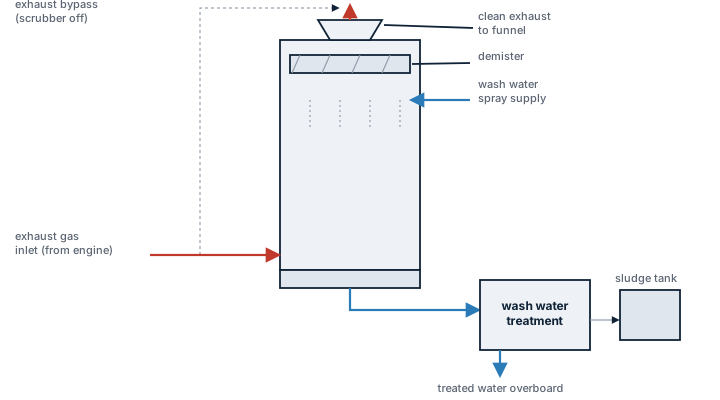
Scrubber tower
Vertical vessel in the exhaust line where wash water is sprayed through the rising exhaust gas, stripping sulphur oxides and particulates as the gas passes through.
Washwater treatment plant
Separators and filters that clean the washwater of soot and residues before discharge or recirculation, plus a dosing system for caustic soda on closed-loop units.
Monitoring system
Continuous emission monitoring for SOx and particulates in the exhaust, and washwater monitoring for pH, PAH, turbidity and nitrates before any overboard discharge.
Residue tank
Sludge tank collecting the separated residues from washwater treatment, landed ashore as waste at suitable ports.
Bypass arrangement
A duct allowing exhaust to bypass the scrubber if it is out of service, generally only permitted for limited periods and outside emission control areas.
Selection and sizing
Scrubber capacity is matched to the engine and boiler exhaust flow it treats, and the choice between open-loop, closed-loop, or hybrid depends on the ship's trading pattern - a vessel spending significant time in ports or waters that restrict open-loop discharge needs closed-loop capability even if open-loop would otherwise be cheaper to run. Space and weight for the tower, treatment plant, and residue tanks compete with cargo or accommodation space, which is a bigger factor on smaller ships than on large tankers or bulk carriers with room to spare. Fuel cost differential between high-sulphur and compliant low-sulphur fuel drives the payback calculation but is not itself a technical sizing input.
- Exhaust flow rate from the engines and boilers to be treated
- Open-loop, closed-loop, or hybrid operation against the vessel's trading pattern
- Space and weight available for tower, treatment plant, and residue tanks
- Washwater discharge criteria in the ship's planned trading areas
- Monitoring and data-logging capability to demonstrate continuous compliance
Regulations and class
Scrubbers are the recognised equivalent method under MARPOL Annex VI for meeting the sulphur limit on fuel oil, in place of burning compliant low-sulphur fuel directly, provided the system meets the IMO's guidelines for exhaust gas cleaning systems and washwater discharge criteria. A growing list of ports, coastal states, and some entire regions restrict or prohibit open-loop discharge within their waters, so compliance is not just about the ship's flag but about where it trades. Class societies survey the installation, issue an EGC scheme certificate confirming the system meets the applicable guideline, and require ongoing monitoring records to be kept and available for port state control inspection.
Typical faults
| Fault | Consequence |
|---|---|
| Washwater monitoring sensor drifting or fouled | Discharge exceeds limits without an alarm, port state detention risk |
| Scrubber tower internals scaled or corroded | Reduced SOx removal efficiency, exhaust back-pressure rising |
| Residue tank overfilled or not landed on schedule | No spare capacity, forcing an unplanned discharge or operational restriction |
| Bypass used outside permitted conditions | Non-compliant SOx emissions, logged and detectable at inspection |
| Caustic dosing system miscalibrated on closed-loop units | Washwater pH out of range, treatment plant strain |
What to look for in a supplier
- EGC scheme documentation matching the flag and class the vessel carries
- Proven hybrid capability if the vessel trades through open-loop-restricted waters
- Realistic exhaust back-pressure figures at full engine load, not just at a test condition
- Monitoring package that logs and stores compliance data automatically for inspection
- Service support able to reach the ports the vessel actually calls at, not just major hubs
Track washwater discharge restrictions for every port on the itinerary before arrival, not on arrival - a scrubber that has to switch to closed-loop mode with no warning can run out of storage capacity faster than expected.