Water Mist Extinguisher
A water mist portable extinguisher breaks water into a fine spray under pressure, cooling and smothering the fire surface without the conductivity risk of a jet stream, making it usable on live electrical equipment up to a safe voltage limit.
Read more — Water Mist Extinguisher explained ▾
What Sets Water Mist Apart
A water mist extinguisher forces water through a specially designed nozzle at high pressure, breaking it into droplets typically below 100 microns. The fine mist absorbs heat far faster than a solid jet because of its greater surface area, and it partially displaces oxygen at the seat of the fire through rapid vapor expansion. Unlike a standard water-jet extinguisher, the mist does not form a conductive column back to the operator, so manufacturers rate many units safe for use on live electrical equipment at typical shipboard voltages, and unlike CO2 or dry powder it leaves the compartment breathable and causes far less collateral mess in accommodation and control spaces.
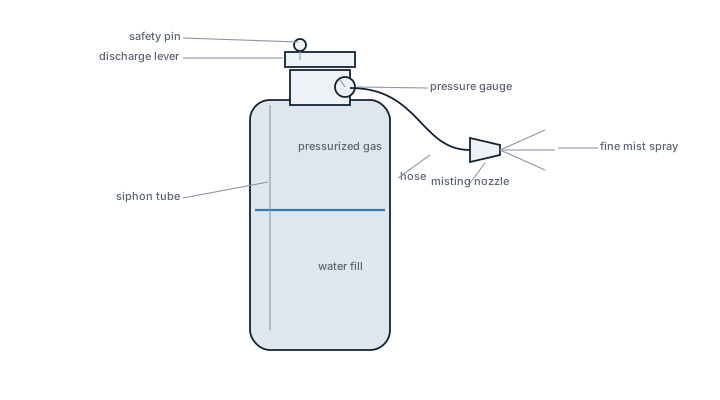
Main Components
Cylinder and Charge
A steel or composite cylinder holds distilled or de-ionized water, sometimes with a small additive package, pressurized with nitrogen to a working pressure in the 8-16 bar range depending on model.
Mist Nozzle
A specialized discharge head, not the plain orifice of a water-jet type, is what actually creates the mist. Swapping in a generic nozzle destroys the fire performance even if the rest of the unit looks identical.
Discharge Valve and Hose
A squeeze-grip or lever valve controls discharge, usually giving 50-90 seconds of continuous use, longer than a comparable CO2 unit of similar weight.
Selection and Sizing
- Fire class coverage: rated for Class A (ordinary combustibles) and often Class F (cooking oil); check the label before assuming Class B suitability
- Electrical safety rating and the minimum safe distance stated by the manufacturer for live equipment
- Discharge time and range, which matter for galley and accommodation layouts with limited retreat space
- Cylinder test pressure and weight, since a mist unit is often heavier than an equivalent CO2 extinguisher
Regulations and Class
Portable extinguishers fall under SOLAS Ch. II-2 and the FSS Code, which set the minimum number, type and distribution of extinguishers by space. Each unit needs a valid service and hydrostatic test certificate, with servicing intervals set by the manufacturer and verified at annual survey; class surveyors check the service tag date against the cylinder itself, not just the deck log.
Typical Faults
| Fault | Consequence |
|---|---|
| Nozzle partially blocked by scale from hard water fill | Discharge reverts to a jet, losing the electrical safety rating and cooling effect |
| Slow nitrogen pressure loss through the valve seal | Reduced range and discharge time, often unnoticed until the annual gauge check |
| Wrong extinguisher grabbed under Class B fire | Ineffective or worsened fire, since a water-based unit is not rated for flammable liquid fires |
| Cylinder past hydrostatic test date left in service | Survey finding, and a real risk of cylinder failure under pressure |
What to Look for in a Supplier
- Independent test certification for the stated electrical safety distance, not just a marketing claim
- Servicing network able to reach the ship's ports of call for the recurring annual and hydrostatic tests
- Consistent nozzle and valve parts across the fleet to simplify spares holding
Check the nozzle, not just the pressure gauge, at every inspection - a mist extinguisher with full pressure but a scaled nozzle discharges a jet, and the crew will not find that out until it is too late.
11 manufacturers · 70 models
Amerex
8
Buckeye Fire
8
Kidde / Badger
8
NAFFCO Marine
8
Survitec Group
8
Dräger
7
Pri-Safety Marine
7
Sapfire
7
Wilhelmsen
7
Gloria
1
- Nozzle blockage from mineral deposits
- Pressure loss
- Handle mechanism wear
- Compact 6 L capacity – easy to store and handle on board
- Low‑residue discharge – minimal clean‑up and no damage to equipment
- Safe for Class E (electrical) fires because water is demineralised
- SOLAS‑approved, meeting basic maritime fire‑extinguishing standards
- Nozzle can become blocked by mineral deposits if water purity lapses
- Pressure loss over time may reduce effective discharge range
- Handle and trigger mechanism subject to wear with frequent use
- Limited extinguishing volume compared with foam or CO₂ systems for large fires
Jockel
1
- Nozzle clogging
- Cylinder corrosion
- Pressure gauge failure
- SOLAS‑approved for maritime use
- Leaves no chemical residue – safe for equipment and crew
- Compact size (6 L) suitable for limited storage spaces
- Environmentally friendly – uses only water
- Limited discharge volume may be insufficient for large fires
- Nozzle can clog in hard‑water or salty environments
- Cylinder material prone to corrosion if not regularly maintained
- Pressure gauge failures reported, affecting reliability of remaining charge