What to check on a Reverse Osmosis.
14 models from RWO/Veolia in Reverse Osmosis. Below: the full model list.
What sets reverse osmosis apart from thermal evaporators
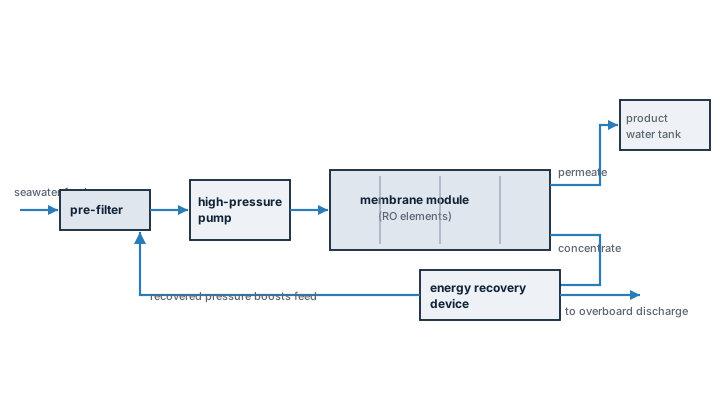
A freshwater generator on most merchant ships uses jacket-cooling water heat to flash-evaporate seawater under vacuum. Reverse osmosis (RO) does the opposite: it stays cold and uses a high-pressure pump to push raw seawater across a semi-permeable membrane, forcing water molecules through while rejecting salt, bacteria and most dissolved solids. Where an evaporator is limited by available waste heat and shuts down when the main engine is stopped or running light, an RO plant only needs electrical power, so it keeps producing water alongside the engine, in port, or on a diesel-electric vessel with no spare heat at all. The trade-off is a much higher specific energy consumption per cubic metre unless an energy recovery device is fitted, and a feed water that must be pre-filtered to protect membranes that an evaporator does not need.
Read the full guide
Main components
High-pressure feed pump
A multistage centrifugal or positive-displacement pump raises seawater to 55-70 bar for typical single-pass seawater RO. It is the largest single power consumer in the plant and the component most exposed to wear from any grit that pre-filtration misses.
Membrane vessels
Spiral-wound thin-film composite membrane elements sit inside pressure vessels, usually six or seven elements per vessel. Rejection rate is typically 98-99.5% of dissolved salts on a well-maintained set.
Pre-treatment
Coarse strainers, cartridge filters down to 5 microns, and often a dosing system for anti-scalant protect the membranes from suspended solids, algae blooms and scale-forming minerals.
Energy recovery device
A pressure exchanger or turbocharger recovers hydraulic energy from the concentrate (brine) stream leaving the membranes and feeds it back into the high-pressure side, cutting specific power consumption roughly in half on modern units.
Post-treatment
Product water passes through a remineralisation or pH-correction stage and UV or chlorination before it is fit to enter the potable water tanks, since RO permeate on its own is aggressive and near-mineral-free.
Selection and sizing
- Daily production capacity in cubic metres per day, matched to crew size and any cargo or process water demand.
- Feed seawater temperature and salinity range for the trading area, since colder or more saline water needs higher pump pressure for the same output.
- Available electrical power and whether an energy recovery device is fitted, which changes specific consumption from roughly 4-6 kWh/m3 down to 2-3 kWh/m3.
- Membrane material and housing pressure rating, since brackish-water elements will not survive full seawater pressure.
- Deck space and weight, particularly on smaller vessels retrofitting a plant into an existing engine room.
Regulations and class
Potable water quality is generally checked against WHO drinking water guidelines rather than a single maritime convention, and flag or port health authorities may sample it. Classification societies require periodic survey of the pressure vessel and piping under their machinery survey regime, and the high-pressure pump and its relief valve are treated as a pressure system needing routine inspection. Ballast Water Management Convention issues do not apply to freshwater generators, but any RO plant drawing from a ballast tank rather than a sea chest needs separate scrutiny.
Typical faults
| Fault | Cause | Consequence |
|---|---|---|
| Falling permeate flow | Membrane fouling by biofilm or scale | Reduced daily production, higher differential pressure across vessels |
| Rising salt passage | Membrane degradation or a torn O-ring | Product water fails salinity limit, must be dumped to bilge |
| High-pressure pump trip | Blocked cartridge filters starving the pump | Loss of production until filters are changed |
| Rapid membrane fouling | Anti-scalant dosing pump failure | Premature membrane replacement, often within months |
What to look for in a supplier
- Availability of spare membrane elements and cartridge filters in the ports the vessel actually calls at, not just at the yard.
- Documented specific energy consumption figures at stated feed conditions, not a single best-case number.
- Compatibility of the energy recovery device with the pump manufacturer, since retrofitting one later is expensive.
- Remote monitoring or trending of conductivity and differential pressure, which gives early warning of fouling before it becomes a rejection failure.
Track membrane differential pressure and permeate conductivity from day one; a slow upward trend over weeks is normal fouling and cleanable with a CIP flush, but a sudden step change usually means a torn membrane or a failed O-ring seal that needs the element pulled.