Rotary Vane Steering Gear
A rotary vane unit turns the rudder stock directly: vanes keyed to the stock split the housing into pressure chambers, so torque is generated without the tiller, quadrant or connecting rods a ram-type gear needs.
What to check on a Rotary Vane Steering Gear.
5 models from Thordon Bearings in Rotary Vane Steering Gear. Below: the full model list.
What sets the rotary vane design apart
In a rotary vane steering gear the rotor is keyed straight onto the rudder stock, and vanes projecting from the rotor divide the surrounding stator housing into working chambers. Hydraulic oil fed to one side of each vane and drained from the other creates a pressure differential that acts directly on the stock as torque. There is no tiller arm, no quadrant, no connecting rod and no ram to translate linear force into rotation, which is exactly what separates this type from the two-ram or four-ram gear found on most large tankers and bulk carriers. The result is a compact, self-contained unit that sits on top of the rudder trunk rather than spread across the steering flat, at the cost of a more demanding sealing job at every vane tip and side face.
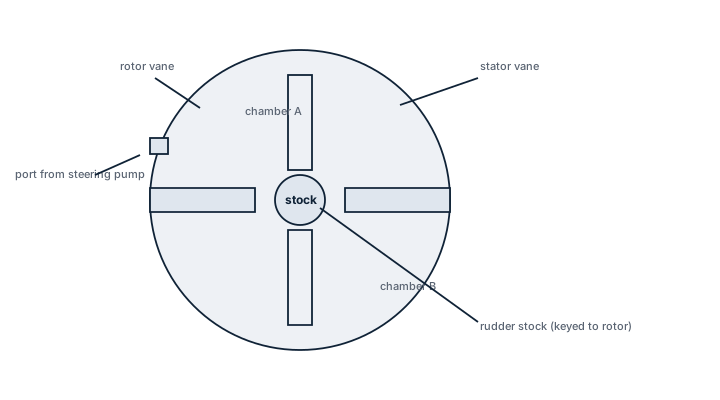
Legend
- rotor vane
- chamber A
- stator vane
- port from steering pump
- stock
- rudder stock (keyed to rotor)
- chamber B
Main components
Rotor and vane assembly
The rotor carries three or four vanes machined or bolted into radial slots. Each vane seals against the stator bore and the rotor hub, and the sealing arrangement - usually a combination of PTFE-faced vane tip seals and side seals - is the part most exposed to wear because it moves under load every time the helm is worked.
Stator housing
The stator is a heavy cast or fabricated ring bolted to the rudder trunk structure, split into chambers by fixed stops that also act as the mechanical end stops limiting rudder travel. It has to absorb the full stall torque of the gear if the rudder is driven against a hard stop or an obstruction.
Read the full guide
Hydraulic power unit
Twin pump sets, usually variable-displacement axial piston pumps on the larger sizes or fixed-displacement pumps with directional solenoid valves on smaller ones, supply the working chambers. SOLAS requires the main and auxiliary supplies to be independent so that a single pump, motor or pipe failure cannot disable steering.
Non-return, relief and buffer valves
Relief valves protect the housing from pressure spikes when the rudder meets green water or an unexpected load; buffer valves cushion the rotor as it approaches the mechanical stops so the vanes do not hammer against them at full helm.
Angle transmitter
A feedback unit mounted on the rotor or stock reports actual rudder angle back to the bridge indicator and to the autopilot. Misalignment here shows up as an indicated angle that does not match the rudder actually seen from aft.
Sizing and selection
The gear is selected on stall torque, not on rudder area alone: torque depends on rudder area, the ship's maximum ahead service speed squared, and the type of rudder, since a spade rudder with high lift needs more torque than a simple flat-plate rudder of the same area. Working pressure and vane count are then set to deliver that torque within the housing diameter the trunk allows.
- Rated torque at maximum working pressure, with margin for helm reversal under way
- Rudder angle range, normally 35 degrees each side with mechanical stops slightly beyond
- Response time from hard-over to hard-over at rated pump output
- Housing diameter versus the space available in the steering flat and rudder trunk
Regulations and class
SOLAS Chapter II-1 requires the main steering gear to put the rudder from 35 degrees on one side to 30 degrees on the other in not more than 28 seconds at maximum ahead service speed and deepest draught, and requires an independent auxiliary means capable of steering the ship on its own. Steering gear must be tested before departure, and class societies survey the gear periodically, including a tightness and function test and a check of the rudder stock coupling and seals.
Typical faults
| Fault | Consequence |
|---|---|
| Vane tip or side seal wear | Internal leakage between chambers, rudder creeps off course when the helm is left amidships |
| External seal or O-ring failure | Hydraulic oil loss, low reservoir alarm, eventual loss of pressure to one system |
| Non-return valve sticking | Pressure drop when changing over from main to auxiliary pump |
| Angle transmitter misalignment | Bridge indicator disagrees with actual rudder position, dangerous during pilotage |
| Stator housing overload from grounding contact | Cracking at the chamber stops, requiring dry-dock repair |
What to look for in a supplier
- A type test certificate from a recognised class society matching the rated torque to the actual rudder torque calculation, not just the nameplate figure
- Seal kits and vane tip seals held as stock spares, since these are wear items with a defined service life
- An angle transmitter output compatible with the existing autopilot and bridge indicator wiring
- A service network able to reach the vessel for the hydraulic power unit, not only the vane assembly
A slow, steady rudder creep with the helm amidships and no alarm is usually vane seal wear, not a control system fault - run the pre-departure test and watch the drift rate before blaming the autopilot.
Models in this type.
The best-documented model of each manufacturer first, then the next — 5 of 5 models in Rotary Vane Steering Gear. Every row links to full specifications, documents and service notes.
Manufacturers.
All 151 manufacturers with models of Rotary Vane Steering Gear. Names with a manufacturer page open it; the others open a search across the full library.
All manufacturers- Aegir Marine2
- ALAMARIN-JET OY2
- Bonfiglioli Riduttori S.p.A.2
- BOUND 4 BLUE, S.L.2
- C W F Hamilton & Co. Ltd.15
- Centa-Antriebe Kirschey5
- D-I Industrial4
- Dana Motion Systems Italia S.r.l.2
- EAGLE INDUSTRY CO., LTD. Marine Division4
- Filtration Group GmbH3
- Finnøy Gear & Propeller10
- Flender-Graffenstaden SAS France3
Show all 151 manufacturers
- ABB Oy, Marine and Ports1
- ACM Bearings Ltd1
- Alfa Laval Aalborg1
- Alfa Laval Technologies AB1
- ALTRA INDUSTRIAL MOTION DO BRASIL EQUIPAMENTOS INDUSTRIAIS LTDA.1
- Anemoi Marine Technologies Ltd.1
- Anhui Zhongxue Adhesive Tape MFG Co., Ltd.1
- BAR Technologies Ltd1
- BOSVIK A/S1
- Chock-Design B.V.1
- Clouth-Gummiwalzen GmbH & Co. KG1
- CRUG-VERSITEC1
- Cryostar1
- CSSC Shanghai Marine Energy Saving Technology Co., Ltd.1
- Dae Kyung Chemical Inc.1
- Daihatsu Diesel Mfg. Co., Ltd. Moriyama Division1
- Dalian Deep Blue Pump Co., Ltd.1
- Danfoss2
- Danfoss Drives1
- Destinus OPRA B.V.1
- Dinamic Oil S.p.A.2
- Dipl.-Ing. Herwarth Reich GmbH2
- Dril-Quip, Inc.2
- Duramax Marine1
- EagleBurgmann Espey1
- EagleBurgmann Japan Co., Ltd.1
- Eco Bearings AS1
- ECO FLETTNER GmbH1
- ELAFLEX HIBY1
- Elephant Machinery Co., Ltd.1
- Enmar Engines AB1
- ETUDES ET PRODUCTIONS SCHLUMBERGER SAS2
- Fives Cryomec AG1
- Flender GmbH2
- GALI-Deutschland Gesellschaft mit beschränkter Haftung1
- GASSO EQUIPMENTS, S.A.1
- Geislinger2
- Gelenkwellenwerk Stadtilm GmbH1
- Georg Fischer JRG AG1
- H.D. Service Co., Ltd.1
- HANSA-FLEX AG1
- Hanwha Ocean Co., Ltd.1
- Hatlapa1
- HD Hyundai Heavy Industries Co., Ltd2
- Hi-Kalibre Equipment Ltd.1
- Howden Turbo UK1
- HS-Cooler GmbH Wittenburg1
- Hutchinson Industries1
- Hydrasun Ltd.1
- Hydropath Technology Limited1
- Hyupsung Metallize Co., Ltd.1
- Innovative Manufacturing Inc.1
- Intertraco (Italia)1
- Iron Pump A/S1
- Isoleermaterialenindustrie Pull B.V.1
- J.M. Voith SE & Co. KG / VTA1
- Jastram1
- Jiangsu Nanji Machinery Co., Ltd.1
- Jingjiang Dakeyuan New Material Engineering Co., Ltd.1
- JRCS1
- Kobelt Manufacturing2
- KTR Kunststofftechnik Rodenberg GmbH1
- Kumera Marine1
- Lagersmit Sealing Solutions B.V.1
- Logan Industries International Corporation1
- Lufkin Gears France SAS2
- Luminar Marine Co., Ltd.2
- Maprom Engineering B.V.1
- Marol2
- MASKINSPECIALISTEN AS1
- Masson Marine1
- ME Production1
- Modine Söderköping AB1
- Modine Thermal Systems (Wuxi) Co. Ltd1
- Nakakita Seisakusho Co., Ltd.2
- Nanjing taihang marine fittings co.,ltd.1
- NGB Corporation dba Stellar Technology2
- Nogva Heimdal Propulsion AS2
- Nord-Lock1
- OCEANWINGS SAS1
- OneSubsea LLC - Houston1
- Otto Piening Schiffspropeller und Wellenanlagen GmbH1
- Parker Hannifin Manufacturing Germany GmbH & Co. KG1
- PERMALI GLOUCESTER LTD2
- Pleiger Maschinenbau GmbH & Co. KG1
- PMH Norway2
- Power Engineering & Manufacturing, Ltd.1
- ProfiSeal GmbH1
- PTG FrioNordica AS1
- Qingdao Zhixiang Composites Co., Ltd.1
- RITAG Ritterhuder Armaturen GmbH & Co. Armaturenwerk KG1
- RM Propulsion B.V.1
- Rolls-Royce2
- Saipem S.p.A.1
- Schottel2
- Shanghai Tiannai Industrial Co., Ltd.1
- Sleipner Motor2
- Solar Turbines Incorporated1
- Steel Recon Industries1
- Stern Keeper Co.,Ltd.1
- Teledyne Instruments, Inc. dba Teledyne Oil & Gas1
- Thermal Ceramics UK1
- THOMPSON VALVES LIMITED1
- TPS Woodco USA, LLC1
- Tufcot Engineering Ltd.1
- Twin Disc International S.A.1
- TYM Ganain, S.L.1
- U.N. Produkte GmbH1
- Ulmatec Pyro AS1
- Virginia Engineering Service (Pty) Ltd, T/A Vescoplastics1
- Wieland Provides S.r.l.2
- Wikov TurboGear s.r.o.1
- Winel1
- WinGD1
- ZF Industrieantriebe Witten GmbH2
Also in Steering Gear.
The other equipment types in this category.
One request. A person reads it and replies by e-mail.
Tell us the manufacturer, the model and what you need — a part, a service call, a second opinion. A person reads every request and replies by e-mail.
No details at hand? A photo of the rating plate or the part is enough — simply attach it to the request.
Three things people ask first.
Is Rotary Vane Steering Gear data free?
Yes. Every model page, every guide and every datasheet for this type is readable without an account. An account adds saved searches and requests, nothing is taken away.
My model is missing — what now?
Send us the nameplate. We identify it by hand, add it to the library, and if you need a part or a service, the request is already on our desk.
Can you source a Rotary Vane Steering Gear part?
Yes. Tell us the manufacturer, the model and what you need — a person reads every request and replies by e-mail.