What to check on a EPIRB (406 MHz) Category I.
Both Category I and Category II 406 MHz EPIRBs transmit the same distress signal to the Cospas-Sarsat satellite system and both carry an integrated GPS receiver on current models, so the position accuracy at the rescue coordination centre is identical. The difference is entirely in how the beacon gets into the water. Category I sits in a float-free bracket fitted with a hydrostatic release unit (HRU): if the vessel sinks, water pressure at a depth of roughly 1.5 to 4 metres fires the release, the bracket lets go, and the…
What sets Category I apart from Category II
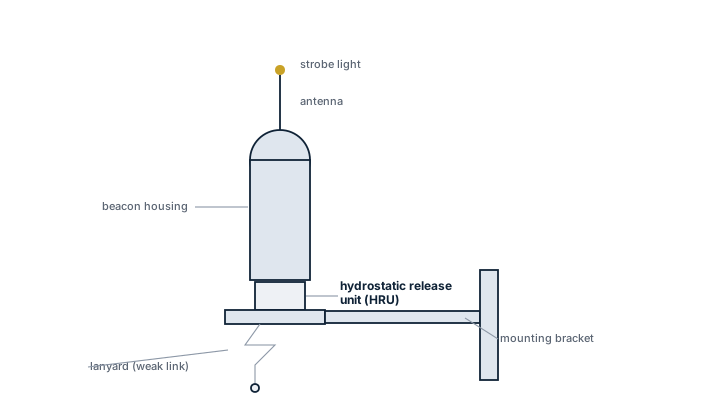
Both Category I and Category II 406 MHz EPIRBs transmit the same distress signal to the Cospas-Sarsat satellite system and both carry an integrated GPS receiver on current models, so the position accuracy at the rescue coordination centre is identical. The difference is entirely in how the beacon gets into the water. Category I sits in a float-free bracket fitted with a hydrostatic release unit (HRU): if the vessel sinks, water pressure at a depth of roughly 1.5 to 4 metres fires the release, the bracket lets go, and the beacon floats to the surface and starts transmitting on its own. Category II has no HRU it stays in its bracket until someone removes it by hand and either straps it to a liferaft or carries it aboard a survival craft. Category I is the mandatory type for vessels required to carry a float-free beacon under SOLAS; Category II is acceptable where manual carriage is permitted, typically smaller vessels with a shorter abandon-ship sequence.
Main components
Beacon housing and battery
The waterproof housing carries a lithium battery pack rated for five years of shelf life and a minimum of 48 hours of continuous transmission once activated. The battery date is stamped on the case and is the single most common reason a beacon fails its annual inspection.
Hydrostatic release unit
The HRU is a separate, independently certified component, commonly a hydrostatic pressure cell such as the Hammar H20 or a comparable design, fitted between the bracket and the beacon. It has its own expiry date, typically two years, independent of the beacon battery, and both dates must be tracked separately.
Antenna, GPS and strobe
A folding or fixed antenna transmits on 406 MHz to the satellite system and on 121.5 MHz as a homing signal for search aircraft and rescue craft fitted with direction-finding equipment. An integrated GPS module encodes position into the 406 MHz burst, cutting the time to a confirmed fix compared with the older Doppler-only method. A xenon strobe light aids close-range visual location after daylight search has narrowed the area.
Selection and sizing
There is little sizing in the mechanical sense the choice is about bracket compatibility and registration, not output power. Key points when specifying a unit:
- Float-free bracket must suit the mounting location and be clear of obstructions that could prevent release or foul the beacon on the way up.
- GPS-enabled models are now standard; a non-GPS unit relies on satellite Doppler positioning, which is slower and less accurate.
- Cospas-Sarsat type approval certificate must match the specific model and hull-coded identifier being programmed.
- The beacon's 15-digit identification code must be programmed with the vessel's MMSI or a Cospas-Sarsat-issued serial number and registered with the relevant national authority before the beacon goes into service.
Regulations and class
SOLAS Chapter IV (GMDSS) requires cargo ships of 300 GT and above and all passenger ships to carry a satellite EPIRB, float-free and capable of manual activation and release. Class surveyors check the HRU and battery expiry dates at each annual safety equipment survey, and a beacon with either date lapsed is a deficiency that can hold a ship in port. Registration of the beacon's identification code with the flag state or a recognised register is a separate requirement from carriage an unregistered beacon that activates gives rescue coordination centres a position but no vessel details.
Typical faults
| Fault | Cause | Consequence |
|---|---|---|
| No transmission on test | Battery past expiry or corroded contacts | Beacon fails self-test, must be replaced before departure |
| Bracket will not release | HRU past expiry, seized weak link, or paint/lashing over the bracket | Beacon stays with a sinking vessel instead of floating free |
| False activation | Bracket loose, beacon dropped, or heavy green water over the mounting position | Unnecessary SAR response launched |
| Wrong position reported | Incorrect MMSI programmed after a beacon swap or vessel sale | Rescue centre has a valid signal but the wrong vessel identity on file |
What to look for in a supplier
- Current Cospas-Sarsat type approval for the exact model, not a superseded variant.
- Fresh battery and HRU manufacture dates, not stock that has already used up years of shelf life.
- Programming and registration service included, with a certificate confirming the identification code on file.
- Class or flag-state recognition for the annual servicing and battery replacement scheme offered.
Run the self-test monthly using the beacon's own test button, never by holding down the activation switch a genuine 406 MHz burst during a test alerts the satellite system and can trigger a real search.