Radar
Marine radar detects targets by timing the echo of a transmitted pulse, and the practical difference between units comes down to band, X-band versus S-band, because that choice trades fine resolution against performance in rain and sea clutter.
What to check on a Radar.
77 models from Furuno Electric in Radar. Below: the full model list.
What sets radar apart from the rest of the navigation suite
Radar is an active sensor: it transmits its own pulses and measures the echo, so it works independently of satellite signals, AIS transponders on other vessels, or visibility, which is why it remains the primary anti-collision and landfall tool when everything else fails. The main design choice within radar itself is frequency band. X-band (around 9 GHz) gives a shorter wavelength and finer resolution, so it is the standard choice for target discrimination and close-range collision avoidance. S-band (around 3 GHz) has a longer wavelength that penetrates rain and sea clutter far better, at the cost of coarser resolution, which is why SOLAS ships over a certain size are required to carry both: X-band for detail, S-band for reliable detection in heavy weather. A single-band fit is a real operational limitation, not just a cost saving, because neither band alone covers both jobs well.
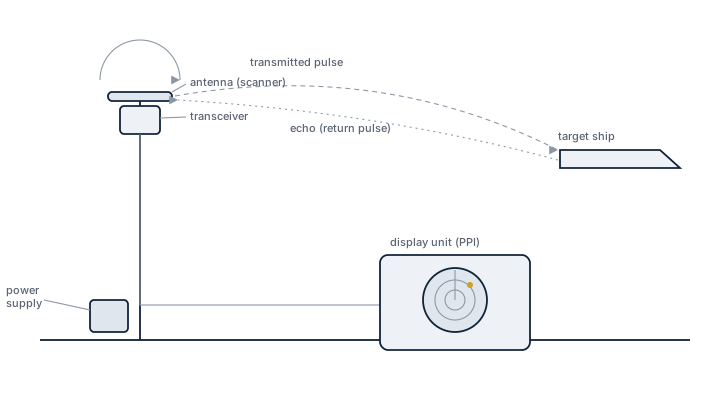
Legend
- transmitted pulse
- Antenna (scanner)
- echo (return pulse)
- Transceiver
- Target ship
- Display unit (PPI)
- Power supply
Main components
Transceiver / scanner unit
Combines the transmitter, receiver and rotating antenna in one mast-mounted unit on modern solid-state sets, replacing the older separate magnetron transmitter and antenna arrangement found on legacy pulse radars.
Antenna
A rotating slotted waveguide array; longer antennas give finer bearing resolution, which is why larger vessels fit longer scanners than small craft.
Read the full guide
Display and processor
Processes the returned echoes into the plan position indicator picture, runs target tracking (ARPA), and on integrated bridge systems overlays the radar picture onto ECDIS chart data.
Transmitter technology
Magnetron sets generate high-power short pulses and are simple and robust but wear out, since the magnetron itself is a consumable; solid-state pulse-compression sets use lower peak power over a longer, coded pulse, giving comparable range performance with no magnetron replacement and generally better short-range clutter performance.
Selection and sizing
- Vessel size and SOLAS category - determines whether one or two radars are required, and whether S-band is mandatory alongside X-band.
- Antenna length - longer antenna improves bearing discrimination between close targets, relevant in traffic-dense or coastal navigation.
- Transmitter technology - magnetron versus solid-state trades upfront simplicity against long-term maintenance cost and clutter performance.
- Integration - whether the radar needs to feed a full integrated bridge/ECDIS overlay or stand alone.
Regulations and class
SOLAS Chapter V sets the carriage requirements: cargo ships of 3,000 gross tonnage and upwards and passenger ships must carry two radar systems capable of operating independently, one of which must be a 9 GHz (X-band) set, arranged so that failure of one does not disable the other. Radar equipment must meet IMO performance standards and carry type approval referencing the relevant IEC test standard. Class and flag state surveys check the radar is operational, correctly interfaced to gyro/heading and speed inputs, and that the required second unit is genuinely independent, not sharing a single point of failure with the first.
Typical faults
- Magnetron degradation - a slow drop in transmitted power reduces detection range long before the set fails outright, often unnoticed until a comparison with the second radar reveals it.
- Antenna motor or bearing wear - irregular rotation speed distorts the picture and can eventually stop the scanner entirely.
- Waveguide or antenna joint corrosion - moisture ingress attenuates the signal, showing up as reduced range performance that is easy to mistake for a transmitter fault.
- Heading/speed input failure - a lost gyro or log feed degrades ARPA target tracking accuracy even though the radar picture itself looks normal.
What to look for in a supplier
- Type approval certificate confirming compliance with current IMO radar performance standards for the vessel's SOLAS category.
- Confirmed independence of the two required radar installations, down to separate power supplies where required.
- Spares and service support for the transmitter technology fitted, particularly magnetron replacement lead time if that technology is retained.
Compare both radars against each other regularly, not just against the chart - a slowly failing magnetron loses range gradually, and the difference only becomes obvious when the second, healthy set is checked side by side.
Models in this type.
The best-documented model of each manufacturer first, then the next — 77 of 77 models in Radar. Every row links to full specifications, documents and service notes.
Manufacturers.
All 50 manufacturers with models of Radar. Names with a manufacturer page open it; the others open a search across the full library.
All manufacturersAlso in Radar & ECDIS.
The other equipment types in this category.
One request. A person reads it and replies by e-mail.
Tell us the manufacturer, the model and what you need — a part, a service call, a second opinion. A person reads every request and replies by e-mail.
No details at hand? A photo of the rating plate or the part is enough — simply attach it to the request.
Three things people ask first.
Is Radar data free?
Yes. Every model page, every guide and every datasheet for this type is readable without an account. An account adds saved searches and requests, nothing is taken away.
My model is missing — what now?
Send us the nameplate. We identify it by hand, add it to the library, and if you need a part or a service, the request is already on our desk.
Can you source a Radar part?
Yes. Tell us the manufacturer, the model and what you need — a person reads every request and replies by e-mail.