OceanSphere
Engines

Power Cable (6/10 kV)

medium 270 / 270 models (Inspector)

6/10 kV power cable carries medium-voltage distribution aboard ships large enough to need it, mainly generator-to-switchboard feeders, where insulation and screening, not conductor size alone, decide whether the cable survives shipboard vibration and fire risk.

Read more — Power Cable (6/10 kV) explained

What defines 6/10 kV shipboard power cable

The 6/10 kV rating describes a cable insulated for 6 kV phase-to-earth and 10 kV phase-to-phase, the medium-voltage band used aboard ships with large electrical loads — cruise ships, LNG carriers, drillships, large offshore vessels — where generator output and main bus distribution run above the low-voltage range covered by standard 0.6/1 kV shipboard cable. What separates it from onshore medium-voltage cable of the same rating is the insulation and armouring built for continuous vibration, tight bend radii in cable trunking, and the flame and smoke performance ships require.
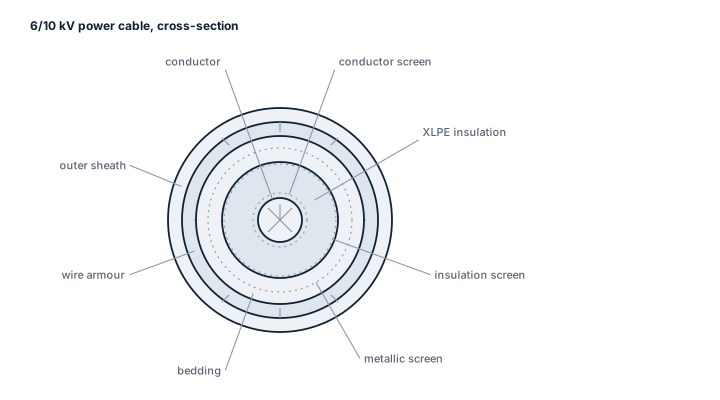
6/10 kV power cable, cross-section
Cross-section of a single-core 6/10 kV shipboard power cable showing, from centre outward, the stranded conductor, conductor screen, XLPE insulation, insulation screen, metallic screen, bedding, wire armour and outer sheath.

Main components

Conductor

Stranded copper conductor, sized to the load current with a derating applied for the number of cables run together in a trunk and for engine room ambient temperatures well above onshore assumptions.

Semiconducting and insulation screen

At this voltage the insulation needs a semiconducting layer bonded to both the conductor and the outer screen to control the electrical stress field evenly; without it, voids at the insulation surface cause partial discharge that erodes the cable from the inside over years of service.

Insulation

Cross-linked polyethylene (XLPE) or ethylene propylene rubber (EPR), chosen for dielectric strength, thermal rating and, on EPR types, better flexibility for tight shipboard routing.

Metallic screen and armour

A copper wire or tape screen carries fault current to earth and controls electromagnetic emission; galvanised steel wire armour or braid gives mechanical protection through cable trunking and at penetrations, and both layers double as part of the earth-fault protection scheme.

Outer sheath

Low-smoke, halogen-free (LSHF) compound as standard on passenger and most commercial tonnage, chosen so a cable fire does not add toxic, corrosive smoke to a compartment crew may need to fight through.

Selection and sizing

  • Load current and short-circuit rating of the switchboard it connects to, since medium-voltage cable must survive fault current for the time the protection takes to clear
  • Number of cables grouped in one trunk, which derates current-carrying capacity sharply compared with a single cable in free air
  • Bend radius achievable in the actual routing, which is tighter on a ship than in a shore installation
  • Fire performance class — flame retardant as a minimum, fire resistant on circuits that must stay live during a fire, such as emergency switchboard feeders or fire pump supply

Regulations and class

SOLAS Ch. II-1 sets requirements for electrical installations including cable routing away from and protection through machinery spaces, segregation of essential services, and fire integrity of cabling for services required to remain operational during a fire. Class societies apply their own rules for medium-voltage cable type approval, testing including partial discharge testing at manufacture, and installation practice, and require cable routes for duplicated essential systems to be physically segregated so one damaged trunk cannot take out both the main and the standby feed.

Typical faults

FaultConsequence
Semiconducting screen damaged or misaligned during terminationLocalised electrical stress, partial discharge and eventual insulation breakdown
Cable overloaded through under-rated derating for trunk fillProgressive insulation ageing, shortened cable life
Armour or screen not properly earthed at glandsFault current has no controlled path to earth, protection may not trip correctly
Minimum bend radius exceeded during installationInsulation and screen stressed unevenly, early failure at the bend

What to look for in a supplier

  • Type approval certificate from the relevant class society for the specific construction supplied
  • Partial discharge test records from manufacture, not just a general conformity statement
  • LSHF sheath compound confirmed for passenger or high-fire-risk tonnage where required
  • Termination and jointing kits rated to match, since a mismatched termination undoes the cable's own screening design

Have medium-voltage terminations made only by personnel trained on that specific kit — a rushed or misaligned semiconducting layer at a joint is invisible until it fails, often years later and usually under load.
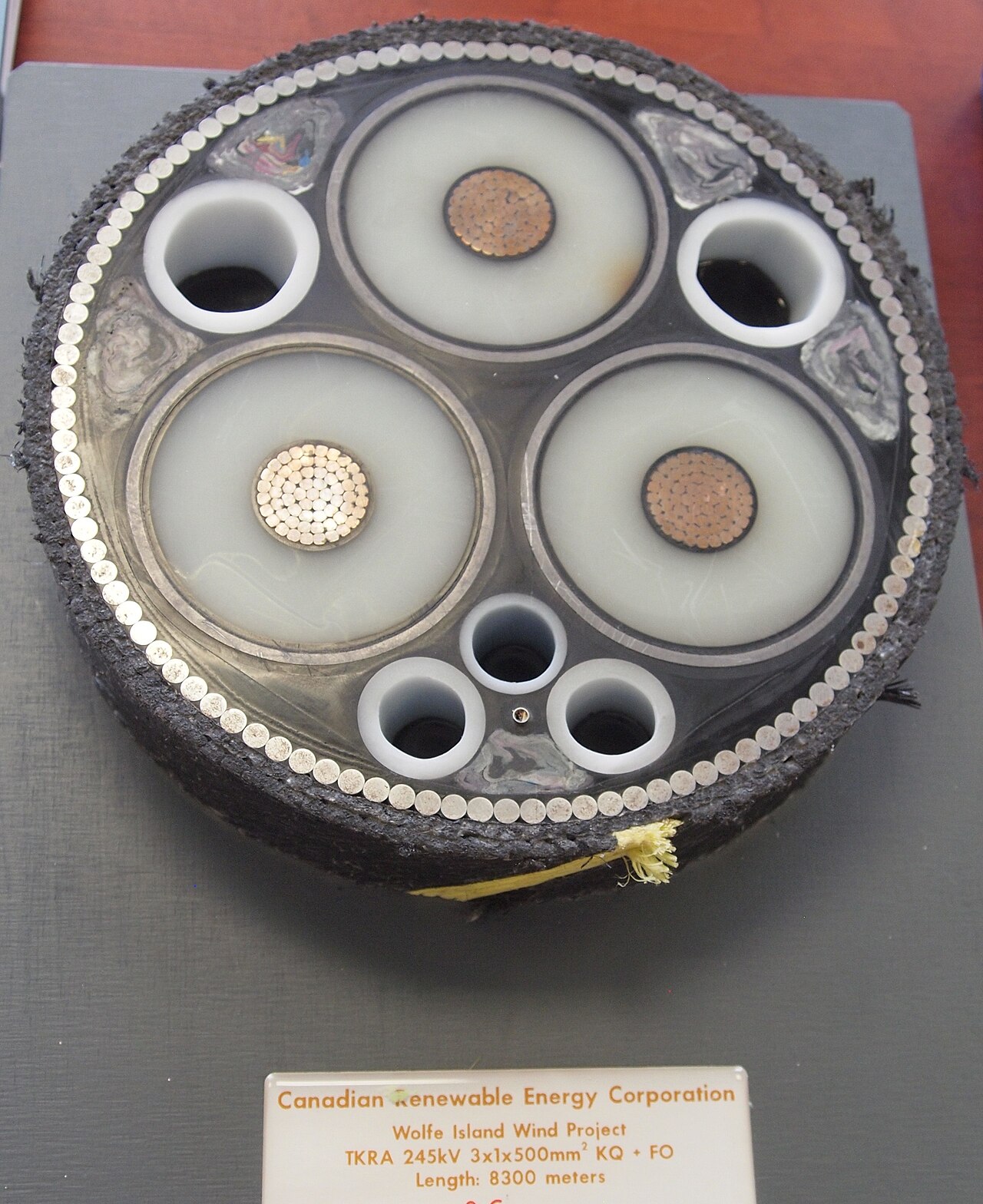
Submarine power cable
Submarine power cable. Photo: Z22, CC BY-SA 3.0, via Wikimedia Commons
Inspector Mode Show All 270 / 270 with inspector value

10 manufacturers · 270 models

Draka/Prysmian

36
LFHÖF-HV 1Cx35mm2 6/10kV unverified
Cross Section (mm²)
35
Voltage Class
6/10kV
Cores
1
Material
Cu
Insulation
EPR
Fire Rating
IEC60332-1
Halogen-Free
nein
Common Failures & Inspection Points
  • Mechanical damage, crushing or excessive bending damages insulation and causes earth faults, conductor failure or intermittent circuits
  • Loose or corroded terminations create resistance heating and cause voltage drop, discoloration or intermittent signals
  • Water ingress through damaged sheaths or glands reduces insulation integrity and causes earth-fault alarms or unreliable operation
  • Heat, oil or chemical exposure degrades insulation and causes cracking, swelling or loss of dielectric integrity
  • Poor screening, bonding or separation on signal cables introduces electrical noise and causes unstable instrumentation or communication data
Service: Inspect accessible cable runs, supports, penetrations, glands, terminations and signs of heat, oil or mechanical damage. Check insulation condition and termination integrity using an approved test method appropriate to the circuit. Maintain fire stopping, segregation and shielding arrangements at penetrations and terminations. Refer to the cable and connected-equipment documentation for the exact figure for test voltage, bend radius and termination requirements.
Spare Parts: Carry approved glands, lugs, ferrules, heat-shrink or jointing materials and representative replacement cable for critical circuits where vessel practice requires it.
Use Cases: Electrical power distribution, motor feeders, control, instrumentation, communication and safety-system wiring.
LFHÖF-HV 3Cx35mm2 6/10kV unverified
Cross Section (mm²)
35
Voltage Class
6/10kV
Cores
3
Material
Cu
Insulation
EPR
Fire Rating
IEC60332-1
Halogen-Free
nein
Common Failures & Inspection Points
  • Mechanical damage, crushing or excessive bending damages insulation and causes earth faults, conductor failure or intermittent circuits
  • Loose or corroded terminations create resistance heating and cause voltage drop, discoloration or intermittent signals
  • Water ingress through damaged sheaths or glands reduces insulation integrity and causes earth-fault alarms or unreliable operation
  • Heat, oil or chemical exposure degrades insulation and causes cracking, swelling or loss of dielectric integrity
  • Poor screening, bonding or separation on signal cables introduces electrical noise and causes unstable instrumentation or communication data
Service: Inspect accessible cable runs, supports, penetrations, glands, terminations and signs of heat, oil or mechanical damage. Check insulation condition and termination integrity using an approved test method appropriate to the circuit. Maintain fire stopping, segregation and shielding arrangements at penetrations and terminations. Refer to the cable and connected-equipment documentation for the exact figure for test voltage, bend radius and termination requirements.
Spare Parts: Carry approved glands, lugs, ferrules, heat-shrink or jointing materials and representative replacement cable for critical circuits where vessel practice requires it.
Use Cases: Electrical power distribution, motor feeders, control, instrumentation, communication and safety-system wiring.
LFHÖF-HV 1Cx50mm2 6/10kV unverified
Cross Section (mm²)
50
Voltage Class
6/10kV
Cores
1
Material
Cu
Insulation
EPR
Fire Rating
IEC60332-1
Halogen-Free
nein
Common Failures & Inspection Points
  • Mechanical damage, crushing or excessive bending damages insulation and causes earth faults, conductor failure or intermittent circuits
  • Loose or corroded terminations create resistance heating and cause voltage drop, discoloration or intermittent signals
  • Water ingress through damaged sheaths or glands reduces insulation integrity and causes earth-fault alarms or unreliable operation
  • Heat, oil or chemical exposure degrades insulation and causes cracking, swelling or loss of dielectric integrity
  • Poor screening, bonding or separation on signal cables introduces electrical noise and causes unstable instrumentation or communication data
Service: Inspect accessible cable runs, supports, penetrations, glands, terminations and signs of heat, oil or mechanical damage. Check insulation condition and termination integrity using an approved test method appropriate to the circuit. Maintain fire stopping, segregation and shielding arrangements at penetrations and terminations. Refer to the cable and connected-equipment documentation for the exact figure for test voltage, bend radius and termination requirements.
Spare Parts: Carry approved glands, lugs, ferrules, heat-shrink or jointing materials and representative replacement cable for critical circuits where vessel practice requires it.
Use Cases: Electrical power distribution, motor feeders, control, instrumentation, communication and safety-system wiring.
LFHÖF-HV 3Cx50mm2 6/10kV unverified
Cross Section (mm²)
50
Voltage Class
6/10kV
Cores
3
Material
Cu
Insulation
EPR
Fire Rating
IEC60332-1
Halogen-Free
nein
Common Failures & Inspection Points
  • Mechanical damage, crushing or excessive bending damages insulation and causes earth faults, conductor failure or intermittent circuits
  • Loose or corroded terminations create resistance heating and cause voltage drop, discoloration or intermittent signals
  • Water ingress through damaged sheaths or glands reduces insulation integrity and causes earth-fault alarms or unreliable operation
  • Heat, oil or chemical exposure degrades insulation and causes cracking, swelling or loss of dielectric integrity
  • Poor screening, bonding or separation on signal cables introduces electrical noise and causes unstable instrumentation or communication data
Service: Inspect accessible cable runs, supports, penetrations, glands, terminations and signs of heat, oil or mechanical damage. Check insulation condition and termination integrity using an approved test method appropriate to the circuit. Maintain fire stopping, segregation and shielding arrangements at penetrations and terminations. Refer to the cable and connected-equipment documentation for the exact figure for test voltage, bend radius and termination requirements.
Spare Parts: Carry approved glands, lugs, ferrules, heat-shrink or jointing materials and representative replacement cable for critical circuits where vessel practice requires it.
Use Cases: Electrical power distribution, motor feeders, control, instrumentation, communication and safety-system wiring.
LFHÖF-HV 1Cx70mm2 6/10kV unverified
Cross Section (mm²)
70
Voltage Class
6/10kV
Cores
1
Material
Cu
Insulation
EPR
Fire Rating
IEC60332-1
Halogen-Free
nein
Common Failures & Inspection Points
  • Mechanical damage, crushing or excessive bending damages insulation and causes earth faults, conductor failure or intermittent circuits
  • Loose or corroded terminations create resistance heating and cause voltage drop, discoloration or intermittent signals
  • Water ingress through damaged sheaths or glands reduces insulation integrity and causes earth-fault alarms or unreliable operation
  • Heat, oil or chemical exposure degrades insulation and causes cracking, swelling or loss of dielectric integrity
  • Poor screening, bonding or separation on signal cables introduces electrical noise and causes unstable instrumentation or communication data
Service: Inspect accessible cable runs, supports, penetrations, glands, terminations and signs of heat, oil or mechanical damage. Check insulation condition and termination integrity using an approved test method appropriate to the circuit. Maintain fire stopping, segregation and shielding arrangements at penetrations and terminations. Refer to the cable and connected-equipment documentation for the exact figure for test voltage, bend radius and termination requirements.
Spare Parts: Carry approved glands, lugs, ferrules, heat-shrink or jointing materials and representative replacement cable for critical circuits where vessel practice requires it.
Use Cases: Electrical power distribution, motor feeders, control, instrumentation, communication and safety-system wiring.
LFHÖF-HV 3Cx70mm2 6/10kV unverified
Cross Section (mm²)
70
Voltage Class
6/10kV
Cores
3
Material
Cu
Insulation
EPR
Fire Rating
IEC60332-1
Halogen-Free
nein
Common Failures & Inspection Points
  • Mechanical damage, crushing or excessive bending damages insulation and causes earth faults, conductor failure or intermittent circuits
  • Loose or corroded terminations create resistance heating and cause voltage drop, discoloration or intermittent signals
  • Water ingress through damaged sheaths or glands reduces insulation integrity and causes earth-fault alarms or unreliable operation
  • Heat, oil or chemical exposure degrades insulation and causes cracking, swelling or loss of dielectric integrity
  • Poor screening, bonding or separation on signal cables introduces electrical noise and causes unstable instrumentation or communication data
Service: Inspect accessible cable runs, supports, penetrations, glands, terminations and signs of heat, oil or mechanical damage. Check insulation condition and termination integrity using an approved test method appropriate to the circuit. Maintain fire stopping, segregation and shielding arrangements at penetrations and terminations. Refer to the cable and connected-equipment documentation for the exact figure for test voltage, bend radius and termination requirements.
Spare Parts: Carry approved glands, lugs, ferrules, heat-shrink or jointing materials and representative replacement cable for critical circuits where vessel practice requires it.
Use Cases: Electrical power distribution, motor feeders, control, instrumentation, communication and safety-system wiring.
LFHÖF-HV 1Cx95mm2 6/10kV unverified
Cross Section (mm²)
95
Voltage Class
6/10kV
Cores
1
Material
Cu
Insulation
EPR
Fire Rating
IEC60332-1
Halogen-Free
nein
Common Failures & Inspection Points
  • Mechanical damage, crushing or excessive bending damages insulation and causes earth faults, conductor failure or intermittent circuits
  • Loose or corroded terminations create resistance heating and cause voltage drop, discoloration or intermittent signals
  • Water ingress through damaged sheaths or glands reduces insulation integrity and causes earth-fault alarms or unreliable operation
  • Heat, oil or chemical exposure degrades insulation and causes cracking, swelling or loss of dielectric integrity
  • Poor screening, bonding or separation on signal cables introduces electrical noise and causes unstable instrumentation or communication data
Service: Inspect accessible cable runs, supports, penetrations, glands, terminations and signs of heat, oil or mechanical damage. Check insulation condition and termination integrity using an approved test method appropriate to the circuit. Maintain fire stopping, segregation and shielding arrangements at penetrations and terminations. Refer to the cable and connected-equipment documentation for the exact figure for test voltage, bend radius and termination requirements.
Spare Parts: Carry approved glands, lugs, ferrules, heat-shrink or jointing materials and representative replacement cable for critical circuits where vessel practice requires it.
Use Cases: Electrical power distribution, motor feeders, control, instrumentation, communication and safety-system wiring.
LFHÖF-HV 3Cx95mm2 6/10kV unverified
Cross Section (mm²)
95
Voltage Class
6/10kV
Cores
3
Material
Cu
Insulation
EPR
Fire Rating
IEC60332-1
Halogen-Free
nein
Common Failures & Inspection Points
  • Mechanical damage, crushing or excessive bending damages insulation and causes earth faults, conductor failure or intermittent circuits
  • Loose or corroded terminations create resistance heating and cause voltage drop, discoloration or intermittent signals
  • Water ingress through damaged sheaths or glands reduces insulation integrity and causes earth-fault alarms or unreliable operation
  • Heat, oil or chemical exposure degrades insulation and causes cracking, swelling or loss of dielectric integrity
  • Poor screening, bonding or separation on signal cables introduces electrical noise and causes unstable instrumentation or communication data
Service: Inspect accessible cable runs, supports, penetrations, glands, terminations and signs of heat, oil or mechanical damage. Check insulation condition and termination integrity using an approved test method appropriate to the circuit. Maintain fire stopping, segregation and shielding arrangements at penetrations and terminations. Refer to the cable and connected-equipment documentation for the exact figure for test voltage, bend radius and termination requirements.
Spare Parts: Carry approved glands, lugs, ferrules, heat-shrink or jointing materials and representative replacement cable for critical circuits where vessel practice requires it.
Use Cases: Electrical power distribution, motor feeders, control, instrumentation, communication and safety-system wiring.
LFHÖF-HV 1Cx120mm2 6/10kV unverified
Cross Section (mm²)
120
Voltage Class
6/10kV
Cores
1
Material
Cu
Insulation
EPR
Fire Rating
IEC60332-1
Halogen-Free
nein
Common Failures & Inspection Points
  • Insulation deterioration caused by heat, oil, ultraviolet exposure, moisture or age, resulting in low insulation resistance, earth faults or intermittent trips
  • Termination overheating caused by loose lugs, corrosion or poor crimping, resulting in discoloration, odor or localized temperature rise
  • Mechanical damage caused by chafing, crushing, excessive bend or unsupported routing, resulting in exposed armor, sheath damage or conductor failure
  • Water ingress caused by damaged glands, sheath or deck penetrations, resulting in corrosion, leakage current or communication faults
  • Screening, grounding or fire-seal deficiency caused by incorrect installation or maintenance, resulting in interference, poor fault protection or reduced fire integrity
Service: Inspect visible cable runs, supports, glands, terminations, penetrations and fire stops for damage, corrosion, overheating and unauthorized modifications. Maintain bend radius and support without imposing strain on equipment terminals. Check insulation resistance or continuity using procedures suitable for connected equipment and isolate sensitive electronics when required. Inspect cable glands and deck penetrations for water ingress and verify screens and armor are terminated according to the approved design. Replace damaged cable with an approved equivalent rather than patching critical insulation casually. Refer to the manufacturer documentation for the exact figure for conductor ratings, bend radius and test limits.
Spare Parts: Keep suitable lengths of approved cable for critical services together with glands, lugs, ferrules, heat-shrink, identification materials and certified fire-stop products appropriate to the installation. Communication and fire-resistant cable replacements must preserve required screening and approval. Verify voltage, conductor size and material before use.
Use Cases: Power distribution, motor feeders, control circuits, instrumentation, safety systems and communications throughout merchant ships and offshore installations.
LFHÖF-HV 3Cx120mm2 6/10kV unverified
Cross Section (mm²)
120
Voltage Class
6/10kV
Cores
3
Material
Cu
Insulation
EPR
Fire Rating
IEC60332-1
Halogen-Free
nein
Common Failures & Inspection Points
  • Insulation deterioration caused by heat, oil, ultraviolet exposure, moisture or age, resulting in low insulation resistance, earth faults or intermittent trips
  • Termination overheating caused by loose lugs, corrosion or poor crimping, resulting in discoloration, odor or localized temperature rise
  • Mechanical damage caused by chafing, crushing, excessive bend or unsupported routing, resulting in exposed armor, sheath damage or conductor failure
  • Water ingress caused by damaged glands, sheath or deck penetrations, resulting in corrosion, leakage current or communication faults
  • Screening, grounding or fire-seal deficiency caused by incorrect installation or maintenance, resulting in interference, poor fault protection or reduced fire integrity
Service: Inspect visible cable runs, supports, glands, terminations, penetrations and fire stops for damage, corrosion, overheating and unauthorized modifications. Maintain bend radius and support without imposing strain on equipment terminals. Check insulation resistance or continuity using procedures suitable for connected equipment and isolate sensitive electronics when required. Inspect cable glands and deck penetrations for water ingress and verify screens and armor are terminated according to the approved design. Replace damaged cable with an approved equivalent rather than patching critical insulation casually. Refer to the manufacturer documentation for the exact figure for conductor ratings, bend radius and test limits.
Spare Parts: Keep suitable lengths of approved cable for critical services together with glands, lugs, ferrules, heat-shrink, identification materials and certified fire-stop products appropriate to the installation. Communication and fire-resistant cable replacements must preserve required screening and approval. Verify voltage, conductor size and material before use.
Use Cases: Power distribution, motor feeders, control circuits, instrumentation, safety systems and communications throughout merchant ships and offshore installations.
LFHÖF-HV 1Cx150mm2 6/10kV unverified
Cross Section (mm²)
150
Voltage Class
6/10kV
Cores
1
Material
Cu
Insulation
EPR
Fire Rating
IEC60332-1
Halogen-Free
nein
Common Failures & Inspection Points
  • Insulation deterioration caused by heat, oil, ultraviolet exposure, moisture or age, resulting in low insulation resistance, earth faults or intermittent trips
  • Termination overheating caused by loose lugs, corrosion or poor crimping, resulting in discoloration, odor or localized temperature rise
  • Mechanical damage caused by chafing, crushing, excessive bend or unsupported routing, resulting in exposed armor, sheath damage or conductor failure
  • Water ingress caused by damaged glands, sheath or deck penetrations, resulting in corrosion, leakage current or communication faults
  • Screening, grounding or fire-seal deficiency caused by incorrect installation or maintenance, resulting in interference, poor fault protection or reduced fire integrity
Service: Inspect visible cable runs, supports, glands, terminations, penetrations and fire stops for damage, corrosion, overheating and unauthorized modifications. Maintain bend radius and support without imposing strain on equipment terminals. Check insulation resistance or continuity using procedures suitable for connected equipment and isolate sensitive electronics when required. Inspect cable glands and deck penetrations for water ingress and verify screens and armor are terminated according to the approved design. Replace damaged cable with an approved equivalent rather than patching critical insulation casually. Refer to the manufacturer documentation for the exact figure for conductor ratings, bend radius and test limits.
Spare Parts: Keep suitable lengths of approved cable for critical services together with glands, lugs, ferrules, heat-shrink, identification materials and certified fire-stop products appropriate to the installation. Communication and fire-resistant cable replacements must preserve required screening and approval. Verify voltage, conductor size and material before use.
Use Cases: Power distribution, motor feeders, control circuits, instrumentation, safety systems and communications throughout merchant ships and offshore installations.
LFHÖF-HV 3Cx150mm2 6/10kV unverified
Cross Section (mm²)
150
Voltage Class
6/10kV
Cores
3
Material
Cu
Insulation
EPR
Fire Rating
IEC60332-1
Halogen-Free
nein
Common Failures & Inspection Points
  • Insulation deterioration caused by heat, oil, ultraviolet exposure, moisture or age, resulting in low insulation resistance, earth faults or intermittent trips
  • Termination overheating caused by loose lugs, corrosion or poor crimping, resulting in discoloration, odor or localized temperature rise
  • Mechanical damage caused by chafing, crushing, excessive bend or unsupported routing, resulting in exposed armor, sheath damage or conductor failure
  • Water ingress caused by damaged glands, sheath or deck penetrations, resulting in corrosion, leakage current or communication faults
  • Screening, grounding or fire-seal deficiency caused by incorrect installation or maintenance, resulting in interference, poor fault protection or reduced fire integrity
Service: Inspect visible cable runs, supports, glands, terminations, penetrations and fire stops for damage, corrosion, overheating and unauthorized modifications. Maintain bend radius and support without imposing strain on equipment terminals. Check insulation resistance or continuity using procedures suitable for connected equipment and isolate sensitive electronics when required. Inspect cable glands and deck penetrations for water ingress and verify screens and armor are terminated according to the approved design. Replace damaged cable with an approved equivalent rather than patching critical insulation casually. Refer to the manufacturer documentation for the exact figure for conductor ratings, bend radius and test limits.
Spare Parts: Keep suitable lengths of approved cable for critical services together with glands, lugs, ferrules, heat-shrink, identification materials and certified fire-stop products appropriate to the installation. Communication and fire-resistant cable replacements must preserve required screening and approval. Verify voltage, conductor size and material before use.
Use Cases: Power distribution, motor feeders, control circuits, instrumentation, safety systems and communications throughout merchant ships and offshore installations.
LFHÖF-HV 1Cx185mm2 6/10kV unverified
Cross Section (mm²)
185
Voltage Class
6/10kV
Cores
1
Material
Cu
Insulation
EPR
Fire Rating
IEC60332-1
Halogen-Free
nein
Common Failures & Inspection Points
  • Insulation deterioration caused by heat, oil, ultraviolet exposure, moisture or age, resulting in low insulation resistance, earth faults or intermittent trips
  • Termination overheating caused by loose lugs, corrosion or poor crimping, resulting in discoloration, odor or localized temperature rise
  • Mechanical damage caused by chafing, crushing, excessive bend or unsupported routing, resulting in exposed armor, sheath damage or conductor failure
  • Water ingress caused by damaged glands, sheath or deck penetrations, resulting in corrosion, leakage current or communication faults
  • Screening, grounding or fire-seal deficiency caused by incorrect installation or maintenance, resulting in interference, poor fault protection or reduced fire integrity
Service: Inspect visible cable runs, supports, glands, terminations, penetrations and fire stops for damage, corrosion, overheating and unauthorized modifications. Maintain bend radius and support without imposing strain on equipment terminals. Check insulation resistance or continuity using procedures suitable for connected equipment and isolate sensitive electronics when required. Inspect cable glands and deck penetrations for water ingress and verify screens and armor are terminated according to the approved design. Replace damaged cable with an approved equivalent rather than patching critical insulation casually. Refer to the manufacturer documentation for the exact figure for conductor ratings, bend radius and test limits.
Spare Parts: Keep suitable lengths of approved cable for critical services together with glands, lugs, ferrules, heat-shrink, identification materials and certified fire-stop products appropriate to the installation. Communication and fire-resistant cable replacements must preserve required screening and approval. Verify voltage, conductor size and material before use.
Use Cases: Power distribution, motor feeders, control circuits, instrumentation, safety systems and communications throughout merchant ships and offshore installations.
LFHÖF-HV 3Cx185mm2 6/10kV unverified
Cross Section (mm²)
185
Voltage Class
6/10kV
Cores
3
Material
Cu
Insulation
EPR
Fire Rating
IEC60332-1
Halogen-Free
nein
Common Failures & Inspection Points
  • Insulation deterioration caused by heat, oil, ultraviolet exposure, moisture or age, resulting in low insulation resistance, earth faults or intermittent trips
  • Termination overheating caused by loose lugs, corrosion or poor crimping, resulting in discoloration, odor or localized temperature rise
  • Mechanical damage caused by chafing, crushing, excessive bend or unsupported routing, resulting in exposed armor, sheath damage or conductor failure
  • Water ingress caused by damaged glands, sheath or deck penetrations, resulting in corrosion, leakage current or communication faults
  • Screening, grounding or fire-seal deficiency caused by incorrect installation or maintenance, resulting in interference, poor fault protection or reduced fire integrity
Service: Inspect visible cable runs, supports, glands, terminations, penetrations and fire stops for damage, corrosion, overheating and unauthorized modifications. Maintain bend radius and support without imposing strain on equipment terminals. Check insulation resistance or continuity using procedures suitable for connected equipment and isolate sensitive electronics when required. Inspect cable glands and deck penetrations for water ingress and verify screens and armor are terminated according to the approved design. Replace damaged cable with an approved equivalent rather than patching critical insulation casually. Refer to the manufacturer documentation for the exact figure for conductor ratings, bend radius and test limits.
Spare Parts: Keep suitable lengths of approved cable for critical services together with glands, lugs, ferrules, heat-shrink, identification materials and certified fire-stop products appropriate to the installation. Communication and fire-resistant cable replacements must preserve required screening and approval. Verify voltage, conductor size and material before use.
Use Cases: Power distribution, motor feeders, control circuits, instrumentation, safety systems and communications throughout merchant ships and offshore installations.
LFHÖF-HV 1Cx240mm2 6/10kV unverified
Cross Section (mm²)
240
Voltage Class
6/10kV
Cores
1
Material
Cu
Insulation
EPR
Fire Rating
IEC60332-1
Halogen-Free
nein
Common Failures & Inspection Points
  • Insulation deterioration caused by heat, oil, ultraviolet exposure, moisture or age, resulting in low insulation resistance, earth faults or intermittent trips
  • Termination overheating caused by loose lugs, corrosion or poor crimping, resulting in discoloration, odor or localized temperature rise
  • Mechanical damage caused by chafing, crushing, excessive bend or unsupported routing, resulting in exposed armor, sheath damage or conductor failure
  • Water ingress caused by damaged glands, sheath or deck penetrations, resulting in corrosion, leakage current or communication faults
  • Screening, grounding or fire-seal deficiency caused by incorrect installation or maintenance, resulting in interference, poor fault protection or reduced fire integrity
Service: Inspect visible cable runs, supports, glands, terminations, penetrations and fire stops for damage, corrosion, overheating and unauthorized modifications. Maintain bend radius and support without imposing strain on equipment terminals. Check insulation resistance or continuity using procedures suitable for connected equipment and isolate sensitive electronics when required. Inspect cable glands and deck penetrations for water ingress and verify screens and armor are terminated according to the approved design. Replace damaged cable with an approved equivalent rather than patching critical insulation casually. Refer to the manufacturer documentation for the exact figure for conductor ratings, bend radius and test limits.
Spare Parts: Keep suitable lengths of approved cable for critical services together with glands, lugs, ferrules, heat-shrink, identification materials and certified fire-stop products appropriate to the installation. Communication and fire-resistant cable replacements must preserve required screening and approval. Verify voltage, conductor size and material before use.
Use Cases: Power distribution, motor feeders, control circuits, instrumentation, safety systems and communications throughout merchant ships and offshore installations.
LFHÖF-HV 3Cx240mm2 6/10kV unverified
Cross Section (mm²)
240
Voltage Class
6/10kV
Cores
3
Material
Cu
Insulation
EPR
Fire Rating
IEC60332-1
Halogen-Free
nein
Common Failures & Inspection Points
  • Insulation deterioration caused by heat, oil, ultraviolet exposure, moisture or age, resulting in low insulation resistance, earth faults or intermittent trips
  • Termination overheating caused by loose lugs, corrosion or poor crimping, resulting in discoloration, odor or localized temperature rise
  • Mechanical damage caused by chafing, crushing, excessive bend or unsupported routing, resulting in exposed armor, sheath damage or conductor failure
  • Water ingress caused by damaged glands, sheath or deck penetrations, resulting in corrosion, leakage current or communication faults
  • Screening, grounding or fire-seal deficiency caused by incorrect installation or maintenance, resulting in interference, poor fault protection or reduced fire integrity
Service: Inspect visible cable runs, supports, glands, terminations, penetrations and fire stops for damage, corrosion, overheating and unauthorized modifications. Maintain bend radius and support without imposing strain on equipment terminals. Check insulation resistance or continuity using procedures suitable for connected equipment and isolate sensitive electronics when required. Inspect cable glands and deck penetrations for water ingress and verify screens and armor are terminated according to the approved design. Replace damaged cable with an approved equivalent rather than patching critical insulation casually. Refer to the manufacturer documentation for the exact figure for conductor ratings, bend radius and test limits.
Spare Parts: Keep suitable lengths of approved cable for critical services together with glands, lugs, ferrules, heat-shrink, identification materials and certified fire-stop products appropriate to the installation. Communication and fire-resistant cable replacements must preserve required screening and approval. Verify voltage, conductor size and material before use.
Use Cases: Power distribution, motor feeders, control circuits, instrumentation, safety systems and communications throughout merchant ships and offshore installations.
LFHÖF-HV 1Cx300mm2 6/10kV unverified
Cross Section (mm²)
300
Voltage Class
6/10kV
Cores
1
Material
Cu
Insulation
EPR
Fire Rating
IEC60332-1
Halogen-Free
nein
Common Failures & Inspection Points
  • Insulation deterioration caused by heat, oil, ultraviolet exposure, moisture or age, resulting in low insulation resistance, earth faults or intermittent trips
  • Termination overheating caused by loose lugs, corrosion or poor crimping, resulting in discoloration, odor or localized temperature rise
  • Mechanical damage caused by chafing, crushing, excessive bend or unsupported routing, resulting in exposed armor, sheath damage or conductor failure
  • Water ingress caused by damaged glands, sheath or deck penetrations, resulting in corrosion, leakage current or communication faults
  • Screening, grounding or fire-seal deficiency caused by incorrect installation or maintenance, resulting in interference, poor fault protection or reduced fire integrity
Service: Inspect visible cable runs, supports, glands, terminations, penetrations and fire stops for damage, corrosion, overheating and unauthorized modifications. Maintain bend radius and support without imposing strain on equipment terminals. Check insulation resistance or continuity using procedures suitable for connected equipment and isolate sensitive electronics when required. Inspect cable glands and deck penetrations for water ingress and verify screens and armor are terminated according to the approved design. Replace damaged cable with an approved equivalent rather than patching critical insulation casually. Refer to the manufacturer documentation for the exact figure for conductor ratings, bend radius and test limits.
Spare Parts: Keep suitable lengths of approved cable for critical services together with glands, lugs, ferrules, heat-shrink, identification materials and certified fire-stop products appropriate to the installation. Communication and fire-resistant cable replacements must preserve required screening and approval. Verify voltage, conductor size and material before use.
Use Cases: Power distribution, motor feeders, control circuits, instrumentation, safety systems and communications throughout merchant ships and offshore installations.
LFHÖF-HV 3Cx300mm2 6/10kV unverified
Cross Section (mm²)
300
Voltage Class
6/10kV
Cores
3
Material
Cu
Insulation
EPR
Fire Rating
IEC60332-1
Halogen-Free
nein
Common Failures & Inspection Points
  • Insulation deterioration caused by heat, oil, ultraviolet exposure, moisture or age, resulting in low insulation resistance, earth faults or intermittent trips
  • Termination overheating caused by loose lugs, corrosion or poor crimping, resulting in discoloration, odor or localized temperature rise
  • Mechanical damage caused by chafing, crushing, excessive bend or unsupported routing, resulting in exposed armor, sheath damage or conductor failure
  • Water ingress caused by damaged glands, sheath or deck penetrations, resulting in corrosion, leakage current or communication faults
  • Screening, grounding or fire-seal deficiency caused by incorrect installation or maintenance, resulting in interference, poor fault protection or reduced fire integrity
Service: Inspect visible cable runs, supports, glands, terminations, penetrations and fire stops for damage, corrosion, overheating and unauthorized modifications. Maintain bend radius and support without imposing strain on equipment terminals. Check insulation resistance or continuity using procedures suitable for connected equipment and isolate sensitive electronics when required. Inspect cable glands and deck penetrations for water ingress and verify screens and armor are terminated according to the approved design. Replace damaged cable with an approved equivalent rather than patching critical insulation casually. Refer to the manufacturer documentation for the exact figure for conductor ratings, bend radius and test limits.
Spare Parts: Keep suitable lengths of approved cable for critical services together with glands, lugs, ferrules, heat-shrink, identification materials and certified fire-stop products appropriate to the installation. Communication and fire-resistant cable replacements must preserve required screening and approval. Verify voltage, conductor size and material before use.
Use Cases: Power distribution, motor feeders, control circuits, instrumentation, safety systems and communications throughout merchant ships and offshore installations.
LFHÖF 1Cx35mm2 6/10kV SWA unverified
Cross Section (mm²)
35
Voltage Class
6/10kV
Cores
1
Material
Cu
Insulation
EPR
Fire Rating
IEC60332-1
Halogen-Free
ja
Armor
SWA
Common Failures & Inspection Points
  • Mechanical damage, crushing or excessive bending damages insulation and causes earth faults, conductor failure or intermittent circuits
  • Loose or corroded terminations create resistance heating and cause voltage drop, discoloration or intermittent signals
  • Water ingress through damaged sheaths or glands reduces insulation integrity and causes earth-fault alarms or unreliable operation
  • Heat, oil or chemical exposure degrades insulation and causes cracking, swelling or loss of dielectric integrity
  • Poor screening, bonding or separation on signal cables introduces electrical noise and causes unstable instrumentation or communication data
Service: Inspect accessible cable runs, supports, penetrations, glands, terminations and signs of heat, oil or mechanical damage. Check insulation condition and termination integrity using an approved test method appropriate to the circuit. Maintain fire stopping, segregation and shielding arrangements at penetrations and terminations. Refer to the cable and connected-equipment documentation for the exact figure for test voltage, bend radius and termination requirements.
Spare Parts: Carry approved glands, lugs, ferrules, heat-shrink or jointing materials and representative replacement cable for critical circuits where vessel practice requires it.
Use Cases: Electrical power distribution, motor feeders, control, instrumentation, communication and safety-system wiring.
LFHÖF 1Cx35mm2 6/10kV unarmored unverified
Cross Section (mm²)
35
Voltage Class
6/10kV
Cores
1
Material
Cu
Insulation
EPR
Fire Rating
IEC60332-1
Halogen-Free
ja
Armor
unarmored
Common Failures & Inspection Points
  • Insulation deterioration caused by heat, oil, ultraviolet exposure, moisture or age, resulting in low insulation resistance, earth faults or intermittent trips
  • Termination overheating caused by loose lugs, corrosion or poor crimping, resulting in discoloration, odor or localized temperature rise
  • Mechanical damage caused by chafing, crushing, excessive bend or unsupported routing, resulting in sheath damage, exposed armor or conductor failure
  • Water ingress caused by damaged glands, sheath or deck penetrations, resulting in corrosion, leakage current or communication faults
  • Screening, grounding or fire-seal deficiency caused by incorrect installation or maintenance, resulting in interference, poor fault protection or reduced fire integrity
Service: Inspect visible cable runs, supports, glands, terminations, penetrations and fire stops for damage, corrosion, overheating and unauthorized modifications. Maintain bend radius and support without imposing strain on equipment terminals. Check insulation resistance or continuity using procedures suitable for the connected equipment and isolate sensitive electronics when required. Inspect cable glands and deck penetrations for water ingress and verify screens and armor are terminated according to the approved design. Replace damaged cable with an approved equivalent rather than patching critical insulation casually. Refer to the manufacturer documentation for the exact figure for conductor ratings, bend radius and test limits.
Spare Parts: Keep suitable lengths of approved cable for critical services together with glands, lugs, ferrules, heat-shrink, identification materials and certified fire-stop products. Instrumentation and fire-resistant cable replacements must preserve required screening and approval.
Use Cases: It is used for shipboard power, control and communication circuits on merchant ships, passenger vessels, offshore units or other vessel types where this equipment category is fitted.
LFHÖF 1Cx50mm2 6/10kV SWA unverified
Cross Section (mm²)
50
Voltage Class
6/10kV
Cores
1
Material
Cu
Insulation
EPR
Fire Rating
IEC60332-1
Halogen-Free
ja
Armor
SWA
Common Failures & Inspection Points
  • Mechanical damage, crushing or excessive bending damages insulation and causes earth faults, conductor failure or intermittent circuits
  • Loose or corroded terminations create resistance heating and cause voltage drop, discoloration or intermittent signals
  • Water ingress through damaged sheaths or glands reduces insulation integrity and causes earth-fault alarms or unreliable operation
  • Heat, oil or chemical exposure degrades insulation and causes cracking, swelling or loss of dielectric integrity
  • Poor screening, bonding or separation on signal cables introduces electrical noise and causes unstable instrumentation or communication data
Service: Inspect accessible cable runs, supports, penetrations, glands, terminations and signs of heat, oil or mechanical damage. Check insulation condition and termination integrity using an approved test method appropriate to the circuit. Maintain fire stopping, segregation and shielding arrangements at penetrations and terminations. Refer to the cable and connected-equipment documentation for the exact figure for test voltage, bend radius and termination requirements.
Spare Parts: Carry approved glands, lugs, ferrules, heat-shrink or jointing materials and representative replacement cable for critical circuits where vessel practice requires it.
Use Cases: Electrical power distribution, motor feeders, control, instrumentation, communication and safety-system wiring.
LFHÖF 1Cx50mm2 6/10kV unarmored unverified
Cross Section (mm²)
50
Voltage Class
6/10kV
Cores
1
Material
Cu
Insulation
EPR
Fire Rating
IEC60332-1
Halogen-Free
ja
Armor
unarmored
Common Failures & Inspection Points
  • Insulation deterioration caused by heat, oil, ultraviolet exposure, moisture or age, resulting in low insulation resistance, earth faults or intermittent trips
  • Termination overheating caused by loose lugs, corrosion or poor crimping, resulting in discoloration, odor or localized temperature rise
  • Mechanical damage caused by chafing, crushing, excessive bend or unsupported routing, resulting in sheath damage, exposed armor or conductor failure
  • Water ingress caused by damaged glands, sheath or deck penetrations, resulting in corrosion, leakage current or communication faults
  • Screening, grounding or fire-seal deficiency caused by incorrect installation or maintenance, resulting in interference, poor fault protection or reduced fire integrity
Service: Inspect visible cable runs, supports, glands, terminations, penetrations and fire stops for damage, corrosion, overheating and unauthorized modifications. Maintain bend radius and support without imposing strain on equipment terminals. Check insulation resistance or continuity using procedures suitable for the connected equipment and isolate sensitive electronics when required. Inspect cable glands and deck penetrations for water ingress and verify screens and armor are terminated according to the approved design. Replace damaged cable with an approved equivalent rather than patching critical insulation casually. Refer to the manufacturer documentation for the exact figure for conductor ratings, bend radius and test limits.
Spare Parts: Keep suitable lengths of approved cable for critical services together with glands, lugs, ferrules, heat-shrink, identification materials and certified fire-stop products. Instrumentation and fire-resistant cable replacements must preserve required screening and approval.
Use Cases: It is used for shipboard power, control and communication circuits on merchant ships, passenger vessels, offshore units or other vessel types where this equipment category is fitted.
LFHÖF 1Cx70mm2 6/10kV SWA unverified
Cross Section (mm²)
70
Voltage Class
6/10kV
Cores
1
Material
Cu
Insulation
EPR
Fire Rating
IEC60332-1
Halogen-Free
ja
Armor
SWA
Common Failures & Inspection Points
  • Mechanical damage, crushing or excessive bending damages insulation and causes earth faults, conductor failure or intermittent circuits
  • Loose or corroded terminations create resistance heating and cause voltage drop, discoloration or intermittent signals
  • Water ingress through damaged sheaths or glands reduces insulation integrity and causes earth-fault alarms or unreliable operation
  • Heat, oil or chemical exposure degrades insulation and causes cracking, swelling or loss of dielectric integrity
  • Poor screening, bonding or separation on signal cables introduces electrical noise and causes unstable instrumentation or communication data
Service: Inspect accessible cable runs, supports, penetrations, glands, terminations and signs of heat, oil or mechanical damage. Check insulation condition and termination integrity using an approved test method appropriate to the circuit. Maintain fire stopping, segregation and shielding arrangements at penetrations and terminations. Refer to the cable and connected-equipment documentation for the exact figure for test voltage, bend radius and termination requirements.
Spare Parts: Carry approved glands, lugs, ferrules, heat-shrink or jointing materials and representative replacement cable for critical circuits where vessel practice requires it.
Use Cases: Electrical power distribution, motor feeders, control, instrumentation, communication and safety-system wiring.
LFHÖF 1Cx70mm2 6/10kV unarmored unverified
Cross Section (mm²)
70
Voltage Class
6/10kV
Cores
1
Material
Cu
Insulation
EPR
Fire Rating
IEC60332-1
Halogen-Free
ja
Armor
unarmored
Common Failures & Inspection Points
  • Insulation deterioration caused by heat, oil, ultraviolet exposure, moisture or age, resulting in low insulation resistance, earth faults or intermittent trips
  • Termination overheating caused by loose lugs, corrosion or poor crimping, resulting in discoloration, odor or localized temperature rise
  • Mechanical damage caused by chafing, crushing, excessive bend or unsupported routing, resulting in sheath damage, exposed armor or conductor failure
  • Water ingress caused by damaged glands, sheath or deck penetrations, resulting in corrosion, leakage current or communication faults
  • Screening, grounding or fire-seal deficiency caused by incorrect installation or maintenance, resulting in interference, poor fault protection or reduced fire integrity
Service: Inspect visible cable runs, supports, glands, terminations, penetrations and fire stops for damage, corrosion, overheating and unauthorized modifications. Maintain bend radius and support without imposing strain on equipment terminals. Check insulation resistance or continuity using procedures suitable for the connected equipment and isolate sensitive electronics when required. Inspect cable glands and deck penetrations for water ingress and verify screens and armor are terminated according to the approved design. Replace damaged cable with an approved equivalent rather than patching critical insulation casually. Refer to the manufacturer documentation for the exact figure for conductor ratings, bend radius and test limits.
Spare Parts: Keep suitable lengths of approved cable for critical services together with glands, lugs, ferrules, heat-shrink, identification materials and certified fire-stop products. Instrumentation and fire-resistant cable replacements must preserve required screening and approval.
Use Cases: It is used for shipboard power, control and communication circuits on merchant ships, passenger vessels, offshore units or other vessel types where this equipment category is fitted.
LFHÖF 1Cx95mm2 6/10kV SWA unverified
Cross Section (mm²)
95
Voltage Class
6/10kV
Cores
1
Material
Cu
Insulation
EPR
Fire Rating
IEC60332-1
Halogen-Free
ja
Armor
SWA
Common Failures & Inspection Points
  • Mechanical damage, crushing or excessive bending damages insulation and causes earth faults, conductor failure or intermittent circuits
  • Loose or corroded terminations create resistance heating and cause voltage drop, discoloration or intermittent signals
  • Water ingress through damaged sheaths or glands reduces insulation integrity and causes earth-fault alarms or unreliable operation
  • Heat, oil or chemical exposure degrades insulation and causes cracking, swelling or loss of dielectric integrity
  • Poor screening, bonding or separation on signal cables introduces electrical noise and causes unstable instrumentation or communication data
Service: Inspect accessible cable runs, supports, penetrations, glands, terminations and signs of heat, oil or mechanical damage. Check insulation condition and termination integrity using an approved test method appropriate to the circuit. Maintain fire stopping, segregation and shielding arrangements at penetrations and terminations. Refer to the cable and connected-equipment documentation for the exact figure for test voltage, bend radius and termination requirements.
Spare Parts: Carry approved glands, lugs, ferrules, heat-shrink or jointing materials and representative replacement cable for critical circuits where vessel practice requires it.
Use Cases: Electrical power distribution, motor feeders, control, instrumentation, communication and safety-system wiring.
LFHÖF 1Cx95mm2 6/10kV unarmored unverified
Cross Section (mm²)
95
Voltage Class
6/10kV
Cores
1
Material
Cu
Insulation
EPR
Fire Rating
IEC60332-1
Halogen-Free
ja
Armor
unarmored
Common Failures & Inspection Points
  • Insulation deterioration caused by heat, oil, ultraviolet exposure, moisture or age, resulting in low insulation resistance, earth faults or intermittent trips
  • Termination overheating caused by loose lugs, corrosion or poor crimping, resulting in discoloration, odor or localized temperature rise
  • Mechanical damage caused by chafing, crushing, excessive bend or unsupported routing, resulting in sheath damage, exposed armor or conductor failure
  • Water ingress caused by damaged glands, sheath or deck penetrations, resulting in corrosion, leakage current or communication faults
  • Screening, grounding or fire-seal deficiency caused by incorrect installation or maintenance, resulting in interference, poor fault protection or reduced fire integrity
Service: Inspect visible cable runs, supports, glands, terminations, penetrations and fire stops for damage, corrosion, overheating and unauthorized modifications. Maintain bend radius and support without imposing strain on equipment terminals. Check insulation resistance or continuity using procedures suitable for the connected equipment and isolate sensitive electronics when required. Inspect cable glands and deck penetrations for water ingress and verify screens and armor are terminated according to the approved design. Replace damaged cable with an approved equivalent rather than patching critical insulation casually. Refer to the manufacturer documentation for the exact figure for conductor ratings, bend radius and test limits.
Spare Parts: Keep suitable lengths of approved cable for critical services together with glands, lugs, ferrules, heat-shrink, identification materials and certified fire-stop products. Instrumentation and fire-resistant cable replacements must preserve required screening and approval.
Use Cases: It is used for shipboard power, control and communication circuits on merchant ships, passenger vessels, offshore units or other vessel types where this equipment category is fitted.
LFHÖF 1Cx120mm2 6/10kV SWA unverified
Cross Section (mm²)
120
Voltage Class
6/10kV
Cores
1
Material
Cu
Insulation
EPR
Fire Rating
IEC60332-1
Halogen-Free
ja
Armor
SWA
Common Failures & Inspection Points
  • Insulation deterioration caused by heat, oil, ultraviolet exposure, moisture or age, resulting in low insulation resistance, earth faults or intermittent trips
  • Termination overheating caused by loose lugs, corrosion or poor crimping, resulting in discoloration, odor or localized temperature rise
  • Mechanical damage caused by chafing, crushing, excessive bend or unsupported routing, resulting in exposed armor, sheath damage or conductor failure
  • Water ingress caused by damaged glands, sheath or deck penetrations, resulting in corrosion, leakage current or communication faults
  • Screening, grounding or fire-seal deficiency caused by incorrect installation or maintenance, resulting in interference, poor fault protection or reduced fire integrity
Service: Inspect visible cable runs, supports, glands, terminations, penetrations and fire stops for damage, corrosion, overheating and unauthorized modifications. Maintain bend radius and support without imposing strain on equipment terminals. Check insulation resistance or continuity using procedures suitable for connected equipment and isolate sensitive electronics when required. Inspect cable glands and deck penetrations for water ingress and verify screens and armor are terminated according to the approved design. Replace damaged cable with an approved equivalent rather than patching critical insulation casually. Refer to the manufacturer documentation for the exact figure for conductor ratings, bend radius and test limits.
Spare Parts: Keep suitable lengths of approved cable for critical services together with glands, lugs, ferrules, heat-shrink, identification materials and certified fire-stop products appropriate to the installation. Communication and fire-resistant cable replacements must preserve required screening and approval. Verify voltage, conductor size and material before use.
Use Cases: Power distribution, motor feeders, control circuits, instrumentation, safety systems and communications throughout merchant ships and offshore installations.
LFHÖF 1Cx120mm2 6/10kV unarmored unverified
Cross Section (mm²)
120
Voltage Class
6/10kV
Cores
1
Material
Cu
Insulation
EPR
Fire Rating
IEC60332-1
Halogen-Free
ja
Armor
unarmored
Common Failures & Inspection Points
  • Insulation deterioration caused by heat, oil, ultraviolet exposure, moisture or age, resulting in low insulation resistance, earth faults or intermittent trips
  • Termination overheating caused by loose lugs, corrosion or poor crimping, resulting in discoloration, odor or localized temperature rise
  • Mechanical damage caused by chafing, crushing, excessive bend or unsupported routing, resulting in sheath damage, exposed armor or conductor failure
  • Water ingress caused by damaged glands, sheath or deck penetrations, resulting in corrosion, leakage current or communication faults
  • Screening, grounding or fire-seal deficiency caused by incorrect installation or maintenance, resulting in interference, poor fault protection or reduced fire integrity
Service: Inspect visible cable runs, supports, glands, terminations, penetrations and fire stops for damage, corrosion, overheating and unauthorized modifications. Maintain bend radius and support without imposing strain on equipment terminals. Check insulation resistance or continuity using procedures suitable for the connected equipment and isolate sensitive electronics when required. Inspect cable glands and deck penetrations for water ingress and verify screens and armor are terminated according to the approved design. Replace damaged cable with an approved equivalent rather than patching critical insulation casually. Refer to the manufacturer documentation for the exact figure for conductor ratings, bend radius and test limits.
Spare Parts: Keep suitable lengths of approved cable for critical services together with glands, lugs, ferrules, heat-shrink, identification materials and certified fire-stop products. Instrumentation and fire-resistant cable replacements must preserve required screening and approval.
Use Cases: It is used for shipboard power, control and communication circuits on merchant ships, passenger vessels, offshore units or other vessel types where this equipment category is fitted.
LFHÖF 1Cx150mm2 6/10kV SWA unverified
Cross Section (mm²)
150
Voltage Class
6/10kV
Cores
1
Material
Cu
Insulation
EPR
Fire Rating
IEC60332-1
Halogen-Free
ja
Armor
SWA
Common Failures & Inspection Points
  • Insulation deterioration caused by heat, oil, ultraviolet exposure, moisture or age, resulting in low insulation resistance, earth faults or intermittent trips
  • Termination overheating caused by loose lugs, corrosion or poor crimping, resulting in discoloration, odor or localized temperature rise
  • Mechanical damage caused by chafing, crushing, excessive bend or unsupported routing, resulting in exposed armor, sheath damage or conductor failure
  • Water ingress caused by damaged glands, sheath or deck penetrations, resulting in corrosion, leakage current or communication faults
  • Screening, grounding or fire-seal deficiency caused by incorrect installation or maintenance, resulting in interference, poor fault protection or reduced fire integrity
Service: Inspect visible cable runs, supports, glands, terminations, penetrations and fire stops for damage, corrosion, overheating and unauthorized modifications. Maintain bend radius and support without imposing strain on equipment terminals. Check insulation resistance or continuity using procedures suitable for connected equipment and isolate sensitive electronics when required. Inspect cable glands and deck penetrations for water ingress and verify screens and armor are terminated according to the approved design. Replace damaged cable with an approved equivalent rather than patching critical insulation casually. Refer to the manufacturer documentation for the exact figure for conductor ratings, bend radius and test limits.
Spare Parts: Keep suitable lengths of approved cable for critical services together with glands, lugs, ferrules, heat-shrink, identification materials and certified fire-stop products appropriate to the installation. Communication and fire-resistant cable replacements must preserve required screening and approval. Verify voltage, conductor size and material before use.
Use Cases: Power distribution, motor feeders, control circuits, instrumentation, safety systems and communications throughout merchant ships and offshore installations.
LFHÖF 1Cx150mm2 6/10kV unarmored unverified
Cross Section (mm²)
150
Voltage Class
6/10kV
Cores
1
Material
Cu
Insulation
EPR
Fire Rating
IEC60332-1
Halogen-Free
ja
Armor
unarmored
Common Failures & Inspection Points
  • Insulation deterioration caused by heat, oil, ultraviolet exposure, moisture or age, resulting in low insulation resistance, earth faults or intermittent trips
  • Termination overheating caused by loose lugs, corrosion or poor crimping, resulting in discoloration, odor or localized temperature rise
  • Mechanical damage caused by chafing, crushing, excessive bend or unsupported routing, resulting in sheath damage, exposed armor or conductor failure
  • Water ingress caused by damaged glands, sheath or deck penetrations, resulting in corrosion, leakage current or communication faults
  • Screening, grounding or fire-seal deficiency caused by incorrect installation or maintenance, resulting in interference, poor fault protection or reduced fire integrity
Service: Inspect visible cable runs, supports, glands, terminations, penetrations and fire stops for damage, corrosion, overheating and unauthorized modifications. Maintain bend radius and support without imposing strain on equipment terminals. Check insulation resistance or continuity using procedures suitable for the connected equipment and isolate sensitive electronics when required. Inspect cable glands and deck penetrations for water ingress and verify screens and armor are terminated according to the approved design. Replace damaged cable with an approved equivalent rather than patching critical insulation casually. Refer to the manufacturer documentation for the exact figure for conductor ratings, bend radius and test limits.
Spare Parts: Keep suitable lengths of approved cable for critical services together with glands, lugs, ferrules, heat-shrink, identification materials and certified fire-stop products. Instrumentation and fire-resistant cable replacements must preserve required screening and approval.
Use Cases: It is used for shipboard power, control and communication circuits on merchant ships, passenger vessels, offshore units or other vessel types where this equipment category is fitted.
LFHÖF 1Cx185mm2 6/10kV SWA unverified
Cross Section (mm²)
185
Voltage Class
6/10kV
Cores
1
Material
Cu
Insulation
EPR
Fire Rating
IEC60332-1
Halogen-Free
ja
Armor
SWA
Common Failures & Inspection Points
  • Insulation deterioration caused by heat, oil, ultraviolet exposure, moisture or age, resulting in low insulation resistance, earth faults or intermittent trips
  • Termination overheating caused by loose lugs, corrosion or poor crimping, resulting in discoloration, odor or localized temperature rise
  • Mechanical damage caused by chafing, crushing, excessive bend or unsupported routing, resulting in exposed armor, sheath damage or conductor failure
  • Water ingress caused by damaged glands, sheath or deck penetrations, resulting in corrosion, leakage current or communication faults
  • Screening, grounding or fire-seal deficiency caused by incorrect installation or maintenance, resulting in interference, poor fault protection or reduced fire integrity
Service: Inspect visible cable runs, supports, glands, terminations, penetrations and fire stops for damage, corrosion, overheating and unauthorized modifications. Maintain bend radius and support without imposing strain on equipment terminals. Check insulation resistance or continuity using procedures suitable for connected equipment and isolate sensitive electronics when required. Inspect cable glands and deck penetrations for water ingress and verify screens and armor are terminated according to the approved design. Replace damaged cable with an approved equivalent rather than patching critical insulation casually. Refer to the manufacturer documentation for the exact figure for conductor ratings, bend radius and test limits.
Spare Parts: Keep suitable lengths of approved cable for critical services together with glands, lugs, ferrules, heat-shrink, identification materials and certified fire-stop products appropriate to the installation. Communication and fire-resistant cable replacements must preserve required screening and approval. Verify voltage, conductor size and material before use.
Use Cases: Power distribution, motor feeders, control circuits, instrumentation, safety systems and communications throughout merchant ships and offshore installations.
LFHÖF 1Cx185mm2 6/10kV unarmored unverified
Cross Section (mm²)
185
Voltage Class
6/10kV
Cores
1
Material
Cu
Insulation
EPR
Fire Rating
IEC60332-1
Halogen-Free
ja
Armor
unarmored
Common Failures & Inspection Points
  • Insulation deterioration caused by heat, oil, ultraviolet exposure, moisture or age, resulting in low insulation resistance, earth faults or intermittent trips
  • Termination overheating caused by loose lugs, corrosion or poor crimping, resulting in discoloration, odor or localized temperature rise
  • Mechanical damage caused by chafing, crushing, excessive bend or unsupported routing, resulting in sheath damage, exposed armor or conductor failure
  • Water ingress caused by damaged glands, sheath or deck penetrations, resulting in corrosion, leakage current or communication faults
  • Screening, grounding or fire-seal deficiency caused by incorrect installation or maintenance, resulting in interference, poor fault protection or reduced fire integrity
Service: Inspect visible cable runs, supports, glands, terminations, penetrations and fire stops for damage, corrosion, overheating and unauthorized modifications. Maintain bend radius and support without imposing strain on equipment terminals. Check insulation resistance or continuity using procedures suitable for the connected equipment and isolate sensitive electronics when required. Inspect cable glands and deck penetrations for water ingress and verify screens and armor are terminated according to the approved design. Replace damaged cable with an approved equivalent rather than patching critical insulation casually. Refer to the manufacturer documentation for the exact figure for conductor ratings, bend radius and test limits.
Spare Parts: Keep suitable lengths of approved cable for critical services together with glands, lugs, ferrules, heat-shrink, identification materials and certified fire-stop products. Instrumentation and fire-resistant cable replacements must preserve required screening and approval.
Use Cases: It is used for shipboard power, control and communication circuits on merchant ships, passenger vessels, offshore units or other vessel types where this equipment category is fitted.
LFHÖF 1Cx240mm2 6/10kV SWA unverified
Cross Section (mm²)
240
Voltage Class
6/10kV
Cores
1
Material
Cu
Insulation
EPR
Fire Rating
IEC60332-1
Halogen-Free
ja
Armor
SWA
Common Failures & Inspection Points
  • Insulation deterioration caused by heat, oil, ultraviolet exposure, moisture or age, resulting in low insulation resistance, earth faults or intermittent trips
  • Termination overheating caused by loose lugs, corrosion or poor crimping, resulting in discoloration, odor or localized temperature rise
  • Mechanical damage caused by chafing, crushing, excessive bend or unsupported routing, resulting in exposed armor, sheath damage or conductor failure
  • Water ingress caused by damaged glands, sheath or deck penetrations, resulting in corrosion, leakage current or communication faults
  • Screening, grounding or fire-seal deficiency caused by incorrect installation or maintenance, resulting in interference, poor fault protection or reduced fire integrity
Service: Inspect visible cable runs, supports, glands, terminations, penetrations and fire stops for damage, corrosion, overheating and unauthorized modifications. Maintain bend radius and support without imposing strain on equipment terminals. Check insulation resistance or continuity using procedures suitable for connected equipment and isolate sensitive electronics when required. Inspect cable glands and deck penetrations for water ingress and verify screens and armor are terminated according to the approved design. Replace damaged cable with an approved equivalent rather than patching critical insulation casually. Refer to the manufacturer documentation for the exact figure for conductor ratings, bend radius and test limits.
Spare Parts: Keep suitable lengths of approved cable for critical services together with glands, lugs, ferrules, heat-shrink, identification materials and certified fire-stop products appropriate to the installation. Communication and fire-resistant cable replacements must preserve required screening and approval. Verify voltage, conductor size and material before use.
Use Cases: Power distribution, motor feeders, control circuits, instrumentation, safety systems and communications throughout merchant ships and offshore installations.
LFHÖF 1Cx240mm2 6/10kV unarmored unverified
Cross Section (mm²)
240
Voltage Class
6/10kV
Cores
1
Material
Cu
Insulation
EPR
Fire Rating
IEC60332-1
Halogen-Free
ja
Armor
unarmored
Common Failures & Inspection Points
  • Insulation deterioration caused by heat, oil, ultraviolet exposure, moisture or age, resulting in low insulation resistance, earth faults or intermittent trips
  • Termination overheating caused by loose lugs, corrosion or poor crimping, resulting in discoloration, odor or localized temperature rise
  • Mechanical damage caused by chafing, crushing, excessive bend or unsupported routing, resulting in sheath damage, exposed armor or conductor failure
  • Water ingress caused by damaged glands, sheath or deck penetrations, resulting in corrosion, leakage current or communication faults
  • Screening, grounding or fire-seal deficiency caused by incorrect installation or maintenance, resulting in interference, poor fault protection or reduced fire integrity
Service: Inspect visible cable runs, supports, glands, terminations, penetrations and fire stops for damage, corrosion, overheating and unauthorized modifications. Maintain bend radius and support without imposing strain on equipment terminals. Check insulation resistance or continuity using procedures suitable for the connected equipment and isolate sensitive electronics when required. Inspect cable glands and deck penetrations for water ingress and verify screens and armor are terminated according to the approved design. Replace damaged cable with an approved equivalent rather than patching critical insulation casually. Refer to the manufacturer documentation for the exact figure for conductor ratings, bend radius and test limits.
Spare Parts: Keep suitable lengths of approved cable for critical services together with glands, lugs, ferrules, heat-shrink, identification materials and certified fire-stop products. Instrumentation and fire-resistant cable replacements must preserve required screening and approval.
Use Cases: It is used for shipboard power, control and communication circuits on merchant ships, passenger vessels, offshore units or other vessel types where this equipment category is fitted.
LFHÖF 1Cx300mm2 6/10kV SWA unverified
Cross Section (mm²)
300
Voltage Class
6/10kV
Cores
1
Material
Cu
Insulation
EPR
Fire Rating
IEC60332-1
Halogen-Free
ja
Armor
SWA
Common Failures & Inspection Points
  • Insulation deterioration caused by heat, oil, ultraviolet exposure, moisture or age, resulting in low insulation resistance, earth faults or intermittent trips
  • Termination overheating caused by loose lugs, corrosion or poor crimping, resulting in discoloration, odor or localized temperature rise
  • Mechanical damage caused by chafing, crushing, excessive bend or unsupported routing, resulting in exposed armor, sheath damage or conductor failure
  • Water ingress caused by damaged glands, sheath or deck penetrations, resulting in corrosion, leakage current or communication faults
  • Screening, grounding or fire-seal deficiency caused by incorrect installation or maintenance, resulting in interference, poor fault protection or reduced fire integrity
Service: Inspect visible cable runs, supports, glands, terminations, penetrations and fire stops for damage, corrosion, overheating and unauthorized modifications. Maintain bend radius and support without imposing strain on equipment terminals. Check insulation resistance or continuity using procedures suitable for connected equipment and isolate sensitive electronics when required. Inspect cable glands and deck penetrations for water ingress and verify screens and armor are terminated according to the approved design. Replace damaged cable with an approved equivalent rather than patching critical insulation casually. Refer to the manufacturer documentation for the exact figure for conductor ratings, bend radius and test limits.
Spare Parts: Keep suitable lengths of approved cable for critical services together with glands, lugs, ferrules, heat-shrink, identification materials and certified fire-stop products appropriate to the installation. Communication and fire-resistant cable replacements must preserve required screening and approval. Verify voltage, conductor size and material before use.
Use Cases: Power distribution, motor feeders, control circuits, instrumentation, safety systems and communications throughout merchant ships and offshore installations.
LFHÖF 1Cx300mm2 6/10kV unarmored unverified
Cross Section (mm²)
300
Voltage Class
6/10kV
Cores
1
Material
Cu
Insulation
EPR
Fire Rating
IEC60332-1
Halogen-Free
ja
Armor
unarmored
Common Failures & Inspection Points
  • Insulation deterioration caused by heat, oil, ultraviolet exposure, moisture or age, resulting in low insulation resistance, earth faults or intermittent trips
  • Termination overheating caused by loose lugs, corrosion or poor crimping, resulting in discoloration, odor or localized temperature rise
  • Mechanical damage caused by chafing, crushing, excessive bend or unsupported routing, resulting in sheath damage, exposed armor or conductor failure
  • Water ingress caused by damaged glands, sheath or deck penetrations, resulting in corrosion, leakage current or communication faults
  • Screening, grounding or fire-seal deficiency caused by incorrect installation or maintenance, resulting in interference, poor fault protection or reduced fire integrity
Service: Inspect visible cable runs, supports, glands, terminations, penetrations and fire stops for damage, corrosion, overheating and unauthorized modifications. Maintain bend radius and support without imposing strain on equipment terminals. Check insulation resistance or continuity using procedures suitable for the connected equipment and isolate sensitive electronics when required. Inspect cable glands and deck penetrations for water ingress and verify screens and armor are terminated according to the approved design. Replace damaged cable with an approved equivalent rather than patching critical insulation casually. Refer to the manufacturer documentation for the exact figure for conductor ratings, bend radius and test limits.
Spare Parts: Keep suitable lengths of approved cable for critical services together with glands, lugs, ferrules, heat-shrink, identification materials and certified fire-stop products. Instrumentation and fire-resistant cable replacements must preserve required screening and approval.
Use Cases: It is used for shipboard power, control and communication circuits on merchant ships, passenger vessels, offshore units or other vessel types where this equipment category is fitted.

Helkama Bica

36
LKAM 1Cx35mm2 6/10kV unverified
Cross Section (mm²)
35
Voltage Class
6/10kV
Cores
1
Material
Cu
Insulation
EPR
Fire Rating
IEC60332-1
Halogen-Free
nein
Common Failures & Inspection Points
  • Insulation damage from heat, abrasion, oil, chemicals, or mechanical impact causes earth faults, leakage current, or intermittent circuits
  • Loose or corroded terminations increase contact resistance and appear as heating, voltage drop, or unstable signals
  • Water ingress through glands, junction boxes, or damaged sheath causes corrosion, insulation deterioration, or repeated electrical faults
  • Excessive bending, unsupported runs, or vibration damages conductors or shielding and can produce intermittent open circuits
  • Fire or thermal exposure beyond the cable's design condition can degrade insulation and lead to loss of continuity or short circuit
Service: Inspect accessible routes, support spacing, bend condition, segregation, glands, penetrations, fire stops, sheath damage, terminations, earthing or shielding, and signs of overheating. Insulation and continuity testing must suit the circuit and connected equipment; refer to approved cable data for exact test voltages and installation limits.
Spare Parts: Keep approved glands, lugs, ferrules, terminals, junction-box sealing items, repair sleeves where permitted, and suitable replacement cable of the exact approved type and rating.
Use Cases: Used throughout all vessel types for power distribution, control, instrumentation, communications, safety systems, and emergency circuits.
LKAM 3Cx35mm2 6/10kV unverified
Cross Section (mm²)
35
Voltage Class
6/10kV
Cores
3
Material
Cu
Insulation
EPR
Fire Rating
IEC60332-1
Halogen-Free
nein
Common Failures & Inspection Points
  • Insulation damage from heat, abrasion, oil, chemicals, or mechanical impact causes earth faults, leakage current, or intermittent circuits
  • Loose or corroded terminations increase contact resistance and appear as heating, voltage drop, or unstable signals
  • Water ingress through glands, junction boxes, or damaged sheath causes corrosion, insulation deterioration, or repeated electrical faults
  • Excessive bending, unsupported runs, or vibration damages conductors or shielding and can produce intermittent open circuits
  • Fire or thermal exposure beyond the cable's design condition can degrade insulation and lead to loss of continuity or short circuit
Service: Inspect accessible routes, support spacing, bend condition, segregation, glands, penetrations, fire stops, sheath damage, terminations, earthing or shielding, and signs of overheating. Insulation and continuity testing must suit the circuit and connected equipment; refer to approved cable data for exact test voltages and installation limits.
Spare Parts: Keep approved glands, lugs, ferrules, terminals, junction-box sealing items, repair sleeves where permitted, and suitable replacement cable of the exact approved type and rating.
Use Cases: Used throughout all vessel types for power distribution, control, instrumentation, communications, safety systems, and emergency circuits.
LKAM 1Cx50mm2 6/10kV unverified
Cross Section (mm²)
50
Voltage Class
6/10kV
Cores
1
Material
Cu
Insulation
EPR
Fire Rating
IEC60332-1
Halogen-Free
nein
Common Failures & Inspection Points
  • Insulation damage from heat, abrasion, oil, chemicals, or mechanical impact causes earth faults, leakage current, or intermittent circuits
  • Loose or corroded terminations increase contact resistance and appear as heating, voltage drop, or unstable signals
  • Water ingress through glands, junction boxes, or damaged sheath causes corrosion, insulation deterioration, or repeated electrical faults
  • Excessive bending, unsupported runs, or vibration damages conductors or shielding and can produce intermittent open circuits
  • Fire or thermal exposure beyond the cable's design condition can degrade insulation and lead to loss of continuity or short circuit
Service: Inspect accessible routes, support spacing, bend condition, segregation, glands, penetrations, fire stops, sheath damage, terminations, earthing or shielding, and signs of overheating. Insulation and continuity testing must suit the circuit and connected equipment; refer to approved cable data for exact test voltages and installation limits.
Spare Parts: Keep approved glands, lugs, ferrules, terminals, junction-box sealing items, repair sleeves where permitted, and suitable replacement cable of the exact approved type and rating.
Use Cases: Used throughout all vessel types for power distribution, control, instrumentation, communications, safety systems, and emergency circuits.
LKAM 3Cx50mm2 6/10kV unverified
Cross Section (mm²)
50
Voltage Class
6/10kV
Cores
3
Material
Cu
Insulation
EPR
Fire Rating
IEC60332-1
Halogen-Free
nein
Common Failures & Inspection Points
  • Insulation damage from heat, abrasion, oil, chemicals, or mechanical impact causes earth faults, leakage current, or intermittent circuits
  • Loose or corroded terminations increase contact resistance and appear as heating, voltage drop, or unstable signals
  • Water ingress through glands, junction boxes, or damaged sheath causes corrosion, insulation deterioration, or repeated electrical faults
  • Excessive bending, unsupported runs, or vibration damages conductors or shielding and can produce intermittent open circuits
  • Fire or thermal exposure beyond the cable's design condition can degrade insulation and lead to loss of continuity or short circuit
Service: Inspect accessible routes, support spacing, bend condition, segregation, glands, penetrations, fire stops, sheath damage, terminations, earthing or shielding, and signs of overheating. Insulation and continuity testing must suit the circuit and connected equipment; refer to approved cable data for exact test voltages and installation limits.
Spare Parts: Keep approved glands, lugs, ferrules, terminals, junction-box sealing items, repair sleeves where permitted, and suitable replacement cable of the exact approved type and rating.
Use Cases: Used throughout all vessel types for power distribution, control, instrumentation, communications, safety systems, and emergency circuits.
LKAM 1Cx70mm2 6/10kV unverified
Cross Section (mm²)
70
Voltage Class
6/10kV
Cores
1
Material
Cu
Insulation
EPR
Fire Rating
IEC60332-1
Halogen-Free
nein
Common Failures & Inspection Points
  • Insulation damage from heat, abrasion, oil, chemicals, or mechanical impact causes earth faults, leakage current, or intermittent circuits
  • Loose or corroded terminations increase contact resistance and appear as heating, voltage drop, or unstable signals
  • Water ingress through glands, junction boxes, or damaged sheath causes corrosion, insulation deterioration, or repeated electrical faults
  • Excessive bending, unsupported runs, or vibration damages conductors or shielding and can produce intermittent open circuits
  • Fire or thermal exposure beyond the cable's design condition can degrade insulation and lead to loss of continuity or short circuit
Service: Inspect accessible routes, support spacing, bend condition, segregation, glands, penetrations, fire stops, sheath damage, terminations, earthing or shielding, and signs of overheating. Insulation and continuity testing must suit the circuit and connected equipment; refer to approved cable data for exact test voltages and installation limits.
Spare Parts: Keep approved glands, lugs, ferrules, terminals, junction-box sealing items, repair sleeves where permitted, and suitable replacement cable of the exact approved type and rating.
Use Cases: Used throughout all vessel types for power distribution, control, instrumentation, communications, safety systems, and emergency circuits.
LKAM 3Cx70mm2 6/10kV unverified
Cross Section (mm²)
70
Voltage Class
6/10kV
Cores
3
Material
Cu
Insulation
EPR
Fire Rating
IEC60332-1
Halogen-Free
nein
Common Failures & Inspection Points
  • Insulation damage from heat, abrasion, oil, chemicals, or mechanical impact causes earth faults, leakage current, or intermittent circuits
  • Loose or corroded terminations increase contact resistance and appear as heating, voltage drop, or unstable signals
  • Water ingress through glands, junction boxes, or damaged sheath causes corrosion, insulation deterioration, or repeated electrical faults
  • Excessive bending, unsupported runs, or vibration damages conductors or shielding and can produce intermittent open circuits
  • Fire or thermal exposure beyond the cable's design condition can degrade insulation and lead to loss of continuity or short circuit
Service: Inspect accessible routes, support spacing, bend condition, segregation, glands, penetrations, fire stops, sheath damage, terminations, earthing or shielding, and signs of overheating. Insulation and continuity testing must suit the circuit and connected equipment; refer to approved cable data for exact test voltages and installation limits.
Spare Parts: Keep approved glands, lugs, ferrules, terminals, junction-box sealing items, repair sleeves where permitted, and suitable replacement cable of the exact approved type and rating.
Use Cases: Used throughout all vessel types for power distribution, control, instrumentation, communications, safety systems, and emergency circuits.
LKAM 1Cx95mm2 6/10kV unverified
Cross Section (mm²)
95
Voltage Class
6/10kV
Cores
1
Material
Cu
Insulation
EPR
Fire Rating
IEC60332-1
Halogen-Free
nein
Common Failures & Inspection Points
  • Insulation damage from heat, abrasion, oil, chemicals, or mechanical impact causes earth faults, leakage current, or intermittent circuits
  • Loose or corroded terminations increase contact resistance and appear as heating, voltage drop, or unstable signals
  • Water ingress through glands, junction boxes, or damaged sheath causes corrosion, insulation deterioration, or repeated electrical faults
  • Excessive bending, unsupported runs, or vibration damages conductors or shielding and can produce intermittent open circuits
  • Fire or thermal exposure beyond the cable's design condition can degrade insulation and lead to loss of continuity or short circuit
Service: Inspect accessible routes, support spacing, bend condition, segregation, glands, penetrations, fire stops, sheath damage, terminations, earthing or shielding, and signs of overheating. Insulation and continuity testing must suit the circuit and connected equipment; refer to approved cable data for exact test voltages and installation limits.
Spare Parts: Keep approved glands, lugs, ferrules, terminals, junction-box sealing items, repair sleeves where permitted, and suitable replacement cable of the exact approved type and rating.
Use Cases: Used throughout all vessel types for power distribution, control, instrumentation, communications, safety systems, and emergency circuits.
LKAM 3Cx95mm2 6/10kV unverified
Cross Section (mm²)
95
Voltage Class
6/10kV
Cores
3
Material
Cu
Insulation
EPR
Fire Rating
IEC60332-1
Halogen-Free
nein
Common Failures & Inspection Points
  • Insulation damage from heat, abrasion, oil, chemicals, or mechanical impact causes earth faults, leakage current, or intermittent circuits
  • Loose or corroded terminations increase contact resistance and appear as heating, voltage drop, or unstable signals
  • Water ingress through glands, junction boxes, or damaged sheath causes corrosion, insulation deterioration, or repeated electrical faults
  • Excessive bending, unsupported runs, or vibration damages conductors or shielding and can produce intermittent open circuits
  • Fire or thermal exposure beyond the cable's design condition can degrade insulation and lead to loss of continuity or short circuit
Service: Inspect accessible routes, support spacing, bend condition, segregation, glands, penetrations, fire stops, sheath damage, terminations, earthing or shielding, and signs of overheating. Insulation and continuity testing must suit the circuit and connected equipment; refer to approved cable data for exact test voltages and installation limits.
Spare Parts: Keep approved glands, lugs, ferrules, terminals, junction-box sealing items, repair sleeves where permitted, and suitable replacement cable of the exact approved type and rating.
Use Cases: Used throughout all vessel types for power distribution, control, instrumentation, communications, safety systems, and emergency circuits.
LKAM 1Cx120mm2 6/10kV unverified
Cross Section (mm²)
120
Voltage Class
6/10kV
Cores
1
Material
Cu
Insulation
EPR
Fire Rating
IEC60332-1
Halogen-Free
nein
Common Failures & Inspection Points
  • Insulation deterioration from heat, oil, chemicals, UV exposure or ageing, typically indicated by low insulation resistance, earth-fault alarms or visible cracking
  • Mechanical damage from chafing, crushing or poor support, typically indicated by exposed armour or conductors, intermittent faults or short circuits
  • Water ingress through damaged glands or transits, typically indicated by corrosion, insulation alarms or intermittent operation
  • Loose or overheated terminations from poor tightening or excessive current, typically indicated by discoloration, hot spots, voltage drop or burnt insulation
  • Shielding, armour or bonding discontinuity from corrosion or incorrect termination, typically indicated by electrical noise, unreliable signals or failed protective bonding checks
Service: Inspect cable routes, supports, bending, glands, armour or screens, fire-stop transits and terminations; perform insulation, continuity or functional testing as appropriate and use manufacturer/class documentation for exact acceptance values.
Spare Parts: Keep approved cable glands, lugs, ferrules, heat-shrink, transit inserts or sealing modules and suitable lengths of critical cable types used on board.
Use Cases: Used in all vessel electrical, automation, propulsion, communication and safety systems, with the exact cable type selected for voltage, fire performance and signal duty. This entry applies specifically to the Power Cable (6/10 kV) variant identified as Helkama Bica LKAM 1Cx120mm2 6/10kV.
LKAM 3Cx120mm2 6/10kV unverified
Cross Section (mm²)
120
Voltage Class
6/10kV
Cores
3
Material
Cu
Insulation
EPR
Fire Rating
IEC60332-1
Halogen-Free
nein
Common Failures & Inspection Points
  • Insulation deterioration from heat, oil, chemicals, UV exposure or ageing, typically indicated by low insulation resistance, earth-fault alarms or visible cracking
  • Mechanical damage from chafing, crushing or poor support, typically indicated by exposed armour or conductors, intermittent faults or short circuits
  • Water ingress through damaged glands or transits, typically indicated by corrosion, insulation alarms or intermittent operation
  • Loose or overheated terminations from poor tightening or excessive current, typically indicated by discoloration, hot spots, voltage drop or burnt insulation
  • Shielding, armour or bonding discontinuity from corrosion or incorrect termination, typically indicated by electrical noise, unreliable signals or failed protective bonding checks
Service: Inspect cable routes, supports, bending, glands, armour or screens, fire-stop transits and terminations; perform insulation, continuity or functional testing as appropriate and use manufacturer/class documentation for exact acceptance values.
Spare Parts: Keep approved cable glands, lugs, ferrules, heat-shrink, transit inserts or sealing modules and suitable lengths of critical cable types used on board.
Use Cases: Used in all vessel electrical, automation, propulsion, communication and safety systems, with the exact cable type selected for voltage, fire performance and signal duty. This entry applies specifically to the Power Cable (6/10 kV) variant identified as Helkama Bica LKAM 3Cx120mm2 6/10kV.
LKAM 1Cx150mm2 6/10kV unverified
Cross Section (mm²)
150
Voltage Class
6/10kV
Cores
1
Material
Cu
Insulation
EPR
Fire Rating
IEC60332-1
Halogen-Free
nein
Common Failures & Inspection Points
  • Insulation deterioration from heat, oil, chemicals, UV exposure or ageing, typically indicated by low insulation resistance, earth-fault alarms or visible cracking
  • Mechanical damage from chafing, crushing or poor support, typically indicated by exposed armour or conductors, intermittent faults or short circuits
  • Water ingress through damaged glands or transits, typically indicated by corrosion, insulation alarms or intermittent operation
  • Loose or overheated terminations from poor tightening or excessive current, typically indicated by discoloration, hot spots, voltage drop or burnt insulation
  • Shielding, armour or bonding discontinuity from corrosion or incorrect termination, typically indicated by electrical noise, unreliable signals or failed protective bonding checks
Service: Inspect cable routes, supports, bending, glands, armour or screens, fire-stop transits and terminations; perform insulation, continuity or functional testing as appropriate and use manufacturer/class documentation for exact acceptance values.
Spare Parts: Keep approved cable glands, lugs, ferrules, heat-shrink, transit inserts or sealing modules and suitable lengths of critical cable types used on board.
Use Cases: Used in all vessel electrical, automation, propulsion, communication and safety systems, with the exact cable type selected for voltage, fire performance and signal duty. This entry applies specifically to the Power Cable (6/10 kV) variant identified as Helkama Bica LKAM 1Cx150mm2 6/10kV.
LKAM 3Cx150mm2 6/10kV unverified
Cross Section (mm²)
150
Voltage Class
6/10kV
Cores
3
Material
Cu
Insulation
EPR
Fire Rating
IEC60332-1
Halogen-Free
nein
Common Failures & Inspection Points
  • Insulation deterioration from heat, oil, chemicals, UV exposure or ageing, typically indicated by low insulation resistance, earth-fault alarms or visible cracking
  • Mechanical damage from chafing, crushing or poor support, typically indicated by exposed armour or conductors, intermittent faults or short circuits
  • Water ingress through damaged glands or transits, typically indicated by corrosion, insulation alarms or intermittent operation
  • Loose or overheated terminations from poor tightening or excessive current, typically indicated by discoloration, hot spots, voltage drop or burnt insulation
  • Shielding, armour or bonding discontinuity from corrosion or incorrect termination, typically indicated by electrical noise, unreliable signals or failed protective bonding checks
Service: Inspect cable routes, supports, bending, glands, armour or screens, fire-stop transits and terminations; perform insulation, continuity or functional testing as appropriate and use manufacturer/class documentation for exact acceptance values.
Spare Parts: Keep approved cable glands, lugs, ferrules, heat-shrink, transit inserts or sealing modules and suitable lengths of critical cable types used on board.
Use Cases: Used in all vessel electrical, automation, propulsion, communication and safety systems, with the exact cable type selected for voltage, fire performance and signal duty. This entry applies specifically to the Power Cable (6/10 kV) variant identified as Helkama Bica LKAM 3Cx150mm2 6/10kV.
LKAM 1Cx185mm2 6/10kV unverified
Cross Section (mm²)
185
Voltage Class
6/10kV
Cores
1
Material
Cu
Insulation
EPR
Fire Rating
IEC60332-1
Halogen-Free
nein
Common Failures & Inspection Points
  • Insulation deterioration from heat, oil, chemicals, UV exposure or ageing, typically indicated by low insulation resistance, earth-fault alarms or visible cracking
  • Mechanical damage from chafing, crushing or poor support, typically indicated by exposed armour or conductors, intermittent faults or short circuits
  • Water ingress through damaged glands or transits, typically indicated by corrosion, insulation alarms or intermittent operation
  • Loose or overheated terminations from poor tightening or excessive current, typically indicated by discoloration, hot spots, voltage drop or burnt insulation
  • Shielding, armour or bonding discontinuity from corrosion or incorrect termination, typically indicated by electrical noise, unreliable signals or failed protective bonding checks
Service: Inspect cable routes, supports, bending, glands, armour or screens, fire-stop transits and terminations; perform insulation, continuity or functional testing as appropriate and use manufacturer/class documentation for exact acceptance values.
Spare Parts: Keep approved cable glands, lugs, ferrules, heat-shrink, transit inserts or sealing modules and suitable lengths of critical cable types used on board.
Use Cases: Used in all vessel electrical, automation, propulsion, communication and safety systems, with the exact cable type selected for voltage, fire performance and signal duty. This entry applies specifically to the Power Cable (6/10 kV) variant identified as Helkama Bica LKAM 1Cx185mm2 6/10kV.
LKAM 3Cx185mm2 6/10kV unverified
Cross Section (mm²)
185
Voltage Class
6/10kV
Cores
3
Material
Cu
Insulation
EPR
Fire Rating
IEC60332-1
Halogen-Free
nein
Common Failures & Inspection Points
  • Insulation deterioration from heat, oil, chemicals, UV exposure or ageing, typically indicated by low insulation resistance, earth-fault alarms or visible cracking
  • Mechanical damage from chafing, crushing or poor support, typically indicated by exposed armour or conductors, intermittent faults or short circuits
  • Water ingress through damaged glands or transits, typically indicated by corrosion, insulation alarms or intermittent operation
  • Loose or overheated terminations from poor tightening or excessive current, typically indicated by discoloration, hot spots, voltage drop or burnt insulation
  • Shielding, armour or bonding discontinuity from corrosion or incorrect termination, typically indicated by electrical noise, unreliable signals or failed protective bonding checks
Service: Inspect cable routes, supports, bending, glands, armour or screens, fire-stop transits and terminations; perform insulation, continuity or functional testing as appropriate and use manufacturer/class documentation for exact acceptance values.
Spare Parts: Keep approved cable glands, lugs, ferrules, heat-shrink, transit inserts or sealing modules and suitable lengths of critical cable types used on board.
Use Cases: Used in all vessel electrical, automation, propulsion, communication and safety systems, with the exact cable type selected for voltage, fire performance and signal duty. This entry applies specifically to the Power Cable (6/10 kV) variant identified as Helkama Bica LKAM 3Cx185mm2 6/10kV.
LKAM 1Cx240mm2 6/10kV unverified
Cross Section (mm²)
240
Voltage Class
6/10kV
Cores
1
Material
Cu
Insulation
EPR
Fire Rating
IEC60332-1
Halogen-Free
nein
Common Failures & Inspection Points
  • Insulation deterioration from heat, oil, chemicals, UV exposure or ageing, typically indicated by low insulation resistance, earth-fault alarms or visible cracking
  • Mechanical damage from chafing, crushing or poor support, typically indicated by exposed armour or conductors, intermittent faults or short circuits
  • Water ingress through damaged glands or transits, typically indicated by corrosion, insulation alarms or intermittent operation
  • Loose or overheated terminations from poor tightening or excessive current, typically indicated by discoloration, hot spots, voltage drop or burnt insulation
  • Shielding, armour or bonding discontinuity from corrosion or incorrect termination, typically indicated by electrical noise, unreliable signals or failed protective bonding checks
Service: Inspect cable routes, supports, bending, glands, armour or screens, fire-stop transits and terminations; perform insulation, continuity or functional testing as appropriate and use manufacturer/class documentation for exact acceptance values.
Spare Parts: Keep approved cable glands, lugs, ferrules, heat-shrink, transit inserts or sealing modules and suitable lengths of critical cable types used on board.
Use Cases: Used in all vessel electrical, automation, propulsion, communication and safety systems, with the exact cable type selected for voltage, fire performance and signal duty. This entry applies specifically to the Power Cable (6/10 kV) variant identified as Helkama Bica LKAM 1Cx240mm2 6/10kV.
LKAM 3Cx240mm2 6/10kV unverified
Cross Section (mm²)
240
Voltage Class
6/10kV
Cores
3
Material
Cu
Insulation
EPR
Fire Rating
IEC60332-1
Halogen-Free
nein
Common Failures & Inspection Points
  • Insulation deterioration from heat, oil, chemicals, UV exposure or ageing, typically indicated by low insulation resistance, earth-fault alarms or visible cracking
  • Mechanical damage from chafing, crushing or poor support, typically indicated by exposed armour or conductors, intermittent faults or short circuits
  • Water ingress through damaged glands or transits, typically indicated by corrosion, insulation alarms or intermittent operation
  • Loose or overheated terminations from poor tightening or excessive current, typically indicated by discoloration, hot spots, voltage drop or burnt insulation
  • Shielding, armour or bonding discontinuity from corrosion or incorrect termination, typically indicated by electrical noise, unreliable signals or failed protective bonding checks
Service: Inspect cable routes, supports, bending, glands, armour or screens, fire-stop transits and terminations; perform insulation, continuity or functional testing as appropriate and use manufacturer/class documentation for exact acceptance values.
Spare Parts: Keep approved cable glands, lugs, ferrules, heat-shrink, transit inserts or sealing modules and suitable lengths of critical cable types used on board.
Use Cases: Used in all vessel electrical, automation, propulsion, communication and safety systems, with the exact cable type selected for voltage, fire performance and signal duty. This entry applies specifically to the Power Cable (6/10 kV) variant identified as Helkama Bica LKAM 3Cx240mm2 6/10kV.
LKAM 1Cx300mm2 6/10kV unverified
Cross Section (mm²)
300
Voltage Class
6/10kV
Cores
1
Material
Cu
Insulation
EPR
Fire Rating
IEC60332-1
Halogen-Free
nein
Common Failures & Inspection Points
  • Insulation deterioration from heat, oil, chemicals, UV exposure or ageing, typically indicated by low insulation resistance, earth-fault alarms or visible cracking
  • Mechanical damage from chafing, crushing or poor support, typically indicated by exposed armour or conductors, intermittent faults or short circuits
  • Water ingress through damaged glands or transits, typically indicated by corrosion, insulation alarms or intermittent operation
  • Loose or overheated terminations from poor tightening or excessive current, typically indicated by discoloration, hot spots, voltage drop or burnt insulation
  • Shielding, armour or bonding discontinuity from corrosion or incorrect termination, typically indicated by electrical noise, unreliable signals or failed protective bonding checks
Service: Inspect cable routes, supports, bending, glands, armour or screens, fire-stop transits and terminations; perform insulation, continuity or functional testing as appropriate and use manufacturer/class documentation for exact acceptance values.
Spare Parts: Keep approved cable glands, lugs, ferrules, heat-shrink, transit inserts or sealing modules and suitable lengths of critical cable types used on board.
Use Cases: Used in all vessel electrical, automation, propulsion, communication and safety systems, with the exact cable type selected for voltage, fire performance and signal duty. This entry applies specifically to the Power Cable (6/10 kV) variant identified as Helkama Bica LKAM 1Cx300mm2 6/10kV.
LKAM 3Cx300mm2 6/10kV unverified
Cross Section (mm²)
300
Voltage Class
6/10kV
Cores
3
Material
Cu
Insulation
EPR
Fire Rating
IEC60332-1
Halogen-Free
nein
Common Failures & Inspection Points
  • Insulation deterioration from heat, oil, chemicals, UV exposure or ageing, typically indicated by low insulation resistance, earth-fault alarms or visible cracking
  • Mechanical damage from chafing, crushing or poor support, typically indicated by exposed armour or conductors, intermittent faults or short circuits
  • Water ingress through damaged glands or transits, typically indicated by corrosion, insulation alarms or intermittent operation
  • Loose or overheated terminations from poor tightening or excessive current, typically indicated by discoloration, hot spots, voltage drop or burnt insulation
  • Shielding, armour or bonding discontinuity from corrosion or incorrect termination, typically indicated by electrical noise, unreliable signals or failed protective bonding checks
Service: Inspect cable routes, supports, bending, glands, armour or screens, fire-stop transits and terminations; perform insulation, continuity or functional testing as appropriate and use manufacturer/class documentation for exact acceptance values.
Spare Parts: Keep approved cable glands, lugs, ferrules, heat-shrink, transit inserts or sealing modules and suitable lengths of critical cable types used on board.
Use Cases: Used in all vessel electrical, automation, propulsion, communication and safety systems, with the exact cable type selected for voltage, fire performance and signal duty. This entry applies specifically to the Power Cable (6/10 kV) variant identified as Helkama Bica LKAM 3Cx300mm2 6/10kV.
LKM 1Cx35mm2 6/10kV SWA unverified
Cross Section (mm²)
35
Voltage Class
6/10kV
Cores
1
Material
Cu
Insulation
EPR
Fire Rating
IEC60332-1
Halogen-Free
ja
Armor
SWA
Common Failures & Inspection Points
  • Insulation deterioration from heat, oil, chemicals, UV exposure or ageing, typically indicated by low insulation resistance, earth-fault alarms or visible cracking
  • Mechanical damage from chafing, crushing or poor support, typically indicated by exposed armour or conductors, intermittent faults or short circuits
  • Water ingress through damaged glands or transits, typically indicated by corrosion, insulation alarms or intermittent operation
  • Loose or overheated terminations from poor tightening or excessive current, typically indicated by discoloration, hot spots, voltage drop or burnt insulation
  • Shielding, armour or bonding discontinuity from corrosion or incorrect termination, typically indicated by electrical noise, unreliable signals or failed protective bonding checks
Service: Inspect cable routes, supports, bending, glands, armour or screens, fire-stop transits and terminations; perform insulation, continuity or functional testing as appropriate and use manufacturer/class documentation for exact acceptance values.
Spare Parts: Keep approved cable glands, lugs, ferrules, heat-shrink, transit inserts or sealing modules and suitable lengths of critical cable types used on board.
Use Cases: Used in all vessel electrical, automation, propulsion, communication and safety systems, with the exact cable type selected for voltage, fire performance and signal duty. This entry applies specifically to the Power Cable (6/10 kV) variant identified as Helkama Bica LKM 1Cx35mm2 6/10kV SWA.
LKM 1Cx35mm2 6/10kV unarmored unverified
Cross Section (mm²)
35
Voltage Class
6/10kV
Cores
1
Material
Cu
Insulation
EPR
Fire Rating
IEC60332-1
Halogen-Free
ja
Armor
unarmored
Common Failures & Inspection Points
  • Insulation deterioration caused by heat, oil, ultraviolet exposure, moisture or age, resulting in low insulation resistance, earth faults or intermittent trips
  • Termination overheating caused by loose lugs, corrosion or poor crimping, resulting in discoloration, odor or localized temperature rise
  • Mechanical damage caused by chafing, crushing, excessive bend or unsupported routing, resulting in exposed armor, sheath damage or conductor failure
  • Water ingress caused by damaged glands, sheath or deck penetrations, resulting in corrosion, leakage current or communication faults
  • Screening, grounding or fire-seal deficiency caused by incorrect installation or maintenance, resulting in interference, poor fault protection or reduced fire integrity
Service: Inspect visible cable runs, supports, glands, terminations, penetrations and fire stops for damage, corrosion, overheating and unauthorized modifications. Maintain bend radius and support without imposing strain on equipment terminals. Check insulation resistance or continuity using procedures suitable for connected equipment and isolate sensitive electronics when required. Inspect cable glands and deck penetrations for water ingress and verify screens and armor are terminated according to the approved design. Replace damaged cable with an approved equivalent rather than patching critical insulation casually. Refer to the manufacturer documentation for the exact figure for conductor ratings, bend radius and test limits.
Spare Parts: Keep suitable lengths of approved cable for critical services together with glands, lugs, ferrules, heat-shrink, identification materials and certified fire-stop products appropriate to the installation. Communication and fire-resistant cable replacements must preserve required screening and approval. Verify voltage, conductor size and material before use.
Use Cases: Power distribution, motor feeders, control circuits, instrumentation, safety systems and communications throughout merchant ships and offshore installations.
LKM 1Cx50mm2 6/10kV SWA unverified
Cross Section (mm²)
50
Voltage Class
6/10kV
Cores
1
Material
Cu
Insulation
EPR
Fire Rating
IEC60332-1
Halogen-Free
ja
Armor
SWA
Common Failures & Inspection Points
  • Insulation deterioration from heat, oil, chemicals, UV exposure or ageing, typically indicated by low insulation resistance, earth-fault alarms or visible cracking
  • Mechanical damage from chafing, crushing or poor support, typically indicated by exposed armour or conductors, intermittent faults or short circuits
  • Water ingress through damaged glands or transits, typically indicated by corrosion, insulation alarms or intermittent operation
  • Loose or overheated terminations from poor tightening or excessive current, typically indicated by discoloration, hot spots, voltage drop or burnt insulation
  • Shielding, armour or bonding discontinuity from corrosion or incorrect termination, typically indicated by electrical noise, unreliable signals or failed protective bonding checks
Service: Inspect cable routes, supports, bending, glands, armour or screens, fire-stop transits and terminations; perform insulation, continuity or functional testing as appropriate and use manufacturer/class documentation for exact acceptance values.
Spare Parts: Keep approved cable glands, lugs, ferrules, heat-shrink, transit inserts or sealing modules and suitable lengths of critical cable types used on board.
Use Cases: Used in all vessel electrical, automation, propulsion, communication and safety systems, with the exact cable type selected for voltage, fire performance and signal duty. This entry applies specifically to the Power Cable (6/10 kV) variant identified as Helkama Bica LKM 1Cx50mm2 6/10kV SWA.
LKM 1Cx50mm2 6/10kV unarmored unverified
Cross Section (mm²)
50
Voltage Class
6/10kV
Cores
1
Material
Cu
Insulation
EPR
Fire Rating
IEC60332-1
Halogen-Free
ja
Armor
unarmored
Common Failures & Inspection Points
  • Insulation deterioration caused by heat, oil, ultraviolet exposure, moisture or age, resulting in low insulation resistance, earth faults or intermittent trips
  • Termination overheating caused by loose lugs, corrosion or poor crimping, resulting in discoloration, odor or localized temperature rise
  • Mechanical damage caused by chafing, crushing, excessive bend or unsupported routing, resulting in exposed armor, sheath damage or conductor failure
  • Water ingress caused by damaged glands, sheath or deck penetrations, resulting in corrosion, leakage current or communication faults
  • Screening, grounding or fire-seal deficiency caused by incorrect installation or maintenance, resulting in interference, poor fault protection or reduced fire integrity
Service: Inspect visible cable runs, supports, glands, terminations, penetrations and fire stops for damage, corrosion, overheating and unauthorized modifications. Maintain bend radius and support without imposing strain on equipment terminals. Check insulation resistance or continuity using procedures suitable for connected equipment and isolate sensitive electronics when required. Inspect cable glands and deck penetrations for water ingress and verify screens and armor are terminated according to the approved design. Replace damaged cable with an approved equivalent rather than patching critical insulation casually. Refer to the manufacturer documentation for the exact figure for conductor ratings, bend radius and test limits.
Spare Parts: Keep suitable lengths of approved cable for critical services together with glands, lugs, ferrules, heat-shrink, identification materials and certified fire-stop products appropriate to the installation. Communication and fire-resistant cable replacements must preserve required screening and approval. Verify voltage, conductor size and material before use.
Use Cases: Power distribution, motor feeders, control circuits, instrumentation, safety systems and communications throughout merchant ships and offshore installations.
LKM 1Cx70mm2 6/10kV SWA unverified
Cross Section (mm²)
70
Voltage Class
6/10kV
Cores
1
Material
Cu
Insulation
EPR
Fire Rating
IEC60332-1
Halogen-Free
ja
Armor
SWA
Common Failures & Inspection Points
  • Insulation deterioration from heat, oil, chemicals, UV exposure or ageing, typically indicated by low insulation resistance, earth-fault alarms or visible cracking
  • Mechanical damage from chafing, crushing or poor support, typically indicated by exposed armour or conductors, intermittent faults or short circuits
  • Water ingress through damaged glands or transits, typically indicated by corrosion, insulation alarms or intermittent operation
  • Loose or overheated terminations from poor tightening or excessive current, typically indicated by discoloration, hot spots, voltage drop or burnt insulation
  • Shielding, armour or bonding discontinuity from corrosion or incorrect termination, typically indicated by electrical noise, unreliable signals or failed protective bonding checks
Service: Inspect cable routes, supports, bending, glands, armour or screens, fire-stop transits and terminations; perform insulation, continuity or functional testing as appropriate and use manufacturer/class documentation for exact acceptance values.
Spare Parts: Keep approved cable glands, lugs, ferrules, heat-shrink, transit inserts or sealing modules and suitable lengths of critical cable types used on board.
Use Cases: Used in all vessel electrical, automation, propulsion, communication and safety systems, with the exact cable type selected for voltage, fire performance and signal duty. This entry applies specifically to the Power Cable (6/10 kV) variant identified as Helkama Bica LKM 1Cx70mm2 6/10kV SWA.
LKM 1Cx70mm2 6/10kV unarmored unverified
Cross Section (mm²)
70
Voltage Class
6/10kV
Cores
1
Material
Cu
Insulation
EPR
Fire Rating
IEC60332-1
Halogen-Free
ja
Armor
unarmored
Common Failures & Inspection Points
  • Insulation deterioration caused by heat, oil, ultraviolet exposure, moisture or age, resulting in low insulation resistance, earth faults or intermittent trips
  • Termination overheating caused by loose lugs, corrosion or poor crimping, resulting in discoloration, odor or localized temperature rise
  • Mechanical damage caused by chafing, crushing, excessive bend or unsupported routing, resulting in exposed armor, sheath damage or conductor failure
  • Water ingress caused by damaged glands, sheath or deck penetrations, resulting in corrosion, leakage current or communication faults
  • Screening, grounding or fire-seal deficiency caused by incorrect installation or maintenance, resulting in interference, poor fault protection or reduced fire integrity
Service: Inspect visible cable runs, supports, glands, terminations, penetrations and fire stops for damage, corrosion, overheating and unauthorized modifications. Maintain bend radius and support without imposing strain on equipment terminals. Check insulation resistance or continuity using procedures suitable for connected equipment and isolate sensitive electronics when required. Inspect cable glands and deck penetrations for water ingress and verify screens and armor are terminated according to the approved design. Replace damaged cable with an approved equivalent rather than patching critical insulation casually. Refer to the manufacturer documentation for the exact figure for conductor ratings, bend radius and test limits.
Spare Parts: Keep suitable lengths of approved cable for critical services together with glands, lugs, ferrules, heat-shrink, identification materials and certified fire-stop products appropriate to the installation. Communication and fire-resistant cable replacements must preserve required screening and approval. Verify voltage, conductor size and material before use.
Use Cases: Power distribution, motor feeders, control circuits, instrumentation, safety systems and communications throughout merchant ships and offshore installations.
LKM 1Cx95mm2 6/10kV SWA unverified
Cross Section (mm²)
95
Voltage Class
6/10kV
Cores
1
Material
Cu
Insulation
EPR
Fire Rating
IEC60332-1
Halogen-Free
ja
Armor
SWA
Common Failures & Inspection Points
  • Insulation deterioration from heat, oil, chemicals, UV exposure or ageing, typically indicated by low insulation resistance, earth-fault alarms or visible cracking
  • Mechanical damage from chafing, crushing or poor support, typically indicated by exposed armour or conductors, intermittent faults or short circuits
  • Water ingress through damaged glands or transits, typically indicated by corrosion, insulation alarms or intermittent operation
  • Loose or overheated terminations from poor tightening or excessive current, typically indicated by discoloration, hot spots, voltage drop or burnt insulation
  • Shielding, armour or bonding discontinuity from corrosion or incorrect termination, typically indicated by electrical noise, unreliable signals or failed protective bonding checks
Service: Inspect cable routes, supports, bending, glands, armour or screens, fire-stop transits and terminations; perform insulation, continuity or functional testing as appropriate and use manufacturer/class documentation for exact acceptance values.
Spare Parts: Keep approved cable glands, lugs, ferrules, heat-shrink, transit inserts or sealing modules and suitable lengths of critical cable types used on board.
Use Cases: Used in all vessel electrical, automation, propulsion, communication and safety systems, with the exact cable type selected for voltage, fire performance and signal duty. This entry applies specifically to the Power Cable (6/10 kV) variant identified as Helkama Bica LKM 1Cx95mm2 6/10kV SWA.
LKM 1Cx95mm2 6/10kV unarmored unverified
Cross Section (mm²)
95
Voltage Class
6/10kV
Cores
1
Material
Cu
Insulation
EPR
Fire Rating
IEC60332-1
Halogen-Free
ja
Armor
unarmored
Common Failures & Inspection Points
  • Insulation deterioration caused by heat, oil, ultraviolet exposure, moisture or age, resulting in low insulation resistance, earth faults or intermittent trips
  • Termination overheating caused by loose lugs, corrosion or poor crimping, resulting in discoloration, odor or localized temperature rise
  • Mechanical damage caused by chafing, crushing, excessive bend or unsupported routing, resulting in exposed armor, sheath damage or conductor failure
  • Water ingress caused by damaged glands, sheath or deck penetrations, resulting in corrosion, leakage current or communication faults
  • Screening, grounding or fire-seal deficiency caused by incorrect installation or maintenance, resulting in interference, poor fault protection or reduced fire integrity
Service: Inspect visible cable runs, supports, glands, terminations, penetrations and fire stops for damage, corrosion, overheating and unauthorized modifications. Maintain bend radius and support without imposing strain on equipment terminals. Check insulation resistance or continuity using procedures suitable for connected equipment and isolate sensitive electronics when required. Inspect cable glands and deck penetrations for water ingress and verify screens and armor are terminated according to the approved design. Replace damaged cable with an approved equivalent rather than patching critical insulation casually. Refer to the manufacturer documentation for the exact figure for conductor ratings, bend radius and test limits.
Spare Parts: Keep suitable lengths of approved cable for critical services together with glands, lugs, ferrules, heat-shrink, identification materials and certified fire-stop products appropriate to the installation. Communication and fire-resistant cable replacements must preserve required screening and approval. Verify voltage, conductor size and material before use.
Use Cases: Power distribution, motor feeders, control circuits, instrumentation, safety systems and communications throughout merchant ships and offshore installations.
LKM 1Cx120mm2 6/10kV SWA unverified
Cross Section (mm²)
120
Voltage Class
6/10kV
Cores
1
Material
Cu
Insulation
EPR
Fire Rating
IEC60332-1
Halogen-Free
ja
Armor
SWA
Common Failures & Inspection Points
  • Mechanical damage, crushing or excessive bending damages insulation and causes earth faults, conductor failure or intermittent circuits
  • Loose or corroded terminations create resistance heating and cause voltage drop, discoloration or intermittent signals
  • Water ingress through damaged sheaths or glands reduces insulation integrity and causes earth-fault alarms or unreliable operation
  • Heat, oil or chemical exposure degrades insulation and causes cracking, swelling or loss of dielectric integrity
  • Poor screening, bonding or separation on signal cables introduces electrical noise and causes unstable instrumentation or communication data
Service: Inspect accessible cable runs, supports, penetrations, glands, terminations and signs of heat, oil or mechanical damage. Check insulation condition and termination integrity using an approved test method appropriate to the circuit. Maintain fire stopping, segregation and shielding arrangements at penetrations and terminations. Refer to the cable and connected-equipment documentation for the exact figure for test voltage, bend radius and termination requirements.
Spare Parts: Carry approved glands, lugs, ferrules, heat-shrink or jointing materials and representative replacement cable for critical circuits where vessel practice requires it.
Use Cases: Electrical power distribution, motor feeders, control, instrumentation, communication and safety-system wiring.
LKM 1Cx120mm2 6/10kV unarmored unverified
Cross Section (mm²)
120
Voltage Class
6/10kV
Cores
1
Material
Cu
Insulation
EPR
Fire Rating
IEC60332-1
Halogen-Free
ja
Armor
unarmored
Common Failures & Inspection Points
  • Insulation deterioration caused by heat, oil, ultraviolet exposure, moisture or age, resulting in low insulation resistance, earth faults or intermittent trips
  • Termination overheating caused by loose lugs, corrosion or poor crimping, resulting in discoloration, odor or localized temperature rise
  • Mechanical damage caused by chafing, crushing, excessive bend or unsupported routing, resulting in exposed armor, sheath damage or conductor failure
  • Water ingress caused by damaged glands, sheath or deck penetrations, resulting in corrosion, leakage current or communication faults
  • Screening, grounding or fire-seal deficiency caused by incorrect installation or maintenance, resulting in interference, poor fault protection or reduced fire integrity
Service: Inspect visible cable runs, supports, glands, terminations, penetrations and fire stops for damage, corrosion, overheating and unauthorized modifications. Maintain bend radius and support without imposing strain on equipment terminals. Check insulation resistance or continuity using procedures suitable for connected equipment and isolate sensitive electronics when required. Inspect cable glands and deck penetrations for water ingress and verify screens and armor are terminated according to the approved design. Replace damaged cable with an approved equivalent rather than patching critical insulation casually. Refer to the manufacturer documentation for the exact figure for conductor ratings, bend radius and test limits.
Spare Parts: Keep suitable lengths of approved cable for critical services together with glands, lugs, ferrules, heat-shrink, identification materials and certified fire-stop products appropriate to the installation. Communication and fire-resistant cable replacements must preserve required screening and approval. Verify voltage, conductor size and material before use.
Use Cases: Power distribution, motor feeders, control circuits, instrumentation, safety systems and communications throughout merchant ships and offshore installations.
LKM 1Cx150mm2 6/10kV SWA unverified
Cross Section (mm²)
150
Voltage Class
6/10kV
Cores
1
Material
Cu
Insulation
EPR
Fire Rating
IEC60332-1
Halogen-Free
ja
Armor
SWA
Common Failures & Inspection Points
  • Mechanical damage, crushing or excessive bending damages insulation and causes earth faults, conductor failure or intermittent circuits
  • Loose or corroded terminations create resistance heating and cause voltage drop, discoloration or intermittent signals
  • Water ingress through damaged sheaths or glands reduces insulation integrity and causes earth-fault alarms or unreliable operation
  • Heat, oil or chemical exposure degrades insulation and causes cracking, swelling or loss of dielectric integrity
  • Poor screening, bonding or separation on signal cables introduces electrical noise and causes unstable instrumentation or communication data
Service: Inspect accessible cable runs, supports, penetrations, glands, terminations and signs of heat, oil or mechanical damage. Check insulation condition and termination integrity using an approved test method appropriate to the circuit. Maintain fire stopping, segregation and shielding arrangements at penetrations and terminations. Refer to the cable and connected-equipment documentation for the exact figure for test voltage, bend radius and termination requirements.
Spare Parts: Carry approved glands, lugs, ferrules, heat-shrink or jointing materials and representative replacement cable for critical circuits where vessel practice requires it.
Use Cases: Electrical power distribution, motor feeders, control, instrumentation, communication and safety-system wiring.
LKM 1Cx150mm2 6/10kV unarmored unverified
Cross Section (mm²)
150
Voltage Class
6/10kV
Cores
1
Material
Cu
Insulation
EPR
Fire Rating
IEC60332-1
Halogen-Free
ja
Armor
unarmored
Common Failures & Inspection Points
  • Insulation deterioration caused by heat, oil, ultraviolet exposure, moisture or age, resulting in low insulation resistance, earth faults or intermittent trips
  • Termination overheating caused by loose lugs, corrosion or poor crimping, resulting in discoloration, odor or localized temperature rise
  • Mechanical damage caused by chafing, crushing, excessive bend or unsupported routing, resulting in exposed armor, sheath damage or conductor failure
  • Water ingress caused by damaged glands, sheath or deck penetrations, resulting in corrosion, leakage current or communication faults
  • Screening, grounding or fire-seal deficiency caused by incorrect installation or maintenance, resulting in interference, poor fault protection or reduced fire integrity
Service: Inspect visible cable runs, supports, glands, terminations, penetrations and fire stops for damage, corrosion, overheating and unauthorized modifications. Maintain bend radius and support without imposing strain on equipment terminals. Check insulation resistance or continuity using procedures suitable for connected equipment and isolate sensitive electronics when required. Inspect cable glands and deck penetrations for water ingress and verify screens and armor are terminated according to the approved design. Replace damaged cable with an approved equivalent rather than patching critical insulation casually. Refer to the manufacturer documentation for the exact figure for conductor ratings, bend radius and test limits.
Spare Parts: Keep suitable lengths of approved cable for critical services together with glands, lugs, ferrules, heat-shrink, identification materials and certified fire-stop products appropriate to the installation. Communication and fire-resistant cable replacements must preserve required screening and approval. Verify voltage, conductor size and material before use.
Use Cases: Power distribution, motor feeders, control circuits, instrumentation, safety systems and communications throughout merchant ships and offshore installations.
LKM 1Cx185mm2 6/10kV SWA unverified
Cross Section (mm²)
185
Voltage Class
6/10kV
Cores
1
Material
Cu
Insulation
EPR
Fire Rating
IEC60332-1
Halogen-Free
ja
Armor
SWA
Common Failures & Inspection Points
  • Mechanical damage, crushing or excessive bending damages insulation and causes earth faults, conductor failure or intermittent circuits
  • Loose or corroded terminations create resistance heating and cause voltage drop, discoloration or intermittent signals
  • Water ingress through damaged sheaths or glands reduces insulation integrity and causes earth-fault alarms or unreliable operation
  • Heat, oil or chemical exposure degrades insulation and causes cracking, swelling or loss of dielectric integrity
  • Poor screening, bonding or separation on signal cables introduces electrical noise and causes unstable instrumentation or communication data
Service: Inspect accessible cable runs, supports, penetrations, glands, terminations and signs of heat, oil or mechanical damage. Check insulation condition and termination integrity using an approved test method appropriate to the circuit. Maintain fire stopping, segregation and shielding arrangements at penetrations and terminations. Refer to the cable and connected-equipment documentation for the exact figure for test voltage, bend radius and termination requirements.
Spare Parts: Carry approved glands, lugs, ferrules, heat-shrink or jointing materials and representative replacement cable for critical circuits where vessel practice requires it.
Use Cases: Electrical power distribution, motor feeders, control, instrumentation, communication and safety-system wiring.
LKM 1Cx185mm2 6/10kV unarmored unverified
Cross Section (mm²)
185
Voltage Class
6/10kV
Cores
1
Material
Cu
Insulation
EPR
Fire Rating
IEC60332-1
Halogen-Free
ja
Armor
unarmored
Common Failures & Inspection Points
  • Insulation deterioration caused by heat, oil, ultraviolet exposure, moisture or age, resulting in low insulation resistance, earth faults or intermittent trips
  • Termination overheating caused by loose lugs, corrosion or poor crimping, resulting in discoloration, odor or localized temperature rise
  • Mechanical damage caused by chafing, crushing, excessive bend or unsupported routing, resulting in exposed armor, sheath damage or conductor failure
  • Water ingress caused by damaged glands, sheath or deck penetrations, resulting in corrosion, leakage current or communication faults
  • Screening, grounding or fire-seal deficiency caused by incorrect installation or maintenance, resulting in interference, poor fault protection or reduced fire integrity
Service: Inspect visible cable runs, supports, glands, terminations, penetrations and fire stops for damage, corrosion, overheating and unauthorized modifications. Maintain bend radius and support without imposing strain on equipment terminals. Check insulation resistance or continuity using procedures suitable for connected equipment and isolate sensitive electronics when required. Inspect cable glands and deck penetrations for water ingress and verify screens and armor are terminated according to the approved design. Replace damaged cable with an approved equivalent rather than patching critical insulation casually. Refer to the manufacturer documentation for the exact figure for conductor ratings, bend radius and test limits.
Spare Parts: Keep suitable lengths of approved cable for critical services together with glands, lugs, ferrules, heat-shrink, identification materials and certified fire-stop products appropriate to the installation. Communication and fire-resistant cable replacements must preserve required screening and approval. Verify voltage, conductor size and material before use.
Use Cases: Power distribution, motor feeders, control circuits, instrumentation, safety systems and communications throughout merchant ships and offshore installations.
LKM 1Cx240mm2 6/10kV SWA unverified
Cross Section (mm²)
240
Voltage Class
6/10kV
Cores
1
Material
Cu
Insulation
EPR
Fire Rating
IEC60332-1
Halogen-Free
ja
Armor
SWA
Common Failures & Inspection Points
  • Mechanical damage, crushing or excessive bending damages insulation and causes earth faults, conductor failure or intermittent circuits
  • Loose or corroded terminations create resistance heating and cause voltage drop, discoloration or intermittent signals
  • Water ingress through damaged sheaths or glands reduces insulation integrity and causes earth-fault alarms or unreliable operation
  • Heat, oil or chemical exposure degrades insulation and causes cracking, swelling or loss of dielectric integrity
  • Poor screening, bonding or separation on signal cables introduces electrical noise and causes unstable instrumentation or communication data
Service: Inspect accessible cable runs, supports, penetrations, glands, terminations and signs of heat, oil or mechanical damage. Check insulation condition and termination integrity using an approved test method appropriate to the circuit. Maintain fire stopping, segregation and shielding arrangements at penetrations and terminations. Refer to the cable and connected-equipment documentation for the exact figure for test voltage, bend radius and termination requirements.
Spare Parts: Carry approved glands, lugs, ferrules, heat-shrink or jointing materials and representative replacement cable for critical circuits where vessel practice requires it.
Use Cases: Electrical power distribution, motor feeders, control, instrumentation, communication and safety-system wiring.
LKM 1Cx240mm2 6/10kV unarmored unverified
Cross Section (mm²)
240
Voltage Class
6/10kV
Cores
1
Material
Cu
Insulation
EPR
Fire Rating
IEC60332-1
Halogen-Free
ja
Armor
unarmored
Common Failures & Inspection Points
  • Insulation deterioration caused by heat, oil, ultraviolet exposure, moisture or age, resulting in low insulation resistance, earth faults or intermittent trips
  • Termination overheating caused by loose lugs, corrosion or poor crimping, resulting in discoloration, odor or localized temperature rise
  • Mechanical damage caused by chafing, crushing, excessive bend or unsupported routing, resulting in exposed armor, sheath damage or conductor failure
  • Water ingress caused by damaged glands, sheath or deck penetrations, resulting in corrosion, leakage current or communication faults
  • Screening, grounding or fire-seal deficiency caused by incorrect installation or maintenance, resulting in interference, poor fault protection or reduced fire integrity
Service: Inspect visible cable runs, supports, glands, terminations, penetrations and fire stops for damage, corrosion, overheating and unauthorized modifications. Maintain bend radius and support without imposing strain on equipment terminals. Check insulation resistance or continuity using procedures suitable for connected equipment and isolate sensitive electronics when required. Inspect cable glands and deck penetrations for water ingress and verify screens and armor are terminated according to the approved design. Replace damaged cable with an approved equivalent rather than patching critical insulation casually. Refer to the manufacturer documentation for the exact figure for conductor ratings, bend radius and test limits.
Spare Parts: Keep suitable lengths of approved cable for critical services together with glands, lugs, ferrules, heat-shrink, identification materials and certified fire-stop products appropriate to the installation. Communication and fire-resistant cable replacements must preserve required screening and approval. Verify voltage, conductor size and material before use.
Use Cases: Power distribution, motor feeders, control circuits, instrumentation, safety systems and communications throughout merchant ships and offshore installations.
LKM 1Cx300mm2 6/10kV SWA unverified
Cross Section (mm²)
300
Voltage Class
6/10kV
Cores
1
Material
Cu
Insulation
EPR
Fire Rating
IEC60332-1
Halogen-Free
ja
Armor
SWA
Common Failures & Inspection Points
  • Mechanical damage, crushing or excessive bending damages insulation and causes earth faults, conductor failure or intermittent circuits
  • Loose or corroded terminations create resistance heating and cause voltage drop, discoloration or intermittent signals
  • Water ingress through damaged sheaths or glands reduces insulation integrity and causes earth-fault alarms or unreliable operation
  • Heat, oil or chemical exposure degrades insulation and causes cracking, swelling or loss of dielectric integrity
  • Poor screening, bonding or separation on signal cables introduces electrical noise and causes unstable instrumentation or communication data
Service: Inspect accessible cable runs, supports, penetrations, glands, terminations and signs of heat, oil or mechanical damage. Check insulation condition and termination integrity using an approved test method appropriate to the circuit. Maintain fire stopping, segregation and shielding arrangements at penetrations and terminations. Refer to the cable and connected-equipment documentation for the exact figure for test voltage, bend radius and termination requirements.
Spare Parts: Carry approved glands, lugs, ferrules, heat-shrink or jointing materials and representative replacement cable for critical circuits where vessel practice requires it.
Use Cases: Electrical power distribution, motor feeders, control, instrumentation, communication and safety-system wiring.
LKM 1Cx300mm2 6/10kV unarmored unverified
Cross Section (mm²)
300
Voltage Class
6/10kV
Cores
1
Material
Cu
Insulation
EPR
Fire Rating
IEC60332-1
Halogen-Free
ja
Armor
unarmored
Common Failures & Inspection Points
  • Insulation deterioration caused by heat, oil, ultraviolet exposure, moisture or age, resulting in low insulation resistance, earth faults or intermittent trips
  • Termination overheating caused by loose lugs, corrosion or poor crimping, resulting in discoloration, odor or localized temperature rise
  • Mechanical damage caused by chafing, crushing, excessive bend or unsupported routing, resulting in exposed armor, sheath damage or conductor failure
  • Water ingress caused by damaged glands, sheath or deck penetrations, resulting in corrosion, leakage current or communication faults
  • Screening, grounding or fire-seal deficiency caused by incorrect installation or maintenance, resulting in interference, poor fault protection or reduced fire integrity
Service: Inspect visible cable runs, supports, glands, terminations, penetrations and fire stops for damage, corrosion, overheating and unauthorized modifications. Maintain bend radius and support without imposing strain on equipment terminals. Check insulation resistance or continuity using procedures suitable for connected equipment and isolate sensitive electronics when required. Inspect cable glands and deck penetrations for water ingress and verify screens and armor are terminated according to the approved design. Replace damaged cable with an approved equivalent rather than patching critical insulation casually. Refer to the manufacturer documentation for the exact figure for conductor ratings, bend radius and test limits.
Spare Parts: Keep suitable lengths of approved cable for critical services together with glands, lugs, ferrules, heat-shrink, identification materials and certified fire-stop products appropriate to the installation. Communication and fire-resistant cable replacements must preserve required screening and approval. Verify voltage, conductor size and material before use.
Use Cases: Power distribution, motor feeders, control circuits, instrumentation, safety systems and communications throughout merchant ships and offshore installations.

LS Cable

36
TPYC 1Cx35mm2 6/10kV unverified
Cross Section (mm²)
35
Voltage Class
6/10kV
Cores
1
Material
Cu
Insulation
EPR
Fire Rating
IEC60332-1
Halogen-Free
nein
Common Failures & Inspection Points
  • Insulation damage caused by heat, oil, sharp edges, crushing or ageing can produce low insulation resistance, earth faults or protective trips
  • Loose or corroded terminations caused by vibration or moisture can create intermittent circuits, overheating or voltage drop
  • Water ingress through damaged glands or penetrations can lead to corrosion, insulation deterioration and recurring faults
  • Mechanical damage or unsupported runs caused by poor routing or disturbed clips can produce chafing, broken conductors or visible jacket damage
  • Incorrect replacement cable or compromised fire stopping after maintenance can leave the installation non-compliant even if electrical continuity appears normal
Service: Inspect routing, supports, bend areas, glands, penetrations, terminations and visible sheath condition. Test insulation, continuity or shielding only with methods suitable for the connected equipment and isolate sensitive electronics as required. Verify cable type and fire-stop restoration against approved drawings and manufacturer documentation.
Spare Parts: Maintain approved cable lengths or repair material where the vessel's strategy requires them, together with correct glands, lugs, ferrules, identification sleeves, clips and certified penetration-sealing materials.
Use Cases: Power distribution, machinery control, communication and safety-system wiring throughout marine vessels.
TPYC 3Cx35mm2 6/10kV unverified
Cross Section (mm²)
35
Voltage Class
6/10kV
Cores
3
Material
Cu
Insulation
EPR
Fire Rating
IEC60332-1
Halogen-Free
nein
Common Failures & Inspection Points
  • Insulation damage caused by heat, oil, sharp edges, crushing or ageing can produce low insulation resistance, earth faults or protective trips
  • Loose or corroded terminations caused by vibration or moisture can create intermittent circuits, overheating or voltage drop
  • Water ingress through damaged glands or penetrations can lead to corrosion, insulation deterioration and recurring faults
  • Mechanical damage or unsupported runs caused by poor routing or disturbed clips can produce chafing, broken conductors or visible jacket damage
  • Incorrect replacement cable or compromised fire stopping after maintenance can leave the installation non-compliant even if electrical continuity appears normal
Service: Inspect routing, supports, bend areas, glands, penetrations, terminations and visible sheath condition. Test insulation, continuity or shielding only with methods suitable for the connected equipment and isolate sensitive electronics as required. Verify cable type and fire-stop restoration against approved drawings and manufacturer documentation.
Spare Parts: Maintain approved cable lengths or repair material where the vessel's strategy requires them, together with correct glands, lugs, ferrules, identification sleeves, clips and certified penetration-sealing materials.
Use Cases: Power distribution, machinery control, communication and safety-system wiring throughout marine vessels.
TPYC 1Cx50mm2 6/10kV unverified
Cross Section (mm²)
50
Voltage Class
6/10kV
Cores
1
Material
Cu
Insulation
EPR
Fire Rating
IEC60332-1
Halogen-Free
nein
Common Failures & Inspection Points
  • Insulation damage caused by heat, oil, sharp edges, crushing or ageing can produce low insulation resistance, earth faults or protective trips
  • Loose or corroded terminations caused by vibration or moisture can create intermittent circuits, overheating or voltage drop
  • Water ingress through damaged glands or penetrations can lead to corrosion, insulation deterioration and recurring faults
  • Mechanical damage or unsupported runs caused by poor routing or disturbed clips can produce chafing, broken conductors or visible jacket damage
  • Incorrect replacement cable or compromised fire stopping after maintenance can leave the installation non-compliant even if electrical continuity appears normal
Service: Inspect routing, supports, bend areas, glands, penetrations, terminations and visible sheath condition. Test insulation, continuity or shielding only with methods suitable for the connected equipment and isolate sensitive electronics as required. Verify cable type and fire-stop restoration against approved drawings and manufacturer documentation.
Spare Parts: Maintain approved cable lengths or repair material where the vessel's strategy requires them, together with correct glands, lugs, ferrules, identification sleeves, clips and certified penetration-sealing materials.
Use Cases: Power distribution, machinery control, communication and safety-system wiring throughout marine vessels.
TPYC 3Cx50mm2 6/10kV unverified
Cross Section (mm²)
50
Voltage Class
6/10kV
Cores
3
Material
Cu
Insulation
EPR
Fire Rating
IEC60332-1
Halogen-Free
nein
Common Failures & Inspection Points
  • Insulation damage caused by heat, oil, sharp edges, crushing or ageing can produce low insulation resistance, earth faults or protective trips
  • Loose or corroded terminations caused by vibration or moisture can create intermittent circuits, overheating or voltage drop
  • Water ingress through damaged glands or penetrations can lead to corrosion, insulation deterioration and recurring faults
  • Mechanical damage or unsupported runs caused by poor routing or disturbed clips can produce chafing, broken conductors or visible jacket damage
  • Incorrect replacement cable or compromised fire stopping after maintenance can leave the installation non-compliant even if electrical continuity appears normal
Service: Inspect routing, supports, bend areas, glands, penetrations, terminations and visible sheath condition. Test insulation, continuity or shielding only with methods suitable for the connected equipment and isolate sensitive electronics as required. Verify cable type and fire-stop restoration against approved drawings and manufacturer documentation.
Spare Parts: Maintain approved cable lengths or repair material where the vessel's strategy requires them, together with correct glands, lugs, ferrules, identification sleeves, clips and certified penetration-sealing materials.
Use Cases: Power distribution, machinery control, communication and safety-system wiring throughout marine vessels.
TPYC 1Cx70mm2 6/10kV unverified
Cross Section (mm²)
70
Voltage Class
6/10kV
Cores
1
Material
Cu
Insulation
EPR
Fire Rating
IEC60332-1
Halogen-Free
nein
Common Failures & Inspection Points
  • Insulation damage caused by heat, oil, sharp edges, crushing or ageing can produce low insulation resistance, earth faults or protective trips
  • Loose or corroded terminations caused by vibration or moisture can create intermittent circuits, overheating or voltage drop
  • Water ingress through damaged glands or penetrations can lead to corrosion, insulation deterioration and recurring faults
  • Mechanical damage or unsupported runs caused by poor routing or disturbed clips can produce chafing, broken conductors or visible jacket damage
  • Incorrect replacement cable or compromised fire stopping after maintenance can leave the installation non-compliant even if electrical continuity appears normal
Service: Inspect routing, supports, bend areas, glands, penetrations, terminations and visible sheath condition. Test insulation, continuity or shielding only with methods suitable for the connected equipment and isolate sensitive electronics as required. Verify cable type and fire-stop restoration against approved drawings and manufacturer documentation.
Spare Parts: Maintain approved cable lengths or repair material where the vessel's strategy requires them, together with correct glands, lugs, ferrules, identification sleeves, clips and certified penetration-sealing materials.
Use Cases: Power distribution, machinery control, communication and safety-system wiring throughout marine vessels.
TPYC 3Cx70mm2 6/10kV unverified
Cross Section (mm²)
70
Voltage Class
6/10kV
Cores
3
Material
Cu
Insulation
EPR
Fire Rating
IEC60332-1
Halogen-Free
nein
Common Failures & Inspection Points
  • Insulation damage caused by heat, oil, sharp edges, crushing or ageing can produce low insulation resistance, earth faults or protective trips
  • Loose or corroded terminations caused by vibration or moisture can create intermittent circuits, overheating or voltage drop
  • Water ingress through damaged glands or penetrations can lead to corrosion, insulation deterioration and recurring faults
  • Mechanical damage or unsupported runs caused by poor routing or disturbed clips can produce chafing, broken conductors or visible jacket damage
  • Incorrect replacement cable or compromised fire stopping after maintenance can leave the installation non-compliant even if electrical continuity appears normal
Service: Inspect routing, supports, bend areas, glands, penetrations, terminations and visible sheath condition. Test insulation, continuity or shielding only with methods suitable for the connected equipment and isolate sensitive electronics as required. Verify cable type and fire-stop restoration against approved drawings and manufacturer documentation.
Spare Parts: Maintain approved cable lengths or repair material where the vessel's strategy requires them, together with correct glands, lugs, ferrules, identification sleeves, clips and certified penetration-sealing materials.
Use Cases: Power distribution, machinery control, communication and safety-system wiring throughout marine vessels.
TPYC 1Cx95mm2 6/10kV unverified
Cross Section (mm²)
95
Voltage Class
6/10kV
Cores
1
Material
Cu
Insulation
EPR
Fire Rating
IEC60332-1
Halogen-Free
nein
Common Failures & Inspection Points
  • Insulation damage caused by heat, oil, sharp edges, crushing or ageing can produce low insulation resistance, earth faults or protective trips
  • Loose or corroded terminations caused by vibration or moisture can create intermittent circuits, overheating or voltage drop
  • Water ingress through damaged glands or penetrations can lead to corrosion, insulation deterioration and recurring faults
  • Mechanical damage or unsupported runs caused by poor routing or disturbed clips can produce chafing, broken conductors or visible jacket damage
  • Incorrect replacement cable or compromised fire stopping after maintenance can leave the installation non-compliant even if electrical continuity appears normal
Service: Inspect routing, supports, bend areas, glands, penetrations, terminations and visible sheath condition. Test insulation, continuity or shielding only with methods suitable for the connected equipment and isolate sensitive electronics as required. Verify cable type and fire-stop restoration against approved drawings and manufacturer documentation.
Spare Parts: Maintain approved cable lengths or repair material where the vessel's strategy requires them, together with correct glands, lugs, ferrules, identification sleeves, clips and certified penetration-sealing materials.
Use Cases: Power distribution, machinery control, communication and safety-system wiring throughout marine vessels.
TPYC 3Cx95mm2 6/10kV unverified
Cross Section (mm²)
95
Voltage Class
6/10kV
Cores
3
Material
Cu
Insulation
EPR
Fire Rating
IEC60332-1
Halogen-Free
nein
Common Failures & Inspection Points
  • Insulation damage caused by heat, oil, sharp edges, crushing or ageing can produce low insulation resistance, earth faults or protective trips
  • Loose or corroded terminations caused by vibration or moisture can create intermittent circuits, overheating or voltage drop
  • Water ingress through damaged glands or penetrations can lead to corrosion, insulation deterioration and recurring faults
  • Mechanical damage or unsupported runs caused by poor routing or disturbed clips can produce chafing, broken conductors or visible jacket damage
  • Incorrect replacement cable or compromised fire stopping after maintenance can leave the installation non-compliant even if electrical continuity appears normal
Service: Inspect routing, supports, bend areas, glands, penetrations, terminations and visible sheath condition. Test insulation, continuity or shielding only with methods suitable for the connected equipment and isolate sensitive electronics as required. Verify cable type and fire-stop restoration against approved drawings and manufacturer documentation.
Spare Parts: Maintain approved cable lengths or repair material where the vessel's strategy requires them, together with correct glands, lugs, ferrules, identification sleeves, clips and certified penetration-sealing materials.
Use Cases: Power distribution, machinery control, communication and safety-system wiring throughout marine vessels.
TPYC 1Cx120mm2 6/10kV unverified
Cross Section (mm²)
120
Voltage Class
6/10kV
Cores
1
Material
Cu
Insulation
EPR
Fire Rating
IEC60332-1
Halogen-Free
nein
Common Failures & Inspection Points
  • Mechanical damage, crushing or excessive bending damages insulation and causes earth faults or conductor failure
  • Loose or corroded terminations cause heating, voltage drop, intermittent control signals or communication loss
  • Water ingress at glands or damaged sheaths reduces insulation resistance and causes intermittent faults
  • Heat, oil or chemical exposure degrades insulation and produces cracking or discoloration
  • Poor screening, grounding or separation on signal cables causes electrical noise and unstable data
Service: Inspect accessible cable runs, supports, penetrations, glands, terminations and signs of heat, oil or mechanical damage. Check insulation condition and termination integrity using approved test methods appropriate to the circuit. Maintain fire-stopping and segregation at penetrations. Refer to the cable and equipment documentation for the exact figure for test voltages, bend radii and termination requirements.
Spare Parts: Carry suitable glands, lugs, ferrules, heat-shrink or approved jointing materials and representative replacement cable for critical circuits where vessel practice requires it.
Use Cases: Electrical power, control, instrumentation, communication and safety-system wiring.
TPYC 3Cx120mm2 6/10kV unverified
Cross Section (mm²)
120
Voltage Class
6/10kV
Cores
3
Material
Cu
Insulation
EPR
Fire Rating
IEC60332-1
Halogen-Free
nein
Common Failures & Inspection Points
  • Mechanical damage, crushing or excessive bending damages insulation and causes earth faults or conductor failure
  • Loose or corroded terminations cause heating, voltage drop, intermittent control signals or communication loss
  • Water ingress at glands or damaged sheaths reduces insulation resistance and causes intermittent faults
  • Heat, oil or chemical exposure degrades insulation and produces cracking or discoloration
  • Poor screening, grounding or separation on signal cables causes electrical noise and unstable data
Service: Inspect accessible cable runs, supports, penetrations, glands, terminations and signs of heat, oil or mechanical damage. Check insulation condition and termination integrity using approved test methods appropriate to the circuit. Maintain fire-stopping and segregation at penetrations. Refer to the cable and equipment documentation for the exact figure for test voltages, bend radii and termination requirements.
Spare Parts: Carry suitable glands, lugs, ferrules, heat-shrink or approved jointing materials and representative replacement cable for critical circuits where vessel practice requires it.
Use Cases: Electrical power, control, instrumentation, communication and safety-system wiring.
TPYC 1Cx150mm2 6/10kV unverified
Cross Section (mm²)
150
Voltage Class
6/10kV
Cores
1
Material
Cu
Insulation
EPR
Fire Rating
IEC60332-1
Halogen-Free
nein
Common Failures & Inspection Points
  • Mechanical damage, crushing or excessive bending damages insulation and causes earth faults or conductor failure
  • Loose or corroded terminations cause heating, voltage drop, intermittent control signals or communication loss
  • Water ingress at glands or damaged sheaths reduces insulation resistance and causes intermittent faults
  • Heat, oil or chemical exposure degrades insulation and produces cracking or discoloration
  • Poor screening, grounding or separation on signal cables causes electrical noise and unstable data
Service: Inspect accessible cable runs, supports, penetrations, glands, terminations and signs of heat, oil or mechanical damage. Check insulation condition and termination integrity using approved test methods appropriate to the circuit. Maintain fire-stopping and segregation at penetrations. Refer to the cable and equipment documentation for the exact figure for test voltages, bend radii and termination requirements.
Spare Parts: Carry suitable glands, lugs, ferrules, heat-shrink or approved jointing materials and representative replacement cable for critical circuits where vessel practice requires it.
Use Cases: Electrical power, control, instrumentation, communication and safety-system wiring.
TPYC 3Cx150mm2 6/10kV unverified
Cross Section (mm²)
150
Voltage Class
6/10kV
Cores
3
Material
Cu
Insulation
EPR
Fire Rating
IEC60332-1
Halogen-Free
nein
Common Failures & Inspection Points
  • Mechanical damage, crushing or excessive bending damages insulation and causes earth faults or conductor failure
  • Loose or corroded terminations cause heating, voltage drop, intermittent control signals or communication loss
  • Water ingress at glands or damaged sheaths reduces insulation resistance and causes intermittent faults
  • Heat, oil or chemical exposure degrades insulation and produces cracking or discoloration
  • Poor screening, grounding or separation on signal cables causes electrical noise and unstable data
Service: Inspect accessible cable runs, supports, penetrations, glands, terminations and signs of heat, oil or mechanical damage. Check insulation condition and termination integrity using approved test methods appropriate to the circuit. Maintain fire-stopping and segregation at penetrations. Refer to the cable and equipment documentation for the exact figure for test voltages, bend radii and termination requirements.
Spare Parts: Carry suitable glands, lugs, ferrules, heat-shrink or approved jointing materials and representative replacement cable for critical circuits where vessel practice requires it.
Use Cases: Electrical power, control, instrumentation, communication and safety-system wiring.
TPYC 1Cx185mm2 6/10kV unverified
Cross Section (mm²)
185
Voltage Class
6/10kV
Cores
1
Material
Cu
Insulation
EPR
Fire Rating
IEC60332-1
Halogen-Free
nein
Common Failures & Inspection Points
  • Mechanical damage, crushing or excessive bending damages insulation and causes earth faults or conductor failure
  • Loose or corroded terminations cause heating, voltage drop, intermittent control signals or communication loss
  • Water ingress at glands or damaged sheaths reduces insulation resistance and causes intermittent faults
  • Heat, oil or chemical exposure degrades insulation and produces cracking or discoloration
  • Poor screening, grounding or separation on signal cables causes electrical noise and unstable data
Service: Inspect accessible cable runs, supports, penetrations, glands, terminations and signs of heat, oil or mechanical damage. Check insulation condition and termination integrity using approved test methods appropriate to the circuit. Maintain fire-stopping and segregation at penetrations. Refer to the cable and equipment documentation for the exact figure for test voltages, bend radii and termination requirements.
Spare Parts: Carry suitable glands, lugs, ferrules, heat-shrink or approved jointing materials and representative replacement cable for critical circuits where vessel practice requires it.
Use Cases: Electrical power, control, instrumentation, communication and safety-system wiring.
TPYC 3Cx185mm2 6/10kV unverified
Cross Section (mm²)
185
Voltage Class
6/10kV
Cores
3
Material
Cu
Insulation
EPR
Fire Rating
IEC60332-1
Halogen-Free
nein
Common Failures & Inspection Points
  • Mechanical damage, crushing or excessive bending damages insulation and causes earth faults or conductor failure
  • Loose or corroded terminations cause heating, voltage drop, intermittent control signals or communication loss
  • Water ingress at glands or damaged sheaths reduces insulation resistance and causes intermittent faults
  • Heat, oil or chemical exposure degrades insulation and produces cracking or discoloration
  • Poor screening, grounding or separation on signal cables causes electrical noise and unstable data
Service: Inspect accessible cable runs, supports, penetrations, glands, terminations and signs of heat, oil or mechanical damage. Check insulation condition and termination integrity using approved test methods appropriate to the circuit. Maintain fire-stopping and segregation at penetrations. Refer to the cable and equipment documentation for the exact figure for test voltages, bend radii and termination requirements.
Spare Parts: Carry suitable glands, lugs, ferrules, heat-shrink or approved jointing materials and representative replacement cable for critical circuits where vessel practice requires it.
Use Cases: Electrical power, control, instrumentation, communication and safety-system wiring.
TPYC 1Cx240mm2 6/10kV unverified
Cross Section (mm²)
240
Voltage Class
6/10kV
Cores
1
Material
Cu
Insulation
EPR
Fire Rating
IEC60332-1
Halogen-Free
nein
Common Failures & Inspection Points
  • Mechanical damage, crushing or excessive bending damages insulation and causes earth faults or conductor failure
  • Loose or corroded terminations cause heating, voltage drop, intermittent control signals or communication loss
  • Water ingress at glands or damaged sheaths reduces insulation resistance and causes intermittent faults
  • Heat, oil or chemical exposure degrades insulation and produces cracking or discoloration
  • Poor screening, grounding or separation on signal cables causes electrical noise and unstable data
Service: Inspect accessible cable runs, supports, penetrations, glands, terminations and signs of heat, oil or mechanical damage. Check insulation condition and termination integrity using approved test methods appropriate to the circuit. Maintain fire-stopping and segregation at penetrations. Refer to the cable and equipment documentation for the exact figure for test voltages, bend radii and termination requirements.
Spare Parts: Carry suitable glands, lugs, ferrules, heat-shrink or approved jointing materials and representative replacement cable for critical circuits where vessel practice requires it.
Use Cases: Electrical power, control, instrumentation, communication and safety-system wiring.
TPYC 3Cx240mm2 6/10kV unverified
Cross Section (mm²)
240
Voltage Class
6/10kV
Cores
3
Material
Cu
Insulation
EPR
Fire Rating
IEC60332-1
Halogen-Free
nein
Common Failures & Inspection Points
  • Mechanical damage, crushing or excessive bending damages insulation and causes earth faults or conductor failure
  • Loose or corroded terminations cause heating, voltage drop, intermittent control signals or communication loss
  • Water ingress at glands or damaged sheaths reduces insulation resistance and causes intermittent faults
  • Heat, oil or chemical exposure degrades insulation and produces cracking or discoloration
  • Poor screening, grounding or separation on signal cables causes electrical noise and unstable data
Service: Inspect accessible cable runs, supports, penetrations, glands, terminations and signs of heat, oil or mechanical damage. Check insulation condition and termination integrity using approved test methods appropriate to the circuit. Maintain fire-stopping and segregation at penetrations. Refer to the cable and equipment documentation for the exact figure for test voltages, bend radii and termination requirements.
Spare Parts: Carry suitable glands, lugs, ferrules, heat-shrink or approved jointing materials and representative replacement cable for critical circuits where vessel practice requires it.
Use Cases: Electrical power, control, instrumentation, communication and safety-system wiring.
TPYC 1Cx300mm2 6/10kV unverified
Cross Section (mm²)
300
Voltage Class
6/10kV
Cores
1
Material
Cu
Insulation
EPR
Fire Rating
IEC60332-1
Halogen-Free
nein
Common Failures & Inspection Points
  • Mechanical damage, crushing or excessive bending damages insulation and causes earth faults or conductor failure
  • Loose or corroded terminations cause heating, voltage drop, intermittent control signals or communication loss
  • Water ingress at glands or damaged sheaths reduces insulation resistance and causes intermittent faults
  • Heat, oil or chemical exposure degrades insulation and produces cracking or discoloration
  • Poor screening, grounding or separation on signal cables causes electrical noise and unstable data
Service: Inspect accessible cable runs, supports, penetrations, glands, terminations and signs of heat, oil or mechanical damage. Check insulation condition and termination integrity using approved test methods appropriate to the circuit. Maintain fire-stopping and segregation at penetrations. Refer to the cable and equipment documentation for the exact figure for test voltages, bend radii and termination requirements.
Spare Parts: Carry suitable glands, lugs, ferrules, heat-shrink or approved jointing materials and representative replacement cable for critical circuits where vessel practice requires it.
Use Cases: Electrical power, control, instrumentation, communication and safety-system wiring.
TPYC 3Cx300mm2 6/10kV unverified
Cross Section (mm²)
300
Voltage Class
6/10kV
Cores
3
Material
Cu
Insulation
EPR
Fire Rating
IEC60332-1
Halogen-Free
nein
Common Failures & Inspection Points
  • Mechanical damage, crushing or excessive bending damages insulation and causes earth faults or conductor failure
  • Loose or corroded terminations cause heating, voltage drop, intermittent control signals or communication loss
  • Water ingress at glands or damaged sheaths reduces insulation resistance and causes intermittent faults
  • Heat, oil or chemical exposure degrades insulation and produces cracking or discoloration
  • Poor screening, grounding or separation on signal cables causes electrical noise and unstable data
Service: Inspect accessible cable runs, supports, penetrations, glands, terminations and signs of heat, oil or mechanical damage. Check insulation condition and termination integrity using approved test methods appropriate to the circuit. Maintain fire-stopping and segregation at penetrations. Refer to the cable and equipment documentation for the exact figure for test voltages, bend radii and termination requirements.
Spare Parts: Carry suitable glands, lugs, ferrules, heat-shrink or approved jointing materials and representative replacement cable for critical circuits where vessel practice requires it.
Use Cases: Electrical power, control, instrumentation, communication and safety-system wiring.
DPYC 1Cx35mm2 6/10kV SWA unverified
Cross Section (mm²)
35
Voltage Class
6/10kV
Cores
1
Material
Cu
Insulation
EPR
Fire Rating
IEC60332-1
Halogen-Free
ja
Armor
SWA
Common Failures & Inspection Points
  • Insulation damage from heat, abrasion, oil, chemicals, or mechanical impact causes earth faults, leakage current, or intermittent circuits
  • Loose or corroded terminations increase contact resistance and appear as heating, voltage drop, or unstable signals
  • Water ingress through glands, junction boxes, or damaged sheath causes corrosion, insulation deterioration, or repeated electrical faults
  • Excessive bending, unsupported runs, or vibration damages conductors or shielding and can produce intermittent open circuits
  • Fire or thermal exposure beyond the cable's design condition can degrade insulation and lead to loss of continuity or short circuit
Service: Inspect accessible routes, support spacing, bend condition, segregation, glands, penetrations, fire stops, sheath damage, terminations, earthing or shielding, and signs of overheating. Insulation and continuity testing must suit the circuit and connected equipment; refer to approved cable data for exact test voltages and installation limits.
Spare Parts: Keep approved glands, lugs, ferrules, terminals, junction-box sealing items, repair sleeves where permitted, and suitable replacement cable of the exact approved type and rating.
Use Cases: Used throughout all vessel types for power distribution, control, instrumentation, communications, safety systems, and emergency circuits.
DPYC 1Cx35mm2 6/10kV unarmored unverified
Cross Section (mm²)
35
Voltage Class
6/10kV
Cores
1
Material
Cu
Insulation
EPR
Fire Rating
IEC60332-1
Halogen-Free
ja
Armor
unarmored
Common Failures & Inspection Points
  • Mechanical damage, crushing or excessive bending damages insulation and causes earth faults, conductor failure or intermittent circuits
  • Loose or corroded terminations create resistance heating and cause voltage drop, discoloration or intermittent signals
  • Water ingress through damaged sheaths or glands reduces insulation integrity and causes earth-fault alarms or unreliable operation
  • Heat, oil or chemical exposure degrades insulation and causes cracking, swelling or loss of dielectric integrity
  • Poor screening, bonding or separation on signal cables introduces electrical noise and causes unstable instrumentation or communication data
Service: Inspect accessible cable runs, supports, penetrations, glands, terminations and signs of heat, oil or mechanical damage. Check insulation condition and termination integrity using an approved test method appropriate to the circuit. Maintain fire stopping, segregation and shielding arrangements at penetrations and terminations. Refer to the cable and connected-equipment documentation for the exact figure for test voltage, bend radius and termination requirements.
Spare Parts: Carry approved glands, lugs, ferrules, heat-shrink or jointing materials and representative replacement cable for critical circuits where vessel practice requires it.
Use Cases: Electrical power distribution, motor feeders, control, instrumentation, communication and safety-system wiring.
DPYC 1Cx50mm2 6/10kV SWA unverified
Cross Section (mm²)
50
Voltage Class
6/10kV
Cores
1
Material
Cu
Insulation
EPR
Fire Rating
IEC60332-1
Halogen-Free
ja
Armor
SWA
Common Failures & Inspection Points
  • Insulation damage from heat, abrasion, oil, chemicals, or mechanical impact causes earth faults, leakage current, or intermittent circuits
  • Loose or corroded terminations increase contact resistance and appear as heating, voltage drop, or unstable signals
  • Water ingress through glands, junction boxes, or damaged sheath causes corrosion, insulation deterioration, or repeated electrical faults
  • Excessive bending, unsupported runs, or vibration damages conductors or shielding and can produce intermittent open circuits
  • Fire or thermal exposure beyond the cable's design condition can degrade insulation and lead to loss of continuity or short circuit
Service: Inspect accessible routes, support spacing, bend condition, segregation, glands, penetrations, fire stops, sheath damage, terminations, earthing or shielding, and signs of overheating. Insulation and continuity testing must suit the circuit and connected equipment; refer to approved cable data for exact test voltages and installation limits.
Spare Parts: Keep approved glands, lugs, ferrules, terminals, junction-box sealing items, repair sleeves where permitted, and suitable replacement cable of the exact approved type and rating.
Use Cases: Used throughout all vessel types for power distribution, control, instrumentation, communications, safety systems, and emergency circuits.
DPYC 1Cx50mm2 6/10kV unarmored unverified
Cross Section (mm²)
50
Voltage Class
6/10kV
Cores
1
Material
Cu
Insulation
EPR
Fire Rating
IEC60332-1
Halogen-Free
ja
Armor
unarmored
Common Failures & Inspection Points
  • Mechanical damage, crushing or excessive bending damages insulation and causes earth faults, conductor failure or intermittent circuits
  • Loose or corroded terminations create resistance heating and cause voltage drop, discoloration or intermittent signals
  • Water ingress through damaged sheaths or glands reduces insulation integrity and causes earth-fault alarms or unreliable operation
  • Heat, oil or chemical exposure degrades insulation and causes cracking, swelling or loss of dielectric integrity
  • Poor screening, bonding or separation on signal cables introduces electrical noise and causes unstable instrumentation or communication data
Service: Inspect accessible cable runs, supports, penetrations, glands, terminations and signs of heat, oil or mechanical damage. Check insulation condition and termination integrity using an approved test method appropriate to the circuit. Maintain fire stopping, segregation and shielding arrangements at penetrations and terminations. Refer to the cable and connected-equipment documentation for the exact figure for test voltage, bend radius and termination requirements.
Spare Parts: Carry approved glands, lugs, ferrules, heat-shrink or jointing materials and representative replacement cable for critical circuits where vessel practice requires it.
Use Cases: Electrical power distribution, motor feeders, control, instrumentation, communication and safety-system wiring.
DPYC 1Cx70mm2 6/10kV SWA unverified
Cross Section (mm²)
70
Voltage Class
6/10kV
Cores
1
Material
Cu
Insulation
EPR
Fire Rating
IEC60332-1
Halogen-Free
ja
Armor
SWA
Common Failures & Inspection Points
  • Insulation damage from heat, abrasion, oil, chemicals, or mechanical impact causes earth faults, leakage current, or intermittent circuits
  • Loose or corroded terminations increase contact resistance and appear as heating, voltage drop, or unstable signals
  • Water ingress through glands, junction boxes, or damaged sheath causes corrosion, insulation deterioration, or repeated electrical faults
  • Excessive bending, unsupported runs, or vibration damages conductors or shielding and can produce intermittent open circuits
  • Fire or thermal exposure beyond the cable's design condition can degrade insulation and lead to loss of continuity or short circuit
Service: Inspect accessible routes, support spacing, bend condition, segregation, glands, penetrations, fire stops, sheath damage, terminations, earthing or shielding, and signs of overheating. Insulation and continuity testing must suit the circuit and connected equipment; refer to approved cable data for exact test voltages and installation limits.
Spare Parts: Keep approved glands, lugs, ferrules, terminals, junction-box sealing items, repair sleeves where permitted, and suitable replacement cable of the exact approved type and rating.
Use Cases: Used throughout all vessel types for power distribution, control, instrumentation, communications, safety systems, and emergency circuits.
DPYC 1Cx70mm2 6/10kV unarmored unverified
Cross Section (mm²)
70
Voltage Class
6/10kV
Cores
1
Material
Cu
Insulation
EPR
Fire Rating
IEC60332-1
Halogen-Free
ja
Armor
unarmored
Common Failures & Inspection Points
  • Mechanical damage, crushing or excessive bending damages insulation and causes earth faults, conductor failure or intermittent circuits
  • Loose or corroded terminations create resistance heating and cause voltage drop, discoloration or intermittent signals
  • Water ingress through damaged sheaths or glands reduces insulation integrity and causes earth-fault alarms or unreliable operation
  • Heat, oil or chemical exposure degrades insulation and causes cracking, swelling or loss of dielectric integrity
  • Poor screening, bonding or separation on signal cables introduces electrical noise and causes unstable instrumentation or communication data
Service: Inspect accessible cable runs, supports, penetrations, glands, terminations and signs of heat, oil or mechanical damage. Check insulation condition and termination integrity using an approved test method appropriate to the circuit. Maintain fire stopping, segregation and shielding arrangements at penetrations and terminations. Refer to the cable and connected-equipment documentation for the exact figure for test voltage, bend radius and termination requirements.
Spare Parts: Carry approved glands, lugs, ferrules, heat-shrink or jointing materials and representative replacement cable for critical circuits where vessel practice requires it.
Use Cases: Electrical power distribution, motor feeders, control, instrumentation, communication and safety-system wiring.
DPYC 1Cx95mm2 6/10kV SWA unverified
Cross Section (mm²)
95
Voltage Class
6/10kV
Cores
1
Material
Cu
Insulation
EPR
Fire Rating
IEC60332-1
Halogen-Free
ja
Armor
SWA
Common Failures & Inspection Points
  • Insulation damage from heat, abrasion, oil, chemicals, or mechanical impact causes earth faults, leakage current, or intermittent circuits
  • Loose or corroded terminations increase contact resistance and appear as heating, voltage drop, or unstable signals
  • Water ingress through glands, junction boxes, or damaged sheath causes corrosion, insulation deterioration, or repeated electrical faults
  • Excessive bending, unsupported runs, or vibration damages conductors or shielding and can produce intermittent open circuits
  • Fire or thermal exposure beyond the cable's design condition can degrade insulation and lead to loss of continuity or short circuit
Service: Inspect accessible routes, support spacing, bend condition, segregation, glands, penetrations, fire stops, sheath damage, terminations, earthing or shielding, and signs of overheating. Insulation and continuity testing must suit the circuit and connected equipment; refer to approved cable data for exact test voltages and installation limits.
Spare Parts: Keep approved glands, lugs, ferrules, terminals, junction-box sealing items, repair sleeves where permitted, and suitable replacement cable of the exact approved type and rating.
Use Cases: Used throughout all vessel types for power distribution, control, instrumentation, communications, safety systems, and emergency circuits.
DPYC 1Cx95mm2 6/10kV unarmored unverified
Cross Section (mm²)
95
Voltage Class
6/10kV
Cores
1
Material
Cu
Insulation
EPR
Fire Rating
IEC60332-1
Halogen-Free
ja
Armor
unarmored
Common Failures & Inspection Points
  • Mechanical damage, crushing or excessive bending damages insulation and causes earth faults, conductor failure or intermittent circuits
  • Loose or corroded terminations create resistance heating and cause voltage drop, discoloration or intermittent signals
  • Water ingress through damaged sheaths or glands reduces insulation integrity and causes earth-fault alarms or unreliable operation
  • Heat, oil or chemical exposure degrades insulation and causes cracking, swelling or loss of dielectric integrity
  • Poor screening, bonding or separation on signal cables introduces electrical noise and causes unstable instrumentation or communication data
Service: Inspect accessible cable runs, supports, penetrations, glands, terminations and signs of heat, oil or mechanical damage. Check insulation condition and termination integrity using an approved test method appropriate to the circuit. Maintain fire stopping, segregation and shielding arrangements at penetrations and terminations. Refer to the cable and connected-equipment documentation for the exact figure for test voltage, bend radius and termination requirements.
Spare Parts: Carry approved glands, lugs, ferrules, heat-shrink or jointing materials and representative replacement cable for critical circuits where vessel practice requires it.
Use Cases: Electrical power distribution, motor feeders, control, instrumentation, communication and safety-system wiring.
DPYC 1Cx120mm2 6/10kV SWA unverified
Cross Section (mm²)
120
Voltage Class
6/10kV
Cores
1
Material
Cu
Insulation
EPR
Fire Rating
IEC60332-1
Halogen-Free
ja
Armor
SWA
Common Failures & Inspection Points
  • Insulation deterioration from heat, oil, chemicals, UV exposure or ageing, typically indicated by low insulation resistance, earth-fault alarms or visible cracking
  • Mechanical damage from chafing, crushing or poor support, typically indicated by exposed armour or conductors, intermittent faults or short circuits
  • Water ingress through damaged glands or transits, typically indicated by corrosion, insulation alarms or intermittent operation
  • Loose or overheated terminations from poor tightening or excessive current, typically indicated by discoloration, hot spots, voltage drop or burnt insulation
  • Shielding, armour or bonding discontinuity from corrosion or incorrect termination, typically indicated by electrical noise, unreliable signals or failed protective bonding checks
Service: Inspect cable routes, supports, bending, glands, armour or screens, fire-stop transits and terminations; perform insulation, continuity or functional testing as appropriate and use manufacturer/class documentation for exact acceptance values.
Spare Parts: Keep approved cable glands, lugs, ferrules, heat-shrink, transit inserts or sealing modules and suitable lengths of critical cable types used on board.
Use Cases: Used in all vessel electrical, automation, propulsion, communication and safety systems, with the exact cable type selected for voltage, fire performance and signal duty. This entry applies specifically to the Power Cable (6/10 kV) variant identified as LS Cable DPYC 1Cx120mm2 6/10kV SWA.
DPYC 1Cx120mm2 6/10kV unarmored unverified
Cross Section (mm²)
120
Voltage Class
6/10kV
Cores
1
Material
Cu
Insulation
EPR
Fire Rating
IEC60332-1
Halogen-Free
ja
Armor
unarmored
Common Failures & Inspection Points
  • Insulation deterioration caused by heat, oil, ultraviolet exposure, moisture or age, resulting in low insulation resistance, earth faults or intermittent trips
  • Termination overheating caused by loose lugs, corrosion or poor crimping, resulting in discoloration, odor or localized temperature rise
  • Mechanical damage caused by chafing, crushing, excessive bend or unsupported routing, resulting in exposed armor, sheath damage or conductor failure
  • Water ingress caused by damaged glands, sheath or deck penetrations, resulting in corrosion, leakage current or communication faults
  • Screening, grounding or fire-seal deficiency caused by incorrect installation or maintenance, resulting in interference, poor fault protection or reduced fire integrity
Service: Inspect visible cable runs, supports, glands, terminations, penetrations and fire stops for damage, corrosion, overheating and unauthorized modifications. Maintain bend radius and support without imposing strain on equipment terminals. Check insulation resistance or continuity using procedures suitable for connected equipment and isolate sensitive electronics when required. Inspect cable glands and deck penetrations for water ingress and verify screens and armor are terminated according to the approved design. Replace damaged cable with an approved equivalent rather than patching critical insulation casually. Refer to the manufacturer documentation for the exact figure for conductor ratings, bend radius and test limits.
Spare Parts: Keep suitable lengths of approved cable for critical services together with glands, lugs, ferrules, heat-shrink, identification materials and certified fire-stop products appropriate to the installation. Communication and fire-resistant cable replacements must preserve required screening and approval. Verify voltage, conductor size and material before use.
Use Cases: Power distribution, motor feeders, control circuits, instrumentation, safety systems and communications throughout merchant ships and offshore installations.
DPYC 1Cx150mm2 6/10kV SWA unverified
Cross Section (mm²)
150
Voltage Class
6/10kV
Cores
1
Material
Cu
Insulation
EPR
Fire Rating
IEC60332-1
Halogen-Free
ja
Armor
SWA
Common Failures & Inspection Points
  • Insulation deterioration from heat, oil, chemicals, UV exposure or ageing, typically indicated by low insulation resistance, earth-fault alarms or visible cracking
  • Mechanical damage from chafing, crushing or poor support, typically indicated by exposed armour or conductors, intermittent faults or short circuits
  • Water ingress through damaged glands or transits, typically indicated by corrosion, insulation alarms or intermittent operation
  • Loose or overheated terminations from poor tightening or excessive current, typically indicated by discoloration, hot spots, voltage drop or burnt insulation
  • Shielding, armour or bonding discontinuity from corrosion or incorrect termination, typically indicated by electrical noise, unreliable signals or failed protective bonding checks
Service: Inspect cable routes, supports, bending, glands, armour or screens, fire-stop transits and terminations; perform insulation, continuity or functional testing as appropriate and use manufacturer/class documentation for exact acceptance values.
Spare Parts: Keep approved cable glands, lugs, ferrules, heat-shrink, transit inserts or sealing modules and suitable lengths of critical cable types used on board.
Use Cases: Used in all vessel electrical, automation, propulsion, communication and safety systems, with the exact cable type selected for voltage, fire performance and signal duty. This entry applies specifically to the Power Cable (6/10 kV) variant identified as LS Cable DPYC 1Cx150mm2 6/10kV SWA.
DPYC 1Cx150mm2 6/10kV unarmored unverified
Cross Section (mm²)
150
Voltage Class
6/10kV
Cores
1
Material
Cu
Insulation
EPR
Fire Rating
IEC60332-1
Halogen-Free
ja
Armor
unarmored
Common Failures & Inspection Points
  • Insulation deterioration caused by heat, oil, ultraviolet exposure, moisture or age, resulting in low insulation resistance, earth faults or intermittent trips
  • Termination overheating caused by loose lugs, corrosion or poor crimping, resulting in discoloration, odor or localized temperature rise
  • Mechanical damage caused by chafing, crushing, excessive bend or unsupported routing, resulting in exposed armor, sheath damage or conductor failure
  • Water ingress caused by damaged glands, sheath or deck penetrations, resulting in corrosion, leakage current or communication faults
  • Screening, grounding or fire-seal deficiency caused by incorrect installation or maintenance, resulting in interference, poor fault protection or reduced fire integrity
Service: Inspect visible cable runs, supports, glands, terminations, penetrations and fire stops for damage, corrosion, overheating and unauthorized modifications. Maintain bend radius and support without imposing strain on equipment terminals. Check insulation resistance or continuity using procedures suitable for connected equipment and isolate sensitive electronics when required. Inspect cable glands and deck penetrations for water ingress and verify screens and armor are terminated according to the approved design. Replace damaged cable with an approved equivalent rather than patching critical insulation casually. Refer to the manufacturer documentation for the exact figure for conductor ratings, bend radius and test limits.
Spare Parts: Keep suitable lengths of approved cable for critical services together with glands, lugs, ferrules, heat-shrink, identification materials and certified fire-stop products appropriate to the installation. Communication and fire-resistant cable replacements must preserve required screening and approval. Verify voltage, conductor size and material before use.
Use Cases: Power distribution, motor feeders, control circuits, instrumentation, safety systems and communications throughout merchant ships and offshore installations.
DPYC 1Cx185mm2 6/10kV SWA unverified
Cross Section (mm²)
185
Voltage Class
6/10kV
Cores
1
Material
Cu
Insulation
EPR
Fire Rating
IEC60332-1
Halogen-Free
ja
Armor
SWA
Common Failures & Inspection Points
  • Insulation deterioration from heat, oil, chemicals, UV exposure or ageing, typically indicated by low insulation resistance, earth-fault alarms or visible cracking
  • Mechanical damage from chafing, crushing or poor support, typically indicated by exposed armour or conductors, intermittent faults or short circuits
  • Water ingress through damaged glands or transits, typically indicated by corrosion, insulation alarms or intermittent operation
  • Loose or overheated terminations from poor tightening or excessive current, typically indicated by discoloration, hot spots, voltage drop or burnt insulation
  • Shielding, armour or bonding discontinuity from corrosion or incorrect termination, typically indicated by electrical noise, unreliable signals or failed protective bonding checks
Service: Inspect cable routes, supports, bending, glands, armour or screens, fire-stop transits and terminations; perform insulation, continuity or functional testing as appropriate and use manufacturer/class documentation for exact acceptance values.
Spare Parts: Keep approved cable glands, lugs, ferrules, heat-shrink, transit inserts or sealing modules and suitable lengths of critical cable types used on board.
Use Cases: Used in all vessel electrical, automation, propulsion, communication and safety systems, with the exact cable type selected for voltage, fire performance and signal duty. This entry applies specifically to the Power Cable (6/10 kV) variant identified as LS Cable DPYC 1Cx185mm2 6/10kV SWA.
DPYC 1Cx185mm2 6/10kV unarmored unverified
Cross Section (mm²)
185
Voltage Class
6/10kV
Cores
1
Material
Cu
Insulation
EPR
Fire Rating
IEC60332-1
Halogen-Free
ja
Armor
unarmored
Common Failures & Inspection Points
  • Insulation deterioration caused by heat, oil, ultraviolet exposure, moisture or age, resulting in low insulation resistance, earth faults or intermittent trips
  • Termination overheating caused by loose lugs, corrosion or poor crimping, resulting in discoloration, odor or localized temperature rise
  • Mechanical damage caused by chafing, crushing, excessive bend or unsupported routing, resulting in exposed armor, sheath damage or conductor failure
  • Water ingress caused by damaged glands, sheath or deck penetrations, resulting in corrosion, leakage current or communication faults
  • Screening, grounding or fire-seal deficiency caused by incorrect installation or maintenance, resulting in interference, poor fault protection or reduced fire integrity
Service: Inspect visible cable runs, supports, glands, terminations, penetrations and fire stops for damage, corrosion, overheating and unauthorized modifications. Maintain bend radius and support without imposing strain on equipment terminals. Check insulation resistance or continuity using procedures suitable for connected equipment and isolate sensitive electronics when required. Inspect cable glands and deck penetrations for water ingress and verify screens and armor are terminated according to the approved design. Replace damaged cable with an approved equivalent rather than patching critical insulation casually. Refer to the manufacturer documentation for the exact figure for conductor ratings, bend radius and test limits.
Spare Parts: Keep suitable lengths of approved cable for critical services together with glands, lugs, ferrules, heat-shrink, identification materials and certified fire-stop products appropriate to the installation. Communication and fire-resistant cable replacements must preserve required screening and approval. Verify voltage, conductor size and material before use.
Use Cases: Power distribution, motor feeders, control circuits, instrumentation, safety systems and communications throughout merchant ships and offshore installations.
DPYC 1Cx240mm2 6/10kV SWA unverified
Cross Section (mm²)
240
Voltage Class
6/10kV
Cores
1
Material
Cu
Insulation
EPR
Fire Rating
IEC60332-1
Halogen-Free
ja
Armor
SWA
Common Failures & Inspection Points
  • Insulation deterioration from heat, oil, chemicals, UV exposure or ageing, typically indicated by low insulation resistance, earth-fault alarms or visible cracking
  • Mechanical damage from chafing, crushing or poor support, typically indicated by exposed armour or conductors, intermittent faults or short circuits
  • Water ingress through damaged glands or transits, typically indicated by corrosion, insulation alarms or intermittent operation
  • Loose or overheated terminations from poor tightening or excessive current, typically indicated by discoloration, hot spots, voltage drop or burnt insulation
  • Shielding, armour or bonding discontinuity from corrosion or incorrect termination, typically indicated by electrical noise, unreliable signals or failed protective bonding checks
Service: Inspect cable routes, supports, bending, glands, armour or screens, fire-stop transits and terminations; perform insulation, continuity or functional testing as appropriate and use manufacturer/class documentation for exact acceptance values.
Spare Parts: Keep approved cable glands, lugs, ferrules, heat-shrink, transit inserts or sealing modules and suitable lengths of critical cable types used on board.
Use Cases: Used in all vessel electrical, automation, propulsion, communication and safety systems, with the exact cable type selected for voltage, fire performance and signal duty. This entry applies specifically to the Power Cable (6/10 kV) variant identified as LS Cable DPYC 1Cx240mm2 6/10kV SWA.
DPYC 1Cx240mm2 6/10kV unarmored unverified
Cross Section (mm²)
240
Voltage Class
6/10kV
Cores
1
Material
Cu
Insulation
EPR
Fire Rating
IEC60332-1
Halogen-Free
ja
Armor
unarmored
Common Failures & Inspection Points
  • Insulation deterioration caused by heat, oil, ultraviolet exposure, moisture or age, resulting in low insulation resistance, earth faults or intermittent trips
  • Termination overheating caused by loose lugs, corrosion or poor crimping, resulting in discoloration, odor or localized temperature rise
  • Mechanical damage caused by chafing, crushing, excessive bend or unsupported routing, resulting in exposed armor, sheath damage or conductor failure
  • Water ingress caused by damaged glands, sheath or deck penetrations, resulting in corrosion, leakage current or communication faults
  • Screening, grounding or fire-seal deficiency caused by incorrect installation or maintenance, resulting in interference, poor fault protection or reduced fire integrity
Service: Inspect visible cable runs, supports, glands, terminations, penetrations and fire stops for damage, corrosion, overheating and unauthorized modifications. Maintain bend radius and support without imposing strain on equipment terminals. Check insulation resistance or continuity using procedures suitable for connected equipment and isolate sensitive electronics when required. Inspect cable glands and deck penetrations for water ingress and verify screens and armor are terminated according to the approved design. Replace damaged cable with an approved equivalent rather than patching critical insulation casually. Refer to the manufacturer documentation for the exact figure for conductor ratings, bend radius and test limits.
Spare Parts: Keep suitable lengths of approved cable for critical services together with glands, lugs, ferrules, heat-shrink, identification materials and certified fire-stop products appropriate to the installation. Communication and fire-resistant cable replacements must preserve required screening and approval. Verify voltage, conductor size and material before use.
Use Cases: Power distribution, motor feeders, control circuits, instrumentation, safety systems and communications throughout merchant ships and offshore installations.
DPYC 1Cx300mm2 6/10kV SWA unverified
Cross Section (mm²)
300
Voltage Class
6/10kV
Cores
1
Material
Cu
Insulation
EPR
Fire Rating
IEC60332-1
Halogen-Free
ja
Armor
SWA
Common Failures & Inspection Points
  • Insulation deterioration from heat, oil, chemicals, UV exposure or ageing, typically indicated by low insulation resistance, earth-fault alarms or visible cracking
  • Mechanical damage from chafing, crushing or poor support, typically indicated by exposed armour or conductors, intermittent faults or short circuits
  • Water ingress through damaged glands or transits, typically indicated by corrosion, insulation alarms or intermittent operation
  • Loose or overheated terminations from poor tightening or excessive current, typically indicated by discoloration, hot spots, voltage drop or burnt insulation
  • Shielding, armour or bonding discontinuity from corrosion or incorrect termination, typically indicated by electrical noise, unreliable signals or failed protective bonding checks
Service: Inspect cable routes, supports, bending, glands, armour or screens, fire-stop transits and terminations; perform insulation, continuity or functional testing as appropriate and use manufacturer/class documentation for exact acceptance values.
Spare Parts: Keep approved cable glands, lugs, ferrules, heat-shrink, transit inserts or sealing modules and suitable lengths of critical cable types used on board.
Use Cases: Used in all vessel electrical, automation, propulsion, communication and safety systems, with the exact cable type selected for voltage, fire performance and signal duty. This entry applies specifically to the Power Cable (6/10 kV) variant identified as LS Cable DPYC 1Cx300mm2 6/10kV SWA.
DPYC 1Cx300mm2 6/10kV unarmored unverified
Cross Section (mm²)
300
Voltage Class
6/10kV
Cores
1
Material
Cu
Insulation
EPR
Fire Rating
IEC60332-1
Halogen-Free
ja
Armor
unarmored
Common Failures & Inspection Points
  • Insulation deterioration caused by heat, oil, ultraviolet exposure, moisture or age, resulting in low insulation resistance, earth faults or intermittent trips
  • Termination overheating caused by loose lugs, corrosion or poor crimping, resulting in discoloration, odor or localized temperature rise
  • Mechanical damage caused by chafing, crushing, excessive bend or unsupported routing, resulting in exposed armor, sheath damage or conductor failure
  • Water ingress caused by damaged glands, sheath or deck penetrations, resulting in corrosion, leakage current or communication faults
  • Screening, grounding or fire-seal deficiency caused by incorrect installation or maintenance, resulting in interference, poor fault protection or reduced fire integrity
Service: Inspect visible cable runs, supports, glands, terminations, penetrations and fire stops for damage, corrosion, overheating and unauthorized modifications. Maintain bend radius and support without imposing strain on equipment terminals. Check insulation resistance or continuity using procedures suitable for connected equipment and isolate sensitive electronics when required. Inspect cable glands and deck penetrations for water ingress and verify screens and armor are terminated according to the approved design. Replace damaged cable with an approved equivalent rather than patching critical insulation casually. Refer to the manufacturer documentation for the exact figure for conductor ratings, bend radius and test limits.
Spare Parts: Keep suitable lengths of approved cable for critical services together with glands, lugs, ferrules, heat-shrink, identification materials and certified fire-stop products appropriate to the installation. Communication and fire-resistant cable replacements must preserve required screening and approval. Verify voltage, conductor size and material before use.
Use Cases: Power distribution, motor feeders, control circuits, instrumentation, safety systems and communications throughout merchant ships and offshore installations.

Nexans Marine

36
NSGAFÖU 1Cx35mm2 6/10kV unverified
Cross Section (mm²)
35
Voltage Class
6/10kV
Cores
1
Material
Cu
Insulation
EPR
Fire Rating
IEC60332-1
Halogen-Free
nein
Common Failures & Inspection Points
  • Insulation deterioration from heat, oil, chemicals, UV exposure or ageing, typically indicated by low insulation resistance, earth-fault alarms or visible cracking
  • Mechanical damage from chafing, crushing or poor support, typically indicated by exposed armour or conductors, intermittent faults or short circuits
  • Water ingress through damaged glands or transits, typically indicated by corrosion, insulation alarms or intermittent operation
  • Loose or overheated terminations from poor tightening or excessive current, typically indicated by discoloration, hot spots, voltage drop or burnt insulation
  • Shielding, armour or bonding discontinuity from corrosion or incorrect termination, typically indicated by electrical noise, unreliable signals or failed protective bonding checks
Service: Inspect cable routes, supports, bending, glands, armour or screens, fire-stop transits and terminations; perform insulation, continuity or functional testing as appropriate and use manufacturer/class documentation for exact acceptance values.
Spare Parts: Keep approved cable glands, lugs, ferrules, heat-shrink, transit inserts or sealing modules and suitable lengths of critical cable types used on board.
Use Cases: Used in all vessel electrical, automation, propulsion, communication and safety systems, with the exact cable type selected for voltage, fire performance and signal duty. This entry applies specifically to the Power Cable (6/10 kV) variant identified as Nexans Marine NSGAFÖU 1Cx35mm2 6/10kV.
NSGAFÖU 3Cx35mm2 6/10kV unverified
Cross Section (mm²)
35
Voltage Class
6/10kV
Cores
3
Material
Cu
Insulation
EPR
Fire Rating
IEC60332-1
Halogen-Free
nein
Common Failures & Inspection Points
  • Insulation deterioration from heat, oil, chemicals, UV exposure or ageing, typically indicated by low insulation resistance, earth-fault alarms or visible cracking
  • Mechanical damage from chafing, crushing or poor support, typically indicated by exposed armour or conductors, intermittent faults or short circuits
  • Water ingress through damaged glands or transits, typically indicated by corrosion, insulation alarms or intermittent operation
  • Loose or overheated terminations from poor tightening or excessive current, typically indicated by discoloration, hot spots, voltage drop or burnt insulation
  • Shielding, armour or bonding discontinuity from corrosion or incorrect termination, typically indicated by electrical noise, unreliable signals or failed protective bonding checks
Service: Inspect cable routes, supports, bending, glands, armour or screens, fire-stop transits and terminations; perform insulation, continuity or functional testing as appropriate and use manufacturer/class documentation for exact acceptance values.
Spare Parts: Keep approved cable glands, lugs, ferrules, heat-shrink, transit inserts or sealing modules and suitable lengths of critical cable types used on board.
Use Cases: Used in all vessel electrical, automation, propulsion, communication and safety systems, with the exact cable type selected for voltage, fire performance and signal duty. This entry applies specifically to the Power Cable (6/10 kV) variant identified as Nexans Marine NSGAFÖU 3Cx35mm2 6/10kV.
NSGAFÖU 1Cx50mm2 6/10kV unverified
Cross Section (mm²)
50
Voltage Class
6/10kV
Cores
1
Material
Cu
Insulation
EPR
Fire Rating
IEC60332-1
Halogen-Free
nein
Common Failures & Inspection Points
  • Insulation deterioration from heat, oil, chemicals, UV exposure or ageing, typically indicated by low insulation resistance, earth-fault alarms or visible cracking
  • Mechanical damage from chafing, crushing or poor support, typically indicated by exposed armour or conductors, intermittent faults or short circuits
  • Water ingress through damaged glands or transits, typically indicated by corrosion, insulation alarms or intermittent operation
  • Loose or overheated terminations from poor tightening or excessive current, typically indicated by discoloration, hot spots, voltage drop or burnt insulation
  • Shielding, armour or bonding discontinuity from corrosion or incorrect termination, typically indicated by electrical noise, unreliable signals or failed protective bonding checks
Service: Inspect cable routes, supports, bending, glands, armour or screens, fire-stop transits and terminations; perform insulation, continuity or functional testing as appropriate and use manufacturer/class documentation for exact acceptance values.
Spare Parts: Keep approved cable glands, lugs, ferrules, heat-shrink, transit inserts or sealing modules and suitable lengths of critical cable types used on board.
Use Cases: Used in all vessel electrical, automation, propulsion, communication and safety systems, with the exact cable type selected for voltage, fire performance and signal duty. This entry applies specifically to the Power Cable (6/10 kV) variant identified as Nexans Marine NSGAFÖU 1Cx50mm2 6/10kV.
NSGAFÖU 3Cx50mm2 6/10kV unverified
Cross Section (mm²)
50
Voltage Class
6/10kV
Cores
3
Material
Cu
Insulation
EPR
Fire Rating
IEC60332-1
Halogen-Free
nein
Common Failures & Inspection Points
  • Insulation deterioration from heat, oil, chemicals, UV exposure or ageing, typically indicated by low insulation resistance, earth-fault alarms or visible cracking
  • Mechanical damage from chafing, crushing or poor support, typically indicated by exposed armour or conductors, intermittent faults or short circuits
  • Water ingress through damaged glands or transits, typically indicated by corrosion, insulation alarms or intermittent operation
  • Loose or overheated terminations from poor tightening or excessive current, typically indicated by discoloration, hot spots, voltage drop or burnt insulation
  • Shielding, armour or bonding discontinuity from corrosion or incorrect termination, typically indicated by electrical noise, unreliable signals or failed protective bonding checks
Service: Inspect cable routes, supports, bending, glands, armour or screens, fire-stop transits and terminations; perform insulation, continuity or functional testing as appropriate and use manufacturer/class documentation for exact acceptance values.
Spare Parts: Keep approved cable glands, lugs, ferrules, heat-shrink, transit inserts or sealing modules and suitable lengths of critical cable types used on board.
Use Cases: Used in all vessel electrical, automation, propulsion, communication and safety systems, with the exact cable type selected for voltage, fire performance and signal duty. This entry applies specifically to the Power Cable (6/10 kV) variant identified as Nexans Marine NSGAFÖU 3Cx50mm2 6/10kV.
NSGAFÖU 1Cx70mm2 6/10kV unverified
Cross Section (mm²)
70
Voltage Class
6/10kV
Cores
1
Material
Cu
Insulation
EPR
Fire Rating
IEC60332-1
Halogen-Free
nein
Common Failures & Inspection Points
  • Insulation deterioration from heat, oil, chemicals, UV exposure or ageing, typically indicated by low insulation resistance, earth-fault alarms or visible cracking
  • Mechanical damage from chafing, crushing or poor support, typically indicated by exposed armour or conductors, intermittent faults or short circuits
  • Water ingress through damaged glands or transits, typically indicated by corrosion, insulation alarms or intermittent operation
  • Loose or overheated terminations from poor tightening or excessive current, typically indicated by discoloration, hot spots, voltage drop or burnt insulation
  • Shielding, armour or bonding discontinuity from corrosion or incorrect termination, typically indicated by electrical noise, unreliable signals or failed protective bonding checks
Service: Inspect cable routes, supports, bending, glands, armour or screens, fire-stop transits and terminations; perform insulation, continuity or functional testing as appropriate and use manufacturer/class documentation for exact acceptance values.
Spare Parts: Keep approved cable glands, lugs, ferrules, heat-shrink, transit inserts or sealing modules and suitable lengths of critical cable types used on board.
Use Cases: Used in all vessel electrical, automation, propulsion, communication and safety systems, with the exact cable type selected for voltage, fire performance and signal duty. This entry applies specifically to the Power Cable (6/10 kV) variant identified as Nexans Marine NSGAFÖU 1Cx70mm2 6/10kV.
NSGAFÖU 3Cx70mm2 6/10kV unverified
Cross Section (mm²)
70
Voltage Class
6/10kV
Cores
3
Material
Cu
Insulation
EPR
Fire Rating
IEC60332-1
Halogen-Free
nein
Common Failures & Inspection Points
  • Insulation deterioration from heat, oil, chemicals, UV exposure or ageing, typically indicated by low insulation resistance, earth-fault alarms or visible cracking
  • Mechanical damage from chafing, crushing or poor support, typically indicated by exposed armour or conductors, intermittent faults or short circuits
  • Water ingress through damaged glands or transits, typically indicated by corrosion, insulation alarms or intermittent operation
  • Loose or overheated terminations from poor tightening or excessive current, typically indicated by discoloration, hot spots, voltage drop or burnt insulation
  • Shielding, armour or bonding discontinuity from corrosion or incorrect termination, typically indicated by electrical noise, unreliable signals or failed protective bonding checks
Service: Inspect cable routes, supports, bending, glands, armour or screens, fire-stop transits and terminations; perform insulation, continuity or functional testing as appropriate and use manufacturer/class documentation for exact acceptance values.
Spare Parts: Keep approved cable glands, lugs, ferrules, heat-shrink, transit inserts or sealing modules and suitable lengths of critical cable types used on board.
Use Cases: Used in all vessel electrical, automation, propulsion, communication and safety systems, with the exact cable type selected for voltage, fire performance and signal duty. This entry applies specifically to the Power Cable (6/10 kV) variant identified as Nexans Marine NSGAFÖU 3Cx70mm2 6/10kV.
NSGAFÖU 1Cx95mm2 6/10kV unverified
Cross Section (mm²)
95
Voltage Class
6/10kV
Cores
1
Material
Cu
Insulation
EPR
Fire Rating
IEC60332-1
Halogen-Free
nein
Common Failures & Inspection Points
  • Insulation deterioration from heat, oil, chemicals, UV exposure or ageing, typically indicated by low insulation resistance, earth-fault alarms or visible cracking
  • Mechanical damage from chafing, crushing or poor support, typically indicated by exposed armour or conductors, intermittent faults or short circuits
  • Water ingress through damaged glands or transits, typically indicated by corrosion, insulation alarms or intermittent operation
  • Loose or overheated terminations from poor tightening or excessive current, typically indicated by discoloration, hot spots, voltage drop or burnt insulation
  • Shielding, armour or bonding discontinuity from corrosion or incorrect termination, typically indicated by electrical noise, unreliable signals or failed protective bonding checks
Service: Inspect cable routes, supports, bending, glands, armour or screens, fire-stop transits and terminations; perform insulation, continuity or functional testing as appropriate and use manufacturer/class documentation for exact acceptance values.
Spare Parts: Keep approved cable glands, lugs, ferrules, heat-shrink, transit inserts or sealing modules and suitable lengths of critical cable types used on board.
Use Cases: Used in all vessel electrical, automation, propulsion, communication and safety systems, with the exact cable type selected for voltage, fire performance and signal duty. This entry applies specifically to the Power Cable (6/10 kV) variant identified as Nexans Marine NSGAFÖU 1Cx95mm2 6/10kV.
NSGAFÖU 3Cx95mm2 6/10kV unverified
Cross Section (mm²)
95
Voltage Class
6/10kV
Cores
3
Material
Cu
Insulation
EPR
Fire Rating
IEC60332-1
Halogen-Free
nein
Common Failures & Inspection Points
  • Insulation deterioration from heat, oil, chemicals, UV exposure or ageing, typically indicated by low insulation resistance, earth-fault alarms or visible cracking
  • Mechanical damage from chafing, crushing or poor support, typically indicated by exposed armour or conductors, intermittent faults or short circuits
  • Water ingress through damaged glands or transits, typically indicated by corrosion, insulation alarms or intermittent operation
  • Loose or overheated terminations from poor tightening or excessive current, typically indicated by discoloration, hot spots, voltage drop or burnt insulation
  • Shielding, armour or bonding discontinuity from corrosion or incorrect termination, typically indicated by electrical noise, unreliable signals or failed protective bonding checks
Service: Inspect cable routes, supports, bending, glands, armour or screens, fire-stop transits and terminations; perform insulation, continuity or functional testing as appropriate and use manufacturer/class documentation for exact acceptance values.
Spare Parts: Keep approved cable glands, lugs, ferrules, heat-shrink, transit inserts or sealing modules and suitable lengths of critical cable types used on board.
Use Cases: Used in all vessel electrical, automation, propulsion, communication and safety systems, with the exact cable type selected for voltage, fire performance and signal duty. This entry applies specifically to the Power Cable (6/10 kV) variant identified as Nexans Marine NSGAFÖU 3Cx95mm2 6/10kV.
NSGAFÖU 1Cx120mm2 6/10kV unverified
Cross Section (mm²)
120
Voltage Class
6/10kV
Cores
1
Material
Cu
Insulation
EPR
Fire Rating
IEC60332-1
Halogen-Free
nein
NSGAFÖU 3Cx120mm2 6/10kV unverified
Cross Section (mm²)
120
Voltage Class
6/10kV
Cores
3
Material
Cu
Insulation
EPR
Fire Rating
IEC60332-1
Halogen-Free
nein
Common Failures & Inspection Points
  • Mechanical damage, crushing or excessive bending damages insulation and causes earth faults, conductor failure or intermittent circuits
  • Loose or corroded terminations create resistance heating and cause voltage drop, discoloration or intermittent signals
  • Water ingress through damaged sheaths or glands reduces insulation integrity and causes earth-fault alarms or unreliable operation
  • Heat, oil or chemical exposure degrades insulation and causes cracking, swelling or loss of dielectric integrity
  • Poor screening, bonding or separation on signal cables introduces electrical noise and causes unstable instrumentation or communication data
Service: Inspect accessible cable runs, supports, penetrations, glands, terminations and signs of heat, oil or mechanical damage. Check insulation condition and termination integrity using an approved test method appropriate to the circuit. Maintain fire stopping, segregation and shielding arrangements at penetrations and terminations. Refer to the cable and connected-equipment documentation for the exact figure for test voltage, bend radius and termination requirements.
Spare Parts: Carry approved glands, lugs, ferrules, heat-shrink or jointing materials and representative replacement cable for critical circuits where vessel practice requires it.
Use Cases: Electrical power distribution, motor feeders, control, instrumentation, communication and safety-system wiring.
NSGAFÖU 1Cx150mm2 6/10kV unverified
Cross Section (mm²)
150
Voltage Class
6/10kV
Cores
1
Material
Cu
Insulation
EPR
Fire Rating
IEC60332-1
Halogen-Free
nein
Common Failures & Inspection Points
  • Mechanical damage, crushing or excessive bending damages insulation and causes earth faults, conductor failure or intermittent circuits
  • Loose or corroded terminations create resistance heating and cause voltage drop, discoloration or intermittent signals
  • Water ingress through damaged sheaths or glands reduces insulation integrity and causes earth-fault alarms or unreliable operation
  • Heat, oil or chemical exposure degrades insulation and causes cracking, swelling or loss of dielectric integrity
  • Poor screening, bonding or separation on signal cables introduces electrical noise and causes unstable instrumentation or communication data
Service: Inspect accessible cable runs, supports, penetrations, glands, terminations and signs of heat, oil or mechanical damage. Check insulation condition and termination integrity using an approved test method appropriate to the circuit. Maintain fire stopping, segregation and shielding arrangements at penetrations and terminations. Refer to the cable and connected-equipment documentation for the exact figure for test voltage, bend radius and termination requirements.
Spare Parts: Carry approved glands, lugs, ferrules, heat-shrink or jointing materials and representative replacement cable for critical circuits where vessel practice requires it.
Use Cases: Electrical power distribution, motor feeders, control, instrumentation, communication and safety-system wiring.
NSGAFÖU 3Cx150mm2 6/10kV unverified
Cross Section (mm²)
150
Voltage Class
6/10kV
Cores
3
Material
Cu
Insulation
EPR
Fire Rating
IEC60332-1
Halogen-Free
nein
Common Failures & Inspection Points
  • Mechanical damage, crushing or excessive bending damages insulation and causes earth faults, conductor failure or intermittent circuits
  • Loose or corroded terminations create resistance heating and cause voltage drop, discoloration or intermittent signals
  • Water ingress through damaged sheaths or glands reduces insulation integrity and causes earth-fault alarms or unreliable operation
  • Heat, oil or chemical exposure degrades insulation and causes cracking, swelling or loss of dielectric integrity
  • Poor screening, bonding or separation on signal cables introduces electrical noise and causes unstable instrumentation or communication data
Service: Inspect accessible cable runs, supports, penetrations, glands, terminations and signs of heat, oil or mechanical damage. Check insulation condition and termination integrity using an approved test method appropriate to the circuit. Maintain fire stopping, segregation and shielding arrangements at penetrations and terminations. Refer to the cable and connected-equipment documentation for the exact figure for test voltage, bend radius and termination requirements.
Spare Parts: Carry approved glands, lugs, ferrules, heat-shrink or jointing materials and representative replacement cable for critical circuits where vessel practice requires it.
Use Cases: Electrical power distribution, motor feeders, control, instrumentation, communication and safety-system wiring.
NSGAFÖU 1Cx185mm2 6/10kV unverified
Cross Section (mm²)
185
Voltage Class
6/10kV
Cores
1
Material
Cu
Insulation
EPR
Fire Rating
IEC60332-1
Halogen-Free
nein
Common Failures & Inspection Points
  • Mechanical damage, crushing or excessive bending damages insulation and causes earth faults, conductor failure or intermittent circuits
  • Loose or corroded terminations create resistance heating and cause voltage drop, discoloration or intermittent signals
  • Water ingress through damaged sheaths or glands reduces insulation integrity and causes earth-fault alarms or unreliable operation
  • Heat, oil or chemical exposure degrades insulation and causes cracking, swelling or loss of dielectric integrity
  • Poor screening, bonding or separation on signal cables introduces electrical noise and causes unstable instrumentation or communication data
Service: Inspect accessible cable runs, supports, penetrations, glands, terminations and signs of heat, oil or mechanical damage. Check insulation condition and termination integrity using an approved test method appropriate to the circuit. Maintain fire stopping, segregation and shielding arrangements at penetrations and terminations. Refer to the cable and connected-equipment documentation for the exact figure for test voltage, bend radius and termination requirements.
Spare Parts: Carry approved glands, lugs, ferrules, heat-shrink or jointing materials and representative replacement cable for critical circuits where vessel practice requires it.
Use Cases: Electrical power distribution, motor feeders, control, instrumentation, communication and safety-system wiring.
NSGAFÖU 3Cx185mm2 6/10kV unverified
Cross Section (mm²)
185
Voltage Class
6/10kV
Cores
3
Material
Cu
Insulation
EPR
Fire Rating
IEC60332-1
Halogen-Free
nein
Common Failures & Inspection Points
  • Mechanical damage, crushing or excessive bending damages insulation and causes earth faults, conductor failure or intermittent circuits
  • Loose or corroded terminations create resistance heating and cause voltage drop, discoloration or intermittent signals
  • Water ingress through damaged sheaths or glands reduces insulation integrity and causes earth-fault alarms or unreliable operation
  • Heat, oil or chemical exposure degrades insulation and causes cracking, swelling or loss of dielectric integrity
  • Poor screening, bonding or separation on signal cables introduces electrical noise and causes unstable instrumentation or communication data
Service: Inspect accessible cable runs, supports, penetrations, glands, terminations and signs of heat, oil or mechanical damage. Check insulation condition and termination integrity using an approved test method appropriate to the circuit. Maintain fire stopping, segregation and shielding arrangements at penetrations and terminations. Refer to the cable and connected-equipment documentation for the exact figure for test voltage, bend radius and termination requirements.
Spare Parts: Carry approved glands, lugs, ferrules, heat-shrink or jointing materials and representative replacement cable for critical circuits where vessel practice requires it.
Use Cases: Electrical power distribution, motor feeders, control, instrumentation, communication and safety-system wiring.
NSGAFÖU 1Cx240mm2 6/10kV unverified
Cross Section (mm²)
240
Voltage Class
6/10kV
Cores
1
Material
Cu
Insulation
EPR
Fire Rating
IEC60332-1
Halogen-Free
nein
Common Failures & Inspection Points
  • Mechanical damage, crushing or excessive bending damages insulation and causes earth faults, conductor failure or intermittent circuits
  • Loose or corroded terminations create resistance heating and cause voltage drop, discoloration or intermittent signals
  • Water ingress through damaged sheaths or glands reduces insulation integrity and causes earth-fault alarms or unreliable operation
  • Heat, oil or chemical exposure degrades insulation and causes cracking, swelling or loss of dielectric integrity
  • Poor screening, bonding or separation on signal cables introduces electrical noise and causes unstable instrumentation or communication data
Service: Inspect accessible cable runs, supports, penetrations, glands, terminations and signs of heat, oil or mechanical damage. Check insulation condition and termination integrity using an approved test method appropriate to the circuit. Maintain fire stopping, segregation and shielding arrangements at penetrations and terminations. Refer to the cable and connected-equipment documentation for the exact figure for test voltage, bend radius and termination requirements.
Spare Parts: Carry approved glands, lugs, ferrules, heat-shrink or jointing materials and representative replacement cable for critical circuits where vessel practice requires it.
Use Cases: Electrical power distribution, motor feeders, control, instrumentation, communication and safety-system wiring.
NSGAFÖU 3Cx240mm2 6/10kV unverified
Cross Section (mm²)
240
Voltage Class
6/10kV
Cores
3
Material
Cu
Insulation
EPR
Fire Rating
IEC60332-1
Halogen-Free
nein
Common Failures & Inspection Points
  • Mechanical damage, crushing or excessive bending damages insulation and causes earth faults, conductor failure or intermittent circuits
  • Loose or corroded terminations create resistance heating and cause voltage drop, discoloration or intermittent signals
  • Water ingress through damaged sheaths or glands reduces insulation integrity and causes earth-fault alarms or unreliable operation
  • Heat, oil or chemical exposure degrades insulation and causes cracking, swelling or loss of dielectric integrity
  • Poor screening, bonding or separation on signal cables introduces electrical noise and causes unstable instrumentation or communication data
Service: Inspect accessible cable runs, supports, penetrations, glands, terminations and signs of heat, oil or mechanical damage. Check insulation condition and termination integrity using an approved test method appropriate to the circuit. Maintain fire stopping, segregation and shielding arrangements at penetrations and terminations. Refer to the cable and connected-equipment documentation for the exact figure for test voltage, bend radius and termination requirements.
Spare Parts: Carry approved glands, lugs, ferrules, heat-shrink or jointing materials and representative replacement cable for critical circuits where vessel practice requires it.
Use Cases: Electrical power distribution, motor feeders, control, instrumentation, communication and safety-system wiring.
NSGAFÖU 1Cx300mm2 6/10kV unverified
Cross Section (mm²)
300
Voltage Class
6/10kV
Cores
1
Material
Cu
Insulation
EPR
Fire Rating
IEC60332-1
Halogen-Free
nein
Common Failures & Inspection Points
  • Mechanical damage, crushing or excessive bending damages insulation and causes earth faults, conductor failure or intermittent circuits
  • Loose or corroded terminations create resistance heating and cause voltage drop, discoloration or intermittent signals
  • Water ingress through damaged sheaths or glands reduces insulation integrity and causes earth-fault alarms or unreliable operation
  • Heat, oil or chemical exposure degrades insulation and causes cracking, swelling or loss of dielectric integrity
  • Poor screening, bonding or separation on signal cables introduces electrical noise and causes unstable instrumentation or communication data
Service: Inspect accessible cable runs, supports, penetrations, glands, terminations and signs of heat, oil or mechanical damage. Check insulation condition and termination integrity using an approved test method appropriate to the circuit. Maintain fire stopping, segregation and shielding arrangements at penetrations and terminations. Refer to the cable and connected-equipment documentation for the exact figure for test voltage, bend radius and termination requirements.
Spare Parts: Carry approved glands, lugs, ferrules, heat-shrink or jointing materials and representative replacement cable for critical circuits where vessel practice requires it.
Use Cases: Electrical power distribution, motor feeders, control, instrumentation, communication and safety-system wiring.
NSGAFÖU 3Cx300mm2 6/10kV unverified
Cross Section (mm²)
300
Voltage Class
6/10kV
Cores
3
Material
Cu
Insulation
EPR
Fire Rating
IEC60332-1
Halogen-Free
nein
Common Failures & Inspection Points
  • Mechanical damage, crushing or excessive bending damages insulation and causes earth faults, conductor failure or intermittent circuits
  • Loose or corroded terminations create resistance heating and cause voltage drop, discoloration or intermittent signals
  • Water ingress through damaged sheaths or glands reduces insulation integrity and causes earth-fault alarms or unreliable operation
  • Heat, oil or chemical exposure degrades insulation and causes cracking, swelling or loss of dielectric integrity
  • Poor screening, bonding or separation on signal cables introduces electrical noise and causes unstable instrumentation or communication data
Service: Inspect accessible cable runs, supports, penetrations, glands, terminations and signs of heat, oil or mechanical damage. Check insulation condition and termination integrity using an approved test method appropriate to the circuit. Maintain fire stopping, segregation and shielding arrangements at penetrations and terminations. Refer to the cable and connected-equipment documentation for the exact figure for test voltage, bend radius and termination requirements.
Spare Parts: Carry approved glands, lugs, ferrules, heat-shrink or jointing materials and representative replacement cable for critical circuits where vessel practice requires it.
Use Cases: Electrical power distribution, motor feeders, control, instrumentation, communication and safety-system wiring.
RFOU 1Cx35mm2 6/10kV SWA unverified
Cross Section (mm²)
35
Voltage Class
6/10kV
Cores
1
Material
Cu
Insulation
EPR
Fire Rating
IEC60332-1
Halogen-Free
ja
Armor
SWA
Common Failures & Inspection Points
  • Mechanical damage, crushing or excessive bending damages insulation and causes earth faults, conductor failure or intermittent circuits
  • Loose or corroded terminations create resistance heating and cause voltage drop, discoloration or intermittent signals
  • Water ingress through damaged sheaths or glands reduces insulation integrity and causes earth-fault alarms or unreliable operation
  • Heat, oil or chemical exposure degrades insulation and causes cracking, swelling or loss of dielectric integrity
  • Poor screening, bonding or separation on signal cables introduces electrical noise and causes unstable instrumentation or communication data
Service: Inspect accessible cable runs, supports, penetrations, glands, terminations and signs of heat, oil or mechanical damage. Check insulation condition and termination integrity using an approved test method appropriate to the circuit. Maintain fire stopping, segregation and shielding arrangements at penetrations and terminations. Refer to the cable and connected-equipment documentation for the exact figure for test voltage, bend radius and termination requirements.
Spare Parts: Carry approved glands, lugs, ferrules, heat-shrink or jointing materials and representative replacement cable for critical circuits where vessel practice requires it.
Use Cases: Electrical power distribution, motor feeders, control, instrumentation, communication and safety-system wiring.
RFOU 1Cx35mm2 6/10kV unarmored unverified
Cross Section (mm²)
35
Voltage Class
6/10kV
Cores
1
Material
Cu
Insulation
EPR
Fire Rating
IEC60332-1
Halogen-Free
ja
Armor
unarmored
Common Failures & Inspection Points
  • Insulation deterioration caused by heat, oil, ultraviolet exposure, moisture or age, resulting in low insulation resistance, earth faults or intermittent trips
  • Termination overheating caused by loose lugs, corrosion or poor crimping, resulting in discoloration, odor or localized temperature rise
  • Mechanical damage caused by chafing, crushing, excessive bend or unsupported routing, resulting in exposed armor, sheath damage or conductor failure
  • Water ingress caused by damaged glands, sheath or deck penetrations, resulting in corrosion, leakage current or communication faults
  • Screening, grounding or fire-seal deficiency caused by incorrect installation or maintenance, resulting in interference, poor fault protection or reduced fire integrity
Service: Inspect visible cable runs, supports, glands, terminations, penetrations and fire stops for damage, corrosion, overheating and unauthorized modifications. Maintain bend radius and support without imposing strain on equipment terminals. Check insulation resistance or continuity using procedures suitable for connected equipment and isolate sensitive electronics when required. Inspect cable glands and deck penetrations for water ingress and verify screens and armor are terminated according to the approved design. Replace damaged cable with an approved equivalent rather than patching critical insulation casually. Refer to the manufacturer documentation for the exact figure for conductor ratings, bend radius and test limits.
Spare Parts: Keep suitable lengths of approved cable for critical services together with glands, lugs, ferrules, heat-shrink, identification materials and certified fire-stop products appropriate to the installation. Communication and fire-resistant cable replacements must preserve required screening and approval. Verify voltage, conductor size and material before use.
Use Cases: Power distribution, motor feeders, control circuits, instrumentation, safety systems and communications throughout merchant ships and offshore installations.
RFOU 1Cx50mm2 6/10kV SWA unverified
Cross Section (mm²)
50
Voltage Class
6/10kV
Cores
1
Material
Cu
Insulation
EPR
Fire Rating
IEC60332-1
Halogen-Free
ja
Armor
SWA
Common Failures & Inspection Points
  • Mechanical damage, crushing or excessive bending damages insulation and causes earth faults, conductor failure or intermittent circuits
  • Loose or corroded terminations create resistance heating and cause voltage drop, discoloration or intermittent signals
  • Water ingress through damaged sheaths or glands reduces insulation integrity and causes earth-fault alarms or unreliable operation
  • Heat, oil or chemical exposure degrades insulation and causes cracking, swelling or loss of dielectric integrity
  • Poor screening, bonding or separation on signal cables introduces electrical noise and causes unstable instrumentation or communication data
Service: Inspect accessible cable runs, supports, penetrations, glands, terminations and signs of heat, oil or mechanical damage. Check insulation condition and termination integrity using an approved test method appropriate to the circuit. Maintain fire stopping, segregation and shielding arrangements at penetrations and terminations. Refer to the cable and connected-equipment documentation for the exact figure for test voltage, bend radius and termination requirements.
Spare Parts: Carry approved glands, lugs, ferrules, heat-shrink or jointing materials and representative replacement cable for critical circuits where vessel practice requires it.
Use Cases: Electrical power distribution, motor feeders, control, instrumentation, communication and safety-system wiring.
RFOU 1Cx50mm2 6/10kV unarmored unverified
Cross Section (mm²)
50
Voltage Class
6/10kV
Cores
1
Material
Cu
Insulation
EPR
Fire Rating
IEC60332-1
Halogen-Free
ja
Armor
unarmored
Common Failures & Inspection Points
  • Insulation deterioration caused by heat, oil, ultraviolet exposure, moisture or age, resulting in low insulation resistance, earth faults or intermittent trips
  • Termination overheating caused by loose lugs, corrosion or poor crimping, resulting in discoloration, odor or localized temperature rise
  • Mechanical damage caused by chafing, crushing, excessive bend or unsupported routing, resulting in exposed armor, sheath damage or conductor failure
  • Water ingress caused by damaged glands, sheath or deck penetrations, resulting in corrosion, leakage current or communication faults
  • Screening, grounding or fire-seal deficiency caused by incorrect installation or maintenance, resulting in interference, poor fault protection or reduced fire integrity
Service: Inspect visible cable runs, supports, glands, terminations, penetrations and fire stops for damage, corrosion, overheating and unauthorized modifications. Maintain bend radius and support without imposing strain on equipment terminals. Check insulation resistance or continuity using procedures suitable for connected equipment and isolate sensitive electronics when required. Inspect cable glands and deck penetrations for water ingress and verify screens and armor are terminated according to the approved design. Replace damaged cable with an approved equivalent rather than patching critical insulation casually. Refer to the manufacturer documentation for the exact figure for conductor ratings, bend radius and test limits.
Spare Parts: Keep suitable lengths of approved cable for critical services together with glands, lugs, ferrules, heat-shrink, identification materials and certified fire-stop products appropriate to the installation. Communication and fire-resistant cable replacements must preserve required screening and approval. Verify voltage, conductor size and material before use.
Use Cases: Power distribution, motor feeders, control circuits, instrumentation, safety systems and communications throughout merchant ships and offshore installations.
RFOU 1Cx70mm2 6/10kV SWA unverified
Cross Section (mm²)
70
Voltage Class
6/10kV
Cores
1
Material
Cu
Insulation
EPR
Fire Rating
IEC60332-1
Halogen-Free
ja
Armor
SWA
Common Failures & Inspection Points
  • Mechanical damage, crushing or excessive bending damages insulation and causes earth faults, conductor failure or intermittent circuits
  • Loose or corroded terminations create resistance heating and cause voltage drop, discoloration or intermittent signals
  • Water ingress through damaged sheaths or glands reduces insulation integrity and causes earth-fault alarms or unreliable operation
  • Heat, oil or chemical exposure degrades insulation and causes cracking, swelling or loss of dielectric integrity
  • Poor screening, bonding or separation on signal cables introduces electrical noise and causes unstable instrumentation or communication data
Service: Inspect accessible cable runs, supports, penetrations, glands, terminations and signs of heat, oil or mechanical damage. Check insulation condition and termination integrity using an approved test method appropriate to the circuit. Maintain fire stopping, segregation and shielding arrangements at penetrations and terminations. Refer to the cable and connected-equipment documentation for the exact figure for test voltage, bend radius and termination requirements.
Spare Parts: Carry approved glands, lugs, ferrules, heat-shrink or jointing materials and representative replacement cable for critical circuits where vessel practice requires it.
Use Cases: Electrical power distribution, motor feeders, control, instrumentation, communication and safety-system wiring.
RFOU 1Cx70mm2 6/10kV unarmored unverified
Cross Section (mm²)
70
Voltage Class
6/10kV
Cores
1
Material
Cu
Insulation
EPR
Fire Rating
IEC60332-1
Halogen-Free
ja
Armor
unarmored
Common Failures & Inspection Points
  • Insulation deterioration caused by heat, oil, ultraviolet exposure, moisture or age, resulting in low insulation resistance, earth faults or intermittent trips
  • Termination overheating caused by loose lugs, corrosion or poor crimping, resulting in discoloration, odor or localized temperature rise
  • Mechanical damage caused by chafing, crushing, excessive bend or unsupported routing, resulting in exposed armor, sheath damage or conductor failure
  • Water ingress caused by damaged glands, sheath or deck penetrations, resulting in corrosion, leakage current or communication faults
  • Screening, grounding or fire-seal deficiency caused by incorrect installation or maintenance, resulting in interference, poor fault protection or reduced fire integrity
Service: Inspect visible cable runs, supports, glands, terminations, penetrations and fire stops for damage, corrosion, overheating and unauthorized modifications. Maintain bend radius and support without imposing strain on equipment terminals. Check insulation resistance or continuity using procedures suitable for connected equipment and isolate sensitive electronics when required. Inspect cable glands and deck penetrations for water ingress and verify screens and armor are terminated according to the approved design. Replace damaged cable with an approved equivalent rather than patching critical insulation casually. Refer to the manufacturer documentation for the exact figure for conductor ratings, bend radius and test limits.
Spare Parts: Keep suitable lengths of approved cable for critical services together with glands, lugs, ferrules, heat-shrink, identification materials and certified fire-stop products appropriate to the installation. Communication and fire-resistant cable replacements must preserve required screening and approval. Verify voltage, conductor size and material before use.
Use Cases: Power distribution, motor feeders, control circuits, instrumentation, safety systems and communications throughout merchant ships and offshore installations.
RFOU 1Cx95mm2 6/10kV SWA unverified
Cross Section (mm²)
95
Voltage Class
6/10kV
Cores
1
Material
Cu
Insulation
EPR
Fire Rating
IEC60332-1
Halogen-Free
ja
Armor
SWA
Common Failures & Inspection Points
  • Mechanical damage, crushing or excessive bending damages insulation and causes earth faults, conductor failure or intermittent circuits
  • Loose or corroded terminations create resistance heating and cause voltage drop, discoloration or intermittent signals
  • Water ingress through damaged sheaths or glands reduces insulation integrity and causes earth-fault alarms or unreliable operation
  • Heat, oil or chemical exposure degrades insulation and causes cracking, swelling or loss of dielectric integrity
  • Poor screening, bonding or separation on signal cables introduces electrical noise and causes unstable instrumentation or communication data
Service: Inspect accessible cable runs, supports, penetrations, glands, terminations and signs of heat, oil or mechanical damage. Check insulation condition and termination integrity using an approved test method appropriate to the circuit. Maintain fire stopping, segregation and shielding arrangements at penetrations and terminations. Refer to the cable and connected-equipment documentation for the exact figure for test voltage, bend radius and termination requirements.
Spare Parts: Carry approved glands, lugs, ferrules, heat-shrink or jointing materials and representative replacement cable for critical circuits where vessel practice requires it.
Use Cases: Electrical power distribution, motor feeders, control, instrumentation, communication and safety-system wiring.
RFOU 1Cx95mm2 6/10kV unarmored unverified
Cross Section (mm²)
95
Voltage Class
6/10kV
Cores
1
Material
Cu
Insulation
EPR
Fire Rating
IEC60332-1
Halogen-Free
ja
Armor
unarmored
Common Failures & Inspection Points
  • Insulation deterioration caused by heat, oil, ultraviolet exposure, moisture or age, resulting in low insulation resistance, earth faults or intermittent trips
  • Termination overheating caused by loose lugs, corrosion or poor crimping, resulting in discoloration, odor or localized temperature rise
  • Mechanical damage caused by chafing, crushing, excessive bend or unsupported routing, resulting in exposed armor, sheath damage or conductor failure
  • Water ingress caused by damaged glands, sheath or deck penetrations, resulting in corrosion, leakage current or communication faults
  • Screening, grounding or fire-seal deficiency caused by incorrect installation or maintenance, resulting in interference, poor fault protection or reduced fire integrity
Service: Inspect visible cable runs, supports, glands, terminations, penetrations and fire stops for damage, corrosion, overheating and unauthorized modifications. Maintain bend radius and support without imposing strain on equipment terminals. Check insulation resistance or continuity using procedures suitable for connected equipment and isolate sensitive electronics when required. Inspect cable glands and deck penetrations for water ingress and verify screens and armor are terminated according to the approved design. Replace damaged cable with an approved equivalent rather than patching critical insulation casually. Refer to the manufacturer documentation for the exact figure for conductor ratings, bend radius and test limits.
Spare Parts: Keep suitable lengths of approved cable for critical services together with glands, lugs, ferrules, heat-shrink, identification materials and certified fire-stop products appropriate to the installation. Communication and fire-resistant cable replacements must preserve required screening and approval. Verify voltage, conductor size and material before use.
Use Cases: Power distribution, motor feeders, control circuits, instrumentation, safety systems and communications throughout merchant ships and offshore installations.
RFOU 1Cx120mm2 6/10kV SWA unverified
Cross Section (mm²)
120
Voltage Class
6/10kV
Cores
1
Material
Cu
Insulation
EPR
Fire Rating
IEC60332-1
Halogen-Free
ja
Armor
SWA
Common Failures & Inspection Points
  • Mechanical damage, crushing or excessive bending damages insulation and causes earth faults, conductor failure or intermittent circuits
  • Loose or corroded terminations create resistance heating and cause voltage drop, discoloration or intermittent signals
  • Water ingress through damaged sheaths or glands reduces insulation integrity and causes earth-fault alarms or unreliable operation
  • Heat, oil or chemical exposure degrades insulation and causes cracking, swelling or loss of dielectric integrity
  • Poor screening, bonding or separation on signal cables introduces electrical noise and causes unstable instrumentation or communication data
Service: Inspect accessible cable runs, supports, penetrations, glands, terminations and signs of heat, oil or mechanical damage. Check insulation condition and termination integrity using an approved test method appropriate to the circuit. Maintain fire stopping, segregation and shielding arrangements at penetrations and terminations. Refer to the cable and connected-equipment documentation for the exact figure for test voltage, bend radius and termination requirements.
Spare Parts: Carry approved glands, lugs, ferrules, heat-shrink or jointing materials and representative replacement cable for critical circuits where vessel practice requires it.
Use Cases: Electrical power distribution, motor feeders, control, instrumentation, communication and safety-system wiring.
RFOU 1Cx120mm2 6/10kV unarmored unverified
Cross Section (mm²)
120
Voltage Class
6/10kV
Cores
1
Material
Cu
Insulation
EPR
Fire Rating
IEC60332-1
Halogen-Free
ja
Armor
unarmored
Common Failures & Inspection Points
  • Insulation deterioration caused by heat, oil, ultraviolet exposure, moisture or age, resulting in low insulation resistance, earth faults or intermittent trips
  • Termination overheating caused by loose lugs, corrosion or poor crimping, resulting in discoloration, odor or localized temperature rise
  • Mechanical damage caused by chafing, crushing, excessive bend or unsupported routing, resulting in sheath damage, exposed armor or conductor failure
  • Water ingress caused by damaged glands, sheath or deck penetrations, resulting in corrosion, leakage current or communication faults
  • Screening, grounding or fire-seal deficiency caused by incorrect installation or maintenance, resulting in interference, poor fault protection or reduced fire integrity
Service: Inspect visible cable runs, supports, glands, terminations, penetrations and fire stops for damage, corrosion, overheating and unauthorized modifications. Maintain bend radius and support without imposing strain on equipment terminals. Check insulation resistance or continuity using procedures suitable for the connected equipment and isolate sensitive electronics when required. Inspect cable glands and deck penetrations for water ingress and verify screens and armor are terminated according to the approved design. Replace damaged cable with an approved equivalent rather than patching critical insulation casually. Refer to the manufacturer documentation for the exact figure for conductor ratings, bend radius and test limits.
Spare Parts: Keep suitable lengths of approved cable for critical services together with glands, lugs, ferrules, heat-shrink, identification materials and certified fire-stop products. Instrumentation and fire-resistant cable replacements must preserve required screening and approval.
Use Cases: It is used for shipboard power, control and communication circuits on merchant ships, passenger vessels, offshore units or other vessel types where this equipment category is fitted.
RFOU 1Cx150mm2 6/10kV SWA unverified
Cross Section (mm²)
150
Voltage Class
6/10kV
Cores
1
Material
Cu
Insulation
EPR
Fire Rating
IEC60332-1
Halogen-Free
ja
Armor
SWA
Common Failures & Inspection Points
  • Mechanical damage, crushing or excessive bending damages insulation and causes earth faults, conductor failure or intermittent circuits
  • Loose or corroded terminations create resistance heating and cause voltage drop, discoloration or intermittent signals
  • Water ingress through damaged sheaths or glands reduces insulation integrity and causes earth-fault alarms or unreliable operation
  • Heat, oil or chemical exposure degrades insulation and causes cracking, swelling or loss of dielectric integrity
  • Poor screening, bonding or separation on signal cables introduces electrical noise and causes unstable instrumentation or communication data
Service: Inspect accessible cable runs, supports, penetrations, glands, terminations and signs of heat, oil or mechanical damage. Check insulation condition and termination integrity using an approved test method appropriate to the circuit. Maintain fire stopping, segregation and shielding arrangements at penetrations and terminations. Refer to the cable and connected-equipment documentation for the exact figure for test voltage, bend radius and termination requirements.
Spare Parts: Carry approved glands, lugs, ferrules, heat-shrink or jointing materials and representative replacement cable for critical circuits where vessel practice requires it.
Use Cases: Electrical power distribution, motor feeders, control, instrumentation, communication and safety-system wiring.
RFOU 1Cx150mm2 6/10kV unarmored unverified
Cross Section (mm²)
150
Voltage Class
6/10kV
Cores
1
Material
Cu
Insulation
EPR
Fire Rating
IEC60332-1
Halogen-Free
ja
Armor
unarmored
Common Failures & Inspection Points
  • Insulation deterioration caused by heat, oil, ultraviolet exposure, moisture or age, resulting in low insulation resistance, earth faults or intermittent trips
  • Termination overheating caused by loose lugs, corrosion or poor crimping, resulting in discoloration, odor or localized temperature rise
  • Mechanical damage caused by chafing, crushing, excessive bend or unsupported routing, resulting in sheath damage, exposed armor or conductor failure
  • Water ingress caused by damaged glands, sheath or deck penetrations, resulting in corrosion, leakage current or communication faults
  • Screening, grounding or fire-seal deficiency caused by incorrect installation or maintenance, resulting in interference, poor fault protection or reduced fire integrity
Service: Inspect visible cable runs, supports, glands, terminations, penetrations and fire stops for damage, corrosion, overheating and unauthorized modifications. Maintain bend radius and support without imposing strain on equipment terminals. Check insulation resistance or continuity using procedures suitable for the connected equipment and isolate sensitive electronics when required. Inspect cable glands and deck penetrations for water ingress and verify screens and armor are terminated according to the approved design. Replace damaged cable with an approved equivalent rather than patching critical insulation casually. Refer to the manufacturer documentation for the exact figure for conductor ratings, bend radius and test limits.
Spare Parts: Keep suitable lengths of approved cable for critical services together with glands, lugs, ferrules, heat-shrink, identification materials and certified fire-stop products. Instrumentation and fire-resistant cable replacements must preserve required screening and approval.
Use Cases: It is used for shipboard power, control and communication circuits on merchant ships, passenger vessels, offshore units or other vessel types where this equipment category is fitted.
RFOU 1Cx185mm2 6/10kV SWA unverified
Cross Section (mm²)
185
Voltage Class
6/10kV
Cores
1
Material
Cu
Insulation
EPR
Fire Rating
IEC60332-1
Halogen-Free
ja
Armor
SWA
Common Failures & Inspection Points
  • Mechanical damage, crushing or excessive bending damages insulation and causes earth faults, conductor failure or intermittent circuits
  • Loose or corroded terminations create resistance heating and cause voltage drop, discoloration or intermittent signals
  • Water ingress through damaged sheaths or glands reduces insulation integrity and causes earth-fault alarms or unreliable operation
  • Heat, oil or chemical exposure degrades insulation and causes cracking, swelling or loss of dielectric integrity
  • Poor screening, bonding or separation on signal cables introduces electrical noise and causes unstable instrumentation or communication data
Service: Inspect accessible cable runs, supports, penetrations, glands, terminations and signs of heat, oil or mechanical damage. Check insulation condition and termination integrity using an approved test method appropriate to the circuit. Maintain fire stopping, segregation and shielding arrangements at penetrations and terminations. Refer to the cable and connected-equipment documentation for the exact figure for test voltage, bend radius and termination requirements.
Spare Parts: Carry approved glands, lugs, ferrules, heat-shrink or jointing materials and representative replacement cable for critical circuits where vessel practice requires it.
Use Cases: Electrical power distribution, motor feeders, control, instrumentation, communication and safety-system wiring.
RFOU 1Cx185mm2 6/10kV unarmored unverified
Cross Section (mm²)
185
Voltage Class
6/10kV
Cores
1
Material
Cu
Insulation
EPR
Fire Rating
IEC60332-1
Halogen-Free
ja
Armor
unarmored
Common Failures & Inspection Points
  • Insulation deterioration caused by heat, oil, ultraviolet exposure, moisture or age, resulting in low insulation resistance, earth faults or intermittent trips
  • Termination overheating caused by loose lugs, corrosion or poor crimping, resulting in discoloration, odor or localized temperature rise
  • Mechanical damage caused by chafing, crushing, excessive bend or unsupported routing, resulting in sheath damage, exposed armor or conductor failure
  • Water ingress caused by damaged glands, sheath or deck penetrations, resulting in corrosion, leakage current or communication faults
  • Screening, grounding or fire-seal deficiency caused by incorrect installation or maintenance, resulting in interference, poor fault protection or reduced fire integrity
Service: Inspect visible cable runs, supports, glands, terminations, penetrations and fire stops for damage, corrosion, overheating and unauthorized modifications. Maintain bend radius and support without imposing strain on equipment terminals. Check insulation resistance or continuity using procedures suitable for the connected equipment and isolate sensitive electronics when required. Inspect cable glands and deck penetrations for water ingress and verify screens and armor are terminated according to the approved design. Replace damaged cable with an approved equivalent rather than patching critical insulation casually. Refer to the manufacturer documentation for the exact figure for conductor ratings, bend radius and test limits.
Spare Parts: Keep suitable lengths of approved cable for critical services together with glands, lugs, ferrules, heat-shrink, identification materials and certified fire-stop products. Instrumentation and fire-resistant cable replacements must preserve required screening and approval.
Use Cases: It is used for shipboard power, control and communication circuits on merchant ships, passenger vessels, offshore units or other vessel types where this equipment category is fitted.
RFOU 1Cx240mm2 6/10kV SWA unverified
Cross Section (mm²)
240
Voltage Class
6/10kV
Cores
1
Material
Cu
Insulation
EPR
Fire Rating
IEC60332-1
Halogen-Free
ja
Armor
SWA
Common Failures & Inspection Points
  • Mechanical damage, crushing or excessive bending damages insulation and causes earth faults, conductor failure or intermittent circuits
  • Loose or corroded terminations create resistance heating and cause voltage drop, discoloration or intermittent signals
  • Water ingress through damaged sheaths or glands reduces insulation integrity and causes earth-fault alarms or unreliable operation
  • Heat, oil or chemical exposure degrades insulation and causes cracking, swelling or loss of dielectric integrity
  • Poor screening, bonding or separation on signal cables introduces electrical noise and causes unstable instrumentation or communication data
Service: Inspect accessible cable runs, supports, penetrations, glands, terminations and signs of heat, oil or mechanical damage. Check insulation condition and termination integrity using an approved test method appropriate to the circuit. Maintain fire stopping, segregation and shielding arrangements at penetrations and terminations. Refer to the cable and connected-equipment documentation for the exact figure for test voltage, bend radius and termination requirements.
Spare Parts: Carry approved glands, lugs, ferrules, heat-shrink or jointing materials and representative replacement cable for critical circuits where vessel practice requires it.
Use Cases: Electrical power distribution, motor feeders, control, instrumentation, communication and safety-system wiring.
RFOU 1Cx240mm2 6/10kV unarmored unverified
Cross Section (mm²)
240
Voltage Class
6/10kV
Cores
1
Material
Cu
Insulation
EPR
Fire Rating
IEC60332-1
Halogen-Free
ja
Armor
unarmored
Common Failures & Inspection Points
  • Insulation deterioration caused by heat, oil, ultraviolet exposure, moisture or age, resulting in low insulation resistance, earth faults or intermittent trips
  • Termination overheating caused by loose lugs, corrosion or poor crimping, resulting in discoloration, odor or localized temperature rise
  • Mechanical damage caused by chafing, crushing, excessive bend or unsupported routing, resulting in sheath damage, exposed armor or conductor failure
  • Water ingress caused by damaged glands, sheath or deck penetrations, resulting in corrosion, leakage current or communication faults
  • Screening, grounding or fire-seal deficiency caused by incorrect installation or maintenance, resulting in interference, poor fault protection or reduced fire integrity
Service: Inspect visible cable runs, supports, glands, terminations, penetrations and fire stops for damage, corrosion, overheating and unauthorized modifications. Maintain bend radius and support without imposing strain on equipment terminals. Check insulation resistance or continuity using procedures suitable for the connected equipment and isolate sensitive electronics when required. Inspect cable glands and deck penetrations for water ingress and verify screens and armor are terminated according to the approved design. Replace damaged cable with an approved equivalent rather than patching critical insulation casually. Refer to the manufacturer documentation for the exact figure for conductor ratings, bend radius and test limits.
Spare Parts: Keep suitable lengths of approved cable for critical services together with glands, lugs, ferrules, heat-shrink, identification materials and certified fire-stop products. Instrumentation and fire-resistant cable replacements must preserve required screening and approval.
Use Cases: It is used for shipboard power, control and communication circuits on merchant ships, passenger vessels, offshore units or other vessel types where this equipment category is fitted.
RFOU 1Cx300mm2 6/10kV SWA unverified
Cross Section (mm²)
300
Voltage Class
6/10kV
Cores
1
Material
Cu
Insulation
EPR
Fire Rating
IEC60332-1
Halogen-Free
ja
Armor
SWA
Common Failures & Inspection Points
  • Mechanical damage, crushing or excessive bending damages insulation and causes earth faults, conductor failure or intermittent circuits
  • Loose or corroded terminations create resistance heating and cause voltage drop, discoloration or intermittent signals
  • Water ingress through damaged sheaths or glands reduces insulation integrity and causes earth-fault alarms or unreliable operation
  • Heat, oil or chemical exposure degrades insulation and causes cracking, swelling or loss of dielectric integrity
  • Poor screening, bonding or separation on signal cables introduces electrical noise and causes unstable instrumentation or communication data
Service: Inspect accessible cable runs, supports, penetrations, glands, terminations and signs of heat, oil or mechanical damage. Check insulation condition and termination integrity using an approved test method appropriate to the circuit. Maintain fire stopping, segregation and shielding arrangements at penetrations and terminations. Refer to the cable and connected-equipment documentation for the exact figure for test voltage, bend radius and termination requirements.
Spare Parts: Carry approved glands, lugs, ferrules, heat-shrink or jointing materials and representative replacement cable for critical circuits where vessel practice requires it.
Use Cases: Electrical power distribution, motor feeders, control, instrumentation, communication and safety-system wiring.
RFOU 1Cx300mm2 6/10kV unarmored unverified
Cross Section (mm²)
300
Voltage Class
6/10kV
Cores
1
Material
Cu
Insulation
EPR
Fire Rating
IEC60332-1
Halogen-Free
ja
Armor
unarmored
Common Failures & Inspection Points
  • Insulation deterioration caused by heat, oil, ultraviolet exposure, moisture or age, resulting in low insulation resistance, earth faults or intermittent trips
  • Termination overheating caused by loose lugs, corrosion or poor crimping, resulting in discoloration, odor or localized temperature rise
  • Mechanical damage caused by chafing, crushing, excessive bend or unsupported routing, resulting in sheath damage, exposed armor or conductor failure
  • Water ingress caused by damaged glands, sheath or deck penetrations, resulting in corrosion, leakage current or communication faults
  • Screening, grounding or fire-seal deficiency caused by incorrect installation or maintenance, resulting in interference, poor fault protection or reduced fire integrity
Service: Inspect visible cable runs, supports, glands, terminations, penetrations and fire stops for damage, corrosion, overheating and unauthorized modifications. Maintain bend radius and support without imposing strain on equipment terminals. Check insulation resistance or continuity using procedures suitable for the connected equipment and isolate sensitive electronics when required. Inspect cable glands and deck penetrations for water ingress and verify screens and armor are terminated according to the approved design. Replace damaged cable with an approved equivalent rather than patching critical insulation casually. Refer to the manufacturer documentation for the exact figure for conductor ratings, bend radius and test limits.
Spare Parts: Keep suitable lengths of approved cable for critical services together with glands, lugs, ferrules, heat-shrink, identification materials and certified fire-stop products. Instrumentation and fire-resistant cable replacements must preserve required screening and approval.
Use Cases: It is used for shipboard power, control and communication circuits on merchant ships, passenger vessels, offshore units or other vessel types where this equipment category is fitted.

Prysmian

36
FRIC 1Cx35mm2 6/10kV unverified
Cross Section (mm²)
35
Voltage Class
6/10kV
Cores
1
Material
Cu
Insulation
EPR
Fire Rating
IEC60332-1
Halogen-Free
nein
Common Failures & Inspection Points
  • Insulation damage caused by heat, oil, sharp edges, crushing or ageing can produce low insulation resistance, earth faults or protective trips
  • Loose or corroded terminations caused by vibration or moisture can create intermittent circuits, overheating or voltage drop
  • Water ingress through damaged glands or penetrations can lead to corrosion, insulation deterioration and recurring faults
  • Mechanical damage or unsupported runs caused by poor routing or disturbed clips can produce chafing, broken conductors or visible jacket damage
  • Incorrect replacement cable or compromised fire stopping after maintenance can leave the installation non-compliant even if electrical continuity appears normal
Service: Inspect routing, supports, bend areas, glands, penetrations, terminations and visible sheath condition. Test insulation, continuity or shielding only with methods suitable for the connected equipment and isolate sensitive electronics as required. Verify cable type and fire-stop restoration against approved drawings and manufacturer documentation.
Spare Parts: Maintain approved cable lengths or repair material where the vessel's strategy requires them, together with correct glands, lugs, ferrules, identification sleeves, clips and certified penetration-sealing materials.
Use Cases: Power distribution, machinery control, communication and safety-system wiring throughout marine vessels.
FRIC 3Cx35mm2 6/10kV unverified
Cross Section (mm²)
35
Voltage Class
6/10kV
Cores
3
Material
Cu
Insulation
EPR
Fire Rating
IEC60332-1
Halogen-Free
nein
Common Failures & Inspection Points
  • Insulation damage caused by heat, oil, sharp edges, crushing or ageing can produce low insulation resistance, earth faults or protective trips
  • Loose or corroded terminations caused by vibration or moisture can create intermittent circuits, overheating or voltage drop
  • Water ingress through damaged glands or penetrations can lead to corrosion, insulation deterioration and recurring faults
  • Mechanical damage or unsupported runs caused by poor routing or disturbed clips can produce chafing, broken conductors or visible jacket damage
  • Incorrect replacement cable or compromised fire stopping after maintenance can leave the installation non-compliant even if electrical continuity appears normal
Service: Inspect routing, supports, bend areas, glands, penetrations, terminations and visible sheath condition. Test insulation, continuity or shielding only with methods suitable for the connected equipment and isolate sensitive electronics as required. Verify cable type and fire-stop restoration against approved drawings and manufacturer documentation.
Spare Parts: Maintain approved cable lengths or repair material where the vessel's strategy requires them, together with correct glands, lugs, ferrules, identification sleeves, clips and certified penetration-sealing materials.
Use Cases: Power distribution, machinery control, communication and safety-system wiring throughout marine vessels.
FRIC 1Cx50mm2 6/10kV unverified
Cross Section (mm²)
50
Voltage Class
6/10kV
Cores
1
Material
Cu
Insulation
EPR
Fire Rating
IEC60332-1
Halogen-Free
nein
Common Failures & Inspection Points
  • Insulation damage caused by heat, oil, sharp edges, crushing or ageing can produce low insulation resistance, earth faults or protective trips
  • Loose or corroded terminations caused by vibration or moisture can create intermittent circuits, overheating or voltage drop
  • Water ingress through damaged glands or penetrations can lead to corrosion, insulation deterioration and recurring faults
  • Mechanical damage or unsupported runs caused by poor routing or disturbed clips can produce chafing, broken conductors or visible jacket damage
  • Incorrect replacement cable or compromised fire stopping after maintenance can leave the installation non-compliant even if electrical continuity appears normal
Service: Inspect routing, supports, bend areas, glands, penetrations, terminations and visible sheath condition. Test insulation, continuity or shielding only with methods suitable for the connected equipment and isolate sensitive electronics as required. Verify cable type and fire-stop restoration against approved drawings and manufacturer documentation.
Spare Parts: Maintain approved cable lengths or repair material where the vessel's strategy requires them, together with correct glands, lugs, ferrules, identification sleeves, clips and certified penetration-sealing materials.
Use Cases: Power distribution, machinery control, communication and safety-system wiring throughout marine vessels.
FRIC 3Cx50mm2 6/10kV unverified
Cross Section (mm²)
50
Voltage Class
6/10kV
Cores
3
Material
Cu
Insulation
EPR
Fire Rating
IEC60332-1
Halogen-Free
nein
Common Failures & Inspection Points
  • Insulation damage caused by heat, oil, sharp edges, crushing or ageing can produce low insulation resistance, earth faults or protective trips
  • Loose or corroded terminations caused by vibration or moisture can create intermittent circuits, overheating or voltage drop
  • Water ingress through damaged glands or penetrations can lead to corrosion, insulation deterioration and recurring faults
  • Mechanical damage or unsupported runs caused by poor routing or disturbed clips can produce chafing, broken conductors or visible jacket damage
  • Incorrect replacement cable or compromised fire stopping after maintenance can leave the installation non-compliant even if electrical continuity appears normal
Service: Inspect routing, supports, bend areas, glands, penetrations, terminations and visible sheath condition. Test insulation, continuity or shielding only with methods suitable for the connected equipment and isolate sensitive electronics as required. Verify cable type and fire-stop restoration against approved drawings and manufacturer documentation.
Spare Parts: Maintain approved cable lengths or repair material where the vessel's strategy requires them, together with correct glands, lugs, ferrules, identification sleeves, clips and certified penetration-sealing materials.
Use Cases: Power distribution, machinery control, communication and safety-system wiring throughout marine vessels.
FRIC 1Cx70mm2 6/10kV unverified
Cross Section (mm²)
70
Voltage Class
6/10kV
Cores
1
Material
Cu
Insulation
EPR
Fire Rating
IEC60332-1
Halogen-Free
nein
Common Failures & Inspection Points
  • Insulation damage caused by heat, oil, sharp edges, crushing or ageing can produce low insulation resistance, earth faults or protective trips
  • Loose or corroded terminations caused by vibration or moisture can create intermittent circuits, overheating or voltage drop
  • Water ingress through damaged glands or penetrations can lead to corrosion, insulation deterioration and recurring faults
  • Mechanical damage or unsupported runs caused by poor routing or disturbed clips can produce chafing, broken conductors or visible jacket damage
  • Incorrect replacement cable or compromised fire stopping after maintenance can leave the installation non-compliant even if electrical continuity appears normal
Service: Inspect routing, supports, bend areas, glands, penetrations, terminations and visible sheath condition. Test insulation, continuity or shielding only with methods suitable for the connected equipment and isolate sensitive electronics as required. Verify cable type and fire-stop restoration against approved drawings and manufacturer documentation.
Spare Parts: Maintain approved cable lengths or repair material where the vessel's strategy requires them, together with correct glands, lugs, ferrules, identification sleeves, clips and certified penetration-sealing materials.
Use Cases: Power distribution, machinery control, communication and safety-system wiring throughout marine vessels.
FRIC 3Cx70mm2 6/10kV unverified
Cross Section (mm²)
70
Voltage Class
6/10kV
Cores
3
Material
Cu
Insulation
EPR
Fire Rating
IEC60332-1
Halogen-Free
nein
Common Failures & Inspection Points
  • Insulation damage caused by heat, oil, sharp edges, crushing or ageing can produce low insulation resistance, earth faults or protective trips
  • Loose or corroded terminations caused by vibration or moisture can create intermittent circuits, overheating or voltage drop
  • Water ingress through damaged glands or penetrations can lead to corrosion, insulation deterioration and recurring faults
  • Mechanical damage or unsupported runs caused by poor routing or disturbed clips can produce chafing, broken conductors or visible jacket damage
  • Incorrect replacement cable or compromised fire stopping after maintenance can leave the installation non-compliant even if electrical continuity appears normal
Service: Inspect routing, supports, bend areas, glands, penetrations, terminations and visible sheath condition. Test insulation, continuity or shielding only with methods suitable for the connected equipment and isolate sensitive electronics as required. Verify cable type and fire-stop restoration against approved drawings and manufacturer documentation.
Spare Parts: Maintain approved cable lengths or repair material where the vessel's strategy requires them, together with correct glands, lugs, ferrules, identification sleeves, clips and certified penetration-sealing materials.
Use Cases: Power distribution, machinery control, communication and safety-system wiring throughout marine vessels.
FRIC 1Cx95mm2 6/10kV unverified
Cross Section (mm²)
95
Voltage Class
6/10kV
Cores
1
Material
Cu
Insulation
EPR
Fire Rating
IEC60332-1
Halogen-Free
nein
Common Failures & Inspection Points
  • Insulation damage caused by heat, oil, sharp edges, crushing or ageing can produce low insulation resistance, earth faults or protective trips
  • Loose or corroded terminations caused by vibration or moisture can create intermittent circuits, overheating or voltage drop
  • Water ingress through damaged glands or penetrations can lead to corrosion, insulation deterioration and recurring faults
  • Mechanical damage or unsupported runs caused by poor routing or disturbed clips can produce chafing, broken conductors or visible jacket damage
  • Incorrect replacement cable or compromised fire stopping after maintenance can leave the installation non-compliant even if electrical continuity appears normal
Service: Inspect routing, supports, bend areas, glands, penetrations, terminations and visible sheath condition. Test insulation, continuity or shielding only with methods suitable for the connected equipment and isolate sensitive electronics as required. Verify cable type and fire-stop restoration against approved drawings and manufacturer documentation.
Spare Parts: Maintain approved cable lengths or repair material where the vessel's strategy requires them, together with correct glands, lugs, ferrules, identification sleeves, clips and certified penetration-sealing materials.
Use Cases: Power distribution, machinery control, communication and safety-system wiring throughout marine vessels.
FRIC 3Cx95mm2 6/10kV unverified
Cross Section (mm²)
95
Voltage Class
6/10kV
Cores
3
Material
Cu
Insulation
EPR
Fire Rating
IEC60332-1
Halogen-Free
nein
Common Failures & Inspection Points
  • Insulation damage caused by heat, oil, sharp edges, crushing or ageing can produce low insulation resistance, earth faults or protective trips
  • Loose or corroded terminations caused by vibration or moisture can create intermittent circuits, overheating or voltage drop
  • Water ingress through damaged glands or penetrations can lead to corrosion, insulation deterioration and recurring faults
  • Mechanical damage or unsupported runs caused by poor routing or disturbed clips can produce chafing, broken conductors or visible jacket damage
  • Incorrect replacement cable or compromised fire stopping after maintenance can leave the installation non-compliant even if electrical continuity appears normal
Service: Inspect routing, supports, bend areas, glands, penetrations, terminations and visible sheath condition. Test insulation, continuity or shielding only with methods suitable for the connected equipment and isolate sensitive electronics as required. Verify cable type and fire-stop restoration against approved drawings and manufacturer documentation.
Spare Parts: Maintain approved cable lengths or repair material where the vessel's strategy requires them, together with correct glands, lugs, ferrules, identification sleeves, clips and certified penetration-sealing materials.
Use Cases: Power distribution, machinery control, communication and safety-system wiring throughout marine vessels.
FRIC 1Cx120mm2 6/10kV unverified
Cross Section (mm²)
120
Voltage Class
6/10kV
Cores
1
Material
Cu
Insulation
EPR
Fire Rating
IEC60332-1
Halogen-Free
nein
Common Failures & Inspection Points
  • Mechanical damage, crushing or excessive bending damages insulation and causes earth faults or conductor failure
  • Loose or corroded terminations cause heating, voltage drop, intermittent control signals or communication loss
  • Water ingress at glands or damaged sheaths reduces insulation resistance and causes intermittent faults
  • Heat, oil or chemical exposure degrades insulation and produces cracking or discoloration
  • Poor screening, grounding or separation on signal cables causes electrical noise and unstable data
Service: Inspect accessible cable runs, supports, penetrations, glands, terminations and signs of heat, oil or mechanical damage. Check insulation condition and termination integrity using approved test methods appropriate to the circuit. Maintain fire-stopping and segregation at penetrations. Refer to the cable and equipment documentation for the exact figure for test voltages, bend radii and termination requirements.
Spare Parts: Carry suitable glands, lugs, ferrules, heat-shrink or approved jointing materials and representative replacement cable for critical circuits where vessel practice requires it.
Use Cases: Electrical power, control, instrumentation, communication and safety-system wiring.
FRIC 3Cx120mm2 6/10kV unverified
Cross Section (mm²)
120
Voltage Class
6/10kV
Cores
3
Material
Cu
Insulation
EPR
Fire Rating
IEC60332-1
Halogen-Free
nein
Common Failures & Inspection Points
  • Mechanical damage, crushing or excessive bending damages insulation and causes earth faults or conductor failure
  • Loose or corroded terminations cause heating, voltage drop, intermittent control signals or communication loss
  • Water ingress at glands or damaged sheaths reduces insulation resistance and causes intermittent faults
  • Heat, oil or chemical exposure degrades insulation and produces cracking or discoloration
  • Poor screening, grounding or separation on signal cables causes electrical noise and unstable data
Service: Inspect accessible cable runs, supports, penetrations, glands, terminations and signs of heat, oil or mechanical damage. Check insulation condition and termination integrity using approved test methods appropriate to the circuit. Maintain fire-stopping and segregation at penetrations. Refer to the cable and equipment documentation for the exact figure for test voltages, bend radii and termination requirements.
Spare Parts: Carry suitable glands, lugs, ferrules, heat-shrink or approved jointing materials and representative replacement cable for critical circuits where vessel practice requires it.
Use Cases: Electrical power, control, instrumentation, communication and safety-system wiring.
FRIC 1Cx150mm2 6/10kV unverified
Cross Section (mm²)
150
Voltage Class
6/10kV
Cores
1
Material
Cu
Insulation
EPR
Fire Rating
IEC60332-1
Halogen-Free
nein
Common Failures & Inspection Points
  • Mechanical damage, crushing or excessive bending damages insulation and causes earth faults or conductor failure
  • Loose or corroded terminations cause heating, voltage drop, intermittent control signals or communication loss
  • Water ingress at glands or damaged sheaths reduces insulation resistance and causes intermittent faults
  • Heat, oil or chemical exposure degrades insulation and produces cracking or discoloration
  • Poor screening, grounding or separation on signal cables causes electrical noise and unstable data
Service: Inspect accessible cable runs, supports, penetrations, glands, terminations and signs of heat, oil or mechanical damage. Check insulation condition and termination integrity using approved test methods appropriate to the circuit. Maintain fire-stopping and segregation at penetrations. Refer to the cable and equipment documentation for the exact figure for test voltages, bend radii and termination requirements.
Spare Parts: Carry suitable glands, lugs, ferrules, heat-shrink or approved jointing materials and representative replacement cable for critical circuits where vessel practice requires it.
Use Cases: Electrical power, control, instrumentation, communication and safety-system wiring.
FRIC 3Cx150mm2 6/10kV unverified
Cross Section (mm²)
150
Voltage Class
6/10kV
Cores
3
Material
Cu
Insulation
EPR
Fire Rating
IEC60332-1
Halogen-Free
nein
Common Failures & Inspection Points
  • Mechanical damage, crushing or excessive bending damages insulation and causes earth faults or conductor failure
  • Loose or corroded terminations cause heating, voltage drop, intermittent control signals or communication loss
  • Water ingress at glands or damaged sheaths reduces insulation resistance and causes intermittent faults
  • Heat, oil or chemical exposure degrades insulation and produces cracking or discoloration
  • Poor screening, grounding or separation on signal cables causes electrical noise and unstable data
Service: Inspect accessible cable runs, supports, penetrations, glands, terminations and signs of heat, oil or mechanical damage. Check insulation condition and termination integrity using approved test methods appropriate to the circuit. Maintain fire-stopping and segregation at penetrations. Refer to the cable and equipment documentation for the exact figure for test voltages, bend radii and termination requirements.
Spare Parts: Carry suitable glands, lugs, ferrules, heat-shrink or approved jointing materials and representative replacement cable for critical circuits where vessel practice requires it.
Use Cases: Electrical power, control, instrumentation, communication and safety-system wiring.
FRIC 1Cx185mm2 6/10kV unverified
Cross Section (mm²)
185
Voltage Class
6/10kV
Cores
1
Material
Cu
Insulation
EPR
Fire Rating
IEC60332-1
Halogen-Free
nein
Common Failures & Inspection Points
  • Mechanical damage, crushing or excessive bending damages insulation and causes earth faults or conductor failure
  • Loose or corroded terminations cause heating, voltage drop, intermittent control signals or communication loss
  • Water ingress at glands or damaged sheaths reduces insulation resistance and causes intermittent faults
  • Heat, oil or chemical exposure degrades insulation and produces cracking or discoloration
  • Poor screening, grounding or separation on signal cables causes electrical noise and unstable data
Service: Inspect accessible cable runs, supports, penetrations, glands, terminations and signs of heat, oil or mechanical damage. Check insulation condition and termination integrity using approved test methods appropriate to the circuit. Maintain fire-stopping and segregation at penetrations. Refer to the cable and equipment documentation for the exact figure for test voltages, bend radii and termination requirements.
Spare Parts: Carry suitable glands, lugs, ferrules, heat-shrink or approved jointing materials and representative replacement cable for critical circuits where vessel practice requires it.
Use Cases: Electrical power, control, instrumentation, communication and safety-system wiring.
FRIC 3Cx185mm2 6/10kV unverified
Cross Section (mm²)
185
Voltage Class
6/10kV
Cores
3
Material
Cu
Insulation
EPR
Fire Rating
IEC60332-1
Halogen-Free
nein
Common Failures & Inspection Points
  • Mechanical damage, crushing or excessive bending damages insulation and causes earth faults or conductor failure
  • Loose or corroded terminations cause heating, voltage drop, intermittent control signals or communication loss
  • Water ingress at glands or damaged sheaths reduces insulation resistance and causes intermittent faults
  • Heat, oil or chemical exposure degrades insulation and produces cracking or discoloration
  • Poor screening, grounding or separation on signal cables causes electrical noise and unstable data
Service: Inspect accessible cable runs, supports, penetrations, glands, terminations and signs of heat, oil or mechanical damage. Check insulation condition and termination integrity using approved test methods appropriate to the circuit. Maintain fire-stopping and segregation at penetrations. Refer to the cable and equipment documentation for the exact figure for test voltages, bend radii and termination requirements.
Spare Parts: Carry suitable glands, lugs, ferrules, heat-shrink or approved jointing materials and representative replacement cable for critical circuits where vessel practice requires it.
Use Cases: Electrical power, control, instrumentation, communication and safety-system wiring.
FRIC 1Cx240mm2 6/10kV unverified
Cross Section (mm²)
240
Voltage Class
6/10kV
Cores
1
Material
Cu
Insulation
EPR
Fire Rating
IEC60332-1
Halogen-Free
nein
Common Failures & Inspection Points
  • Mechanical damage, crushing or excessive bending damages insulation and causes earth faults or conductor failure
  • Loose or corroded terminations cause heating, voltage drop, intermittent control signals or communication loss
  • Water ingress at glands or damaged sheaths reduces insulation resistance and causes intermittent faults
  • Heat, oil or chemical exposure degrades insulation and produces cracking or discoloration
  • Poor screening, grounding or separation on signal cables causes electrical noise and unstable data
Service: Inspect accessible cable runs, supports, penetrations, glands, terminations and signs of heat, oil or mechanical damage. Check insulation condition and termination integrity using approved test methods appropriate to the circuit. Maintain fire-stopping and segregation at penetrations. Refer to the cable and equipment documentation for the exact figure for test voltages, bend radii and termination requirements.
Spare Parts: Carry suitable glands, lugs, ferrules, heat-shrink or approved jointing materials and representative replacement cable for critical circuits where vessel practice requires it.
Use Cases: Electrical power, control, instrumentation, communication and safety-system wiring.
FRIC 3Cx240mm2 6/10kV unverified
Cross Section (mm²)
240
Voltage Class
6/10kV
Cores
3
Material
Cu
Insulation
EPR
Fire Rating
IEC60332-1
Halogen-Free
nein
Common Failures & Inspection Points
  • Mechanical damage, crushing or excessive bending damages insulation and causes earth faults or conductor failure
  • Loose or corroded terminations cause heating, voltage drop, intermittent control signals or communication loss
  • Water ingress at glands or damaged sheaths reduces insulation resistance and causes intermittent faults
  • Heat, oil or chemical exposure degrades insulation and produces cracking or discoloration
  • Poor screening, grounding or separation on signal cables causes electrical noise and unstable data
Service: Inspect accessible cable runs, supports, penetrations, glands, terminations and signs of heat, oil or mechanical damage. Check insulation condition and termination integrity using approved test methods appropriate to the circuit. Maintain fire-stopping and segregation at penetrations. Refer to the cable and equipment documentation for the exact figure for test voltages, bend radii and termination requirements.
Spare Parts: Carry suitable glands, lugs, ferrules, heat-shrink or approved jointing materials and representative replacement cable for critical circuits where vessel practice requires it.
Use Cases: Electrical power, control, instrumentation, communication and safety-system wiring.
FRIC 1Cx300mm2 6/10kV unverified
Cross Section (mm²)
300
Voltage Class
6/10kV
Cores
1
Material
Cu
Insulation
EPR
Fire Rating
IEC60332-1
Halogen-Free
nein
Common Failures & Inspection Points
  • Mechanical damage, crushing or excessive bending damages insulation and causes earth faults or conductor failure
  • Loose or corroded terminations cause heating, voltage drop, intermittent control signals or communication loss
  • Water ingress at glands or damaged sheaths reduces insulation resistance and causes intermittent faults
  • Heat, oil or chemical exposure degrades insulation and produces cracking or discoloration
  • Poor screening, grounding or separation on signal cables causes electrical noise and unstable data
Service: Inspect accessible cable runs, supports, penetrations, glands, terminations and signs of heat, oil or mechanical damage. Check insulation condition and termination integrity using approved test methods appropriate to the circuit. Maintain fire-stopping and segregation at penetrations. Refer to the cable and equipment documentation for the exact figure for test voltages, bend radii and termination requirements.
Spare Parts: Carry suitable glands, lugs, ferrules, heat-shrink or approved jointing materials and representative replacement cable for critical circuits where vessel practice requires it.
Use Cases: Electrical power, control, instrumentation, communication and safety-system wiring.
FRIC 3Cx300mm2 6/10kV unverified
Cross Section (mm²)
300
Voltage Class
6/10kV
Cores
3
Material
Cu
Insulation
EPR
Fire Rating
IEC60332-1
Halogen-Free
nein
Common Failures & Inspection Points
  • Mechanical damage, crushing or excessive bending damages insulation and causes earth faults or conductor failure
  • Loose or corroded terminations cause heating, voltage drop, intermittent control signals or communication loss
  • Water ingress at glands or damaged sheaths reduces insulation resistance and causes intermittent faults
  • Heat, oil or chemical exposure degrades insulation and produces cracking or discoloration
  • Poor screening, grounding or separation on signal cables causes electrical noise and unstable data
Service: Inspect accessible cable runs, supports, penetrations, glands, terminations and signs of heat, oil or mechanical damage. Check insulation condition and termination integrity using approved test methods appropriate to the circuit. Maintain fire-stopping and segregation at penetrations. Refer to the cable and equipment documentation for the exact figure for test voltages, bend radii and termination requirements.
Spare Parts: Carry suitable glands, lugs, ferrules, heat-shrink or approved jointing materials and representative replacement cable for critical circuits where vessel practice requires it.
Use Cases: Electrical power, control, instrumentation, communication and safety-system wiring.
IRCWOU 1Cx35mm2 6/10kV SWA unverified
Cross Section (mm²)
35
Voltage Class
6/10kV
Cores
1
Material
Cu
Insulation
EPR
Fire Rating
IEC60332-1
Halogen-Free
ja
Armor
SWA
Common Failures & Inspection Points
  • Insulation deterioration from heat, oil, chemicals, UV exposure or ageing, typically indicated by low insulation resistance, earth-fault alarms or visible cracking
  • Mechanical damage from chafing, crushing or poor support, typically indicated by exposed armour or conductors, intermittent faults or short circuits
  • Water ingress through damaged glands or transits, typically indicated by corrosion, insulation alarms or intermittent operation
  • Loose or overheated terminations from poor tightening or excessive current, typically indicated by discoloration, hot spots, voltage drop or burnt insulation
  • Shielding, armour or bonding discontinuity from corrosion or incorrect termination, typically indicated by electrical noise, unreliable signals or failed protective bonding checks
Service: Inspect cable routes, supports, bending, glands, armour or screens, fire-stop transits and terminations; perform insulation, continuity or functional testing as appropriate and use manufacturer/class documentation for exact acceptance values.
Spare Parts: Keep approved cable glands, lugs, ferrules, heat-shrink, transit inserts or sealing modules and suitable lengths of critical cable types used on board.
Use Cases: Used in all vessel electrical, automation, propulsion, communication and safety systems, with the exact cable type selected for voltage, fire performance and signal duty. This entry applies specifically to the Power Cable (6/10 kV) variant identified as Prysmian IRCWOU 1Cx35mm2 6/10kV SWA.
IRCWOU 1Cx35mm2 6/10kV unarmored unverified
Cross Section (mm²)
35
Voltage Class
6/10kV
Cores
1
Material
Cu
Insulation
EPR
Fire Rating
IEC60332-1
Halogen-Free
ja
Armor
unarmored
Common Failures & Inspection Points
  • Insulation deterioration caused by heat, oil, ultraviolet exposure, moisture or age, resulting in low insulation resistance, earth faults or intermittent trips
  • Termination overheating caused by loose lugs, corrosion or poor crimping, resulting in discoloration, odor or localized temperature rise
  • Mechanical damage caused by chafing, crushing, excessive bend or unsupported routing, resulting in exposed armor, sheath damage or conductor failure
  • Water ingress caused by damaged glands, sheath or deck penetrations, resulting in corrosion, leakage current or communication faults
  • Screening, grounding or fire-seal deficiency caused by incorrect installation or maintenance, resulting in interference, poor fault protection or reduced fire integrity
Service: Inspect visible cable runs, supports, glands, terminations, penetrations and fire stops for damage, corrosion, overheating and unauthorized modifications. Maintain bend radius and support without imposing strain on equipment terminals. Check insulation resistance or continuity using procedures suitable for connected equipment and isolate sensitive electronics when required. Inspect cable glands and deck penetrations for water ingress and verify screens and armor are terminated according to the approved design. Replace damaged cable with an approved equivalent rather than patching critical insulation casually. Refer to the manufacturer documentation for the exact figure for conductor ratings, bend radius and test limits.
Spare Parts: Keep suitable lengths of approved cable for critical services together with glands, lugs, ferrules, heat-shrink, identification materials and certified fire-stop products appropriate to the installation. Communication and fire-resistant cable replacements must preserve required screening and approval. Verify voltage, conductor size and material before use.
Use Cases: Power distribution, motor feeders, control circuits, instrumentation, safety systems and communications throughout merchant ships and offshore installations.
IRCWOU 1Cx50mm2 6/10kV SWA unverified
Cross Section (mm²)
50
Voltage Class
6/10kV
Cores
1
Material
Cu
Insulation
EPR
Fire Rating
IEC60332-1
Halogen-Free
ja
Armor
SWA
Common Failures & Inspection Points
  • Insulation deterioration from heat, oil, chemicals, UV exposure or ageing, typically indicated by low insulation resistance, earth-fault alarms or visible cracking
  • Mechanical damage from chafing, crushing or poor support, typically indicated by exposed armour or conductors, intermittent faults or short circuits
  • Water ingress through damaged glands or transits, typically indicated by corrosion, insulation alarms or intermittent operation
  • Loose or overheated terminations from poor tightening or excessive current, typically indicated by discoloration, hot spots, voltage drop or burnt insulation
  • Shielding, armour or bonding discontinuity from corrosion or incorrect termination, typically indicated by electrical noise, unreliable signals or failed protective bonding checks
Service: Inspect cable routes, supports, bending, glands, armour or screens, fire-stop transits and terminations; perform insulation, continuity or functional testing as appropriate and use manufacturer/class documentation for exact acceptance values.
Spare Parts: Keep approved cable glands, lugs, ferrules, heat-shrink, transit inserts or sealing modules and suitable lengths of critical cable types used on board.
Use Cases: Used in all vessel electrical, automation, propulsion, communication and safety systems, with the exact cable type selected for voltage, fire performance and signal duty. This entry applies specifically to the Power Cable (6/10 kV) variant identified as Prysmian IRCWOU 1Cx50mm2 6/10kV SWA.
IRCWOU 1Cx50mm2 6/10kV unarmored unverified
Cross Section (mm²)
50
Voltage Class
6/10kV
Cores
1
Material
Cu
Insulation
EPR
Fire Rating
IEC60332-1
Halogen-Free
ja
Armor
unarmored
Common Failures & Inspection Points
  • Insulation deterioration caused by heat, oil, ultraviolet exposure, moisture or age, resulting in low insulation resistance, earth faults or intermittent trips
  • Termination overheating caused by loose lugs, corrosion or poor crimping, resulting in discoloration, odor or localized temperature rise
  • Mechanical damage caused by chafing, crushing, excessive bend or unsupported routing, resulting in exposed armor, sheath damage or conductor failure
  • Water ingress caused by damaged glands, sheath or deck penetrations, resulting in corrosion, leakage current or communication faults
  • Screening, grounding or fire-seal deficiency caused by incorrect installation or maintenance, resulting in interference, poor fault protection or reduced fire integrity
Service: Inspect visible cable runs, supports, glands, terminations, penetrations and fire stops for damage, corrosion, overheating and unauthorized modifications. Maintain bend radius and support without imposing strain on equipment terminals. Check insulation resistance or continuity using procedures suitable for connected equipment and isolate sensitive electronics when required. Inspect cable glands and deck penetrations for water ingress and verify screens and armor are terminated according to the approved design. Replace damaged cable with an approved equivalent rather than patching critical insulation casually. Refer to the manufacturer documentation for the exact figure for conductor ratings, bend radius and test limits.
Spare Parts: Keep suitable lengths of approved cable for critical services together with glands, lugs, ferrules, heat-shrink, identification materials and certified fire-stop products appropriate to the installation. Communication and fire-resistant cable replacements must preserve required screening and approval. Verify voltage, conductor size and material before use.
Use Cases: Power distribution, motor feeders, control circuits, instrumentation, safety systems and communications throughout merchant ships and offshore installations.
IRCWOU 1Cx70mm2 6/10kV SWA unverified
Cross Section (mm²)
70
Voltage Class
6/10kV
Cores
1
Material
Cu
Insulation
EPR
Fire Rating
IEC60332-1
Halogen-Free
ja
Armor
SWA
Common Failures & Inspection Points
  • Insulation deterioration from heat, oil, chemicals, UV exposure or ageing, typically indicated by low insulation resistance, earth-fault alarms or visible cracking
  • Mechanical damage from chafing, crushing or poor support, typically indicated by exposed armour or conductors, intermittent faults or short circuits
  • Water ingress through damaged glands or transits, typically indicated by corrosion, insulation alarms or intermittent operation
  • Loose or overheated terminations from poor tightening or excessive current, typically indicated by discoloration, hot spots, voltage drop or burnt insulation
  • Shielding, armour or bonding discontinuity from corrosion or incorrect termination, typically indicated by electrical noise, unreliable signals or failed protective bonding checks
Service: Inspect cable routes, supports, bending, glands, armour or screens, fire-stop transits and terminations; perform insulation, continuity or functional testing as appropriate and use manufacturer/class documentation for exact acceptance values.
Spare Parts: Keep approved cable glands, lugs, ferrules, heat-shrink, transit inserts or sealing modules and suitable lengths of critical cable types used on board.
Use Cases: Used in all vessel electrical, automation, propulsion, communication and safety systems, with the exact cable type selected for voltage, fire performance and signal duty. This entry applies specifically to the Power Cable (6/10 kV) variant identified as Prysmian IRCWOU 1Cx70mm2 6/10kV SWA.
IRCWOU 1Cx70mm2 6/10kV unarmored unverified
Cross Section (mm²)
70
Voltage Class
6/10kV
Cores
1
Material
Cu
Insulation
EPR
Fire Rating
IEC60332-1
Halogen-Free
ja
Armor
unarmored
Common Failures & Inspection Points
  • Insulation deterioration caused by heat, oil, ultraviolet exposure, moisture or age, resulting in low insulation resistance, earth faults or intermittent trips
  • Termination overheating caused by loose lugs, corrosion or poor crimping, resulting in discoloration, odor or localized temperature rise
  • Mechanical damage caused by chafing, crushing, excessive bend or unsupported routing, resulting in exposed armor, sheath damage or conductor failure
  • Water ingress caused by damaged glands, sheath or deck penetrations, resulting in corrosion, leakage current or communication faults
  • Screening, grounding or fire-seal deficiency caused by incorrect installation or maintenance, resulting in interference, poor fault protection or reduced fire integrity
Service: Inspect visible cable runs, supports, glands, terminations, penetrations and fire stops for damage, corrosion, overheating and unauthorized modifications. Maintain bend radius and support without imposing strain on equipment terminals. Check insulation resistance or continuity using procedures suitable for connected equipment and isolate sensitive electronics when required. Inspect cable glands and deck penetrations for water ingress and verify screens and armor are terminated according to the approved design. Replace damaged cable with an approved equivalent rather than patching critical insulation casually. Refer to the manufacturer documentation for the exact figure for conductor ratings, bend radius and test limits.
Spare Parts: Keep suitable lengths of approved cable for critical services together with glands, lugs, ferrules, heat-shrink, identification materials and certified fire-stop products appropriate to the installation. Communication and fire-resistant cable replacements must preserve required screening and approval. Verify voltage, conductor size and material before use.
Use Cases: Power distribution, motor feeders, control circuits, instrumentation, safety systems and communications throughout merchant ships and offshore installations.
IRCWOU 1Cx95mm2 6/10kV SWA unverified
Cross Section (mm²)
95
Voltage Class
6/10kV
Cores
1
Material
Cu
Insulation
EPR
Fire Rating
IEC60332-1
Halogen-Free
ja
Armor
SWA
Common Failures & Inspection Points
  • Insulation deterioration from heat, oil, chemicals, UV exposure or ageing, typically indicated by low insulation resistance, earth-fault alarms or visible cracking
  • Mechanical damage from chafing, crushing or poor support, typically indicated by exposed armour or conductors, intermittent faults or short circuits
  • Water ingress through damaged glands or transits, typically indicated by corrosion, insulation alarms or intermittent operation
  • Loose or overheated terminations from poor tightening or excessive current, typically indicated by discoloration, hot spots, voltage drop or burnt insulation
  • Shielding, armour or bonding discontinuity from corrosion or incorrect termination, typically indicated by electrical noise, unreliable signals or failed protective bonding checks
Service: Inspect cable routes, supports, bending, glands, armour or screens, fire-stop transits and terminations; perform insulation, continuity or functional testing as appropriate and use manufacturer/class documentation for exact acceptance values.
Spare Parts: Keep approved cable glands, lugs, ferrules, heat-shrink, transit inserts or sealing modules and suitable lengths of critical cable types used on board.
Use Cases: Used in all vessel electrical, automation, propulsion, communication and safety systems, with the exact cable type selected for voltage, fire performance and signal duty. This entry applies specifically to the Power Cable (6/10 kV) variant identified as Prysmian IRCWOU 1Cx95mm2 6/10kV SWA.
IRCWOU 1Cx95mm2 6/10kV unarmored unverified
Cross Section (mm²)
95
Voltage Class
6/10kV
Cores
1
Material
Cu
Insulation
EPR
Fire Rating
IEC60332-1
Halogen-Free
ja
Armor
unarmored
Common Failures & Inspection Points
  • Insulation deterioration caused by heat, oil, ultraviolet exposure, moisture or age, resulting in low insulation resistance, earth faults or intermittent trips
  • Termination overheating caused by loose lugs, corrosion or poor crimping, resulting in discoloration, odor or localized temperature rise
  • Mechanical damage caused by chafing, crushing, excessive bend or unsupported routing, resulting in exposed armor, sheath damage or conductor failure
  • Water ingress caused by damaged glands, sheath or deck penetrations, resulting in corrosion, leakage current or communication faults
  • Screening, grounding or fire-seal deficiency caused by incorrect installation or maintenance, resulting in interference, poor fault protection or reduced fire integrity
Service: Inspect visible cable runs, supports, glands, terminations, penetrations and fire stops for damage, corrosion, overheating and unauthorized modifications. Maintain bend radius and support without imposing strain on equipment terminals. Check insulation resistance or continuity using procedures suitable for connected equipment and isolate sensitive electronics when required. Inspect cable glands and deck penetrations for water ingress and verify screens and armor are terminated according to the approved design. Replace damaged cable with an approved equivalent rather than patching critical insulation casually. Refer to the manufacturer documentation for the exact figure for conductor ratings, bend radius and test limits.
Spare Parts: Keep suitable lengths of approved cable for critical services together with glands, lugs, ferrules, heat-shrink, identification materials and certified fire-stop products appropriate to the installation. Communication and fire-resistant cable replacements must preserve required screening and approval. Verify voltage, conductor size and material before use.
Use Cases: Power distribution, motor feeders, control circuits, instrumentation, safety systems and communications throughout merchant ships and offshore installations.
IRCWOU 1Cx120mm2 6/10kV SWA unverified
Cross Section (mm²)
120
Voltage Class
6/10kV
Cores
1
Material
Cu
Insulation
EPR
Fire Rating
IEC60332-1
Halogen-Free
ja
Armor
SWA
Common Failures & Inspection Points
  • Insulation deterioration from heat, oil, chemicals, UV exposure or ageing, typically indicated by low insulation resistance, earth-fault alarms or visible cracking
  • Mechanical damage from chafing, crushing or poor support, typically indicated by exposed armour or conductors, intermittent faults or short circuits
  • Water ingress through damaged glands or transits, typically indicated by corrosion, insulation alarms or intermittent operation
  • Loose or overheated terminations from poor tightening or excessive current, typically indicated by discoloration, hot spots, voltage drop or burnt insulation
  • Shielding, armour or bonding discontinuity from corrosion or incorrect termination, typically indicated by electrical noise, unreliable signals or failed protective bonding checks
Service: Inspect cable routes, supports, bending, glands, armour or screens, fire-stop transits and terminations; perform insulation, continuity or functional testing as appropriate and use manufacturer/class documentation for exact acceptance values.
Spare Parts: Keep approved cable glands, lugs, ferrules, heat-shrink, transit inserts or sealing modules and suitable lengths of critical cable types used on board.
Use Cases: Used in all vessel electrical, automation, propulsion, communication and safety systems, with the exact cable type selected for voltage, fire performance and signal duty. This entry applies specifically to the Power Cable (6/10 kV) variant identified as Prysmian IRCWOU 1Cx120mm2 6/10kV SWA.
IRCWOU 1Cx120mm2 6/10kV unarmored unverified
Cross Section (mm²)
120
Voltage Class
6/10kV
Cores
1
Material
Cu
Insulation
EPR
Fire Rating
IEC60332-1
Halogen-Free
ja
Armor
unarmored
Common Failures & Inspection Points
  • Insulation deterioration caused by heat, oil, ultraviolet exposure, moisture or age, resulting in low insulation resistance, earth faults or intermittent trips
  • Termination overheating caused by loose lugs, corrosion or poor crimping, resulting in discoloration, odor or localized temperature rise
  • Mechanical damage caused by chafing, crushing, excessive bend or unsupported routing, resulting in exposed armor, sheath damage or conductor failure
  • Water ingress caused by damaged glands, sheath or deck penetrations, resulting in corrosion, leakage current or communication faults
  • Screening, grounding or fire-seal deficiency caused by incorrect installation or maintenance, resulting in interference, poor fault protection or reduced fire integrity
Service: Inspect visible cable runs, supports, glands, terminations, penetrations and fire stops for damage, corrosion, overheating and unauthorized modifications. Maintain bend radius and support without imposing strain on equipment terminals. Check insulation resistance or continuity using procedures suitable for connected equipment and isolate sensitive electronics when required. Inspect cable glands and deck penetrations for water ingress and verify screens and armor are terminated according to the approved design. Replace damaged cable with an approved equivalent rather than patching critical insulation casually. Refer to the manufacturer documentation for the exact figure for conductor ratings, bend radius and test limits.
Spare Parts: Keep suitable lengths of approved cable for critical services together with glands, lugs, ferrules, heat-shrink, identification materials and certified fire-stop products appropriate to the installation. Communication and fire-resistant cable replacements must preserve required screening and approval. Verify voltage, conductor size and material before use.
Use Cases: Power distribution, motor feeders, control circuits, instrumentation, safety systems and communications throughout merchant ships and offshore installations.
IRCWOU 1Cx150mm2 6/10kV SWA unverified
Cross Section (mm²)
150
Voltage Class
6/10kV
Cores
1
Material
Cu
Insulation
EPR
Fire Rating
IEC60332-1
Halogen-Free
ja
Armor
SWA
Common Failures & Inspection Points
  • Insulation deterioration from heat, oil, chemicals, UV exposure or ageing, typically indicated by low insulation resistance, earth-fault alarms or visible cracking
  • Mechanical damage from chafing, crushing or poor support, typically indicated by exposed armour or conductors, intermittent faults or short circuits
  • Water ingress through damaged glands or transits, typically indicated by corrosion, insulation alarms or intermittent operation
  • Loose or overheated terminations from poor tightening or excessive current, typically indicated by discoloration, hot spots, voltage drop or burnt insulation
  • Shielding, armour or bonding discontinuity from corrosion or incorrect termination, typically indicated by electrical noise, unreliable signals or failed protective bonding checks
Service: Inspect cable routes, supports, bending, glands, armour or screens, fire-stop transits and terminations; perform insulation, continuity or functional testing as appropriate and use manufacturer/class documentation for exact acceptance values.
Spare Parts: Keep approved cable glands, lugs, ferrules, heat-shrink, transit inserts or sealing modules and suitable lengths of critical cable types used on board.
Use Cases: Used in all vessel electrical, automation, propulsion, communication and safety systems, with the exact cable type selected for voltage, fire performance and signal duty. This entry applies specifically to the Power Cable (6/10 kV) variant identified as Prysmian IRCWOU 1Cx150mm2 6/10kV SWA.
IRCWOU 1Cx150mm2 6/10kV unarmored unverified
Cross Section (mm²)
150
Voltage Class
6/10kV
Cores
1
Material
Cu
Insulation
EPR
Fire Rating
IEC60332-1
Halogen-Free
ja
Armor
unarmored
Common Failures & Inspection Points
  • Insulation deterioration caused by heat, oil, ultraviolet exposure, moisture or age, resulting in low insulation resistance, earth faults or intermittent trips
  • Termination overheating caused by loose lugs, corrosion or poor crimping, resulting in discoloration, odor or localized temperature rise
  • Mechanical damage caused by chafing, crushing, excessive bend or unsupported routing, resulting in exposed armor, sheath damage or conductor failure
  • Water ingress caused by damaged glands, sheath or deck penetrations, resulting in corrosion, leakage current or communication faults
  • Screening, grounding or fire-seal deficiency caused by incorrect installation or maintenance, resulting in interference, poor fault protection or reduced fire integrity
Service: Inspect visible cable runs, supports, glands, terminations, penetrations and fire stops for damage, corrosion, overheating and unauthorized modifications. Maintain bend radius and support without imposing strain on equipment terminals. Check insulation resistance or continuity using procedures suitable for connected equipment and isolate sensitive electronics when required. Inspect cable glands and deck penetrations for water ingress and verify screens and armor are terminated according to the approved design. Replace damaged cable with an approved equivalent rather than patching critical insulation casually. Refer to the manufacturer documentation for the exact figure for conductor ratings, bend radius and test limits.
Spare Parts: Keep suitable lengths of approved cable for critical services together with glands, lugs, ferrules, heat-shrink, identification materials and certified fire-stop products appropriate to the installation. Communication and fire-resistant cable replacements must preserve required screening and approval. Verify voltage, conductor size and material before use.
Use Cases: Power distribution, motor feeders, control circuits, instrumentation, safety systems and communications throughout merchant ships and offshore installations.
IRCWOU 1Cx185mm2 6/10kV SWA unverified
Cross Section (mm²)
185
Voltage Class
6/10kV
Cores
1
Material
Cu
Insulation
EPR
Fire Rating
IEC60332-1
Halogen-Free
ja
Armor
SWA
Common Failures & Inspection Points
  • Insulation deterioration from heat, oil, chemicals, UV exposure or ageing, typically indicated by low insulation resistance, earth-fault alarms or visible cracking
  • Mechanical damage from chafing, crushing or poor support, typically indicated by exposed armour or conductors, intermittent faults or short circuits
  • Water ingress through damaged glands or transits, typically indicated by corrosion, insulation alarms or intermittent operation
  • Loose or overheated terminations from poor tightening or excessive current, typically indicated by discoloration, hot spots, voltage drop or burnt insulation
  • Shielding, armour or bonding discontinuity from corrosion or incorrect termination, typically indicated by electrical noise, unreliable signals or failed protective bonding checks
Service: Inspect cable routes, supports, bending, glands, armour or screens, fire-stop transits and terminations; perform insulation, continuity or functional testing as appropriate and use manufacturer/class documentation for exact acceptance values.
Spare Parts: Keep approved cable glands, lugs, ferrules, heat-shrink, transit inserts or sealing modules and suitable lengths of critical cable types used on board.
Use Cases: Used in all vessel electrical, automation, propulsion, communication and safety systems, with the exact cable type selected for voltage, fire performance and signal duty. This entry applies specifically to the Power Cable (6/10 kV) variant identified as Prysmian IRCWOU 1Cx185mm2 6/10kV SWA.
IRCWOU 1Cx185mm2 6/10kV unarmored unverified
Cross Section (mm²)
185
Voltage Class
6/10kV
Cores
1
Material
Cu
Insulation
EPR
Fire Rating
IEC60332-1
Halogen-Free
ja
Armor
unarmored
Common Failures & Inspection Points
  • Insulation deterioration caused by heat, oil, ultraviolet exposure, moisture or age, resulting in low insulation resistance, earth faults or intermittent trips
  • Termination overheating caused by loose lugs, corrosion or poor crimping, resulting in discoloration, odor or localized temperature rise
  • Mechanical damage caused by chafing, crushing, excessive bend or unsupported routing, resulting in exposed armor, sheath damage or conductor failure
  • Water ingress caused by damaged glands, sheath or deck penetrations, resulting in corrosion, leakage current or communication faults
  • Screening, grounding or fire-seal deficiency caused by incorrect installation or maintenance, resulting in interference, poor fault protection or reduced fire integrity
Service: Inspect visible cable runs, supports, glands, terminations, penetrations and fire stops for damage, corrosion, overheating and unauthorized modifications. Maintain bend radius and support without imposing strain on equipment terminals. Check insulation resistance or continuity using procedures suitable for connected equipment and isolate sensitive electronics when required. Inspect cable glands and deck penetrations for water ingress and verify screens and armor are terminated according to the approved design. Replace damaged cable with an approved equivalent rather than patching critical insulation casually. Refer to the manufacturer documentation for the exact figure for conductor ratings, bend radius and test limits.
Spare Parts: Keep suitable lengths of approved cable for critical services together with glands, lugs, ferrules, heat-shrink, identification materials and certified fire-stop products appropriate to the installation. Communication and fire-resistant cable replacements must preserve required screening and approval. Verify voltage, conductor size and material before use.
Use Cases: Power distribution, motor feeders, control circuits, instrumentation, safety systems and communications throughout merchant ships and offshore installations.
IRCWOU 1Cx240mm2 6/10kV SWA unverified
Cross Section (mm²)
240
Voltage Class
6/10kV
Cores
1
Material
Cu
Insulation
EPR
Fire Rating
IEC60332-1
Halogen-Free
ja
Armor
SWA
Common Failures & Inspection Points
  • Insulation deterioration from heat, oil, chemicals, UV exposure or ageing, typically indicated by low insulation resistance, earth-fault alarms or visible cracking
  • Mechanical damage from chafing, crushing or poor support, typically indicated by exposed armour or conductors, intermittent faults or short circuits
  • Water ingress through damaged glands or transits, typically indicated by corrosion, insulation alarms or intermittent operation
  • Loose or overheated terminations from poor tightening or excessive current, typically indicated by discoloration, hot spots, voltage drop or burnt insulation
  • Shielding, armour or bonding discontinuity from corrosion or incorrect termination, typically indicated by electrical noise, unreliable signals or failed protective bonding checks
Service: Inspect cable routes, supports, bending, glands, armour or screens, fire-stop transits and terminations; perform insulation, continuity or functional testing as appropriate and use manufacturer/class documentation for exact acceptance values.
Spare Parts: Keep approved cable glands, lugs, ferrules, heat-shrink, transit inserts or sealing modules and suitable lengths of critical cable types used on board.
Use Cases: Used in all vessel electrical, automation, propulsion, communication and safety systems, with the exact cable type selected for voltage, fire performance and signal duty. This entry applies specifically to the Power Cable (6/10 kV) variant identified as Prysmian IRCWOU 1Cx240mm2 6/10kV SWA.
IRCWOU 1Cx240mm2 6/10kV unarmored unverified
Cross Section (mm²)
240
Voltage Class
6/10kV
Cores
1
Material
Cu
Insulation
EPR
Fire Rating
IEC60332-1
Halogen-Free
ja
Armor
unarmored
Common Failures & Inspection Points
  • Insulation deterioration caused by heat, oil, ultraviolet exposure, moisture or age, resulting in low insulation resistance, earth faults or intermittent trips
  • Termination overheating caused by loose lugs, corrosion or poor crimping, resulting in discoloration, odor or localized temperature rise
  • Mechanical damage caused by chafing, crushing, excessive bend or unsupported routing, resulting in exposed armor, sheath damage or conductor failure
  • Water ingress caused by damaged glands, sheath or deck penetrations, resulting in corrosion, leakage current or communication faults
  • Screening, grounding or fire-seal deficiency caused by incorrect installation or maintenance, resulting in interference, poor fault protection or reduced fire integrity
Service: Inspect visible cable runs, supports, glands, terminations, penetrations and fire stops for damage, corrosion, overheating and unauthorized modifications. Maintain bend radius and support without imposing strain on equipment terminals. Check insulation resistance or continuity using procedures suitable for connected equipment and isolate sensitive electronics when required. Inspect cable glands and deck penetrations for water ingress and verify screens and armor are terminated according to the approved design. Replace damaged cable with an approved equivalent rather than patching critical insulation casually. Refer to the manufacturer documentation for the exact figure for conductor ratings, bend radius and test limits.
Spare Parts: Keep suitable lengths of approved cable for critical services together with glands, lugs, ferrules, heat-shrink, identification materials and certified fire-stop products appropriate to the installation. Communication and fire-resistant cable replacements must preserve required screening and approval. Verify voltage, conductor size and material before use.
Use Cases: Power distribution, motor feeders, control circuits, instrumentation, safety systems and communications throughout merchant ships and offshore installations.
IRCWOU 1Cx300mm2 6/10kV SWA unverified
Cross Section (mm²)
300
Voltage Class
6/10kV
Cores
1
Material
Cu
Insulation
EPR
Fire Rating
IEC60332-1
Halogen-Free
ja
Armor
SWA
Common Failures & Inspection Points
  • Insulation deterioration from heat, oil, chemicals, UV exposure or ageing, typically indicated by low insulation resistance, earth-fault alarms or visible cracking
  • Mechanical damage from chafing, crushing or poor support, typically indicated by exposed armour or conductors, intermittent faults or short circuits
  • Water ingress through damaged glands or transits, typically indicated by corrosion, insulation alarms or intermittent operation
  • Loose or overheated terminations from poor tightening or excessive current, typically indicated by discoloration, hot spots, voltage drop or burnt insulation
  • Shielding, armour or bonding discontinuity from corrosion or incorrect termination, typically indicated by electrical noise, unreliable signals or failed protective bonding checks
Service: Inspect cable routes, supports, bending, glands, armour or screens, fire-stop transits and terminations; perform insulation, continuity or functional testing as appropriate and use manufacturer/class documentation for exact acceptance values.
Spare Parts: Keep approved cable glands, lugs, ferrules, heat-shrink, transit inserts or sealing modules and suitable lengths of critical cable types used on board.
Use Cases: Used in all vessel electrical, automation, propulsion, communication and safety systems, with the exact cable type selected for voltage, fire performance and signal duty. This entry applies specifically to the Power Cable (6/10 kV) variant identified as Prysmian IRCWOU 1Cx300mm2 6/10kV SWA.
IRCWOU 1Cx300mm2 6/10kV unarmored unverified
Cross Section (mm²)
300
Voltage Class
6/10kV
Cores
1
Material
Cu
Insulation
EPR
Fire Rating
IEC60332-1
Halogen-Free
ja
Armor
unarmored
Common Failures & Inspection Points
  • Insulation deterioration caused by heat, oil, ultraviolet exposure, moisture or age, resulting in low insulation resistance, earth faults or intermittent trips
  • Termination overheating caused by loose lugs, corrosion or poor crimping, resulting in discoloration, odor or localized temperature rise
  • Mechanical damage caused by chafing, crushing, excessive bend or unsupported routing, resulting in exposed armor, sheath damage or conductor failure
  • Water ingress caused by damaged glands, sheath or deck penetrations, resulting in corrosion, leakage current or communication faults
  • Screening, grounding or fire-seal deficiency caused by incorrect installation or maintenance, resulting in interference, poor fault protection or reduced fire integrity
Service: Inspect visible cable runs, supports, glands, terminations, penetrations and fire stops for damage, corrosion, overheating and unauthorized modifications. Maintain bend radius and support without imposing strain on equipment terminals. Check insulation resistance or continuity using procedures suitable for connected equipment and isolate sensitive electronics when required. Inspect cable glands and deck penetrations for water ingress and verify screens and armor are terminated according to the approved design. Replace damaged cable with an approved equivalent rather than patching critical insulation casually. Refer to the manufacturer documentation for the exact figure for conductor ratings, bend radius and test limits.
Spare Parts: Keep suitable lengths of approved cable for critical services together with glands, lugs, ferrules, heat-shrink, identification materials and certified fire-stop products appropriate to the installation. Communication and fire-resistant cable replacements must preserve required screening and approval. Verify voltage, conductor size and material before use.
Use Cases: Power distribution, motor feeders, control circuits, instrumentation, safety systems and communications throughout merchant ships and offshore installations.

Eland Cables

18
MGCL-HV 1Cx35mm2 6/10kV unverified
Cross Section (mm²)
35
Voltage Class
6/10kV
Cores
1
Material
Cu
Insulation
EPR
Fire Rating
IEC60332-1
Halogen-Free
nein
Common Failures & Inspection Points
  • Insulation deterioration from heat, oil, chemicals, UV exposure or ageing, typically indicated by low insulation resistance, earth-fault alarms or visible cracking
  • Mechanical damage from chafing, crushing or poor support, typically indicated by exposed armour or conductors, intermittent faults or short circuits
  • Water ingress through damaged glands or transits, typically indicated by corrosion, insulation alarms or intermittent operation
  • Loose or overheated terminations from poor tightening or excessive current, typically indicated by discoloration, hot spots, voltage drop or burnt insulation
  • Shielding, armour or bonding discontinuity from corrosion or incorrect termination, typically indicated by electrical noise, unreliable signals or failed protective bonding checks
Service: Inspect cable routes, supports, bending, glands, armour or screens, fire-stop transits and terminations; perform insulation, continuity or functional testing as appropriate and use manufacturer/class documentation for exact acceptance values.
Spare Parts: Keep approved cable glands, lugs, ferrules, heat-shrink, transit inserts or sealing modules and suitable lengths of critical cable types used on board.
Use Cases: Used in all vessel electrical, automation, propulsion, communication and safety systems, with the exact cable type selected for voltage, fire performance and signal duty. This entry applies specifically to the Power Cable (6/10 kV) variant identified as Eland Cables MGCL-HV 1Cx35mm2 6/10kV.
MGCL-HV 3Cx35mm2 6/10kV unverified
Cross Section (mm²)
35
Voltage Class
6/10kV
Cores
3
Material
Cu
Insulation
EPR
Fire Rating
IEC60332-1
Halogen-Free
nein
Common Failures & Inspection Points
  • Insulation deterioration from heat, oil, chemicals, UV exposure or ageing, typically indicated by low insulation resistance, earth-fault alarms or visible cracking
  • Mechanical damage from chafing, crushing or poor support, typically indicated by exposed armour or conductors, intermittent faults or short circuits
  • Water ingress through damaged glands or transits, typically indicated by corrosion, insulation alarms or intermittent operation
  • Loose or overheated terminations from poor tightening or excessive current, typically indicated by discoloration, hot spots, voltage drop or burnt insulation
  • Shielding, armour or bonding discontinuity from corrosion or incorrect termination, typically indicated by electrical noise, unreliable signals or failed protective bonding checks
Service: Inspect cable routes, supports, bending, glands, armour or screens, fire-stop transits and terminations; perform insulation, continuity or functional testing as appropriate and use manufacturer/class documentation for exact acceptance values.
Spare Parts: Keep approved cable glands, lugs, ferrules, heat-shrink, transit inserts or sealing modules and suitable lengths of critical cable types used on board.
Use Cases: Used in all vessel electrical, automation, propulsion, communication and safety systems, with the exact cable type selected for voltage, fire performance and signal duty. This entry applies specifically to the Power Cable (6/10 kV) variant identified as Eland Cables MGCL-HV 3Cx35mm2 6/10kV.
MGCL-HV 1Cx50mm2 6/10kV unverified
Cross Section (mm²)
50
Voltage Class
6/10kV
Cores
1
Material
Cu
Insulation
EPR
Fire Rating
IEC60332-1
Halogen-Free
nein
Common Failures & Inspection Points
  • Insulation deterioration from heat, oil, chemicals, UV exposure or ageing, typically indicated by low insulation resistance, earth-fault alarms or visible cracking
  • Mechanical damage from chafing, crushing or poor support, typically indicated by exposed armour or conductors, intermittent faults or short circuits
  • Water ingress through damaged glands or transits, typically indicated by corrosion, insulation alarms or intermittent operation
  • Loose or overheated terminations from poor tightening or excessive current, typically indicated by discoloration, hot spots, voltage drop or burnt insulation
  • Shielding, armour or bonding discontinuity from corrosion or incorrect termination, typically indicated by electrical noise, unreliable signals or failed protective bonding checks
Service: Inspect cable routes, supports, bending, glands, armour or screens, fire-stop transits and terminations; perform insulation, continuity or functional testing as appropriate and use manufacturer/class documentation for exact acceptance values.
Spare Parts: Keep approved cable glands, lugs, ferrules, heat-shrink, transit inserts or sealing modules and suitable lengths of critical cable types used on board.
Use Cases: Used in all vessel electrical, automation, propulsion, communication and safety systems, with the exact cable type selected for voltage, fire performance and signal duty. This entry applies specifically to the Power Cable (6/10 kV) variant identified as Eland Cables MGCL-HV 1Cx50mm2 6/10kV.
MGCL-HV 3Cx50mm2 6/10kV unverified
Cross Section (mm²)
50
Voltage Class
6/10kV
Cores
3
Material
Cu
Insulation
EPR
Fire Rating
IEC60332-1
Halogen-Free
nein
Common Failures & Inspection Points
  • Insulation deterioration from heat, oil, chemicals, UV exposure or ageing, typically indicated by low insulation resistance, earth-fault alarms or visible cracking
  • Mechanical damage from chafing, crushing or poor support, typically indicated by exposed armour or conductors, intermittent faults or short circuits
  • Water ingress through damaged glands or transits, typically indicated by corrosion, insulation alarms or intermittent operation
  • Loose or overheated terminations from poor tightening or excessive current, typically indicated by discoloration, hot spots, voltage drop or burnt insulation
  • Shielding, armour or bonding discontinuity from corrosion or incorrect termination, typically indicated by electrical noise, unreliable signals or failed protective bonding checks
Service: Inspect cable routes, supports, bending, glands, armour or screens, fire-stop transits and terminations; perform insulation, continuity or functional testing as appropriate and use manufacturer/class documentation for exact acceptance values.
Spare Parts: Keep approved cable glands, lugs, ferrules, heat-shrink, transit inserts or sealing modules and suitable lengths of critical cable types used on board.
Use Cases: Used in all vessel electrical, automation, propulsion, communication and safety systems, with the exact cable type selected for voltage, fire performance and signal duty. This entry applies specifically to the Power Cable (6/10 kV) variant identified as Eland Cables MGCL-HV 3Cx50mm2 6/10kV.
MGCL-HV 1Cx70mm2 6/10kV unverified
Cross Section (mm²)
70
Voltage Class
6/10kV
Cores
1
Material
Cu
Insulation
EPR
Fire Rating
IEC60332-1
Halogen-Free
nein
Common Failures & Inspection Points
  • Insulation deterioration from heat, oil, chemicals, UV exposure or ageing, typically indicated by low insulation resistance, earth-fault alarms or visible cracking
  • Mechanical damage from chafing, crushing or poor support, typically indicated by exposed armour or conductors, intermittent faults or short circuits
  • Water ingress through damaged glands or transits, typically indicated by corrosion, insulation alarms or intermittent operation
  • Loose or overheated terminations from poor tightening or excessive current, typically indicated by discoloration, hot spots, voltage drop or burnt insulation
  • Shielding, armour or bonding discontinuity from corrosion or incorrect termination, typically indicated by electrical noise, unreliable signals or failed protective bonding checks
Service: Inspect cable routes, supports, bending, glands, armour or screens, fire-stop transits and terminations; perform insulation, continuity or functional testing as appropriate and use manufacturer/class documentation for exact acceptance values.
Spare Parts: Keep approved cable glands, lugs, ferrules, heat-shrink, transit inserts or sealing modules and suitable lengths of critical cable types used on board.
Use Cases: Used in all vessel electrical, automation, propulsion, communication and safety systems, with the exact cable type selected for voltage, fire performance and signal duty. This entry applies specifically to the Power Cable (6/10 kV) variant identified as Eland Cables MGCL-HV 1Cx70mm2 6/10kV.
MGCL-HV 3Cx70mm2 6/10kV unverified
Cross Section (mm²)
70
Voltage Class
6/10kV
Cores
3
Material
Cu
Insulation
EPR
Fire Rating
IEC60332-1
Halogen-Free
nein
Common Failures & Inspection Points
  • Insulation deterioration from heat, oil, chemicals, UV exposure or ageing, typically indicated by low insulation resistance, earth-fault alarms or visible cracking
  • Mechanical damage from chafing, crushing or poor support, typically indicated by exposed armour or conductors, intermittent faults or short circuits
  • Water ingress through damaged glands or transits, typically indicated by corrosion, insulation alarms or intermittent operation
  • Loose or overheated terminations from poor tightening or excessive current, typically indicated by discoloration, hot spots, voltage drop or burnt insulation
  • Shielding, armour or bonding discontinuity from corrosion or incorrect termination, typically indicated by electrical noise, unreliable signals or failed protective bonding checks
Service: Inspect cable routes, supports, bending, glands, armour or screens, fire-stop transits and terminations; perform insulation, continuity or functional testing as appropriate and use manufacturer/class documentation for exact acceptance values.
Spare Parts: Keep approved cable glands, lugs, ferrules, heat-shrink, transit inserts or sealing modules and suitable lengths of critical cable types used on board.
Use Cases: Used in all vessel electrical, automation, propulsion, communication and safety systems, with the exact cable type selected for voltage, fire performance and signal duty. This entry applies specifically to the Power Cable (6/10 kV) variant identified as Eland Cables MGCL-HV 3Cx70mm2 6/10kV.
MGCL-HV 1Cx95mm2 6/10kV unverified
Cross Section (mm²)
95
Voltage Class
6/10kV
Cores
1
Material
Cu
Insulation
EPR
Fire Rating
IEC60332-1
Halogen-Free
nein
Common Failures & Inspection Points
  • Insulation deterioration from heat, oil, chemicals, UV exposure or ageing, typically indicated by low insulation resistance, earth-fault alarms or visible cracking
  • Mechanical damage from chafing, crushing or poor support, typically indicated by exposed armour or conductors, intermittent faults or short circuits
  • Water ingress through damaged glands or transits, typically indicated by corrosion, insulation alarms or intermittent operation
  • Loose or overheated terminations from poor tightening or excessive current, typically indicated by discoloration, hot spots, voltage drop or burnt insulation
  • Shielding, armour or bonding discontinuity from corrosion or incorrect termination, typically indicated by electrical noise, unreliable signals or failed protective bonding checks
Service: Inspect cable routes, supports, bending, glands, armour or screens, fire-stop transits and terminations; perform insulation, continuity or functional testing as appropriate and use manufacturer/class documentation for exact acceptance values.
Spare Parts: Keep approved cable glands, lugs, ferrules, heat-shrink, transit inserts or sealing modules and suitable lengths of critical cable types used on board.
Use Cases: Used in all vessel electrical, automation, propulsion, communication and safety systems, with the exact cable type selected for voltage, fire performance and signal duty. This entry applies specifically to the Power Cable (6/10 kV) variant identified as Eland Cables MGCL-HV 1Cx95mm2 6/10kV.
MGCL-HV 3Cx95mm2 6/10kV unverified
Cross Section (mm²)
95
Voltage Class
6/10kV
Cores
3
Material
Cu
Insulation
EPR
Fire Rating
IEC60332-1
Halogen-Free
nein
Common Failures & Inspection Points
  • Insulation deterioration from heat, oil, chemicals, UV exposure or ageing, typically indicated by low insulation resistance, earth-fault alarms or visible cracking
  • Mechanical damage from chafing, crushing or poor support, typically indicated by exposed armour or conductors, intermittent faults or short circuits
  • Water ingress through damaged glands or transits, typically indicated by corrosion, insulation alarms or intermittent operation
  • Loose or overheated terminations from poor tightening or excessive current, typically indicated by discoloration, hot spots, voltage drop or burnt insulation
  • Shielding, armour or bonding discontinuity from corrosion or incorrect termination, typically indicated by electrical noise, unreliable signals or failed protective bonding checks
Service: Inspect cable routes, supports, bending, glands, armour or screens, fire-stop transits and terminations; perform insulation, continuity or functional testing as appropriate and use manufacturer/class documentation for exact acceptance values.
Spare Parts: Keep approved cable glands, lugs, ferrules, heat-shrink, transit inserts or sealing modules and suitable lengths of critical cable types used on board.
Use Cases: Used in all vessel electrical, automation, propulsion, communication and safety systems, with the exact cable type selected for voltage, fire performance and signal duty. This entry applies specifically to the Power Cable (6/10 kV) variant identified as Eland Cables MGCL-HV 3Cx95mm2 6/10kV.
MGCL-HV 1Cx120mm2 6/10kV unverified
Cross Section (mm²)
120
Voltage Class
6/10kV
Cores
1
Material
Cu
Insulation
EPR
Fire Rating
IEC60332-1
Halogen-Free
nein
Common Failures & Inspection Points
  • Mechanical damage, crushing or excessive bending damages insulation and causes earth faults, conductor failure or intermittent circuits
  • Loose or corroded terminations create resistance heating and cause voltage drop, discoloration or intermittent signals
  • Water ingress through damaged sheaths or glands reduces insulation integrity and causes earth-fault alarms or unreliable operation
  • Heat, oil or chemical exposure degrades insulation and causes cracking, swelling or loss of dielectric integrity
  • Poor screening, bonding or separation on signal cables introduces electrical noise and causes unstable instrumentation or communication data
Service: Inspect accessible cable runs, supports, penetrations, glands, terminations and signs of heat, oil or mechanical damage. Check insulation condition and termination integrity using an approved test method appropriate to the circuit. Maintain fire stopping, segregation and shielding arrangements at penetrations and terminations. Refer to the cable and connected-equipment documentation for the exact figure for test voltage, bend radius and termination requirements.
Spare Parts: Carry approved glands, lugs, ferrules, heat-shrink or jointing materials and representative replacement cable for critical circuits where vessel practice requires it.
Use Cases: Electrical power distribution, motor feeders, control, instrumentation, communication and safety-system wiring.
MGCL-HV 3Cx120mm2 6/10kV unverified
Cross Section (mm²)
120
Voltage Class
6/10kV
Cores
3
Material
Cu
Insulation
EPR
Fire Rating
IEC60332-1
Halogen-Free
nein
Common Failures & Inspection Points
  • Mechanical damage, crushing or excessive bending damages insulation and causes earth faults, conductor failure or intermittent circuits
  • Loose or corroded terminations create resistance heating and cause voltage drop, discoloration or intermittent signals
  • Water ingress through damaged sheaths or glands reduces insulation integrity and causes earth-fault alarms or unreliable operation
  • Heat, oil or chemical exposure degrades insulation and causes cracking, swelling or loss of dielectric integrity
  • Poor screening, bonding or separation on signal cables introduces electrical noise and causes unstable instrumentation or communication data
Service: Inspect accessible cable runs, supports, penetrations, glands, terminations and signs of heat, oil or mechanical damage. Check insulation condition and termination integrity using an approved test method appropriate to the circuit. Maintain fire stopping, segregation and shielding arrangements at penetrations and terminations. Refer to the cable and connected-equipment documentation for the exact figure for test voltage, bend radius and termination requirements.
Spare Parts: Carry approved glands, lugs, ferrules, heat-shrink or jointing materials and representative replacement cable for critical circuits where vessel practice requires it.
Use Cases: Electrical power distribution, motor feeders, control, instrumentation, communication and safety-system wiring.
MGCL-HV 1Cx150mm2 6/10kV unverified
Cross Section (mm²)
150
Voltage Class
6/10kV
Cores
1
Material
Cu
Insulation
EPR
Fire Rating
IEC60332-1
Halogen-Free
nein
Common Failures & Inspection Points
  • Mechanical damage, crushing or excessive bending damages insulation and causes earth faults, conductor failure or intermittent circuits
  • Loose or corroded terminations create resistance heating and cause voltage drop, discoloration or intermittent signals
  • Water ingress through damaged sheaths or glands reduces insulation integrity and causes earth-fault alarms or unreliable operation
  • Heat, oil or chemical exposure degrades insulation and causes cracking, swelling or loss of dielectric integrity
  • Poor screening, bonding or separation on signal cables introduces electrical noise and causes unstable instrumentation or communication data
Service: Inspect accessible cable runs, supports, penetrations, glands, terminations and signs of heat, oil or mechanical damage. Check insulation condition and termination integrity using an approved test method appropriate to the circuit. Maintain fire stopping, segregation and shielding arrangements at penetrations and terminations. Refer to the cable and connected-equipment documentation for the exact figure for test voltage, bend radius and termination requirements.
Spare Parts: Carry approved glands, lugs, ferrules, heat-shrink or jointing materials and representative replacement cable for critical circuits where vessel practice requires it.
Use Cases: Electrical power distribution, motor feeders, control, instrumentation, communication and safety-system wiring.
MGCL-HV 3Cx150mm2 6/10kV unverified
Cross Section (mm²)
150
Voltage Class
6/10kV
Cores
3
Material
Cu
Insulation
EPR
Fire Rating
IEC60332-1
Halogen-Free
nein
Common Failures & Inspection Points
  • Mechanical damage, crushing or excessive bending damages insulation and causes earth faults, conductor failure or intermittent circuits
  • Loose or corroded terminations create resistance heating and cause voltage drop, discoloration or intermittent signals
  • Water ingress through damaged sheaths or glands reduces insulation integrity and causes earth-fault alarms or unreliable operation
  • Heat, oil or chemical exposure degrades insulation and causes cracking, swelling or loss of dielectric integrity
  • Poor screening, bonding or separation on signal cables introduces electrical noise and causes unstable instrumentation or communication data
Service: Inspect accessible cable runs, supports, penetrations, glands, terminations and signs of heat, oil or mechanical damage. Check insulation condition and termination integrity using an approved test method appropriate to the circuit. Maintain fire stopping, segregation and shielding arrangements at penetrations and terminations. Refer to the cable and connected-equipment documentation for the exact figure for test voltage, bend radius and termination requirements.
Spare Parts: Carry approved glands, lugs, ferrules, heat-shrink or jointing materials and representative replacement cable for critical circuits where vessel practice requires it.
Use Cases: Electrical power distribution, motor feeders, control, instrumentation, communication and safety-system wiring.
MGCL-HV 1Cx185mm2 6/10kV unverified
Cross Section (mm²)
185
Voltage Class
6/10kV
Cores
1
Material
Cu
Insulation
EPR
Fire Rating
IEC60332-1
Halogen-Free
nein
Common Failures & Inspection Points
  • Mechanical damage, crushing or excessive bending damages insulation and causes earth faults, conductor failure or intermittent circuits
  • Loose or corroded terminations create resistance heating and cause voltage drop, discoloration or intermittent signals
  • Water ingress through damaged sheaths or glands reduces insulation integrity and causes earth-fault alarms or unreliable operation
  • Heat, oil or chemical exposure degrades insulation and causes cracking, swelling or loss of dielectric integrity
  • Poor screening, bonding or separation on signal cables introduces electrical noise and causes unstable instrumentation or communication data
Service: Inspect accessible cable runs, supports, penetrations, glands, terminations and signs of heat, oil or mechanical damage. Check insulation condition and termination integrity using an approved test method appropriate to the circuit. Maintain fire stopping, segregation and shielding arrangements at penetrations and terminations. Refer to the cable and connected-equipment documentation for the exact figure for test voltage, bend radius and termination requirements.
Spare Parts: Carry approved glands, lugs, ferrules, heat-shrink or jointing materials and representative replacement cable for critical circuits where vessel practice requires it.
Use Cases: Electrical power distribution, motor feeders, control, instrumentation, communication and safety-system wiring.
MGCL-HV 3Cx185mm2 6/10kV unverified
Cross Section (mm²)
185
Voltage Class
6/10kV
Cores
3
Material
Cu
Insulation
EPR
Fire Rating
IEC60332-1
Halogen-Free
nein
Common Failures & Inspection Points
  • Mechanical damage, crushing or excessive bending damages insulation and causes earth faults, conductor failure or intermittent circuits
  • Loose or corroded terminations create resistance heating and cause voltage drop, discoloration or intermittent signals
  • Water ingress through damaged sheaths or glands reduces insulation integrity and causes earth-fault alarms or unreliable operation
  • Heat, oil or chemical exposure degrades insulation and causes cracking, swelling or loss of dielectric integrity
  • Poor screening, bonding or separation on signal cables introduces electrical noise and causes unstable instrumentation or communication data
Service: Inspect accessible cable runs, supports, penetrations, glands, terminations and signs of heat, oil or mechanical damage. Check insulation condition and termination integrity using an approved test method appropriate to the circuit. Maintain fire stopping, segregation and shielding arrangements at penetrations and terminations. Refer to the cable and connected-equipment documentation for the exact figure for test voltage, bend radius and termination requirements.
Spare Parts: Carry approved glands, lugs, ferrules, heat-shrink or jointing materials and representative replacement cable for critical circuits where vessel practice requires it.
Use Cases: Electrical power distribution, motor feeders, control, instrumentation, communication and safety-system wiring.
MGCL-HV 1Cx240mm2 6/10kV unverified
Cross Section (mm²)
240
Voltage Class
6/10kV
Cores
1
Material
Cu
Insulation
EPR
Fire Rating
IEC60332-1
Halogen-Free
nein
Common Failures & Inspection Points
  • Mechanical damage, crushing or excessive bending damages insulation and causes earth faults, conductor failure or intermittent circuits
  • Loose or corroded terminations create resistance heating and cause voltage drop, discoloration or intermittent signals
  • Water ingress through damaged sheaths or glands reduces insulation integrity and causes earth-fault alarms or unreliable operation
  • Heat, oil or chemical exposure degrades insulation and causes cracking, swelling or loss of dielectric integrity
  • Poor screening, bonding or separation on signal cables introduces electrical noise and causes unstable instrumentation or communication data
Service: Inspect accessible cable runs, supports, penetrations, glands, terminations and signs of heat, oil or mechanical damage. Check insulation condition and termination integrity using an approved test method appropriate to the circuit. Maintain fire stopping, segregation and shielding arrangements at penetrations and terminations. Refer to the cable and connected-equipment documentation for the exact figure for test voltage, bend radius and termination requirements.
Spare Parts: Carry approved glands, lugs, ferrules, heat-shrink or jointing materials and representative replacement cable for critical circuits where vessel practice requires it.
Use Cases: Electrical power distribution, motor feeders, control, instrumentation, communication and safety-system wiring.
MGCL-HV 3Cx240mm2 6/10kV unverified
Cross Section (mm²)
240
Voltage Class
6/10kV
Cores
3
Material
Cu
Insulation
EPR
Fire Rating
IEC60332-1
Halogen-Free
nein
Common Failures & Inspection Points
  • Mechanical damage, crushing or excessive bending damages insulation and causes earth faults, conductor failure or intermittent circuits
  • Loose or corroded terminations create resistance heating and cause voltage drop, discoloration or intermittent signals
  • Water ingress through damaged sheaths or glands reduces insulation integrity and causes earth-fault alarms or unreliable operation
  • Heat, oil or chemical exposure degrades insulation and causes cracking, swelling or loss of dielectric integrity
  • Poor screening, bonding or separation on signal cables introduces electrical noise and causes unstable instrumentation or communication data
Service: Inspect accessible cable runs, supports, penetrations, glands, terminations and signs of heat, oil or mechanical damage. Check insulation condition and termination integrity using an approved test method appropriate to the circuit. Maintain fire stopping, segregation and shielding arrangements at penetrations and terminations. Refer to the cable and connected-equipment documentation for the exact figure for test voltage, bend radius and termination requirements.
Spare Parts: Carry approved glands, lugs, ferrules, heat-shrink or jointing materials and representative replacement cable for critical circuits where vessel practice requires it.
Use Cases: Electrical power distribution, motor feeders, control, instrumentation, communication and safety-system wiring.
MGCL-HV 1Cx300mm2 6/10kV unverified
Cross Section (mm²)
300
Voltage Class
6/10kV
Cores
1
Material
Cu
Insulation
EPR
Fire Rating
IEC60332-1
Halogen-Free
nein
Common Failures & Inspection Points
  • Mechanical damage, crushing or excessive bending damages insulation and causes earth faults, conductor failure or intermittent circuits
  • Loose or corroded terminations create resistance heating and cause voltage drop, discoloration or intermittent signals
  • Water ingress through damaged sheaths or glands reduces insulation integrity and causes earth-fault alarms or unreliable operation
  • Heat, oil or chemical exposure degrades insulation and causes cracking, swelling or loss of dielectric integrity
  • Poor screening, bonding or separation on signal cables introduces electrical noise and causes unstable instrumentation or communication data
Service: Inspect accessible cable runs, supports, penetrations, glands, terminations and signs of heat, oil or mechanical damage. Check insulation condition and termination integrity using an approved test method appropriate to the circuit. Maintain fire stopping, segregation and shielding arrangements at penetrations and terminations. Refer to the cable and connected-equipment documentation for the exact figure for test voltage, bend radius and termination requirements.
Spare Parts: Carry approved glands, lugs, ferrules, heat-shrink or jointing materials and representative replacement cable for critical circuits where vessel practice requires it.
Use Cases: Electrical power distribution, motor feeders, control, instrumentation, communication and safety-system wiring.
MGCL-HV 3Cx300mm2 6/10kV unverified
Cross Section (mm²)
300
Voltage Class
6/10kV
Cores
3
Material
Cu
Insulation
EPR
Fire Rating
IEC60332-1
Halogen-Free
nein
Common Failures & Inspection Points
  • Mechanical damage, crushing or excessive bending damages insulation and causes earth faults, conductor failure or intermittent circuits
  • Loose or corroded terminations create resistance heating and cause voltage drop, discoloration or intermittent signals
  • Water ingress through damaged sheaths or glands reduces insulation integrity and causes earth-fault alarms or unreliable operation
  • Heat, oil or chemical exposure degrades insulation and causes cracking, swelling or loss of dielectric integrity
  • Poor screening, bonding or separation on signal cables introduces electrical noise and causes unstable instrumentation or communication data
Service: Inspect accessible cable runs, supports, penetrations, glands, terminations and signs of heat, oil or mechanical damage. Check insulation condition and termination integrity using an approved test method appropriate to the circuit. Maintain fire stopping, segregation and shielding arrangements at penetrations and terminations. Refer to the cable and connected-equipment documentation for the exact figure for test voltage, bend radius and termination requirements.
Spare Parts: Carry approved glands, lugs, ferrules, heat-shrink or jointing materials and representative replacement cable for critical circuits where vessel practice requires it.
Use Cases: Electrical power distribution, motor feeders, control, instrumentation, communication and safety-system wiring.

NKT Marine

18
N2XSY-HV 1Cx35mm2 6/10kV unverified
Cross Section (mm²)
35
Voltage Class
6/10kV
Cores
1
Material
Cu
Insulation
EPR
Fire Rating
IEC60332-1
Halogen-Free
nein
Common Failures & Inspection Points
  • Insulation deterioration from heat, oil, chemicals, UV exposure or ageing, typically indicated by low insulation resistance, earth-fault alarms or visible cracking
  • Mechanical damage from chafing, crushing or poor support, typically indicated by exposed armour or conductors, intermittent faults or short circuits
  • Water ingress through damaged glands or transits, typically indicated by corrosion, insulation alarms or intermittent operation
  • Loose or overheated terminations from poor tightening or excessive current, typically indicated by discoloration, hot spots, voltage drop or burnt insulation
  • Shielding, armour or bonding discontinuity from corrosion or incorrect termination, typically indicated by electrical noise, unreliable signals or failed protective bonding checks
Service: Inspect cable routes, supports, bending, glands, armour or screens, fire-stop transits and terminations; perform insulation, continuity or functional testing as appropriate and use manufacturer/class documentation for exact acceptance values.
Spare Parts: Keep approved cable glands, lugs, ferrules, heat-shrink, transit inserts or sealing modules and suitable lengths of critical cable types used on board.
Use Cases: Used in all vessel electrical, automation, propulsion, communication and safety systems, with the exact cable type selected for voltage, fire performance and signal duty. This entry applies specifically to the Power Cable (6/10 kV) variant identified as NKT Marine N2XSY-HV 1Cx35mm2 6/10kV.
N2XSY-HV 3Cx35mm2 6/10kV unverified
Cross Section (mm²)
35
Voltage Class
6/10kV
Cores
3
Material
Cu
Insulation
EPR
Fire Rating
IEC60332-1
Halogen-Free
nein
Common Failures & Inspection Points
  • Insulation deterioration from heat, oil, chemicals, UV exposure or ageing, typically indicated by low insulation resistance, earth-fault alarms or visible cracking
  • Mechanical damage from chafing, crushing or poor support, typically indicated by exposed armour or conductors, intermittent faults or short circuits
  • Water ingress through damaged glands or transits, typically indicated by corrosion, insulation alarms or intermittent operation
  • Loose or overheated terminations from poor tightening or excessive current, typically indicated by discoloration, hot spots, voltage drop or burnt insulation
  • Shielding, armour or bonding discontinuity from corrosion or incorrect termination, typically indicated by electrical noise, unreliable signals or failed protective bonding checks
Service: Inspect cable routes, supports, bending, glands, armour or screens, fire-stop transits and terminations; perform insulation, continuity or functional testing as appropriate and use manufacturer/class documentation for exact acceptance values.
Spare Parts: Keep approved cable glands, lugs, ferrules, heat-shrink, transit inserts or sealing modules and suitable lengths of critical cable types used on board.
Use Cases: Used in all vessel electrical, automation, propulsion, communication and safety systems, with the exact cable type selected for voltage, fire performance and signal duty. This entry applies specifically to the Power Cable (6/10 kV) variant identified as NKT Marine N2XSY-HV 3Cx35mm2 6/10kV.
N2XSY-HV 1Cx50mm2 6/10kV unverified
Cross Section (mm²)
50
Voltage Class
6/10kV
Cores
1
Material
Cu
Insulation
EPR
Fire Rating
IEC60332-1
Halogen-Free
nein
Common Failures & Inspection Points
  • Insulation deterioration from heat, oil, chemicals, UV exposure or ageing, typically indicated by low insulation resistance, earth-fault alarms or visible cracking
  • Mechanical damage from chafing, crushing or poor support, typically indicated by exposed armour or conductors, intermittent faults or short circuits
  • Water ingress through damaged glands or transits, typically indicated by corrosion, insulation alarms or intermittent operation
  • Loose or overheated terminations from poor tightening or excessive current, typically indicated by discoloration, hot spots, voltage drop or burnt insulation
  • Shielding, armour or bonding discontinuity from corrosion or incorrect termination, typically indicated by electrical noise, unreliable signals or failed protective bonding checks
Service: Inspect cable routes, supports, bending, glands, armour or screens, fire-stop transits and terminations; perform insulation, continuity or functional testing as appropriate and use manufacturer/class documentation for exact acceptance values.
Spare Parts: Keep approved cable glands, lugs, ferrules, heat-shrink, transit inserts or sealing modules and suitable lengths of critical cable types used on board.
Use Cases: Used in all vessel electrical, automation, propulsion, communication and safety systems, with the exact cable type selected for voltage, fire performance and signal duty. This entry applies specifically to the Power Cable (6/10 kV) variant identified as NKT Marine N2XSY-HV 1Cx50mm2 6/10kV.
N2XSY-HV 3Cx50mm2 6/10kV unverified
Cross Section (mm²)
50
Voltage Class
6/10kV
Cores
3
Material
Cu
Insulation
EPR
Fire Rating
IEC60332-1
Halogen-Free
nein
Common Failures & Inspection Points
  • Insulation deterioration from heat, oil, chemicals, UV exposure or ageing, typically indicated by low insulation resistance, earth-fault alarms or visible cracking
  • Mechanical damage from chafing, crushing or poor support, typically indicated by exposed armour or conductors, intermittent faults or short circuits
  • Water ingress through damaged glands or transits, typically indicated by corrosion, insulation alarms or intermittent operation
  • Loose or overheated terminations from poor tightening or excessive current, typically indicated by discoloration, hot spots, voltage drop or burnt insulation
  • Shielding, armour or bonding discontinuity from corrosion or incorrect termination, typically indicated by electrical noise, unreliable signals or failed protective bonding checks
Service: Inspect cable routes, supports, bending, glands, armour or screens, fire-stop transits and terminations; perform insulation, continuity or functional testing as appropriate and use manufacturer/class documentation for exact acceptance values.
Spare Parts: Keep approved cable glands, lugs, ferrules, heat-shrink, transit inserts or sealing modules and suitable lengths of critical cable types used on board.
Use Cases: Used in all vessel electrical, automation, propulsion, communication and safety systems, with the exact cable type selected for voltage, fire performance and signal duty. This entry applies specifically to the Power Cable (6/10 kV) variant identified as NKT Marine N2XSY-HV 3Cx50mm2 6/10kV.
N2XSY-HV 1Cx70mm2 6/10kV unverified
Cross Section (mm²)
70
Voltage Class
6/10kV
Cores
1
Material
Cu
Insulation
EPR
Fire Rating
IEC60332-1
Halogen-Free
nein
Common Failures & Inspection Points
  • Insulation deterioration from heat, oil, chemicals, UV exposure or ageing, typically indicated by low insulation resistance, earth-fault alarms or visible cracking
  • Mechanical damage from chafing, crushing or poor support, typically indicated by exposed armour or conductors, intermittent faults or short circuits
  • Water ingress through damaged glands or transits, typically indicated by corrosion, insulation alarms or intermittent operation
  • Loose or overheated terminations from poor tightening or excessive current, typically indicated by discoloration, hot spots, voltage drop or burnt insulation
  • Shielding, armour or bonding discontinuity from corrosion or incorrect termination, typically indicated by electrical noise, unreliable signals or failed protective bonding checks
Service: Inspect cable routes, supports, bending, glands, armour or screens, fire-stop transits and terminations; perform insulation, continuity or functional testing as appropriate and use manufacturer/class documentation for exact acceptance values.
Spare Parts: Keep approved cable glands, lugs, ferrules, heat-shrink, transit inserts or sealing modules and suitable lengths of critical cable types used on board.
Use Cases: Used in all vessel electrical, automation, propulsion, communication and safety systems, with the exact cable type selected for voltage, fire performance and signal duty. This entry applies specifically to the Power Cable (6/10 kV) variant identified as NKT Marine N2XSY-HV 1Cx70mm2 6/10kV.
N2XSY-HV 3Cx70mm2 6/10kV unverified
Cross Section (mm²)
70
Voltage Class
6/10kV
Cores
3
Material
Cu
Insulation
EPR
Fire Rating
IEC60332-1
Halogen-Free
nein
Common Failures & Inspection Points
  • Insulation deterioration from heat, oil, chemicals, UV exposure or ageing, typically indicated by low insulation resistance, earth-fault alarms or visible cracking
  • Mechanical damage from chafing, crushing or poor support, typically indicated by exposed armour or conductors, intermittent faults or short circuits
  • Water ingress through damaged glands or transits, typically indicated by corrosion, insulation alarms or intermittent operation
  • Loose or overheated terminations from poor tightening or excessive current, typically indicated by discoloration, hot spots, voltage drop or burnt insulation
  • Shielding, armour or bonding discontinuity from corrosion or incorrect termination, typically indicated by electrical noise, unreliable signals or failed protective bonding checks
Service: Inspect cable routes, supports, bending, glands, armour or screens, fire-stop transits and terminations; perform insulation, continuity or functional testing as appropriate and use manufacturer/class documentation for exact acceptance values.
Spare Parts: Keep approved cable glands, lugs, ferrules, heat-shrink, transit inserts or sealing modules and suitable lengths of critical cable types used on board.
Use Cases: Used in all vessel electrical, automation, propulsion, communication and safety systems, with the exact cable type selected for voltage, fire performance and signal duty. This entry applies specifically to the Power Cable (6/10 kV) variant identified as NKT Marine N2XSY-HV 3Cx70mm2 6/10kV.
N2XSY-HV 1Cx95mm2 6/10kV unverified
Cross Section (mm²)
95
Voltage Class
6/10kV
Cores
1
Material
Cu
Insulation
EPR
Fire Rating
IEC60332-1
Halogen-Free
nein
Common Failures & Inspection Points
  • Insulation deterioration from heat, oil, chemicals, UV exposure or ageing, typically indicated by low insulation resistance, earth-fault alarms or visible cracking
  • Mechanical damage from chafing, crushing or poor support, typically indicated by exposed armour or conductors, intermittent faults or short circuits
  • Water ingress through damaged glands or transits, typically indicated by corrosion, insulation alarms or intermittent operation
  • Loose or overheated terminations from poor tightening or excessive current, typically indicated by discoloration, hot spots, voltage drop or burnt insulation
  • Shielding, armour or bonding discontinuity from corrosion or incorrect termination, typically indicated by electrical noise, unreliable signals or failed protective bonding checks
Service: Inspect cable routes, supports, bending, glands, armour or screens, fire-stop transits and terminations; perform insulation, continuity or functional testing as appropriate and use manufacturer/class documentation for exact acceptance values.
Spare Parts: Keep approved cable glands, lugs, ferrules, heat-shrink, transit inserts or sealing modules and suitable lengths of critical cable types used on board.
Use Cases: Used in all vessel electrical, automation, propulsion, communication and safety systems, with the exact cable type selected for voltage, fire performance and signal duty. This entry applies specifically to the Power Cable (6/10 kV) variant identified as NKT Marine N2XSY-HV 1Cx95mm2 6/10kV.
N2XSY-HV 3Cx95mm2 6/10kV unverified
Cross Section (mm²)
95
Voltage Class
6/10kV
Cores
3
Material
Cu
Insulation
EPR
Fire Rating
IEC60332-1
Halogen-Free
nein
Common Failures & Inspection Points
  • Insulation deterioration from heat, oil, chemicals, UV exposure or ageing, typically indicated by low insulation resistance, earth-fault alarms or visible cracking
  • Mechanical damage from chafing, crushing or poor support, typically indicated by exposed armour or conductors, intermittent faults or short circuits
  • Water ingress through damaged glands or transits, typically indicated by corrosion, insulation alarms or intermittent operation
  • Loose or overheated terminations from poor tightening or excessive current, typically indicated by discoloration, hot spots, voltage drop or burnt insulation
  • Shielding, armour or bonding discontinuity from corrosion or incorrect termination, typically indicated by electrical noise, unreliable signals or failed protective bonding checks
Service: Inspect cable routes, supports, bending, glands, armour or screens, fire-stop transits and terminations; perform insulation, continuity or functional testing as appropriate and use manufacturer/class documentation for exact acceptance values.
Spare Parts: Keep approved cable glands, lugs, ferrules, heat-shrink, transit inserts or sealing modules and suitable lengths of critical cable types used on board.
Use Cases: Used in all vessel electrical, automation, propulsion, communication and safety systems, with the exact cable type selected for voltage, fire performance and signal duty. This entry applies specifically to the Power Cable (6/10 kV) variant identified as NKT Marine N2XSY-HV 3Cx95mm2 6/10kV.
N2XSY-HV 1Cx120mm2 6/10kV unverified
Cross Section (mm²)
120
Voltage Class
6/10kV
Cores
1
Material
Cu
Insulation
EPR
Fire Rating
IEC60332-1
Halogen-Free
nein
Common Failures & Inspection Points
  • Insulation deterioration from heat, oil, chemicals, UV exposure or ageing, typically indicated by low insulation resistance, earth-fault alarms or visible cracking
  • Mechanical damage from chafing, crushing or poor support, typically indicated by exposed armour or conductors, intermittent faults or short circuits
  • Water ingress through damaged glands or transits, typically indicated by corrosion, insulation alarms or intermittent operation
  • Loose or overheated terminations from poor tightening or excessive current, typically indicated by discoloration, hot spots, voltage drop or burnt insulation
  • Shielding, armour or bonding discontinuity from corrosion or incorrect termination, typically indicated by electrical noise, unreliable signals or failed protective bonding checks
Service: Inspect cable routes, supports, bending, glands, armour or screens, fire-stop transits and terminations; perform insulation, continuity or functional testing as appropriate and use manufacturer/class documentation for exact acceptance values.
Spare Parts: Keep approved cable glands, lugs, ferrules, heat-shrink, transit inserts or sealing modules and suitable lengths of critical cable types used on board.
Use Cases: Used in all vessel electrical, automation, propulsion, communication and safety systems, with the exact cable type selected for voltage, fire performance and signal duty. This entry applies specifically to the Power Cable (6/10 kV) variant identified as NKT Marine N2XSY-HV 1Cx120mm2 6/10kV.
N2XSY-HV 3Cx120mm2 6/10kV unverified
Cross Section (mm²)
120
Voltage Class
6/10kV
Cores
3
Material
Cu
Insulation
EPR
Fire Rating
IEC60332-1
Halogen-Free
nein
Common Failures & Inspection Points
  • Insulation deterioration from heat, oil, chemicals, UV exposure or ageing, typically indicated by low insulation resistance, earth-fault alarms or visible cracking
  • Mechanical damage from chafing, crushing or poor support, typically indicated by exposed armour or conductors, intermittent faults or short circuits
  • Water ingress through damaged glands or transits, typically indicated by corrosion, insulation alarms or intermittent operation
  • Loose or overheated terminations from poor tightening or excessive current, typically indicated by discoloration, hot spots, voltage drop or burnt insulation
  • Shielding, armour or bonding discontinuity from corrosion or incorrect termination, typically indicated by electrical noise, unreliable signals or failed protective bonding checks
Service: Inspect cable routes, supports, bending, glands, armour or screens, fire-stop transits and terminations; perform insulation, continuity or functional testing as appropriate and use manufacturer/class documentation for exact acceptance values.
Spare Parts: Keep approved cable glands, lugs, ferrules, heat-shrink, transit inserts or sealing modules and suitable lengths of critical cable types used on board.
Use Cases: Used in all vessel electrical, automation, propulsion, communication and safety systems, with the exact cable type selected for voltage, fire performance and signal duty. This entry applies specifically to the Power Cable (6/10 kV) variant identified as NKT Marine N2XSY-HV 3Cx120mm2 6/10kV.
N2XSY-HV 1Cx150mm2 6/10kV unverified
Cross Section (mm²)
150
Voltage Class
6/10kV
Cores
1
Material
Cu
Insulation
EPR
Fire Rating
IEC60332-1
Halogen-Free
nein
Common Failures & Inspection Points
  • Insulation deterioration from heat, oil, chemicals, UV exposure or ageing, typically indicated by low insulation resistance, earth-fault alarms or visible cracking
  • Mechanical damage from chafing, crushing or poor support, typically indicated by exposed armour or conductors, intermittent faults or short circuits
  • Water ingress through damaged glands or transits, typically indicated by corrosion, insulation alarms or intermittent operation
  • Loose or overheated terminations from poor tightening or excessive current, typically indicated by discoloration, hot spots, voltage drop or burnt insulation
  • Shielding, armour or bonding discontinuity from corrosion or incorrect termination, typically indicated by electrical noise, unreliable signals or failed protective bonding checks
Service: Inspect cable routes, supports, bending, glands, armour or screens, fire-stop transits and terminations; perform insulation, continuity or functional testing as appropriate and use manufacturer/class documentation for exact acceptance values.
Spare Parts: Keep approved cable glands, lugs, ferrules, heat-shrink, transit inserts or sealing modules and suitable lengths of critical cable types used on board.
Use Cases: Used in all vessel electrical, automation, propulsion, communication and safety systems, with the exact cable type selected for voltage, fire performance and signal duty. This entry applies specifically to the Power Cable (6/10 kV) variant identified as NKT Marine N2XSY-HV 1Cx150mm2 6/10kV.
N2XSY-HV 3Cx150mm2 6/10kV unverified
Cross Section (mm²)
150
Voltage Class
6/10kV
Cores
3
Material
Cu
Insulation
EPR
Fire Rating
IEC60332-1
Halogen-Free
nein
Common Failures & Inspection Points
  • Insulation deterioration from heat, oil, chemicals, UV exposure or ageing, typically indicated by low insulation resistance, earth-fault alarms or visible cracking
  • Mechanical damage from chafing, crushing or poor support, typically indicated by exposed armour or conductors, intermittent faults or short circuits
  • Water ingress through damaged glands or transits, typically indicated by corrosion, insulation alarms or intermittent operation
  • Loose or overheated terminations from poor tightening or excessive current, typically indicated by discoloration, hot spots, voltage drop or burnt insulation
  • Shielding, armour or bonding discontinuity from corrosion or incorrect termination, typically indicated by electrical noise, unreliable signals or failed protective bonding checks
Service: Inspect cable routes, supports, bending, glands, armour or screens, fire-stop transits and terminations; perform insulation, continuity or functional testing as appropriate and use manufacturer/class documentation for exact acceptance values.
Spare Parts: Keep approved cable glands, lugs, ferrules, heat-shrink, transit inserts or sealing modules and suitable lengths of critical cable types used on board.
Use Cases: Used in all vessel electrical, automation, propulsion, communication and safety systems, with the exact cable type selected for voltage, fire performance and signal duty. This entry applies specifically to the Power Cable (6/10 kV) variant identified as NKT Marine N2XSY-HV 3Cx150mm2 6/10kV.
N2XSY-HV 1Cx185mm2 6/10kV unverified
Cross Section (mm²)
185
Voltage Class
6/10kV
Cores
1
Material
Cu
Insulation
EPR
Fire Rating
IEC60332-1
Halogen-Free
nein
Common Failures & Inspection Points
  • Insulation deterioration from heat, oil, chemicals, UV exposure or ageing, typically indicated by low insulation resistance, earth-fault alarms or visible cracking
  • Mechanical damage from chafing, crushing or poor support, typically indicated by exposed armour or conductors, intermittent faults or short circuits
  • Water ingress through damaged glands or transits, typically indicated by corrosion, insulation alarms or intermittent operation
  • Loose or overheated terminations from poor tightening or excessive current, typically indicated by discoloration, hot spots, voltage drop or burnt insulation
  • Shielding, armour or bonding discontinuity from corrosion or incorrect termination, typically indicated by electrical noise, unreliable signals or failed protective bonding checks
Service: Inspect cable routes, supports, bending, glands, armour or screens, fire-stop transits and terminations; perform insulation, continuity or functional testing as appropriate and use manufacturer/class documentation for exact acceptance values.
Spare Parts: Keep approved cable glands, lugs, ferrules, heat-shrink, transit inserts or sealing modules and suitable lengths of critical cable types used on board.
Use Cases: Used in all vessel electrical, automation, propulsion, communication and safety systems, with the exact cable type selected for voltage, fire performance and signal duty. This entry applies specifically to the Power Cable (6/10 kV) variant identified as NKT Marine N2XSY-HV 1Cx185mm2 6/10kV.
N2XSY-HV 3Cx185mm2 6/10kV unverified
Cross Section (mm²)
185
Voltage Class
6/10kV
Cores
3
Material
Cu
Insulation
EPR
Fire Rating
IEC60332-1
Halogen-Free
nein
Common Failures & Inspection Points
  • Insulation deterioration from heat, oil, chemicals, UV exposure or ageing, typically indicated by low insulation resistance, earth-fault alarms or visible cracking
  • Mechanical damage from chafing, crushing or poor support, typically indicated by exposed armour or conductors, intermittent faults or short circuits
  • Water ingress through damaged glands or transits, typically indicated by corrosion, insulation alarms or intermittent operation
  • Loose or overheated terminations from poor tightening or excessive current, typically indicated by discoloration, hot spots, voltage drop or burnt insulation
  • Shielding, armour or bonding discontinuity from corrosion or incorrect termination, typically indicated by electrical noise, unreliable signals or failed protective bonding checks
Service: Inspect cable routes, supports, bending, glands, armour or screens, fire-stop transits and terminations; perform insulation, continuity or functional testing as appropriate and use manufacturer/class documentation for exact acceptance values.
Spare Parts: Keep approved cable glands, lugs, ferrules, heat-shrink, transit inserts or sealing modules and suitable lengths of critical cable types used on board.
Use Cases: Used in all vessel electrical, automation, propulsion, communication and safety systems, with the exact cable type selected for voltage, fire performance and signal duty. This entry applies specifically to the Power Cable (6/10 kV) variant identified as NKT Marine N2XSY-HV 3Cx185mm2 6/10kV.
N2XSY-HV 1Cx240mm2 6/10kV unverified
Cross Section (mm²)
240
Voltage Class
6/10kV
Cores
1
Material
Cu
Insulation
EPR
Fire Rating
IEC60332-1
Halogen-Free
nein
Common Failures & Inspection Points
  • Insulation deterioration from heat, oil, chemicals, UV exposure or ageing, typically indicated by low insulation resistance, earth-fault alarms or visible cracking
  • Mechanical damage from chafing, crushing or poor support, typically indicated by exposed armour or conductors, intermittent faults or short circuits
  • Water ingress through damaged glands or transits, typically indicated by corrosion, insulation alarms or intermittent operation
  • Loose or overheated terminations from poor tightening or excessive current, typically indicated by discoloration, hot spots, voltage drop or burnt insulation
  • Shielding, armour or bonding discontinuity from corrosion or incorrect termination, typically indicated by electrical noise, unreliable signals or failed protective bonding checks
Service: Inspect cable routes, supports, bending, glands, armour or screens, fire-stop transits and terminations; perform insulation, continuity or functional testing as appropriate and use manufacturer/class documentation for exact acceptance values.
Spare Parts: Keep approved cable glands, lugs, ferrules, heat-shrink, transit inserts or sealing modules and suitable lengths of critical cable types used on board.
Use Cases: Used in all vessel electrical, automation, propulsion, communication and safety systems, with the exact cable type selected for voltage, fire performance and signal duty. This entry applies specifically to the Power Cable (6/10 kV) variant identified as NKT Marine N2XSY-HV 1Cx240mm2 6/10kV.
N2XSY-HV 3Cx240mm2 6/10kV unverified
Cross Section (mm²)
240
Voltage Class
6/10kV
Cores
3
Material
Cu
Insulation
EPR
Fire Rating
IEC60332-1
Halogen-Free
nein
Common Failures & Inspection Points
  • Insulation deterioration from heat, oil, chemicals, UV exposure or ageing, typically indicated by low insulation resistance, earth-fault alarms or visible cracking
  • Mechanical damage from chafing, crushing or poor support, typically indicated by exposed armour or conductors, intermittent faults or short circuits
  • Water ingress through damaged glands or transits, typically indicated by corrosion, insulation alarms or intermittent operation
  • Loose or overheated terminations from poor tightening or excessive current, typically indicated by discoloration, hot spots, voltage drop or burnt insulation
  • Shielding, armour or bonding discontinuity from corrosion or incorrect termination, typically indicated by electrical noise, unreliable signals or failed protective bonding checks
Service: Inspect cable routes, supports, bending, glands, armour or screens, fire-stop transits and terminations; perform insulation, continuity or functional testing as appropriate and use manufacturer/class documentation for exact acceptance values.
Spare Parts: Keep approved cable glands, lugs, ferrules, heat-shrink, transit inserts or sealing modules and suitable lengths of critical cable types used on board.
Use Cases: Used in all vessel electrical, automation, propulsion, communication and safety systems, with the exact cable type selected for voltage, fire performance and signal duty. This entry applies specifically to the Power Cable (6/10 kV) variant identified as NKT Marine N2XSY-HV 3Cx240mm2 6/10kV.
N2XSY-HV 1Cx300mm2 6/10kV unverified
Cross Section (mm²)
300
Voltage Class
6/10kV
Cores
1
Material
Cu
Insulation
EPR
Fire Rating
IEC60332-1
Halogen-Free
nein
Common Failures & Inspection Points
  • Insulation deterioration from heat, oil, chemicals, UV exposure or ageing, typically indicated by low insulation resistance, earth-fault alarms or visible cracking
  • Mechanical damage from chafing, crushing or poor support, typically indicated by exposed armour or conductors, intermittent faults or short circuits
  • Water ingress through damaged glands or transits, typically indicated by corrosion, insulation alarms or intermittent operation
  • Loose or overheated terminations from poor tightening or excessive current, typically indicated by discoloration, hot spots, voltage drop or burnt insulation
  • Shielding, armour or bonding discontinuity from corrosion or incorrect termination, typically indicated by electrical noise, unreliable signals or failed protective bonding checks
Service: Inspect cable routes, supports, bending, glands, armour or screens, fire-stop transits and terminations; perform insulation, continuity or functional testing as appropriate and use manufacturer/class documentation for exact acceptance values.
Spare Parts: Keep approved cable glands, lugs, ferrules, heat-shrink, transit inserts or sealing modules and suitable lengths of critical cable types used on board.
Use Cases: Used in all vessel electrical, automation, propulsion, communication and safety systems, with the exact cable type selected for voltage, fire performance and signal duty. This entry applies specifically to the Power Cable (6/10 kV) variant identified as NKT Marine N2XSY-HV 1Cx300mm2 6/10kV.
N2XSY-HV 3Cx300mm2 6/10kV unverified
Cross Section (mm²)
300
Voltage Class
6/10kV
Cores
3
Material
Cu
Insulation
EPR
Fire Rating
IEC60332-1
Halogen-Free
nein
Common Failures & Inspection Points
  • Insulation deterioration from heat, oil, chemicals, UV exposure or ageing, typically indicated by low insulation resistance, earth-fault alarms or visible cracking
  • Mechanical damage from chafing, crushing or poor support, typically indicated by exposed armour or conductors, intermittent faults or short circuits
  • Water ingress through damaged glands or transits, typically indicated by corrosion, insulation alarms or intermittent operation
  • Loose or overheated terminations from poor tightening or excessive current, typically indicated by discoloration, hot spots, voltage drop or burnt insulation
  • Shielding, armour or bonding discontinuity from corrosion or incorrect termination, typically indicated by electrical noise, unreliable signals or failed protective bonding checks
Service: Inspect cable routes, supports, bending, glands, armour or screens, fire-stop transits and terminations; perform insulation, continuity or functional testing as appropriate and use manufacturer/class documentation for exact acceptance values.
Spare Parts: Keep approved cable glands, lugs, ferrules, heat-shrink, transit inserts or sealing modules and suitable lengths of critical cable types used on board.
Use Cases: Used in all vessel electrical, automation, propulsion, communication and safety systems, with the exact cable type selected for voltage, fire performance and signal duty. This entry applies specifically to the Power Cable (6/10 kV) variant identified as NKT Marine N2XSY-HV 3Cx300mm2 6/10kV.

Studer Cables

18
BETAflam-HV 1Cx35mm2 6/10kV unverified
Cross Section (mm²)
35
Voltage Class
6/10kV
Cores
1
Material
Cu
Insulation
EPR
Fire Rating
IEC60332-1
Halogen-Free
nein
Common Failures & Inspection Points
  • Insulation deterioration caused by heat, oil, ultraviolet exposure, moisture or age, resulting in low insulation resistance, earth faults or intermittent trips
  • Termination overheating caused by loose lugs, corrosion or poor crimping, resulting in discoloration, odor or localized temperature rise
  • Mechanical damage caused by chafing, crushing, excessive bend or unsupported routing, resulting in exposed armor, sheath damage or conductor failure
  • Water ingress caused by damaged glands, sheath or deck penetrations, resulting in corrosion, leakage current or communication faults
  • Screening, grounding or fire-seal deficiency caused by incorrect installation or maintenance, resulting in interference, poor fault protection or reduced fire integrity
Service: Inspect visible cable runs, supports, glands, terminations, penetrations and fire stops for damage, corrosion, overheating and unauthorized modifications. Maintain bend radius and support without imposing strain on equipment terminals. Check insulation resistance or continuity using procedures suitable for connected equipment and isolate sensitive electronics when required. Inspect cable glands and deck penetrations for water ingress and verify screens and armor are terminated according to the approved design. Replace damaged cable with an approved equivalent rather than patching critical insulation casually. Refer to the manufacturer documentation for the exact figure for conductor ratings, bend radius and test limits.
Spare Parts: Keep suitable lengths of approved cable for critical services together with glands, lugs, ferrules, heat-shrink, identification materials and certified fire-stop products appropriate to the installation. Communication and fire-resistant cable replacements must preserve required screening and approval. Verify voltage, conductor size and material before use.
Use Cases: Power distribution, motor feeders, control circuits, instrumentation, safety systems and communications throughout merchant ships and offshore installations.
BETAflam-HV 3Cx35mm2 6/10kV unverified
Cross Section (mm²)
35
Voltage Class
6/10kV
Cores
3
Material
Cu
Insulation
EPR
Fire Rating
IEC60332-1
Halogen-Free
nein
Common Failures & Inspection Points
  • Insulation deterioration caused by heat, oil, ultraviolet exposure, moisture or age, resulting in low insulation resistance, earth faults or intermittent trips
  • Termination overheating caused by loose lugs, corrosion or poor crimping, resulting in discoloration, odor or localized temperature rise
  • Mechanical damage caused by chafing, crushing, excessive bend or unsupported routing, resulting in exposed armor, sheath damage or conductor failure
  • Water ingress caused by damaged glands, sheath or deck penetrations, resulting in corrosion, leakage current or communication faults
  • Screening, grounding or fire-seal deficiency caused by incorrect installation or maintenance, resulting in interference, poor fault protection or reduced fire integrity
Service: Inspect visible cable runs, supports, glands, terminations, penetrations and fire stops for damage, corrosion, overheating and unauthorized modifications. Maintain bend radius and support without imposing strain on equipment terminals. Check insulation resistance or continuity using procedures suitable for connected equipment and isolate sensitive electronics when required. Inspect cable glands and deck penetrations for water ingress and verify screens and armor are terminated according to the approved design. Replace damaged cable with an approved equivalent rather than patching critical insulation casually. Refer to the manufacturer documentation for the exact figure for conductor ratings, bend radius and test limits.
Spare Parts: Keep suitable lengths of approved cable for critical services together with glands, lugs, ferrules, heat-shrink, identification materials and certified fire-stop products appropriate to the installation. Communication and fire-resistant cable replacements must preserve required screening and approval. Verify voltage, conductor size and material before use.
Use Cases: Power distribution, motor feeders, control circuits, instrumentation, safety systems and communications throughout merchant ships and offshore installations.
BETAflam-HV 1Cx50mm2 6/10kV unverified
Cross Section (mm²)
50
Voltage Class
6/10kV
Cores
1
Material
Cu
Insulation
EPR
Fire Rating
IEC60332-1
Halogen-Free
nein
Common Failures & Inspection Points
  • Insulation deterioration caused by heat, oil, ultraviolet exposure, moisture or age, resulting in low insulation resistance, earth faults or intermittent trips
  • Termination overheating caused by loose lugs, corrosion or poor crimping, resulting in discoloration, odor or localized temperature rise
  • Mechanical damage caused by chafing, crushing, excessive bend or unsupported routing, resulting in exposed armor, sheath damage or conductor failure
  • Water ingress caused by damaged glands, sheath or deck penetrations, resulting in corrosion, leakage current or communication faults
  • Screening, grounding or fire-seal deficiency caused by incorrect installation or maintenance, resulting in interference, poor fault protection or reduced fire integrity
Service: Inspect visible cable runs, supports, glands, terminations, penetrations and fire stops for damage, corrosion, overheating and unauthorized modifications. Maintain bend radius and support without imposing strain on equipment terminals. Check insulation resistance or continuity using procedures suitable for connected equipment and isolate sensitive electronics when required. Inspect cable glands and deck penetrations for water ingress and verify screens and armor are terminated according to the approved design. Replace damaged cable with an approved equivalent rather than patching critical insulation casually. Refer to the manufacturer documentation for the exact figure for conductor ratings, bend radius and test limits.
Spare Parts: Keep suitable lengths of approved cable for critical services together with glands, lugs, ferrules, heat-shrink, identification materials and certified fire-stop products appropriate to the installation. Communication and fire-resistant cable replacements must preserve required screening and approval. Verify voltage, conductor size and material before use.
Use Cases: Power distribution, motor feeders, control circuits, instrumentation, safety systems and communications throughout merchant ships and offshore installations.
BETAflam-HV 3Cx50mm2 6/10kV unverified
Cross Section (mm²)
50
Voltage Class
6/10kV
Cores
3
Material
Cu
Insulation
EPR
Fire Rating
IEC60332-1
Halogen-Free
nein
Common Failures & Inspection Points
  • Insulation deterioration caused by heat, oil, ultraviolet exposure, moisture or age, resulting in low insulation resistance, earth faults or intermittent trips
  • Termination overheating caused by loose lugs, corrosion or poor crimping, resulting in discoloration, odor or localized temperature rise
  • Mechanical damage caused by chafing, crushing, excessive bend or unsupported routing, resulting in exposed armor, sheath damage or conductor failure
  • Water ingress caused by damaged glands, sheath or deck penetrations, resulting in corrosion, leakage current or communication faults
  • Screening, grounding or fire-seal deficiency caused by incorrect installation or maintenance, resulting in interference, poor fault protection or reduced fire integrity
Service: Inspect visible cable runs, supports, glands, terminations, penetrations and fire stops for damage, corrosion, overheating and unauthorized modifications. Maintain bend radius and support without imposing strain on equipment terminals. Check insulation resistance or continuity using procedures suitable for connected equipment and isolate sensitive electronics when required. Inspect cable glands and deck penetrations for water ingress and verify screens and armor are terminated according to the approved design. Replace damaged cable with an approved equivalent rather than patching critical insulation casually. Refer to the manufacturer documentation for the exact figure for conductor ratings, bend radius and test limits.
Spare Parts: Keep suitable lengths of approved cable for critical services together with glands, lugs, ferrules, heat-shrink, identification materials and certified fire-stop products appropriate to the installation. Communication and fire-resistant cable replacements must preserve required screening and approval. Verify voltage, conductor size and material before use.
Use Cases: Power distribution, motor feeders, control circuits, instrumentation, safety systems and communications throughout merchant ships and offshore installations.
BETAflam-HV 1Cx70mm2 6/10kV unverified
Cross Section (mm²)
70
Voltage Class
6/10kV
Cores
1
Material
Cu
Insulation
EPR
Fire Rating
IEC60332-1
Halogen-Free
nein
Common Failures & Inspection Points
  • Insulation deterioration caused by heat, oil, ultraviolet exposure, moisture or age, resulting in low insulation resistance, earth faults or intermittent trips
  • Termination overheating caused by loose lugs, corrosion or poor crimping, resulting in discoloration, odor or localized temperature rise
  • Mechanical damage caused by chafing, crushing, excessive bend or unsupported routing, resulting in exposed armor, sheath damage or conductor failure
  • Water ingress caused by damaged glands, sheath or deck penetrations, resulting in corrosion, leakage current or communication faults
  • Screening, grounding or fire-seal deficiency caused by incorrect installation or maintenance, resulting in interference, poor fault protection or reduced fire integrity
Service: Inspect visible cable runs, supports, glands, terminations, penetrations and fire stops for damage, corrosion, overheating and unauthorized modifications. Maintain bend radius and support without imposing strain on equipment terminals. Check insulation resistance or continuity using procedures suitable for connected equipment and isolate sensitive electronics when required. Inspect cable glands and deck penetrations for water ingress and verify screens and armor are terminated according to the approved design. Replace damaged cable with an approved equivalent rather than patching critical insulation casually. Refer to the manufacturer documentation for the exact figure for conductor ratings, bend radius and test limits.
Spare Parts: Keep suitable lengths of approved cable for critical services together with glands, lugs, ferrules, heat-shrink, identification materials and certified fire-stop products appropriate to the installation. Communication and fire-resistant cable replacements must preserve required screening and approval. Verify voltage, conductor size and material before use.
Use Cases: Power distribution, motor feeders, control circuits, instrumentation, safety systems and communications throughout merchant ships and offshore installations.
BETAflam-HV 3Cx70mm2 6/10kV unverified
Cross Section (mm²)
70
Voltage Class
6/10kV
Cores
3
Material
Cu
Insulation
EPR
Fire Rating
IEC60332-1
Halogen-Free
nein
Common Failures & Inspection Points
  • Insulation deterioration caused by heat, oil, ultraviolet exposure, moisture or age, resulting in low insulation resistance, earth faults or intermittent trips
  • Termination overheating caused by loose lugs, corrosion or poor crimping, resulting in discoloration, odor or localized temperature rise
  • Mechanical damage caused by chafing, crushing, excessive bend or unsupported routing, resulting in exposed armor, sheath damage or conductor failure
  • Water ingress caused by damaged glands, sheath or deck penetrations, resulting in corrosion, leakage current or communication faults
  • Screening, grounding or fire-seal deficiency caused by incorrect installation or maintenance, resulting in interference, poor fault protection or reduced fire integrity
Service: Inspect visible cable runs, supports, glands, terminations, penetrations and fire stops for damage, corrosion, overheating and unauthorized modifications. Maintain bend radius and support without imposing strain on equipment terminals. Check insulation resistance or continuity using procedures suitable for connected equipment and isolate sensitive electronics when required. Inspect cable glands and deck penetrations for water ingress and verify screens and armor are terminated according to the approved design. Replace damaged cable with an approved equivalent rather than patching critical insulation casually. Refer to the manufacturer documentation for the exact figure for conductor ratings, bend radius and test limits.
Spare Parts: Keep suitable lengths of approved cable for critical services together with glands, lugs, ferrules, heat-shrink, identification materials and certified fire-stop products appropriate to the installation. Communication and fire-resistant cable replacements must preserve required screening and approval. Verify voltage, conductor size and material before use.
Use Cases: Power distribution, motor feeders, control circuits, instrumentation, safety systems and communications throughout merchant ships and offshore installations.
BETAflam-HV 1Cx95mm2 6/10kV unverified
Cross Section (mm²)
95
Voltage Class
6/10kV
Cores
1
Material
Cu
Insulation
EPR
Fire Rating
IEC60332-1
Halogen-Free
nein
Common Failures & Inspection Points
  • Insulation deterioration caused by heat, oil, ultraviolet exposure, moisture or age, resulting in low insulation resistance, earth faults or intermittent trips
  • Termination overheating caused by loose lugs, corrosion or poor crimping, resulting in discoloration, odor or localized temperature rise
  • Mechanical damage caused by chafing, crushing, excessive bend or unsupported routing, resulting in exposed armor, sheath damage or conductor failure
  • Water ingress caused by damaged glands, sheath or deck penetrations, resulting in corrosion, leakage current or communication faults
  • Screening, grounding or fire-seal deficiency caused by incorrect installation or maintenance, resulting in interference, poor fault protection or reduced fire integrity
Service: Inspect visible cable runs, supports, glands, terminations, penetrations and fire stops for damage, corrosion, overheating and unauthorized modifications. Maintain bend radius and support without imposing strain on equipment terminals. Check insulation resistance or continuity using procedures suitable for connected equipment and isolate sensitive electronics when required. Inspect cable glands and deck penetrations for water ingress and verify screens and armor are terminated according to the approved design. Replace damaged cable with an approved equivalent rather than patching critical insulation casually. Refer to the manufacturer documentation for the exact figure for conductor ratings, bend radius and test limits.
Spare Parts: Keep suitable lengths of approved cable for critical services together with glands, lugs, ferrules, heat-shrink, identification materials and certified fire-stop products appropriate to the installation. Communication and fire-resistant cable replacements must preserve required screening and approval. Verify voltage, conductor size and material before use.
Use Cases: Power distribution, motor feeders, control circuits, instrumentation, safety systems and communications throughout merchant ships and offshore installations.
BETAflam-HV 3Cx95mm2 6/10kV unverified
Cross Section (mm²)
95
Voltage Class
6/10kV
Cores
3
Material
Cu
Insulation
EPR
Fire Rating
IEC60332-1
Halogen-Free
nein
Common Failures & Inspection Points
  • Insulation deterioration caused by heat, oil, ultraviolet exposure, moisture or age, resulting in low insulation resistance, earth faults or intermittent trips
  • Termination overheating caused by loose lugs, corrosion or poor crimping, resulting in discoloration, odor or localized temperature rise
  • Mechanical damage caused by chafing, crushing, excessive bend or unsupported routing, resulting in exposed armor, sheath damage or conductor failure
  • Water ingress caused by damaged glands, sheath or deck penetrations, resulting in corrosion, leakage current or communication faults
  • Screening, grounding or fire-seal deficiency caused by incorrect installation or maintenance, resulting in interference, poor fault protection or reduced fire integrity
Service: Inspect visible cable runs, supports, glands, terminations, penetrations and fire stops for damage, corrosion, overheating and unauthorized modifications. Maintain bend radius and support without imposing strain on equipment terminals. Check insulation resistance or continuity using procedures suitable for connected equipment and isolate sensitive electronics when required. Inspect cable glands and deck penetrations for water ingress and verify screens and armor are terminated according to the approved design. Replace damaged cable with an approved equivalent rather than patching critical insulation casually. Refer to the manufacturer documentation for the exact figure for conductor ratings, bend radius and test limits.
Spare Parts: Keep suitable lengths of approved cable for critical services together with glands, lugs, ferrules, heat-shrink, identification materials and certified fire-stop products appropriate to the installation. Communication and fire-resistant cable replacements must preserve required screening and approval. Verify voltage, conductor size and material before use.
Use Cases: Power distribution, motor feeders, control circuits, instrumentation, safety systems and communications throughout merchant ships and offshore installations.
BETAflam-HV 1Cx120mm2 6/10kV unverified
Cross Section (mm²)
120
Voltage Class
6/10kV
Cores
1
Material
Cu
Insulation
EPR
Fire Rating
IEC60332-1
Halogen-Free
nein
Common Failures & Inspection Points
  • Insulation deterioration caused by heat, oil, ultraviolet exposure, moisture or age, resulting in low insulation resistance, earth faults or intermittent trips
  • Termination overheating caused by loose lugs, corrosion or poor crimping, resulting in discoloration, odor or localized temperature rise
  • Mechanical damage caused by chafing, crushing, excessive bend or unsupported routing, resulting in exposed armor, sheath damage or conductor failure
  • Water ingress caused by damaged glands, sheath or deck penetrations, resulting in corrosion, leakage current or communication faults
  • Screening, grounding or fire-seal deficiency caused by incorrect installation or maintenance, resulting in interference, poor fault protection or reduced fire integrity
Service: Inspect visible cable runs, supports, glands, terminations, penetrations and fire stops for damage, corrosion, overheating and unauthorized modifications. Maintain bend radius and support without imposing strain on equipment terminals. Check insulation resistance or continuity using procedures suitable for connected equipment and isolate sensitive electronics when required. Inspect cable glands and deck penetrations for water ingress and verify screens and armor are terminated according to the approved design. Replace damaged cable with an approved equivalent rather than patching critical insulation casually. Refer to the manufacturer documentation for the exact figure for conductor ratings, bend radius and test limits.
Spare Parts: Keep suitable lengths of approved cable for critical services together with glands, lugs, ferrules, heat-shrink, identification materials and certified fire-stop products appropriate to the installation. Communication and fire-resistant cable replacements must preserve required screening and approval. Verify voltage, conductor size and material before use.
Use Cases: Power distribution, motor feeders, control circuits, instrumentation, safety systems and communications throughout merchant ships and offshore installations.
BETAflam-HV 3Cx120mm2 6/10kV unverified
Cross Section (mm²)
120
Voltage Class
6/10kV
Cores
3
Material
Cu
Insulation
EPR
Fire Rating
IEC60332-1
Halogen-Free
nein
Common Failures & Inspection Points
  • Insulation deterioration caused by heat, oil, ultraviolet exposure, moisture or age, resulting in low insulation resistance, earth faults or intermittent trips
  • Termination overheating caused by loose lugs, corrosion or poor crimping, resulting in discoloration, odor or localized temperature rise
  • Mechanical damage caused by chafing, crushing, excessive bend or unsupported routing, resulting in exposed armor, sheath damage or conductor failure
  • Water ingress caused by damaged glands, sheath or deck penetrations, resulting in corrosion, leakage current or communication faults
  • Screening, grounding or fire-seal deficiency caused by incorrect installation or maintenance, resulting in interference, poor fault protection or reduced fire integrity
Service: Inspect visible cable runs, supports, glands, terminations, penetrations and fire stops for damage, corrosion, overheating and unauthorized modifications. Maintain bend radius and support without imposing strain on equipment terminals. Check insulation resistance or continuity using procedures suitable for connected equipment and isolate sensitive electronics when required. Inspect cable glands and deck penetrations for water ingress and verify screens and armor are terminated according to the approved design. Replace damaged cable with an approved equivalent rather than patching critical insulation casually. Refer to the manufacturer documentation for the exact figure for conductor ratings, bend radius and test limits.
Spare Parts: Keep suitable lengths of approved cable for critical services together with glands, lugs, ferrules, heat-shrink, identification materials and certified fire-stop products appropriate to the installation. Communication and fire-resistant cable replacements must preserve required screening and approval. Verify voltage, conductor size and material before use.
Use Cases: Power distribution, motor feeders, control circuits, instrumentation, safety systems and communications throughout merchant ships and offshore installations.
BETAflam-HV 1Cx150mm2 6/10kV unverified
Cross Section (mm²)
150
Voltage Class
6/10kV
Cores
1
Material
Cu
Insulation
EPR
Fire Rating
IEC60332-1
Halogen-Free
nein
Common Failures & Inspection Points
  • Insulation deterioration caused by heat, oil, ultraviolet exposure, moisture or age, resulting in low insulation resistance, earth faults or intermittent trips
  • Termination overheating caused by loose lugs, corrosion or poor crimping, resulting in discoloration, odor or localized temperature rise
  • Mechanical damage caused by chafing, crushing, excessive bend or unsupported routing, resulting in exposed armor, sheath damage or conductor failure
  • Water ingress caused by damaged glands, sheath or deck penetrations, resulting in corrosion, leakage current or communication faults
  • Screening, grounding or fire-seal deficiency caused by incorrect installation or maintenance, resulting in interference, poor fault protection or reduced fire integrity
Service: Inspect visible cable runs, supports, glands, terminations, penetrations and fire stops for damage, corrosion, overheating and unauthorized modifications. Maintain bend radius and support without imposing strain on equipment terminals. Check insulation resistance or continuity using procedures suitable for connected equipment and isolate sensitive electronics when required. Inspect cable glands and deck penetrations for water ingress and verify screens and armor are terminated according to the approved design. Replace damaged cable with an approved equivalent rather than patching critical insulation casually. Refer to the manufacturer documentation for the exact figure for conductor ratings, bend radius and test limits.
Spare Parts: Keep suitable lengths of approved cable for critical services together with glands, lugs, ferrules, heat-shrink, identification materials and certified fire-stop products appropriate to the installation. Communication and fire-resistant cable replacements must preserve required screening and approval. Verify voltage, conductor size and material before use.
Use Cases: Power distribution, motor feeders, control circuits, instrumentation, safety systems and communications throughout merchant ships and offshore installations.
BETAflam-HV 3Cx150mm2 6/10kV unverified
Cross Section (mm²)
150
Voltage Class
6/10kV
Cores
3
Material
Cu
Insulation
EPR
Fire Rating
IEC60332-1
Halogen-Free
nein
Common Failures & Inspection Points
  • Insulation deterioration caused by heat, oil, ultraviolet exposure, moisture or age, resulting in low insulation resistance, earth faults or intermittent trips
  • Termination overheating caused by loose lugs, corrosion or poor crimping, resulting in discoloration, odor or localized temperature rise
  • Mechanical damage caused by chafing, crushing, excessive bend or unsupported routing, resulting in exposed armor, sheath damage or conductor failure
  • Water ingress caused by damaged glands, sheath or deck penetrations, resulting in corrosion, leakage current or communication faults
  • Screening, grounding or fire-seal deficiency caused by incorrect installation or maintenance, resulting in interference, poor fault protection or reduced fire integrity
Service: Inspect visible cable runs, supports, glands, terminations, penetrations and fire stops for damage, corrosion, overheating and unauthorized modifications. Maintain bend radius and support without imposing strain on equipment terminals. Check insulation resistance or continuity using procedures suitable for connected equipment and isolate sensitive electronics when required. Inspect cable glands and deck penetrations for water ingress and verify screens and armor are terminated according to the approved design. Replace damaged cable with an approved equivalent rather than patching critical insulation casually. Refer to the manufacturer documentation for the exact figure for conductor ratings, bend radius and test limits.
Spare Parts: Keep suitable lengths of approved cable for critical services together with glands, lugs, ferrules, heat-shrink, identification materials and certified fire-stop products appropriate to the installation. Communication and fire-resistant cable replacements must preserve required screening and approval. Verify voltage, conductor size and material before use.
Use Cases: Power distribution, motor feeders, control circuits, instrumentation, safety systems and communications throughout merchant ships and offshore installations.
BETAflam-HV 1Cx185mm2 6/10kV unverified
Cross Section (mm²)
185
Voltage Class
6/10kV
Cores
1
Material
Cu
Insulation
EPR
Fire Rating
IEC60332-1
Halogen-Free
nein
Common Failures & Inspection Points
  • Insulation deterioration caused by heat, oil, ultraviolet exposure, moisture or age, resulting in low insulation resistance, earth faults or intermittent trips
  • Termination overheating caused by loose lugs, corrosion or poor crimping, resulting in discoloration, odor or localized temperature rise
  • Mechanical damage caused by chafing, crushing, excessive bend or unsupported routing, resulting in exposed armor, sheath damage or conductor failure
  • Water ingress caused by damaged glands, sheath or deck penetrations, resulting in corrosion, leakage current or communication faults
  • Screening, grounding or fire-seal deficiency caused by incorrect installation or maintenance, resulting in interference, poor fault protection or reduced fire integrity
Service: Inspect visible cable runs, supports, glands, terminations, penetrations and fire stops for damage, corrosion, overheating and unauthorized modifications. Maintain bend radius and support without imposing strain on equipment terminals. Check insulation resistance or continuity using procedures suitable for connected equipment and isolate sensitive electronics when required. Inspect cable glands and deck penetrations for water ingress and verify screens and armor are terminated according to the approved design. Replace damaged cable with an approved equivalent rather than patching critical insulation casually. Refer to the manufacturer documentation for the exact figure for conductor ratings, bend radius and test limits.
Spare Parts: Keep suitable lengths of approved cable for critical services together with glands, lugs, ferrules, heat-shrink, identification materials and certified fire-stop products appropriate to the installation. Communication and fire-resistant cable replacements must preserve required screening and approval. Verify voltage, conductor size and material before use.
Use Cases: Power distribution, motor feeders, control circuits, instrumentation, safety systems and communications throughout merchant ships and offshore installations.
BETAflam-HV 3Cx185mm2 6/10kV unverified
Cross Section (mm²)
185
Voltage Class
6/10kV
Cores
3
Material
Cu
Insulation
EPR
Fire Rating
IEC60332-1
Halogen-Free
nein
Common Failures & Inspection Points
  • Insulation deterioration caused by heat, oil, ultraviolet exposure, moisture or age, resulting in low insulation resistance, earth faults or intermittent trips
  • Termination overheating caused by loose lugs, corrosion or poor crimping, resulting in discoloration, odor or localized temperature rise
  • Mechanical damage caused by chafing, crushing, excessive bend or unsupported routing, resulting in exposed armor, sheath damage or conductor failure
  • Water ingress caused by damaged glands, sheath or deck penetrations, resulting in corrosion, leakage current or communication faults
  • Screening, grounding or fire-seal deficiency caused by incorrect installation or maintenance, resulting in interference, poor fault protection or reduced fire integrity
Service: Inspect visible cable runs, supports, glands, terminations, penetrations and fire stops for damage, corrosion, overheating and unauthorized modifications. Maintain bend radius and support without imposing strain on equipment terminals. Check insulation resistance or continuity using procedures suitable for connected equipment and isolate sensitive electronics when required. Inspect cable glands and deck penetrations for water ingress and verify screens and armor are terminated according to the approved design. Replace damaged cable with an approved equivalent rather than patching critical insulation casually. Refer to the manufacturer documentation for the exact figure for conductor ratings, bend radius and test limits.
Spare Parts: Keep suitable lengths of approved cable for critical services together with glands, lugs, ferrules, heat-shrink, identification materials and certified fire-stop products appropriate to the installation. Communication and fire-resistant cable replacements must preserve required screening and approval. Verify voltage, conductor size and material before use.
Use Cases: Power distribution, motor feeders, control circuits, instrumentation, safety systems and communications throughout merchant ships and offshore installations.
BETAflam-HV 1Cx240mm2 6/10kV unverified
Cross Section (mm²)
240
Voltage Class
6/10kV
Cores
1
Material
Cu
Insulation
EPR
Fire Rating
IEC60332-1
Halogen-Free
nein
Common Failures & Inspection Points
  • Insulation deterioration caused by heat, oil, ultraviolet exposure, moisture or age, resulting in low insulation resistance, earth faults or intermittent trips
  • Termination overheating caused by loose lugs, corrosion or poor crimping, resulting in discoloration, odor or localized temperature rise
  • Mechanical damage caused by chafing, crushing, excessive bend or unsupported routing, resulting in exposed armor, sheath damage or conductor failure
  • Water ingress caused by damaged glands, sheath or deck penetrations, resulting in corrosion, leakage current or communication faults
  • Screening, grounding or fire-seal deficiency caused by incorrect installation or maintenance, resulting in interference, poor fault protection or reduced fire integrity
Service: Inspect visible cable runs, supports, glands, terminations, penetrations and fire stops for damage, corrosion, overheating and unauthorized modifications. Maintain bend radius and support without imposing strain on equipment terminals. Check insulation resistance or continuity using procedures suitable for connected equipment and isolate sensitive electronics when required. Inspect cable glands and deck penetrations for water ingress and verify screens and armor are terminated according to the approved design. Replace damaged cable with an approved equivalent rather than patching critical insulation casually. Refer to the manufacturer documentation for the exact figure for conductor ratings, bend radius and test limits.
Spare Parts: Keep suitable lengths of approved cable for critical services together with glands, lugs, ferrules, heat-shrink, identification materials and certified fire-stop products appropriate to the installation. Communication and fire-resistant cable replacements must preserve required screening and approval. Verify voltage, conductor size and material before use.
Use Cases: Power distribution, motor feeders, control circuits, instrumentation, safety systems and communications throughout merchant ships and offshore installations.
BETAflam-HV 3Cx240mm2 6/10kV unverified
Cross Section (mm²)
240
Voltage Class
6/10kV
Cores
3
Material
Cu
Insulation
EPR
Fire Rating
IEC60332-1
Halogen-Free
nein
Common Failures & Inspection Points
  • Insulation deterioration caused by heat, oil, ultraviolet exposure, moisture or age, resulting in low insulation resistance, earth faults or intermittent trips
  • Termination overheating caused by loose lugs, corrosion or poor crimping, resulting in discoloration, odor or localized temperature rise
  • Mechanical damage caused by chafing, crushing, excessive bend or unsupported routing, resulting in exposed armor, sheath damage or conductor failure
  • Water ingress caused by damaged glands, sheath or deck penetrations, resulting in corrosion, leakage current or communication faults
  • Screening, grounding or fire-seal deficiency caused by incorrect installation or maintenance, resulting in interference, poor fault protection or reduced fire integrity
Service: Inspect visible cable runs, supports, glands, terminations, penetrations and fire stops for damage, corrosion, overheating and unauthorized modifications. Maintain bend radius and support without imposing strain on equipment terminals. Check insulation resistance or continuity using procedures suitable for connected equipment and isolate sensitive electronics when required. Inspect cable glands and deck penetrations for water ingress and verify screens and armor are terminated according to the approved design. Replace damaged cable with an approved equivalent rather than patching critical insulation casually. Refer to the manufacturer documentation for the exact figure for conductor ratings, bend radius and test limits.
Spare Parts: Keep suitable lengths of approved cable for critical services together with glands, lugs, ferrules, heat-shrink, identification materials and certified fire-stop products appropriate to the installation. Communication and fire-resistant cable replacements must preserve required screening and approval. Verify voltage, conductor size and material before use.
Use Cases: Power distribution, motor feeders, control circuits, instrumentation, safety systems and communications throughout merchant ships and offshore installations.
BETAflam-HV 1Cx300mm2 6/10kV unverified
Cross Section (mm²)
300
Voltage Class
6/10kV
Cores
1
Material
Cu
Insulation
EPR
Fire Rating
IEC60332-1
Halogen-Free
nein
Common Failures & Inspection Points
  • Insulation deterioration caused by heat, oil, ultraviolet exposure, moisture or age, resulting in low insulation resistance, earth faults or intermittent trips
  • Termination overheating caused by loose lugs, corrosion or poor crimping, resulting in discoloration, odor or localized temperature rise
  • Mechanical damage caused by chafing, crushing, excessive bend or unsupported routing, resulting in exposed armor, sheath damage or conductor failure
  • Water ingress caused by damaged glands, sheath or deck penetrations, resulting in corrosion, leakage current or communication faults
  • Screening, grounding or fire-seal deficiency caused by incorrect installation or maintenance, resulting in interference, poor fault protection or reduced fire integrity
Service: Inspect visible cable runs, supports, glands, terminations, penetrations and fire stops for damage, corrosion, overheating and unauthorized modifications. Maintain bend radius and support without imposing strain on equipment terminals. Check insulation resistance or continuity using procedures suitable for connected equipment and isolate sensitive electronics when required. Inspect cable glands and deck penetrations for water ingress and verify screens and armor are terminated according to the approved design. Replace damaged cable with an approved equivalent rather than patching critical insulation casually. Refer to the manufacturer documentation for the exact figure for conductor ratings, bend radius and test limits.
Spare Parts: Keep suitable lengths of approved cable for critical services together with glands, lugs, ferrules, heat-shrink, identification materials and certified fire-stop products appropriate to the installation. Communication and fire-resistant cable replacements must preserve required screening and approval. Verify voltage, conductor size and material before use.
Use Cases: Power distribution, motor feeders, control circuits, instrumentation, safety systems and communications throughout merchant ships and offshore installations.
BETAflam-HV 3Cx300mm2 6/10kV unverified
Cross Section (mm²)
300
Voltage Class
6/10kV
Cores
3
Material
Cu
Insulation
EPR
Fire Rating
IEC60332-1
Halogen-Free
nein
Common Failures & Inspection Points
  • Insulation deterioration caused by heat, oil, ultraviolet exposure, moisture or age, resulting in low insulation resistance, earth faults or intermittent trips
  • Termination overheating caused by loose lugs, corrosion or poor crimping, resulting in discoloration, odor or localized temperature rise
  • Mechanical damage caused by chafing, crushing, excessive bend or unsupported routing, resulting in exposed armor, sheath damage or conductor failure
  • Water ingress caused by damaged glands, sheath or deck penetrations, resulting in corrosion, leakage current or communication faults
  • Screening, grounding or fire-seal deficiency caused by incorrect installation or maintenance, resulting in interference, poor fault protection or reduced fire integrity
Service: Inspect visible cable runs, supports, glands, terminations, penetrations and fire stops for damage, corrosion, overheating and unauthorized modifications. Maintain bend radius and support without imposing strain on equipment terminals. Check insulation resistance or continuity using procedures suitable for connected equipment and isolate sensitive electronics when required. Inspect cable glands and deck penetrations for water ingress and verify screens and armor are terminated according to the approved design. Replace damaged cable with an approved equivalent rather than patching critical insulation casually. Refer to the manufacturer documentation for the exact figure for conductor ratings, bend radius and test limits.
Spare Parts: Keep suitable lengths of approved cable for critical services together with glands, lugs, ferrules, heat-shrink, identification materials and certified fire-stop products appropriate to the installation. Communication and fire-resistant cable replacements must preserve required screening and approval. Verify voltage, conductor size and material before use.
Use Cases: Power distribution, motor feeders, control circuits, instrumentation, safety systems and communications throughout merchant ships and offshore installations.

TKF/TKD

18
S8-HV 1Cx35mm2 6/10kV unverified
Cross Section (mm²)
35
Voltage Class
6/10kV
Cores
1
Material
Cu
Insulation
EPR
Fire Rating
IEC60332-1
Halogen-Free
nein
Common Failures & Inspection Points
  • Insulation damage caused by heat, oil, sharp edges, crushing or ageing can produce low insulation resistance, earth faults or protective trips
  • Loose or corroded terminations caused by vibration or moisture can create intermittent circuits, overheating or voltage drop
  • Water ingress through damaged glands or penetrations can lead to corrosion, insulation deterioration and recurring faults
  • Mechanical damage or unsupported runs caused by poor routing or disturbed clips can produce chafing, broken conductors or visible jacket damage
  • Incorrect replacement cable or compromised fire stopping after maintenance can leave the installation non-compliant even if electrical continuity appears normal
Service: Inspect routing, supports, bend areas, glands, penetrations, terminations and visible sheath condition. Test insulation, continuity or shielding only with methods suitable for the connected equipment and isolate sensitive electronics as required. Verify cable type and fire-stop restoration against approved drawings and manufacturer documentation.
Spare Parts: Maintain approved cable lengths or repair material where the vessel's strategy requires them, together with correct glands, lugs, ferrules, identification sleeves, clips and certified penetration-sealing materials.
Use Cases: Power distribution, machinery control, communication and safety-system wiring throughout marine vessels.
S8-HV 3Cx35mm2 6/10kV unverified
Cross Section (mm²)
35
Voltage Class
6/10kV
Cores
3
Material
Cu
Insulation
EPR
Fire Rating
IEC60332-1
Halogen-Free
nein
Common Failures & Inspection Points
  • Insulation damage caused by heat, oil, sharp edges, crushing or ageing can produce low insulation resistance, earth faults or protective trips
  • Loose or corroded terminations caused by vibration or moisture can create intermittent circuits, overheating or voltage drop
  • Water ingress through damaged glands or penetrations can lead to corrosion, insulation deterioration and recurring faults
  • Mechanical damage or unsupported runs caused by poor routing or disturbed clips can produce chafing, broken conductors or visible jacket damage
  • Incorrect replacement cable or compromised fire stopping after maintenance can leave the installation non-compliant even if electrical continuity appears normal
Service: Inspect routing, supports, bend areas, glands, penetrations, terminations and visible sheath condition. Test insulation, continuity or shielding only with methods suitable for the connected equipment and isolate sensitive electronics as required. Verify cable type and fire-stop restoration against approved drawings and manufacturer documentation.
Spare Parts: Maintain approved cable lengths or repair material where the vessel's strategy requires them, together with correct glands, lugs, ferrules, identification sleeves, clips and certified penetration-sealing materials.
Use Cases: Power distribution, machinery control, communication and safety-system wiring throughout marine vessels.
S8-HV 1Cx50mm2 6/10kV unverified
Cross Section (mm²)
50
Voltage Class
6/10kV
Cores
1
Material
Cu
Insulation
EPR
Fire Rating
IEC60332-1
Halogen-Free
nein
Common Failures & Inspection Points
  • Insulation damage caused by heat, oil, sharp edges, crushing or ageing can produce low insulation resistance, earth faults or protective trips
  • Loose or corroded terminations caused by vibration or moisture can create intermittent circuits, overheating or voltage drop
  • Water ingress through damaged glands or penetrations can lead to corrosion, insulation deterioration and recurring faults
  • Mechanical damage or unsupported runs caused by poor routing or disturbed clips can produce chafing, broken conductors or visible jacket damage
  • Incorrect replacement cable or compromised fire stopping after maintenance can leave the installation non-compliant even if electrical continuity appears normal
Service: Inspect routing, supports, bend areas, glands, penetrations, terminations and visible sheath condition. Test insulation, continuity or shielding only with methods suitable for the connected equipment and isolate sensitive electronics as required. Verify cable type and fire-stop restoration against approved drawings and manufacturer documentation.
Spare Parts: Maintain approved cable lengths or repair material where the vessel's strategy requires them, together with correct glands, lugs, ferrules, identification sleeves, clips and certified penetration-sealing materials.
Use Cases: Power distribution, machinery control, communication and safety-system wiring throughout marine vessels.
S8-HV 3Cx50mm2 6/10kV unverified
Cross Section (mm²)
50
Voltage Class
6/10kV
Cores
3
Material
Cu
Insulation
EPR
Fire Rating
IEC60332-1
Halogen-Free
nein
Common Failures & Inspection Points
  • Insulation damage caused by heat, oil, sharp edges, crushing or ageing can produce low insulation resistance, earth faults or protective trips
  • Loose or corroded terminations caused by vibration or moisture can create intermittent circuits, overheating or voltage drop
  • Water ingress through damaged glands or penetrations can lead to corrosion, insulation deterioration and recurring faults
  • Mechanical damage or unsupported runs caused by poor routing or disturbed clips can produce chafing, broken conductors or visible jacket damage
  • Incorrect replacement cable or compromised fire stopping after maintenance can leave the installation non-compliant even if electrical continuity appears normal
Service: Inspect routing, supports, bend areas, glands, penetrations, terminations and visible sheath condition. Test insulation, continuity or shielding only with methods suitable for the connected equipment and isolate sensitive electronics as required. Verify cable type and fire-stop restoration against approved drawings and manufacturer documentation.
Spare Parts: Maintain approved cable lengths or repair material where the vessel's strategy requires them, together with correct glands, lugs, ferrules, identification sleeves, clips and certified penetration-sealing materials.
Use Cases: Power distribution, machinery control, communication and safety-system wiring throughout marine vessels.
S8-HV 1Cx70mm2 6/10kV unverified
Cross Section (mm²)
70
Voltage Class
6/10kV
Cores
1
Material
Cu
Insulation
EPR
Fire Rating
IEC60332-1
Halogen-Free
nein
Common Failures & Inspection Points
  • Insulation damage caused by heat, oil, sharp edges, crushing or ageing can produce low insulation resistance, earth faults or protective trips
  • Loose or corroded terminations caused by vibration or moisture can create intermittent circuits, overheating or voltage drop
  • Water ingress through damaged glands or penetrations can lead to corrosion, insulation deterioration and recurring faults
  • Mechanical damage or unsupported runs caused by poor routing or disturbed clips can produce chafing, broken conductors or visible jacket damage
  • Incorrect replacement cable or compromised fire stopping after maintenance can leave the installation non-compliant even if electrical continuity appears normal
Service: Inspect routing, supports, bend areas, glands, penetrations, terminations and visible sheath condition. Test insulation, continuity or shielding only with methods suitable for the connected equipment and isolate sensitive electronics as required. Verify cable type and fire-stop restoration against approved drawings and manufacturer documentation.
Spare Parts: Maintain approved cable lengths or repair material where the vessel's strategy requires them, together with correct glands, lugs, ferrules, identification sleeves, clips and certified penetration-sealing materials.
Use Cases: Power distribution, machinery control, communication and safety-system wiring throughout marine vessels.
S8-HV 3Cx70mm2 6/10kV unverified
Cross Section (mm²)
70
Voltage Class
6/10kV
Cores
3
Material
Cu
Insulation
EPR
Fire Rating
IEC60332-1
Halogen-Free
nein
Common Failures & Inspection Points
  • Insulation damage caused by heat, oil, sharp edges, crushing or ageing can produce low insulation resistance, earth faults or protective trips
  • Loose or corroded terminations caused by vibration or moisture can create intermittent circuits, overheating or voltage drop
  • Water ingress through damaged glands or penetrations can lead to corrosion, insulation deterioration and recurring faults
  • Mechanical damage or unsupported runs caused by poor routing or disturbed clips can produce chafing, broken conductors or visible jacket damage
  • Incorrect replacement cable or compromised fire stopping after maintenance can leave the installation non-compliant even if electrical continuity appears normal
Service: Inspect routing, supports, bend areas, glands, penetrations, terminations and visible sheath condition. Test insulation, continuity or shielding only with methods suitable for the connected equipment and isolate sensitive electronics as required. Verify cable type and fire-stop restoration against approved drawings and manufacturer documentation.
Spare Parts: Maintain approved cable lengths or repair material where the vessel's strategy requires them, together with correct glands, lugs, ferrules, identification sleeves, clips and certified penetration-sealing materials.
Use Cases: Power distribution, machinery control, communication and safety-system wiring throughout marine vessels.
S8-HV 1Cx95mm2 6/10kV unverified
Cross Section (mm²)
95
Voltage Class
6/10kV
Cores
1
Material
Cu
Insulation
EPR
Fire Rating
IEC60332-1
Halogen-Free
nein
Common Failures & Inspection Points
  • Insulation damage caused by heat, oil, sharp edges, crushing or ageing can produce low insulation resistance, earth faults or protective trips
  • Loose or corroded terminations caused by vibration or moisture can create intermittent circuits, overheating or voltage drop
  • Water ingress through damaged glands or penetrations can lead to corrosion, insulation deterioration and recurring faults
  • Mechanical damage or unsupported runs caused by poor routing or disturbed clips can produce chafing, broken conductors or visible jacket damage
  • Incorrect replacement cable or compromised fire stopping after maintenance can leave the installation non-compliant even if electrical continuity appears normal
Service: Inspect routing, supports, bend areas, glands, penetrations, terminations and visible sheath condition. Test insulation, continuity or shielding only with methods suitable for the connected equipment and isolate sensitive electronics as required. Verify cable type and fire-stop restoration against approved drawings and manufacturer documentation.
Spare Parts: Maintain approved cable lengths or repair material where the vessel's strategy requires them, together with correct glands, lugs, ferrules, identification sleeves, clips and certified penetration-sealing materials.
Use Cases: Power distribution, machinery control, communication and safety-system wiring throughout marine vessels.
S8-HV 3Cx95mm2 6/10kV unverified
Cross Section (mm²)
95
Voltage Class
6/10kV
Cores
3
Material
Cu
Insulation
EPR
Fire Rating
IEC60332-1
Halogen-Free
nein
Common Failures & Inspection Points
  • Insulation damage caused by heat, oil, sharp edges, crushing or ageing can produce low insulation resistance, earth faults or protective trips
  • Loose or corroded terminations caused by vibration or moisture can create intermittent circuits, overheating or voltage drop
  • Water ingress through damaged glands or penetrations can lead to corrosion, insulation deterioration and recurring faults
  • Mechanical damage or unsupported runs caused by poor routing or disturbed clips can produce chafing, broken conductors or visible jacket damage
  • Incorrect replacement cable or compromised fire stopping after maintenance can leave the installation non-compliant even if electrical continuity appears normal
Service: Inspect routing, supports, bend areas, glands, penetrations, terminations and visible sheath condition. Test insulation, continuity or shielding only with methods suitable for the connected equipment and isolate sensitive electronics as required. Verify cable type and fire-stop restoration against approved drawings and manufacturer documentation.
Spare Parts: Maintain approved cable lengths or repair material where the vessel's strategy requires them, together with correct glands, lugs, ferrules, identification sleeves, clips and certified penetration-sealing materials.
Use Cases: Power distribution, machinery control, communication and safety-system wiring throughout marine vessels.
S8-HV 1Cx120mm2 6/10kV unverified
Cross Section (mm²)
120
Voltage Class
6/10kV
Cores
1
Material
Cu
Insulation
EPR
Fire Rating
IEC60332-1
Halogen-Free
nein
Common Failures & Inspection Points
  • Mechanical damage, crushing or excessive bending damages insulation and causes earth faults or conductor failure
  • Loose or corroded terminations cause heating, voltage drop, intermittent control signals or communication loss
  • Water ingress at glands or damaged sheaths reduces insulation resistance and causes intermittent faults
  • Heat, oil or chemical exposure degrades insulation and produces cracking or discoloration
  • Poor screening, grounding or separation on signal cables causes electrical noise and unstable data
Service: Inspect accessible cable runs, supports, penetrations, glands, terminations and signs of heat, oil or mechanical damage. Check insulation condition and termination integrity using approved test methods appropriate to the circuit. Maintain fire-stopping and segregation at penetrations. Refer to the cable and equipment documentation for the exact figure for test voltages, bend radii and termination requirements.
Spare Parts: Carry suitable glands, lugs, ferrules, heat-shrink or approved jointing materials and representative replacement cable for critical circuits where vessel practice requires it.
Use Cases: Electrical power, control, instrumentation, communication and safety-system wiring.
S8-HV 3Cx120mm2 6/10kV unverified
Cross Section (mm²)
120
Voltage Class
6/10kV
Cores
3
Material
Cu
Insulation
EPR
Fire Rating
IEC60332-1
Halogen-Free
nein
Common Failures & Inspection Points
  • Mechanical damage, crushing or excessive bending damages insulation and causes earth faults or conductor failure
  • Loose or corroded terminations cause heating, voltage drop, intermittent control signals or communication loss
  • Water ingress at glands or damaged sheaths reduces insulation resistance and causes intermittent faults
  • Heat, oil or chemical exposure degrades insulation and produces cracking or discoloration
  • Poor screening, grounding or separation on signal cables causes electrical noise and unstable data
Service: Inspect accessible cable runs, supports, penetrations, glands, terminations and signs of heat, oil or mechanical damage. Check insulation condition and termination integrity using approved test methods appropriate to the circuit. Maintain fire-stopping and segregation at penetrations. Refer to the cable and equipment documentation for the exact figure for test voltages, bend radii and termination requirements.
Spare Parts: Carry suitable glands, lugs, ferrules, heat-shrink or approved jointing materials and representative replacement cable for critical circuits where vessel practice requires it.
Use Cases: Electrical power, control, instrumentation, communication and safety-system wiring.
S8-HV 1Cx150mm2 6/10kV unverified
Cross Section (mm²)
150
Voltage Class
6/10kV
Cores
1
Material
Cu
Insulation
EPR
Fire Rating
IEC60332-1
Halogen-Free
nein
Common Failures & Inspection Points
  • Mechanical damage, crushing or excessive bending damages insulation and causes earth faults or conductor failure
  • Loose or corroded terminations cause heating, voltage drop, intermittent control signals or communication loss
  • Water ingress at glands or damaged sheaths reduces insulation resistance and causes intermittent faults
  • Heat, oil or chemical exposure degrades insulation and produces cracking or discoloration
  • Poor screening, grounding or separation on signal cables causes electrical noise and unstable data
Service: Inspect accessible cable runs, supports, penetrations, glands, terminations and signs of heat, oil or mechanical damage. Check insulation condition and termination integrity using approved test methods appropriate to the circuit. Maintain fire-stopping and segregation at penetrations. Refer to the cable and equipment documentation for the exact figure for test voltages, bend radii and termination requirements.
Spare Parts: Carry suitable glands, lugs, ferrules, heat-shrink or approved jointing materials and representative replacement cable for critical circuits where vessel practice requires it.
Use Cases: Electrical power, control, instrumentation, communication and safety-system wiring.
S8-HV 3Cx150mm2 6/10kV unverified
Cross Section (mm²)
150
Voltage Class
6/10kV
Cores
3
Material
Cu
Insulation
EPR
Fire Rating
IEC60332-1
Halogen-Free
nein
Common Failures & Inspection Points
  • Mechanical damage, crushing or excessive bending damages insulation and causes earth faults or conductor failure
  • Loose or corroded terminations cause heating, voltage drop, intermittent control signals or communication loss
  • Water ingress at glands or damaged sheaths reduces insulation resistance and causes intermittent faults
  • Heat, oil or chemical exposure degrades insulation and produces cracking or discoloration
  • Poor screening, grounding or separation on signal cables causes electrical noise and unstable data
Service: Inspect accessible cable runs, supports, penetrations, glands, terminations and signs of heat, oil or mechanical damage. Check insulation condition and termination integrity using approved test methods appropriate to the circuit. Maintain fire-stopping and segregation at penetrations. Refer to the cable and equipment documentation for the exact figure for test voltages, bend radii and termination requirements.
Spare Parts: Carry suitable glands, lugs, ferrules, heat-shrink or approved jointing materials and representative replacement cable for critical circuits where vessel practice requires it.
Use Cases: Electrical power, control, instrumentation, communication and safety-system wiring.
S8-HV 1Cx185mm2 6/10kV unverified
Cross Section (mm²)
185
Voltage Class
6/10kV
Cores
1
Material
Cu
Insulation
EPR
Fire Rating
IEC60332-1
Halogen-Free
nein
Common Failures & Inspection Points
  • Mechanical damage, crushing or excessive bending damages insulation and causes earth faults or conductor failure
  • Loose or corroded terminations cause heating, voltage drop, intermittent control signals or communication loss
  • Water ingress at glands or damaged sheaths reduces insulation resistance and causes intermittent faults
  • Heat, oil or chemical exposure degrades insulation and produces cracking or discoloration
  • Poor screening, grounding or separation on signal cables causes electrical noise and unstable data
Service: Inspect accessible cable runs, supports, penetrations, glands, terminations and signs of heat, oil or mechanical damage. Check insulation condition and termination integrity using approved test methods appropriate to the circuit. Maintain fire-stopping and segregation at penetrations. Refer to the cable and equipment documentation for the exact figure for test voltages, bend radii and termination requirements.
Spare Parts: Carry suitable glands, lugs, ferrules, heat-shrink or approved jointing materials and representative replacement cable for critical circuits where vessel practice requires it.
Use Cases: Electrical power, control, instrumentation, communication and safety-system wiring.
S8-HV 3Cx185mm2 6/10kV unverified
Cross Section (mm²)
185
Voltage Class
6/10kV
Cores
3
Material
Cu
Insulation
EPR
Fire Rating
IEC60332-1
Halogen-Free
nein
Common Failures & Inspection Points
  • Mechanical damage, crushing or excessive bending damages insulation and causes earth faults or conductor failure
  • Loose or corroded terminations cause heating, voltage drop, intermittent control signals or communication loss
  • Water ingress at glands or damaged sheaths reduces insulation resistance and causes intermittent faults
  • Heat, oil or chemical exposure degrades insulation and produces cracking or discoloration
  • Poor screening, grounding or separation on signal cables causes electrical noise and unstable data
Service: Inspect accessible cable runs, supports, penetrations, glands, terminations and signs of heat, oil or mechanical damage. Check insulation condition and termination integrity using approved test methods appropriate to the circuit. Maintain fire-stopping and segregation at penetrations. Refer to the cable and equipment documentation for the exact figure for test voltages, bend radii and termination requirements.
Spare Parts: Carry suitable glands, lugs, ferrules, heat-shrink or approved jointing materials and representative replacement cable for critical circuits where vessel practice requires it.
Use Cases: Electrical power, control, instrumentation, communication and safety-system wiring.
S8-HV 1Cx240mm2 6/10kV unverified
Cross Section (mm²)
240
Voltage Class
6/10kV
Cores
1
Material
Cu
Insulation
EPR
Fire Rating
IEC60332-1
Halogen-Free
nein
Common Failures & Inspection Points
  • Mechanical damage, crushing or excessive bending damages insulation and causes earth faults or conductor failure
  • Loose or corroded terminations cause heating, voltage drop, intermittent control signals or communication loss
  • Water ingress at glands or damaged sheaths reduces insulation resistance and causes intermittent faults
  • Heat, oil or chemical exposure degrades insulation and produces cracking or discoloration
  • Poor screening, grounding or separation on signal cables causes electrical noise and unstable data
Service: Inspect accessible cable runs, supports, penetrations, glands, terminations and signs of heat, oil or mechanical damage. Check insulation condition and termination integrity using approved test methods appropriate to the circuit. Maintain fire-stopping and segregation at penetrations. Refer to the cable and equipment documentation for the exact figure for test voltages, bend radii and termination requirements.
Spare Parts: Carry suitable glands, lugs, ferrules, heat-shrink or approved jointing materials and representative replacement cable for critical circuits where vessel practice requires it.
Use Cases: Electrical power, control, instrumentation, communication and safety-system wiring.
S8-HV 3Cx240mm2 6/10kV unverified
Cross Section (mm²)
240
Voltage Class
6/10kV
Cores
3
Material
Cu
Insulation
EPR
Fire Rating
IEC60332-1
Halogen-Free
nein
Common Failures & Inspection Points
  • Mechanical damage, crushing or excessive bending damages insulation and causes earth faults or conductor failure
  • Loose or corroded terminations cause heating, voltage drop, intermittent control signals or communication loss
  • Water ingress at glands or damaged sheaths reduces insulation resistance and causes intermittent faults
  • Heat, oil or chemical exposure degrades insulation and produces cracking or discoloration
  • Poor screening, grounding or separation on signal cables causes electrical noise and unstable data
Service: Inspect accessible cable runs, supports, penetrations, glands, terminations and signs of heat, oil or mechanical damage. Check insulation condition and termination integrity using approved test methods appropriate to the circuit. Maintain fire-stopping and segregation at penetrations. Refer to the cable and equipment documentation for the exact figure for test voltages, bend radii and termination requirements.
Spare Parts: Carry suitable glands, lugs, ferrules, heat-shrink or approved jointing materials and representative replacement cable for critical circuits where vessel practice requires it.
Use Cases: Electrical power, control, instrumentation, communication and safety-system wiring.
S8-HV 1Cx300mm2 6/10kV unverified
Cross Section (mm²)
300
Voltage Class
6/10kV
Cores
1
Material
Cu
Insulation
EPR
Fire Rating
IEC60332-1
Halogen-Free
nein
Common Failures & Inspection Points
  • Mechanical damage, crushing or excessive bending damages insulation and causes earth faults or conductor failure
  • Loose or corroded terminations cause heating, voltage drop, intermittent control signals or communication loss
  • Water ingress at glands or damaged sheaths reduces insulation resistance and causes intermittent faults
  • Heat, oil or chemical exposure degrades insulation and produces cracking or discoloration
  • Poor screening, grounding or separation on signal cables causes electrical noise and unstable data
Service: Inspect accessible cable runs, supports, penetrations, glands, terminations and signs of heat, oil or mechanical damage. Check insulation condition and termination integrity using approved test methods appropriate to the circuit. Maintain fire-stopping and segregation at penetrations. Refer to the cable and equipment documentation for the exact figure for test voltages, bend radii and termination requirements.
Spare Parts: Carry suitable glands, lugs, ferrules, heat-shrink or approved jointing materials and representative replacement cable for critical circuits where vessel practice requires it.
Use Cases: Electrical power, control, instrumentation, communication and safety-system wiring.
S8-HV 3Cx300mm2 6/10kV unverified
Cross Section (mm²)
300
Voltage Class
6/10kV
Cores
3
Material
Cu
Insulation
EPR
Fire Rating
IEC60332-1
Halogen-Free
nein
Common Failures & Inspection Points
  • Mechanical damage, crushing or excessive bending damages insulation and causes earth faults or conductor failure
  • Loose or corroded terminations cause heating, voltage drop, intermittent control signals or communication loss
  • Water ingress at glands or damaged sheaths reduces insulation resistance and causes intermittent faults
  • Heat, oil or chemical exposure degrades insulation and produces cracking or discoloration
  • Poor screening, grounding or separation on signal cables causes electrical noise and unstable data
Service: Inspect accessible cable runs, supports, penetrations, glands, terminations and signs of heat, oil or mechanical damage. Check insulation condition and termination integrity using approved test methods appropriate to the circuit. Maintain fire-stopping and segregation at penetrations. Refer to the cable and equipment documentation for the exact figure for test voltages, bend radii and termination requirements.
Spare Parts: Carry suitable glands, lugs, ferrules, heat-shrink or approved jointing materials and representative replacement cable for critical circuits where vessel practice requires it.
Use Cases: Electrical power, control, instrumentation, communication and safety-system wiring.

TMC Marine

18
FX-HV 1Cx35mm2 6/10kV unverified
Cross Section (mm²)
35
Voltage Class
6/10kV
Cores
1
Material
Cu
Insulation
EPR
Fire Rating
IEC60332-1
Halogen-Free
nein
Common Failures & Inspection Points
  • Insulation damage from heat, abrasion, oil, chemicals, or mechanical impact causes earth faults, leakage current, or intermittent circuits
  • Loose or corroded terminations increase contact resistance and appear as heating, voltage drop, or unstable signals
  • Water ingress through glands, junction boxes, or damaged sheath causes corrosion, insulation deterioration, or repeated electrical faults
  • Excessive bending, unsupported runs, or vibration damages conductors or shielding and can produce intermittent open circuits
  • Fire or thermal exposure beyond the cable's design condition can degrade insulation and lead to loss of continuity or short circuit
Service: Inspect accessible routes, support spacing, bend condition, segregation, glands, penetrations, fire stops, sheath damage, terminations, earthing or shielding, and signs of overheating. Insulation and continuity testing must suit the circuit and connected equipment; refer to approved cable data for exact test voltages and installation limits.
Spare Parts: Keep approved glands, lugs, ferrules, terminals, junction-box sealing items, repair sleeves where permitted, and suitable replacement cable of the exact approved type and rating.
Use Cases: Used throughout all vessel types for power distribution, control, instrumentation, communications, safety systems, and emergency circuits.
FX-HV 3Cx35mm2 6/10kV unverified
Cross Section (mm²)
35
Voltage Class
6/10kV
Cores
3
Material
Cu
Insulation
EPR
Fire Rating
IEC60332-1
Halogen-Free
nein
Common Failures & Inspection Points
  • Insulation damage from heat, abrasion, oil, chemicals, or mechanical impact causes earth faults, leakage current, or intermittent circuits
  • Loose or corroded terminations increase contact resistance and appear as heating, voltage drop, or unstable signals
  • Water ingress through glands, junction boxes, or damaged sheath causes corrosion, insulation deterioration, or repeated electrical faults
  • Excessive bending, unsupported runs, or vibration damages conductors or shielding and can produce intermittent open circuits
  • Fire or thermal exposure beyond the cable's design condition can degrade insulation and lead to loss of continuity or short circuit
Service: Inspect accessible routes, support spacing, bend condition, segregation, glands, penetrations, fire stops, sheath damage, terminations, earthing or shielding, and signs of overheating. Insulation and continuity testing must suit the circuit and connected equipment; refer to approved cable data for exact test voltages and installation limits.
Spare Parts: Keep approved glands, lugs, ferrules, terminals, junction-box sealing items, repair sleeves where permitted, and suitable replacement cable of the exact approved type and rating.
Use Cases: Used throughout all vessel types for power distribution, control, instrumentation, communications, safety systems, and emergency circuits.
FX-HV 1Cx50mm2 6/10kV unverified
Cross Section (mm²)
50
Voltage Class
6/10kV
Cores
1
Material
Cu
Insulation
EPR
Fire Rating
IEC60332-1
Halogen-Free
nein
Common Failures & Inspection Points
  • Insulation damage from heat, abrasion, oil, chemicals, or mechanical impact causes earth faults, leakage current, or intermittent circuits
  • Loose or corroded terminations increase contact resistance and appear as heating, voltage drop, or unstable signals
  • Water ingress through glands, junction boxes, or damaged sheath causes corrosion, insulation deterioration, or repeated electrical faults
  • Excessive bending, unsupported runs, or vibration damages conductors or shielding and can produce intermittent open circuits
  • Fire or thermal exposure beyond the cable's design condition can degrade insulation and lead to loss of continuity or short circuit
Service: Inspect accessible routes, support spacing, bend condition, segregation, glands, penetrations, fire stops, sheath damage, terminations, earthing or shielding, and signs of overheating. Insulation and continuity testing must suit the circuit and connected equipment; refer to approved cable data for exact test voltages and installation limits.
Spare Parts: Keep approved glands, lugs, ferrules, terminals, junction-box sealing items, repair sleeves where permitted, and suitable replacement cable of the exact approved type and rating.
Use Cases: Used throughout all vessel types for power distribution, control, instrumentation, communications, safety systems, and emergency circuits.
FX-HV 3Cx50mm2 6/10kV unverified
Cross Section (mm²)
50
Voltage Class
6/10kV
Cores
3
Material
Cu
Insulation
EPR
Fire Rating
IEC60332-1
Halogen-Free
nein
Common Failures & Inspection Points
  • Insulation damage from heat, abrasion, oil, chemicals, or mechanical impact causes earth faults, leakage current, or intermittent circuits
  • Loose or corroded terminations increase contact resistance and appear as heating, voltage drop, or unstable signals
  • Water ingress through glands, junction boxes, or damaged sheath causes corrosion, insulation deterioration, or repeated electrical faults
  • Excessive bending, unsupported runs, or vibration damages conductors or shielding and can produce intermittent open circuits
  • Fire or thermal exposure beyond the cable's design condition can degrade insulation and lead to loss of continuity or short circuit
Service: Inspect accessible routes, support spacing, bend condition, segregation, glands, penetrations, fire stops, sheath damage, terminations, earthing or shielding, and signs of overheating. Insulation and continuity testing must suit the circuit and connected equipment; refer to approved cable data for exact test voltages and installation limits.
Spare Parts: Keep approved glands, lugs, ferrules, terminals, junction-box sealing items, repair sleeves where permitted, and suitable replacement cable of the exact approved type and rating.
Use Cases: Used throughout all vessel types for power distribution, control, instrumentation, communications, safety systems, and emergency circuits.
FX-HV 1Cx70mm2 6/10kV unverified
Cross Section (mm²)
70
Voltage Class
6/10kV
Cores
1
Material
Cu
Insulation
EPR
Fire Rating
IEC60332-1
Halogen-Free
nein
Common Failures & Inspection Points
  • Insulation damage from heat, abrasion, oil, chemicals, or mechanical impact causes earth faults, leakage current, or intermittent circuits
  • Loose or corroded terminations increase contact resistance and appear as heating, voltage drop, or unstable signals
  • Water ingress through glands, junction boxes, or damaged sheath causes corrosion, insulation deterioration, or repeated electrical faults
  • Excessive bending, unsupported runs, or vibration damages conductors or shielding and can produce intermittent open circuits
  • Fire or thermal exposure beyond the cable's design condition can degrade insulation and lead to loss of continuity or short circuit
Service: Inspect accessible routes, support spacing, bend condition, segregation, glands, penetrations, fire stops, sheath damage, terminations, earthing or shielding, and signs of overheating. Insulation and continuity testing must suit the circuit and connected equipment; refer to approved cable data for exact test voltages and installation limits.
Spare Parts: Keep approved glands, lugs, ferrules, terminals, junction-box sealing items, repair sleeves where permitted, and suitable replacement cable of the exact approved type and rating.
Use Cases: Used throughout all vessel types for power distribution, control, instrumentation, communications, safety systems, and emergency circuits.
FX-HV 3Cx70mm2 6/10kV unverified
Cross Section (mm²)
70
Voltage Class
6/10kV
Cores
3
Material
Cu
Insulation
EPR
Fire Rating
IEC60332-1
Halogen-Free
nein
Common Failures & Inspection Points
  • Insulation damage from heat, abrasion, oil, chemicals, or mechanical impact causes earth faults, leakage current, or intermittent circuits
  • Loose or corroded terminations increase contact resistance and appear as heating, voltage drop, or unstable signals
  • Water ingress through glands, junction boxes, or damaged sheath causes corrosion, insulation deterioration, or repeated electrical faults
  • Excessive bending, unsupported runs, or vibration damages conductors or shielding and can produce intermittent open circuits
  • Fire or thermal exposure beyond the cable's design condition can degrade insulation and lead to loss of continuity or short circuit
Service: Inspect accessible routes, support spacing, bend condition, segregation, glands, penetrations, fire stops, sheath damage, terminations, earthing or shielding, and signs of overheating. Insulation and continuity testing must suit the circuit and connected equipment; refer to approved cable data for exact test voltages and installation limits.
Spare Parts: Keep approved glands, lugs, ferrules, terminals, junction-box sealing items, repair sleeves where permitted, and suitable replacement cable of the exact approved type and rating.
Use Cases: Used throughout all vessel types for power distribution, control, instrumentation, communications, safety systems, and emergency circuits.
FX-HV 1Cx95mm2 6/10kV unverified
Cross Section (mm²)
95
Voltage Class
6/10kV
Cores
1
Material
Cu
Insulation
EPR
Fire Rating
IEC60332-1
Halogen-Free
nein
Common Failures & Inspection Points
  • Insulation damage from heat, abrasion, oil, chemicals, or mechanical impact causes earth faults, leakage current, or intermittent circuits
  • Loose or corroded terminations increase contact resistance and appear as heating, voltage drop, or unstable signals
  • Water ingress through glands, junction boxes, or damaged sheath causes corrosion, insulation deterioration, or repeated electrical faults
  • Excessive bending, unsupported runs, or vibration damages conductors or shielding and can produce intermittent open circuits
  • Fire or thermal exposure beyond the cable's design condition can degrade insulation and lead to loss of continuity or short circuit
Service: Inspect accessible routes, support spacing, bend condition, segregation, glands, penetrations, fire stops, sheath damage, terminations, earthing or shielding, and signs of overheating. Insulation and continuity testing must suit the circuit and connected equipment; refer to approved cable data for exact test voltages and installation limits.
Spare Parts: Keep approved glands, lugs, ferrules, terminals, junction-box sealing items, repair sleeves where permitted, and suitable replacement cable of the exact approved type and rating.
Use Cases: Used throughout all vessel types for power distribution, control, instrumentation, communications, safety systems, and emergency circuits.
FX-HV 3Cx95mm2 6/10kV unverified
Cross Section (mm²)
95
Voltage Class
6/10kV
Cores
3
Material
Cu
Insulation
EPR
Fire Rating
IEC60332-1
Halogen-Free
nein
Common Failures & Inspection Points
  • Insulation damage from heat, abrasion, oil, chemicals, or mechanical impact causes earth faults, leakage current, or intermittent circuits
  • Loose or corroded terminations increase contact resistance and appear as heating, voltage drop, or unstable signals
  • Water ingress through glands, junction boxes, or damaged sheath causes corrosion, insulation deterioration, or repeated electrical faults
  • Excessive bending, unsupported runs, or vibration damages conductors or shielding and can produce intermittent open circuits
  • Fire or thermal exposure beyond the cable's design condition can degrade insulation and lead to loss of continuity or short circuit
Service: Inspect accessible routes, support spacing, bend condition, segregation, glands, penetrations, fire stops, sheath damage, terminations, earthing or shielding, and signs of overheating. Insulation and continuity testing must suit the circuit and connected equipment; refer to approved cable data for exact test voltages and installation limits.
Spare Parts: Keep approved glands, lugs, ferrules, terminals, junction-box sealing items, repair sleeves where permitted, and suitable replacement cable of the exact approved type and rating.
Use Cases: Used throughout all vessel types for power distribution, control, instrumentation, communications, safety systems, and emergency circuits.
FX-HV 1Cx120mm2 6/10kV unverified
Cross Section (mm²)
120
Voltage Class
6/10kV
Cores
1
Material
Cu
Insulation
EPR
Fire Rating
IEC60332-1
Halogen-Free
nein
Common Failures & Inspection Points
  • Insulation damage from heat, abrasion, oil, chemicals, or mechanical impact causes earth faults, leakage current, or intermittent circuits
  • Loose or corroded terminations increase contact resistance and appear as heating, voltage drop, or unstable signals
  • Water ingress through glands, junction boxes, or damaged sheath causes corrosion, insulation deterioration, or repeated electrical faults
  • Excessive bending, unsupported runs, or vibration damages conductors or shielding and can produce intermittent open circuits
  • Fire or thermal exposure beyond the cable's design condition can degrade insulation and lead to loss of continuity or short circuit
Service: Inspect accessible routes, support spacing, bend condition, segregation, glands, penetrations, fire stops, sheath damage, terminations, earthing or shielding, and signs of overheating. Insulation and continuity testing must suit the circuit and connected equipment; refer to approved cable data for exact test voltages and installation limits.
Spare Parts: Keep approved glands, lugs, ferrules, terminals, junction-box sealing items, repair sleeves where permitted, and suitable replacement cable of the exact approved type and rating.
Use Cases: Used throughout all vessel types for power distribution, control, instrumentation, communications, safety systems, and emergency circuits.
FX-HV 3Cx120mm2 6/10kV unverified
Cross Section (mm²)
120
Voltage Class
6/10kV
Cores
3
Material
Cu
Insulation
EPR
Fire Rating
IEC60332-1
Halogen-Free
nein
Common Failures & Inspection Points
  • Insulation damage from heat, abrasion, oil, chemicals, or mechanical impact causes earth faults, leakage current, or intermittent circuits
  • Loose or corroded terminations increase contact resistance and appear as heating, voltage drop, or unstable signals
  • Water ingress through glands, junction boxes, or damaged sheath causes corrosion, insulation deterioration, or repeated electrical faults
  • Excessive bending, unsupported runs, or vibration damages conductors or shielding and can produce intermittent open circuits
  • Fire or thermal exposure beyond the cable's design condition can degrade insulation and lead to loss of continuity or short circuit
Service: Inspect accessible routes, support spacing, bend condition, segregation, glands, penetrations, fire stops, sheath damage, terminations, earthing or shielding, and signs of overheating. Insulation and continuity testing must suit the circuit and connected equipment; refer to approved cable data for exact test voltages and installation limits.
Spare Parts: Keep approved glands, lugs, ferrules, terminals, junction-box sealing items, repair sleeves where permitted, and suitable replacement cable of the exact approved type and rating.
Use Cases: Used throughout all vessel types for power distribution, control, instrumentation, communications, safety systems, and emergency circuits.
FX-HV 1Cx150mm2 6/10kV unverified
Cross Section (mm²)
150
Voltage Class
6/10kV
Cores
1
Material
Cu
Insulation
EPR
Fire Rating
IEC60332-1
Halogen-Free
nein
Common Failures & Inspection Points
  • Insulation damage from heat, abrasion, oil, chemicals, or mechanical impact causes earth faults, leakage current, or intermittent circuits
  • Loose or corroded terminations increase contact resistance and appear as heating, voltage drop, or unstable signals
  • Water ingress through glands, junction boxes, or damaged sheath causes corrosion, insulation deterioration, or repeated electrical faults
  • Excessive bending, unsupported runs, or vibration damages conductors or shielding and can produce intermittent open circuits
  • Fire or thermal exposure beyond the cable's design condition can degrade insulation and lead to loss of continuity or short circuit
Service: Inspect accessible routes, support spacing, bend condition, segregation, glands, penetrations, fire stops, sheath damage, terminations, earthing or shielding, and signs of overheating. Insulation and continuity testing must suit the circuit and connected equipment; refer to approved cable data for exact test voltages and installation limits.
Spare Parts: Keep approved glands, lugs, ferrules, terminals, junction-box sealing items, repair sleeves where permitted, and suitable replacement cable of the exact approved type and rating.
Use Cases: Used throughout all vessel types for power distribution, control, instrumentation, communications, safety systems, and emergency circuits.
FX-HV 3Cx150mm2 6/10kV unverified
Cross Section (mm²)
150
Voltage Class
6/10kV
Cores
3
Material
Cu
Insulation
EPR
Fire Rating
IEC60332-1
Halogen-Free
nein
Common Failures & Inspection Points
  • Insulation damage from heat, abrasion, oil, chemicals, or mechanical impact causes earth faults, leakage current, or intermittent circuits
  • Loose or corroded terminations increase contact resistance and appear as heating, voltage drop, or unstable signals
  • Water ingress through glands, junction boxes, or damaged sheath causes corrosion, insulation deterioration, or repeated electrical faults
  • Excessive bending, unsupported runs, or vibration damages conductors or shielding and can produce intermittent open circuits
  • Fire or thermal exposure beyond the cable's design condition can degrade insulation and lead to loss of continuity or short circuit
Service: Inspect accessible routes, support spacing, bend condition, segregation, glands, penetrations, fire stops, sheath damage, terminations, earthing or shielding, and signs of overheating. Insulation and continuity testing must suit the circuit and connected equipment; refer to approved cable data for exact test voltages and installation limits.
Spare Parts: Keep approved glands, lugs, ferrules, terminals, junction-box sealing items, repair sleeves where permitted, and suitable replacement cable of the exact approved type and rating.
Use Cases: Used throughout all vessel types for power distribution, control, instrumentation, communications, safety systems, and emergency circuits.
FX-HV 1Cx185mm2 6/10kV unverified
Cross Section (mm²)
185
Voltage Class
6/10kV
Cores
1
Material
Cu
Insulation
EPR
Fire Rating
IEC60332-1
Halogen-Free
nein
Common Failures & Inspection Points
  • Insulation damage from heat, abrasion, oil, chemicals, or mechanical impact causes earth faults, leakage current, or intermittent circuits
  • Loose or corroded terminations increase contact resistance and appear as heating, voltage drop, or unstable signals
  • Water ingress through glands, junction boxes, or damaged sheath causes corrosion, insulation deterioration, or repeated electrical faults
  • Excessive bending, unsupported runs, or vibration damages conductors or shielding and can produce intermittent open circuits
  • Fire or thermal exposure beyond the cable's design condition can degrade insulation and lead to loss of continuity or short circuit
Service: Inspect accessible routes, support spacing, bend condition, segregation, glands, penetrations, fire stops, sheath damage, terminations, earthing or shielding, and signs of overheating. Insulation and continuity testing must suit the circuit and connected equipment; refer to approved cable data for exact test voltages and installation limits.
Spare Parts: Keep approved glands, lugs, ferrules, terminals, junction-box sealing items, repair sleeves where permitted, and suitable replacement cable of the exact approved type and rating.
Use Cases: Used throughout all vessel types for power distribution, control, instrumentation, communications, safety systems, and emergency circuits.
FX-HV 3Cx185mm2 6/10kV unverified
Cross Section (mm²)
185
Voltage Class
6/10kV
Cores
3
Material
Cu
Insulation
EPR
Fire Rating
IEC60332-1
Halogen-Free
nein
Common Failures & Inspection Points
  • Insulation damage from heat, abrasion, oil, chemicals, or mechanical impact causes earth faults, leakage current, or intermittent circuits
  • Loose or corroded terminations increase contact resistance and appear as heating, voltage drop, or unstable signals
  • Water ingress through glands, junction boxes, or damaged sheath causes corrosion, insulation deterioration, or repeated electrical faults
  • Excessive bending, unsupported runs, or vibration damages conductors or shielding and can produce intermittent open circuits
  • Fire or thermal exposure beyond the cable's design condition can degrade insulation and lead to loss of continuity or short circuit
Service: Inspect accessible routes, support spacing, bend condition, segregation, glands, penetrations, fire stops, sheath damage, terminations, earthing or shielding, and signs of overheating. Insulation and continuity testing must suit the circuit and connected equipment; refer to approved cable data for exact test voltages and installation limits.
Spare Parts: Keep approved glands, lugs, ferrules, terminals, junction-box sealing items, repair sleeves where permitted, and suitable replacement cable of the exact approved type and rating.
Use Cases: Used throughout all vessel types for power distribution, control, instrumentation, communications, safety systems, and emergency circuits.
FX-HV 1Cx240mm2 6/10kV unverified
Cross Section (mm²)
240
Voltage Class
6/10kV
Cores
1
Material
Cu
Insulation
EPR
Fire Rating
IEC60332-1
Halogen-Free
nein
Common Failures & Inspection Points
  • Insulation damage from heat, abrasion, oil, chemicals, or mechanical impact causes earth faults, leakage current, or intermittent circuits
  • Loose or corroded terminations increase contact resistance and appear as heating, voltage drop, or unstable signals
  • Water ingress through glands, junction boxes, or damaged sheath causes corrosion, insulation deterioration, or repeated electrical faults
  • Excessive bending, unsupported runs, or vibration damages conductors or shielding and can produce intermittent open circuits
  • Fire or thermal exposure beyond the cable's design condition can degrade insulation and lead to loss of continuity or short circuit
Service: Inspect accessible routes, support spacing, bend condition, segregation, glands, penetrations, fire stops, sheath damage, terminations, earthing or shielding, and signs of overheating. Insulation and continuity testing must suit the circuit and connected equipment; refer to approved cable data for exact test voltages and installation limits.
Spare Parts: Keep approved glands, lugs, ferrules, terminals, junction-box sealing items, repair sleeves where permitted, and suitable replacement cable of the exact approved type and rating.
Use Cases: Used throughout all vessel types for power distribution, control, instrumentation, communications, safety systems, and emergency circuits.
FX-HV 3Cx240mm2 6/10kV unverified
Cross Section (mm²)
240
Voltage Class
6/10kV
Cores
3
Material
Cu
Insulation
EPR
Fire Rating
IEC60332-1
Halogen-Free
nein
Common Failures & Inspection Points
  • Insulation damage from heat, abrasion, oil, chemicals, or mechanical impact causes earth faults, leakage current, or intermittent circuits
  • Loose or corroded terminations increase contact resistance and appear as heating, voltage drop, or unstable signals
  • Water ingress through glands, junction boxes, or damaged sheath causes corrosion, insulation deterioration, or repeated electrical faults
  • Excessive bending, unsupported runs, or vibration damages conductors or shielding and can produce intermittent open circuits
  • Fire or thermal exposure beyond the cable's design condition can degrade insulation and lead to loss of continuity or short circuit
Service: Inspect accessible routes, support spacing, bend condition, segregation, glands, penetrations, fire stops, sheath damage, terminations, earthing or shielding, and signs of overheating. Insulation and continuity testing must suit the circuit and connected equipment; refer to approved cable data for exact test voltages and installation limits.
Spare Parts: Keep approved glands, lugs, ferrules, terminals, junction-box sealing items, repair sleeves where permitted, and suitable replacement cable of the exact approved type and rating.
Use Cases: Used throughout all vessel types for power distribution, control, instrumentation, communications, safety systems, and emergency circuits.
FX-HV 1Cx300mm2 6/10kV unverified
Cross Section (mm²)
300
Voltage Class
6/10kV
Cores
1
Material
Cu
Insulation
EPR
Fire Rating
IEC60332-1
Halogen-Free
nein
Common Failures & Inspection Points
  • Insulation damage from heat, abrasion, oil, chemicals, or mechanical impact causes earth faults, leakage current, or intermittent circuits
  • Loose or corroded terminations increase contact resistance and appear as heating, voltage drop, or unstable signals
  • Water ingress through glands, junction boxes, or damaged sheath causes corrosion, insulation deterioration, or repeated electrical faults
  • Excessive bending, unsupported runs, or vibration damages conductors or shielding and can produce intermittent open circuits
  • Fire or thermal exposure beyond the cable's design condition can degrade insulation and lead to loss of continuity or short circuit
Service: Inspect accessible routes, support spacing, bend condition, segregation, glands, penetrations, fire stops, sheath damage, terminations, earthing or shielding, and signs of overheating. Insulation and continuity testing must suit the circuit and connected equipment; refer to approved cable data for exact test voltages and installation limits.
Spare Parts: Keep approved glands, lugs, ferrules, terminals, junction-box sealing items, repair sleeves where permitted, and suitable replacement cable of the exact approved type and rating.
Use Cases: Used throughout all vessel types for power distribution, control, instrumentation, communications, safety systems, and emergency circuits.
FX-HV 3Cx300mm2 6/10kV unverified
Cross Section (mm²)
300
Voltage Class
6/10kV
Cores
3
Material
Cu
Insulation
EPR
Fire Rating
IEC60332-1
Halogen-Free
nein
Common Failures & Inspection Points
  • Insulation damage from heat, abrasion, oil, chemicals, or mechanical impact causes earth faults, leakage current, or intermittent circuits
  • Loose or corroded terminations increase contact resistance and appear as heating, voltage drop, or unstable signals
  • Water ingress through glands, junction boxes, or damaged sheath causes corrosion, insulation deterioration, or repeated electrical faults
  • Excessive bending, unsupported runs, or vibration damages conductors or shielding and can produce intermittent open circuits
  • Fire or thermal exposure beyond the cable's design condition can degrade insulation and lead to loss of continuity or short circuit
Service: Inspect accessible routes, support spacing, bend condition, segregation, glands, penetrations, fire stops, sheath damage, terminations, earthing or shielding, and signs of overheating. Insulation and continuity testing must suit the circuit and connected equipment; refer to approved cable data for exact test voltages and installation limits.
Spare Parts: Keep approved glands, lugs, ferrules, terminals, junction-box sealing items, repair sleeves where permitted, and suitable replacement cable of the exact approved type and rating.
Use Cases: Used throughout all vessel types for power distribution, control, instrumentation, communications, safety systems, and emergency circuits.