What to check on a Marine Generator / Alternator.
1 models from Kohler in Marine Generator / Alternator. Below: the full model list.
What makes this type
A marine alternator converts the mechanical rotation delivered by its prime mover (usually a diesel engine, sometimes a steam turbine or shaft-driven power take-off) into three-phase AC power at a fixed frequency. What distinguishes marine alternators from ashore industrial generators is that they must run stably in parallel with one another on a floating, isolated grid with no shore-side stiffness to fall back on — the ship's switchboard is the entire grid. Getting two alternators to share both real load (kW, set by engine governors) and reactive load (kVAr, set by the AVRs) correctly, without one machine hunting or motoring the other, is the defining engineering problem of marine power generation and is why alternator and governor tuning is treated as a matched system, not independent components.
Read the full guide
Main components
Stator and rotor
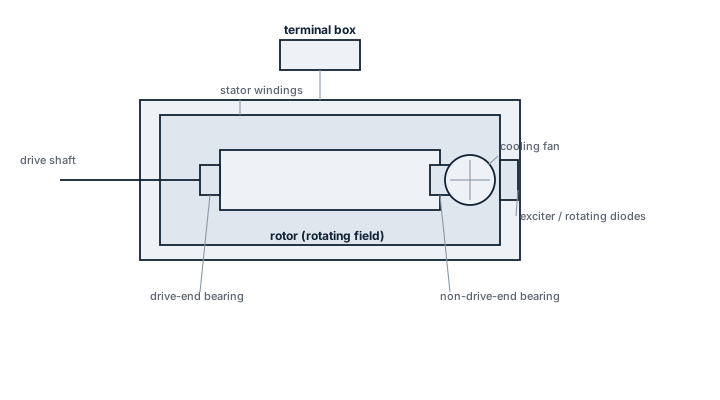
The stator carries the output windings; the rotor carries the field winding, excited either by a rotating exciter (brushless, standard on modern ships) or by slip rings and brushes on older designs.
Automatic Voltage Regulator (AVR)
Senses terminal voltage and adjusts field excitation to hold it constant as load changes; it also carries out reactive load sharing between paralleled alternators through droop or cross-current compensation wiring.
Bearings and cooling
Air- or water-air-cooled depending on rating; bearing insulation is used on larger machines to prevent stray shaft currents from pitting the bearings.
Protection relays
Over/under voltage, over/under frequency, reverse power, and differential protection sit between the alternator and the switchboard and are what actually trips a unit off the bus during a fault.
Selection / Sizing
Rated in kVA at a stated power factor (commonly 0.8 lagging), which sets both the real power (kW) and reactive power (kVAr) the machine can deliver — a common sizing mistake is checking kW against the load list without checking whether the load's actual power factor pushes reactive demand past what the alternator can supply. Insulation class and temperature rise class (typically class F insulation with class B temperature rise, giving a service margin) affect how hard the machine can be run continuously versus how much thermal headroom is left for overload conditions like a large motor starting.
Regulations / Class
Class rules (IACS members' unified requirements) set short-circuit withstand and protection coordination requirements for switchboard-connected generators, and require type testing of the alternator including temperature rise and short-circuit tests. IEC 60092 series standards govern marine electrical installations broadly, and class surveys confirm protection relay settings match the approved switchboard studies at each renewal.
Typical faults
- AVR drift or failure — voltage instability that shows up first as difficulty sharing reactive load when paralleling with another set.
- Bearing pitting from stray shaft currents — on larger machines without proper shaft grounding brushes, current finds a path through the bearings and erodes the races over time.
- Insulation degradation from moisture — a common issue after long idle periods in humid engine rooms; megger testing before starting a long-idle set catches this before it causes a ground fault.
- Exciter diode failure — on brushless machines, a failed rotating rectifier diode causes ripple in the field current and erratic voltage output.
- Reverse power trips during load transfer — often a symptom of governor response lag rather than the alternator itself, but it looks like an alternator fault on the switchboard alarm.
What to look for in a supplier
- Type-test certificates covering short-circuit withstand and temperature rise for the specific frame size, not just a data sheet.
- AVR and governor compatibility confirmed for parallel operation with the ship's existing sets, if this is a replacement or addition to an existing switchboard.
- Insulation class and service factor documented, matched to the engine room's actual ambient temperature range.
- Protection relay coordination study included or supportable, since a mismatched relay setting is a common cause of nuisance trips after installation.
Megger the windings before starting any generator that has sat idle more than a few weeks in a humid engine room — a ground fault on load is a far worse day than a five-minute insulation test beforehand.