Radar Plot System (ARPA)
ARPA takes a standard radar picture and adds automatic target tracking, converting echoes into vectors with a computed closest point of approach, which is what turns a radar screen into a collision-avoidance tool rather than just a picture of the surrounding traffic.
What to check on a Radar Plot System (ARPA).
2 models from Kelvin Hughes in Radar Plot System (ARPA). Below: the full model list.
What Sets ARPA Apart from Plain Radar
A basic marine radar shows raw echoes and lets the officer of the watch plot targets by hand, marking bearing and range at intervals on a reflection plotter. ARPA automates that plotting: once a target is acquired, the processor tracks it across successive sweeps and computes course, speed, closest point of approach (CPA) and time to closest point of approach (TCPA) continuously, updating a vector display without the watchkeeper doing the arithmetic. The value is not the tracking alone but the trial manoeuvre function, which lets the bridge team test a proposed course or speed change against all tracked targets before actually altering the ship's heading.
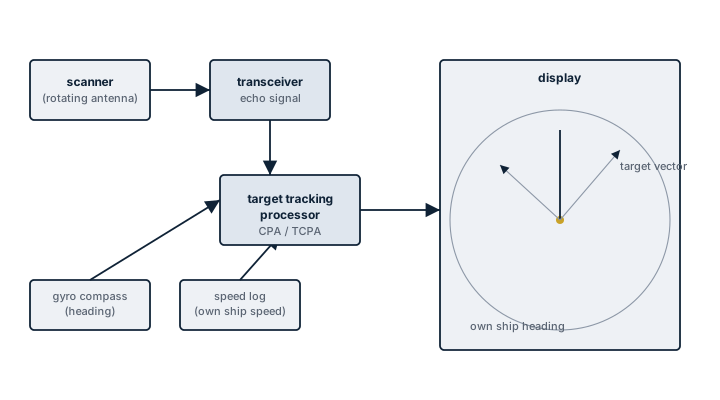
Main Components
Scanner and Transceiver
The rotating antenna and its transmitter/receiver unit are shared with the base radar; ARPA is a processing and display layer built on top, most often the X-band set for target detail with an S-band set on larger ships for tracking in heavy rain or sea clutter.
Tracking Processor
Software correlates successive echo returns from the same target, filters out clutter and applies a tracking algorithm, typically a form of alpha-beta or Kalman filter, to smooth the target's estimated course and speed.
Read the full guide
Display and Vector Presentation
Targets appear with a velocity vector in either true or relative motion mode, vector length scaled to a chosen time interval so the watchkeeper can read closing speed at a glance rather than reading numbers off a data box.
Trial Manoeuvre Function
The operator inputs a hypothetical own-ship course or speed change and the system projects how CPA and TCPA against every tracked target would change, without committing the ship to the manoeuvre.
Selection and Sizing
The relevant figures are tracking capacity, minimum 20 simultaneous targets under the IMO performance standard, and the number of targets the display remains readable with in dense traffic. Antenna length and transmitter power are chosen for the ship's expected range requirements rather than for ARPA itself, since the tracking layer works with whatever raw picture the scanner delivers.
Regulations and Class
- SOLAS Chapter V, Regulation 19 sets the carriage requirement for radar and automatic tracking aids by ship size and type; large ships on international voyages need both an X-band set and a second radar, commonly S-band, each capable of ARPA tracking.
- IMO Resolution A.823(19) is the performance standard ARPA equipment must meet, covering minimum tracking accuracy, target capacity and trial manoeuvre function.
- STCW requires bridge officers to hold ARPA-specific training and certification separate from general radar observer courses, since misreading a vector display has been a contributing factor in collision cases.
Typical Faults
| Fault | Consequence |
|---|---|
| Gyro or speed log input drops out or freezes | Tracked vectors compute against stale heading and speed data, CPA and TCPA become unreliable |
| Sea clutter setting too aggressive in heavy weather | Small craft or debris lost from tracking, false sense of a clear picture |
| Scanner motor bearing wear | Irregular rotation speed degrades tracking accuracy before the fault is visually obvious |
| Software target swap in close-quarters traffic | System assigns one target's vector to a different nearby contact, giving a false CPA |
What to Look for in a Supplier
- Type approval certificate confirming compliance with the current IMO performance standard for the specific software version installed, since ARPA firmware is revised periodically.
- Interface compatibility with the ship's existing gyro, speed log and AIS feeds without a separate signal converter for each.
- Training support and simulator access for officers converting from an older display to a new touchscreen or multifunction bridge system.
Treat the trial manoeuvre output as a planning aid, not a guarantee: it only knows what the tracked targets are doing at the moment of the trial, and a target that alters course after you commit to your own manoeuvre will not update the projection you already acted on.

Models in this type.
The best-documented model of each manufacturer first, then the next — 2 of 2 models in Radar Plot System (ARPA). Every row links to full specifications, documents and service notes.
Manufacturers.
All 5 manufacturers with models of Radar Plot System (ARPA). Names with a manufacturer page open it; the others open a search across the full library.
All manufacturersAlso in Radar & ECDIS.
The other equipment types in this category.
One request. A person reads it and replies by e-mail.
Tell us the manufacturer, the model and what you need — a part, a service call, a second opinion. A person reads every request and replies by e-mail.
No details at hand? A photo of the rating plate or the part is enough — simply attach it to the request.
Three things people ask first.
Is Radar Plot System (ARPA) data free?
Yes. Every model page, every guide and every datasheet for this type is readable without an account. An account adds saved searches and requests, nothing is taken away.
My model is missing — what now?
Send us the nameplate. We identify it by hand, add it to the library, and if you need a part or a service, the request is already on our desk.
Can you source a Radar Plot System (ARPA) part?
Yes. Tell us the manufacturer, the model and what you need — a person reads every request and replies by e-mail.