What to check on an EPIRB/SART.
2 models from Daniamant in EPIRB/SART. Below: the full model list.
What distinguishes these two devices
An EPIRB and a SART are often bought and mounted side by side, but they do unrelated jobs. The EPIRB transmits on 406 MHz to the Cospas-Sarsat satellite constellation, sending the ship's identity and, with a GNSS fix, its position to rescue coordination centres — it works globally and needs no rescue unit nearby yet. A SART only responds when a searching ship's or aircraft's 9 GHz radar illuminates it, returning a distinctive line of dots on that radar's display — it is useless until a search is already close by, but at that point it is far more precise than any position report.
Read the full guide
Main components
EPIRB
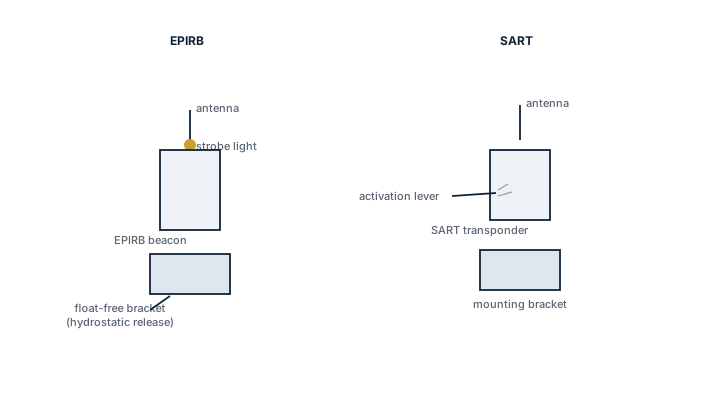
Float-free hydrostatic release unit, internal or integrated GNSS receiver, 406 MHz and 121.5 MHz homing transmitter, and a battery rated for a minimum operating period once activated. Category I units release and activate automatically at a set depth; Category II units require manual activation.
SART
Compact radar transponder, usually mounted on a telescopic pole in a liferaft or lifeboat, with its own battery. Newer AIS-SART units transmit an AIS position message instead of triggering the radar directly, giving nearby AIS-equipped ships a plotted position rather than just a dot pattern.
Selection and sizing
SOLAS sets carriage requirements by ship type and area of operation rather than leaving the choice open; the practical decision for the buyer is EPIRB battery and hydrostatic release service life against the ship's survey schedule, and whether to fit radar SART, AIS-SART, or both per lifeboat and liferaft where the rules allow a choice.
Regulations and class
SOLAS Ch. IV, the GMDSS chapter, sets EPIRB and SART carriage requirements by ship category and sea area. Hydrostatic release units on float-free EPIRBs have a service life, typically two years, independent of the EPIRB's own battery life, and both must be tracked separately. Annual testing and battery or hydrostatic unit replacement are recordable survey items, and an EPIRB registered to the wrong vessel identity after a sale or renaming is treated as a serious deficiency since it misdirects a real rescue response.
Typical faults
- Hydrostatic release expired — cause: service interval missed; consequence: EPIRB will not float free automatically if the ship sinks
- Outdated vessel identity in EPIRB memory — cause: not updated after ownership or name change; consequence: rescue centre receives wrong vessel identity
- Battery expired — cause: missed replacement schedule; consequence: transmission duration falls short of the rated minimum in an actual distress
- SART pole damaged or missing — cause: rough handling during lifeboat drills; consequence: reduced radar detection height and range
What to look for in a supplier
- Cospas-Sarsat type approval and current battery and hydrostatic release service network coverage in the ship's trading area
- Clear registration update procedure so the unit's coded identity always matches current vessel details
- AIS-SART option where the fleet standard already favours it over radar-only SART
- Bracket and mounting arrangement proven for the specific float-free release height requirement
Re-register the EPIRB the same week the vessel changes name, flag or owner, because a beacon still broadcasting the old identity sends rescue coordinators chasing paperwork instead of a position.