Air Compressor
Ships typically carry two distinct compressed air systems: high-pressure starting air, around 25-30 bar, for main engine starting, and low-pressure service air for control and workshop use - specifying one where the other is needed is a common buyer error.
What to check on an Air Compressor.
31 models from Deno Compressors in Air Compressor. Below: the full model list.
What Defines a Marine Air Compressor
A marine air compressor generates the compressed air that starts diesel engines, actuates pneumatic control valves, and supplies general service and workshop use. Ships almost always carry two separate air systems built around different compressors: high-pressure starting air compressors, typically reciprocating multi-stage units producing 25-30 bar, and lower-pressure service air compressors around 7-10 bar for control air, tools and general service, often screw type. Confusing the two in specification is a real risk, since a screw compressor cannot deliver engine starting pressure, and a high-pressure reciprocating unit is oversized and inefficient for simple service air duty.
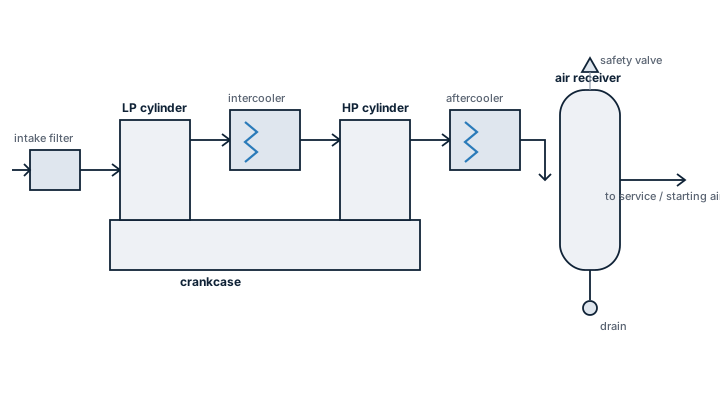
Legend
- Safety valve
- Intercooler
- Aftercooler
- LP cylinder
- HP cylinder
- Air receiver
- Intake filter
- To service / starting air
- Crankcase
- Drain
Main components
Compression stage
Reciprocating compressors use two or three stages with intercooling to reach starting-air pressures efficiently and to limit discharge temperature; screw compressors compress in a single stage using meshing rotors and suit continuous lower-pressure service duty.
Intercoolers and aftercooler
Heat exchangers between stages, and after the final stage, cool the air to reduce its volume before storage and to condense out moisture before it reaches the receiver.
Read the full guide
Air receiver
A pressure vessel storing compressed air to smooth demand peaks and, on starting air systems, to hold enough capacity for the required number of consecutive engine start attempts without the compressor running.
Safety and control devices
Safety relief valves, automatic drain traps for condensate, pressure switches for automatic start/stop, and on reciprocating machines, unloader valves that let the compressor start against no load.
Selection and sizing
- Delivery pressure and capacity in free air delivery, matched to whether the duty is starting air, control air or general service
- Air receiver volume, sized on starting air systems to guarantee class-required consecutive start attempts for the main engine without recharging
- Number of compressors and redundancy, since class rules require at least two independent means of producing starting air
- Duty cycle - continuous running service compressors favour screw types; intermittent high-pressure charging favours reciprocating units
- Cooling method, air-cooled for smaller units, water-cooled for larger reciprocating compressors
Class and regulatory requirements
Classification society rules require at least two starting air compressors and two starting air receivers on vessels with reversible main engines, sized so the receivers together hold enough air for a specified minimum number of consecutive starts without recharging, split so the failure of one compressor or receiver does not remove the ability to start the engine. Air receivers, as pressure vessels, are subject to periodic internal and hydraulic pressure testing at class survey intervals, and safety relief valves are tested and set at each renewal. Automatic drain traps and low-point drains must be maintained, since accumulated condensate in a receiver both reduces effective volume and promotes internal corrosion.
Typical faults
| Fault | Cause | Consequence |
|---|---|---|
| Excessive discharge temperature | Fouled intercooler or worn piston rings raising compression heat | Risk of lubricating oil vapour ignition inside the air system |
| Valve plate failure | Carbon buildup or fatigue on reciprocating compressor suction/discharge valves | Loss of capacity, in severe cases compressor damage from liquid slugging |
| Receiver corrosion | Condensate not drained regularly | Internal wall thinning, potential failure of a pressure vessel |
| Automatic drain trap blockage | Debris or scale jamming the trap mechanism | Water accumulates in the system, causing icing or corrosion downstream |
What to look for in a supplier
- Free air delivery figures verified at the actual discharge pressure specified, not at a lower reference pressure
- Discharge temperature margins built in for tropical engine room ambient conditions
- Availability of valve plate and piston ring spares, the most frequently replaced items on reciprocating units
- Receiver design pressure and volume matched exactly to class starting-attempt requirements before ordering
Log discharge temperature on every starting air compressor at every watch, not just when an alarm sounds; a slow creep upward over weeks is almost always fouled intercoolers or worn rings developing long before the high-temperature trip ever activates.
Models in this type.
The best-documented model of each manufacturer first, then the next — 31 of 31 models in Air Compressor. Every row links to full specifications, documents and service notes.
Manufacturers.
All 51 manufacturers with models of Air Compressor. Names with a manufacturer page open it; the others open a search across the full library.
All manufacturersShow all 51 manufacturers
One request. A person reads it and replies by e-mail.
Tell us the manufacturer, the model and what you need — a part, a service call, a second opinion. A person reads every request and replies by e-mail.
No details at hand? A photo of the rating plate or the part is enough — simply attach it to the request.
Three things people ask first.
Is Air Compressor data free?
Yes. Every model page, every guide and every datasheet for this type is readable without an account. An account adds saved searches and requests, nothing is taken away.
My model is missing — what now?
Send us the nameplate. We identify it by hand, add it to the library, and if you need a part or a service, the request is already on our desk.
Can you source a Air Compressor part?
Yes. Tell us the manufacturer, the model and what you need — a person reads every request and replies by e-mail.