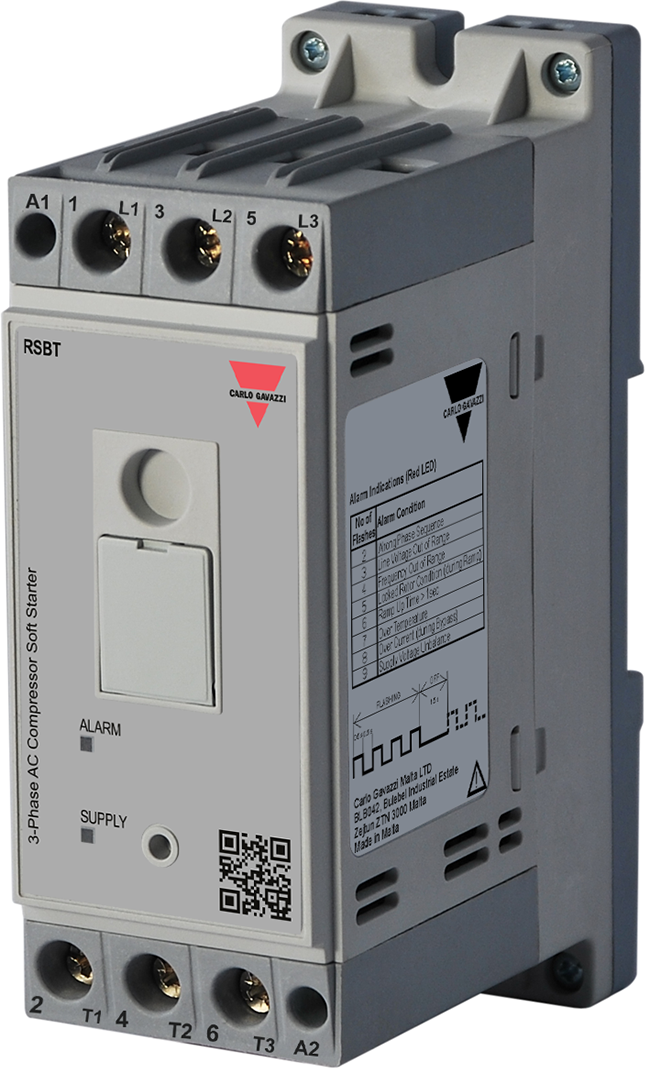
What to check on a Soft Starter.
2 models from Sea Recovery in Soft Starter. Below: the full model list.
What defines this type
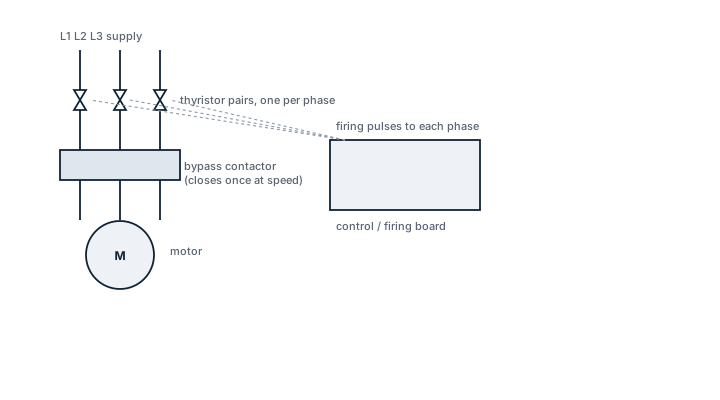
A soft starter is a solid-state device built around back-to-back thyristor pairs on each motor phase, which ramp the applied voltage from a low starting value up to full line voltage over a set time, typically several seconds. It sits between direct-on-line starting, which slams full voltage and six-to-eight-times full-load current onto the motor at the instant of closing, and a variable frequency drive, which controls both voltage and frequency and can run the motor at any speed continuously. Once a soft starter finishes its ramp it usually bypasses the thyristors with a contactor and the motor runs across the line at fixed speed, so it solves a starting problem, not a speed control problem.
Read the full guide
Main components
- Thyristor (SCR) pairs, one pair per phase, that phase-control the voltage during ramp-up and ramp-down
- Bypass contactor that shorts out the thyristors once full voltage is reached, so they are not left carrying full running current and generating heat
- Control board setting ramp time, initial torque/voltage, current limit and stop profile
- Heatsink and, on larger frames, forced-air or water cooling for the thyristor stack
- Overload and phase-loss protection, either built in or via an external motor protection relay
Selection and sizing
Sizing is by motor full-load current and starting duty, not motor kW alone. A soft starter selected only from a kW table can undersize the thyristors for a heavy-inertia load such as a large fan or a pump against a closed valve.
- Motor full-load current and locked-rotor current ratio
- Starts per hour and duty cycle, since thyristors are rated for a limited number of starts before thermal derating applies
- Load type: pump, fan and compressor loads each need a different current-limit and torque-boost setting
- Ambient temperature in the switchboard room, since thyristor current rating derates with temperature
- Whether soft stop (controlled deceleration) is needed, relevant for pumps prone to water hammer on abrupt stop
Regulations and class
There is no dedicated SOLAS chapter for soft starters; they fall under general requirements for electrical installations and motor starting equipment in the class society's rules for electrical machinery. What class surveyors do check is that the starting method does not cause a voltage dip on the switchboard bus beyond the limit the class rules set for other consumers during starting, which is exactly the problem a soft starter is fitted to solve on boards with large motors and limited generator capacity. IACS UR requirements on electrical installations cover the general protection and coordination expectations that apply to the starter as part of the motor circuit.
Typical faults
| Fault | Cause | Consequence |
|---|---|---|
| Thyristor failure short-circuit | Repeated over-current from too-frequent starts or a stalled motor | Motor sees full line voltage uncontrolled, tripping upstream protection |
| Bypass contactor contacts pitted | Contactor closing before the thyristors have fully phased in | Arcing damage, eventual contact welding or failure to bypass |
| Nuisance overload trips | Current-limit or ramp-time setting too aggressive for the actual load inertia | Motor fails to reach speed within the set ramp and trips before running |
| Cooling fan failure | Bearing wear or blocked filter on the starter cabinet | Thyristor overtemperature trip under normal load |
What to look for in a supplier
- Current rating with margin over the motor's actual locked-rotor current, not just its full-load current
- Built-in bypass contactor rather than a separate field-wired one, which simplifies commissioning and spares
- Communication interface matching the vessel's alarm and monitoring system if remote status is required
- Documented derating curve for the switchboard room's design ambient temperature
If a soft-started pump motor still bangs the discharge check valve on stop, the fix is usually the soft-stop ramp, not the check valve, since an abrupt electrical stop still lets the impeller spin down fast enough to slam it shut.