Hatch Cover
As a general type, hatch cover spans the hydraulic and mechanical folding and lift-off pontoon covers fitted to bulk carriers and general cargo ships that are not the specialised side-rolling or piggyback arrangements.
What to check on a Hatch Cover.
2 models from TTS Marine in Hatch Cover. Below: the full model list.
What this general hatch cover type covers
Hatch cover as a general equipment type spans the hydraulic and mechanical cargo hold covers fitted to bulk carriers and general cargo vessels that are not the specialised side-rolling or piggyback arrangements, most commonly single- or multi-panel folding covers and lift-off pontoon covers. The choice between these sits on hold size, coaming height, and whether panels need to stay attached and fold, or be removed entirely for exceptional cargo access.
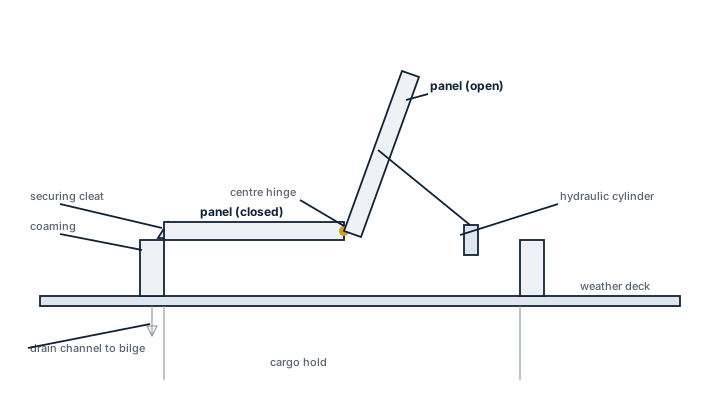
Legend
- panel (open)
- securing cleat
- centre hinge panel (closed)
- hydraulic cylinder
- coaming
- weather deck
- drain channel to bilge
- cargo hold
Main components
Panels
Steel plate panels stiffened by longitudinal girders, sized so that each panel's individual weight stays within the ship's or shore crane's lifting capacity where the design is a lift-off pontoon type, or within the strength of the hinge and drive system where panels stay attached and fold.
Hinges and folding linkage
On folding covers, panels are joined by hinges that let one or more panels lift and fold back on top of the adjacent panel, driven by a hydraulic cylinder acting through a linkage, or by a wire or chain system on older mechanical designs.
Read the full guide
Lifting lugs and pad eyes
Lift-off pontoon covers are fitted with lugs for the ship's own crane or a shore crane to lift each panel clear and stack it on deck; no drive system is needed but the ship depends on lifting capacity being available.
Compression and sealing system
A rubber gasket around the coaming, compressed by cleats, wedges, or a hydraulic clamping bar, gives the weathertight seal; drainage channels at panel joints carry away any water that gets past the outer seal before it can enter the hold.
Cleating and securing
Manual or hydraulic cleats lock the closed cover against the coaming to resist green water loads and prevent the cover lifting in a seaway; on hydraulic folding covers this is usually integrated into the closing cylinder stroke.
Selection and sizing
Sizing follows hold dimensions and the vessel's cargo profile: panel weight limits set by available lifting gear for pontoon types; hinge and cylinder rating set by panel size and green water design load for folding types; coaming height and freeboard deck strength; and how often the hold needs full, unobstructed access, such as grain trimming or project cargo, versus routine bulk loading, which favours a fully opening folding cover over a partially removable pontoon arrangement.
Regulations and class
As with other hatch cover types, the International Convention on Load Lines sets the weathertight closing standard tied to the ship's freeboard, and class rules, commonly aligned with IACS UR S21, set the structural design load. Weathertightness is confirmed by hose test or ultrasonic tightness test at survey, and cover condition, including plating thickness, hinge wear, and compression bar condition, is checked as part of the hull's structural survey regime, since a leaking hatch cover is one of the most common causes of cargo claims on bulk carriers.
Typical faults
- Corroded panel plating, especially at drain channels: thickness loss found at survey, can require steel renewal before the cover passes.
- Hinge pin wear on folding covers: panels no longer close flush, leaving a gap at the joint.
- Compression bar or cleat deformation: uneven sealing pressure along the panel edge, causing localized leakage.
- Hydraulic cylinder seal failure: panel will not fully close or does not hold closed under vibration.
- Lifting lug cracking on pontoon types: found by dye penetrant or visual inspection; a lug failure during lifting risks dropping a panel.
What to look for in a supplier
- Steel grade and coating system suited to the trade, with higher corrosion allowance for cargoes that generate acidic or abrasive dust.
- Design load calculation referenced to the class rule the vessel is built and surveyed under.
- Spare gasket, cleat, and hinge pin availability matched to the installed system, especially on older vessels with discontinued designs.
- Weathertight test support at delivery and guidance for the crew's own periodic testing.
A hatch cover that looks tight when closed can still leak at the panel joints under green water pressure: judge sealing condition by the ultrasonic or hose test result, not by eye.
Models in this type.
The best-documented model of each manufacturer first, then the next — 2 of 2 models in Hatch Cover. Every row links to full specifications, documents and service notes.
Manufacturers.
All 20 manufacturers with models of Hatch Cover. Names with a manufacturer page open it; the others open a search across the full library.
All manufacturers in the libraryAlso in Cargo Hold Equipment.
The other equipment types in this category.
Write to us about this model — the answer comes by e-mail.
Name the make and the model and what the job is: a spare, a service call, a second opinion on a data sheet. We answer by e-mail.
No details at hand? A photo of the rating plate or the part is enough — simply attach it to the request.
Questions that come up with this equipment.
Is Hatch Cover data free?
Yes. Every model page, every guide and every datasheet for this type is readable without an account. An account adds saved searches and requests, nothing is taken away.
My model is missing — what now?
Send us the nameplate. We identify it by hand, add it to the library, and if you need a part or a service, the request is already on our desk.
Can you source a Hatch Cover part?
Yes. Tell us the manufacturer, the model and what you need — a person reads every request and replies by e-mail.