What to check on a Shore Connection Box.
2 models from terasaki in Shore Connection Box. Below: the full model list.
What makes this type
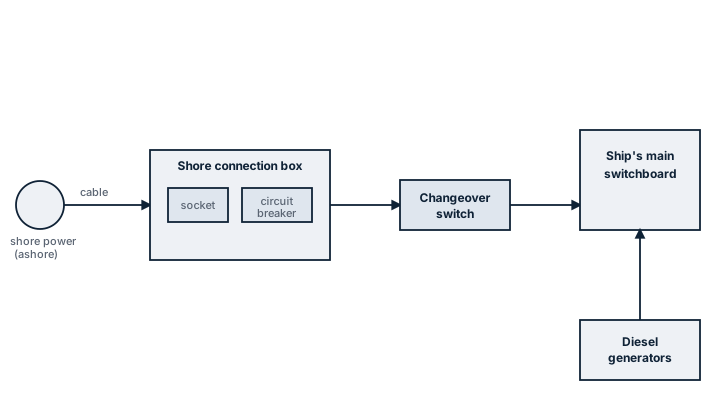
The shore connection box is the interface point where a vessel's electrical distribution system can be switched from its own generators to a shore-side power supply, commonly called cold ironing. Unlike a simple socket, it contains the switching, protection and interlocking needed to guarantee that ship and shore sources are never connected together at the same time. Where the category as a whole covers generation, this specific unit is about the handover: making sure the changeover happens without a blackout and without back-feeding shore cables that were never designed to carry ship-generated current.
Read the full guide
Main components
Connector assembly
The physical plug and socket, built to a recognised marine shore connection standard so that different ports and different ships can mate with the same hardware. On larger vessels this is a high-voltage connector rated for several thousand volts; on coastal and harbour craft it is often a low-voltage industrial connector.
Changeover switchgear
A mechanically or electrically interlocked switch that only permits shore power to close once the ship's generator breakers are open, and vice versa. This is the safety core of the box.
Protection relays
Over/under voltage, over/under frequency and earth fault protection, because shore supply quality varies far more than a ship's own generators.
Frequency and voltage matching
Where shore frequency does not match the ship's own (50 Hz shore supply feeding a 60 Hz vessel, or the reverse), a frequency converter sits between the box and the ship's switchboard. Voltage transformers cover the gap where shore voltage does not match ship voltage directly.
Earthing and bonding link
A dedicated earth conductor that bonds ship and shore hull potential before power is connected, preventing stray current corrosion and step-touch hazards on deck.
Selection / sizing
- Load to be carried while alongside (hotel load, reefer plugs, cargo pumps if applicable) sets the current rating.
- Shore supply voltage and frequency available at the intended ports of call.
- Connector standard expected by the terminal or berth.
- Cable length and whether a motorised cable reel is needed for cable management.
- Space and weight for the frequency converter, which is often the largest single item in the installation.
Regulations / Class
The high-voltage shore connection interface is standardised jointly by IEC, ISO and IEEE under IEC/ISO/IEEE 80005-1, covering connector geometry, interlocking sequence and safety earthing. MARPOL Annex VI does not mandate cold ironing directly but is the regulatory driver behind port and flag state incentives to fit it, since running generators alongside is a source of the emissions the annex targets. Where a class society issues a cold ironing notation, it will require type testing of the interlock logic and periodic survey of the connector and protection settings.
Typical faults
| Fault | Cause | Consequence |
|---|---|---|
| Interlock bypassed or defeated | Crew disables interlock to speed up connection | Risk of paralleling ship and shore sources out of phase, tripping both networks |
| Connector pitting | Repeated hot mating, salt spray, poor cleaning | Rising contact resistance, local heating, eventual burn-through |
| Earth link connected after power | Wrong sequence during connection | Hull potential difference during make-up, corrosion and shock risk |
| Frequency converter fault | Overload or cooling fan failure | Loss of shore power, forced return to generators |
What to look for in a supplier
- Certified compliance with IEC/ISO/IEEE 80005-1 rather than a proprietary connector design.
- Documented interlock logic that can be tested and verified during commissioning, not a black box.
- Track record supplying the specific port infrastructure the vessel actually trades to.
- Service support for the frequency converter, which is the component most likely to need specialist repair.
Never treat the interlock as optional even under time pressure at the berth. A wrong-sequence connection can trip switchboards on both the ship and the shore grid, and the yard or terminal will remember which vessel did it.