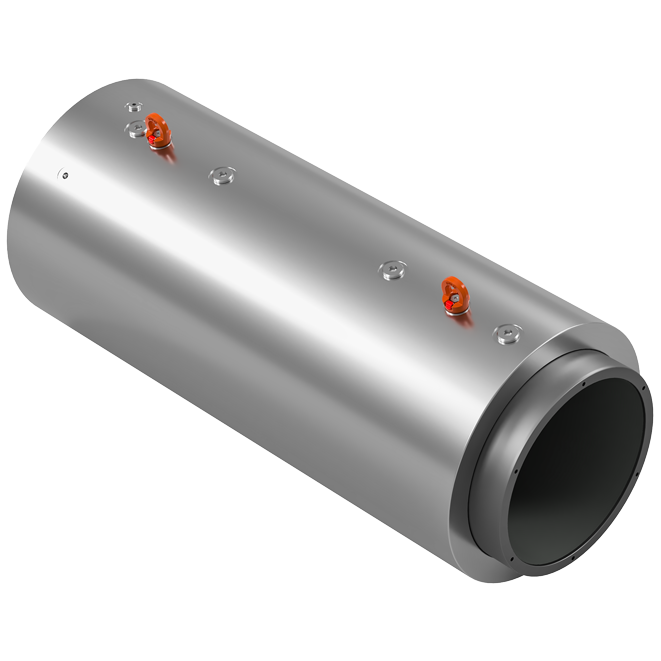
Flexible Coupling
A torsionally flexible coupling sits at the engine flywheel and absorbs torque pulses and misalignment that a rigid coupling cannot handle. Its stiffness and damping figures feed directly into the shaft line's torsional vibration calculation, and a worn coupling can quietly shift the resonance into the normal running range.
Read more — Flexible Coupling explained ▾
What sets a flexible coupling apart
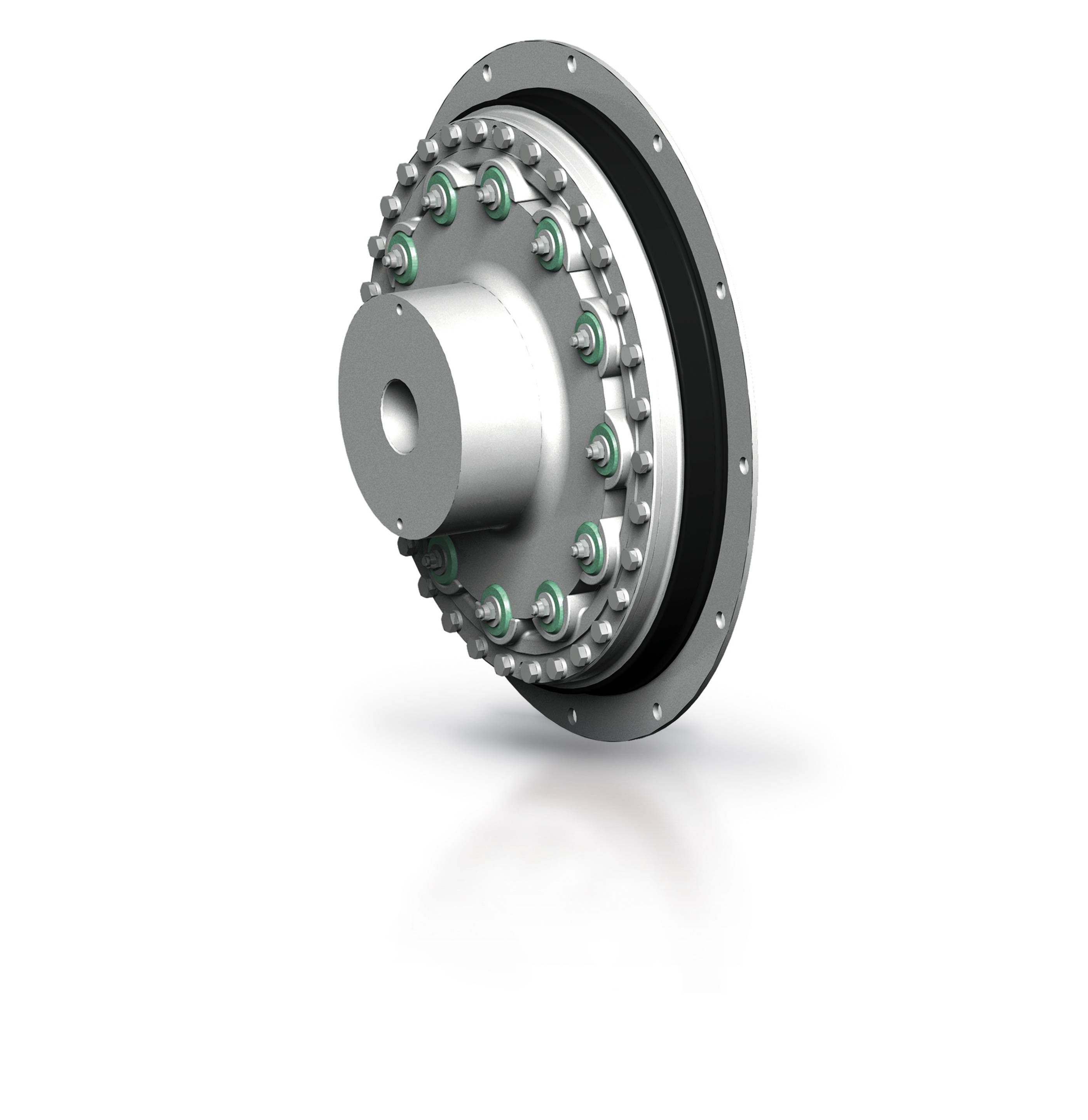
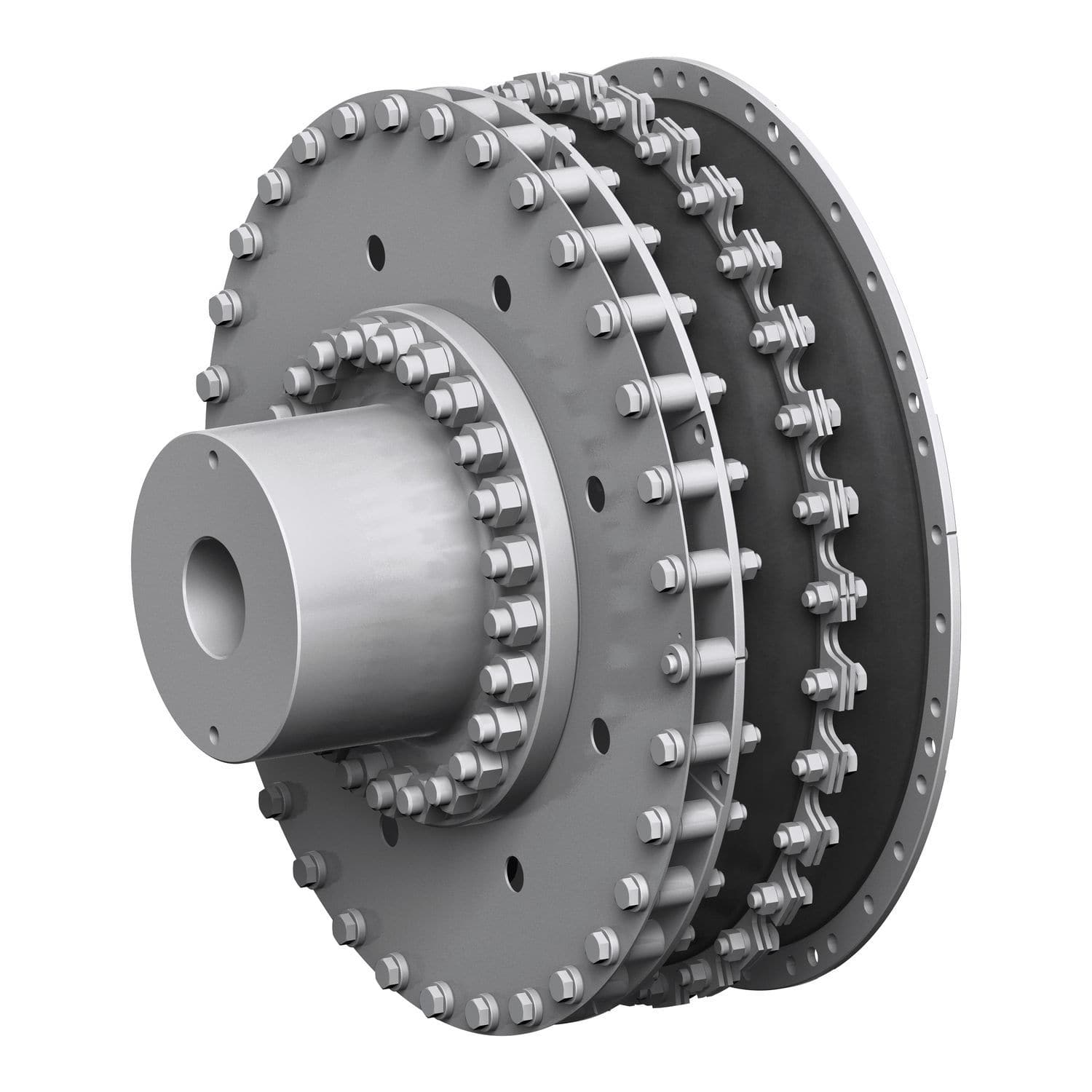
A torsionally flexible coupling sits between the engine and the rest of the shaft line, usually right at the engine flywheel or between engine and gearbox, and its job is to absorb torsional vibration and angular misalignment rather than simply transmit torque. A rigid flange coupling, by contrast, assumes the two shafts it joins are already close to perfectly aligned and torsionally compatible; it is fine further down a shaft line between two already-flexible sections, but it cannot be used straight off a diesel engine's crankshaft, where torque pulses from each cylinder firing would otherwise be passed straight into the gearbox and propeller shaft. The flexible coupling's rubber or steel-disc elements twist slightly under each torque pulse and damp it, which is what keeps the shaft line's torsional natural frequencies clear of the engine's normal running speed range.
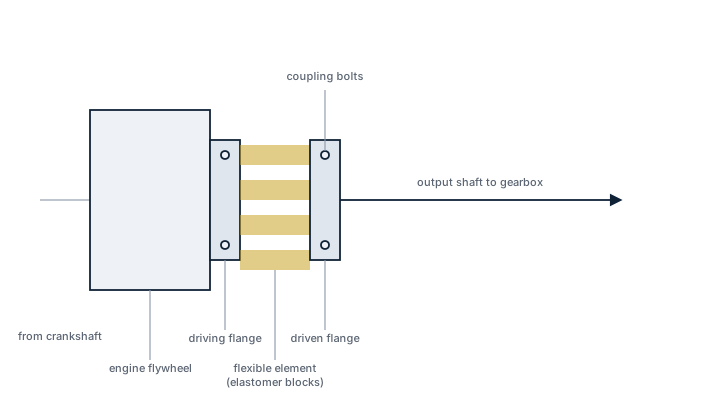
Main components
Flexible element
Rubber-block or rubber-bushing couplings use pre-compressed rubber elements between metal segments to give both torsional flexibility and some vibration damping through internal hysteresis. Steel-disc couplings use thin flexing steel discs instead, giving high torque capacity and no rubber to age, at the cost of less inherent damping.
Hub flanges and bolting
Two hub flanges, one keyed or shrunk onto the engine flywheel or output shaft and one onto the driven shaft, sandwich the flexible elements and are held together with fitted bolts torqued to a specified value; correct bolt tension is what keeps the joint from working loose under cyclic torque.
Torque limiter or shear pin
Some couplings include a deliberately weaker element, a shear pin or friction-slip section, designed to fail or slip before an overload event, such as a fouled propeller, damages the engine or gearbox.
Selection and sizing
Coupling selection is driven by the shaft line's torsional vibration behaviour, not just by torque capacity:
- Nominal and peak torque capacity, with margin for the engine's maximum continuous rating plus transient loads
- Torsional stiffness and damping, since these figures feed directly into the ship's torsional vibration calculation and determine whether a barred speed range is needed
- Permissible misalignment, angular, radial and axial, matched to the actual installation tolerances achievable at the engine seating
Regulations and class
Class societies require a torsional vibration analysis of the complete shaft line, from engine crankshaft to propeller, before the coupling is approved, and the coupling manufacturer's stiffness and damping data are a direct input to that calculation. Where the analysis shows a resonance within the normal operating range, class will impose a barred speed range that the engine must pass through quickly rather than run in continuously, and the coupling forms part of the survey scope at each shaft line examination.
Typical faults
- Rubber elements hardening and cracking from oil contamination or sustained overheating, gradually shifting the coupling's torsional stiffness and moving the resonance point
- Bolts loosening under cyclic load when not torqued or locked correctly at installation, leading to fretting and eventual failure
- Undetected misalignment from engine seating settlement, showing up as uneven wear across the flexible elements
- Wrong stiffness selection at the newbuilding stage producing a barred speed range that falls inside the ship's normal service speed
What to look for in a supplier
- Full torsional stiffness and damping data for the exact coupling size, supplied in the format class societies require for the vibration calculation
- Rubber compound rated for the expected engine room temperature and any oil mist exposure
- Availability of flexible elements as a separate spare, so the whole coupling does not need replacing for a routine element change
- Track record on comparable engine and gearbox combinations, since torsional behaviour is installation-specific
A coupling that looks fine on the outside can already have degraded torsional stiffness; if running speeds start drifting into a range that used to be barred, treat it as a shaft line problem, not a governor problem.
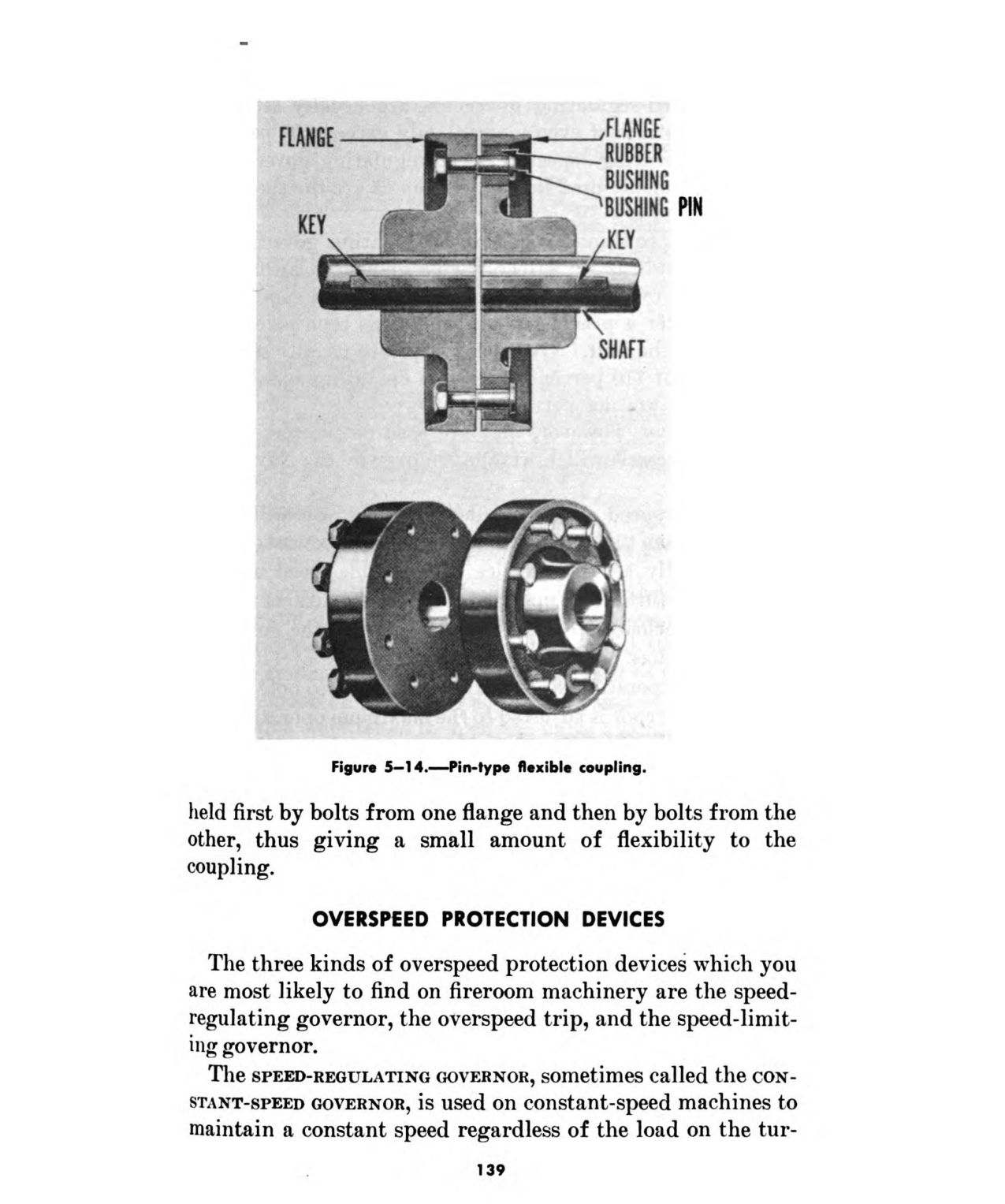
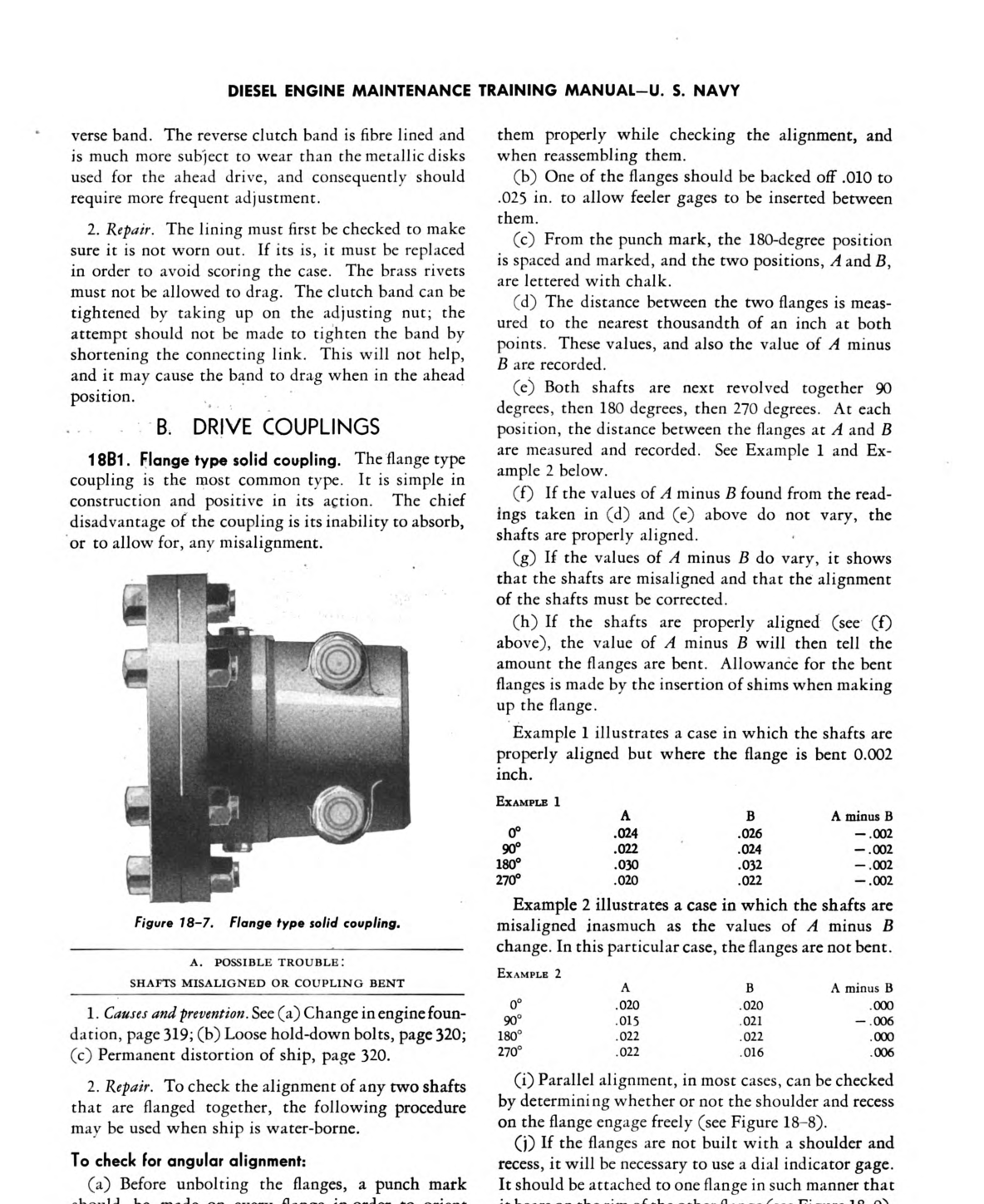
Technical drawings & plates
Historical engineering archive — public domain sources, cited per plate. Principles shown remain valid; always consult the OEM manual for model-specific data.

Typical Manufacturers
24 manufacturers · 71 models
Vulkan
9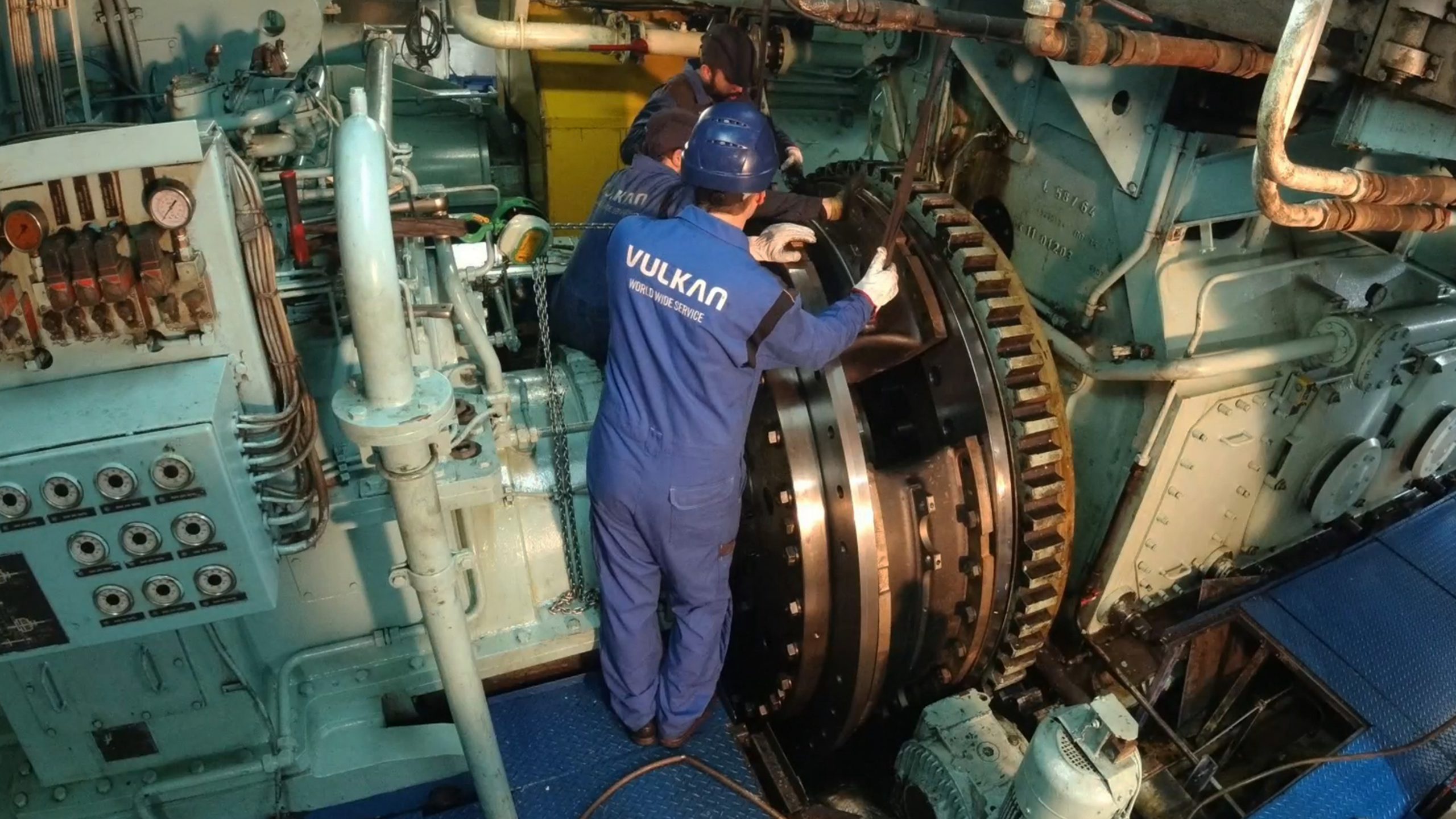
- Misalignment or foundation movement causes vibration, bearing load changes and abnormal temperature
- Bearing, bush or coupling wear causes noise, vibration, backlash or rising temperature
- Seal deterioration causes lubricating-oil leakage or seawater ingress
- Lubrication contamination or low supply damages bearings and produces temperature or pressure alarms
- Control or hydraulic faults on controllable-pitch or PTO equipment cause incorrect response, alarms or loss of function
- High torsional vibration damping due to rubber element
- Compact design with relatively low weight for its torque class
- Simple installation – bolted connection without need for complex alignment tools
- Cost‑effective compared with hydraulic or fluid couplings for moderate power ranges
- Rubber element ages and can crack, requiring inspection every two years
- Bolt loosening is a known failure mode if torque checks are not performed regularly
- Limited speed capability relative to metal gear couplings
- Misalignment beyond design limits leads to premature wear of the rubber
- Misalignment or foundation movement causes vibration, bearing load changes and abnormal temperature
- Bearing, bush or coupling wear causes noise, vibration, backlash or rising temperature
- Seal deterioration causes lubricating-oil leakage or seawater ingress
- Lubrication contamination or low supply damages bearings and produces temperature or pressure alarms
- Control or hydraulic faults on controllable-pitch or PTO equipment cause incorrect response, alarms or loss of function
- Excellent shock‑absorption reduces stress on downstream gearboxes and propellers
- Allows moderate angular, axial and radial misalignment without re‑machining
- Compact design simplifies installation in confined shaft line spaces
- Standardized replacement schedule for elastomer elements eases maintenance planning
- Elastomer elements wear and must be replaced according to Vulkan’s schedule
- Hub keyway fretting can develop, leading to increased vibration over time
- Torque capacity is lower than that of rigid gear couplings, limiting use on high‑power shafts
- Performance degrades at extreme temperatures (very low or very high)
- Potential for vibration increase if wear is not monitored closely
- Elastomer or resilient-element ageing causes cracking, permanent deformation or increased torsional vibration
- Loose bolts or fretting at flanges causes metallic debris, movement or abnormal vibration
- Misalignment overloads coupling elements and causes uneven wear or repeated element failure
- Oil, heat or chemical contamination degrades resilient material and causes softening or swelling
- Fatigue cracks or damaged metallic components cause increasing vibration and may threaten torque transmission
- High torque capacity (up to 500 kW) suitable for main propulsion shafts on medium‑size vessels
- Provides axial, angular and radial flexibility, reducing shaft stress and vibration
- Compact, lightweight design simplifies installation in confined engine rooms
- Low maintenance – no lubrication required for the elastomeric elements
- Designed to meet marine class standards for shock and fatigue resistance
- Maximum torque rating limits use on high‑power (>500 kW) propulsion systems
- Elastomeric elements may require periodic inspection/replacement in harsh sea water environments
- Not suitable for ultra‑high speed shafts where centrifugal forces exceed design limits
- Initial purchase price higher than basic rigid couplings
- Limited availability of spare parts outside Vulkan’s authorized network
- Elastomer or resilient-element ageing causes cracking, permanent deformation or increased torsional vibration
- Loose bolts or fretting at flanges causes metallic debris, movement or abnormal vibration
- Misalignment overloads coupling elements and causes uneven wear or repeated element failure
- Oil, heat or chemical contamination degrades resilient material and causes softening or swelling
- Fatigue cracks or damaged metallic components cause increasing vibration and may threaten torque transmission
- High torsional flexibility reduces stress on shafts and bearings
- Accommodates angular, axial and radial misalignments up to typical limits for marine drives
- Compact design suitable for confined engine rooms
- Low maintenance elastomeric elements with predictable wear life
- Rated for 1500 kW, fitting a wide range of medium‑size vessel propulsion systems
- Elastomeric inserts have temperature and speed limits; extreme conditions may require special material grades
- Limited overload capacity compared with rigid gear couplings
- Periodic inspection/replacement of the flexible element adds scheduled downtime
- Higher initial cost than basic gear or jaw couplings for the same power rating
- Not ideal for applications with very high shock‑load frequency (e.g., heavy‑duty tug propulsion)
- Elastomer or resilient-element ageing causes cracking, permanent deformation or increased torsional vibration
- Loose bolts or fretting at flanges causes metallic debris, movement or abnormal vibration
- Misalignment overloads coupling elements and causes uneven wear or repeated element failure
- Oil, heat or chemical contamination degrades resilient material and causes softening or swelling
- Fatigue cracks or damaged metallic components cause increasing vibration and may threaten torque transmission
- High torque capacity (up to 3000 kW) suitable for main propulsion shafts
- Marine‑grade corrosion‑resistant materials extend service life in saltwater environments
- Built‑in torsional vibration damping reduces stress on bearings and gearboxes
- Compact design saves space in crowded shaft line arrangements
- Rated only to 3000 kW; not applicable for very high‑power vessels (>4000 kW)
- Installation requires careful alignment and torque control to achieve full performance
- Specific certification (IMO D‑2, USCG Type Approval, etc.) is not publicly documented
- Elastomer or resilient-element ageing causes cracking, permanent deformation or increased torsional vibration
- Loose bolts or fretting at flanges causes metallic debris, movement or abnormal vibration
- Misalignment overloads coupling elements and causes uneven wear or repeated element failure
- Oil, heat or chemical contamination degrades resilient material and causes softening or swelling
- Fatigue cracks or damaged metallic components cause increasing vibration and may threaten torque transmission
- Handles up to 6 MW torque capacity, suitable for large propulsion shafts
- Compensates angular, axial and radial misalignment, reducing alignment‑related wear
- Built‑in torsional damping lowers vibration and protects downstream equipment
- Compact design relative to its power rating, easing installation in confined spaces
- Corrosion‑resistant marine‑grade materials extend service life
- Higher initial purchase cost compared with rigid couplings of similar size
- Elastomeric or damping elements require periodic inspection and replacement
- Maximum operating speed may be limited by the coupling’s design
- Axial length can be a constraint in retro‑fit applications
- Performance can degrade if operated outside specified temperature ranges
- Cavitation or erosion can damage blade surfaces, seen as pitting, roughness and loss of hydrodynamic finish
- Impact with debris or grounding can bend or crack blades, noticed as vibration, imbalance or visible deformation
- Corrosion or coating breakdown can attack exposed surfaces, seen as pitting or wastage
- Poor shaft-line alignment or bearing condition can create uneven loading, noticed as vibration and abnormal bearing trends
- For controllable-pitch arrangements, hub-seal or pitch-mechanism faults can impair pitch control, seen as oil leakage or inconsistent thrust response
- Rated torque capacity of up to 1000 kW for medium‑size propulsion systems
- Wide angular and axial misalignment tolerance reduces alignment‑related wear
- Built‑in damping characteristics lower vibration and shock loads on the shaft line
- Corrosion‑resistant alloy construction suitable for continuous seawater exposure
- Compact, modular design simplifies installation and integration with existing shaft lines
- Maximum power rating limits use to vessels with engines ≤1000 kW
- Requires periodic lubrication/maintenance of the elastomeric elements
- Spare‑part availability may be constrained outside the manufacturer’s primary market
- Weight is higher than some lightweight aluminium couplings, affecting overall shaft line mass
- Initial purchase cost can be higher than basic rigid couplings
- Elastomer or resilient-element ageing causes cracking, permanent deformation or increased torsional vibration
- Loose bolts or fretting at flanges causes metallic debris, movement or abnormal vibration
- Misalignment overloads coupling elements and causes uneven wear or repeated element failure
- Oil, heat or chemical contamination degrades resilient material and causes softening or swelling
- Fatigue cracks or damaged metallic components cause increasing vibration and may threaten torque transmission
- High torsional flexibility reduces vibration and shock loads on the propulsion system
- Accommodates angular, axial and radial misalignments up to several millimetres
- Compact design saves space in crowded shaft line arrangements
- Low maintenance – no lubrication required for the elastomer element
- Simple installation with bolt‑on flanges
- Maximum torque rating (≈2500 kW) limits use on very high‑power main engines
- Elastomer material has temperature and chemical exposure limits requiring periodic inspection
- Not suitable for ultra‑high shaft speeds (>300 rpm) where heat buildup can degrade the elastomer
- Replacement of the elastomer element may require dry‑dock time
- Elastomer or resilient-element ageing causes cracking, permanent deformation or increased torsional vibration
- Loose bolts or fretting at flanges causes metallic debris, movement or abnormal vibration
- Misalignment overloads coupling elements and causes uneven wear or repeated element failure
- Oil, heat or chemical contamination degrades resilient material and causes softening or swelling
- Fatigue cracks or damaged metallic components cause increasing vibration and may threaten torque transmission
- Rated for up to 5 000 kW (≈5 MW) continuous power, suitable for large main‑propulsion lines
- Compensates angular, axial and radial misalignments, reducing shaft stress
- Absorbs torsional shock loads, protecting downstream gearboxes and propellers
- Compact design with corrosion‑resistant alloy housings for marine environments
- Low maintenance – sealed unit requiring only periodic visual inspection
- Higher initial purchase price compared with rigid couplings of similar rating
- Limited to typical low‑speed propulsion shafts; not intended for very high rpm applications
- Installation requires careful alignment and torque verification to achieve full flexibility benefits
- Periodic oil‑lubrication checks are needed if the model uses an oil‑filled damping element
Vulkan Kupplungs- und Getriebebau Bernhard Hackforth
9
Centa-Antriebe Kirschey
6KTR Systems
6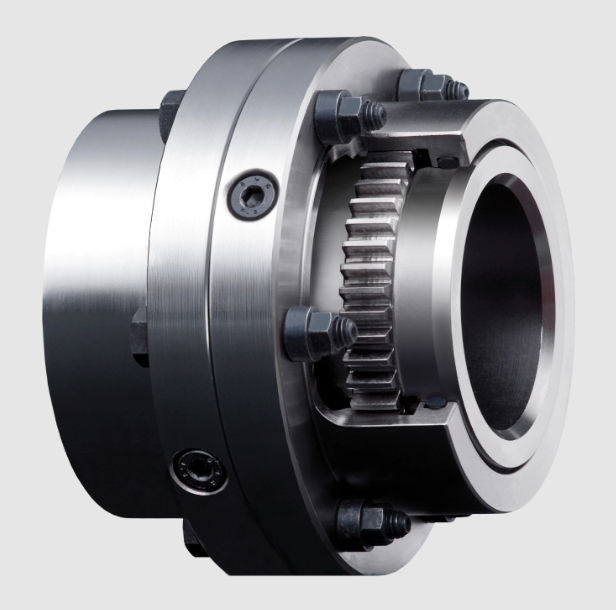
Renold Power Transmission
6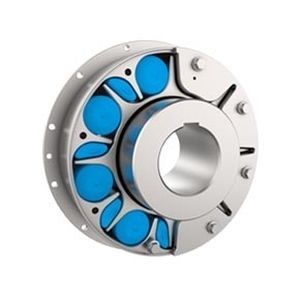
Flender
5Geislinger
4- Misalignment or foundation movement causes vibration, bearing load changes and abnormal temperature
- Bearing, bush or coupling wear causes noise, vibration, backlash or rising temperature
- Seal deterioration causes lubricating-oil leakage or seawater ingress
- Lubrication contamination or low supply damages bearings and produces temperature or pressure alarms
- Control or hydraulic faults on controllable-pitch or PTO equipment cause incorrect response, alarms or loss of function
- High torsional vibration attenuation thanks to leaf‑spring design combined with oil damping
- Compact and relatively lightweight compared with hydraulic couplings
- Proven track record in merchant vessels; easy to install between engine and reduction gear
- Oil damper allows fine tuning of damping characteristics
- No external power required for operation
- Leaf‑spring fatigue can develop after many operating hours, requiring periodic inspection or replacement
- Potential oil leakage from the damper chamber if seals deteriorate
- Damping performance may change over time as oil viscosity varies with temperature and age
- Limited overload capacity compared with hydraulic or elastomeric couplings
- Requires regular oil‑level checks and maintenance of the damper
Dipl.-Ing. Herwarth Reich
3
Kyushu Hasec
3REGAL BELOIT SPAIN, S.A. (JAURE)
3Stromag
3Kawasaki
2ALTRA INDUSTRIAL MOTION DO BRASIL EQUIPAMENTOS INDUSTRIAIS LTDA
1Daihatsu
1Destinus OPRA
1EagleBurgmann Japan
1ISOFLEX TECHNOLOGIES
1John Crane France SAS
1KWD Kupplungswerk Dresden
1Poly Flex Group
1Renk
1- Vane seal leakage in rotary-vane type causes internal bypass
- HPU motor bearing damage after 30,000+ operating hours
- Solenoid valve sticking from oil contamination
- Ruderlage-Rückmeldesystem Kalibrierungsdrift
Walterscheid
1Wärtsilä
1