What to check on a Signal Light.
Navigation lights are fixed: a set arc, a set colour, always on when underway, telling other vessels what the ship is and where it is heading. A signal lamp is the opposite, a handheld or bridge-wing-mounted light the officer aims and switches deliberately, used to send Morse code, attract the attention of a specific vessel, or acknowledge a signal from another ship or a pilot boat. COLREGs recognise it as a distinct means of communication, and it remains standard bridge equipment even though radio has replaced most of its historic…
What a signal lamp does that navigation lights cannot
Navigation lights are fixed: a set arc, a set colour, always on when underway, telling other vessels what the ship is and where it is heading. A signal lamp is the opposite, a handheld or bridge-wing-mounted light the officer aims and switches deliberately, used to send Morse code, attract the attention of a specific vessel, or acknowledge a signal from another ship or a pilot boat. COLREGs recognise it as a distinct means of communication, and it remains standard bridge equipment even though radio has replaced most of its historic traffic.
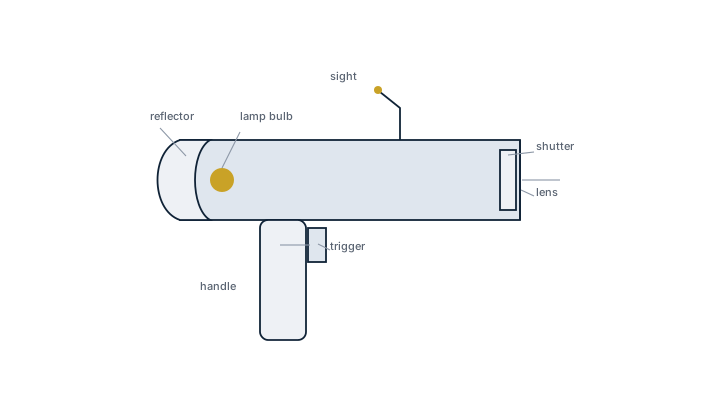
Main components
Lamp head and lens
A focused beam, usually white, bright enough to be read at several miles by day and considerably further at night, with a lens arrangement that keeps the beam tight rather than dispersing like a floodlight.
Shutter or trigger mechanism
The signalling key, a trigger or shutter operated by the sender's hand, that breaks the beam into the dots and dashes of Morse code without the lamp itself needing to switch fully off and on.
Power supply
Ship's mains on a fixed bridge-wing unit, or an internal rechargeable battery on portable Aldis-type lamps, with an emergency battery backup expected on fixed installations in case of a power failure.
Mounting
Fixed lamps are mounted on the bridge wings with a clear arc of visibility matching the horizon the officer needs to signal across; portable lamps are stored ready for use on the bridge itself.
Selection points
Beam intensity and range are the primary specification, matched against the ship's typical operating conditions: coastal traffic and pilotage work benefit from a tighter, longer-range beam than open-ocean signalling. Battery duration on portable units and ease of one-handed operation while the other hand holds binoculars or a radio also factor into the choice.
Regulations and class
COLREGs Rule 36 covers signals to attract attention, and a signal lamp is listed among the acceptable means. SOLAS Ch. V and the ship's equipment list under flag state requirements typically call for a daylight signalling lamp not dependent solely on the ship's main power supply, so a portable or battery-backed unit satisfies the independence requirement.
Typical faults
- Battery on a portable unit flat when needed, not kept on routine charge as part of bridge equipment checks
- Shutter mechanism stiff or sticking, making clean Morse signalling difficult under time pressure
- Bridge-wing lamp aim obstructed by later equipment additions on the wing, reducing the effective signalling arc
- Lens cracked or fogged from weather exposure, so beam intensity drops without an obvious external sign
What to look for in a supplier
- Stated beam range in nautical miles under stated daylight and night conditions, not just lamp wattage
- Battery type and charge-hold performance for portable units
- Mounting bracket compatible with the existing bridge wing fitting
- Robust housing rated for continuous weather exposure on fixed installations
Keep a portable signal lamp on charge and tested as part of the routine bridge equipment check, not just before an inspection: it is one of the few pieces of gear that only gets used in an emergency or a pilotage, and a flat battery is never discovered at a convenient moment.