What to check on a Navigation Light.
Within signalling and visual equipment, navigation lights are the one category with hard numeric requirements written into an international convention rather than left to class or owner judgement. COLREG Rule 21 and Annex I fix the colour, minimum luminous range and arc of visibility for each light — masthead, sidelights, sternlight, towing light and all-round lights — by vessel length. A light that is bright enough to see but shows the wrong arc, the wrong colour chromaticity, or falls short of the required range for the vessel's length is not…
What sets navigation lights apart
Within signalling and visual equipment, navigation lights are the one category with hard numeric requirements written into an international convention rather than left to class or owner judgement. COLREG Rule 21 and Annex I fix the colour, minimum luminous range and arc of visibility for each light — masthead, sidelights, sternlight, towing light and all-round lights — by vessel length. A light that is bright enough to see but shows the wrong arc, the wrong colour chromaticity, or falls short of the required range for the vessel's length is not compliant, regardless of how it looks from the bridge. This is different from a floodlight or a signal lamp, where output and coverage are largely at the designer's discretion.
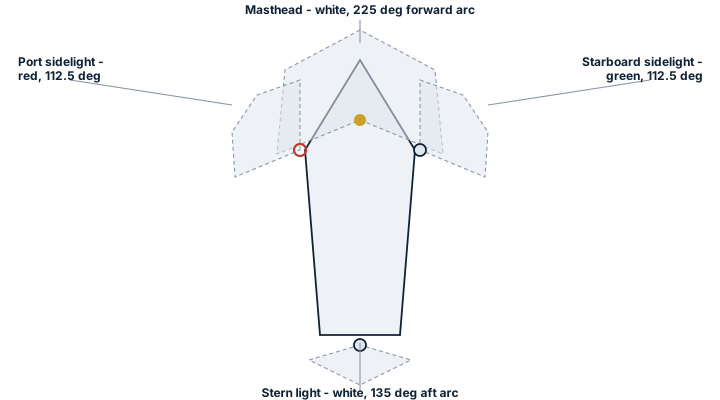
Main components
Lantern housing and lens
A sealed housing holds the lamp or LED module behind a coloured lens (red, green, white or yellow depending on function) whose chromaticity coordinates are specified in Annex I. Salt film or scratching on the lens reduces effective range even when the light source itself is within spec.
Light source
Most new installations use LED modules rather than incandescent bulbs, giving longer service life and more stable output, but LED intensity degrades gradually with age rather than failing suddenly — a light can run for years below its rated range without an obvious full failure.
Failure monitoring panel
SOLAS-required vessels carry a navigation light indicator panel on the bridge that shows each light's operating status and raises an alarm on failure. This panel, not visual observation from the bridge wing, is the practical means of knowing a light has gone out during a watch.
Selection and sizing
- Required range by vessel length: for example a masthead light needs 6 nautical miles on vessels 50 m and over, down to 2 nautical miles under 12 m
- Required arc of visibility: masthead 225°, sidelights 112.5° from dead ahead on each side, sternlight 135° astern, matched to the vessel's actual mast, funnel and superstructure layout so nothing blocks the arc
- Type approval (wheelmark / MED certificate) confirming the unit meets Annex I photometric and chromaticity requirements as tested, not just as designed
- Compatibility with the vessel's existing failure monitoring panel wiring and voltage
Regulations and class
COLREG 1972 Rules 20 to 31 set which lights a vessel must show depending on type, size and activity (underway, at anchor, towing, restricted in ability to manoeuvre), and Annex I fixes the technical detail — colour, intensity, range and arc — for each. SOLAS requires the failure alarm/indicator panel on applicable vessels. Equipment must carry wheelmark (EU) or equivalent flag-recognised type approval before installation; class surveys check the physical arcs are unobstructed as fitted, not just the equipment's paperwork.
Typical faults
| Cause | Consequence |
|---|---|
| Gradual LED intensity degradation with age | Range falls below the required minimum with no outright failure to trigger the alarm panel |
| Salt film or scratching on the lens | Reduced effective range and, on coloured lenses, drift outside the required chromaticity |
| New mast fitting, radar scanner or antenna installed after the original arc survey | Partial obstruction of the required arc that goes unnoticed until a near-miss investigation |
| Failure alarm panel miswired or bulb-based indicator burned out | Bridge unaware a light has failed during the watch, discovered only by another vessel or a port state inspection |
What to look for in a supplier
- Wheelmark or equivalent type approval certificate specific to the model, with the tested range and arc data attached
- LED module replaceable as a spare part without replacing the whole lantern housing
- Documented compatibility with the vessel's existing bridge indicator panel
- Housing material and seal rating suited to the mounting position, since masthead units face far harsher weathering than lower sidelights
Test navigation lights against their rated range on a genuinely dark night with binoculars occasionally, not just for switch-on function at the dock — a light that switches on can still be running well under its required range.
