What to check on a Fuel Oil Purifier Module.
A fuel oil purifier is a centrifugal separator configured to remove both water and solid contaminants from fuel by spinning it at high speed in a bowl with a gravity disc, exploiting the density difference between oil, water, and sludge. That two-phase separation is what distinguishes a purifier from a clarifier, which is set up to remove only solids and pass any water through with the oil, and from a simple filter, which removes solids by straining but does nothing about dissolved or emulsified water at all. On most ships…
What sets a purifier apart within the fuel treatment train
A fuel oil purifier is a centrifugal separator configured to remove both water and solid contaminants from fuel by spinning it at high speed in a bowl with a gravity disc, exploiting the density difference between oil, water, and sludge. That two-phase separation is what distinguishes a purifier from a clarifier, which is set up to remove only solids and pass any water through with the oil, and from a simple filter, which removes solids by straining but does nothing about dissolved or emulsified water at all. On most ships a purifier and a clarifier work in series, with the purifier taking out bulk water first and the clarifier polishing the oil before it reaches the day tank.
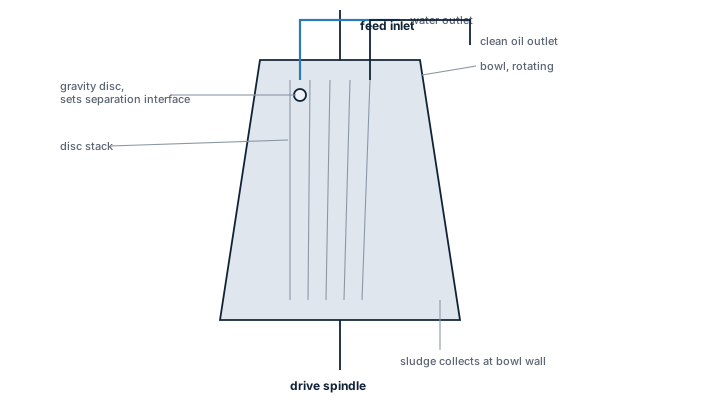
Main components
Bowl and disc stack
Rotates at several thousand rpm, with conical discs that shorten the settling distance particles and water droplets need to travel before being flung to the bowl wall.
Gravity disc
Sized to the density of the fuel being processed — the wrong gravity disc for a heavy fuel oil is one of the most common commissioning errors, and it silently ruins separation efficiency without an obvious alarm.
Feed pump and heater
Preheats heavy fuel oil to reduce viscosity before it enters the bowl, typically to around 98°C for HFO, since separation efficiency depends heavily on viscosity at the moment of separation.
Sludge discharge system
Self-cleaning bowls discharge accumulated sludge automatically on a timed or sensor-triggered cycle, sending it to the sludge tank rather than requiring the bowl to be opened manually.
Control panel / PLC
Monitors back pressure, discharge cycles, and interlocks the feed pump so unpurified fuel cannot bypass the unit during a fault.
Selection and sizing
- Throughput capacity in litres/h matched to daily fuel consumption plus margin for transfer and settling tank turnover, not just main engine consumption at full load.
- Fuel type range — a purifier set up for distillate fuel operates differently from one handling heavy fuel oil, and dual-fuel operation, common now with low-sulphur fuel switching, needs a gravity disc and temperature strategy for both.
- Self-cleaning interval versus sludge loading of the expected fuel quality, since poor-quality bunkers with high catalytic fines content demand more frequent discharge cycles.
- Redundancy — most engine rooms carry at least two purifiers so one can run while the other is opened for inspection.
Regulations and class
There is no dedicated SOLAS chapter for purifiers, but class rules require duplicated fuel treatment capacity on ships where loss of fuel supply would be a safety hazard, and MARPOL Annex I governs the disposal of separated sludge and oily water rather than the separator itself. Class surveys check the sludge tank capacity and disposal arrangements, and verify that purified fuel meets the quality the main engine manufacturer specifies, since catalytic fines above the tolerance the engine can handle are a leading cause of cylinder liner and piston ring damage traced back to inadequate purification.
Typical faults
- Wrong gravity disc fitted for the fuel density in use — reduces separation efficiency without triggering an obvious alarm, and shows up later as water or fines carryover to the engine.
- Insufficient preheat temperature — raises fuel viscosity beyond the design point for the bowl, and separation efficiency drops sharply.
- Sludge discharge too infrequent for fuel quality — bowl fills with sludge between cycles, reducing effective separation volume and eventually triggering a high back-pressure trip.
- Worn or damaged disc stack — allows oil to channel through without proper residence time in the bowl, effectively bypassing the separation process.
- Bowl vibration — usually from an unbalanced or incorrectly assembled disc stack after overhaul, and left unaddressed it accelerates bearing wear.
What to look for in a supplier
- Throughput and separation efficiency figures tested at the actual fuel viscosity and density range the ship burns, not a generic distillate figure.
- Availability of the correct gravity disc set for both current and anticipated future fuel types.
- Spare parts support for the disc stack and bowl seals, the components with the shortest wear life.
- Documentation supporting compliance with the engine manufacturer's fuel cleanliness requirements, since an engine warranty claim can turn on this.
Confirm the gravity disc matches the fuel density every time the ship changes bunker grade — a purifier can run, sound normal, and still pass water straight through to the engine if this one part is wrong.