Fuel Oil Treatment
Fuel oil treatment equipment: heaters, viscosity controllers, filters, blending units
Fuel oil treatment removes water, sediment and catalytic fines from bunkered fuel before it reaches the engine, using settling, heating and centrifugal separation. Untreated fuel carries abrasive ash particles and free water that damage injection equipment and cylinder liners within hours of running, so treatment is never optional on an engine burning heavy fuel.
Read more — Fuel Oil Treatment explained ▾
Why the ship carries fuel oil treatment
Bunkered fuel, particularly heavy fuel oil, is not clean by the time it reaches the ship. It carries water taken on during storage and transport, sediment from tank bottoms, and catalytic fines — hard aluminium and silicon particles left over from the refining process — that are abrasive enough to wear through injection pump plungers and cylinder liners in a matter of running hours if they reach the engine. A ship burning untreated fuel is not gambling with fuel quality in the abstract; it is running an abrasive slurry through precision components built to tolerances measured in microns.
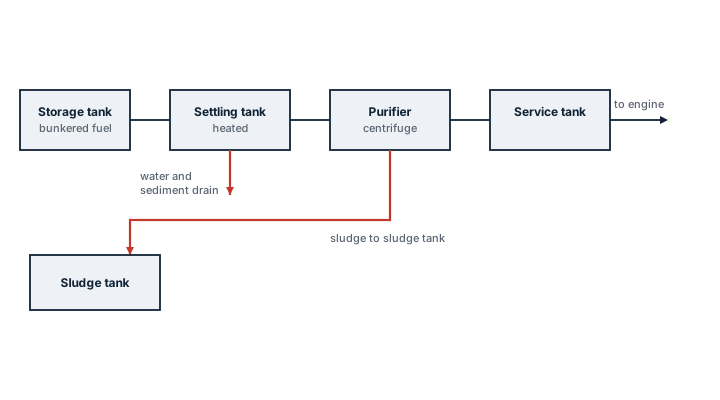
Fuel oil treatment exists to take that fuel down to a level of cleanliness the engine can tolerate before it ever reaches the injection system, using nothing more exotic than settling time, heat, and centrifugal force.
How it works
Fuel first goes to a settling tank, where it is left with gentle heating for as long as the ship's operation allows. Heat lowers viscosity so that water droplets and heavier sediment can fall to the tank bottom under gravity, which is drained off periodically. This is the cheapest stage of treatment and the most easily skipped under time pressure, which is exactly why it is worth insisting on.
From the settling tank, fuel passes through a centrifugal separator, commonly called a purifier. The fuel is spun at high speed in a bowl containing a stack of conical discs; because water and solid particles are denser than the oil, centrifugal force throws them outward to the bowl wall while the lighter, cleaner oil moves toward the centre and out to the service tank. A second stage, the clarifier, removes finer solids that survived the purifier without the water-separating function, since by that point the bulk of the water should already be gone. The separator bowl must be desludged periodically, manually or automatically, to clear accumulated solids before they upset the separation.
Main components
Settling tank and heating coils
Provide time and temperature for the first, gravity-driven separation. A fouled heating coil shows up as fuel that will not reach set temperature, which pushes more work onto the separator than it is designed to handle.
Purifier bowl and disc stack
The core separating element. Worn or damaged discs, or a bowl not cleaned on schedule, reduce separation efficiency and let more water and fines pass through to the service tank.
Gravity disc
Sized to the density of the fuel being run; the wrong gravity disc for a given fuel density is a common reason a purifier that was working fine suddenly stops separating water properly after a bunker change.
Sludge discharge system
Ejects accumulated solids from the bowl, either on a timer or triggered by a sensor. A discharge system firing too often wastes good oil with the sludge; one firing too rarely lets solids build up and reduces separation performance.
Feed pump and heater
Deliver fuel to the separator at a controlled flow rate and temperature. Running the separator above its rated throughput, to save time, is one of the most common ways treatment quality is quietly compromised.
Types
| Type | Typical application | Character |
|---|---|---|
| Self-cleaning disc-stack purifier | Primary water and fines separation for heavy fuel oil | Automatic desludging, minimal manual intervention, the standard on modern ships |
| Clarifier | Second-stage polishing after the purifier | Removes fine solids, no water outlet, run in series after the purifier |
| Automatic self-adjusting separator | Ships running variable fuel qualities or switching grades often | Adjusts to changing density without a gravity disc change, reduces crew workload |
| Coalescer / fine filter | Supplementary polishing close to the engine | Catches residual water or fines that passed the main treatment stage |
Regulations and class
There is no single SOLAS or MARPOL regulation dedicated to fuel oil treatment equipment itself, but its performance is what keeps a ship compliant with the fuel quality and sulphur limits set out in MARPOL Annex VI, and what protects the engine that class societies survey as part of periodic machinery examinations. Class rules from DNV, ABS, LR, BV and ClassNK require the fuel treatment plant to be sized and arranged so the engine always receives fuel within the manufacturer's specified cleanliness limits, and surveyors will look at maintenance records for the separators alongside engine condition when there is a history of injection equipment wear.
Typical faults and what they mean
- Water content rising in the service tank — wrong gravity disc for the current fuel density, or a worn disc stack no longer separating effectively.
- Purifier vibrating or noisy — bowl out of balance, often from uneven sludge buildup between discharges.
- Frequent injector and fuel pump wear despite treatment — throughput set above the separator's rated capacity for the fuel viscosity, giving fuel too little residence time in the bowl.
- Sludge discharge firing excessively — desludge interval set too short, or fuel arriving dirtier than the plant was designed for.
- Separator running but service tank still showing sediment — a settling tank drain valve not opened regularly, pushing more work onto the separator than intended.
What to look for in a supplier
- Separator capacity matched to the engine's actual fuel consumption and to the range of fuel densities the ship expects to burn, not just the design point.
- Spare disc stacks, seals and gaskets readily available, since a purifier out of service for a day is a fuel quality problem waiting to happen.
- Class type approval for the separator and clear documentation of its rated throughput at different viscosities.
- Service support that can commission and calibrate an automatic self-adjusting unit correctly, since a misconfigured automatic separator can look like it is working while quietly under-performing.
If injector wear keeps recurring despite a purifier that tests fine on its own, check the actual throughput against the fuel density in use — a separator run too fast simply does not have time to do its job.
Automatic and manual fuel oil filters for engine protection
Steam and electric heaters for HFO viscosity reduction before engine injection