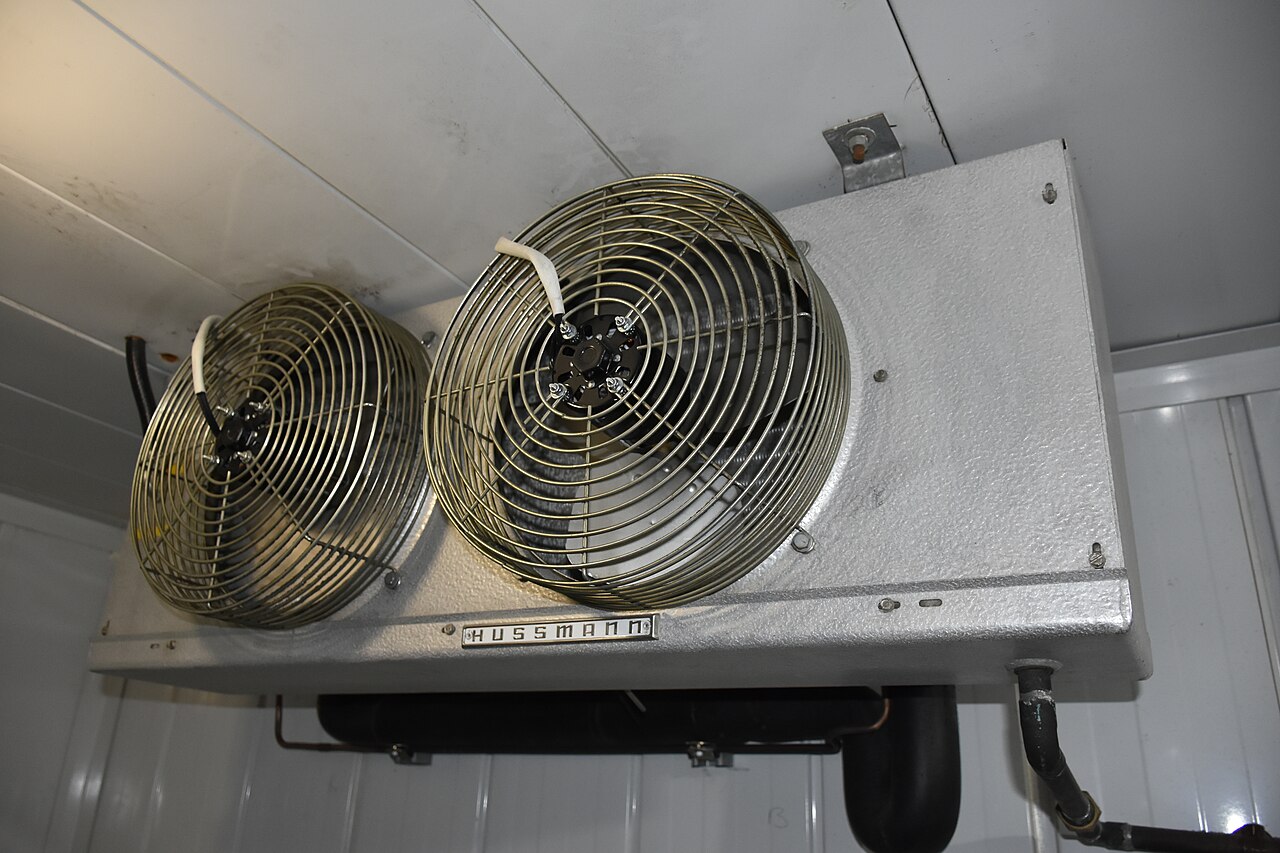
What to check on a Fan Coil Unit.
7 models from MBC Marine in Fan Coil Unit. Below: the full model list.
What sets a fan coil unit apart within an air conditioning plant
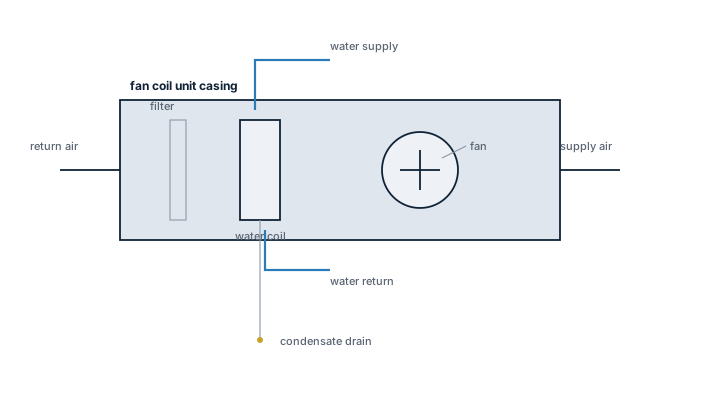
A fan coil unit (FCU) is a terminal device, not a refrigeration machine. It contains no compressor and no refrigerant circuit of its own; it simply draws cabin or space air across a finned coil carrying chilled or hot water supplied from a central chiller or heater package, and a fan pushes the conditioned air back into the space. Because the cooling or heating actually happens centrally, a fault at one fan coil unit almost never means a refrigerant problem — it means a water, air, or electrical fault local to that unit, which is the main reason FCUs are diagnosed differently from packaged or split units that carry their own compressor.
Read the full guide
Main components
Coil
Finned copper tube heat exchanger carrying chilled water (roughly 7-12°C supply) or hot water (usually 50-70°C) depending on season and system design; some units have separate two-pipe or four-pipe circuits for simultaneous heating and cooling zones.
Fan and motor
Usually a forward-curved centrifugal fan on a multi-speed or variable-speed motor, selected for low noise since the unit sits directly above a cabin ceiling or berth.
Filter
Washable mesh or disposable panel filter upstream of the coil, the single most neglected maintenance item on the whole air conditioning plant.
Control valve
Two-way or three-way motorised valve on the water side, modulated by a room thermostat; the three-way version bypasses water rather than throttling it, keeping pump head more stable across the system.
Condensate tray and drain
Catches condensate from the coil in cooling mode and drains it, by gravity or a small condensate pump, to a common drain riser.
Selection and sizing
- Cooling and heating load of the specific space in kW, based on occupancy, equipment heat gain, and hull/deck exposure.
- Available static pressure against duct length and grille resistance, since FCUs are low-pressure devices compared with central air handling units.
- Water flow rate matching the coil design, and whether the vessel's system is two-pipe (heating or cooling, not both at once) or four-pipe.
- Noise rating (dB(A)) appropriate to accommodation versus control room location.
Regulations and class
There is no dedicated SOLAS or MARPOL instrument governing fan coil units specifically; they fall under the general habitability and ventilation requirements of class rules and flag administration accommodation standards, and under ILO/MLC 2006 provisions on adequate ventilation and temperature control in crew accommodation. Class surveys of the air conditioning plant typically check overall performance at representative spaces rather than inspecting every individual FCU, but a pattern of complaints from one deck is usually enough to trigger a closer look.
Typical faults
| Fault | Cause | Consequence |
|---|---|---|
| Reduced airflow / warm cabin | Clogged filter never cleaned during the voyage | Coil ices up on the air side in cooling mode, cutting capacity further |
| Water dripping from the unit | Blocked or disconnected condensate drain, or a stuck condensate pump float switch | Ceiling tile and cabin joinery water damage, often discovered only after staining appears |
| No response to thermostat | Stuck or seized motorised control valve, common after long idle periods in one position | Space stays at whatever temperature the water circuit happens to deliver, hot or cold |
| Fan noise or vibration | Bearing wear or an out-of-balance fan wheel from years of dust build-up | Crew complaints and, if ignored, eventual motor failure |
What to look for in a supplier
- Coil material suited to the water treatment chemistry already used on board, since mixing incompatible metals accelerates corrosion.
- Availability of the exact chassis dimensions as a drop-in replacement, since accommodation FCUs are usually built into a fixed ceiling void.
- Noise data at the actual operating speed the space requires, not just the maximum rating.
- Spare parts commonality with other FCUs already fitted on board, to avoid carrying a separate spares line for a single unit.
Before condemning a fan coil unit as faulty, check the filter and the condensate drain first — the two account for the large majority of reported cabin comfort complaints.