What to check on a ODME.
An oil discharge monitoring equipment (ODME) unit is not a single sensor but a control loop: an oil content meter, a flow meter, a starting point sensor for the ship's speed, and a three-way overboard discharge valve, all tied together by a control unit that calculates instantaneous discharge rate and total quantity discharged in real time. Unlike a simple oil-in-water alarm fitted in an engine room bilge line, the ODME does not just warn, it actively diverts the discharge back to a slop tank the instant any of the MARPOL…
What makes this type distinct
An oil discharge monitoring equipment (ODME) unit is not a single sensor but a control loop: an oil content meter, a flow meter, a starting point sensor for the ship's speed, and a three-way overboard discharge valve, all tied together by a control unit that calculates instantaneous discharge rate and total quantity discharged in real time. Unlike a simple oil-in-water alarm fitted in an engine room bilge line, the ODME does not just warn, it actively diverts the discharge back to a slop tank the instant any of the MARPOL limits would be exceeded, and it produces a printed or electronic record that the ship must be able to show a port state control officer.
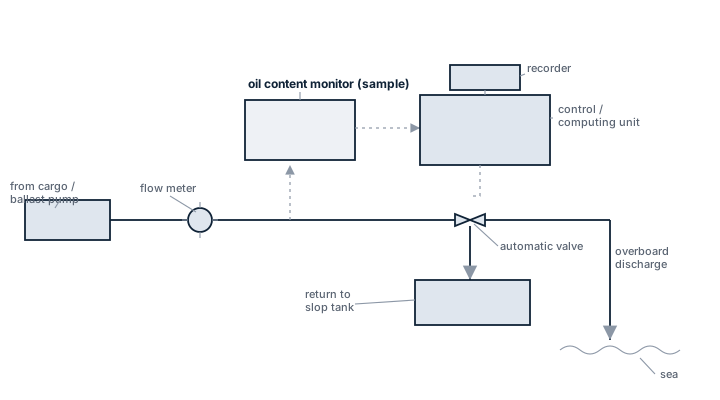
Main components
Oil content meter
Usually an optical or infrared unit sampling a bypass stream from the discharge line, giving a continuous reading in parts per million.
Flow meter
Measures the rate of the effluent being discharged so the control unit can calculate instantaneous rate of discharge of oil, not just its concentration.
Control and recording unit
Combines oil content, flow rate and ship's speed input to compute total oil quantity discharged against distance run, and logs the discharge on a continuous strip or electronic record.
Three-way overboard valve
Automatically diverts the stream to the slop tank the moment a limit is approached; can also be operated manually, but automatic diversion is what class expects to see demonstrated.
Sample and sea water supply lines
Bring a representative sample to the meter and provide the flushing water used to keep the sample line clear between operations.
Selection and sizing
ODMEs are sized to the ship's cargo pump discharge rate and the diameter of the overboard line, not chosen freely: the flow meter and valve must handle the ship's maximum ballast or slop discharge rate without becoming the bottleneck. Newer units built to the 2011 IMO ODME guidelines add tighter accuracy requirements on the oil content meter and require the system to be tamper-evident, which matters when specifying a replacement for an older analogue-recorder unit.
Regulations and class
- MARPOL Annex I Regulation 31 requires an ODME on tankers of 150 gross tonnage and above before any discharge of oily mixtures from cargo areas.
- The discharge itself must meet Regulation 34: outside a special area, more than 50 nautical miles from land, en route, instantaneous rate of discharge not exceeding 30 litres per nautical mile, and total quantity within the applicable limit for the ship.
- IMO Resolution MEPC.108(49), as later revised, sets the performance and testing standard the equipment must meet for type approval.
- Class surveys check the automatic stopping function annually and require the discharge record to be retained and produced on request.
Typical faults
| Fault | Consequence |
|---|---|
| Fouled or scratched optical cell in the oil content meter | False high readings that trigger unnecessary diversion, or false low readings that let an illegal discharge through |
| Flow meter calibration drift | Incorrect instantaneous rate calculation, discharge record no longer matches actual quantity |
| Sample line blockage or air lock | No representative sample reaching the meter, unit reads zero or fails to respond to a real oil slug |
| Three-way valve actuator sticking | Failure to divert on a genuine trip, the single fault a port state inspector treats most seriously |
What to look for in a supplier
- Current type approval certificate against the applicable IMO resolution, matched to the ship's flag requirements.
- Ease of sample line cleaning and access, since a blocked line is the most common cause of unreliable readings in service.
- Whether the electronic record format is accepted by the ship's flag and the ports it trades to, or whether a printed chart is still required.
- Calibration and spares support in the ports the ship actually visits, since a failed ODME can stop cargo tank cleaning operations entirely.
Test the automatic diversion function for real, not just on the panel lamp test, before every ballast water or slop discharge campaign; a valve that answers the test button does not prove the actuator moves the valve under flow.