"> Oil-Water Separator - Equipment Database

Oil-Water Separator

medium 3 models total

A 15 ppm oil-water separator treats bilge water from the machinery space before it can be pumped overboard, holding the discharged oil content below the MARPOL Annex I limit; it is a mechanical treatment stage, not the monitor that proves compliance - that is a separate instrument downstream.

Read more — Oil-Water Separator explained

What this type does

Bilge water collected in the machinery space is a mix of water, fuel and lube oil residue, cleaning chemicals and sludge. An oil-water separator (OWS) strips the free and emulsified oil out of that mixture in stages, using gravity separation followed by coalescing media, before the water can be discharged overboard. It is the mechanical treatment plant; the oil content meter and automatic stopping device fitted downstream is a separate, class-approved instrument that measures what the separator actually achieved and shuts the overboard valve if the result is not good enough. Confusing the two is common on board - a clean OWS with a faulty monitor is still not compliant.
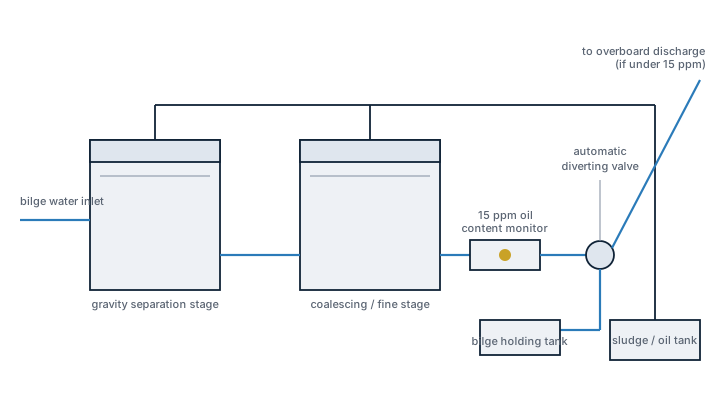
15 ppm oil-water separator, process flow
Flow schematic of a bilge oil-water separator: bilge water enters the gravity stage, passes to a coalescing stage, is checked by the 15 ppm oil content monitor, and an automatic valve routes clean water overboard or dirty water back to a holding tank, while separated oil drains to the sludge tank.

Main components

Gravity separation stage

The first chamber slows the flow so free oil, which is lighter than water, rises and collects at the top while heavier solids settle at the bottom, removing the bulk of the oil load before finer treatment.

Coalescing stage

Plate packs or coalescing media force the remaining fine oil droplets to merge into larger globules that can rise out of the water, which is what allows the unit to reach the low ppm levels gravity alone cannot achieve.

Sludge and oil collection

Separated oil is drained to a sludge or waste oil tank rather than discharged, and this tank needs its own management under the ship's oil record book.

Automatic stopping device and 15 ppm bilge alarm

Fitted downstream of the separator, this unit continuously samples the outlet, alarms if oil content approaches the limit, and automatically closes the overboard discharge valve and diverts flow back to the bilge tank if the limit is exceeded.

Selection and sizing

Capacity is sized to the machinery space bilge accumulation rate, commonly in the range of a few cubic metres per hour on smaller vessels up to considerably more on large ships, with a margin over the expected worst-case leakage rate rather than the average. Materials in contact with oily bilge water are usually corrosion-resistant steel or coated carbon steel, since ordinary mild steel corrodes quickly in this service. Emulsion-breaking capability matters more than raw throughput on vessels that use a lot of detergent-based bilge cleaners, because strong emulsifiers can defeat a separator that would otherwise easily meet the limit on untreated bilge water.

Regulations and class

MARPOL Annex I sets the 15 ppm discharge limit and requires the automatic stopping device to be fitted and functioning whenever the separator is used to discharge overboard. Newer separator types must be type-approved to the IMO performance and test specification in force at the time of installation, and the oil record book Part I must log every discharge, transfer and internal transfer of oily bilge water, which is the document port state control checks first. Class surveys verify the separator and monitor are operable and that seals used to prevent bypassing the system, where fitted by flag or port state, are intact.

Typical faults

FaultCauseConsequence
Oil content meter driftFouled sample cell or uncalibrated sensorFalse readings that either trip the alarm needlessly or fail to catch a real exceedance
Coalescing media foulingDetergent emulsions or accumulated sludge not drainedFalling separation efficiency until the unit can no longer meet 15 ppm
Bypass piping tamperingCrew rigging a direct discharge line to avoid slow processingA criminal MARPOL violation exposing the ship, owner and individuals to detention and prosecution
Automatic valve failing to closeCorroded actuator or lost control air/powerDischarge continues after an alarm, defeating the entire monitoring purpose

What to look for in a supplier

  • Current IMO type approval for the specific separator and monitor combination, not the separator alone.
  • Documented performance with the detergents and cleaning chemicals actually used on board, since some units struggle with heavy emulsifiers.
  • Spare parts availability for coalescing elements and monitor sample cells, which are the routine wear items.
  • Commissioning support that includes calibration of the oil content monitor against a certified reference, not just installation.

A spotless engine room log and a bypass pipe found during a port state control inspection have ended careers - never let the separator's slow throughput become a reason to look for a shortcut.
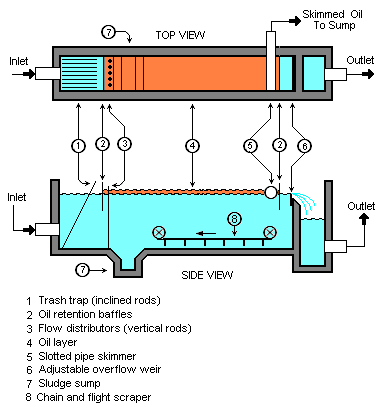
API oil–water separator
API oil–water separator. Photo: Mbeychok at English Wikipedia, CC BY-SA 3.0, via Wikimedia Commons

3 manufacturers · 3 models

Alfa Laval

1
Alfa Laval PureBilge 15 ppm OWS
PureBilge 15 ppm OWS
1-10 m3/h · Ballast Water Oil Content · Coalescer oil‑water separator
Type
ows
Discharge (ppm)
15
Marpol
ja
Common Failures & Inspection Points
  • Coalescer element fouling
  • Oil content monitor drift
  • Pump seal failure
  • Emulsion processing difficulty
Service: MARPOL mandatory. Coalescer replacement per condition. OCM calibration annually.
Spare Parts: Ersatzteile über Alfa Laval oder zugelassene Vertriebspartner. Lead time: 2-6 Wochen.
Strengths
  • Meets MARPOL Annex I 15 ppm discharge requirement out of the box
  • Compact footprint suitable for vessels with limited space
  • Integrated Oil Content Monitor (OCM) provides continuous compliance verification
  • Simple maintenance – coalescer element can be swapped without major disassembly
  • Robust pump and seal design for reliable operation in harsh marine environments
Weaknesses
  • Coalescer element fouls quickly if bilge water contains high oil loads or solids, requiring frequent checks
  • OCM calibration is required annually; drift can lead to false alarms if neglected
  • Limited processing capacity on large tankers or high‑throughput vessels
  • Emulsified oil may reduce separation efficiency and increase discharge time
Typical Vessels: General cargo shipsOffshore supply vesselsFerriesSmall to medium tankersContainer shipsCruise liners
Certifications: IMO Type ApprovalDNV
Decision Guide: Choose if you need a proven, space‑efficient OWS that guarantees MARPOL compliance on vessels with moderate bilge water flow and can accommodate routine maintenance. Avoid if the ship generates very high oil loads, large emulsions, or requires ultra‑high throughput beyond the PureBilge capacity.
Use Cases: The PureBilge 15 ppm is typically installed in the engine room of merchant ships to treat bilge water before discharge, often on vessels where space and weight are at a premium and continuous compliance monitoring is required. It is common on offshore support vessels, ferries, and medium‑size tankers operating in regulated waters.

RWO (Veolia)

1
RWO (Veolia) RWO SKIT/S Oily Water Separator
RWO SKIT/S Oily Water Separator
variable · Ballast Water Oil Content · compact integrated heater OWS
Type
ows
Discharge (ppm)
15
Marpol
ja
Origin
Germany
Common Failures & Inspection Points
  • Separation element degradation
  • OCM sensor fouling
  • Pump failure
  • Heater element burnout
Service: German manufacturer (now Veolia). Annual survey.
Spare Parts: Ersatzteile über RWO (Veolia) oder zugelassene Vertriebspartner. Lead time: 2-6 Wochen.
Strengths
  • Meets the strict 15 ppm MARPOL discharge limit out‑of‑the‑box
  • Compact footprint suitable for vessels with limited space
  • Integrated oil content monitor (OCM) provides continuous compliance reporting
  • Heated separation improves efficiency in cold water conditions
  • German engineering reputation for reliability and build quality
Weaknesses
  • Separation element degrades over time and requires scheduled replacement
  • Heater element can burnout if not properly maintained or overloaded
  • Pump failures have been reported, necessitating spare parts inventory
  • OCM sensor fouling demands regular cleaning to avoid false readings
  • Annual survey required; maintenance intensity higher than some larger‑capacity OWS units
Typical Vessels: Product tanker (coastal/short sea)Chemical tanker (small to medium size)Offshore supply vesselGeneral cargo shipBulk carrier (handysize)
Certifications: IMO Type Approval (MARPOL Annex I)DNV Class Approved
Decision Guide: Choose if: you need a space‑saving OWS that reliably meets the 15 ppm MARPOL limit, operate in cold waters where heating improves separation, and can accommodate regular maintenance cycles. Avoid if: you prefer a low‑maintenance unit for very high‑throughput applications or cannot allocate spare parts for pump/heater replacements.
Use Cases: The SKIT/S is commonly installed on European coastal tankers, offshore support vessels, and handysize bulk carriers where bilge water volumes are moderate and space constraints demand a compact separator. It is also favored in fleets that require integrated monitoring for automated compliance reporting.

Victor Marine

1
Victor Marine OWS
variable · Ballast Water Oil Content · gravity oil‑water separator
Type
ows
Discharge (ppm)
15
Marpol
ja
Origin
UK
Common Failures & Inspection Points
  • Filter element blockage
  • OCM malfunction
  • Valve corrosion
Service: UK manufacturer. MEPC 107(49) approved.
Spare Parts: Ersatzteile über Victor Marine oder zugelassene Vertriebspartner. Lead time: 2-6 Wochen.
Strengths
  • MEPC 107(49) approval provides direct regulatory acceptance for oil discharge monitoring.
  • Discharge limit of 15 ppm meets the strict MARPOL Annex I requirement.
  • UK manufacturing offers local technical support and readily available spare parts.
  • Simple mechanical design with an integrated Oil Content Monitor (OCM) enables real‑time compliance reporting.
  • Compact layout suitable for installation in existing engine room spaces.
Weaknesses
  • Filter element can become blocked, requiring frequent inspection and replacement.
  • Valve corrosion has been reported in high‑salinity or aggressive water conditions.
  • Occasional OCM malfunction may necessitate redundant monitoring equipment.
  • Limited automation; valve operation is primarily manual, increasing crew workload.
  • May be oversized for small vessels with low bilge water generation.
Typical Vessels: Oil TankerProduct CarrierChemical TankerBulk Carrier (oily cargo residues)Offshore Supply Vessel
Certifications: MEPC 107(49) approval
Decision Guide: Choose if you need a proven, MEPC‑approved oil‑water separator with a low 15 ppm discharge limit and prefer UK‑based support. Avoid if your vessel operates in highly corrosive environments, has limited crew for manual valve handling, or requires fully automated monitoring without the reported OCM reliability concerns.
Use Cases: Typically installed on tankers and bulk carriers to treat bilge water before discharge overboard, ensuring MARPOL compliance during routine operations and port stays. Also used on offshore supply vessels where oil‑contaminated wash water must be monitored continuously.