Bilge Pump
A dedicated bilge pump is sized, self-priming and positioned as a safety system under SOLAS, remaining the first line of defence against flooding even when general service or fire pumps are already committed to other duties.
What to check on a Bilge Pump.
1 models from Wärtsilä in Bilge Pump. Below: the full model list.
What sets a bilge pump apart from a general service pump
A dedicated bilge pump is built and piped specifically to remove water from bilge wells and, in an emergency, from a flooded compartment, which is why SOLAS treats bilge pumping capacity as a safety system rather than an ordinary utility. Many ships also permit general service or fire pumps to be cross-connected into the bilge system as a backup, but the dedicated bilge pump is sized, self-priming, and positioned so it remains the first line of defence even if other pumps are occupied with firefighting or ballast duties at the same moment flooding starts.
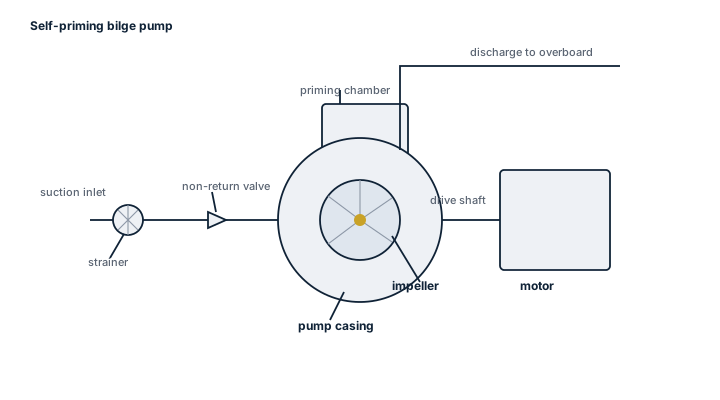
Main components
Pump unit
Usually a self-priming centrifugal pump, since bilge suction lines run dry between uses and a non-self-priming pump would need manual priming before it could draw water at all.
Bilge main and branch lines
Piping running from bilge wells in each watertight compartment to a distribution manifold, with non-return valves preventing water flowing back into a compartment that is not flooded.
Read the full guide
Strainers and mud boxes
Catch debris, rag, and scale before it reaches the pump impeller — one of the most frequently blocked items in the whole system.
Oily water separator interface
Machinery space bilge water is oily and cannot be discharged overboard directly; it is routed through an OWS or to a holding tank, with the bilge pump often feeding that system rather than the sea directly during normal, non-emergency pumping.
Remote and local controls
Bilge high-level alarms in each compartment, and valve remote controls operable from above the bulkhead deck so a compartment does not need to be entered to open its bilge suction during flooding.
Selection and sizing
- Capacity set by class rules as a function of ship length, breadth, and depth, not by an arbitrary engineering choice — the minimum pipe diameter and pump capacity are calculated from a formula in the applicable class rules.
- Number of independent power-driven bilge pumps required, which increases with ship size and passenger ship status.
- Self-priming lift capability against the actual suction head in the deepest bilge well served.
- Material selection resistant to bilge water contaminants — oil, salt water, and occasional chemical residue depending on cargo.
Regulations and class
SOLAS Chapter II-1 sets out bilge pumping and drainage requirements in detail, including minimum number of pumps, minimum bilge main diameter calculated from ship dimensions, and the requirement that at least one power bilge pump be operable with the main engine stopped. MARPOL Annex I Regulation 14 requires that machinery space bilge water be processed through oily water separating equipment, the 15 ppm bilge alarm and separator, before any overboard discharge, which is why the bilge and OWS systems are usually described together even though they perform different jobs. Class surveys verify pump capacity by test, check non-return valve function, and confirm remote valve operation from the required position.
Typical faults
| Fault | Cause | Consequence |
|---|---|---|
| Pump loses prime repeatedly | Worn mechanical seal or a leaking suction line joint drawing in air | Pump runs without moving water, and a genuine flooding event would go unaddressed |
| Reduced flow at rated speed | Blocked strainer or mud box not cleaned on schedule | Bilge levels rise faster than the pump can clear them during heavy washdown or a real leak |
| Non-return valve stuck open | Debris lodged in the valve seat or corrosion of the hinge pin | Water can flow backward between compartments, defeating the watertight subdivision the system is meant to protect |
| OWS 15 ppm alarm trips constantly | Emulsified oil from detergent use in the bilge, or a worn separator element | Bilge water cannot be discharged and accumulates, and crew face pressure to bypass the system illegally, which is a serious MARPOL violation if it happens |
What to look for in a supplier
- Pump capacity certified against the class formula for the specific ship dimensions, not a generic catalogue rating.
- Self-priming performance data at the actual suction lift the installation requires.
- Material compatibility with the ship's actual bilge water chemistry, particularly for chemical or product tankers.
- Spares and service support for the mechanical seal, the component most likely to need attention between dry-dockings.
Test remote bilge valve operation from its required position regularly, not just the pump itself — a pump that runs perfectly is useless if the valve to the flooded compartment cannot be opened from outside it.
Models in this type.
The best-documented model of each manufacturer first, then the next — 1 of 1 models in Bilge Pump. Every row links to full specifications, documents and service notes.
Manufacturers.
All 29 manufacturers with models of Bilge Pump. Names with a manufacturer page open it; the others open a search across the full library.
All manufacturersOne request. A person reads it and replies by e-mail.
Tell us the manufacturer, the model and what you need — a part, a service call, a second opinion. A person reads every request and replies by e-mail.
No details at hand? A photo of the rating plate or the part is enough — simply attach it to the request.
Three things people ask first.
Is Bilge Pump data free?
Yes. Every model page, every guide and every datasheet for this type is readable without an account. An account adds saved searches and requests, nothing is taken away.
My model is missing — what now?
Send us the nameplate. We identify it by hand, add it to the library, and if you need a part or a service, the request is already on our desk.
Can you source a Bilge Pump part?
Yes. Tell us the manufacturer, the model and what you need — a person reads every request and replies by e-mail.