What to check on a Turbocharger.
A marine turbocharger sits between the engine's exhaust manifold and its intake, with a turbine wheel on one end of a common shaft spun by exhaust gas energy that would otherwise be wasted, and a compressor wheel on the other end forcing more air into the cylinders than natural aspiration ever could. Without it a marine diesel would deliver perhaps a third of its rated power from the same cylinder size, which is why every modern marine diesel from small auxiliary sets to the largest two-stroke main engines is turbocharged…
What makes this type
A marine turbocharger sits between the engine's exhaust manifold and its intake, with a turbine wheel on one end of a common shaft spun by exhaust gas energy that would otherwise be wasted, and a compressor wheel on the other end forcing more air into the cylinders than natural aspiration ever could. Without it a marine diesel would deliver perhaps a third of its rated power from the same cylinder size, which is why every modern marine diesel from small auxiliary sets to the largest two-stroke main engines is turbocharged. The shaft runs at very high speed — up to around 20,000 rpm on larger marine units, higher still on smaller ones — supported on bearings that must survive that speed on nothing more than lube oil and, on some designs, a very small amount of self-contained lubrication independent of the main engine system. Because it has no mechanical link to the crankshaft, a turbocharger's condition is invisible to a shaft-speed gauge; it only shows up in boost pressure, exhaust temperature, and fuel consumption figures.
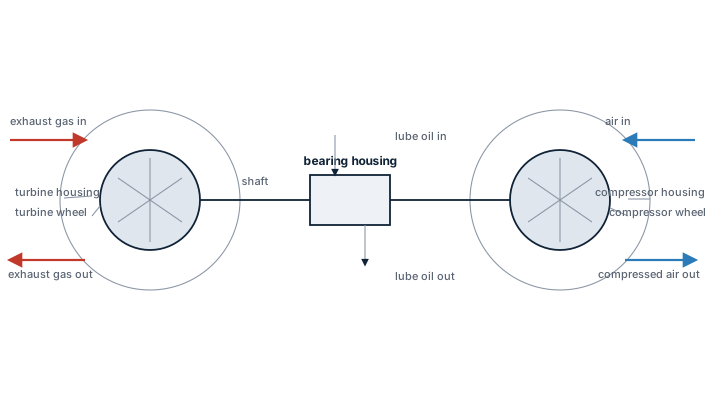
Main components
Turbine wheel and casing
Exhaust gas expands through the turbine, extracting energy; turbine blade fouling from unburned fuel deposits or exhaust valve wear products is one of the most common causes of falling boost pressure over time.
Compressor wheel and casing
Draws in and compresses charge air; fouling here from oil mist or salt-laden intake air (on engines drawing air near the funnel in heavy weather) reduces airflow and raises intake temperature.
Common shaft and bearings
Either oil-lubricated plain bearings fed from the engine's lube oil system, or on some modern designs sealed rolling-element bearings with their own lubrication, chosen partly to reduce dependence on engine oil cleanliness.
Charge air cooler
Not part of the turbocharger itself but functionally inseparable from it — cools compressed air before it enters the cylinders, and a fouled cooler mimics turbocharger underperformance on the gauges even when the turbocharger itself is fine.
Selection / Sizing
Turbochargers are matched to a specific engine model by the engine builder based on required boost pressure, airflow, and the exhaust energy available at rated and part load; they are not generally interchangeable between engine types even at similar power ratings, because the turbine and compressor maps must match the engine's actual operating envelope. Single, twin, or sequential (multiple units, staged for load range) turbocharging arrangements are chosen based on the engine's load profile — an engine that spends significant time at part load benefits from sequential turbocharging or waste-gate control to avoid poor low-load response with an oversized single unit.
Regulations / Class
Turbochargers are not separately class-certified as standalone equipment, but they are integral to the engine's approved configuration and NOx compliance under MARPOL Annex VI — changing turbocharger matching without engine builder and class approval can invalidate the engine's EIAPP certificate, since boost pressure and charge air temperature directly affect NOx formation. Class surveys turbocharger overhaul as part of the engine's periodic survey scheme, and IACS UR requirements govern overspeed and bursting protection for the rotating assembly.
Typical faults
- Turbine-side fouling — deposits from incomplete combustion or poor fuel quality reduce turbine efficiency, showing up as falling boost pressure and rising exhaust temperature for the same load.
- Compressor-side fouling — salt or oil mist deposits on the compressor wheel reduce airflow and can eventually unbalance the rotor.
- Bearing wear from lube oil contamination — given the shaft speed involved, even minor oil contamination or a brief interruption in oil supply can cause rapid bearing failure.
- Surge — unstable, reversing airflow through the compressor at low flow/high pressure conditions, audible as a distinct pulsing noise and damaging to the compressor wheel and bearings if not corrected.
- Charge air cooler fouling mistaken for turbocharger fault — the symptoms overlap closely enough that misdiagnosis leads to unnecessary turbocharger overhaul when the cooler was the actual problem.
What to look for in a supplier
- Confirmed matching to the exact engine model and rating, with the original engine builder's approval where the turbocharger is a replacement rather than original equipment.
- Overhaul and exchange-unit service network reach in the ship's trading pattern, since turbocharger overhaul intervals are frequent enough that downtime waiting for service matters.
- Documentation supporting continued NOx/EIAPP compliance if the unit differs in any way from the originally certified configuration.
- Rotor balancing and bearing clearance data supplied with any overhauled or exchange unit, not just a visual inspection report.
A steadily climbing exhaust temperature at unchanged load is the turbocharger or the charge air cooler talking to you well before it fails outright — trend the numbers, do not just glance at them against the red line.