What to check on a Temperature Sensor.
3 models from victronenergy in Temperature Sensor. Below: the full model list.
What sets a cargo temperature sensor apart
A level gauge tells the deck officer how much cargo is in the tank; the temperature sensor tells them what state that cargo is in. On a crude oil tanker the two readings are used together to convert observed volume to standard volume at 15°C. On an LNG or LPG carrier the temperature reading is the one that keeps the cargo inside its design envelope, because a few degrees of warming can push tank pressure toward the relief valve setting. Where a radar or servo gauge measures a single point at the liquid surface, a dedicated temperature installation is usually built to measure a vertical profile, because cargo in a large tank is rarely uniform in temperature from bottom to top.
Read the full guide
Main components
Sensing element
Two technologies dominate. Platinum resistance elements (Pt100) give high accuracy and stability and are the default for custody transfer work. Thermocouples are cheaper and more robust to shock but drift more over years of service and need more frequent verification.
Multi-point profile probe
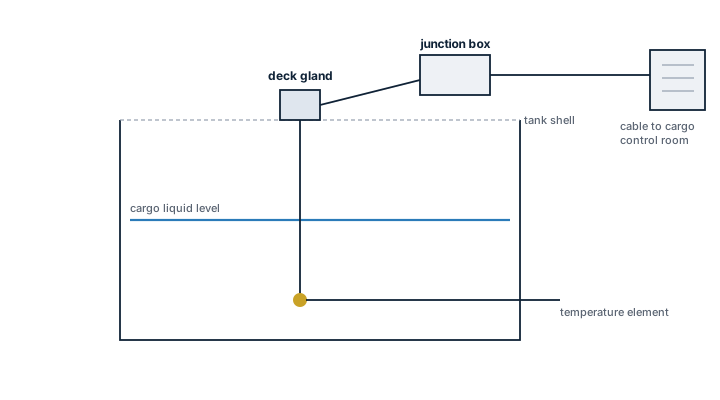
Where the tank needs a temperature profile rather than one figure, several sensing elements are mounted at fixed heights along a single protective tube, each wired back independently so the console can show a top, middle and bottom reading, or a full curve on gas carriers.
Junction box and transmitter
Converts the raw resistance or millivolt signal to a standard 4-20 mA or digital bus signal, usually intrinsically safe for use in a cargo tank atmosphere.
Console interface
Displays the reading alongside level and, on many installations, feeds the cargo calculation system directly so loading computers can compute weight and trim without manual entry.
Selection and sizing
| Criterion | Why it matters |
|---|---|
| Accuracy class | Custody transfer cargoes need tighter tolerance than bunker or slop tanks |
| Temperature range | LNG service needs elements rated well below -160°C; heated fuel oil tanks need the opposite end of the scale |
| Number of measuring points | Deep tanks with stratified cargo need a profile, not a single point |
| Response time | Fast-loading terminals want a sensor that tracks changing temperature without lag |
| Ex-protection method | Must match the zone classification of the tank the cable and housing pass through |
Regulations and class
There is no single SOLAS chapter dedicated to cargo temperature measurement, but class rules for tankers and gas carriers require the cargo control system to display tank temperature where the cargo is temperature-sensitive, and the IGC Code expects temperature monitoring on cargoes carried refrigerated or under pressure. Custody transfer installations are commonly calibrated and verified against a traceable standard at intervals set by the operator's quality system rather than by a single fixed rule, and class surveyors will ask to see that calibration record at survey.
Typical faults
- Element drift over years of service, causing a small but consistent offset that only shows up when checked against a portable reference
- Moisture ingress into the junction box, producing an erratic or fluctuating reading rather than a clean failure
- Cable damage inside the tank from cargo agitation or mechanical cleaning equipment, giving an open-circuit or short-circuit fault
- Ice or wax build-up around the sensing element on cold or waxy cargoes, slowing the response so the display lags the real temperature
- Wrong element type fitted after a spares mix-up, giving a reading that looks plausible but is quietly out of calibration
What to look for in a supplier
- Certified accuracy figures with a calibration certificate traceable to a recognised standard, not just a datasheet claim
- Ex-certification matching the tank's actual zone, with documentation the class surveyor will accept without query
- Element and cable materials proven for the specific cargo range, cryogenic or heated, rather than a generic mid-range product
- Spare element availability that does not require replacing the entire probe assembly
Check the temperature reading against a portable calibrated thermometer at the manifold or sample point before trusting it for a custody transfer figure — a drifted sensor rarely fails outright, it just quietly costs money on every cargo.