What to check on a Radar Level Gauge.
13 models from Panasia in Radar Level Gauge. Below: the full model list.
What sets radar gauging apart
A radar level gauge sits on the tank top and sends a microwave signal down through the vapour space to the liquid surface, then measures either the time the reflection takes to return, known as pulse radar, or the frequency shift of a continuously swept signal, known as FMCW radar, to calculate distance and therefore level. Unlike a float gauge or a servo tape, nothing moves inside the tank, so there is no mechanism to jam, no tape to snap and no float to sink in a dense or viscous cargo. Unlike a capacitance probe, the reading does not depend on the cargo's dielectric constant staying within a narrow band, though a very low-reflectivity cargo can still weaken the return signal.
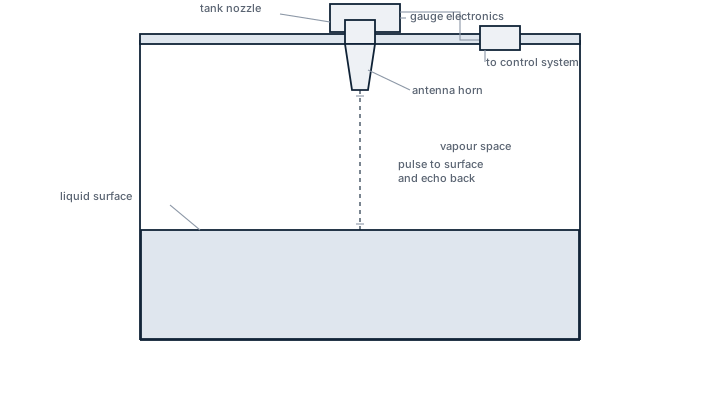
Legend
- Gauge electronics
- To control system
- Tank nozzle
- Antenna horn
- Vapour space
- Pulse down, echo back
- Liquid surface
Read the full guide
Main components
Antenna and transducer
The antenna, whether a horn, parabolic dish or rod depending on tank size and cargo, both transmits and receives the microwave signal. It is mounted through a process connection rated for the tank's pressure and the cargo's vapour, and on gas carriers this connection has to remain gas-tight under the full design pressure.
Still-pipe or stilling well
Many installations run the antenna into a still-pipe that reaches down through the tank, which damps out surface turbulence and slosh and gives the signal a clean path free of reflections from internal structure such as heating coils or swash bulkheads.
Electronics unit
Converts the raw echo into a level value, applies temperature and density compensation, and outputs to the local display and to the cargo control room. On tankers this feeds the loading computer directly.
Reference and calibration point
A fixed reference target or a manual dip point lets the gauge be checked against a physical measurement, which is the only way to catch electronic drift between class surveys.
Selection and sizing
The choice is driven by the tank's height range, the cargo's dielectric properties and the vapour condition expected above it, since inert gas and hydrocarbon vapour both change the signal's travel time slightly and a good installation compensates for this. Custody transfer duty calls for the tightest accuracy class the system offers; general operational gauging can use a coarser one.
- Frequency band matched to tank height and required resolution, since higher frequency narrows the beam and improves accuracy over long ranges
- Process connection rating matched to the tank's design pressure and the cargo's vapour pressure
- Antenna material compatible with the cargo, since chemical carriers rotate through very different products
- Accuracy class stated against a recognised custody transfer standard if the reading is used for commercial quantity
Regulations and class
The IGC Code requires gas carriers to have a level gauging system independent of the high-level alarm, and both are surveyed separately. Chemical and oil tankers under MARPOL are increasingly required to use closed gauging so cargo vapour is not released to check the level, which radar naturally supports since the tank is never opened. Class societies survey the gauging system's function and calibration at intervals set in the ship's survey scheme, and a custody transfer installation is also checked against national metrology or OIML-referenced accuracy requirements where the cargo is sold on the reading.
Typical faults
| Cause | Consequence |
|---|---|
| Foam or heavy turbulence on the cargo surface | Scattered or lost echo, gauge freezes or jumps to a false level |
| Buildup or condensation on the antenna face | Weakened signal, growing error that is easy to miss until a manual dip disagrees |
| False echoes from tank internals | Misread level if the electronics lock onto a coil or ladder reflection instead of the surface |
| Low-reflectivity cargo with a very low dielectric constant | Weak return signal, reduced accuracy or loss of reading near tank bottom |
| Electronics drift uncorrected between surveys | Growing disagreement with manual dip, risk on a custody transfer cargo |
What to look for in a supplier
- Type approval for the specific hazardous area zone and gas group the tank requires
- A stated accuracy class with supporting test data, not just a manufacturer's claim
- Compensation software that accounts for the actual vapour composition the ship carries, not only air
- Service support able to recalibrate or replace the electronics unit without gas-freeing the tank where possible
Cross-check the radar reading against a manual dip at the start of every cargo the ship has not carried recently - a change in dielectric constant between products is the most common reason a previously accurate gauge starts to drift.