Line-Throwing Apparatus
A line-throwing apparatus fires a projectile trailing a light messenger line across open water or to a quay so a heavier hawser, pilot ladder tackle or breeches buoy can be hauled across afterwards; it is separate from pyrotechnic distress signals under SOLAS.
What to check on a Line-Throwing Apparatus.
1 models from Survitec Group in Line-Throwing Apparatus. Below: the full model list.
What a line-throwing apparatus does
A line-throwing apparatus (LTA) launches a rocket or pistol-fired projectile trailing a light messenger line to a distance no unaided throw could reach. It is not a distress flare and not a lifebuoy self-igniting light: its only job is to close the gap between two points, ship to ship, ship to shore, or ship to a person in the water, so that a stronger line, a heaving line, a pilot ladder tackle or a breeches buoy can be hauled across afterwards. SOLAS carries it as a standalone lifesaving appliance separate from pyrotechnic distress signals, even though both often live in the same locker.
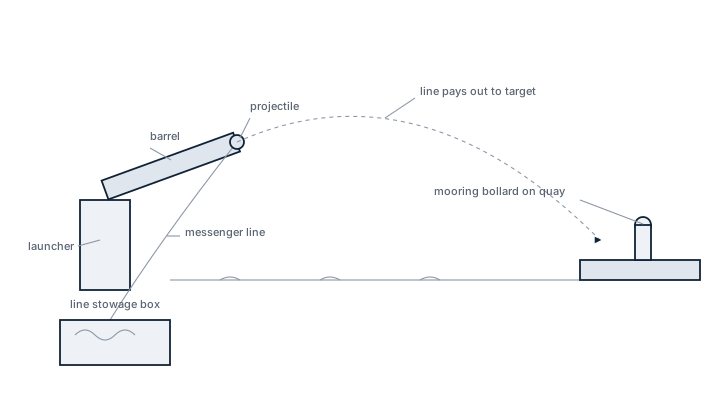
Legend
- projectile
- line pays out to target
- barrel
- launcher
- messenger line
- mooring bollard on quay
- line stowage box
Main components
Rocket or cartridge
A solid-propellant rocket, or in pistol-type sets a blank cartridge, provides the launch energy. Rocket sets are self-contained and hand-held; pistol sets use a reusable line-throwing gun with disposable projectile-and-line cartridges.
Messenger line
A light, low-stretch line, typically polyethylene or similar synthetic, flaked in a container or on a purpose-built line tray so it pays out without snagging. Breaking strength is modest; the line is meant to pull a heavier line across, not to take load itself.
Read the full guide
Line container / flaking box
Keeps the line coiled in a figure-eight or flaked pattern so it runs free during flight instead of fouling in the air, which is the single most common cause of a failed shot.
Launcher
Either integral to the rocket, fire-and-discard, or a separate pistol or gun that is reloaded for each shot; sets intended for repeated pilot transfers favour the reusable gun over disposable rockets.
Selection and sizing
Range and line payload decide the set. SOLAS requires a minimum four-rocket set capable of throwing a line at least 230 metres in calm weather, but ships with regular pilot transfer or working close alongside other vessels often carry additional pistol-type sets with shorter, more controllable range for routine line passing rather than emergency rescue. Line weight is a trade-off: a heavier line reaches less far but tolerates more wind drift without needing to be re-thrown.
Regulations and class
- SOLAS Chapter III, Regulation 18 requires every ship to carry at least one line-throwing appliance capable of projecting a line with reasonable accuracy.
- The set must include no fewer than four projectiles and four lines, stowed ready for use in a location not likely to be adversely affected by weather.
- Rockets fall under dangerous goods handling rules for stowage and disposal once expired, since they contain pyrotechnic propellant.
- Class surveys check expiry dates at each periodical lifesaving appliance survey; expired rockets must be landed and replaced, not just noted.
Typical faults
| Fault | Consequence |
|---|---|
| Line packed loosely or re-flaked incorrectly after a drill | Line fouls mid-flight, projectile stalls short of target |
| Rocket propellant degraded past expiry | Misfire or reduced range during an actual emergency |
| Line container stored in direct weather exposure | Moisture ingress stiffens the line, increasing fouling risk |
| Crew unfamiliar with wind-lead aiming | Repeated failed shots waste the limited four-rocket allowance |
What to look for in a supplier
- Current type approval certificate referencing the applicable LSA Code testing standard.
- Clearly marked expiry dating on every rocket or cartridge, not just the outer set packaging.
- A line-flaking method demonstrated, not just described, to run clean on deployment.
- Availability of individual replacement cartridges rather than only complete sets, for ships that drill regularly.
Practice throws should use a designated drill set, not the certified emergency set; burning through the mandatory four rockets in a training exercise leaves the ship short when it actually needs them.
Models in this type.
The best-documented model of each manufacturer first, then the next — 1 of 1 models in Line-Throwing Apparatus. Every row links to full specifications, documents and service notes.
Manufacturers.
All 10 manufacturers with models of Line-Throwing Apparatus. Names with a manufacturer page open it; the others open a search across the full library.
All manufacturers in the libraryAlso in Emergency Signaling Equipment.
The other equipment types in this category.
Inspection findings for this equipment
From public port state control and US Coast Guard records; OceanSphere assigns them to this equipment type from the descriptions.
Deficiency codes – USCG port state control – foreign-flag vessels
- 11128 · Line-throwing appliance – 42 findings
USCG components
- Line-throwing appliance – 345 findings, 2 with detention
Write to us about your machine — the answer comes by e-mail.
Name the make and the model and what the job is: a spare, a service call, a second opinion on a data sheet. We answer by e-mail.
No details at hand? A photo of the rating plate or the part is enough — simply attach it to the request.
Questions that come up with this equipment.
Is Line-Throwing Apparatus data free?
Yes. Every model page, every guide and every datasheet for this type is readable without an account. An account adds saved searches and requests, nothing is taken away.
My model is missing — what now?
Send us the nameplate. We identify it by hand, add it to the library, and if you need a part or a service, the request is already on our desk.
Can you source a Line-Throwing Apparatus part?
Yes. Tell us the manufacturer, the model and what you need — a person reads every request and replies by e-mail.