"> Emergency Lighting - Equipment Database
Also listed under Lighting (2 models)

Emergency Lighting

medium 3 models total

Emergency lighting keeps escape routes, muster stations and machinery spaces visible for the minutes between a blackout and the emergency generator picking up load, and for as long afterwards as SOLAS requires; fixtures range from mains-fed lights on the emergency switchboard to individual battery packs with no shipboard wiring at all.

Read more — Emergency Lighting explained

What defines this type

Emergency lighting is not one fixture but three separate systems layered on top of each other, each covering a different gap in the power supply. The transitional source of emergency power, normally an accumulator battery, covers the interval between a main blackout and the emergency generator starting and picking up load. The emergency generator then supplies a defined set of lighting circuits for the endurance period required by the ship's service. Self-contained battery units with their own local battery and charger sit apart from both, wired to normal power but switching to internal battery on loss of supply, and are used where running an emergency circuit is impractical, such as at muster station canopies.
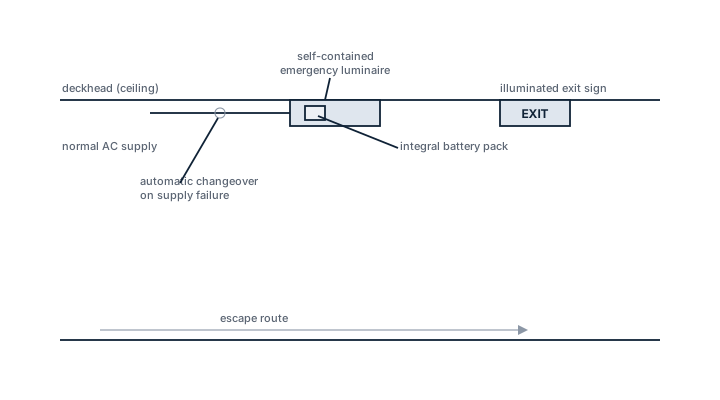
Emergency lighting along an escape route
Side view of a corridor escape route with a self-contained emergency luminaire holding its own battery pack, its automatic changeover from the normal AC supply on blackout, and an illuminated exit sign at the escape route.

Main components

Switchboard-fed emergency lights

Fittings wired back to the emergency switchboard, on a dedicated final circuit separate from normal lighting, so a fault in the normal lighting distribution cannot take the emergency circuit down with it.

Self-contained units

A fixture with an integral battery, usually sealed lead-acid or NiCd, a charger circuit and a change-over relay; it operates independently of any shipboard emergency circuit and is tested by interrupting its own mains feed.

Low-location lighting (LLL)

Photoluminescent strips or low-voltage electric lighting mounted at floor or step level along escape routes on passenger ships and some cargo ships, providing a visible path when smoke has filled the upper part of a corridor.

Selection and sizing

The number and position of fittings follows the ship's escape route plan, not a general lux target: SOLAS requires illumination along stairways, alleyways, exits and at each muster and embarkation station, and the plan is normally fixed at newbuilding stage and only adjusted after a conversion. Battery endurance for self-contained units is chosen against the ship's expected time to abandon or to restore power, commonly around 3 hours for cargo ships; a shorter-duration unit installed to save cost will fail a survey even if it lights correctly at the moment of testing.

Regulations and class

SOLAS Chapter II-1 sets out the transitional source, the emergency source of electrical power and the endurance periods for emergency lighting by ship type. Passenger ships additionally need low-location lighting under the same chapter. Class surveys check both the physical fitting against the approved lighting plan and a discharge test of the batteries, since a battery that reads full voltage on open circuit can still collapse under load.

Typical faults

FaultCauseConsequence
Self-contained unit fails after a few minutes on testAged battery that no longer holds capacity, often not visible on a quick lamp testEscape route goes dark well before the endurance period ends
Fitting stays dark when testedFailed change-over relay or a blown fuse on the emergency final circuitNo back-up light at that location despite the battery itself being healthy
LLL strip discoloured or delaminatingUV exposure or paint overspray during maintenanceReduced photoluminescent output, found only when tested in darkness
Emergency lighting circuit trips on generator startOverloaded final circuit after fittings were added without recalculating cable and breaker sizingLoss of lighting across an entire section at the moment it is needed most

What to look for in a supplier

  • Type approval certificate for the fitting itself, not just a generic marine-grade claim
  • Stated battery chemistry and rated endurance matching the ship's required duration, with a discharge curve if requested
  • Ingress protection rating suited to the space, since engine room fittings need a materially higher rating than accommodation corridors
  • Spares support for the specific battery pack, since a discontinued cell size forces a full fixture replacement instead of a battery swap

Log the discharge test result, not just a pass or fail — a battery trending down survey to survey gets replaced before it fails one, not after.

2 manufacturers · 3 models

Daniamant

2
Daniamant L170 Lifebuoy Light
N/A · Emergency Equipment · water‑activated LED lifebuoy light
Type
lifebuoy_light
Burn time hrs
2
Solas
ja
Common Failures & Inspection Points
  • Expired, moisture-damaged or physically damaged signaling units may fail to activate or perform correctly
  • Battery or lamp failure on electrical emergency lights causes weak or absent indication
  • Corroded firing, release or trigger components cause difficult or failed activation
  • Damaged line, projectile or launcher parts prevent effective line-throwing operation
  • Poor stowage, missing instructions or inaccessible equipment delays emergency deployment
Service: Inspect packaging, casing, labels, expiry or service status, batteries where fitted and secure accessible stowage. Do not test pyrotechnic or line-throwing devices outside the approved procedure. Confirm crew familiarity and inventory against the vessel safety plan. Refer to manufacturer and statutory documentation for the exact figure for service and replacement criteria.
Spare Parts: Maintain complete approved replacement units, batteries where applicable, mounting or stowage hardware and the required statutory inventory rather than attempting unauthorized repair of pyrotechnic devices.
Strengths
  • Meets mandatory SOLAS requirements for lifebuoy lighting
  • 2‑hour burn time ensures visibility during rescue operations
  • Simple water activation – no manual switch needed after immersion
  • Battery service life of 3–5 years reduces routine maintenance
  • Compact form fits standard lifebuoys without modification
Weaknesses
  • Battery must be replaced before expiry; failure renders the unit inoperative
  • Occasional reports of water‑activation switch malfunction
  • Lens can become cloudy over time, reducing light output
  • No built‑in self‑test indicator to verify readiness on board
  • Burn time limited to 2 hours; longer emergencies may need additional lighting
Typical Vessels: Passenger shipFerryOffshore supply vesselTankerBulk carrierContainer shipCruise liner
Certifications: SOLAS
Decision Guide: Choose if you need a low‑maintenance, SOLAS‑compliant lifebuoy light with reliable water activation and a guaranteed 2‑hour illumination period. Avoid if your vessel operates in extreme temperature conditions that may shorten battery life, or if you require longer burn times or a self‑test feature.
Use Cases: Distress signaling, emergency illumination and rescue line deployment.
Daniamant Daniamant L6 Lifejacket Light
Daniamant L6 Lifejacket Light
N/A · Emergency Equipment · LED emergency lighting
Type
lifejacket_light
Solas
ja
Common Failures & Inspection Points
  • Expired, moisture-damaged or physically damaged signaling units may fail to activate or perform correctly
  • Battery or lamp failure on electrical emergency lights causes weak or absent indication
  • Corroded firing, release or trigger components cause difficult or failed activation
  • Damaged line, projectile or launcher parts prevent effective line-throwing operation
  • Poor stowage, missing instructions or inaccessible equipment delays emergency deployment
Service: Inspect packaging, casing, labels, expiry or service status, batteries where fitted and secure accessible stowage. Do not test pyrotechnic or line-throwing devices outside the approved procedure. Confirm crew familiarity and inventory against the vessel safety plan. Refer to manufacturer and statutory documentation for the exact figure for service and replacement criteria.
Spare Parts: Maintain complete approved replacement units, batteries where applicable, mounting or stowage hardware and the required statutory inventory rather than attempting unauthorized repair of pyrotechnic devices.
Strengths
  • Integrated, water‑activated flash eliminates need for manual activation
  • Compact clip design fits directly onto standard lifejackets
  • Long service interval – battery replacement scheduled by the manufacturer
  • High‑intensity flashing LED meets SOLAS visibility requirements
Weaknesses
  • Battery must be replaced on schedule; depletion renders unit ineffective
  • Clip corrosion reported in harsh marine environments if not inspected regularly
  • Activation switch failure can occur, requiring periodic functional checks
Typical Vessels: Passenger ferryCruise shipOffshore supply vesselFishing vesselCoastal patrol boat
Certifications: SOLAS
Decision Guide: Choose if you need a built‑in, automatically activating flashing light on every lifejacket and want to meet SOLAS Chapter III requirements without carrying separate handheld flares. Avoid if your vessel already uses an alternative man‑overboard signaling system or if maintenance resources for regular battery replacement are limited.
Use Cases: Distress signaling, emergency illumination and rescue line deployment.

ACR

1
ACR ACR Firefly PRO SOLAS Strobe
ACR Firefly PRO SOLAS Strobe
N/A · Emergency Equipment · LED strobe
Type
strobe
Solas
ja
Common Failures & Inspection Points
  • Expired, moisture-damaged or physically damaged signaling units may fail to activate or perform correctly
  • Battery or lamp failure on electrical emergency lights causes weak or absent indication
  • Corroded firing, release or trigger components cause difficult or failed activation
  • Damaged line, projectile or launcher parts prevent effective line-throwing operation
  • Poor stowage, missing instructions or inaccessible equipment delays emergency deployment
Service: Inspect packaging, casing, labels, expiry or service status, batteries where fitted and secure accessible stowage. Do not test pyrotechnic or line-throwing devices outside the approved procedure. Confirm crew familiarity and inventory against the vessel safety plan. Refer to manufacturer and statutory documentation for the exact figure for service and replacement criteria.
Spare Parts: Maintain complete approved replacement units, batteries where applicable, mounting or stowage hardware and the required statutory inventory rather than attempting unauthorized repair of pyrotechnic devices.
Strengths
  • SOLAS‑approved, meeting international safety regulations
  • High‑visibility flash pattern with long‑range visibility
  • Automatic activation on loss of ship power plus manual test button
  • Compact mounting and corrosion‑resistant housing for marine environments
Weaknesses
  • Battery must be replaced on schedule; end‑of‑life can cause failure
  • Lens can become scratched or clouded in harsh weather, reducing output
  • Higher upfront cost compared with basic non‑SOLAS strobes
Typical Vessels: Passenger ferryCruise shipOffshore supply vesselContainer shipTanker
Certifications: SOLAS
Decision Guide: Choose if: you need a certified SOLAS emergency strobe with automatic activation and long‑range visibility for passenger or high‑risk vessels. Avoid if: the vessel is exempt from SOLAS lighting requirements or budget constraints preclude a premium unit.
Use Cases: Distress signaling, emergency illumination and rescue line deployment.