What to check on a Totally Enclosed Lifeboat.
A totally enclosed lifeboat is fully closed in by a rigid weathertight and fireproof structure, so occupants are protected from the sea, from exposure and, on the fire-protected version fitted to oil and gas tankers, from radiant heat while motoring away from a burning ship. That marks it out from a partially enclosed lifeboat, which has open sides or ends protected only by canopies, and from an open lifeboat, now essentially obsolete on SOLAS ships. A totally enclosed boat must also be able to right itself if capsized and continue…
What sets a totally enclosed lifeboat apart
A totally enclosed lifeboat is fully closed in by a rigid weathertight and fireproof structure, so occupants are protected from the sea, from exposure and, on the fire-protected version fitted to oil and gas tankers, from radiant heat while motoring away from a burning ship. That marks it out from a partially enclosed lifeboat, which has open sides or ends protected only by canopies, and from an open lifeboat, now essentially obsolete on SOLAS ships. A totally enclosed boat must also be able to right itself if capsized and continue to protect its occupants, which is a structural and stability requirement, not just a matter of adding a roof: buoyancy, ballast and the position of the engine and fuel tank all have to be arranged so the boat comes back upright on its own within a short time even with a full complement aboard.
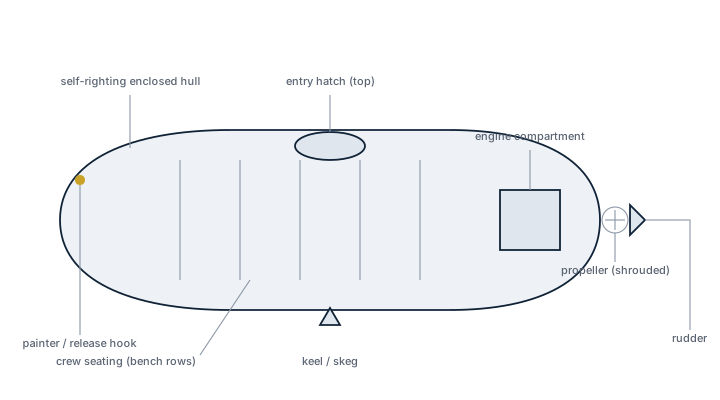
Main components
Rigid hull and canopy
Almost all modern totally enclosed lifeboats are moulded in glass-reinforced plastic, with the canopy formed as part of the same rigid structure rather than a separate cover, giving both strength and buoyancy without relying on inflation.
Engine and propulsion
A diesel engine, started by hand crank, compressed air or battery independent of the ship's power, drives a propeller through a reduction gear, sized to give the boat headway against a moderate wind and sea and to tow a liferaft if required. Fire-protected boats use a self-contained cooling system so the engine does not need to draw in seawater that could be superheated or contaminated near a fire.
Self-righting arrangement
Buoyancy is distributed, and often supplemented by fixed ballast low in the hull, so that if the boat capsizes it rotates back upright unassisted, with the engine designed to stop and restart safely through the roll rather than flood or seize.
Occupant seating and restraint
Fixed seating with individual seat belts or harnesses is required so occupants stay secured through a rough launch, a capsize and righting sequence, and impact loads during boarding and lowering.
Air support system
On lifeboats serving chemical tankers or gas carriers where a toxic or flammable atmosphere might surround the ship, a self-contained air supply pressurises the boat's interior for a defined period so occupants can breathe without opening a hatch into contaminated air.
Regulations and class
Totally enclosed lifeboats are governed by SOLAS Chapter III and LSA Code Chapter IV, which set the self-righting requirement, minimum speed and endurance, seating and restraint standards introduced after capsize incidents during drills, and, for tankers, the water spray fire-protection system rated to shield the boat for a defined period, commonly referenced as around sixty minutes of exposure. Air support system requirements apply specifically where the ship's cargo list includes products presenting a toxic vapour hazard. Annual thorough examination and periodic servicing of the boat, its engine and its air and water spray systems are required under the LSA Code maintenance regime.
Typical faults
- Canopy hatch or window seals perishing and letting water into the boat, found only when the boat is actually lowered and boarded
- Engine failing to start after long periods without exercising, since batteries and fuel systems deteriorate faster in an unheated, unventilated boat than in the engine room
- Water spray or air support system cylinders discharged or out of test date without an obvious external sign
- Seat belts missing, damaged or simply not used, undermining the restraint the design depends on during a capsize and righting event
What to look for in a supplier
- LSA Code type approval covering self-righting performance for the specific hull and full-complement loading, not a smaller test configuration
- Fire-protection water spray system rating matched to the tanker type the boat will serve, where applicable
- Air support system endurance and recharge arrangements suited to the ship's actual cargo list
- Engine model with a service history of reliable cold starts after extended lay-up, since that is the most common in-service failure
A totally enclosed lifeboat that has never been started, self-righted or boarded fully equipped in a drill is an assumption, not a proven capability; the self-righting feature in particular is one crew rarely see demonstrated until it matters.