What to check on a Split AC Unit.
4 models from MBC Marine in Split AC Unit. Below: the full model list.
What defines this type
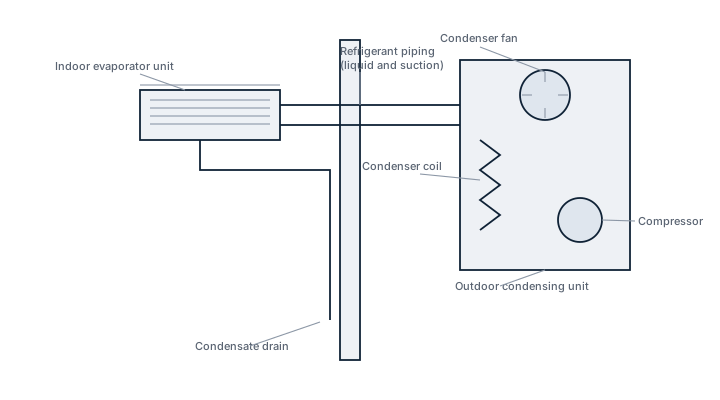
A split unit divides the refrigeration circuit across two boxes: an indoor evaporator, wall or ceiling mounted in the space it serves, and an outdoor or weather-exposed condensing unit connected by refrigerant pipe runs. Each split serves one space independently, so a fault on one unit does not take down cooling anywhere else, unlike a central AHU where a single fan or coil failure affects every space on that branch. This independence is why split units are common on the bridge, ECR and individual cabins where redundancy between spaces matters more than shared ductwork efficiency.
Read the full guide
Main components
- Indoor evaporator unit – contains the evaporator coil, blower and filter, mounted directly in the conditioned space.
- Outdoor condensing unit – houses the compressor and air-cooled condenser coil, exposed to weather and salt spray on deck or in a vented enclosure.
- Interconnecting refrigerant pipework – liquid and suction lines running between indoor and outdoor units, a common leak point at flared or brazed joints.
- Expansion device – a capillary tube or thermostatic expansion valve metering refrigerant into the evaporator.
- Condensate drain – gravity or pumped drain removing water condensed off the evaporator coil.
Selection and sizing
Each space is sized independently against its own heat load, not a share of a building-style total. Points to confirm:
- Cooling capacity matched to the specific space's solar gain, equipment heat load and occupancy, since a bridge with large glazing runs hotter than a similarly sized cabin.
- Maximum allowable pipe run length between indoor and outdoor units, which limits how far the outdoor unit can sit from the space it serves.
- Ambient design temperature the outdoor unit must reject heat against, especially for units mounted on an exposed deck in tropical trades.
- Refrigerant type and charge, since longer pipe runs need additional charge beyond the factory pre-charge.
Regulations
Where refrigerant pipework passes through a fire-rated bulkhead or deck, the penetration must maintain the boundary's fire integrity, the same principle applied to AHU ductwork. Beyond that, split units carry fewer specific class requirements than a central system because each circuit is self-contained and does not distribute air between fire zones.
Typical faults
| Fault | Consequence |
|---|---|
| Refrigerant leak at a flared or vibration-fatigued joint | Gradual capacity loss and eventual compressor short-cycling on low pressure |
| Condensate drain blockage | Water overflow into the cabin or space below the indoor unit |
| Outdoor unit coil corrosion | Falling heat rejection and rising head pressure, worse the longer the unit sits in salt air without rinsing |
| Control board failure from humidity ingress | Erratic operation or total unit shutdown, common on units without a properly sealed control enclosure |
| Compressor short-cycling on low charge | Reduced compressor life and inconsistent room temperature |
What to look for in a supplier
- Marine-grade coil coating on the outdoor unit, not a standard shore residential coil.
- Documented maximum pipe run length and any additional charge calculation for longer runs.
- Indoor unit noise rating, particularly for bridge and cabin installations where quiet operation matters.
- Straightforward retrofit dimensions where the unit replaces an existing split without new ductwork.
Rinse outdoor coils with fresh water on a fixed schedule, not just when capacity starts to fall; salt loading on the fins is progressive and the unit is already down on performance well before it trips on high head pressure.