Gas Detection (Portable)
A portable multi-gas detector is the last line of defence before someone steps into an enclosed space; it earns its keep only if it was bump-tested that day, not just calibrated sometime last quarter.
What to check on a Gas Detection (Portable).
1 models from Vaisala in Gas Detection (Portable). Below: the full model list.
What makes this type
Portable gas detectors are carried instruments used for spot checks and, critically, for enclosed space entry, distinct from fixed systems that monitor continuously without a person present. A crew member uses a portable unit to test the atmosphere of a tank, void or cargo hold before entry, and again while inside if the space is not continuously ventilated, because a space that reads safe at the hatch can still have pockets of dangerous atmosphere deeper in.
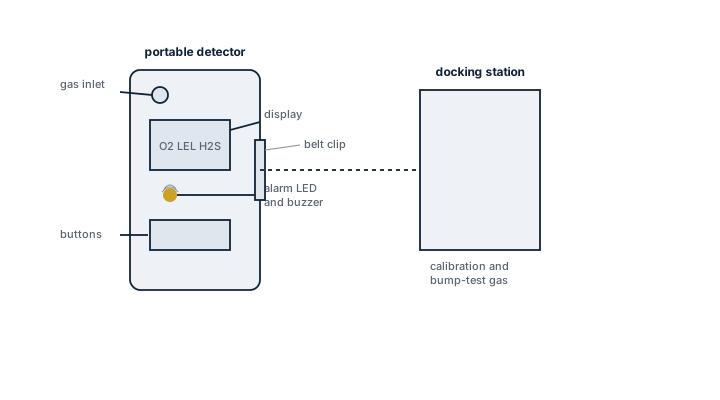
Legend
- gas inlet
- portable detector
- docking station
- display
- O2 LEL H2S
- belt clip
- alarm LED and buzzer
- buttons
- calibration and bump-test gas
Main components
Sensor array
Standard four-gas units combine an oxygen sensor, a catalytic or infrared LEL (lower explosive limit) sensor for flammable gas, and electrochemical cells for H2S and CO. Specialised units add sensors for ammonia, chlorine or other cargo-specific gases depending on trade.
Pump and sample line
Diffusion units rely on ambient gas reaching the sensor; pumped units draw a sample through a hose, essential for testing a space before entry rather than only after opening it, since a pumped unit lets the operator sample from outside without putting their head into the opening.
Read the full guide
Alarm and display
Audible, visual and vibration alarms trigger at pre-set thresholds, with a display showing live readings and a datalogger recording exposure history for later review after an incident or as part of routine compliance.
Selection and sizing
- Gas channels matched to the cargoes and spaces the vessel actually works with, not just a generic four-gas configuration
- Pumped sampling capability if enclosed space entry procedures require pre-entry testing from outside the space
- Battery runtime against typical shift length, and intrinsically safe certification for the zones the unit will be carried into
- Number of units against crew size and the number of simultaneous entries the ship's procedures allow
Regulations and class
SOLAS requires portable atmosphere testing instruments for enclosed space entry, reinforced by the IMO Enclosed Space Entry and Rescue resolution, which mandates testing oxygen, flammable gas and toxic gas levels before entry and continued monitoring during the work. Class and flag state requirements typically call for calibration against a certified reference gas at an interval set by the manufacturer, commonly six to twelve months, with a bump test (a quick functional check against test gas) before each use day.
Typical faults
| Fault | Consequence |
|---|---|
| Sensor not bump-tested before use | A dead or desensitised sensor gives a false safe reading, the most dangerous failure mode of the whole device |
| Battery allowed to run flat mid-entry | Loss of continuous monitoring during the exact period it is needed most |
| Water or dust ingress through a damaged housing | Sensor damage or blocked sample port, giving erratic or no reading |
| Calibration overdue and not tracked | Readings drift out of tolerance without any alarm indicating the unit itself has failed |
What to look for in a supplier
- Sensor package matching the actual gas hazards on board rather than a default configuration
- Straightforward bump-test and calibration procedure that the crew can realistically perform without shore support
- Robust housing rated for the drop and immersion exposure a working deck or tank entry actually involves
- Datalogging that supports the ship's enclosed space entry permit records for audit purposes
Bump-test every portable detector against test gas before each day it will be used for enclosed space entry; a calibration sticker from three months ago says nothing about whether the sensor still responds today.
Models in this type.
The best-documented model of each manufacturer first, then the next — 1 of 1 models in Gas Detection (Portable). Every row links to full specifications, documents and service notes.
Manufacturers.
All 16 manufacturers with models of Gas Detection (Portable). Names with a manufacturer page open it; the others open a search across the full library.
All manufacturers in the libraryAlso in Safety Systems.
The other equipment types in this category.
Write to us about this model — the answer comes by e-mail.
Name the make and the model and what the job is: a spare, a service call, a second opinion on a data sheet. We answer by e-mail.
No details at hand? A photo of the rating plate or the part is enough — simply attach it to the request.
Questions that come up with this equipment.
Is Gas Detection (Portable) data free?
Yes. Every model page, every guide and every datasheet for this type is readable without an account. An account adds saved searches and requests, nothing is taken away.
My model is missing — what now?
Send us the nameplate. We identify it by hand, add it to the library, and if you need a part or a service, the request is already on our desk.
Can you source a Gas Detection (Portable) part?
Yes. Tell us the manufacturer, the model and what you need — a person reads every request and replies by e-mail.